Refine
Estimated Years UndatedClear
92,592 results foundRefine Search
The velocity figures have not been scientif ically developed, it must be noted Health factors.
refid# 2JBmQrXeGkOJaw0p3agVMpGQp1 page
Welding and Cutting The bare rod is fed into the weld puddle, where it melts and mixes with the base metal Equipment Either AC or DC welding units can be used for gas-shielded arc weld ing, depending on whether the weld is wide, deep, or narrow, whether the job is to be per formed on a permanent fixture or a portable machine, and whether it is to be a manual or machine welding operation DC may be used with a reverse polarity or a straight polarity hookup, with current sup plied by a generator or rectifier The AC sup ply may be obtained through a transformer or high-frequency generator The manufacturer ofthe welding equipment should be consulted as to the specific job be fore the equipment is installed, especially when high-frequency AC is used, otherwise, there may be interference with radio trans mission Argon, helium, and gas mixtures are sup plied by manufacturers m cylinders similar to oxygen cylinders Since cylinder pressures range from 2200 to 2640 psi, argon and helium cylinders should be stored and handled like other high-pressure gas cylinders Carbon dioxide, although not strictly an inert gas, is sometimes used as a shield gas when steel is welded by the gas-shielded arc welding process It is usually supplied in partially liquid and partially gaseous form in cylinders at approximately 835 psi pressure These cylinders should therefore be handled like other high-pressure gas cylinders To supply gas to the welding torch, a regu lator must be used to lower the pressure to 25 psig or less, and a flowmeter should con trol the volume of gas If more than one torch is used from the same gas line, a flowmeter should be installed at each torch connection Air is used to cool the torch and electric current cables Water is also used for cooling, generally where the welding current is more than 250 amp The water supply line, even if citv water is used, should be equipped with a strainer to keep out impurities which might get into the torch and plug the water cool ing passages In the gas-shielded tungsten arc torch (Fig 31-9), gas is conducted to the welding point through orifices in the torch around the elec trode holder Cooling water goes through passages through the torch handle and about the holder In the smaller torches, ceramic cups are used A torch for heavier work gen erally has a water-cooled gas cup Other Welding and Cutting Processes There are several heat sources for welding and cutting which are presently in the experi mental stage, such as friction, ultrasonics, and lasers During each stage of their develop ment, these heat sources require guarding and the evolution of a set of safe practices For example, the laser (Light Amplification by Stimulated Emission ofRadiation) presents the hazard of eye damage from the optically amplified light beam, which because of its intensity, can do damage even at great dis tances All employees should therefore be given preemployment and periodic followup eye examinations Most companies require that employees work m pairs when using laser equipment To confine the laser beam, suitable shields should be developed and installed Since a reflected laser beam is also hazardous, the work area should contain no glossy surfaces Power supplies for lasers die high-voltage equipment, which should be operated with the precautions developed for this type of equipment See discussion in Chapter 38, "Personal Protective Equipment," Chapter 41, "In dustrial Hygiene," and Chapter 44, "Ionizing Radiation " Common Hazards Light rays Electric arcs and gas flames both produce ultraviolet and infrared rays which have a harmful effect on the eyes and skin upon con tinued or repeated exposure The usual effect of ultraviolet is to "sunburn" the surface of the eye, which is painful and disabling but temporary in most instances However, per manent eye injury may result from looking directly into a very powerful arc without eye protection Ultraviolet may also produce the same effects on the skin as a severe sunburn Production of ultraviolet radiation is high m gas-shielded arc welding For example, a shield of argon gas around the arc doubles the intensity of the ultraviolet radiation, and, with the greater current densities required (particularly with a consumable electrode). 938
refid# v6k9vNG7dB0OkjD7nqmvY2DkE1 page
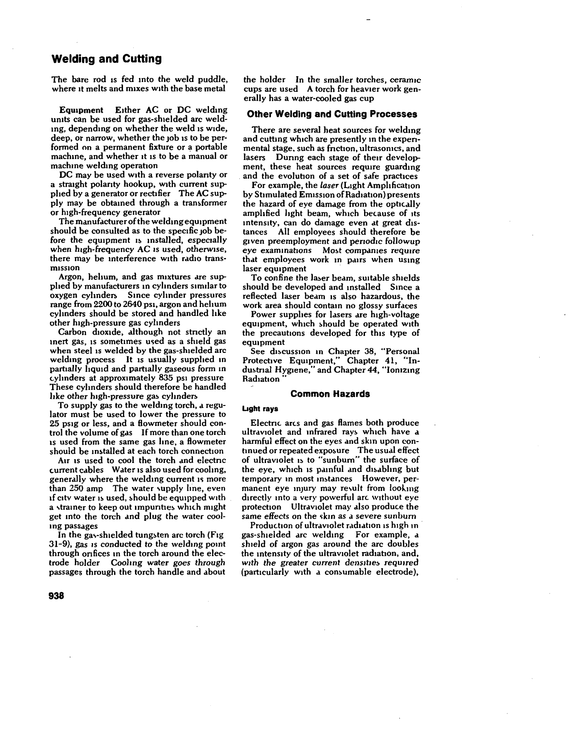
cause injuries when short ends of wire are cut A guard over the cutting edge (Fig 32-15) and the use of safety goggles will prevent fly ing short ends from causing injuries The handles of electricians' pliers should be insulated In addition, the men should wear electricians' gloves, if company policy requires them to Because pliers do not hold the work se curely, they should not be used as a substi tute for a wrench Fig 32-14 --Ends of tongs can be upended, or projections can be welded on them to give clear ance For user's hands Tongs usually are bought, but some com panies make their own to perform specific jobs Often they are designed m such a way that the hands are pinched when the tongs are closed To prevent pinching, the end of one handle should be up-ended toward the other handle, to act as a stop It is also possible to braze, weld, or bolt bumpers on the handles a short distance behind the pivot point so that the handles cannot close against the fingers (Fig 32-14) Pliers Side-cutting pliers sometimes Special cutters for heavy wire, reinforcing wire, and bolts are safer than makeshift tools It is important that the cutting edges apply force at right angles to the wire or other work being cut (Fig 32-16) The cutter should not be used near live electrical circuits and should be used only for the rated capacity specified by the manufacturer Eye protection should be worn Special cutters include those for cutting banding wire and strap Claw hammers and pry bars should not be used to snap metal banding material Only cutters designed for the work provide safe and effective results Nail band crimpers make it possible to keep the top band on kegs and wood barrels after nails or staples have been removed Use of these tools eliminates injury caused by reach ing into kegs or barrels that have projecting nails and staples -i ' Fig 32-15 --At left, the guard on a pair of pliers holds a wire end after it has been cut, thus preventing it from flying At right, a disassembled view of the same pliers Courtesy Copco Co , Ottumwa, Iowa 961
refid# mB7dm5dnNd994o93k7G9DVdnZ1 page
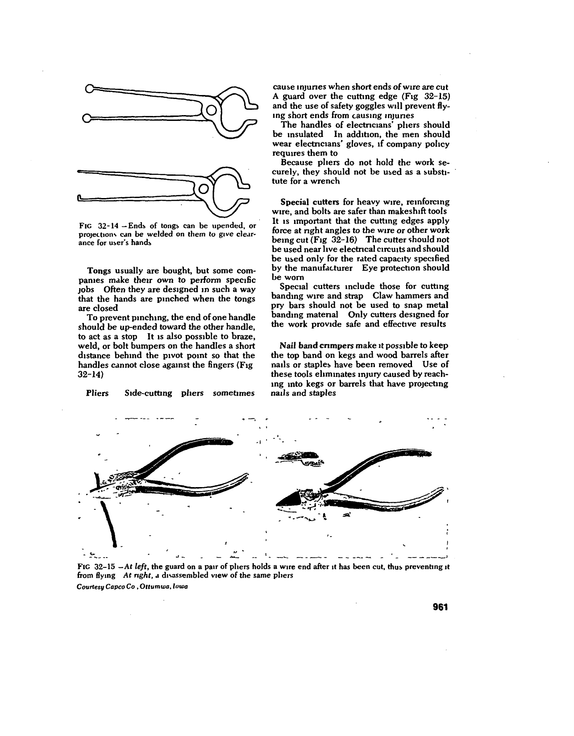
Fig 33-3 -- Isolation-type ground fault interrupter An isolating transformer provides an inductive coupling between load and line, both hot and neutral wires connect to the isolating transformer There is no con tinuous wire between should be placed m a special room or be made inaccessible to other than authorized personnel by screen enclosures Doors to the enclosure should be kept locked Good illumination should be provided for the front and rear of switchboards and main tained ready for use at all times An emer gency source of illumination should also be provided Switch and fuse cabinets should have closefitting doors, and the doors should be kept locked To warn employees that electrical parts are exposed and to remind them to close all doors of equipment, the inside of the doors may be painted orange The switchboard framework and metal parts of guards should be grounded in accord ance with code regulations Connections, wiring, and equipment of switchboards and panel boards should be ar ranged in an orderly manner Switches, fuses, and automatic circuit breakers should be plainly marked and arranged to afford ready identification of circuits or equipment supplied through them It is good practice to keep a diagram of switchboard connections and devices posted near the equipment Protection against accidental shock from live electrical parts, such as switchboards, fuse panels, and control equipment, can be minimized by insulating the floor area within range of the live parts For low-voltage ex posures, special insulating mats or dry wood floors with no metal parts are used These insulating mats should be made of material having proper moisture resistance and nonconductive properties, and should withstand mechanical abuses which may be encountered in such service See American Standard J6 senes, "Specifications for Rubber Protective Equipment for Electncal Workers " Circuits initiated by pushbuttons should be low voltage However, pushbutton controls may be used for a high-voltage circuit if stepdown transformers are provided to prevent the voltage m the control part of the circuit from exceeding 250 volts Motors For maximum safety each motor should be of the type and size required for the load and for the conditions under which it must op erate Excessive overloading for long penods, use of nonapproved motors in areas contain ing flammable vapors or dusts, and defective wiring are typical of the unsafe practices that should be avoided The following are common motor problems in industry dust, stray oil, moisture, misalign ment, vibration, overload, and friction In plant operations, dust is constantly set tling on motors, housings, windings, slip rings, and commutators, and trying to work its way to the bearings The problem of dust 983
refid# 3QDwj5J8k7mD8nYQMYL38X9qE1 page
Fire Loss Control steam whistle or similar device might be ade quate In any case, the alarm system is no better than the level of training given em ployees in how to respond when the alarm is sounded (See details below, and in the next two chapters) Emergency dnlls Regardless of what method is used to alert employees, they should thoroughly under stand what the signal means and how to re spond in the safest possible manner Train ing employees to leave their work place promptly on proper signal, and to evacuate a building speedily but without contusion, is largely accomplished through fire or emer gency drills Exit drills must be carefully planned and earned out in a serious manner under rigid discipline Periodic instruction sheets should be distributed to all employees, and an exit drill organization formed from the supervisory staff Emergency exit drills also serve as a valua ble check on the adequacy and condition of the exits and alarm system Any deficiency should be immediately and permanently cor rected Careful plans must be made to elim inate the possibility of panic in the event of an emergency, regardless of cause, and to guarantee the smooth functioning of the emergency plan Reference should be made to the NFPA pamphlet No 7, Recommenda tions For Management Control of Fire Emer gencies Factors Contributing to Industrial Fires To eliminate causes of fire, we must first know the many ways in which it can start, especially the most common ones A study made by the Associated Factory Mutual Fire Insurance Company of almost 25,000 indus trial fires over a 10 year period indicates that the majority of fires can be traced to four general sources of ignition electrical, smok ing, fuction, and o\er-heatcd materials (Fig 35-7) Electrical equipment fires Electrical equipment should be installed and maintained in accordance with the Na tional Electrical Code Over-heating of elec trical equipment and arcs resulting from short circuits in improperly installed or maintained electrical equipment are two of the leading causes Only approved (or UL-listed) equipment should be used where flammable gases or vapors may be present Electrical equipment necessary in locations which are hazardous because of the presence of flammable liquids, gases or dusts, should be designed for the particular hazardous atmosphere Hazardous locations are divided into three classes depending on the material involved Further division is by degree or severity of the hazard Complete definitions of the several classes and divisions of hazardous locations and tvpes of equipment for each are contained in the National Electrical Code, and are discussed in Chapter 33 Temporary or makeshift wiring, particularly if defective or overloaded, is an outstanding cause of electrical fires, it should not be used unless absolutely necessary and should be removed as soon as possible Over-loaded or partially grounded wiring may also heat up enough to ignite combustibles without blowing fuses or tripping circuit breakers Portable electrical tools and extension cords should conform to the National Electrical Code and should be inspected at frequent intervals and repaired promptly Waterproof cords and sockets should be used in damp places, and explosion-proof fixtures and lamps should be used m the presence of highly flammable gases and vapors All electrical equipment, particularly port able electncal tools, should be grounded for the protection of persons using it Switches, lamps, cords, fixtures, and other electrical equipment should be listed by Underwriters' Laboratories, Inc , or other recognized testing and certifying agency, and should be used only in applications for which the approval or listing was granted Lamp bulbs should be protected b\ heavv lamp guards or b\ adequately sealed trans parent enclosures, and kept awav from shaqi objects and kept from falling Bare bulbs should never be used when exposed to flam mable dusts or vapors Lamp bulbs must be considered as potential hazards in such areas, they must be safeguarded accordingly Employees should be instructed in the use of electncal equipment and should be pro hibited from tampenng, blocking circuit 1056
refid# zzO5dYxR2DrxLjOGqDaJ7RXy31 page
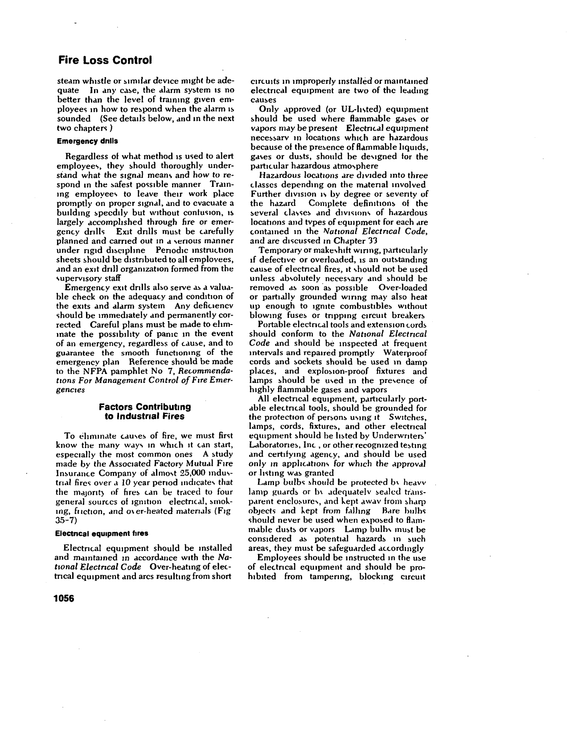
FlG 35-15 -- Demonstration of explosive properties of flour dust Sifting flour through a cloth into the flame produces fiery bursts that illustrate what happens in gram elevators and other dust-laden atmospheres when dust clouds are ignited sions (a) prevent the formation of explosive mixtures of dust and air, and (b) prevent the ignition of such mixtures if their formation cannot be prevented Extraordinary precautions, if such are nec essary, should he taken to prevent accumula tions of dust which may build up to explosive proportions Extensive use of local exhaust and frequent cleaning will do much to mini mize the hazard Where possible, dusty operations should be segregated, and dustproducing equipment should be totally en closed and exhausted to prevent leakage of dust into the general work area Buildings with high explosion hazards, such as grain elevators or plastics plants, are generally provided with extensive dust collecting equipment and so constructed that explosive pressures will push out hinged windows or blow out wall sections or panels designed and built to fail in a predetermined area, rather than cause structural collapse (See NFPA Standard No 68, Explosion Vent ing ) Floor openings should be kept to a minimum and openings for pipes and duct work should be sealed Portable fire extinguishing equipment should be readily available Fog nozzles or finely divided streams of water are more effective than are solid streams of water, which stir up dust Ignition of an explosive mixture of dust and air may be prevented by control of open flames, friction sparks, static electricity, welding, and excessive heat, or by increased humidity, or bv using inert gas Every pre caution should be taken to prevent-over heated bearings, smoking, friction sparks, and sparks from hand tools, from grinding or welding operations, and from static electric ity Only nonferrous tools should be used in dust exposures, and employees should wear shoes with nonferrous nails Nonferrous material should also be used tor truck wheels, and bucket conveyors should be prevented from striking sparks Pneu matic or magnetic separators can be used to re move stones, nails, and other spark-producing foreign objects from the material being processed Only approved dust-tight winng, fixtures, and motors should be used, and employees should be instructed to use only extension cords, lamps, and portable electric tools de signed for protection against this hazard (See NFPA "National Fire Codes," Volume 3) Cases and vapors Gases and vapors that produce flammable mixtures with air or oxy gen are common in industry Some such gases are acetylene, propane, hydrogen, car bon monoxide, methane, natural gas, and manufactured gas Highly volatile liquids which emit flam mable vapors include gasoline, benzene, naphtha, and methyl alcohol Kerosene, tur pentine, Stoddard solvent, and other liquids with flash points above 100 F must generally be heated above normal room temperatures before they give off sufficient vapors to form ignitible concentrations When flammable liquids, including those with flash points above 100 F, must be han dled and used, only minimum amounts, m safety containers, should be allowed in work areas 1069
refid# Yj9mGVKxq9pZ3gK5aMR4dqdo01 page
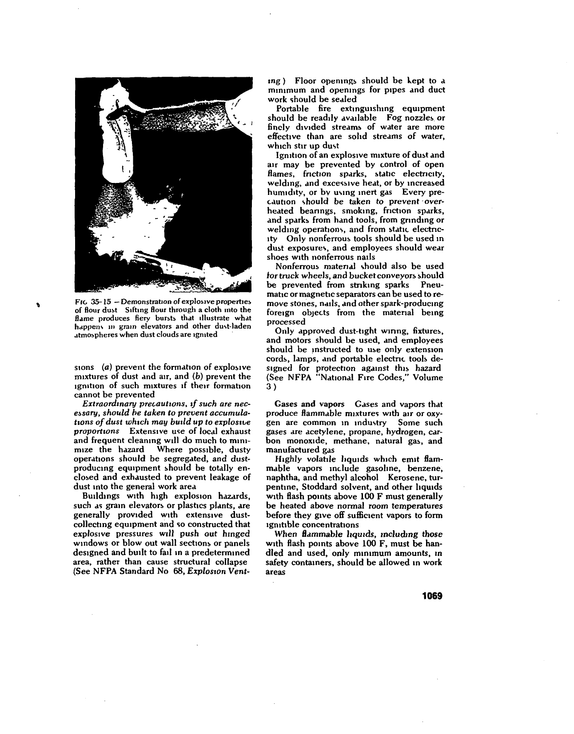
EMERGENCY EXIT INSTRUCTIONS MACHINE SHOP-DAY SHIFT Read Carefully The following persons will be in command in any emergency, and their instructions must be followed CHIEF OF EXIT DRILL-H C Gordon, General Sup't MACHINE SHOP EXIT DRILL CAPTAIN-R L Jones, Foreman MACHINE SHOP MONITORS-Dave Thomas and A L Smith In event of FIRE in machine shop NOTIFY THE GENERAL SUPERINTENDENT'S OFFICE v* PUT OUT THE FIRE, IF POSSIBLE--If the fire cannot quickly be controlled, follow in structions given by Exit Drill Captain R L Jones or by the shop monitors Leave by the exit door at the south end of the shop, if it is blocked by fire, use the door through the toolroom to the outside stairway In event of FIRE or EMERGENCY in other sections of building The general alarm gong will ring for two 10-second periods as an "alert" signal Con tinue work, but be on the alert for the "evacuation" signal, which will be a series of three short rings At the evacuation signal V SHUT OFF ALL POWER TO MACHINES AND FANS TURN OFF GAS UNDER HEAT TREATING OVENS V CLOSE WINDOWS AND CLEAR THE AISLES FORM A DOUBLE LINE IN THE CENTER AISLE AND FOLLOW MONITORS AND EXIT DRILL CAPTAIN TO EXIT--Walk rapidly, but do not run or crowd, do not talk, push, or cause confusion* After leaving the building, do not interfere with the work of the plant fire brigade or the city fire department Await instructions from the General Superintendent or your fore man Returning to the building Return-to-work instructions will be given over the loudspeaker system or by telephone from the Superintendent's office FlC 37-3 --Sample individual instruction notice for general posting 1121
refid# Lg5LGD9p55vRYepvRyBGR5OYQ1 page
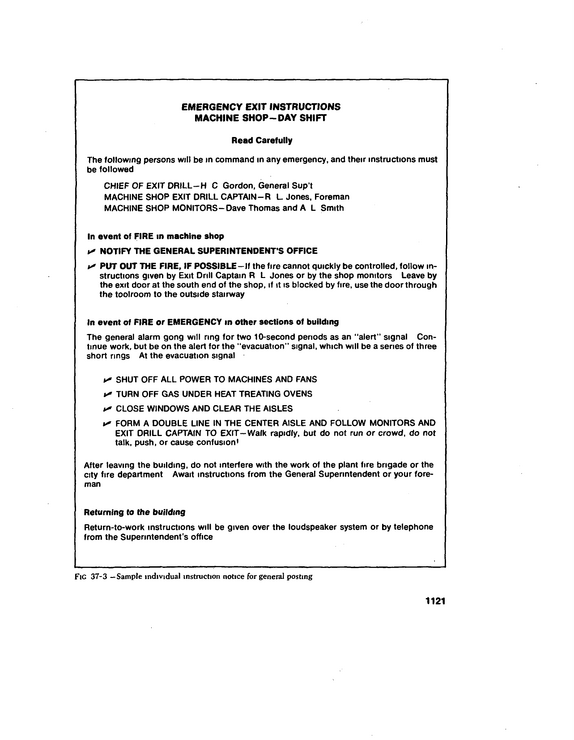
Fig 38-25 operation tor -- Top Lower Dust respirator, safety glasses, and left Twin-cartridge dust respirator ear muffs protect employee during granite surfacing Lower right Twin-cartridge organic vapor respira- 1171
refid# zz6o0ExDyrDj8g5GLB1BQN2en1 page
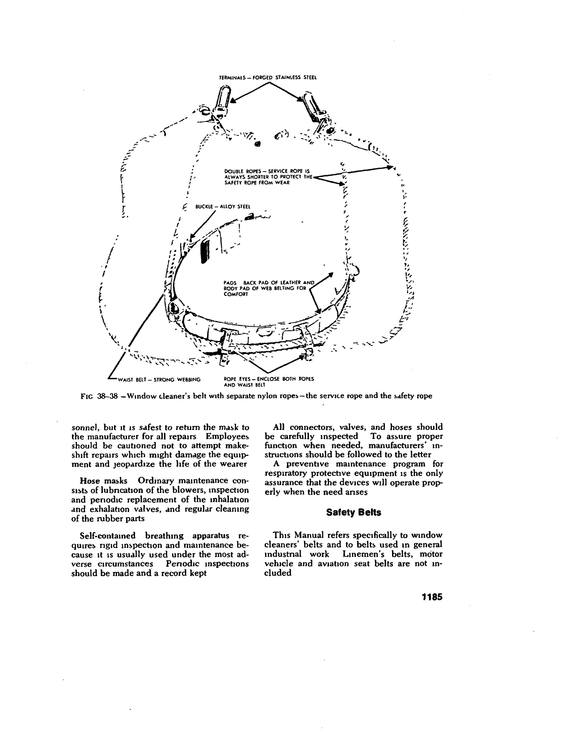
TEBMINAIS - FOUGED STAINLESS STEEL FlC 38-38 --Window cleaner's belt with separate nylon ropes --the service rope and the safety rope sonnel, but it is safest to return the mask to the manufacturer for all repairs Employees should be cautioned not to attempt make shift repairs which might damage the equip ment and jeopardize the life of the wearer Hose masks Ordinary maintenance con sists of lubrication of the blowers, inspection and periodic replacement of the inhalation and exhalation valves, and regular cleaning of the rubber parts Self-contained breathing apparatus re quires rigid inspection and maintenance be cause it is usually used under the most ad verse circumstances Periodic inspections should be made and a record kept All connectors, valves, and hoses should be carefully inspected To assure proper function when needed, manufacturers' in structions should be followed to the letter A preventive maintenance program for respiratory protective equipment is the only assurance that the devices will operate prop erly when the need arises Safety Belts This Manual refers specifically to window cleaners' belts and to belts used in general industrial work Linemen's belts, motor vehicle and aviation seat belts are not in cluded 1185
refid# ByJYopn0Bm5k3ob5Rpbj3npx41 page
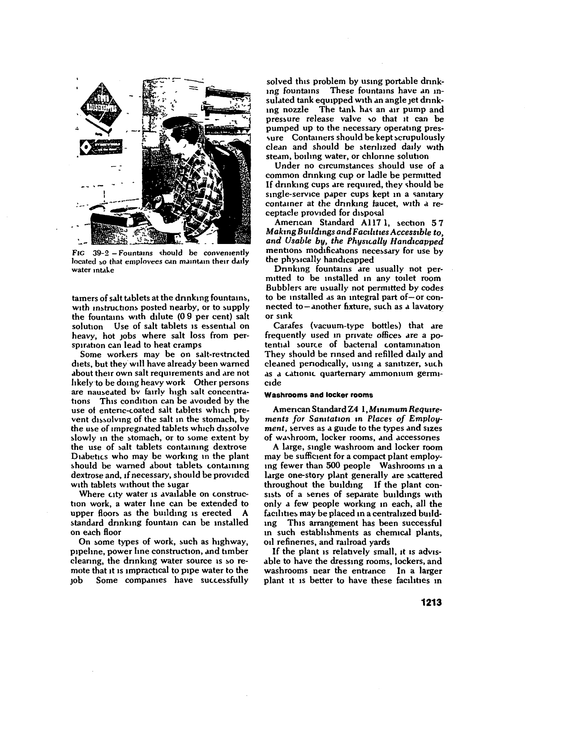
FlC 39-2 -- Fountains should be conveniently located so that employees can maintain their daily water intake tamers of salt tablets at the dnnking fountains, with instructions posted nearby, or to supply the fountains with dilute (0 9 per cent) salt solution Use of salt tablets is essential on heavy, hot jobs where salt loss from per spiration can lead to heat cramps Some workers may be on salt-restncted diets, but they will have already been warned about their own salt requirements and are not likely to be doing heavy work Other persons are nauseated bv fairly high salt concentra tions This condition can be avoided by the use of enteric-coated salt tablets which pre vent dissolving of the salt m the stomach, by the use of impregnated tablets which dissolve slowly in the stomach, or to some extent by the use of salt tablets containing dextrose Diabetics who may be working in the plant should be warned about tablets containing dextrose and, if necessary, should be provided with tablets without the sugar Where city water is available on construc tion work, a water line can be extended to upper floors as the building is erected A standard dnnking fountain can be installed on each floor On some types of work, such as highway, pipeline, power line construction, and timber clearing, the drinking water source is so re mote that it is impractical to pipe water to the job Some companies have successfully solved this problem by using portable dnnk ing fountains These fountains have an in sulated tank equipped with an angle jet drink ing nozzle The tank has an air pump and pressure release valve so that it can be pumped up to the necessary operating pres sure Containers should be kept scrupulously clean and should be stenlized daily with steam, boiling water, or chlorine solution Under no circumstances should use of a common drinking cup or ladle be permitted If drinking cups are required, they should be single-service paper cups kept m a sanitary container at the dnnking faucet, with a re ceptacle provided for disposal American Standard A117 1, section 5 7 Making Buildings and Facilities Accessible to, and Usable by, the Physically Handicapped mentions modifications necessary for use by the physically handicapped Dnnking fountains are usually not per mitted to be installed in any toilet room Bubblers are usually not permitted by codes to be installed as an integral part of--or con nected to--another fixture, such as a lavatory or sink Carafes (vacuum-type bottles) that are frequently used m private offices are a po tential source of bacterial contamination They should be rinsed and refilled daily and cleaned penodically, using a sanitizer, such as a cationic quartemary ammonium germi cide Washrooms and locker rooms American Standard Z4 1, Minimum Require ments for Sanitation in Places of Employ ment, serves as a guide to the types and sizes of washroom, locker rooms, and accessones A large, single washroom and locker room may be sufficient for a compact plant employ ing fewer than 500 people Washrooms in a large one-story plant generally are scattered throughout the building If the plant con sists of a series of separate buildings with only a few people working in each, all the facilities may be placed in a centralized build ing This arrangement has been successful in such establishments as chemical plants, oil refineries, and railroad yards If the plant is relatively small, it is advis able to have the dressing rooms, lockers, and washrooms near the entrance In a larger plant it is better to have these facilities in 1213
refid# gD5ZLj1Q3411VYEJbVpoyJXpq1 page
Industrial Hygiene tected by installing a ventilation system which probably would not have been satis factory if the operation had not been iso lated and thus able to be enclosed Enclosing the process or equipment is a desirable method of control since the en closure will prevent or minimize the escape of solvent vapor into the workroom atmos phere Where some ol the more highly toxic solvents are used, enclosure should be one of the first measures attempted, after con sidering substitution In most instances, the enclosure should also be exhausted to avoid buildup of solvent vapors Additional pre cautions must be taken when cleaning en closed equipment or during start up or shut down in order to avoid high concentrations of solvent vapors Enclosure of an operation effectively pre vents the dispersal of contaminants En closed equipment is usually run tightly closed and is only opened during cleaning or fill ing operations Further examples of where this tvpe of control is effective are radium dial painting, glove booths, airless blast or shot blast machines for cleaning castings, and abrasive blasting cabinets In the chemical industry, the isolation of hazardous processes in closed systems is a widespread practice, which is one reason why the manufacture of toxic substances is often less hazardous than their use In the mechanical industries, complete enclosure is Irequently the best solution of severe dust or fume hazards, such as those from sand blasting or metal spraying operations Wet methods Dust hazards can frequently be minimized or greatlv reduced bv application of water or other suitable liquid at the source of dust, a method often used for silica and loose dusts Wetting of floors before sweeping to keep down the dispersion of harmful dust is ad visable when better methods, such as vacuum cleaning, cannot be applied "Wetting down" is one of the simplest methods for dust control Its effectiveness, however, depends upon proper wetting of the dust This may require the addition of a wetting agent to the water and proper dis posal of the wetted dust before it dnes out and is redispersed Tremendous reductions in dust concentrations have been achieved by the use of water forced through the drill bits used in rock drilling operations Many foundries successfully use water under high pressure for cleaning castings in place of sandblasting Airborne dust concentrations can be kept down if molding sand is kept moist, if castings are wet down before shake out, and if the floors are wetted nitermittentlv Local exhaust ventilation A local exhaust system traps the air con taminant near its source so that a worker standing at the process is not exposed to harmful concentrations This method is usually preferred to general ventilation, but should be used onlv when the contaminant cannot be controlled by substitution, chang ing the process, or isolation or enclosure Even though a process has been isolated, it may still require a local exhaust system After the system is installed and set in op eration, its performance should be checked to see it meets engineering specifications -- correct rates of air flow, duct velocities, nega tive pressures, etc Its performance should be rechecked periodically as a maintenance measure Full details of this method of control are given in Chapter 29, "Local Exhaust Sys tems " For further reference, see NSC Industrial Data Sheet 428, Checking Per formance of Local Exhaust Systems General or dilution ventilation General or dilution ventilation --adding air to keep the concentration of a contami nant below hazardous levels --uses natural convection through open doors or windows, roof ventilators, and chimneys, or artificial air currents produced by fans or blowers Exhaust fans through roofs, walls, or win dows constitutes positive all season dilution ventilation Consideration must be given to providing make-up air, especially during winter months Dilution ventilation is practicable onlv if the degree of air contami nation is not excessive and particularly if the contaminant is teleased at a substantial distance from the worker's breathing zone Under other conditions, the contaminated air will not be diluted sufficiently before inhalation General ventilation should not be used 1288
refid# QX22o2N144j0zpX7JeR4v7zp51 page
B.
refid# baNwrQDk3vLd5O6z88Y5zaqe61 page

refid# RjVr8rko3Qoaqbyz1ja3Jygnn1 page
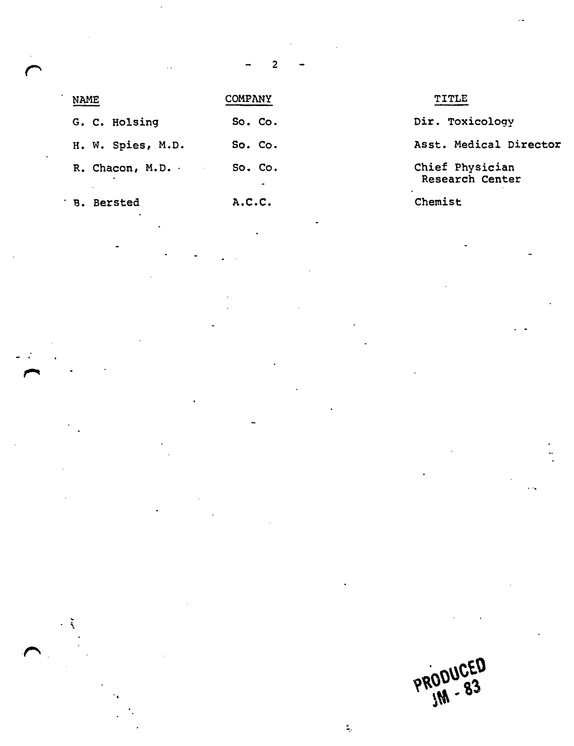
n NAME G.
refid# e5jKj0G5DLQeap0aa3YnXZnb41 page
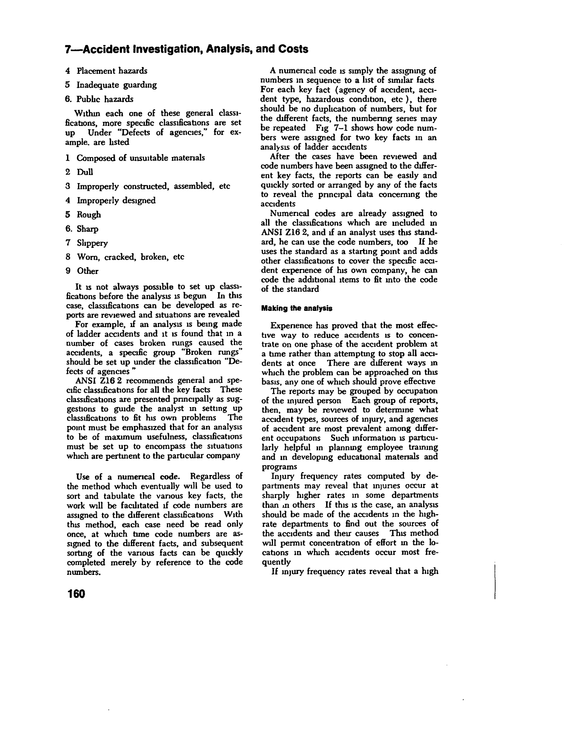
7--Accident Investigation, Analysis, and Costs 4 Placement hazards 5 Inadequate guarding 6.
refid# 5LjRMq6j60vGbxQZoJBqLON541 page