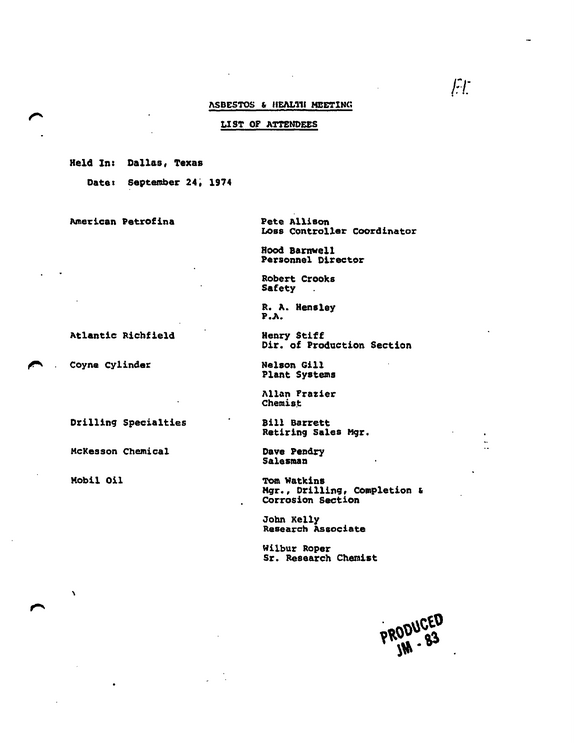
ASBESTOS 6 HEALTH MEETING LIST OF ATTENDEES Held In: Dallas* Texas Date: September 24* 1974 American Petrofina Atlantic Richfield Coyne Cylinder Drilling Specialties McKesson Chemical Mobil Oil Pete Allison Loss Controller Coordinator Hood Barnwell Personnel Director Robert Crooks Safety R.
refid# 93grr4Vkwkb8Eyq7xOaX6621L1 page
U.
refid# qv7wk9pyB2d0X5Rgn3bjQ1Zq1 page
$ | ' \ that this has yet to be worked out.
refid# DM1o111VQ2dpnmw4vNXzRgr0n1 page
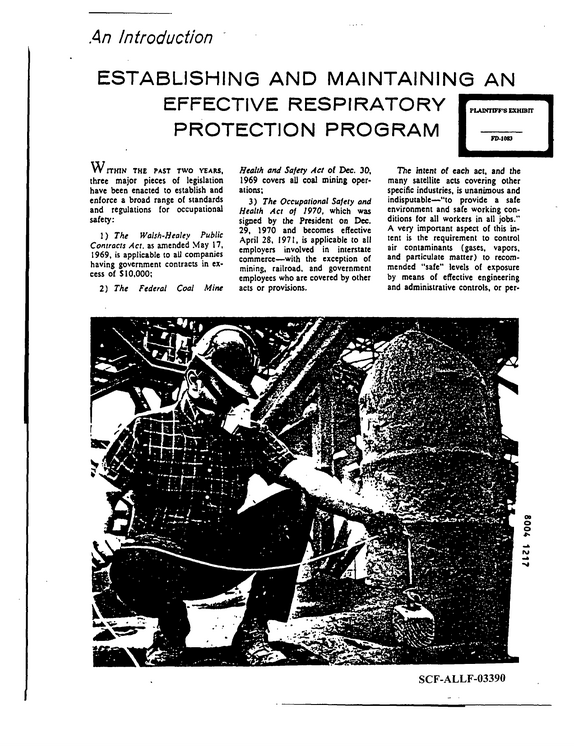
An Introduction ESTABLISHING AND MAINTAINING AN EFFECTIVE RESPIRATORY PROTECTION PROGRAM W ITHIN THE PAST TWO YEARS, three major pieces of legislation have been enacted to establish and enforce a broad range of standards and regulations for occupational safety: 1) The Walsh-Healey Public Contacts Act. as amended May 17, 1969, is applicable to all companies having government contracts in ex cess of $10,000; 2) The Federal Coal Mine Health and Safety Act of Dec. 30, 1969 covers all coal mining oper ations; 3) The Occupational Safety and Health Act of 1970, which was signed by the President on Dec. 29, 1970 and becomes effective April 28, 1971, is applicable to all employers involved in interstate commerce--with the exception of mining, railroad, and government employees who are covered by other acts or provisions.
refid# Yj06qgp5aR6n0QMBYBZQRLk9n1 page
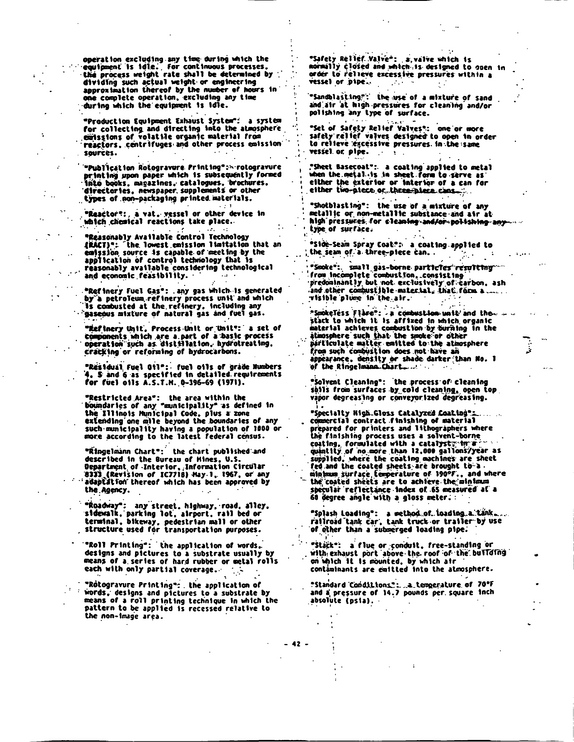
operation excluding any tine during which the -equipment Is idle.. for continuous processes.
refid# 1gV4RJgvpy88dMwdpRrrbxz8Z1 page
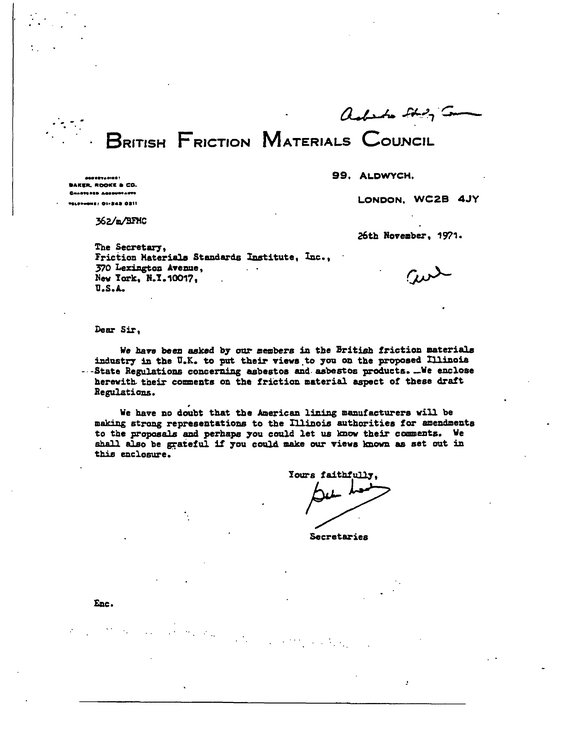
British Friction Materials Council IARIR.
refid# KJ6GGG96w8Nb5gGvOGRmZgxN61 page
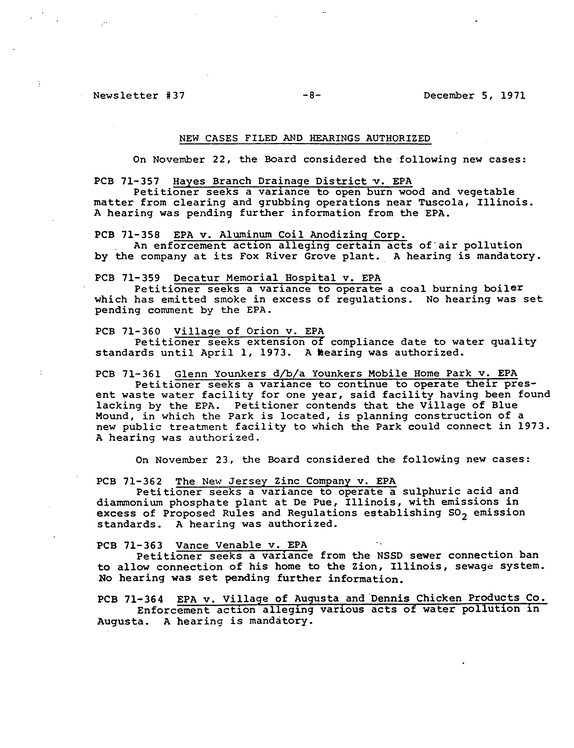
Newsletter #37 8- - December 5, 1971 NEW CASES FILED AND HEARINGS AUTHORIZED On November 22, the Board considered the following new cases: PCB 71-357 Hayes Branch Drainage District v.
refid# Ed3LxN7QBw2oeE0K5x3epBM2V1 page
START, COPY BOX NO.
refid# 1gBwnjMaZJVYedM71wx688y2m1 page
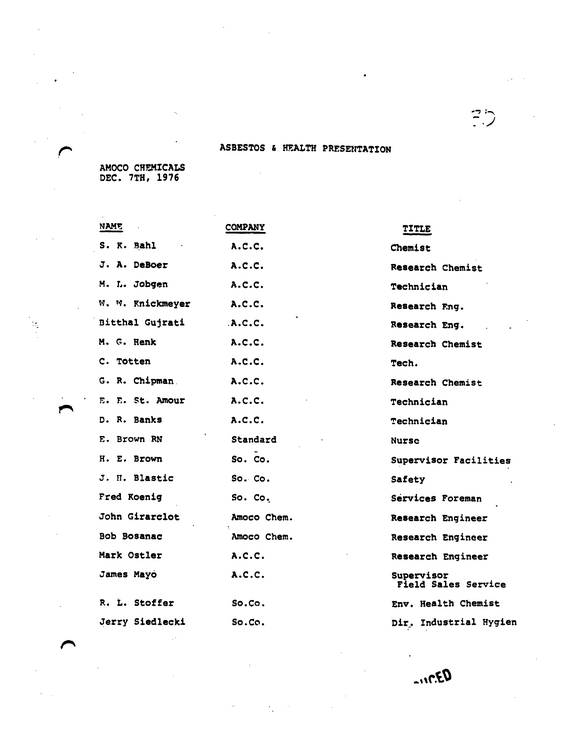
AMOCO CHEMICALS DEC. 7TH, 1976 ASBESTOS & HEALTH PRESENTATION NAME S.
refid# M424GZjo9N5LNJj8k9dbK3mYy1 page
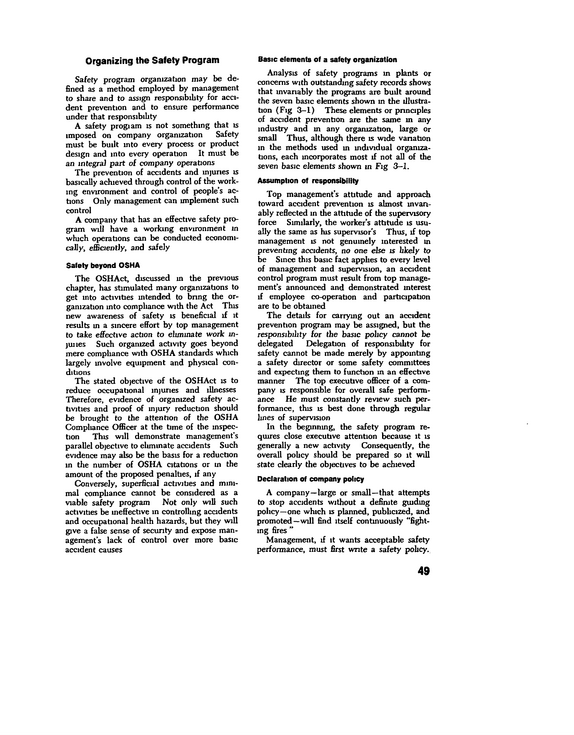
Organizing the Safety Program Safety program organization may be de fined as a method employed by management to share and to assign responsibility for acci dent prevention and to ensure performance under that responsibility A safety progiam is not something that is imposed on company organization Safety must be built into every process or product design and into every operation It must be an integral part of company operations The prevention of accidents and injuries is basically achieved through control of the work ing environment and control of people's ac tions Only management can implement such control A company that has an effective safety pro gram will have a working environment m which operations can be conducted economi cally, efficiently, and safely Safety beyond OSHA The OSHAct, discussed in the previous chapter, has stimulated many organizations to get into activities intended to bring the or ganization into compliance with the Act This new awareness of safety is beneficial if it results in a sincere effort by top management to take effective action to eliminate work mjunes Such organized activity goes beyond mere compliance with OSHA standards which largely mvolve equipment and physical con ditions The stated objective of the OSHAct is to reduce occupational injuries and illnesses Therefore, evidence of organized safety ac tivities and proof of injury reduction should be brought to the attention of the OSHA Compliance Officer at the time of the inspec tion This will demonstrate management's parallel objective to eliminate accidents Such evidence may also be the basis for a reduction in the number of OSHA citations or in the amount of the proposed jpenalbes, if any Conversely, superficial activities and mini mal compliance cannot be considered as a viable safety program Not only will such activities be ineffective in controlling accidents and occupational health hazards, but they will give a false sense of security and expose man agement's lack of control over more basic accident causes Basic elements of a safety organization Analysis of safety programs in plants or concerns with outstanding safety records shows that invariably the programs are built around the seven basic elements shown in the illustra tion (Fig 3-1) These elements or principles of accident prevention are the same m any industry and in any organization, large or small Thus, although there is wide variation in the methods used m individual organiza tions, each mcoiporates most if not all of the seven basic elements shown in Fig 3--1.
refid# KJmm5OqOyxjbgV7jEeZ5a2ngw1 page
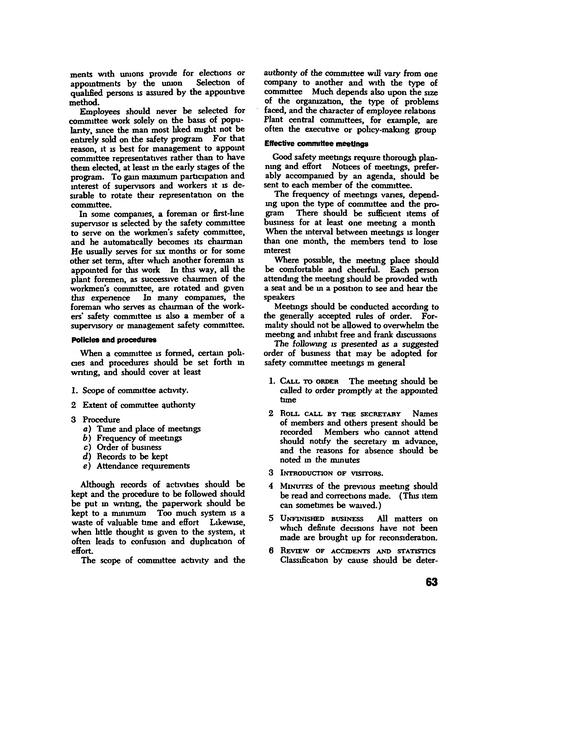
ments with unions provide for elections or appointments by the union Selection of qualified persons is assured by the appointive method.
refid# 9JV9dYeV3wJrdneJpwNpOO5Mp1 page
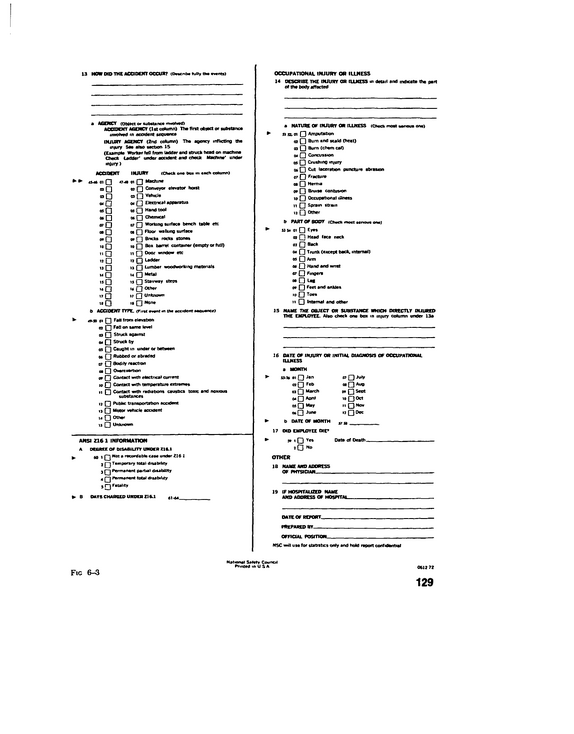
13 HOW DID THE ACCIDENT OCCUR?
refid# 6BogDkz5eX8Vy23QyjOvR7N241 page
which a sufficiently large number of accidents has occurred to be representative can be esti mated with considerable accuracy by multi plying the average uninsured cost per case for each of the four classes by the number of cases occurring in that class during the penod If any deaths, permanent total disabilities, or extraordinarily extensive property damage accidents have occurred, the specific unin sured costs of these should be added to the estimated costs of the four classes of accidents To these uninsured cost totals should be added the cost of workmen's compensation and insured medical expense For companies which are self-insured, this will be the total amount paid out m settlement of claims plus all expenses of administering the insurance For companies not carrying their own in surance, it will be the amount of their in surance premiums The method will have to be modified in accordance with the recordkeeping systems of different companies For example, most selfinsurers will find it impossible to separate compensated medical expense from dispensary care In that case, these items should be combined into one, and the dispensary cost omitted from the analysis of noncompensated costs on the data sheets For an illustration of the development of a final cost estimate, see the example in Tables 7-B and -C References Amencan National Standards Institute, 1430 Broadway, New York, N Y 10018 Standard Method of Recording Baste Facts Relating to die Nature and Occurrence of Work Injuries, Z16 2-1969 Firenze, Robert J Guide to Occupational Safety ir Health Management Dubuque, la, Kendall/Hunt Publishing Co, 1973 Sunonds, Rollin H, and Grimaldi, John V Safety Management--Accident Cost and Control Homewood, 111, Richard D Irwin, Inc, 1963 171
refid# M7kzJKODdmQyLOamr9DGjdpx1 page
8--Workmen's Compensation Insurance account the general occupational classifica tions ot industrial activities of the insured About 15 percent of the employers, paying about 85 percent of the premiums, are ex perience rated That is, their premiums are modified to reflect their loss experience in the past relative to others m the same class Also, the statistical reliability of that experience is taken into account, the larger the business, the more credible its experience Since em ployers with a small number of workers are likely to experience volatile changes m injury rates from year to year, only employers of large numbers arc expenence rated Another factor in the premium setting pro cedure is that discounts are given according to the size of the risk, this is an advantage to large companies Their rates thus reflect the economies of scale which result from spread ing certain fixed costs over a larger amount of premium Finally, large companies by retrospective rating may have their premiums adjusted at the end of a policy year to match their actual expenence Most insurers use rates developed by a rating bureau In some states, the rates de veloped by the bureau are mandatory, in others, advisory only Almost half the pre miums are written on a participating basis Participating policyholders receive periodic dividends that reflect insurer expenence and sometimes their own Financing self-insured benefits Firms that cover workmen's compensation risks through pnvate insurance companies or state funds pay a premium in advance In contrast, self-insurers have several options for financing They may simply pay for liabili ties as they are experienced, directly from operating funds, or they may provide some advance funding m one or more ways In those states requiring deposits of funds by selfinsurers, part or all of the funding for out standing liabilities is provided for in advance mandatonly Even if not requned, a selfinsurer may set aside reserves, or even formally insure its risk through a wholly owned sub sidiary insurance company created for this purpose Such advance funding prevents severe dis ruptions in cash flow from unforeseen loss experience oi accumulated liabilities Insurer administrative costs One of the recurring issues in evaluating workmen's compensation is the financial ef ficiency of the insurance mechanism for pro viding benefits A major part of the issue is the comparison between private and state fund insurance The premiums collected by pnvate insurers aie used not only to pay benefits but also for expenses associated with claims such as in vestigation and legal fees, for sales, supervi sion, and collection, for administration, for safety programs, and for taxes, licenses, and other mandatory fees as well as for earnings In 1970, stock insurers that do not pay divi dends to policyholders had expenses totaling 31 percent of premiums earned, their under writing gain was 5 percent of premiums paid For stock insurers that pay dividends to pol icyholders, the expense ratio was 25 percent, the underwriting gain, 14 percent Mutual insurers had an expense ratio of 24 percent and an underwriting gain of 13 percent The dividend-paying stocks and mutuals returned part of their underwriting gam to their policy holders In addition to their underwriting gains, these insurers had investment profits State funds have much the same costs as private insurers with these exceptions lower (or no) taxes and fees to the state govern ment, no margin for private profit, and lower selling costs Consequently, although the variation among individual funds is great, ex penses have averaged less than 10 percent of total premiums paid, well below the ratio for pnvate insurers Some state funds incur smaller expenses for administrative and legal services, which may be financed from other government funds On the other hand, state funds m some instances may insure greater proportions of high-nsk companies than pnvate earners and incur proportionately heavier charges for benefits Other administrative costs Another aspect of financing workmen's com pensation relates to the cost of supporting the public agenev that administers the program The cost of operating the industrial commis sion (or other admimstenng agency) is borne either by assessments upon insurers and selfinsurers or through appropnations from public 184
refid# Yj24Lqm6rGE1D4YMv1xx9Rj4y1 page
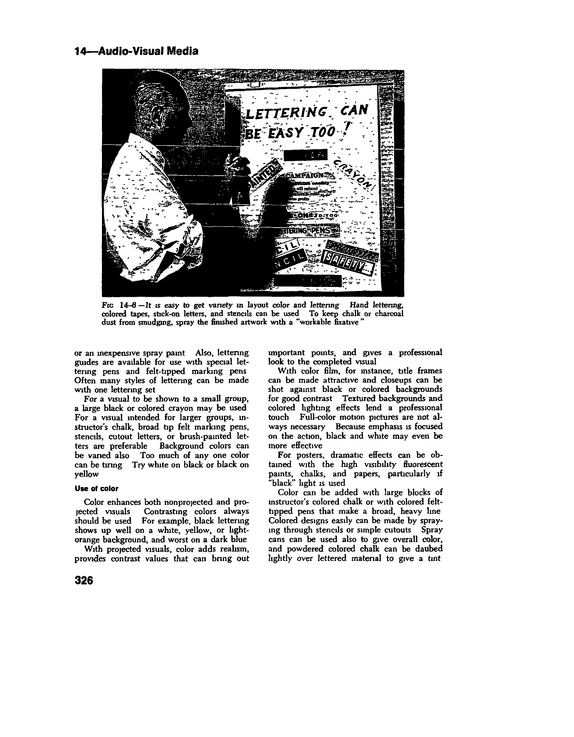
14--Audio-Visual Media Fig 14-6 --It is easy to get variety in layout color and lettering Hand lettering, colored tapes, stack-on letters, and stencils can be used To keep chalk or charcoal dust from smudging, spray the finished artwork with a "workable fixative " or an inexpensive spray paint Also, lettering guides are available for use with special let tering pens and felt-tapped marking pens Often many styles of lettering can be made with one lettering set For a visual to be shown to a small group, a large black or colored crayon may be used For a visual intended for larger groups, in structor's chalk, broad tip felt marking pens, stencils, cutout letters, or brush-painted let ters are preferable Background colors can be varied also Too much of any one color can be tinng Try white on black or black on yellow Use of color Color enhances both nonprojected and pro jected visuals Contrasting colors always should be used For example, black lettering shows up well on a white, yellow, or bghtorange background, and worst on a dark blue With projected visuals, color adds realism, provides contrast values that can bnng out 326 important points, and gives a professional look to the completed visual With color film, for instance, title frames can be made attractive and closeups can be shot against black or colored backgrounds for good contrast Textured backgrounds and colored lighting effects lend a professional touch Full-color motion pictures are not al ways necessary Because emphasis is focused on the action, black and white may even be more effective For posters, dramatic effects can be ob tained with the high visibility fluorescent paints, chalks, and papers, particularly if "black" light is used Color can be added with large blocks of instructor's colored chalk or with colored felttapped pens that make a broad, heavy line Colored designs easily can be made by spray ing through stencils or simple cutouts Spray cans can be used also to give overall color, and powdered colored chalk can be daubed lightly over lettered material to give a tint
refid# 65EXYbBoB7ob9kxng18JpwXg1 page