National Safety Council, 425 North Michigan Ave , Chicago, III 60611 Fundamentals of Industrial Hygiene, 1971 Industrial Data Sheets Checking Performance of Local Exhaust Systems, 428 Dusts, Fumes, and Mists in Industry, 531 Instruments for Testing Exhaust Ventilation Systems, 431 Radiant Heat Control, 381 Pnng, R T, J F Knudsen, and R Dennis "Design of Exhaust Ventilation for Solid Materials Handling " Industrial and Engineering Chemistry, 41 2,442, 1949 Sheinbaum, Milton "Ventilation of Factories, Garages, and Warehouses for Products of Com bustion of Gasoline Engines " Monthly Review, 32 37, Oct 1953 New York City, State Department of Labor, Division of Industrial Hygiene and Safety Standards Stem, Arthur C , ed Air Pollution, Vols I and II New York, N Y , Academic Press, 1962 Stem, Arthur C, and Donald P O'Neil "Recirculation from Industrial Exhaust Systems " Monthly Review, 30 (May, June, July, 1951) New York City, State Department of Labor, Division of Industrial Hygiene and Safety Standards Weisburd, Melvin I, ed Air Pollution Control Field Operations Manual PHS Publication No 937 Washington, D C , U S Department of Health, Education and Welfare Available U S Government Printing Office 1962 895
refid# Ev98eEj5aE96LLQY0zR6b7zQ01 page
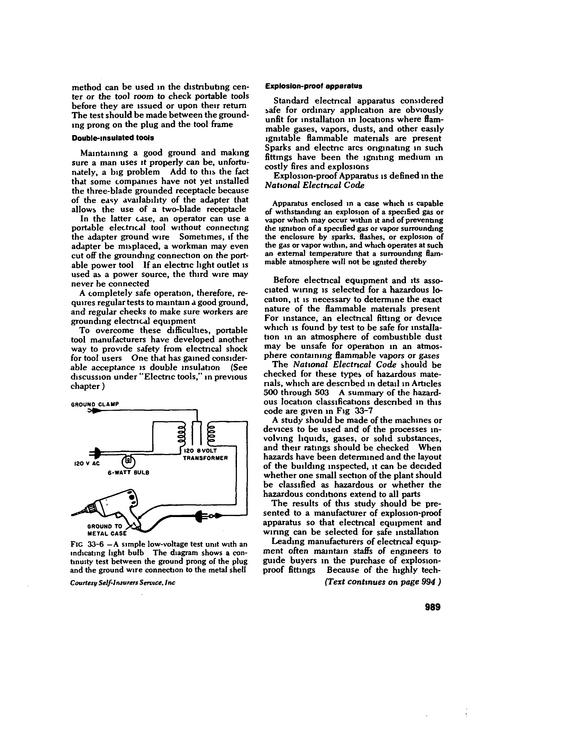
method can be used in the distributing cen ter or the tool room to check portable tools before they are issued or upon their return The test should be made between the ground ing prong on the plug and the tool frame Double-insulated tools Maintaining a good ground and making sure a man uses it properly can be, unfortu nately, a big problem Add to this the fact that some companies have not yet installed the three-blade grounded receptacle because of the easy availability of the adapter that allows the use of a two-blade receptacle In the latter case, an operator can use a portable electrical tool without connecting the adapter ground wire Sometimes, if the adapter be misplaced, a workman may even cut off the grounding connection on the port able power tool If an electric light outlet is used as a power source, the third wire may never be connected A completely safe operation, therefore, re quires regular tests to maintain a good ground, and regular checks to make sure workers are grounding electrical equipment To overcome these difficulties, portable tool manufacturers have developed another way to provide safety from electrical shock for tool users One that has gained consider able acceptance is double insulation (See discussion under "Electric tools," in previous chapter ) GROUND CLAMP Fig 33-6 -- A simple low-voltage test unit with an indicating light bulb The diagram shows a con tinuity test between the ground prong of the plug and the ground wire connection to the metal shell Courtesy Self-Insurers Service.
refid# 7VNabk31KMBawg68XgNKeqLB1 page
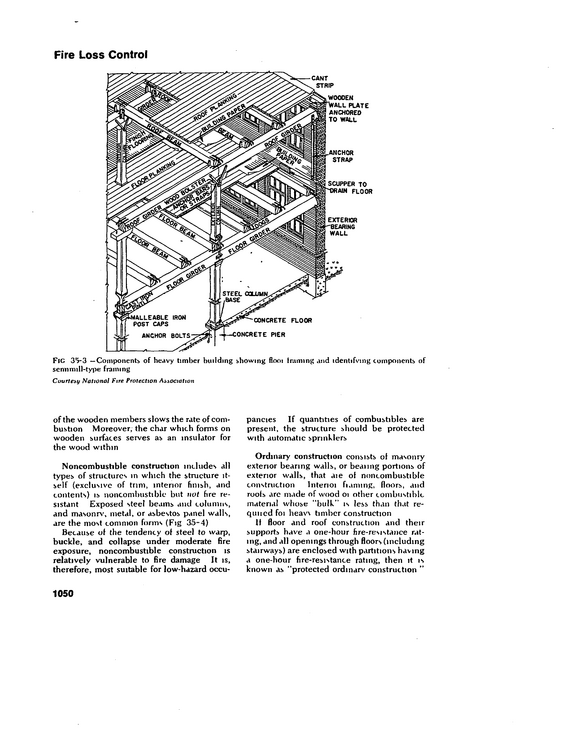
Fire Loss Control FlC 35-3 --Components of heavy timber building showing flooi training and identifvmg components of sennmill-type framing Courtesy Notional Fire Protection Association of the wooden members slows the rate of com bustion Moreover, the char which forms on wooden surfaces serves as an insulator for the wood within Noncombustible construction includes all types of structures in which the structure it self (exclusive of trim, interior finish, and contents) is noncomliustible but not fire re sistant Exposed steel beams and columns, and masonrv, metal, or asbestos panel walls, are the most common forms (Fig 35-4) Because of the tendency of steel to warp, buckle, and collapse under moderate fire exposure, noncombustible construction is relatively vulnerable to fire damage It is, therefore, most suitable for low-hazard occu pancies If quantities of combustibles are present, the structure should be protected with automatic sprinklers Ordinary construction consists of masonry exterior bearing walls, or beanng portions of exterior walls, that aie of noncombustible construction Interioi flaming, floors, and roofs are made of wood oi other combustible material whose "bulk" is less than that re quited foi heav\ timber construction 11 floor and roof construction and their supports have a one-hour fire-resistance rat ing, and all openings through floors (including stairways) are enclosed with partitions having a one-hour fire-resistance rating, then it is known as "protected ordinary construction " 1050
refid# G6J5Qyor5yGq8yJkg6qROx8nV1 page
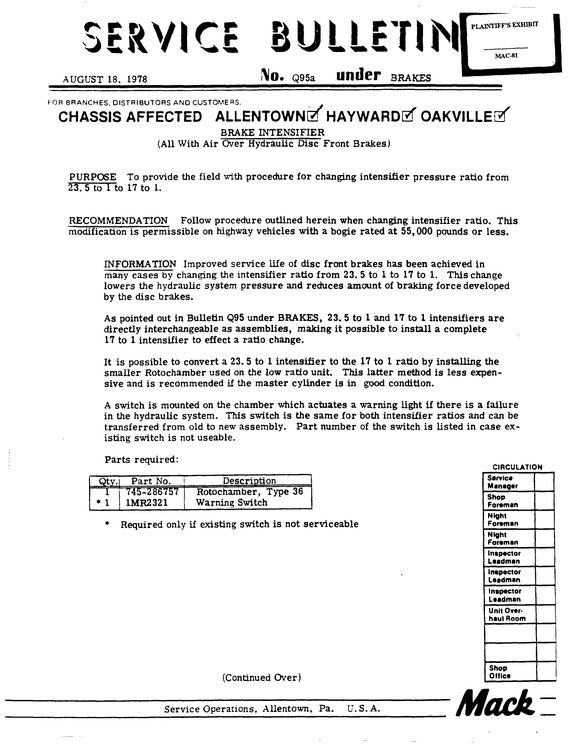
BULLETIN PLAINTIFF'SEXHIBIT AUGUST 18. 1978 No.
refid# danwm3pRB6dOoqjQb6R69EvoG2 pages
Planning for Emergencies governments are responsible for relief meas ures to meet needs resulting from enemy attack This relief is administered and di rected by Civil Defense authorities and fi nanced by the government The Red Cross has offered to assist the government m pro viding food, clothing, and temporary shelter on a mass-care basis during the emergency penod immediately following enemy attack In many communities, local Civil Defense officials have requested Red Cross chapters to assume all or part of this responsibility, acting under Civil Defense authorities In natural disasters, the American Red Cross is responsible for assisting families and individuals to meet disaster-caused needs that cannot be met through their own re sources These relief operations are coor dinated with the activities of the local, state, and federal governments When a disaster occurs, the local chapter of the Amencan Red Cross aids disaster sufferers The resources of the national organization are available to supplement chapter assistance References Amencan Insurance Association, 85 John St, New York N Y 10038 Fire Hazards and Safeguards for Metalworking Industries, Technical Survey No 2 Fire Safeguarding Warehouses, Technical Survey No 1 The South Amboy Port Explosion Windstorm Precautions Amencan Medical Association, Council on Occupational Health, 535 North Dearborn St, Chicago, 111 60610 Guide to Developing an Industrial Disaster Medical Service, latest ed American Society for Industnal Secunty, 651 NADA Building, Washington, D C 20006 In dustrial Security, 1962 Barnard, Robert J , "Three Keys to Specifying Electnca!
refid# MG368q9oLb55xnon8xz6KmMny1 page
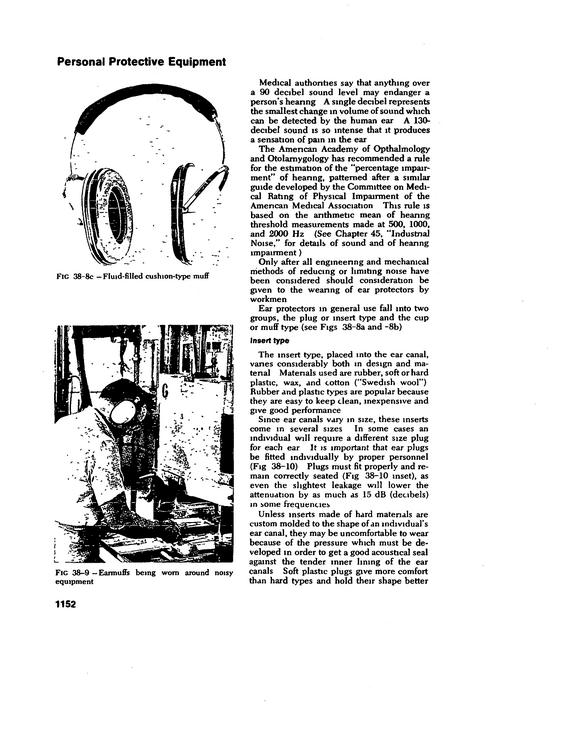
Personal Protective Equipment FlC 38-8c -Fluid-filled cushion-type muff Fic 38-9 -- Earmuffs being worn around noisy equipment Medical authorities say that anything over a 90 decibel sound level may endanger a person's hearing A single decibel represents the smallest change in volume of sound which can be detected by the human ear A 130decibel sound is so intense that it produces a sensation of pain in the ear The American Academy of Opthalmology and Otolamygology has recommended a rule for the estimation of the "percentage impair ment" of hearing, patterned after a similar guide developed by the Committee on Medi cal Rating of Physical Impairment of the American Medical Association This rule is based on the arithmetic mean of hearing threshold measurements made at 500, 1000, and 2000 Hz (See Chapter 45, "Industrial Noise," for details of sound and of hearing impairment) Only after all engineering and mechanical methods of reducing or limiting noise have been considered should consideration be given to the wearing of ear protectors by workmen Ear protectors in general use fall into two groups, the plug or insert type and the cup or muff type (see Figs 38-8a and -8b) Insert type The insert type, placed into the ear canal, vanes considerably both in design and matenal Matenals used are rubber, soft or hard plastic, wax, and cotton ("Swedish wool") Rubber and plastic types are popular because they are easy to keep clean, inexpensive and give good performance Since ear canals vary m size, these inserts come m several sizes In some cases an individual will require a different size plug for each ear It is important that ear plugs be fitted individually by proper personnel (Fig 38-10) Plugs must fit properly and re main correctly seated (Fig 38-10 inset), as even the slightest leakage will lower the attenuation by as much as 15 dB (decibels) in some frequencies Unless inserts made of hard matenals are custom molded to the shape of an individual's ear canal, they may be uncomfortable to wear because of the pressure which must be de veloped in order to get a good acoustical seal against the tender inner lining of the ear canals Soft plastic plugs give more comfort than hard types and hold their shape better 1152
refid# 6B2NzEJvYnbOMGXpydeRR49mo1 page
any kind of inserts other than approved de vices Mufl Type Cup or muff type devices cover the exter nal ear to provide an acoustic barrier (Fig 38-8c) The attenuation provided by ear muffs vanes widely due to differences in size, shape, seal material, shell mass and type of suspension Head size and shape also influence the attenuation characteristics of these protectors The type of cushion used between the shell and the head has a great deal to do with attenuation efficiency Liquid or grease filled cushions give better noise suppression than plastic or foam rubber types, but may present leakage problems Amount of protection Commercially available earplugs if pro perly fitted and used, generally reduce noise reaching the ear by 25-30 dB in the higher frequencies (Fig 38-8a), which are conceded to be the most harmful This will provide ample protection against sound levels of 115 to 120 dB The better type of ear muffs may reduce noise an additional 10 to 15 decibels (Fig 38-8b), making them effective against sound levels of 130 to 135 dB Com binations of ear plugs and muffs give 3 to 5 more dB of protection In no case will total attenuation be greater than about 50 dB be cause at this point, bone conduction becomes significant Face and Eye Protection The protection of the eyes and face from injury by physical or chemical agents, or by radiation is of prime importance m any in dustrial safety program The eye and face protection standard.
refid# zKJGrQbwDz1nEv4ke0kKqvy31 page
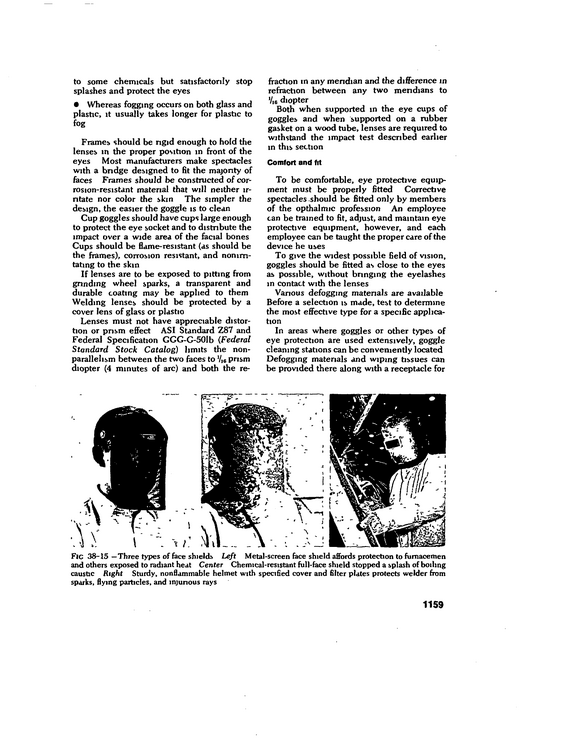
to some chemicals but satisfactorily stop splashes and protect the eyes Whereas fogging occurs on both glass and plastic, it usually takes longer for plastic to fog Frames should be rigid enough to hold the lenses in the proper position m front of the eyes Most manufacturers make spectacles with a bridge designed to fit the majority of faces Frames should be constructed of cor rosion-resistant material that will neither ir ritate nor color the skin The simpler the design, the easier the goggle is to clean Cup goggles should have cups large enough to protect the eye socket and to distribute the impact over a wide area of the facial bones Cups should be flame-resistant (as should be the frames), corrosion resistant, and nonimtating to the skin If lenses are to be exposed to pitting from grinding wheel sparks, a transparent and durable coattng may be applied to them Welding lenses should be protected by a cover lens of glass or plastio Lenses must not have appreciable distor tion or pnsm effect ASI Standard Z87 and Federal Specification GGG-G-501b (Federal Standard Stock Catalog) limits the non parallelism between the two faces to Vis prism diopter (4 minutes of arc) and both the re fraction m any meridian and the difference in refraction between any two meridians to '/is diopter Both when supported in the eye cups of goggles and when supported on a rubber gasket on a wood tube, lenses are required to withstand the impact test described earlier in this section Comfort and fit To be comfortable, eye protective equip ment must be properly fitted Corrective spectacles .should be fitted only by members of the opthalmic profession An employee can be trained to fit, adjust, and maintain eye protective equipment, however, and each employee can be taught the proper care of the device he uses To give the widest possible field of vision, goggles should be fitted as close to the eyes as possible, without bringing the eyelashes in contact with the lenses Various defoggmg materials are available Before a selection is made, test to determine the most effective type for a specific applica tion In areas where goggles or other types of eye protection are used extensively, goggle cleaning stations can be conveniently located Defoggmg materials and wiping tissues can be provided there along with a receptacle for Fic 38-15 --Three types of face shields Left Metal-screen face shield affords protection to fumacemen and others exposed to radiant heat Center Chemical-resistant full-face shield stopped a splash of boiling caustic Right Sturdy, nonflammable helmet with specified cover and filter plates protects welder from sparks, flying particles, and injurious rays 1159
refid# r6x3egXLjGXvDBjNxkN0Z9dbJ1 page
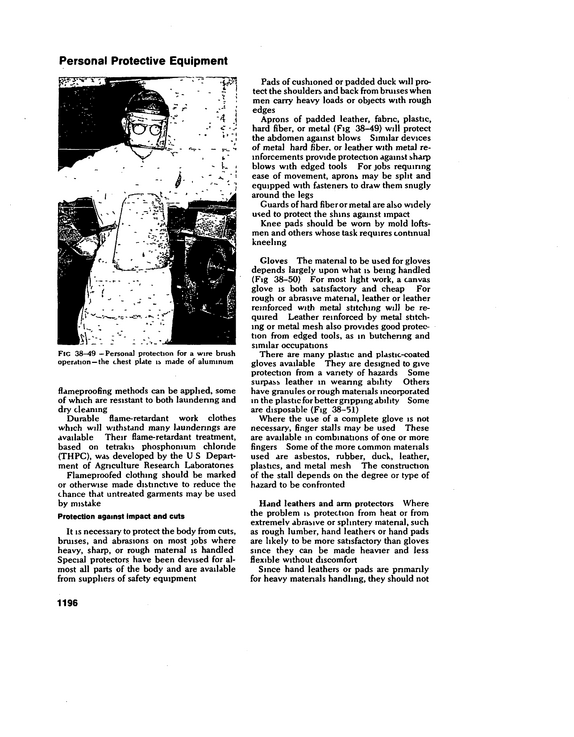
Personal Protective Equipment Pads of cushioned or padded duck will pro tect the shoulders and back from bruises when men carry heavy loads or objects with rough edges Aprons of padded leather, fabric, plastic, hard fiber, or metal (Fig 38-49) will protect the abdomen against blows Similar devices of metal hard fiber, or leather with metal re inforcements provide protection against sharp blows with edged tools For jobs requiring ease of movement, aprons may be split and equipped with fasteners to draw them snugly around the legs Guards of hard fiber or metal are also widely used to protect the shins against impact Knee pads should be worn by mold loftsmen and others whose task requires continual kneeling Fic 38--49 --Personal protection for a wire brush operation--the chest plate is made of aluminum flameproofing methods can be applied, some of which are resistant to both laundering and dry cleaning Durable flame-retardant work clothes which will withstand many launderings are available Their flame-retardant treatment, based on tetrakis phosphonium chloride (THPC), was developed by the U S Depart ment of Agriculture Research Laboratories Flameproofed clothing should be marked or otherwise made distinctive to reduce the chance that untreated garments may be used by mistake Protection against impact and cuts It is necessary to protect the body from cuts, bruises, and abrasions on most jobs where heavy, sharp, or rough material is handled Special protectors have been devised for al most all parts of the body and are available from suppliers of safety equipment Gloves The matenal to be used for gloves depends largely upon what is being handled (Fig 38-50) For most light work, a canvas glove is both satisfactory and cheap For rough or abrasive matenal, leather or leather reinforced with metal stitching will be re quired Leather reinforced by metal stitch ing or metal mesh also provides good protec tion from edged tools, as in butchenng and similar occupations There are many plastic and plastic-coated gloves available They are designed to give protection from a variety of hazards Some surpass leather m weanng ability Others have granules or rough materials incorporated in the plastic for better gripping ability Some are disposable (Fig 38-51) Where the use of a complete glove is not necessary, finger stalls may be used These are available in combinations of one or more fingers Some of the more common materials used are asbestos, rubber, duck, leather, plastics, and metal mesh The construction of the stall depends on the degree or type of hazard to be confronted Hand leathers and arm protectors Where the problem is protection from heat or from extremely abrasive or splintery matenal, such as rough lumber, hand leathers or hand pads are likely to be more satisfactory than gloves since they can be made heavier and less flexible without discomfort Since hand leathers or pads are pnmanly for heavy matenals handling, they should not 1196
refid# 15Ger3G6dRpLMqzojYG18EKRE1 page
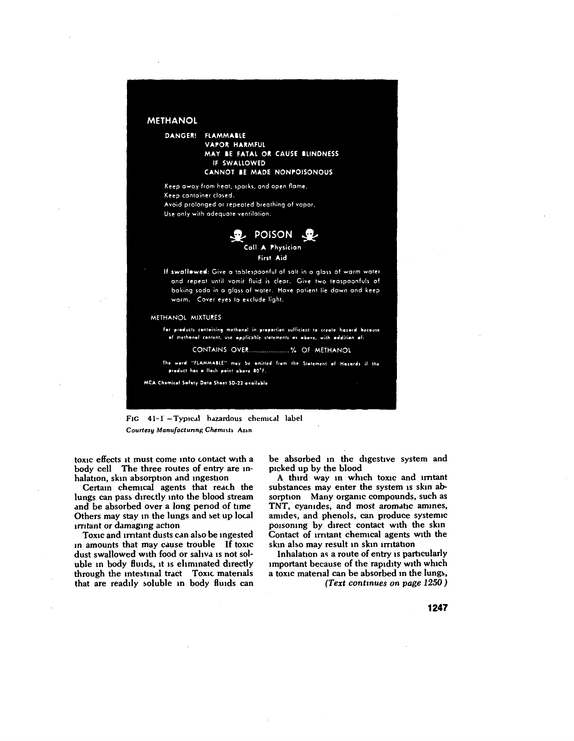
METHANOL DANGER!
refid# z6E5wd9XyBDq4zDJGjeLBaRB1 page
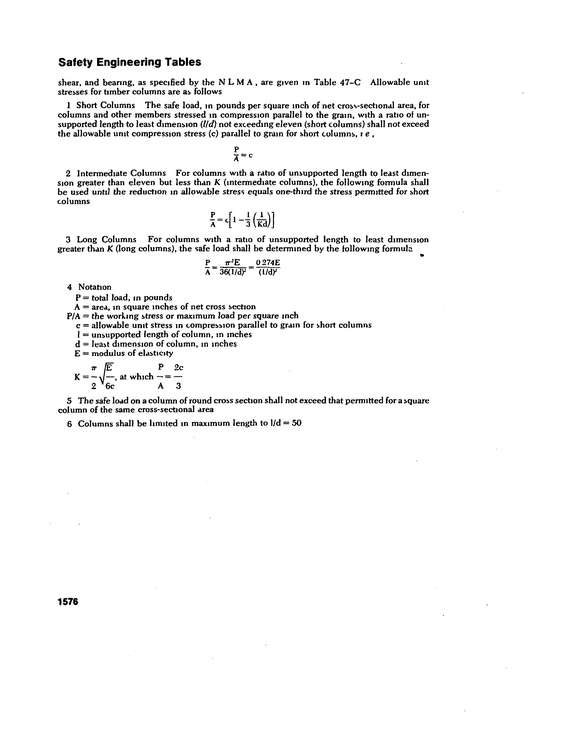
Safety Engineering Tables shear, and bearing, as specified by the NLM A, are given in Table 47-C Allowable unit stresses for timber columns are as follows 1 Short Columns The safe load, in pounds per square inch of net cross-sectional area, for columns and other members stressed in compression parallel to the gram, with a ratio of un supported length to least dimension (Hd) not exceeding eleven (short columns) shall not exceed the allowable unit compression stress (c) parallel to grain for short columns, t e , P A=c 2 Intermediate Columns For columns with a ratio of unsupported length to least dimen sion greater than eleven but less than K (intermediate columns), the following formula shall be used until the reduction in allowable stress equals one-third the stress permitted for short columns 3 Long Columns For columns with a ratio of unsupported length to least dimension greater than K (long columns), the safe load shall be determined by the following formula P 7T*E 0 274E A 36(1/dy (l/dy 4 Notation P = total load, m pounds A = area, m square inches of net cross section P/A = the working stress or maximum load per square inch c = allowable unit stress in compression parallel to grain for short columns 1 = unsupported length of column, m inches d = least dimension of column, m inches E = modulus of elasticity P 2c at which -- = -- A3 5 The safe load on a column of round cross section shall not exceed that permitted for a square column of the same cross-sectional area 6 Columns shall be limited m maximum length to 1/d = 50 1576
refid# evQBjrb62OjQJr95jGnGZz5Ep1 page
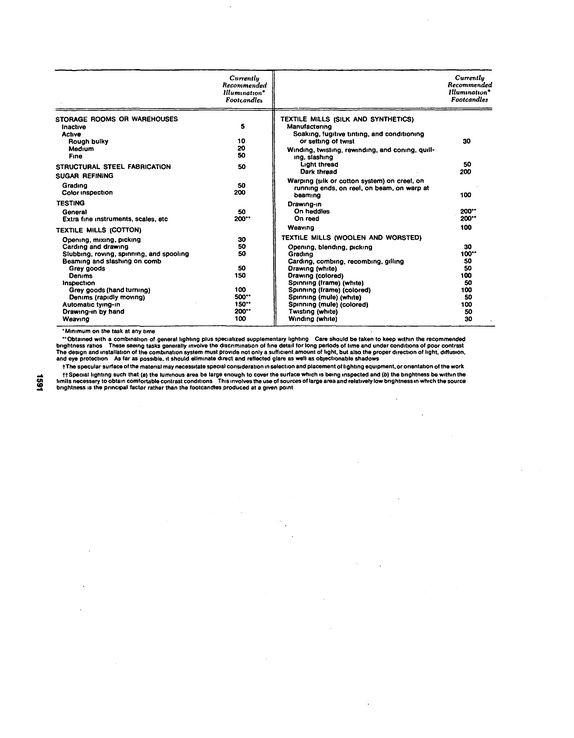
Currently Recommended Illumination* Footcandles Currently Recommended Illumination Footcandles STORAGE ROOMS OR WAREHOUSES Inactive Active Rough bulky Medium Fine STRUCTURAL STEEL FABRICATION SUGAR REFINING Grading Color inspection TESTING General Extra fine instruments, scales, etc TEXTILE MILLS (COTTON) Opening, mixing, picking Carding and drawing Slubbing, roving, spinning, and spooling Beaming and slashing on comb Grey goods Denims Inspection Grey goods (hand turning) Denims (rapidly moving) Automatic tying-in Drawing-in by hand Weaving 5 10 20 50 50 50 200 50 200" 30 50 50 50 150 100 500" 150" 200" 100 TEXTILE MILLS (SILK AND SYNTHETICS) Manufacturing Soaking, fugitive tinting, and conditioning or setting of twist Winding, twisting, rewinding, and coning, quill* mg, slashing Light thread Dark thread Warping (silk or cotton system) on creel, on running ends, on reel, on beam, on warp at beaming Drawing-in On heddles On reed Weaving TEXTILE MILLS (WOOLEN AND WORSTED) Opening, blending, picking Grading Carding, combing, recombing, gillmg Orawing (white) Drawing (colored) Spinning (frame) (white) Spinning (frame) (colored) Spinning (mule) (white) Spinning (mule) (colored) Twisting (white) Winding (white) 30 50 200 100 200" 200" 100 30 100" 50 50 100 50 100 50 100 50 30 Minimum on the task at any lime "Obtained with a combination of general lighting plus specialized supplementary lighting Care should be taken to keep within the recommended brightness ratios These seeing tasks generally involve the discnmination of fine detail tor long periods of time and under conditions of poor contrast The design and installation of the combination system must provide not only a sufficient amount of light, but also the proper direction of light, diffusion, and eye protection As far as possible, it should eliminate direct and reflected glare as well as objectionable shadows tThe specular surface of the matenal may necessitate special consideration in selection and placement of lighting equipment, or onentation of the work ft Special lighting such that (a) the luminous area be large enough to cover the surface which is being inspected and (b) the bnghtness be within the limits necessary to obtain comfortable contrast conditions This involves the use of sources of large area and relatively low bnghtness in which the source brightness is the principal factor rather than the footcandles produced at a given point 1591
refid# ExaJGGBdvQOoO0M99QQ6qp7aL1 page
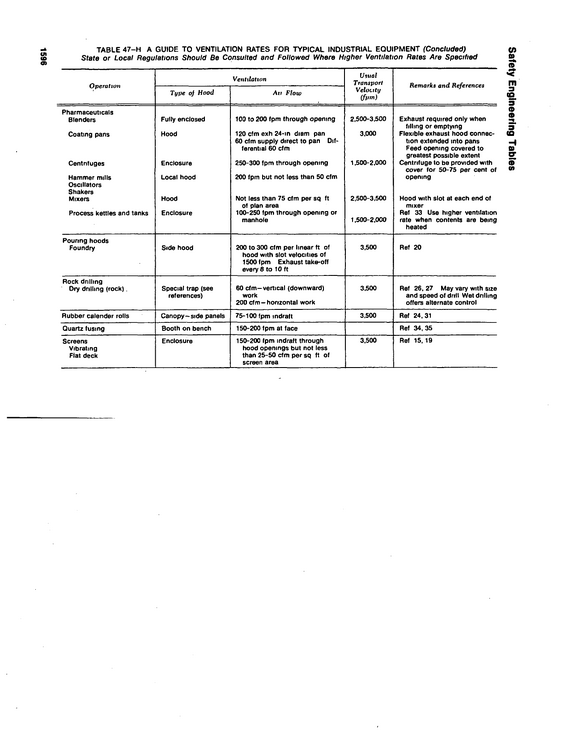
Safety Engineering Tables 1596 TABLE 47-H A GUIDE TO VENTILATION RATES FOR TYPICAL INDUSTRIAL EQUIPMENT (Concluded) State or Local Regulations Should Be Consulted and Followed Where Higher Ventilation Rates Are Specified Operation Pharmaceuticals Blenders Coating pans Centnfuges Hammer mills Oscillators Shakers Mixers Process kettles and tanks Pouring hoods Foundry Rock drilling Dry dnllmg (rock).
refid# qMX2oanE18LNyrK9byGyB5Zk1 page
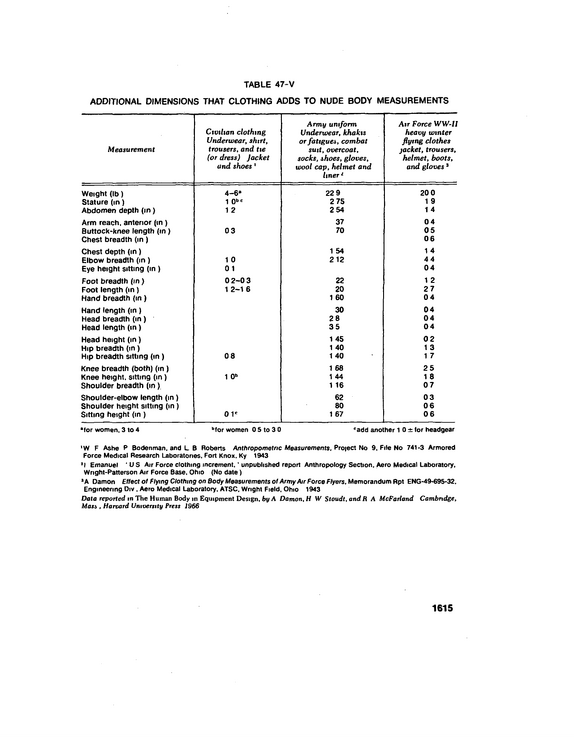
TABLE 47-V ADDITIONAL DIMENSIONS THAT CLOTHING ADDS TO NUDE BODY MEASUREMENTS Measurement Civilian clothing Underwear, shtrt, trousers, and tie (or dress) Jacket and shoes 1 Army uniform Underwear, khakis orfatigues, combat suit, overcoat, socks, shoes, gloves, wool cap, helmet and liner1 Air Force WW-II heavy winter flying clothes jacket, trousers, helmet, boots, and gloves 3 Weight (lb) Stature (in) Abdomen depth (in) Arm reach, anterior (in ) Buttock-knee length (in) Chest breadth (in) Chest depth (in) Elbow breadth (in) Eye height sitting (in ) Foot breadth (in) Foot length (in) Hand breadth (in) Hand length (in) Head breadth (in) Head length (in) Head height (in) Hip breadth (in) Hip breadth sitting (in ) Knee breadth (both) (in ) Knee height, sitting (in) Shoulder breadth (in) Shoulder-elbow length (in) Shoulder height sitting (in ) Sitting height (in ) `for women, 3 to 4 4-6" 1 0bc 12 03 10 01 0 2-0 3 1 2-1 6 08 1 0b 01* "for women 0 5 to 3 0 22 9 2 75 254 37 70 1 54 212 22 20 1 60 30 28 35 1 45 1 40 1 40 1 68 1 44 1 16 62 80 1 67 20 0 19 14 04 05 06 14 44 04 12 27 04 04 04 04 02 13 17 25 18 07 03 06 06 'add another 1 0 . for headgear W F Ashe P Bodenman. and L.
refid# LJbBNrY5nJVnz05px1Z33mbvb1 page
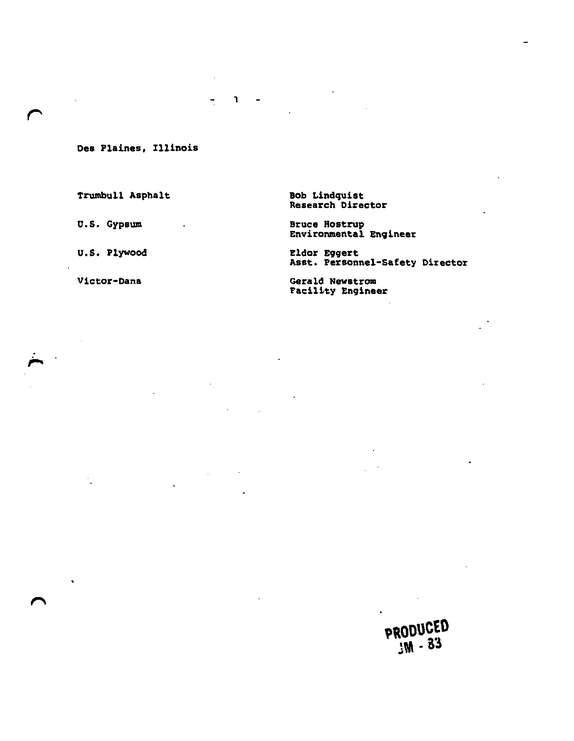
Des Plaines, Illinois Trumbull Asphalt U.S.
refid# JN6B8vMM8x1Nn6b98k9GNdJvv1 page