COMMON TO NEARLY EVERY PERSON Handles used for controlling liquids are expected to turn clockwise for off and counter clockwise for on Knobs on electrical equipment are expected to turn clockwise for on, to increase current, and counter-clockwise for off or to decrease current (Note this is opposite to the stereotype for liquid) Toggle switches are expected to turn "on" when flipped up, "off" when flipped down Certain colors are associated with traffic, operation of vehicles, and safety For control of vehicles m which the operator is riding, the operator expects a control motion to the nght or clockwise to result in a similar motion of his vehicle, and vice versa Sky-earth impressions carry over into colors and shadings Light shades and bluish colors are related to the sky or up, whereas dark shades and greenish or brownish colors are related to the ground or down Things which are further away are expected to look smaller Coolness is associated with blue and blue-green colors, warmth with yellows and reds Very loud sounds or sounds repeated m rapid succession, and visual displays that move rapidly or are very bright, imply urgency and excitement Very large objects or dark objects imply heaviness Small objects or light-colored objects appear light m weight Large, heavy objects are expected to be at the bottom Small, light objects are expected at the top People expect normal speech sounds to be m front of them and approximately head height Seat heights are expected to be at a certain level when a person sits down Source Woodson and Conover, Human Engineering Guide for Equipment Design more relative than absolute judgements Function 3--Man as Controller The third function man serves in the manmachine system is that of controller Just as principles exist for designing displays for man to use more readily, so, too, can controls be designed to eliminate error The control function in the man-machine system can be considered as the response to a given stimulus For many situations, a generalized response is given Most Americans, for example, ex pect a light switch to be turned on by flipping the switch "up" and off by a "down" move ment A clockwise motion generally refers to an increase Such responses are called "population stereotypes," a behavioral response common 115
refid# 5L3DVB1xMBXLX8xMEYrxeK0JV1 page
Maintaining Interest in Safety Departmental meetings have many safety uses Their purpose may be to discuss the company safety program so that employees will better understand what is going on They may be held to provide information about accident causes and accident types They may be purely inspirational, to create an awareness of hazards and a desire to pre vent accidents In many company programs, departmental safety meetings are held monthly The trend is toward meetings conducted by the foreman, who may receive assistance in planning as well as materials, such as visual aids, from the safety department The program for a departmental meeting may include the following 1 Report of injuries in the department since the past meeting, report of a safety inspec tion in the department, and report of the department's standing in a contest (The total time spent on reports must not be so great that this part of the meeting becomes tiresome ) 2 Discussion by the foreman of where ob servance of safe practices needs to be im proved 3 Talk, demonstration, or visual-aid presenta tion on an appropriate accident prevention subject The speaker may be the foreman, a member of the department, the company safety director, an outside expert, or an executive of the company Departmental meetings give the foreman an opportunity to point out in a forceful man ner the dangers of certain unsafe practices By condemning those practices, he practically binds himself to set a good example for his men In addition, most workers welcome an opportunity to "get off their chests" whatever safety ideas thev have At the conclusion of departmental meet ings, the foremen should be required to pre pare written reports for presentation to the plant safety committees and review by the managers Small group meetings with men doing sim ilar kinds of work can be held at or near the work place The supervisor or foreman may discuss the causes of an accident of which the men have personal knowledge or m which they have personal interest The men should be encouraged to join m the discussion, and a conclusion should be reached as to show the accident might have been prevented The supervisor may present a problem that has developed because of new work or new equipment Again the men should partici pate and offer their views At times the supervisor mav present a film or chart talk on a subject related to the work of the group members Other visual aids such as models or exhibits may be used Safety devices or pieces of equipment or material mav be shown and discussed "Production huddles" are instruction ses sions about a specific job being done that in cludes safety Such meetings are particularly useful with maintenance crews when an un usual job is about to start The plans for doing the job safely and efficiently are gone over and a procedure is agreed upon Public utility line crews use this type of meeting and call it a tail board conference Before start ing a job, the crew gathers around the truck and discusses the job, laying out the tools and materials they will need and agreeing upon the part each man is to do A particular advantage of small group meet ings is that they provide excellent opportuni ties for presenting all types of information, including safety information, directly to em ployees and stimulate exchange of ideas that can benefit the accident prevention program To be successful, the small safety meeting must include a tangible message, originality of presentation, opportunity for audience par ticipation, and a conclusion that spurs action toward an attainable goal Planning programs Making the safety meeting interesting is of the utmost importance There should be no complaining or scolding Talks should be definitely limited in time and thev should start and end on time The subject matter of a talk should be considered in advance to make sure that it is pertinent and does not repeat other talks recently presented Large occasional meetings need even more careful planning and timing than do small meetings People who are to speak, includ ing company executives, should review what they intend to say with the person planning 174
refid# byEwXrGvyjjKRqGYJDq7Yz1401 page
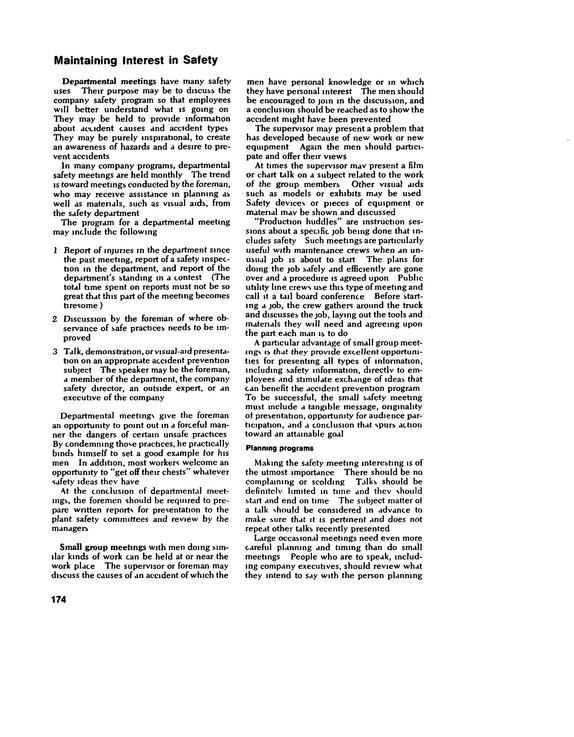
FlC 9-5 --Cooperative planning with editors and program directors is the basis for effective news coverage Here camera crew covers ceremonies marking the completion of a defensive driving publicity film At far left are Howard Pyle, president of the National Safety Council, and Jack Adams, president of Diamond Rio Truck Division of the White Motor Corporation Courtesy Pilot Productions, Inc can say in a press interview The section "TV, Radio, and Newspapers" in Chapter 37, "Planning for Emergencies," has some suggestions on how the press can help when dealing with large-scale disaster situations See page 1139 Working with Company Publications If a safetyman thinks that safety has been neglected m his company publication, it is time to correct the situation This safetyman should ask the editor frankly how to get more news value and human in terest into safety stones He should tell the editor he wants the program to be just as newsworthy as it can possibly be and that he realizes he needs something besides cold facts and colder figures to make safety articles and pictures attractive to his readers The editor is just as eager as anyone to pub lish interesting news and features, and he will go more than halfway to think up ways to put news value and reader interest into safety doings Here is an example of how the safety pro fessional and the editor can team up to make a 211
refid# qK5LD6wKzgkbDv430NX6VgQR1 page
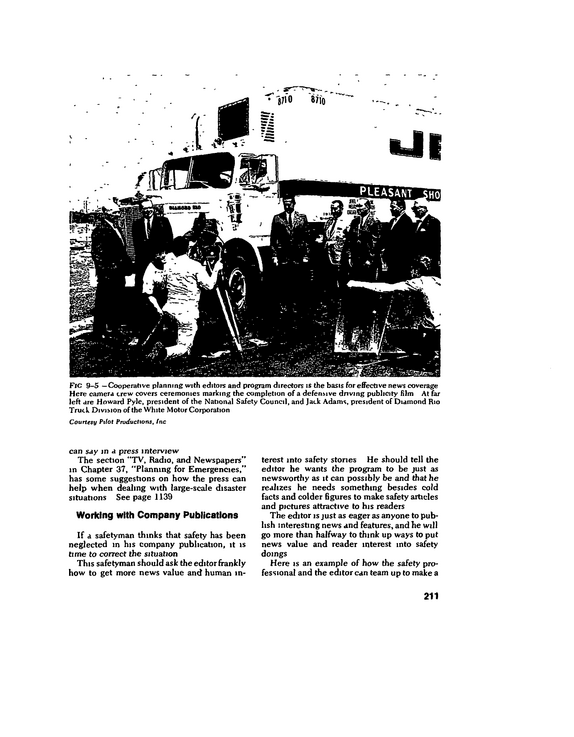
Industrial Buildings and Plant Layout FlC 16-1 --A bridge provides safe crossover of a freight yard Be sure construction and personnel protec tion are adequate Courtesy Guardian Engineering O Development Co Floors, walkways, stairs, ramps, platforms Storage facilities, including those for ex plosives and flammable materials, for harm ful substances, for finished products, and yard storage Electric winng and installation Illumination Mechanical handling equipment cranes, conveyors, industrial trucks Elevators Boilers and other pressure equipment Ventilation, heating, and air conditioning Fire control Health and safety water, waste disposal, first aid, personal protective equipment, distribution and repair facilities, isola tion of excessively noisy operations Water supply adequate for fire fighting Personal service facilities parking, restau rants, rest rooms, employment, and training Site Planning Selection of a site involves consideration of a number of factors possible hazards to the community and their relationship to cli mate and terrain, space requirements, type and size of buildings, necessary facilities, transportation, market, and labor supply Of the factors listed, those of direct concern to the safety professional are discussed below While the safety professional is not directly responsible for specialized plant and process engineering and design, still it is his duty to keep the engineers and architects as safety conscious as possible, and to anticipate poten tial safety hazards and try to have them "de signed out" of the system before the construc tion stage begins Location, climate, and terrain Plants producing or using highly flammable or toxic substances in bulk should be located 392
refid# nkp3wE2gKMgzDebEYXELajEG11 page
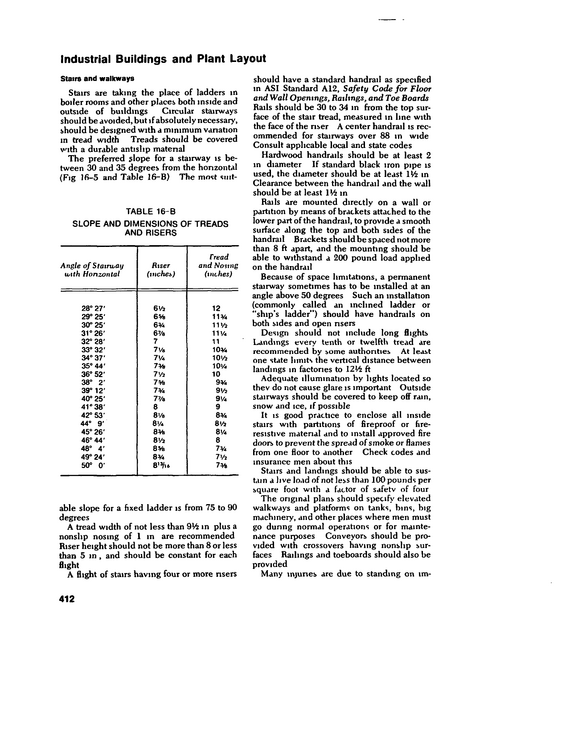
Industrial Buildings and Plant Layout Stairs and walkways Stairs are taking the place of ladders in boiler rooms and other places both inside and outside of buildings Circular stairways should be avoided, but ifabsolutely necessary, should be designed with a minimum variation m tread width Treads should be covered v'lth a durable antishp material The preferred slope for a stairway is be tween 30 and 35 degrees from the horizontal (Fig 16-5 and Table 16-B) The most smt- TABLE 16-B SLOPE AND DIMENSIONS OF TREADS AND RISERS Angle of Stairway with Horizontal Riser (inches) Tread and Nosing (inches) 28 27' 29 25' 30 25' 31 26' 32 28' 33 32' 34 37' 35 44' 36 52' 38 2' 39 12' 40 25' 41 38' 42 53' 44 9' 45 26' 46 44' 48 4' 49 24' 50 O' 61/2 6% 6% 6% 7 7% 7% 7% 7 Vi 7% 7% 7% 8 8 Vs 8% 8% 8V2 8% 8% 8,3fi 12 11% 11 Vi 11% 11 10% 10>/2 10% 10 9% 9'/2 9% 9 8% 8'/2 8% 8 7% IVi 7% able slope for a fixed ladder is from 75 to 90 degrees A tread width of not less than 9Vi in plus a nonslip nosing of 1 in are recommended Riser height should not be more than 8 or less than 5 in , and should be constant for each flight A flight of stairs having four or more risers should have a standard handrail as specified in ASI Standard A12, Safety Code for Floor and Wall Openings, Ratlings, and Toe Boards Rails should be 30 to 34 in from the top sur face of the stair tread, measured in line with the face of the riser A center handrail is rec ommended for stairways over 88 in wide Consult applicable local and state codes Hardwood handrails should be at least 2 in diameter If standard black iron pipe is used, the diameter should be at least 1V& in Clearance between the handrail and the wall should be at least 1V4 m Rails are mounted directly on a wall or partition by means of brackets attached to the lower part of the handrail, to provide a smooth surface along the top and both sides of the handrail Brackets should be spaced not more than 8 ft apart, and the mounting should be able to withstand a 200 pound load applied on the handrail Because of space limitations, a permanent stairway sometimes has to be installed at an angle above 50 degrees Such an installation (commonly called an inclined ladder or "ship's ladder") should have handrails on both sides and open risers Design should not include long flights Landings every tenth or twelfth tread are recommended by some authorities At least one state limits the vertical distance between landings in factories to 12*/ ft Adequate illumination by lights located so thev do not cause glare is important Outside stairways should be covered to keep off rain, snow and ice, if possible It is good practice to enclose all inside stairs with partitions of fireproof or fireresistive material and to install approved fire doors to prevent the spread of smoke or flames from one floor to another Check codes and insurance men about this Stairs and landings should be able to sus tain a live load of not less than 100 pounds per square foot with a factor of safetv of four The original plans should specify elevated walkways and platforms on tanks, bins, big machinery, and other places where men must go during normal operations or for mainte nance purposes Conveyors should be pro vided with crossovers having nonslip sur faces Railings and toeboards should also be provided Many injuries are due to standing on lm- 412
refid# Z59pNyXm22d50728D4XEGBed1 page
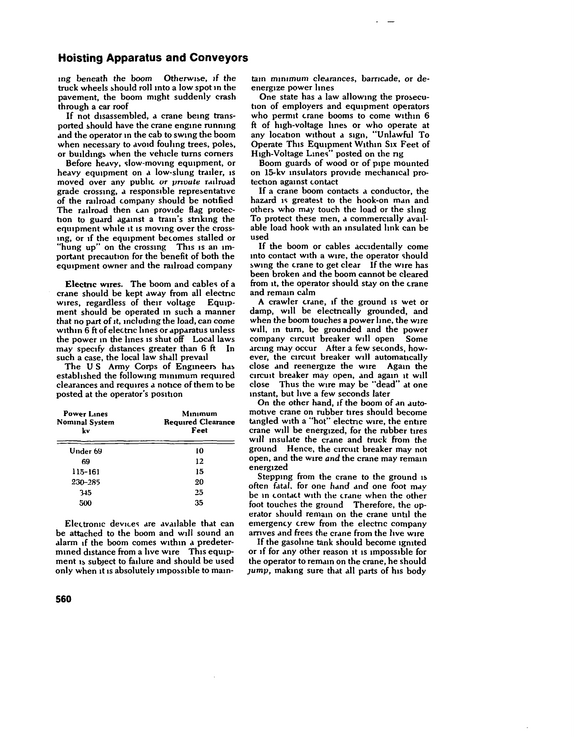
Hoisting Apparatus and Conveyors mg beneath the boom Otherwise, if the truck wheels should roll into a low spot m the pavement, the boom might suddenly crash through a car roof If not disassembled, a crane being trans ported should have the crane engine running and the operator in the cab to swing the boom when necessary to avoid fouling trees, poles, or buildings when the vehicle turns comers Before heavy, slow-moving equipment, or heavy equipment on a low-slung trailer, is moved over any public or private railroad grade crossing, a responsible representative of the railroad company should be notified The railroad then can provide flag protec tion to guard against a train's striking the equipment while it is moving over the cross ing, or if the equipment becomes stalled or "hung up" on die crossing This is an im portant precaution for the benefit of both the equipment owner and the railroad company Electric wires.
refid# 91b3YMrQrLKpvGr6dag72o9kD1 page
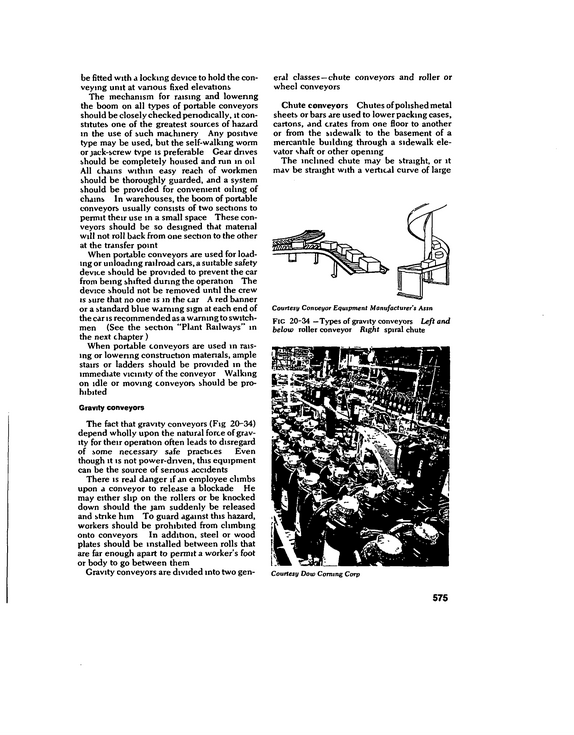
be fitted with a locking device to hold the con veying unit at vanous fixed elevations The mechanism for raising and lowering the boom on all types of portable conveyors should be closely checked periodically, it con stitutes one of the greatest sources of hazard in the use of such machinery' Any positive type may be used, but the self-walking worm or jack-screw tvpe is preferable Gear drives should be completely housed and run in oil All chains within easy reach of workmen should be thoroughly guarded, and a system should be provided for convenient oiling of chains In warehouses, the boom of portable conveyors usually consists of two sections to permit their use in a small space These con veyors should be so designed that material will not roll back from one section to the other at the transfer point When portable conveyors are used for load ing or unloading railroad cars, a suitable safety device should be provided to prevent the car from being shifted dunng the operation The device should not be removed until the crew is sure that no one is in the car A red banner or a standard blue warning sign at each end of the car is recommended as a warning to switch men (See the section "Plant Railways" in the next chapter) When portable conveyors are used in rais ing or lowering construction matenals, ample stairs or ladders should be provided in the immediate vicinity of the conveyor Walking on idle or moving conveyors should be pro hibited Gravity conveyors The fact that gravity conveyors (Fig 20-34) depend wholly upon the natural force of grav ity for their operation often leads to disregard of some necessary safe practices Even though it is not power-dnven, this equipment can be the source of senous accidents There is real danger if an employee climbs upon a conveyor to release a blockade He may either slip on the rollers or be knocked down should the jam suddenly be released and strike him To guard against this hazard, workers should be prohibited from climbing onto conveyors In addition, steel or wood plates should be installed between rolls that are far enough apart to permit a worker's foot or body to go between them Gravity conveyors are divided into two gen eral classes --chute conveyors and roller or wheel conveyors Chute conveyors Chutes of polished metal sheets or bars are used to lower packing cases, cartons, and crates from one floor to another or from the sidewalk to the basement of a mercantile building through a sidewalk ele vator shaft or other opening The inclined chute may be straight, or it mav be straight with a vertical curve of large Courtesy Conveyor Equipment Manufacturer's Assn Fig 20-34 --Types of gravity conveyors Left and below roller conveyor Right spiral chute 575
refid# ym3jpQD70zQX7QZxbVXN8nQxV1 page
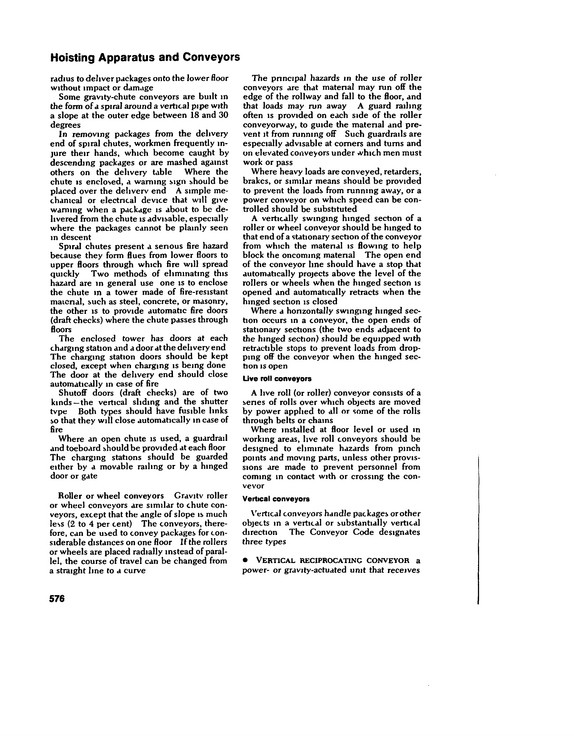
Hoisting Apparatus and Conveyors radius to deliver packages onto the lower floor without impact or damage Some gravity-chute conveyors are built m the form of a spiral around a vertical pipe with a slope at the outer edge between 18 and 30 degrees In removing packages from the delivery end of spiral chutes, workmen ffequendy in jure their hands, which become caught by descending packages or are mashed against others on the delivery table Where the chute is enclosed, a warning sign should be placed over the delivers' end A simple me chanical or electrical device that will give warning when a package is about to be de livered from the chute is advisable, especially where the packages cannot be plainly seen in descent Spiral chutes present a senous fire hazard because they form flues from lower floors to upper floors through which fire will spread quickly Two methods of eliminating this hazard are m general use one is to enclose the chute in a tower made of fire-resistant maicnal, such as steel, concrete, or masonry, the other is to provide automatic fire doors (draft checks) where the chute passes through floors The enclosed tower has doors at each charging station and a door at the delivery end The charging station doors should be kept closed, except when charging is being done The door at the delivery end should close automatically m case of fire Shutoff doors (draft checks) are of two kinds--the vertical sliding and the shutter tvpe Both types should have fusible links so that they will close automatically in case of fire Where an open chute is used, a guardrail and toeboard should be provided at each floor The charging stations should be guarded either by a movable railing or by a hinged door or gate Roller or wheel conveyors Gravity roller or wheel conveyors are similar to chute con veyors, except that the angle of slope is much less (2 to 4 per cent) The conveyors, there fore, can be used to convey packages for con siderable distances on one floor If the rollers or wheels are placed radially instead of paral lel, the course of travel can be changed from a straight line to a curve The principal hazards m the use of roller conveyors are that material may run off the edge of the rollway and fall to the floor, and that loads may run away A guard railing often is provided on each side of the roller conveyorway, to guide the material and pre vent it from running off Such guardrails are especially advisable at comers and turns and on elevated conveyors under which men must work or pass Where heavy loads are conveyed, retarders, brakes, or similar means should be provided to prevent the loads from running away, or a power conveyor on which speed can be con trolled should be substituted A vertically swinging hinged section of a roller or wheel conveyor should be hinged to that end of a stationary section of the conveyor from which the material is flowing to help block the oncoming material The open end of the conveyor line should have a stop that automatically projects above the level of the rollers or wheels when the hinged section is opened and automatically retracts when the hinged section is closed Where a horizontally swinging hinged sec tion occurs in a conveyor, the open ends of stationary sections (the two ends adjacent to the hinged section) should be equipped with retractible stops to prevent loads from drop ping off the conveyor when the hinged sec tion is open Live roll conveyors A live roll (or roller) conveyor consists of a senes of rolls over which objects are moved by power applied to all or some of the rolls through belts or chains Where installed at floor level or used in working areas, live roll conveyors should be designed to eliminate hazards from pinch points and moving parts, unless other provi sions are made to prevent personnel from coming in contact with or crossing the con veyor Vertical conveyors Vertical conveyors handle packages or other objects in a vertical or substantially vertical direction The Conveyor Code designates three types Vertical reciprocating conveyor a power- or gravity-actuated unit that receives 576
refid# K10KOwjMpv9mJN9rxpY1kLJ01 page
Powered Industrial Trucks Safe Operation FjC 22-7 --Triangular guard prevents the operator from riding a powered handtruck the truck must be maneuvered in close quar ters The wheels of many powered handtrucks can be considered guarded by their position under the frame or lift platform However, where the wheels might injure the operator or others, guards should be installed Highlift platform rollers and chain sprockets should also be guarded Many trucks, however, are being manufac tured with a platform for the operator to nde in a standing position If this practice is per mitted, the operator should be protected against foot or leg injuries Pnsm-shaped covers can be installed over the battery box to discourage operators from sitting on the truck during operation (Fig 22-7) Remotely controlled trucks Since they are operated electronically with out the guidance of an operator, remote con trol (programed) trucks (Fig 22-8) must be provided with some means of bringing them to a complete stop if someone steps m front of the truck These trucks should be equipped with a lightweight, flexible bumper which, when contacted, shuts off the power and applies the brakes There should be suffi cient clearance between the bumper and the front of the truck to permit the truck to come to a full stop without contacting anyone m its path Powered industrial truck traffic accidents can be prevented by putting into operation the same safe practices that apply to highway traffic For example, a powered industrial truck operated at excessive speed is being run at a speed too high for the conditions at a given moment Safe speed is the rate of travel which will permit stopping the truck well within the certain clear distance ahead, and permit making a turn without hazard of over turn Wet or slippery floors require a slowerthan-ordinary speed Specific speed limits for trucks should be established A favored maximum speed for loaded power trucks moving forward is 6 mph, although this speed may be too high in con gested areas Many companies have installed governors, locking them in some instances Collisions between trucks and stationary objects often occur while trucks are backing, usually while turning and maneuvering In such cases, the operator may be so intent on handling the load that he forgets where the rear of his truck is going Backing accidents Fig 22-8 --Electronically controlled robot tnick (guided by floor stnp shown at lower right) has bumper which shuts off power when contacted Courtesy Barrett Electronics Corp 616
refid# NEgeK7jj6MD936epo2X41kwDR1 page
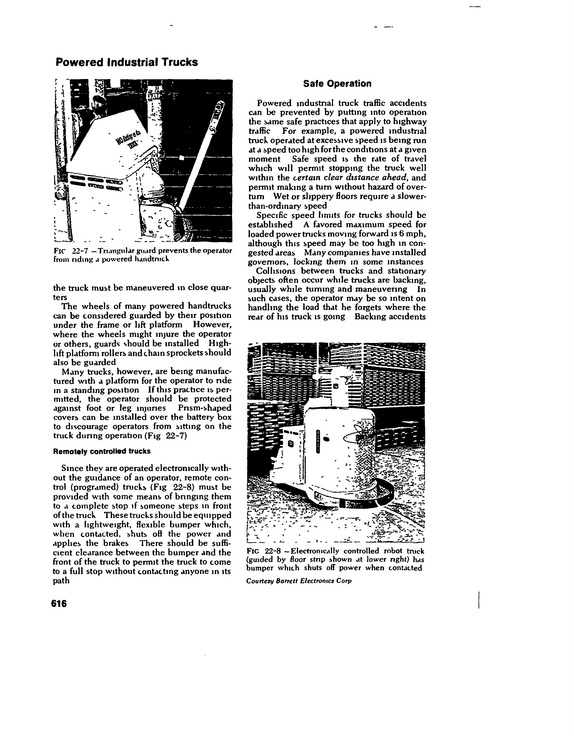
Open Type SWAGED SOCKET Closed Type 100% WIRE ROPE SOCKET--SPELTER ATTACHMENT 100% PRESSED SIEEVE LOOP RACK THIMBU ATTACHMENT I in diameter and smaller 1 Vi tn diameter and larger PS% 92.5% FLEMISH LOOP WITH MECHANICAL SLEEVE ATTACHMENT 1 m diameter and smaller 1% m diameter and larger WEDGE SOCKETS (depending on design) 95% 915% 75-90% CUPS (number el dtps vanes with size of rope) 75-80% THIMBU SPLICE--HAND TUCXB) 1/4 in 5/16 tn 3/6 in 7/16 in 90% 89% 88% 87% 1/2 in 5/6 m 3/4 m 7/6 in and larger 86% 84% 82% 80% LOOP SPLICE-HAND TUCXH) Efficiencies of loop splice are the same as these given for thimble splice FlC 23-4 -- Efficiencies of attaching wire rope to fittings m percentages of strength of rope 647
refid# 6ROv6MJv8o0m6XXqBbRxkxrk41 page
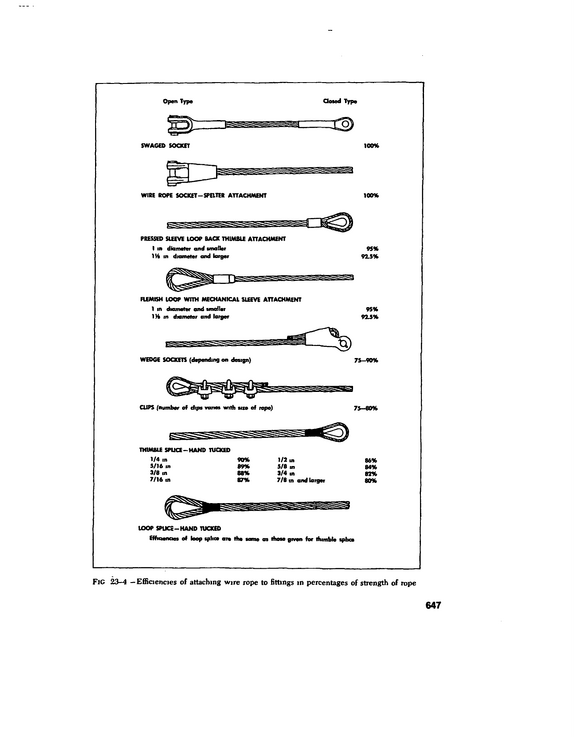
Types of guards To eliminate the dangers involved in ma chine operation, either guards may be built and installed over the hazardous areas or the equipment may be redesigned to have no ex posed dangerous parts The modern lathe is a good example of machinery made safe through improved de sign Its motor drive and gear box are en closed so that line shafts, pulleys, and belts are dispensed with The modern power press, in which all the working parts with the excep tion of the slide are enclosed, is another good example Tvpes of guards which arc used to make machinery safe include the fixed guard, the interlocking guard, and the automatic guard These may be added after a machine is in stalled, or purchased built-in by the manu facturer The fixed guard is considered preferable to all other types and should be used m every case unless it has been definitely determined that this type is not at all practicable The fixed guard at all times prevents access to the dangerous parts of the machine Fixed guards may be adjustable to accom modate different sets of tools or various kinds of work Once adjusted, they should remain "fixed," and there should be no movement nor detachment of them Some fixed guards are installed at a distance from the danger point in association with re mote feeding arrangements which make it unnecessary for the operator to approach the danger point A table of the safe distance of a guard from the danger point and the permissible size of openings in a fixed guard is given m the "De signing Pomt-of-Operation Guards" section of this chapter Examples of fixed guards are found on power presses, sheet leveling or flattening machines, milling machines, gear trains, drill ing machines, and guillotine cutters Interlocking guards.
refid# Byg32oryBXk1wJyOqgoD8GaOk1 page
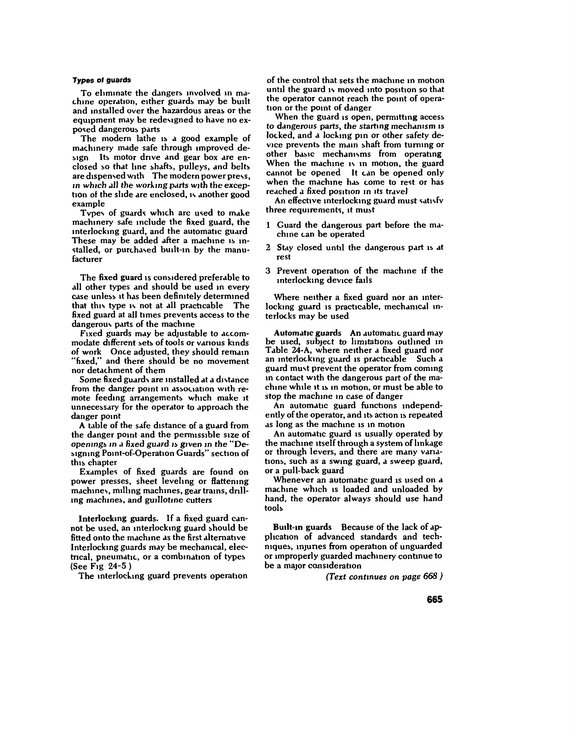
Cold Forming of Metals FlC 25-43 --Mounting bolts (arrow) pass through the ram to fasten upper die securely Lower die is clamped to bolster Note two-hand control slide down to its lowest position by turning the flywheel or crankshaft (If a safety bar is used as a lever to turn the crankshaft, it should have a spring and collar arrangement that will prevent its being accidentally left inserted in the crankshaft See Fig 25-42 ) Measure the clear height between the bottom of the slide and the bolster plate This distance should be slightly greater than, or at least equal to, the height of the closed die If not, raise the slide by means of the adjusting screw until this is assured When physical recessing is necessary, block up the slide with timber, metal blocks or posts provided for this purpose Blocks should be equipped with an electric receptacle plug to hold open the circuit when they are in the die Thus, they will not be left in the press when power is applied For heavy presses--Jog or inch the press to bring the slide down to its lowest position and measure the clear height between it and the bolster plate Again, if this distance is not slightly greater than, or at least equal to, the height of the die m the closed position, adjust the slide until such clearance is as sured Raise the slide, block it m position, shut off the power, and lock the switch Dismantle or disconnect a point-of-operation safety device only if it is absolutely neces sary For example, enclosure guards fastened to the press, gate or barrier guards, and some types of sweep guards will have to be re moved, but not, in general, pull-back guards or photoelectric cells All parts of any dis mantled safety devices should be carefully put aside so that they may be reinstalled m good condition as soon as the new dies have been placed Clean off the bolster plate, preferably with a brush Check that bolt holes are clear of slugs (A pencil-shaped magnet is valuable for removing iron or steel slugs ) Burrs can be removed with a flat file Check the die to make sure it contains no overlooked chips, tools, or finished parts, and that it is in good operating order Then transfer the die from the truck to the press (See "Transferring Dies Safely," above ) Line up the die in the correct operating position and remove the posts or blocks from under the slide (For heavy presses -- Recon nect the power to operate the slide For light presses --Manually tum the flywheel to move the slide, using a safety bar if necessary--Fig 25-42 ) Then, carefully lower the slide until it fits firmly against the top die It is ex tremely important not to put too much pres sure on pierce or trim dies Tighten all bolts and clamps necessary to secure the top half of the die to the slide Bolting the die to the slide with bolts through holes in the upper die shoe is recommended (Fig 25-43) On 732
refid# b5oKgLJMdDd1jy1wa9eoM4R11 page
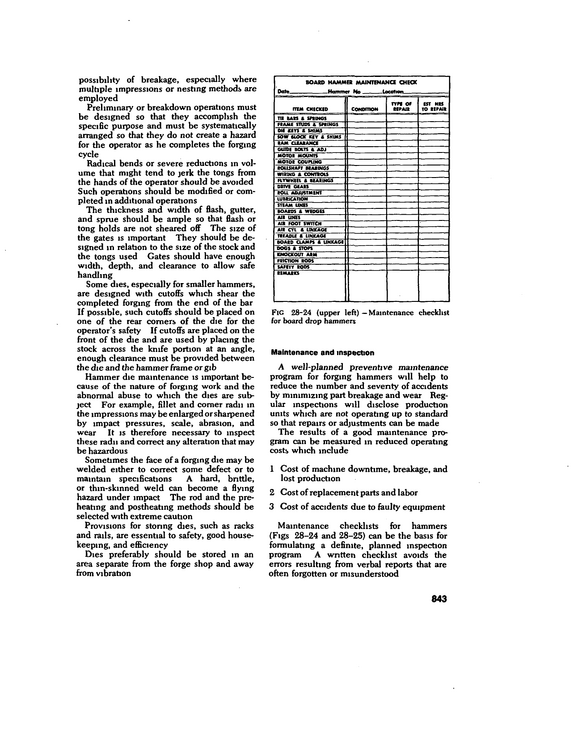
possibility of breakage, especially where multiple impressions or nesting methods are employed Preliminary or breakdown operations must be designed so that they accomplish the specific purpose and must be systematically arranged so that they do not create a hazard for the operator as he completes the forging cycle Radical bends or severe reductions in vol ume that might tend to jerk the tongs from the hands of the operator should be avoided Such operations should be modified or com pleted in additional operations The thickness and width of flash, gutter, and sprue should be ample so that flash or tong holds are not sheared off The size of the gates is important They should be de signed m relation to the size of the stock and the tongs used Cates should have enough width, depth, and clearance to allow safe handling Some dies, especially for smaller hammers, are designed with cutoffs which shear the completed forging from the end of the bar If possible, such cutoffs should be placed on one of the rear comers of the die for the operator's safety If cutoffs are placed on the front of the die and are used by placing the stock across the knife portion at an angle, enough clearance must be provided between the die and the hammer frame or gib Hammer die maintenance is important be cause of the nature of forging work and the abnormal abuse to which the dies are sub ject For example, fillet and comer radii in the impressions may be enlarged or sharpened by impact pressures, scale, abrasion, and wear It is therefore necessary to inspect these radii and correct any alteration that may be hazardous Sometimes the face of a forging die may be welded either to correct some defect or to maintain specifications A hard, brittle, or thin-skinned weld can become a flying hazard under impact The rod and the pre heating and postheating methods should be selected with extreme caution Provisions for storing dies, such as racks and rails, are essential to safety, good house keeping, and efficiency Dies preferably should be stored in an area separate from the forge shop and away from vibration Dote BOARD HAMMER MAINTENANCE CHECK Hummer No targfmw item CHECKED TIE BARS 8 SPRINGS NAME STUDS A SPRINGS DU KEYS A SKIMS SOW BLOCK KCT A SHUNS RAM CLEARANCE GUIDE BOLTS A ADJ MOTOR MOUNTS MOTOR COUPLING ROUSHAFT BEARINGS WIRING A CONTROLS FLYWHEEL A BEARINGS DRIVE GEARS ROU ADJUSTMENT LUBRICATION STEAM LINES BOARDS A WEDGES Alt LINES AIR FOOT SWITCH AIR CU A LINKAGE TREADLE A LINKAGE BOARD CLAMPS A LINKAGE DOGS A STOPS KNOCKOUT ARM FRICTION RODS SAFETY RODS REMARKS CONDITION TYPE OP REPAIR EST HRS TO REPAIR Fig 28-24 (upper left) -- Maintenance checklist for board drop hammers Maintenance and inspection A well-planned preventive maintenance program for forging hammers will help to reduce the number and seventy of accidents by minimizing part breakage and wear Reg ular inspections will disclose production units which are not operating up to standard so that repairs or adjustments can be made The results of a good maintenance pro gram can be measured in reduced operating costs which include 1 Cost of machine downtime, breakage, and lost production 2 Cost of replacement parts and labor 3 Cost of accidents due to faulty equipment Maintenance checklists for hammers (Figs 28-24 and 28-25) can be the basis for formulating a definite, planned inspection program A written checklist avoids the errors resulting from verbal reports that are often forgotten or misunderstood 843
refid# 3eEx59yj1X5nk0Ng3vbLZzaG01 page
Local Exhaust System Low maintenance, that is, infrequent and quick servicing of the collector, is essential to keep to a minimum the exposure of the men doing the job Finally, the radioactive or highly toxic material must be concentrated during col lection to the smallest possible volume Disposal through discharge to air, water, or land in the usual manner is not permitted Incineration is often used, with the irreduc ible residue consigned to a burial ground Only a few types of collectors meet these requirements Drv cyclones are no good be cause their collecting efficiency is too low Any unit with an involved internal structure must be ruled out because of service difficul ties The reverse-jet cloth arrester with wool felt media has become almost a standard where there is no problem of temperature or corrosion Where such problems exist, the high-voltage electrostatic collector can be used Low-efficiency, low-cost filters are often used as integral parts of laboratory hoods or dry boxes m which radioactive matenals are handled They serve as scalping filters to keep high concentrations of contaminated material from entering the main exhaust system They must be followed or backed up by an ultra-high-efficiency filter or dust arrester They have limited capacity and must be changed frequently Before they are changed, they can well be sprayed while still in position with an acrylic spray to fix any radioactive dust Air cleaners for fumes and smokes Fumes come from reactions such as burn ing, sublimation, distillation, and especially the condensing of a vapor given off by a molten metal The composition of fumes mav be different from that of the parent material Lead fume, cadmium fume, zinc oxide, and iron oxide (welding fume) are typical examples Their particles are gen erally below 1 micron, so they show active Brownian movement (that is, they are fai too small to settle out), and they are re markably uniform in size Smokes are com monly organic, coming from incomplete combustion of coal, oil, wood, and other fuels They are usually dark or jet black in color, and obscure light Their particles compare in size to the particles of metal lurgical fumes The high-efficiency dust collectors already mentioned --the cloth filter, high-efficiency wet collector, and electrostatic precipitator-- are best for arresting fumes For smokes, the answer is improved combustion, or the high-voltage electrostatic precipitaloi, oi both Air cleaners for gases and vapors Vapors may be defined as the gaseous form of a material which is normally m the liquid or solid state at room temperature Gases and vapors are not particles, but are indivi dual molecules dispersed among the mole cules of the air Gases and s'apors diffuse Arresters depending on the straining action of filters or on centrifugal force are not appli cable Methods generally used are as follows Absorption.
refid# 5b3nvXVLRNRry733a1VODarRV1 page
curved type, since spaces between blades soon become filled with paint Tempered makeup air to replace air ex hausted by the booth should be supplied This is needed for any exhaust svstem, but deserves special attention here because some spray booths remove huge amounts of room air, which in turn should be supplied directly to the booth or to the area from which the air is drawn into the booth Routine and scheduled cleaning and main tenance of spray booths are a must Flam mable materials when allowed to accumulate increase the fire risk Paint in ducts also cuts down needed air flow There are several products on the market which can be used to cover the inside of the booth, either sprayed or brushed on, which successfully prevent the sticking of the overspray to the booth surfaces Some of these are easily strippable coatings In high production painting much solvent is lost by evaporation from the wet painted surfaces If these surfaces are stacked out in the shop to dry, they may present a health and fire hazard A separate ventilated area should be provided for preliminary drying of the finished materials before they are sent to the ovens for baking Where the production is not high, the ma terial can be left in the booth for preliminary drying In no instance should finished material be stacked in front of the booth so that the air flow is from the freshly finished material to the operator If the booth is used for welding, a heavy canvas curtain should be placed around the front of the booth to safeguard the eyes of others in the room from the ultraviolet rays of the welding arc Dusts from some of the materials used m metallizing are explosive if finely divided and suspended in air in a critical concentra tion When collecting dust from metalliz ing, it is sometimes necessary to provide wet dust arrester units back of the metallizing booth Fume control for electric welding Movable exhaust hoods are needed for most indoor welding applications, and are a must when welding potentially toxic materials such as lead-containing or lead-painted metals, and beryllium alloys Except for production spot welding done at some sort of fixed jig, a welder usually travels over a wide area and this necessitates some ar rangement of flexible or movable piping The hood itself can have a rectangular face with a flared section to which the duct is connected, thus giving a streamlined air flow Normally the hood is surrounded on all four edges by a 3-in flange The breadth of the face and the amount of the air flow ex hausted should be such that fumes will be removed from the welding arc over the length of weld formed during the consumption of one welding rod The capacity of the exhaust, therefore, should be sufficient to "reach" laterally over one-half the length of a weld of this distance Flexible metal duct branches or solid sections with swivel joints and counterbal ances permit easy relocating of the hood A duct branch should not be less than 3 in in diameter and should handle at least 200 cfm Larger branches and higher air flows should be used whenever possible Face velocities can exceed 1500 fpm (average) and duct velocities should assure a sufficiently high air flow into the hood to control fumes at the point of generation (usually several inches away from the hood face), as well as avoid settlement in the duct Specific figures for ventilation based on distance from weld ing arc are given in Chapter 31, "Welding and Cutting " Dust control in foundnes Foundries offer many difficult problems m dust control, particularly in the shake-out and cleaning rooms Dust at the shake-out in a hand foundry that processes small cast ings can be adequately controlled by wet methods, with the castings removed from the sand before the sand dnes out enough to form a great deal of dust In a more mechanized foundry the shake out generally can be covered by a fairly tight enclosing hood if the flasks are small enough to be handled on conveyors, the major part of the exhaust should be taken from overhead to utilize the thermal circu lation of air over the hot metal When the flasks are so large that they must be handled by cranes, a side hood on the shake-out grate is about the only possible choice unless the whole operation can be enclosed and isolated 883
refid# xdrrmEBV2zbKyoVJdMMYLxGj61 page