\ t.yi<': ^ *.** '* hi-:iv- r;.1^ ^V4:'.;:'^ ->, ,,v ' -"`v. . '' * ,' :...;:
refid# dY7mnJOO8dMLV586mmv9vnNL01 page
13818 RULES AND REGULATIONS <b) Framework: (l) Minimum dimensions of material for the framework of all guards except as noted in subparagraph (S) of this paragraph shall be angle iron 1 inch x 1 inch x % inch, metal pipe of % inch in side diameter or metal construction of equivalent strength. <21 All guards shall be rigidly braced every 3 feet or fractional part of tlielr height to some fixed part of machinery or building structure.
refid# byOg1bzwJVbbE7ZaggYM67M9o1 page
National Safety Transactions VOL 16 MINING INDUSTRY NATIONAL SAFETY COUNCIL ^25 North Mlchtgan Avenue Chicago II, Illinois SCF-ALLF-02086
refid# 2jz16zxj5Yqm3d8N4k7Oopjyp1 page
National Safety Council (Board of Directors, continued) 1.
refid# 2JRaYoy3MwBB1N7dqKnRwVpNg1 page
i 4 fel [3S 0O S5 t=a February, 1961 Volume XXV No. 2 Industrial Hygiene Foundation 4400 Fifth Avenue Pittsburgh 13, Pennsylvania INDUSTRIAL HYGIENE DIGEST Literature and News NEWS ITEMS 105 Anatomy for Lawyers.
refid# bk1XRXYgEx7ebVX6qyjrYkd01 page
LUt of Exhibitor!
refid# NNN8orgjy9nKbzwj5mjnd4x4D1 page
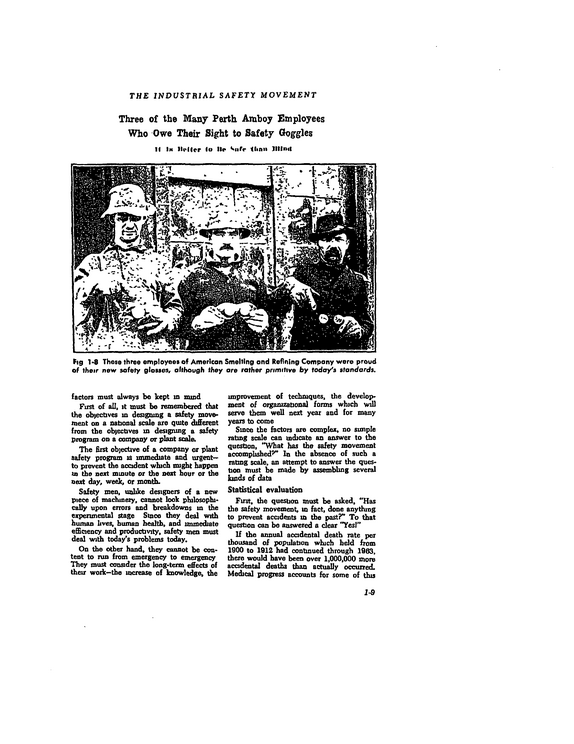
THE INDUSTRIAL SAFETY MOVEMENT Three of the Many Perth Amboy Employees Who Owe Their Sight to Safety Goggles II In Heller lo lip *>nfr tlmn Jlllml Fig 1*8 These three employees of American Smelting and Refining Company were proud of their new safety glosses, although they are rather primitive by todays standards.
refid# pdo6a9rXyjweLnwJ1oKVXGd71 page
SAFETY COMMITTEES member, the primary aim being to arouse interest in the work among all employees to the extent that they will realize that safety is just as important to them as the work they jierform Among die ways of arousing and main taining interest among committeemen, none is more effective than supplying members with informative material, such as data from outside sources, frequency of certain classes of accidents, and comparative state ments with other months of the year, other years, and other organizations.
refid# yvNgyxpjxwgd7KYrm0206RJ31 page
SOURCES OF HELP FOR THE SAFETY MAH A public relations committee adminis ters the details of the institute's blasting cap safety program.
refid# X7JjrdD06j6rp7zNaN3M2zyO41 page
BOILERS AND UNFIRED PRESSURE VESSELS below the working pressure Creat care must be used because a vessel may fail un der test and shatter Detecting cracks and measuring thickness Pressure vessels used to process gases or oily materials may have very small leaks which will not show under hydrostatic tests To detect them, a small amount of ammonia can be released inside the vessel and compressed air is then applied until a maximum pressure of 50 per cent of the working pressure is attained A swab soaked in hydrochloric (munatic) acid is passed over all seams and other suspect areas Leakage will be indicated by a white vapor (ammonium chlonde) formed by contact of escaping ammonia and the acid Usmg a burning sulfur stick is also effective A change in the flame indicates ammonia Radiography is especially good for End ing cracks For example, ammonia tanks used for agriculture are subject to corro sion and may stress crack If care is not taken to catch tanks which become defec tive, there may be some surprised--and seriously hurt--fanners Also, there are a number of applications where it is vital to check the thickness of an unfired pressure vessel without damag ing it There are a number of manufac turers who make instruments for doing this Some are listed under "Gauges or Gages Thickness" ui Thomas Register, and include Sperry Products Division of Auto mation Industries, Inc , Danbury, Conn , and Magnaflux Corporation, subsidiary of General Mills, Chicago Other instruments employ ultrasonic and various electronic-ray producing and measuring means Usmg these instruments, a qualified op erator can determine the thickness of metal to within 2 or 3 per cent Some, like the Magnaflux test, will disclose cracks which extend or are slightly below the surface The use of a radiograph will then be necessary to determine bow deep the cracks are One large boiler insurance company has developed a lacquer method of detecting hairbne cracks that cannot be seen by the naked eye When the head of a pressure vessel is suspected, it is cleaned and given a coat of clear lacquer After the lacquer hardens a hydro test is applied The weak spots, hairline cracks, or fatigue stress cracks will show up as the head expands and cracks the lacquer The more modern dye penetrant tests, when made by compe tent inspectors according to manufacturers* instructions, are considered quite reliable At each inspection of such pressure ves sels as vulcamzers, digesters, and auto claves which have removable cover plates, heads or doors, the holding bolts, cover plate bolts, slots and retaining rings should he checked for wear, and hammer tested for soundness Since these parts are badly abused in service and receive considerable wear it is advisable to replace them annual ly They are comparatively inexpensive The width of the slot should be gauged and a careful check should he made of the retaining rings and cover plates, as cracks are set up by the stress of improper ad justment or dosing of the door plate If cracks cannot be satisfactorily re paired, the vessel should be condemned Operator training and supervision It is important that employees working with pressure vessels, particularly with those which are used in chemical processes, be thoroughly trained both in roufaDe duty and emergency procedure Supervision, too, should be competent and alert A new em ployee being trained as an operator or help er should have the entire process explained to him, the hazards mvolved, and just how his operation affects the entire process In some plants a check list is used to make certain that no step has been over looked in the processing cycle The opera tor or his helper records on a card the information obtained from recording ap paratus and thermometers, and the time and frequency at which he operates the valves to each pressure vessel After each com plete processing cycle, the operator initials the card check list (shown in Fig 16-6) If the contents of a pressure vessel are being discharged to a vessel which the op erator cannot see, or one run by another operator, a system of whistle, bell, or light signals should be installed The tune that these signals are given and action is taken should be noted on the check hst so that the wrong valve will not be opened or closed The plant operating supervisor should in struct operators of vessels with cover plates or removable doors how to tighten the bolts 16-18
refid# GEOq2r53VMb0vxB8KOe1OQj41 page
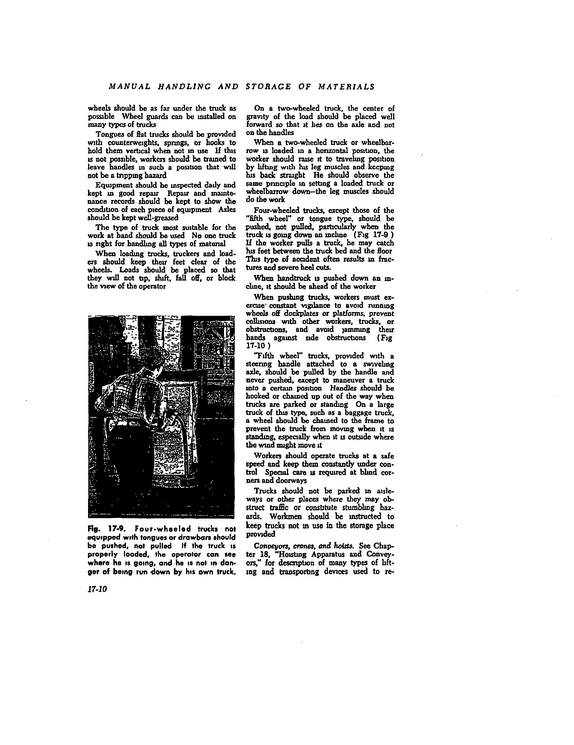
MANUAL HANDLING AND STORAGE OF MATERIALS wheels should be as far under the truck as possible Wheel guards can be installed on many types of trucks Tongues of flat trucks should he provided with counterweights, springs, or hooks to hold them vertical when not in use If this is not possible, woikcrs should be trained to leave handles in such a position that will not be a tripping hazard Equipment should be inspected daily and kept m good repair Repair and mainte nance records should be kept to show the condition of each piece of equipment Axles should be kept well-greased The type of truck most suitable for the work at hand should be used No one truck is right for handling all types of material When loading trucks, truckers and load ers should keep their feet clear of the wheels.
refid# xz9KV7v6aYEQ5XM186ZQxvryE1 page
COLD FORMING OF METALS spected at intervals determined by the type of service of the presses.
refid# KJJrL172zyw0xd01ZZbporoa01 page
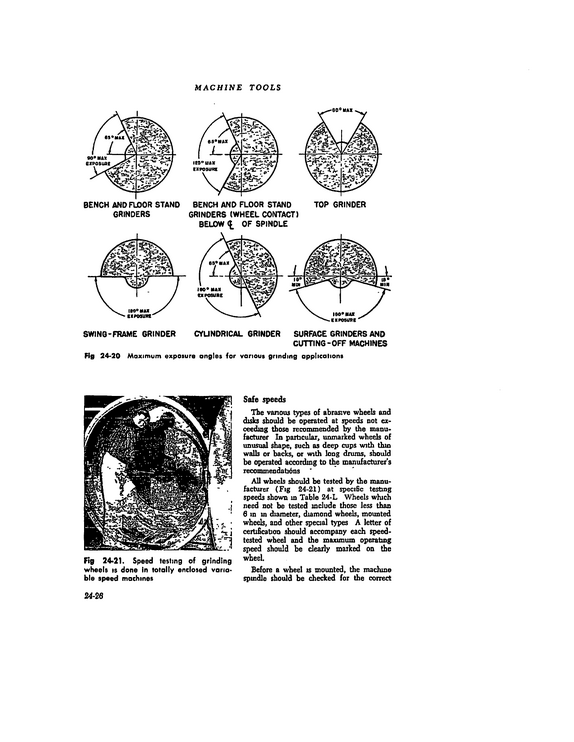
MACHINE TOOLS BENCH AND FLOOR STAND GRINDERS 6RINDERS (WHEEL CONTACT) BELOW t OF SPINDLE SWING-FRAME GRINDER CYLINDRICAL GRINDER SURFACE GRINDERS AND CUTTING-OFF MACHINES Fig 24-20 Maximum exposure ongles for various grinding applications Fig 24-21.
refid# jBEGqyXV2qyYeRGOBEOdkDDyO1 page
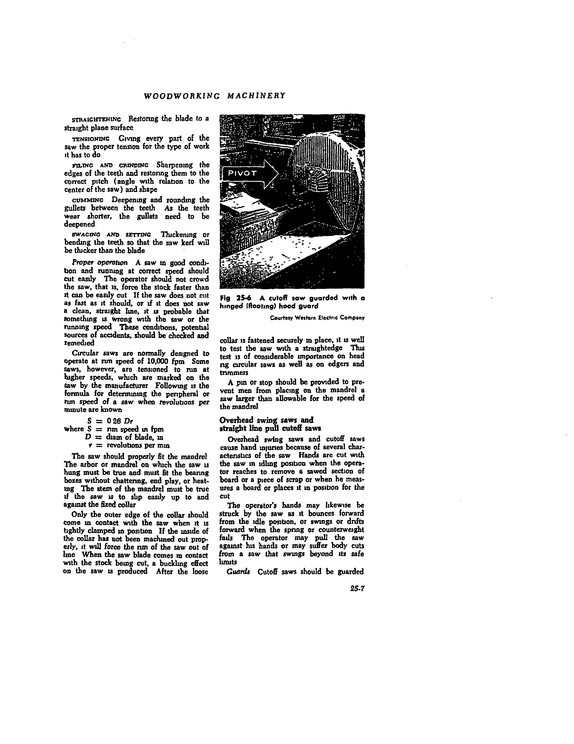
WOODWORKING MACHINERY stbaichteninc Restoring the blade to a straight plane surface tensioninc Giving every part of the saw the proper tension for the type of work it has to do filinc and cnnmorc Sharpening the edges of the teeth and restoring them to the correct pitch (angle with relation to the center of the saw) and shape cumminc Deepening and rounding the gullets between the teeth As the teeth wear shorter, the gullets need to be deepened swacinc and settznc Thickening or bending the teeth so that the saw kerf will be thicker than the blade Proper operation A saw m good condi tion and running at correct speed should cut easily The operator should not crowd the saw, that is, force the stock faster than it can be easily cut If the saw does not cut as fast as it should, or if it does not saw a clean, straight line, it is probable that something is wrong with the saw or the running speed These conditions, potential sources of accidents, should be checked and remedied Circular saws are normally designed to operate at run speed of 10,000 fpm Some saws, however, are tensioned to run at higher speeds, which are marked on the saw by the manufacturer Following is the formula for determining the peripheral or tun speed of a saw when revolutions per minute are known S = 0 26 Dr where S = nm speed in fpm D = diam of blade, in r = revolutions per mm The saw should properly fit the mandrel The arbor or mandrel on which the saw is hung must be true and must fit the bearing boxes without chattering, end play, or heat ing The stem of the mandrel must be true if the saw is to slip easily up to and against the fixed collar Only the outer edge of the collar should come id contact with the saw when it is tightly clamped in position If the inside of the collar has not been machined out prop erly, it will force the nm of the saw out of lino When the saw blade comes in contact with the stock being cut, a buckling effect on the saw is produced After the loose Fig 25-6 A cutoff sow guarded with a hinged (ftootmg) hood guard Courtesy Western Electric Company collar is fastened securely m place, it is well to test the saw with a straightedge This test is of considerable importance on head ng circular saws as well as on edgers and trimmers A pm or stop should be provided to pre vent men from placing on the mandrel a saw larger than allowable for the speed of the mandrel Overhead swing saws and straight U&e pull cutoff saws Overhead swing saws and cutoff saws cause hand injuries because of several charactensiles of the saw Hands are cut with the saw in idling position when the opera tor reaches to remove a sawed section of board or a piece of scrap or when he meas ures a board or places it m position for the cut The operator's hands may likewise be struck by the saw as it bounces forward from the idle position, or swings or drifts forward when the spring or counterweight fails The operator may pull the saw against his hands or may suffer body cuts from a saw that swings beyond its safe limits Guards Cutoff saws should be guarded 25-7
refid# 5RY8722Vza7OD65mQd5pwj9z1 page
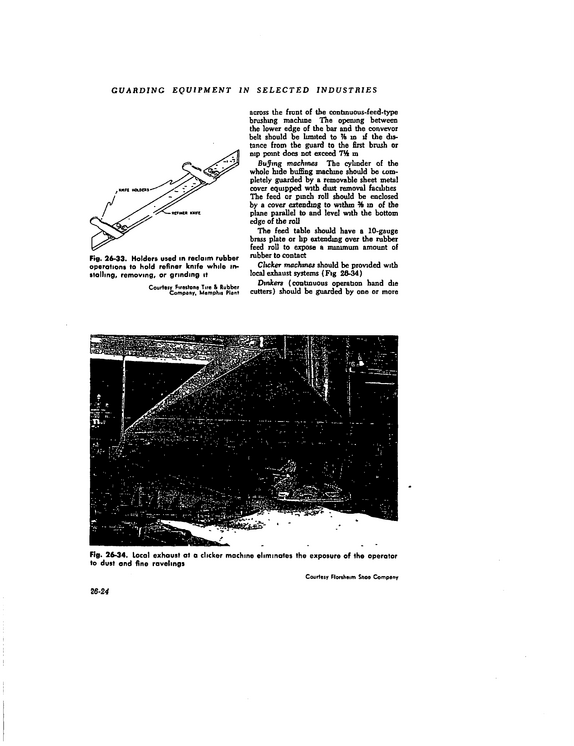
GUARDING EQUIPMENT IN SELECTED INDUSTRIES Fig- 26-33.
refid# RRQbb3G76N1w7BKvL0qq5BkE1 page