Refine
Estimated Years 1960-1969Clear
16,810 results foundRefine Search
940 CHAPTER 65 A high-pressure cutout is normally required to shut off the com pressor if the head pressure should rise above normal working limits.
refid# kRqON15dbpj417w4v300Lez01 page
Industrial Hygiene Digest October, I960 Nov. 2-5 Nov. 2-5 Nov. 2-5 Nov. 3-4 Nov. 4-5 Nov. 4-5 Nov. 4-6 Nov. 6-9 Nov. 7 Nov, 7-9 Nov. 9-11 Nov. 9-11 Nov. 12-19 Nov. 15-19 Nov. 17-20 Nov. 18-19 Nov. 25-26 Nov. 30-Dec. 3 Dec. 3-8 Dec. 9 Dec. 10-11 American Society of Parasitologists, Los Angeles, Calif.
refid# B8LV0QVXe0qKdLpKKx0170oRE1 page
1962 National Safety Congress Rubber Section So far.
refid# zQeM2LZaV8X7XZG3m6Vp1Xz871 page
Mowemlbos 1 Industrial Hygiene Digest March, 1 a0 5 217 Pathology in Respiratory Disease Mechanism Studies.
refid# ZJr5LYe9KrwvL6Z74Eq3ENQ6Y1 page
ACCIDENT INVESTIGATION, ANALYSIS, AND COSTS able for safety work to the greatest advantage by providing them with infor mation about the principal hazards and unsafe practices in their departments 8 Permit an objective evaluation of the progress of a safety program by noting in continuing analyses the effect of differ ent safety measures, educational tech niques, and other methods adopted to prevent injuries The key facts in accidents As explamed in American Standard Z16 2, The American Standard Method of Record ing Baste Facts Relating to the Nature and Occurrence of Work Injuries,0 the purpose of the Standard is to identify certain key facts about each mjuiy and the accident that produced it and to record those facts in a form which will permit summarization to show general patterns of injury and accident occurrence in as great analytical detail as possible These patterns are intended to serve as guides to the areas, conditions, and Cir cumstances to which accident prevention efforts most profitably may be directed For a complete recording of an injury case, one item for each key fact should be selected from the injury rejiort00 The items should be selected according to the following definitions 1 Nature of injury--the type of physical injury incurred 2 Part of body--the part of the injured per son's body directly affected by the injury. 3 Source of injury-the object, substance, exposure, or bodily motion which directly produced or inflicted the injury 4 Accident type--the event which directly resulted in the injury 5 Hazardous condition--the physical condi tion or circumstance which permitted or occasioned the occurrence of the accident type 6 Agency of accident--the object, substance, or part of the premises in which the hazardous condition existed 'Approved 1962 as American Standard 80Whether or not all the key facts are present in a case will be determined by the circumstances of that case. 7.
refid# ppzBxgmdYq4VMEVvOdboqqvZw1 page
EMERGENCY ACTION PLANS hazard control points in the plant.
refid# danGnd68ZgqLMr40dg5E37Lr51 page
ELEMENTS OF INDUSTRIAL TOXICOLOGY on which TLVs are based, are discussed in the preface to and Appendix C of Table 40-B The TLVs in some cases have the nota tion "skin" following the name of the sub stance If skin absorption, mainly from liquid contamination, cannot be made neg ligible, a reduction in the TLV should be made to maintain the total body absorption of the harmful material at a safe level Maximal acceptable concentrations The American Standards Association (ASA) publishes the Z37 senes of maximal acceptable concentrations (MAC) for a number of substances MACs are expressed in ppm and in mg/cu m or milligrams per liter (mg/L) Up until about 1965, the definition of MAC was essentially identical to the TLV of the American Conference of Governmental Industrial Hygienists Since that time the Z37 Committee of the Amer ican Standards Association has reviewed and revised earlier standards and their defi nition of MAC (Table 40-C) The maximal acceptable concentrations are peak concentrations, not averages, and should not be exceeded during a normal workday Any variation in concentration should be below the recommended level The meaning of MAC is discussed in the preface to Table 40-C Application of the values Many individuals refer to published TLVs and MAC'S for a black-and-white value to he used in a specific situation and overlook the important qualifications of these values set forth by the organizations establishing them The preface to the annual list of TLVs (Table 40-B) and the introduction to each of the American Standard Z37 Senes of MAC'S (Table 40-C) provide the'complete explanation of the concepts on which these values are based To intelligently |udge which of the two concepts should be applied in a specific situation requires knowledge of the type of injury that would result from dangerous exposure Adverse toxic effects may he broken down into four major classifications (1) acute toxicity, (2) chrome toxicity, (3) narcosis, and (4) discomfort The time-weighted average concentration (TLV) would be the appropriate guide where acute systemic or chronic toxic ef fects would result from overexposure When protection against narcosis is required, the concentrations should never exceed some peak value as given by the MAC To mini mize discomfort, the instantaneous or peak concentrations are of interest Both the ASA and the ACCIH, in defin ing their respective values, point out that an understanding of the criteria on which the values are established is necessary m decid ing how to use the value The ASA, for instance, lists a MAC of 25 ppm for carbon tetrachloride, but notes that fluctuation should be around 10 ppm, which notation introduces the time-weighted concepts on which TLVs are based On the other hand, the ACCIH has desig nated certain "ceiling" values not to be ex ceeded even for short periods of time and thus have to Some extent adopted the maxi mum limit concept on which MAC'S are based It should be remembered that TLVs and MACs are, even though applied as intended, relative values The concentration that just approaches the threshold limit value is just as hazardous as the one that slightly ex ceeds it There is no magic line that can be drawn to provide complete safety In general, it is desirable to maintain air contamination at the lowest possible level Probably the greatest misuse of both TLV's and MAC'S is the practice of comparing toxic substances by a ratio of their respec tive MAC or TLV These values cannot be used as relative indexes of toxicity It should also be remembered that Deither the TLV nor MAC should be considered the sole criteria of suspected occupational disease The ASA specifically states that its MAC values are intended to serve as stand ards of good practice and as engineering guides, and are not intended as legal re quirements The same thought is implied in the preface to ACCIH values It is highly advisable that the documented justification for the threshold limit value be consulted for detailed information concern ing mode of action and effect of exposure to a particular material Such information is given m the references listed at the end of this chapter, particularly the ACGIH's (Text continues on page 40-13 ) 40-3
refid# a4j6KKgE6k6NzoEJ7DrnyEx2N1 page
@8 fel QQ b----- 1 O0 Industrial Hygiene Digest April, 196- 352 Long-Term Effects of Sulfur Dioxide Exposure in Pulp Mills.
refid# JNmM3DKB1DQRxGzr0zRgaL2LZ1 page
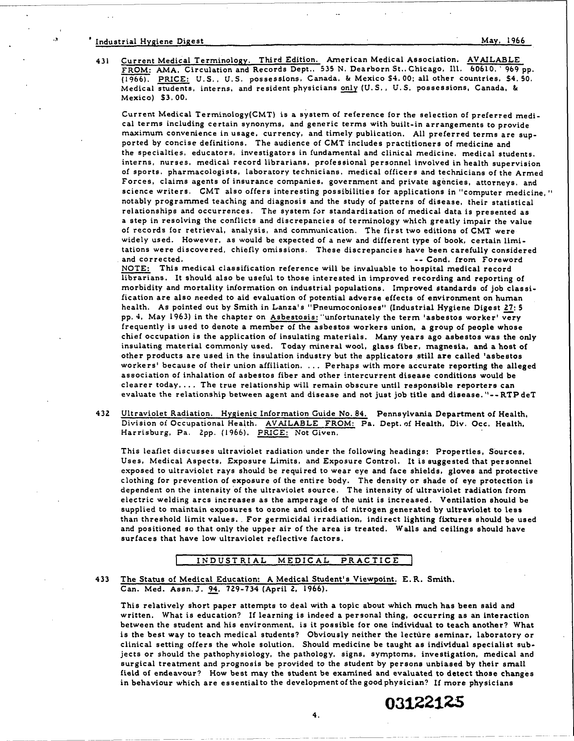
Industrial Hygiene Digest May, 1966 431 Current Medical Terminology.
refid# reJMZk55rLwwweg3gvLbbYnva1 page
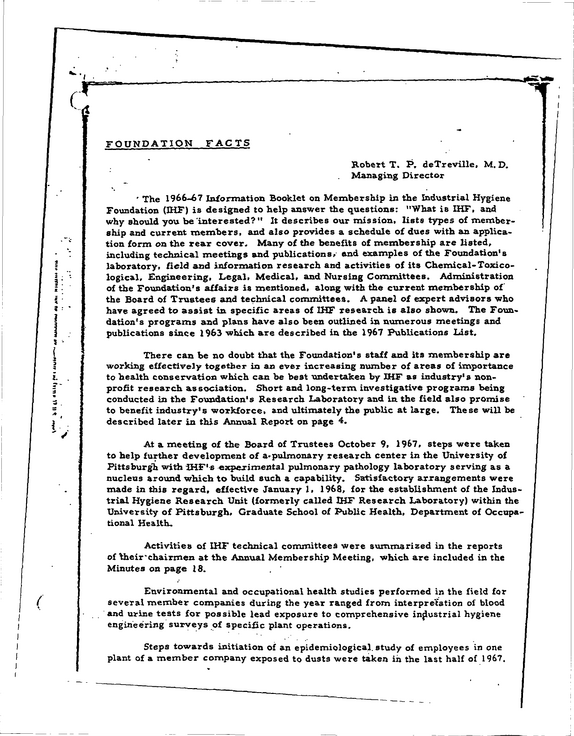
FOUNDATION FACTS Robert T.
refid# VJBBMvMdy588EGMopNRyg46pq1 page
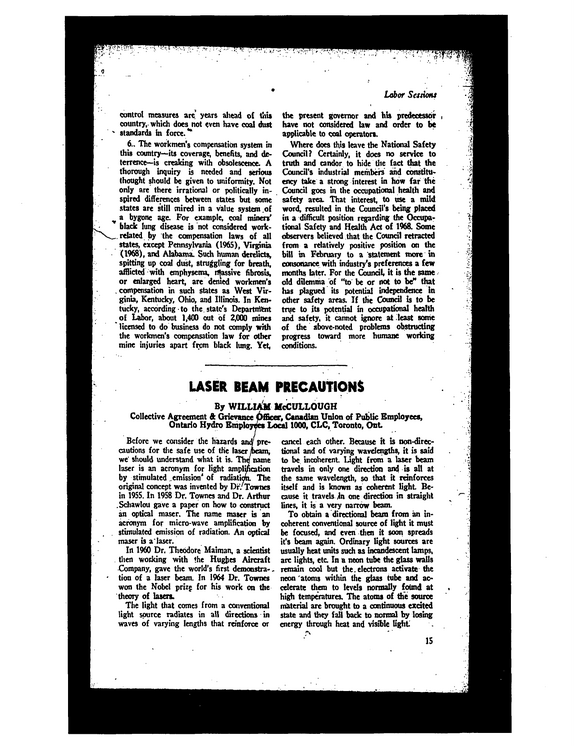
Labor Scsriont control measures arc' years ahead of this country,, which does not even have coal dust standards in force.** 6..
refid# vJG20QREaEVM54bKxYGGQ7YZ1 page
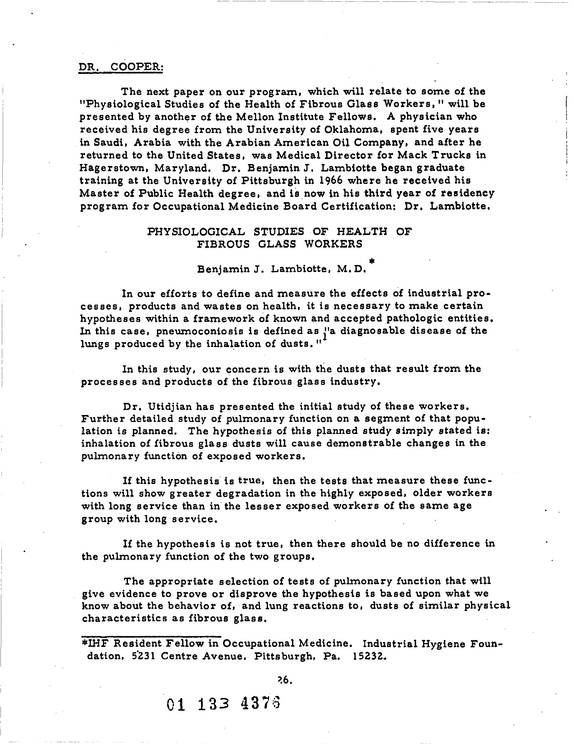
DR.
refid# zdGp3vVRLajk7V4Z6Lk21XnX01 page
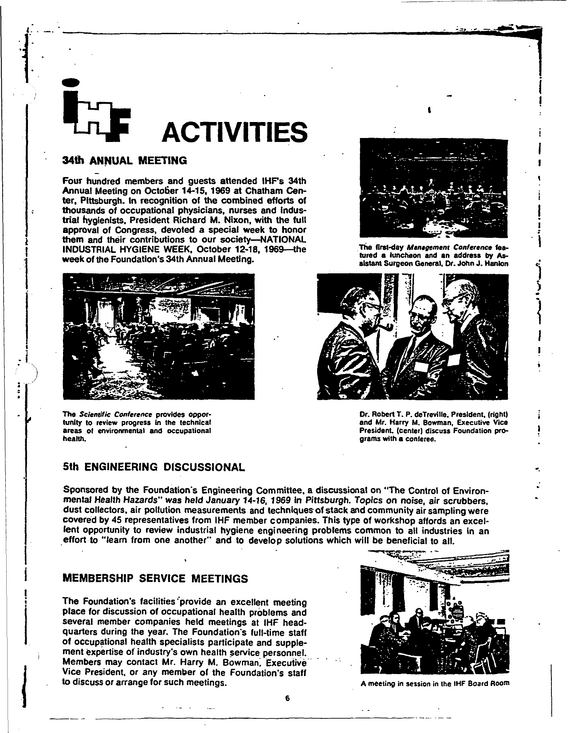
ACTIVITIES 34th ANNUAL MEETING Four hundred members and guests attended IHPs 34th Annual Meeting on October 14-15,1969 at Chatham Cen ter, Pittsburgh.
refid# Kp87MEd6Jb8oJdrD3a5g790K1 page
Inspection and Control Procedures c) Records, d) Packing and shipping, e) Employee training, /) Labeling, advertising, and sales litera ture, and g) Product liability claims-handlmg pro cedures To give the proper degree of importance to this management decision, the philosophy on reliability should be written out and adopted as a policy for guidance It naturally follows that communications must play a very important part in a product safety program and it must be recognized early in the program that everyone in the plant must be brought into the act Some companies have started such a program by means of a kick-off meeting so that all em ployees can be told of the importance of turn ing out a quality product that is safe All employees must be informed and sold on the purpose of the program, which is to reduce to a minimum the number of rejects and to turn out a safe product Zero defects programs.
refid# 7Q9zEeNoxdndqRpm5Db89VE61 page
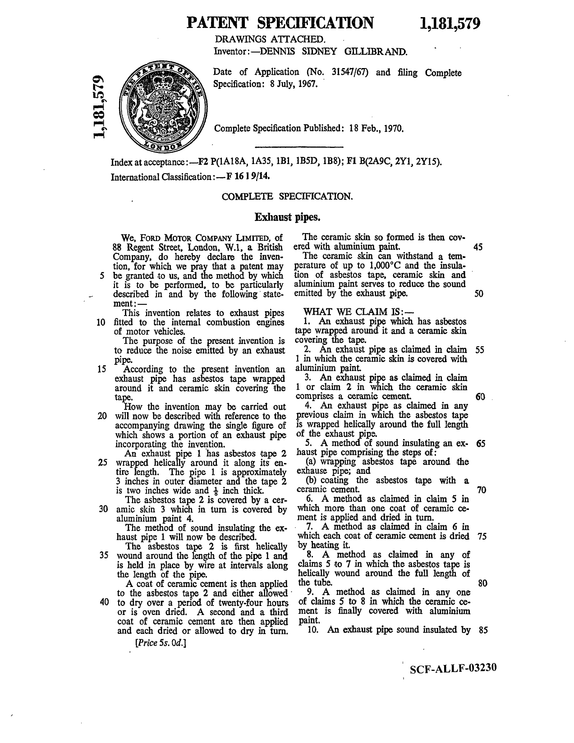
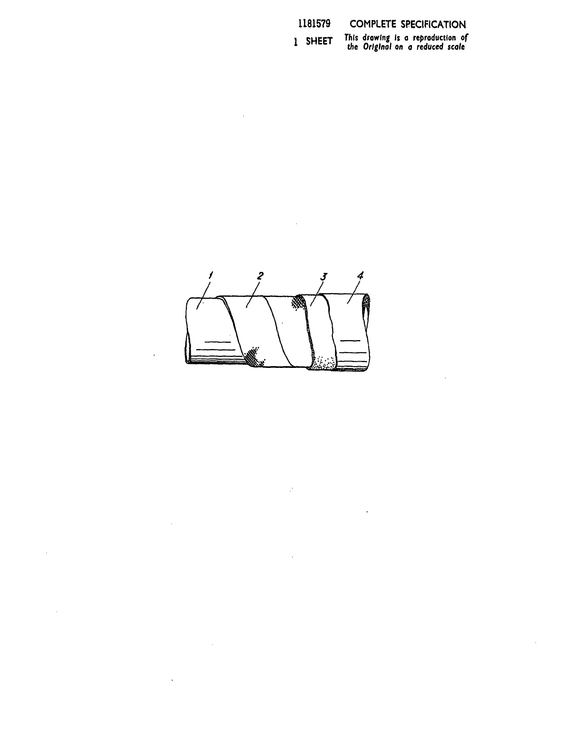
PATENT SPECIFICATION DRAWINGS ATTACHED.
refid# peKQeQmBZxVKKLwOEL8kxLOvk3 pages