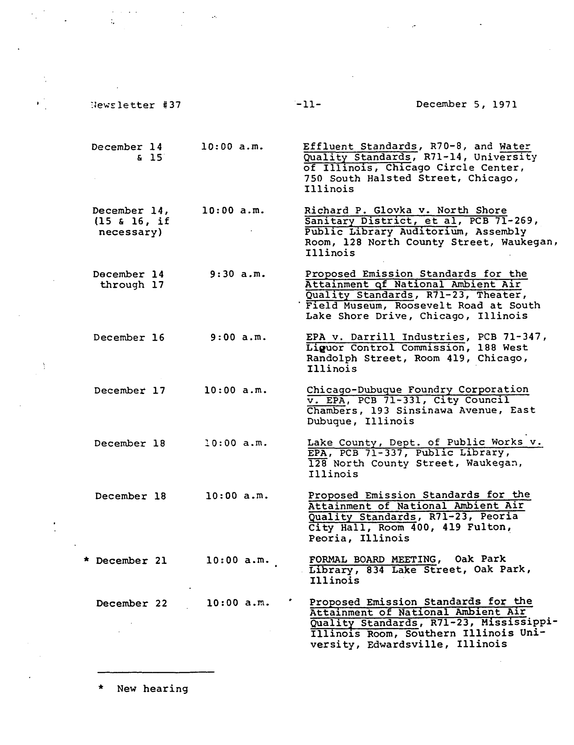
Jewsletter #37 -11- December 5, 1971 December 14 & 15 December 14, (15 & 16, if necessary) December 14 through 17 December 16 December 17 December 18 December 18 * December 21 December 22 10:00 a.m. 10:00 a.m. 9:30 a.m. 9:00 a.m. 10:00 a.m. 10:00 a.m. 10:00 a.m. 10:00 a.m. 10:00 a.m.
refid# rpqxnepz1Jeepej5kbRq6xO3E1 page
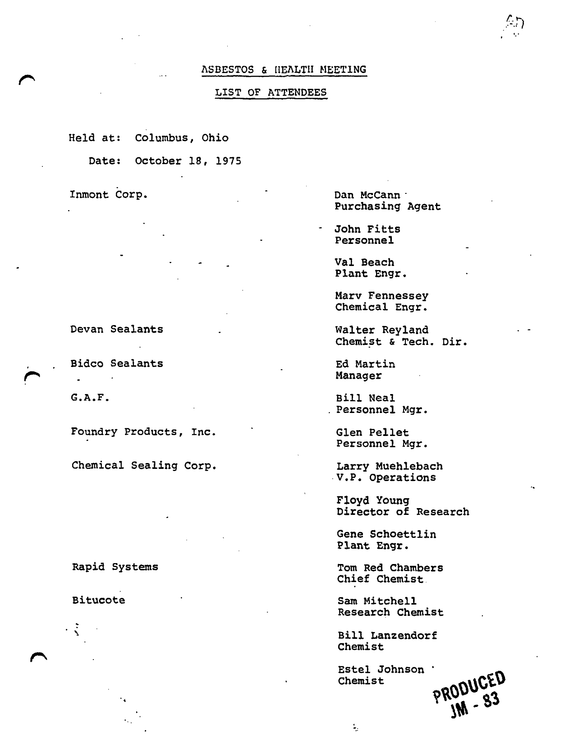
ASBESTOS & HEALTH MEETING LIST OF ATTENDEES Held at: Columbus, Ohio Date: October 18, 1975 Inmont Corp
refid# zXrbOgMrx0dQgKdzGjpzZ5B31 page
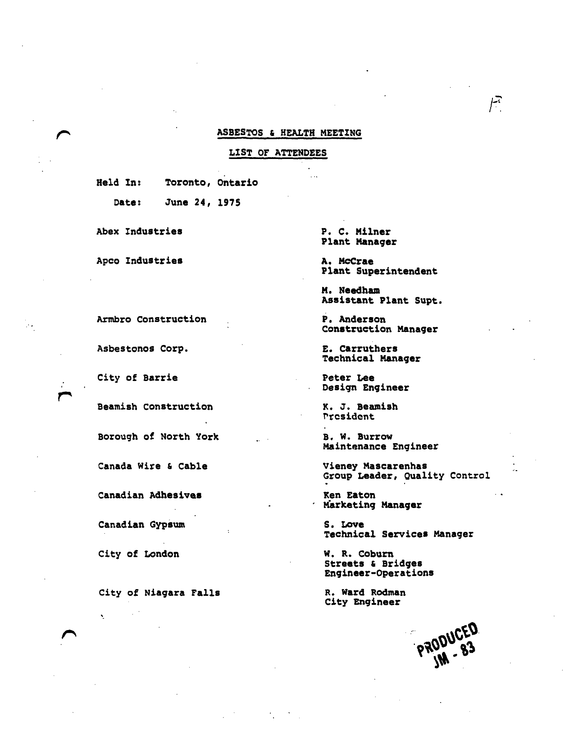
ASBESTOS & HEALTH MEETING LIST OF ATTENDEES Held In: Date: Toronto, Ontario June 24, 1975 Abex Industries Apco Industries Armbro Construction Asbestonos Corp.
refid# jmep6ZE0v3L1aBzOVkpq1n0BZ1 page
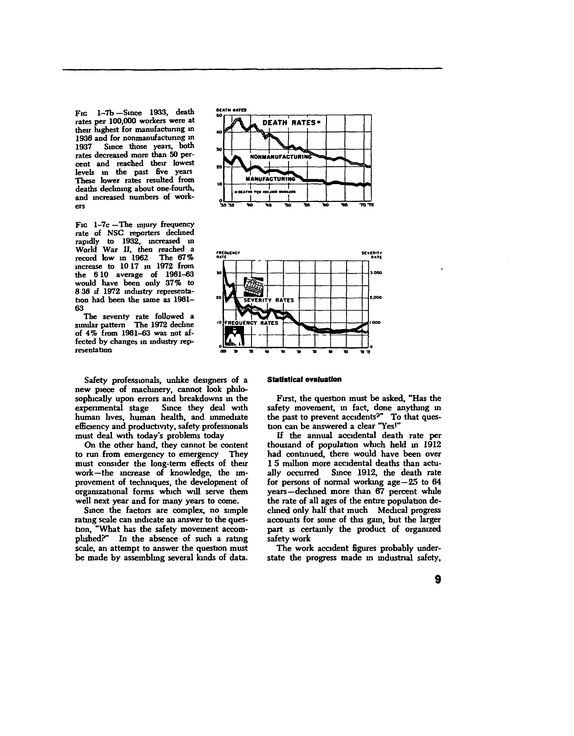
Fic 1--7b --Since 1933, death rates per 100,000 workers were at their highest for manufacturing in 1936 and for nonmanufactunng in 1937 Since thoseyears, both rates decreased more than 50 per cent and reached their lowest levels in the past five years These lower rates resulted from deaths declining about one-fourth, and increased numbers of work ers Fic l-7c --The injury frequency rate of NSC reporters declined rapidly to 1932, increased in World War II, then reached a record low in 1962 The 67% increase to 1017 in 1972 from the 610 average of 1961-63 would have been only 37 % to 8 36 if 1972 industry representa tion had been the same as 198163 The seventy rate followed a similar pattern The 1972 decline of 4% from 1981-63 was not af fected by changes in industry rep resentation OCATft flATO YREOUEIICY MATE SEVERITY RATE Safety professionals, unlike designers of a new piece of machinery, cannot look philo sophically upon errors and breakdowns in the experimental stage Since they deal with human lives, human health, and immediate efficiency and productivity, safety professionals must deal with today's problems today On the other hand, they cannot be content to run from emergency to emergency They must consider the long-term effects of their work--the increase of knowledge, the im provement of techniques, the development of organizational forms which will serve them well next year and for many years to come.
refid# QXmERD2Kj3mJbXJDpKZVezkm81 page
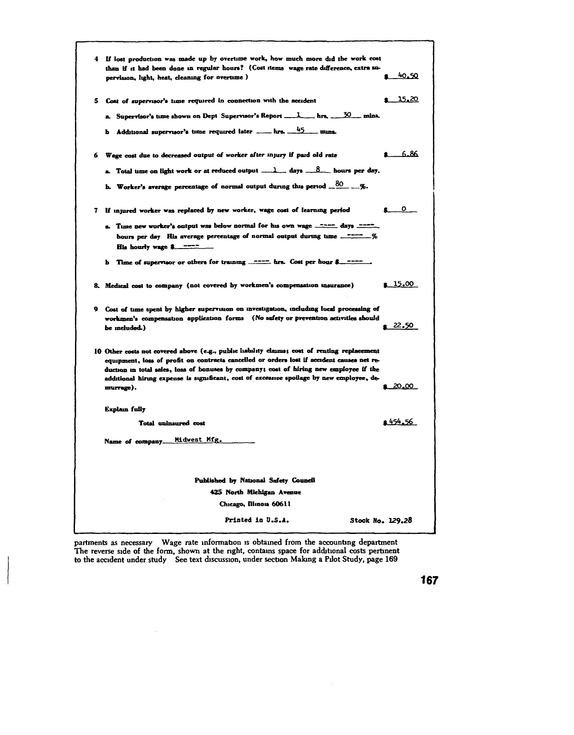
4 If lost production was made up by overtime work, how much more did the work coat tlmw (f it h*d been done in regular hours?
refid# NG37ywO6Lx3mL855L0LENyOng1 page
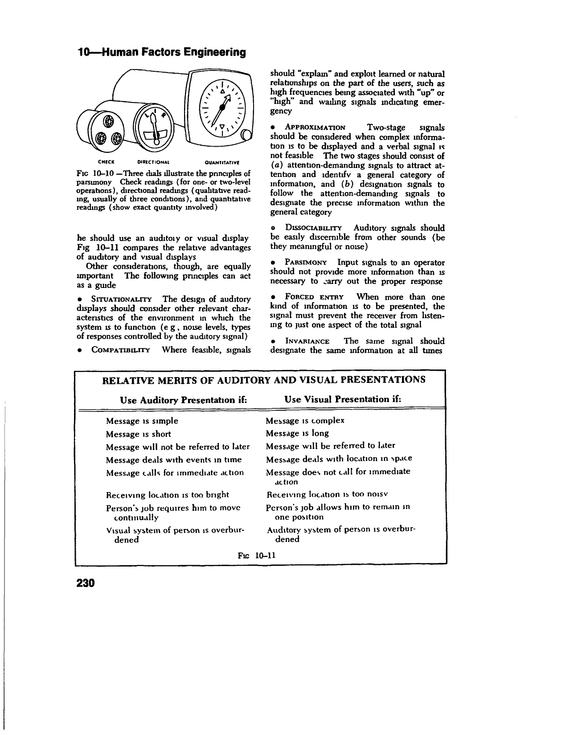
10--Human Factors Engineering Fic 10-10 --Three dials illustrate the principles of parsimony Check readings (for one- or two-level operations), directional readings (qualitative read ing, usually of three conditions), and quantitative readings (show exact quantity involved) he should use an auditoiy or visual display Fig 10-11 compares the relative advantages of auditory and visual displays Other considerations, though, are equally important The following principles can act as a guide Situationality The design of auditory displays should consider other relevant char acteristics of the environment m which the system is to function (e g, noise levels, types of responses controlled by the auditory signal) Compatibility Where feasible, signals should "explain" and exploit learned or natural relationships on the part of the users, such as high frequencies being associated with "up" or "high" and wailing signals indicating emer gency Approximation Two-stage signals should be considered when complex informa tion is to be displayed and a verbal signal is not feasible The two stages should consist of (a) attention-demanding signals to attract at tention and identify a general category of information, and (b) designation signals to follow the attention-demanding signals to designate the precise information within the general category o Dissociability Auditory' signals should be easily discernible from other sounds (be they meaningful or noise) Parsimony Input signals to an operator should not provide more information than is necessary to carry out the proper response Forced entry When more than one kind of information is to be presented, the signal must prevent the receiver from listen ing to just one aspect of the total signal Invariance The same signal should designate the same information at all tunes RELATIVE MERITS OF AUDITORY AND VISUAL PRESENTATIONS Use Auditory Presentation if: Use Visual Presentation if: Message is simple Message is short Message will not be referred to later Message deals with events in time Message calls for immediate action Receiving location is too bright Person's job requires him to move continually Visual system of person is overbur dened Message is complex Message is long Message will be referred to later Message deals with location in space Message does not call for immediate action Receiving location is too noisv Person's job allows him to remain m one position Auditory system of person is overbur dened Fic 10-11 230
refid# jmmrRko0Y2zDnYmbpdp7GD6vp1 page
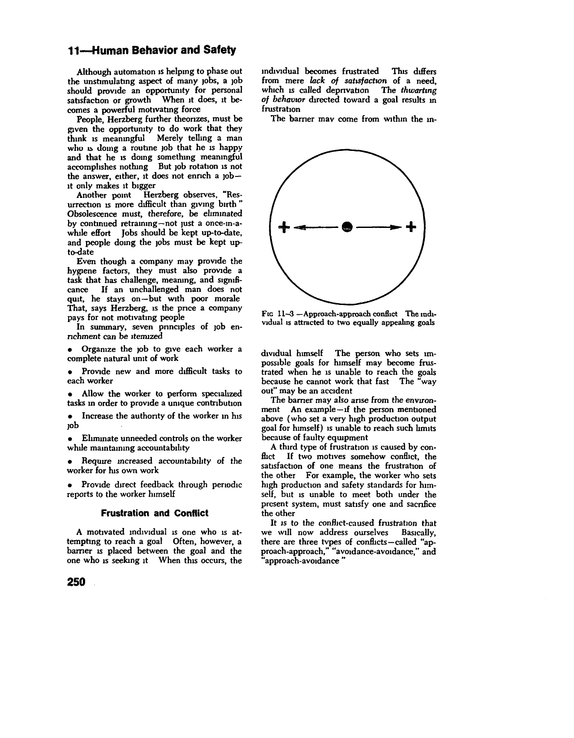
11--Human Behavior and Safety Although automation is helping to phase out the unstimulahng aspect of many jobs, a job should provide an opportunity for personal satisfaction or growth When it does, it be comes a powerful motivating force People, Herzberg further theorizes, must be given the opportunity to do work that they think is meaningful Merely telling a man who is doing a routine job that he is happy and that he is doing something meaningful accomplishes nothing But job rotation is not the answer, either, it does not ennch a job-- it only makes it bigger Another point Herzberg observes, "Res urrection is more difficult than giving birth " Obsolescence must, therefore, be eliminated by continued retraining--not just a once-in-awhile effort Jobs should be kept up-to-date, and people doing the jobs must be kept upto-date Even though a company may provide the hygiene factors, they must also provide a task that has challenge, meaning, and signifi cance If an unchallenged man does not quit, he stays on--but with poor morale That, says Herzberg, is the price a company pays for not motivating people In summary, seven principles of job en richment can be itemized Organize the job to give each worker a complete natural unit of work Provide new and more difficult tasks to each worker Allow the worker to perform specialized tasks in order to provide a unique contribution Increase the authority of the worker in his job Eliminate unneeded controls on the worker while maintaining accountability Require increased accountability of the worker for his own work Provide direct feedback through periodic reports to the worker himself Frustration and Conflict A motivated individual is one who is at tempting to reach a goal Often, however, a barrier is placed between the goal and the one who is seeking it When this occurs, the 250 individual becomes frustrated This differs from mere lack of satisfaction of a need, which is called deprivation The thwarting of behavior directed toward a goal results m frustration The barrier mav come from within the m- Fic 11-3-Approach-approach conflict The indi vidual is attracted to two equally appealing goals dividual himself The person who sets im possible goals for himself may become frus trated when he is unable to reach the goals because he cannot work that fast The "way out" may be an accident The barrier may also arise from the environ ment An example--if the person mentioned above (who set a very high production output goal for himself) is unable to reach such limits because of faulty equipment A third type of frustration is caused by con flict If two motives somehow conflict, the satisfaction of one means the frustration of the other For example, the worker who sets high production and safety standards for him self, but is unable to meet both under the present system, must satisfy one and sacrifice the other It is to the conflict-caused frustration that we will now address ourselves Basically, there are three tvpes of conflicts--called "ap proach-approach," "avoidance-avoidance," and "approach-avoidance "
refid# YrrdYJar0rjr92Vxm7kvX5NNO1 page
ground transparencies in a matter of seconds and at negligible cost by the dry-process copy method, diazo method, or photographic method Full-color transparencies can be made di rectly from day-coated stock originals such as magazines and brochures by means of a special color-lift-off film For repeated show ings of an important subject, the additional expense of full-color transparencies of original subjects might be justified Color can also be added by the use of tinted plastic overlay sheets, either loose sheets or self-adhering The latter can be cut to cover and add color to portions of the art work or can be cut to form interesting art or background designs The transparencies can be as large as 10 in square and can be mounted in cardboard frames "Commentator cues" or a scnpt can be added to the frame for convenient ref erence Unmounted plastic sheets or a large roll of plastic film, which can be rolled to the other side of the projector and either dis carded or rolled back for reference, also can be used.
refid# e73B1434exyO7JX7qbreQvLgg1 page
17--Building Construction and Maintenance design and installation prevents the direct application of radiant heat on to the con tainer Blower type or radiant heaters should not be directed toward any LP-gas container within 20 ft If two or more heater-container units (of either the integral or nonmtegrated type) are located in an unpartitioned area on the same floor, the container (s) of each unit should be separated by at least 20 ft The total water capacity of contamers manifolded together m an unpartiboned area should not be greater than 735 lb (nominal 300 lb LPgas capacity) These containers should also be separated by at least 20 ft On floors on which heaters are not con nected together for use, containers may be manifolded together for connection to heaters on another floor, provided that (a) the total water capacity of the containers connected to any one manifold is not greater than 2450 lb (nominal 1000 lb LP-gas capacity), and (b) where more than one manifold having a total water capacity greater than 735 lb (nommal 300 lb LP-gas capacity) is located m the same unpartitioned area, the manifolds should be separated by at least 50 ft LP-gas cylinders should not be refilled in side buildings or structures Cylinders should be stored outside of buildings, should stand on a firm and substantially level surface, and should be secured m an upright position Demolition o!
refid# 7Raq1z13XOBbwERMj40jq7rVe1 page
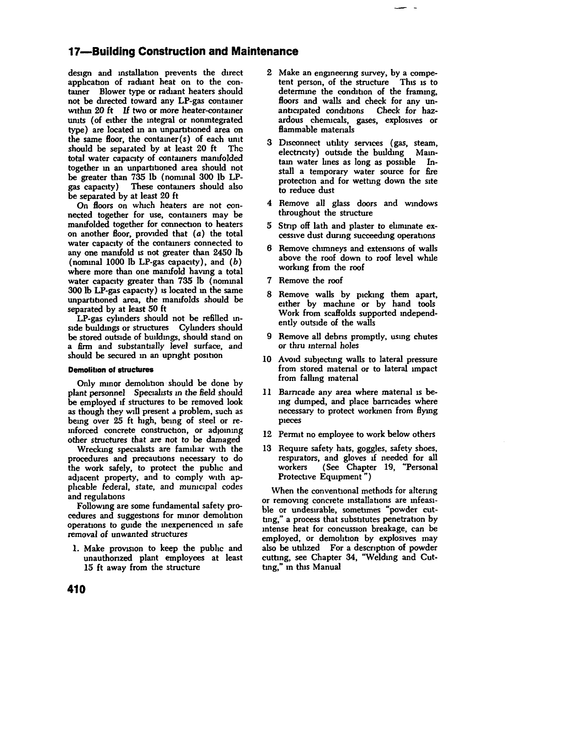
19--Personal Protective Equipment Fic 19-37 --Compressed oxygen (cylinder) rebreathing apparatus as an autoignition source to gases with an autoignition temperature of 600 F or less The apparatus produces more oxygen than the user requires, so venting must be done periodically Some models do this automat ically but with others it must be done by hand The apparatus and canister should nor mally be stored at above-freezing tempeiatures and be completely started before being worn and used at subzero temperatures Quick-start canisters are available, these con tain chemicals that quicklv heat the canister to permit the apparatus to start quickly under low-temperature conditions A new canister should be used each time the apparatus is woin, for it is dangerous to enter a hazardous atmosphere (or even engage m a drill) with a previously opened canister Used canisters should be promptly disposed of m accordance with instructions printed on them- Used canisters should be kept away from combustibles so that residual oxygen will not have a chance to activate them.
refid# Y9vwRyxvZw4z8MdwnjJqLOX2y1 page
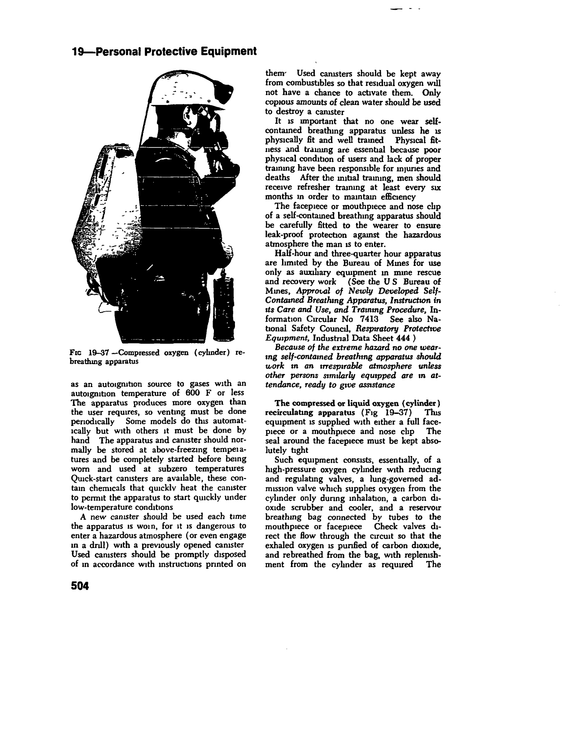
Fic 19-43a --Above Typical safety shoes Second from left illustrates metal instep guards which fit over shoes Third from left are oxfordtype shoes Fic 19-43b --Right Shoe has built-in instep (metatarsal) protec tion This style has proven espe cially valuable m the heavy metals industries to drain off static charges, and with nonferrous construction to reduce the possibility of friction sparks m locations with a fire or ex plosion hazard Initial and subsequent peri odic tests should be made on conductive foot wear in order to make sure that the maximum allowable resistance of 450,000 ohms is not exceeded Foundry shoes Safety shoes of the "congress" or gaiter type are used in some plants where employees are exposed to splashes of molten metal Having no fasteners, such shoes are easily and rapidly removable in an emergency Some National Safety Council members en gaged in foundry and steel mill operations have reported that serious bums have oc curred to men unable to remove shoes of ordinary work type m an emergency As m all such occupations, the tops of the shoes should be covered by the trouser leg, spats, or leggings, to keep out molten metal Exptosrves-operations (nonsparking) shoes Explosives-operations shoes are used (a) in hazardous locations wheie the floors are nonconductive and giounded such as in the manu facture of certain explosive compounds, or (b) when cleaning tanks that have contained 515
refid# BvMB5eXr3mX2DpmY8B72KmQwj1 page
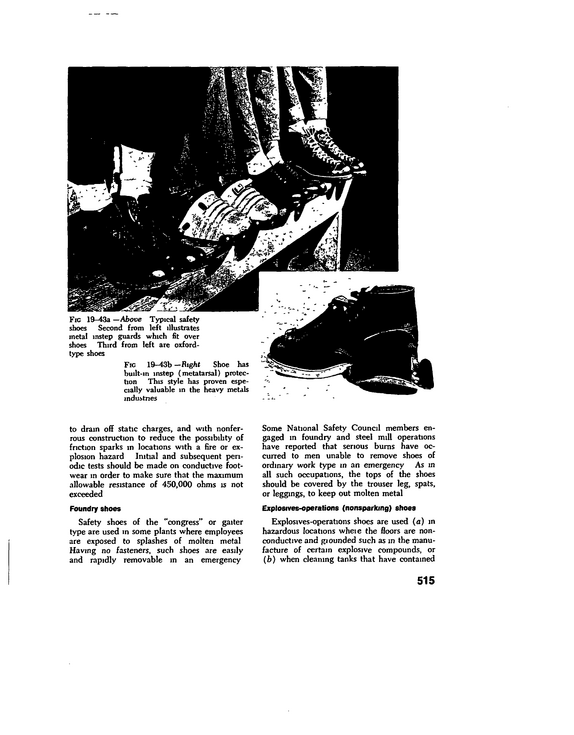
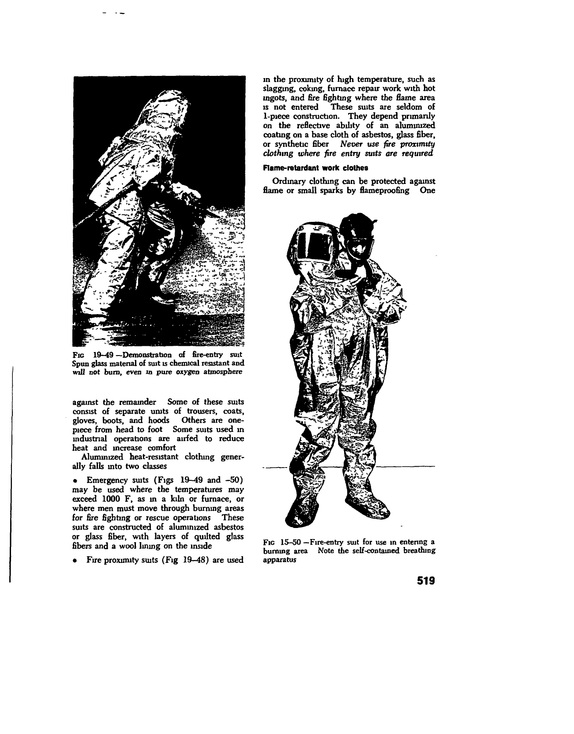
in the proximity of high temperature, such as slagging, coking, furnace repair work with hot ingots, and fire fighting where the flame area is not entered These suits are seldom of 1-piece construction.
refid# vVevJypNap1pkp6KYey22wG181 page
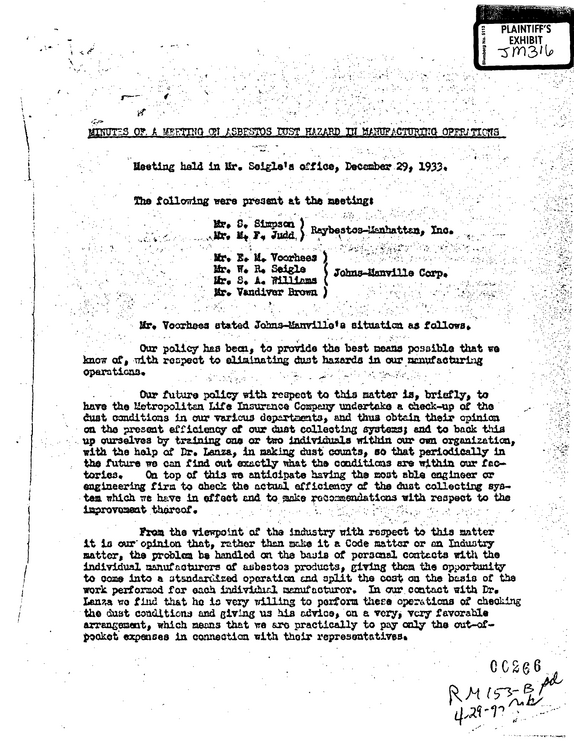
i <& S PLAINTIFF'S fi EXHIBIT \ ^ ' :- ' ' / Mmms of. a M?
refid# pmyV1DQGL252ROQrOp1Y7MNYj3 pages
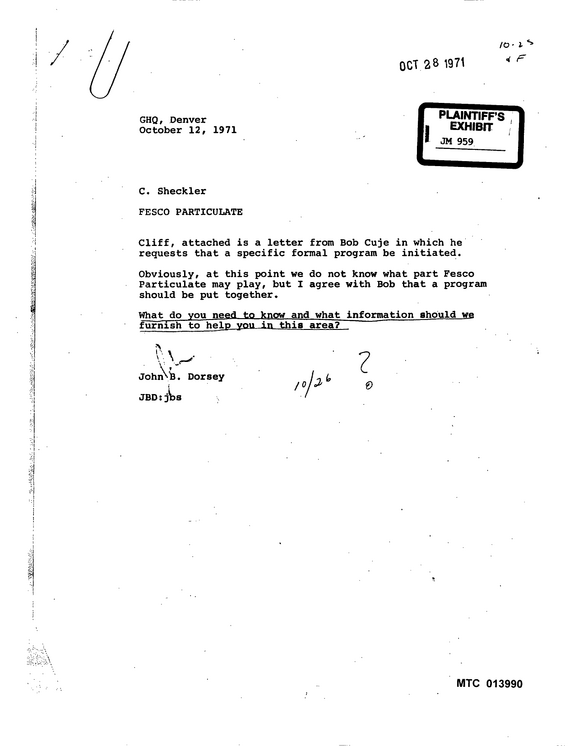
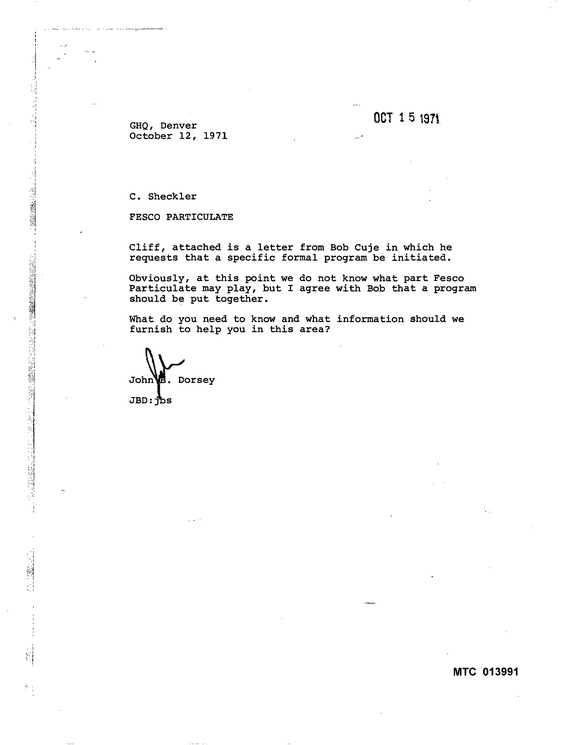
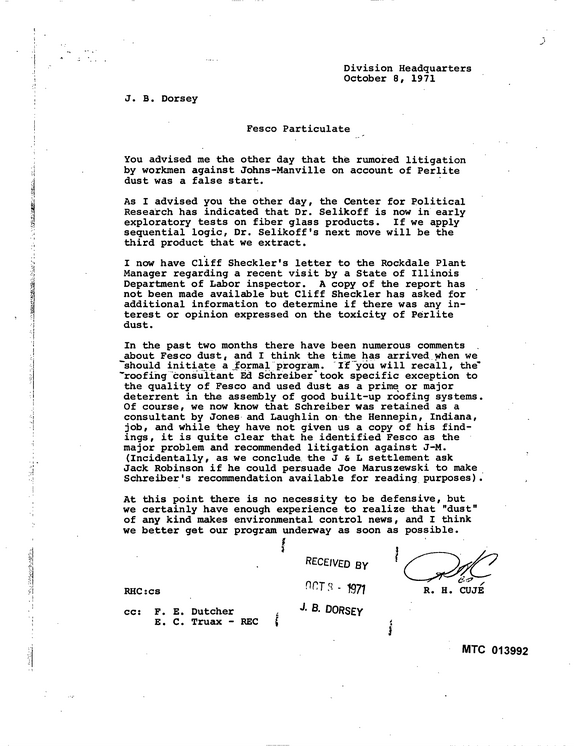
GHQ, Denver October 12, 1971 OCT 28 1971 C.
refid# zbQYQMdBR63nyzxLJwgywng173 pages
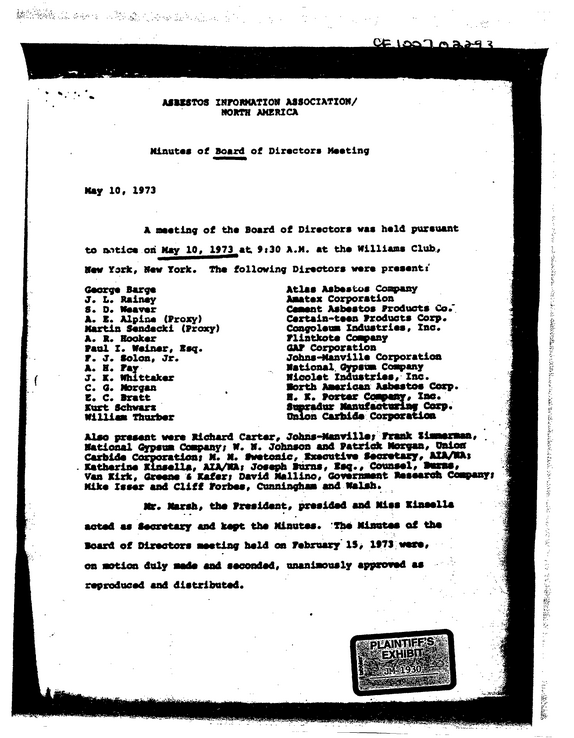
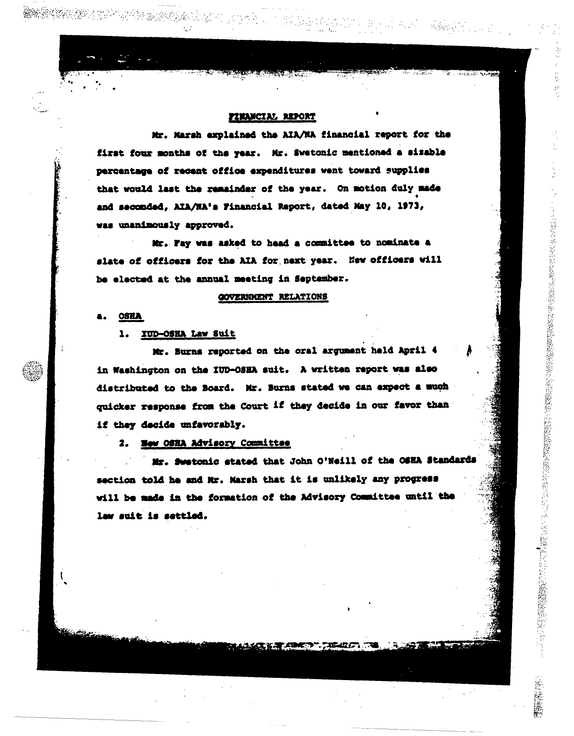
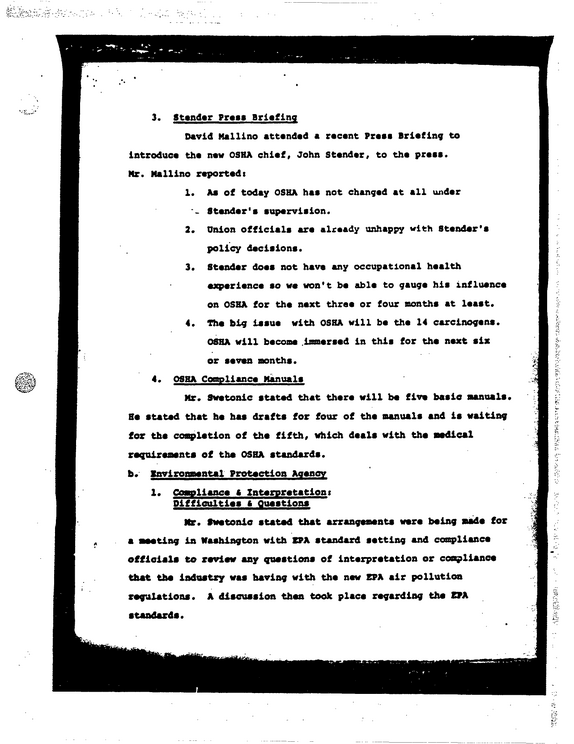
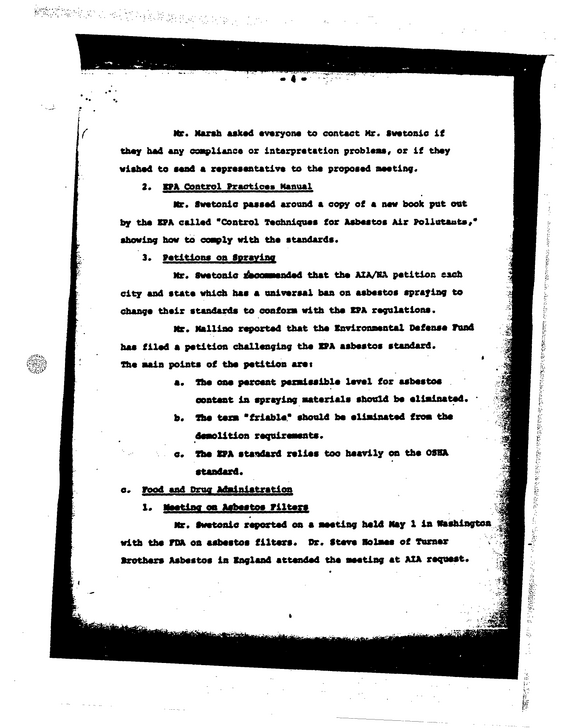
ASBESTOS INFORMATION ASSOCIATION/ NORTH AMERICA Minutes of Board of Directors Mooting May 10, 1973 A mooting of tho Board of Directors was hold pursuant to notice on May 10, 1973.at. 9i30 A.M. at tho Milliams Club, Vow York, Vow York.
refid# qaMqR52XqB6NVmLJeE8pzbBbR11 pages