qualifying statements attached to these pub lished values, for example m NBS Handbook 69, should be closely read and understood In each case, NBS Handbook 69 should be consulted for information on the specific radionuclide being used, and a plan for esti mating internal exposure from human ex cretion data should then be developed (See the list of publications under the subhead " `Radioecology' literature" under "Refer ences" at the end of this chapter) Bio-assay specimens may be analyzed by commercial laboratories Typical Industrial Installations and Operations This section gives details of how to make a specific installation safe, and how to operate it safely The suggestions and procedures have been taken from "Specific Installations and Operations," by Jack Baliff, PE It is Chapter 6 of The Control of Radiation Haz ards tn Industry, published in 1959 by State of New York, Department of Labor, Division of Industrial Hygiene X-ray installations (Industrial radiography) Plan X-ray protection prior to actual installation The primary method of control involves enclosure and shielding In the interest of economy, from the stand point of shielding material and construction costs, consider the following m planning Distance to X-ray tube The installation should be as far removed as circumstances will permit from all spaces occupied by per sons dunng operation of the equipment Spaces adjacent to the installation should, wherever practical, be restricted to storage or other purposes requiring only infrequent presence of personnel Comer locations or comer rooms are especially suited, the out side walls and windows do not require any shielding if they are sufficiently distant from other occupied buildings and areas The center of a room may not always be the best location for the installation, greater pro tection is sometimes gained by placing the equipment m a comer of the room or next to a wall bordering dead storage space Consid eration should, however, be given to future occupancy of nearby areas Direction of useful (primary) X-ray beam Wherever possible, the useful X-ray beam should be directed away from all occupied spaces Where normal operation is not in terfered with, devices for restricting the angulation of the tube may reduce the amount of shielding required Cross section of useful X-ray beam The cross section of the useful X-ray beam should be as small as practicable Whenever pos sible, cones should be used Operating conditions and workload The thickness of required shielding also depends on these two factors Thus, in addition to knowing the type and use of the proposed installation, one should know the kilovoltage, tube current, and the expected working activity of the machine The possibility of operating several machines located in the area at the same time must also be considered For accessibility and viewing, openings m radiation barriers may be necessary but these should be held to a minimum Protection for all such openings should be provided by means of suitably shielded (lead-lined) doors, leaded glass windows, or by suitable baffles equipped with mirrors Closed circuit tele vision can be used for viewing The structural shielding and general lay out requirements of any new installation, or an existing one in which changes are con templated, should be discussed with a quali fied expert early in the planning stage He should be provided with all the previous data as well as the structural details of the build ing in order to properly design the necessary shielding The design of protective barriers should be computed for the maximum kilovoltage, tube current, and the proper work load and occupancy factor It is also advis able that the final plans, detailed drawings and all pertinent specifications be checked by a qualified person before construction begins Plan structural details and layout OF radiation barriers These are an im portant part of shielding Attention must be given to these details to make sure that construction is substantial as well as to mini mize radiation leakage through the shielded enclosure Recommended construction spec- 1463
refid# dYX1vvDj1xd88Bbzyq6NzZXkG1 page
Industrial Noise most often used for testing large numbers of persons It eliminates the need for a tech nician except to begin the test The subject controls the presentabon of sound and re cords his response Band pressure level of a sound for a specified frequency band is the sound pres sure level for the sound contained within the restricted band The reference pressure must be specified Bandwidth When applied to a bandpass filter, bandwidth is determined by the inter val of transmitted waves between the low and high cutoff frequencies Barotrauma An injury to the ear caused by a sudden alterabon in barometric pressure Bone conduction test A special test conducted by placing an oscillator on the mastoid process to determine the nervecanrying capacity of the cochlea and the eighth cranial (auditory) nerve Calibrate To check an audiometer for uniformity or accuracy It may be done bio logically, electronically, or acousbcally Cerumen Ear wax Cochlea The auditory part of the in ternal ear, shaped like a snail shell It con tains the basilar membrane on which the end organs of the auditory nerve are distributed Conduction deafness An impairment of hearing due to the failure of vibrahons to be transmitted to the cochlea This type of deafness can often be corrected medically or surgically Damage risk criterion The suggested base line of noise tolerance, which if not exceeded, should result in no hearing loss due to noise A damage nsk criterion may include in its statement a specificabon of such factors as time of exposure, noise level, and frequency, amount of hearing loss that is considered significant, percentage of the populabon to be protected, and method of measunng the noise DEAF The term used to describe a person who has lost his hearing before the speech patterns were established Deafened Refers to a person who has lost his ability to hear after normal speech patterns were established Decibel A dimensionless unit express ing the logarithmic raho of two amounts of pressure, power, or intensity, between a measured quanbty and a reference quanbty Diffuse sound field One in which the bine average of the mean-square sound pres sure is everywhere the same and the flow of energy m all directions is equally probable Displacement A vector quanbty that specifies the change of position of a body or particle and is usually measured from the mean position or position of rest In general it can be represented by a rotation vector or banslation vector, or both Ear defenders Plugs or muffs designed to keep noxious noise from the ear to pre serve hearing acuity Eustachian tube A structure about 2'/2 in long leading from the back of the throat to middle ear It equalizes the pressure of air m the middle ear with that outside the eardrum Filter A device for separating com ponents of a signal on the basis of their fre quency It allows components m one or more frequency bands to pass relabvely unatten uated, and it attenuates greatly components m other frequency bands Free sound field (free field) A field m a homogeneous, isotropic medium free from boundaries In practice it is a field in which the effects of the boundaries are negli gible over the region of interest Frequency (in cycles per second, or CPS, Hertz OR Hz) The hme rate of repe- bbon of a penodic phenomenon The fre quency is the reciprocal of the period It is sometimes called pitch or the highness or lowness of sound High frequencies damage more easily than low' frequencies m noiseinduced hearing loss Hearing conservation The prevention or minimizing of noise-induced deafness through the use of hearing protection devices and the control of noise through engineering methods HEARING LEVEL Formerly called "hearing loss," is the deviation m decibels of an m- 1518
refid# RjVQvw2veXnyeY5eK57L2Kq6a1 page
Motorized Equipment ing truck has been developed, and informa tion about obtaining the device is available from the Nabonal Safety Council Where a number of men are working and various types of equipment are being used, the dnver should call upon another employee to signal whether or not the path is clear be fore backing or making any other movement A signalman should always take a position within sight of the dnver The Department of Transportation requires that trucks be equipped with back-up lights for night work Insofar as possible, backing, especially without a guide, should be attempted only to the left because the dnver is seated on the left side where he has a good view of the area into which he is backing Moving forward.
refid# nkED1zLrO7vB6q9Yrep4YaK781 page
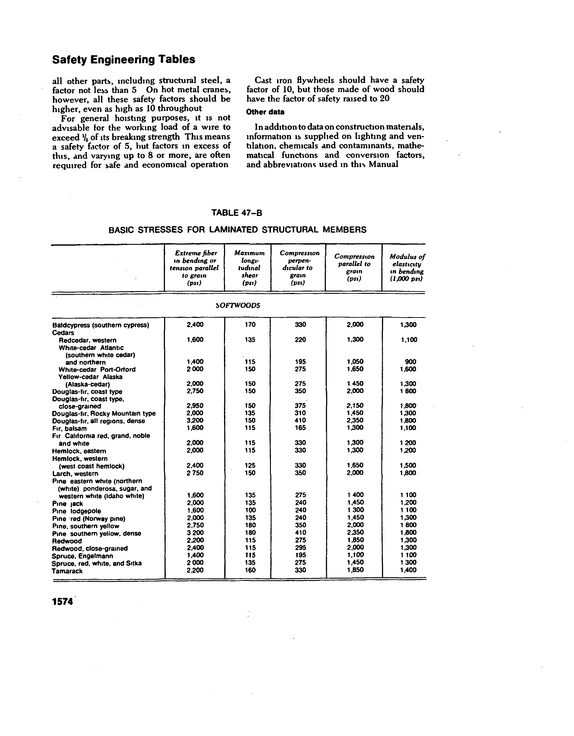
Safety Engineering Tables all other parts, including structural steel, a factor not less than 5 On hot metal cranes, however, all these safety factors should be higher, even as high as 10 throughout For general hoisting purposes, it is not advisable for the working load of a wire to exceed % of its breaking strength This means a safety factor of 5, but factors in excess of this, and varying up to 8 or more, are often required for safe and economical operation Cast iron flywheels should have a safety factor of 10, but those made of wood should have the factor of safety raised to 20 Other data In addition to data on construction materials, information is supplied on lighting and ven tilation. chemicals and contaminants, mathe matical functions and conversion factors, and abbreviations used in this Manual TABLE 47-B BASIC STRESSES FOR LAMINATED STRUCTURAL MEMBERS Extreme jiber in bendtng or tension parallel to gram (psi) Maximum longi tudinal shear (pst) Compression perpen dicular to gram (pst) Compression parallel to grain (pst) Modulus of elasticity in bending (IJ000 psi) Baldcypress (southern cypress) Cedars Redcedar. western White-cedar Atlantic (southern white cedar) and northern White-cedar Port-Orford Yellow-cedar Alaska (Alaska-cedar) Douglas-fir. coast type Douglas-fir. coast type. close-grained Douglas-fir.
refid# QVZ8565aa87j9vrq2KLDvYKE1 page
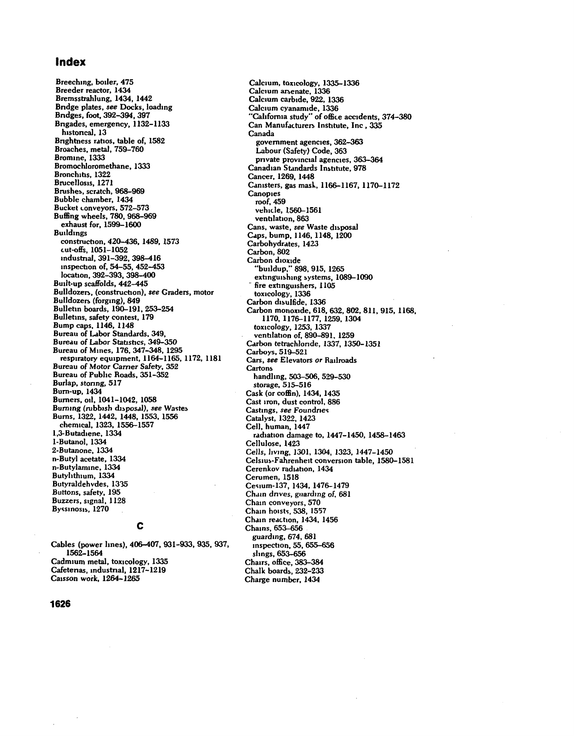
Index Breeching, boiler, 475 Breeder reactor, 1434 Bremsstrahlung, 1434, 1442 Bridge plates, see Docks, loading Bridges, foot, 392-394, 397 Brigades, emergency, 1132-1133 historical, 13 Brightness ratios, table of, 1582 Broaches, metal, 759-760 Bromine, 1333 Bromochloromethane, 1333 Bronchibs, 1322 Brucellosis, 1271 Brushes, scratch, 968-969 Bubble chamber, 1434 Bucket conveyors, 572-573 Buffing wheels, 780, 968-969 exhaust for, 1599-1600 Buildings construction, 420-436, 1489, 1573 cut-offs, 1051-1052 industrial, 391-392, 398-416 inspection of, 54-55, 452-453 location, 392-393, 398-400 Built-up scaffolds, 442-445 Bulldozers, (construction), see Graders, motor Bulldozers (forging), 849 Bulletin boards, 190-191, 253-254 Bulletins, safety contest, 179 Bump caps, 1146, 1148 Bureau of Labor Standards, 349, Bureau of Labor Statistics, 349-350 Bureau of Mines, 176. 347-348, 1295 respiratory equipment, 1164-1165, 1172, 1181 Bureau of Motor Carrier Safety, 352 Bureau of Public Roads, 351-352 Burlap, storing, 517 Bum-up, 1434 Burners, oil, 1041-1042, 1058 Burning (rubbish disposal), see Wastes Bums, 1322, 1442, 1448, 1553, 1556 chemical, 1323, 1556-1557 1,3-Butadiene, 1334 1- Butanol, 1334 2- Butanone, 1334 n-Butyl acetate, 1334 n-Butylamine, 1334 Butylithium, 1334 Butyraldehvdes, 1335 Buttons, safety, 195 Buzzers, signal, 1128 Byssmosis, 1270 c Cables (power lines), 406-407, 931-933, 935, 937, 1562-1564 Cadmium metal, toxicology, 1335 Cafeterias, industnal, 1217-1219 Caisson work, 1264-1265 Calcium, toxicology, 1335-1336 Calcium arsenate, 1336 Calcium carbide, 922, 1336 Calcium cyanamide, 1336 "California study" of office accidents, 374-380 Can Manufacturers Institute, Inc , 335 Canada government agencies, 362-363 Labour (Safety) Code, 363 private provincial agencies, 363-364 Canadian Standards Institute, 978 Cancer, 1269, 1448 Canisters, gas mask, 1166-1167, 1170-1172 Canopies roof, 459 vehicle, 1560-1561 ventilation, 863 Cans, waste, see Waste disposal Caps, bump, 1146, 1148, 1200 Carbohydrates, 1423 Carbon, 802 Carbon dioxide "buildup," 898, 915, 1265 extinguishing systems, 1089-1090 ' fire extinguishers, 1105 toxicology, 1336 Carbon disulfide, 1336 Carbon monoxide, 618, 632, 802, 811, 915, 1168, 1170, 1176-1177, 1259, 1304 toxicology, 1253, 1337 ventilation of, 890-891, 1259 Carbon tetrachloride, 1337, 1350-1351 Carboys, 519-521 Cars, see Elevators or Railroads Cartons handling, 503-506, 529-530 storage, 515-516 Cask (or coffin), 1434, 1435 Cast iron, dust control, 886 Castings, see Foundries Catalyst, 1322, 1423 Cell, human, 1447 radiation damage to, 1447-1450, 1458-1463 Cellulose, 1423 Cells, living, 1301, 1304, 1323, 1447-1450 Celsius-Fahrenheit conversion table, 1580-1581 Cerenkov radiation, 1434 Cerumen, 1518 Cesium-137, 1434, 1476-1479 Chain drives, guarding of, 681 Chain conveyors, 570 Chain hoists, 538, 1557 Chain reaction, 1434, 1456 Chains, 653-656 guarding, 674, 681 inspection, 55, 655-656 slings, 653-656 Chairs, office, 383-384 Chalk boards, 232-233 Charge number, 1434 1626
refid# zbdeQe664ze47BxN5k1xYKxDn1 page
Ir.dustr-.a. r.cr.,.
refid# Mod7bGJGaD3ooBvJD7ZZmXe8x1 page
HORN ' . " .</ "iv:.- .: !'
refid# xYLjBqZY1JZBZg0ELdXJqnEb1 page
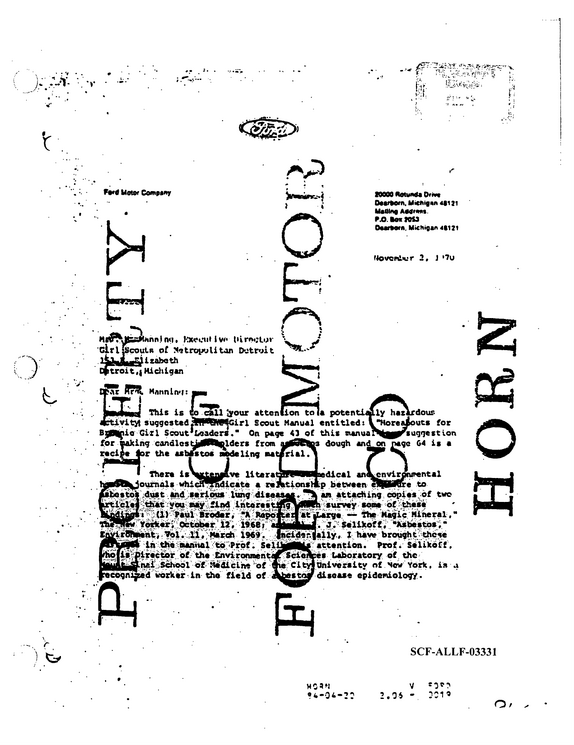
_Gra legs -- would you know they're ,, ".u-.i .*> u - \ ,;r. .si- ri . : ' <<>, >f ,, I wearing Belle Sharmeer't Whisper Sheer support stockings?
refid# N2ab6NkMJ00zYDbBZb4OZ21Lp1 page
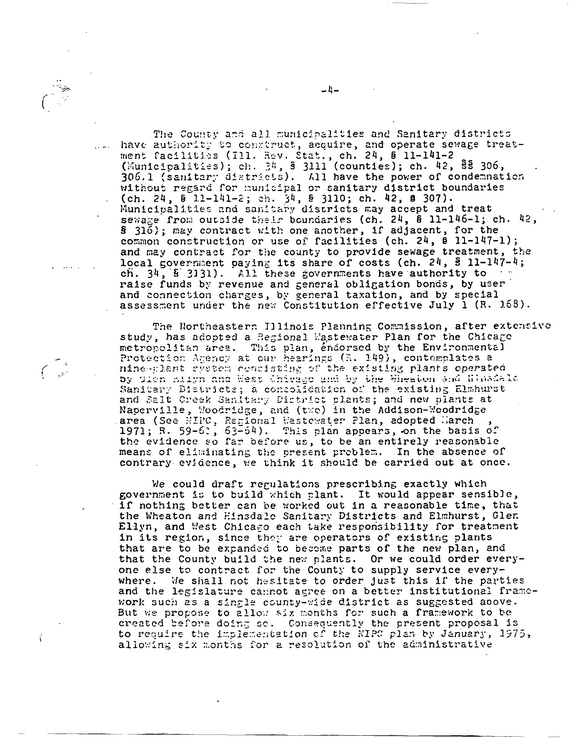
-4- The County and a2. 1 municipalities and Sanitary districts have authority to con:: truet., accuire, and operate sewage fcreat- ment facilities (111. nev :tat
refid# gbxzrpDKdV25OqkzbjdXoJnaV1 page
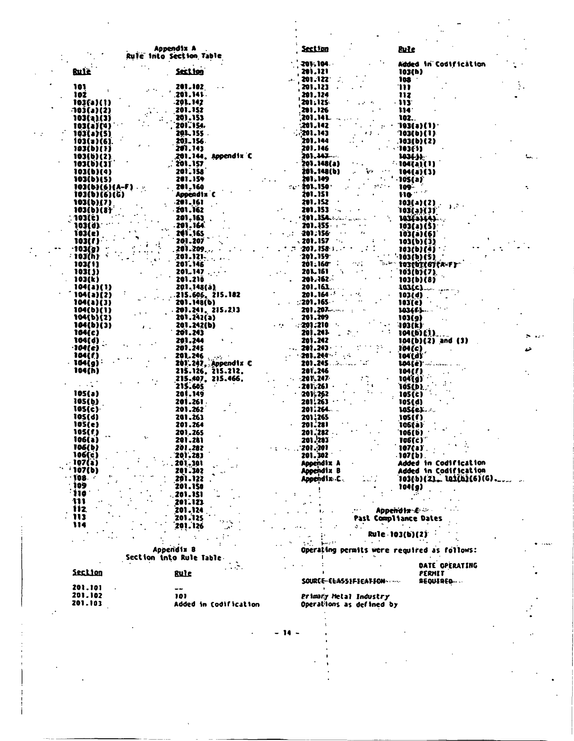
Appendix A Rule Into Sect Ion.
refid# DDDNB80rm7R8GbGx49DK20YZa1 page
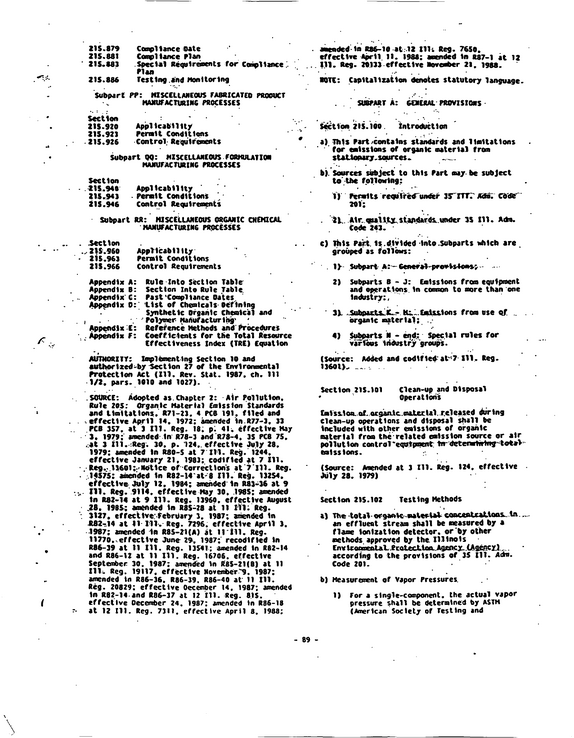
21S.879 215.881 21S.883 215.886 Compliance oate Compliance Plan Special Requirements for Compliance..
refid# LKX5m21ykdXVBOz0YdKMMYQXq1 page
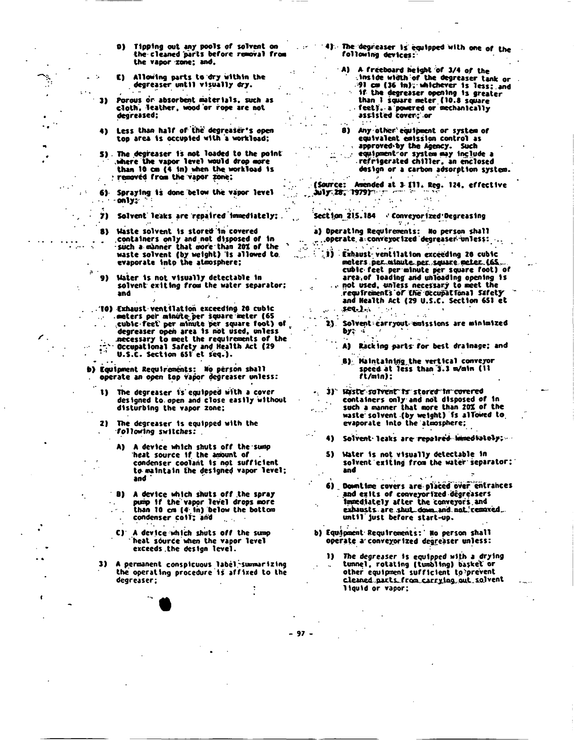
0) Tipping out Mjr pools of solvent on the- cleaned 'parts before rexoval fro* the vapor zone; and.
refid# yro1QoOayaV04w61G16J3Nejd1 page
shall comply with those standards and itmttatlonsi' In accordance with Section 21S.4S2.
refid# 6wXa16woELEVQ7mDaD1Drmka61 page
would have to sell its short fibers.
refid# wqdXOjkmKjegkwKLQvgoD9wKd1 page
R-120 R Preliminary tests Indicated the coating to be zinc oxide.
refid# garqD8m7nX3pQKGGpqK7jRX4e1 page