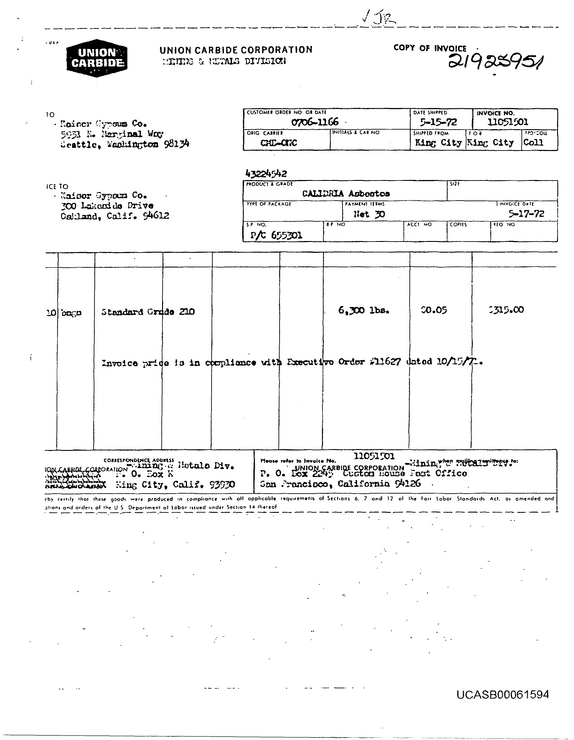
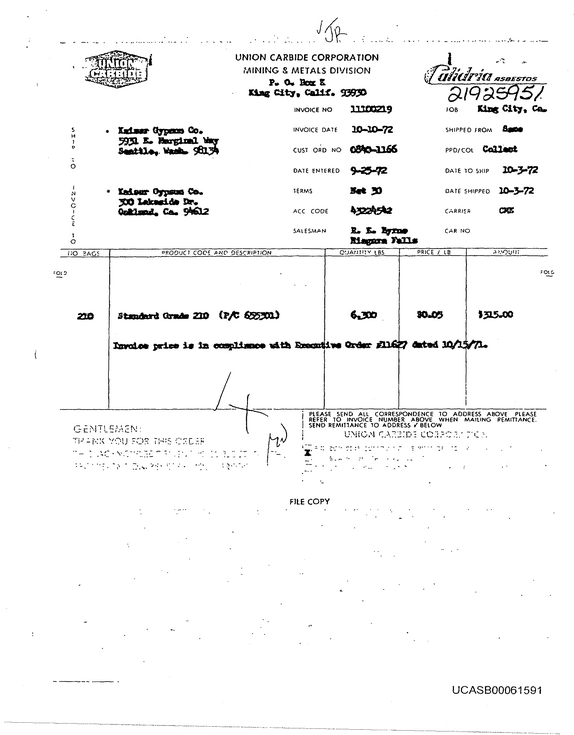
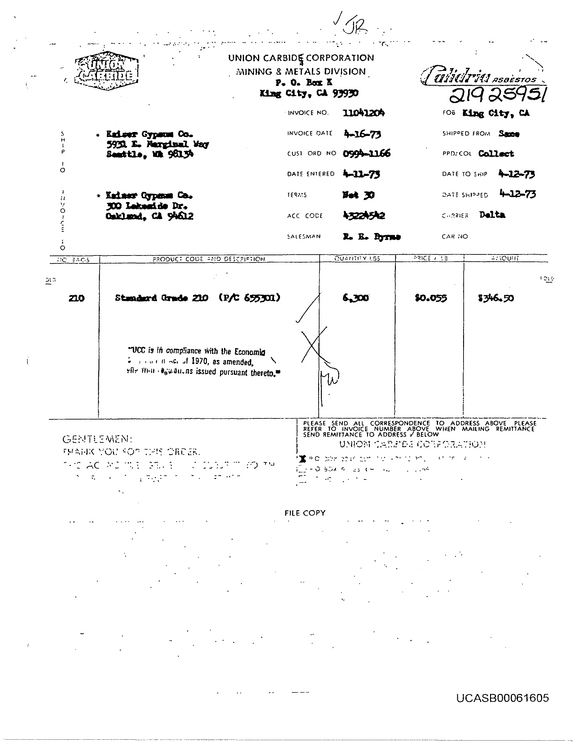
/ Union Carbide Sales of Asbestos to Kaiser Gypsum Seattle, Washington -Hi* UNION CARBIDE CORPORATION COPY OF INVOICE : :irn:?
refid# By2KV8VzxaG8MyJNEy7XLnvgJ11 pages
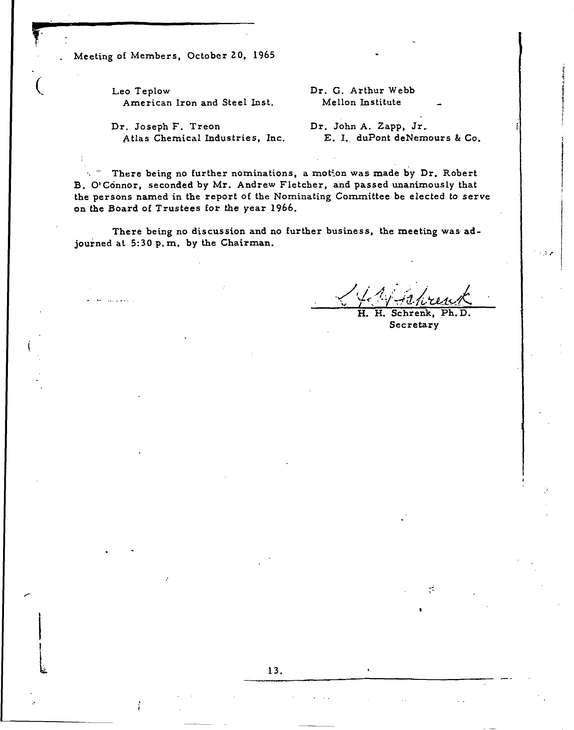
Meeting of Members, October 2 0, 1965 Leo Teplow American Iron and Steel Inst.
refid# x1NXpO6qoD3ZO2oOoaVGK8N9E1 page
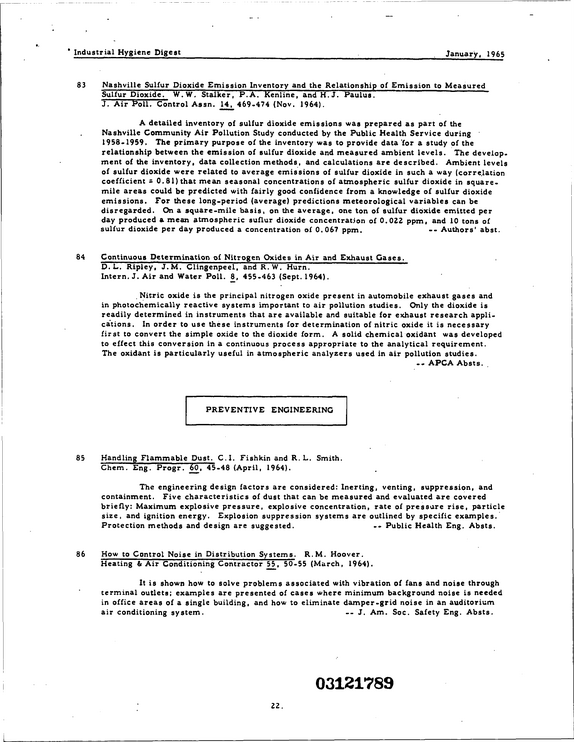
* Industrial Hygiene Digest January, 1965 83 Nashville Sulfur Dioxide Emission Inventory and the Relationship of Emission to Measured Sulfur Dioxide.
refid# mbx8aJXLbDQpn78XokXqmXrrd1 page
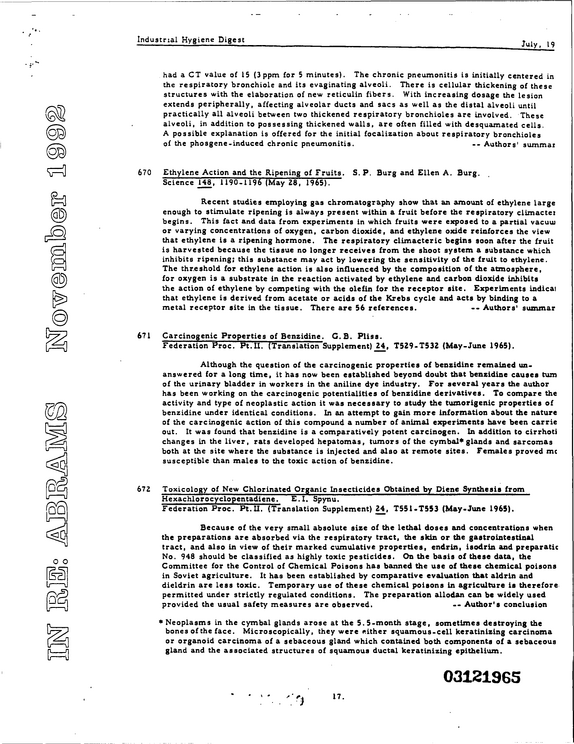
fel c=a Industrial Hygiene Digest July, 19 had a CT value of IS (3 ppm for 5 minutes).
refid# 06JVn9wrnV3QM7wNVyz5bwZ9O1 page
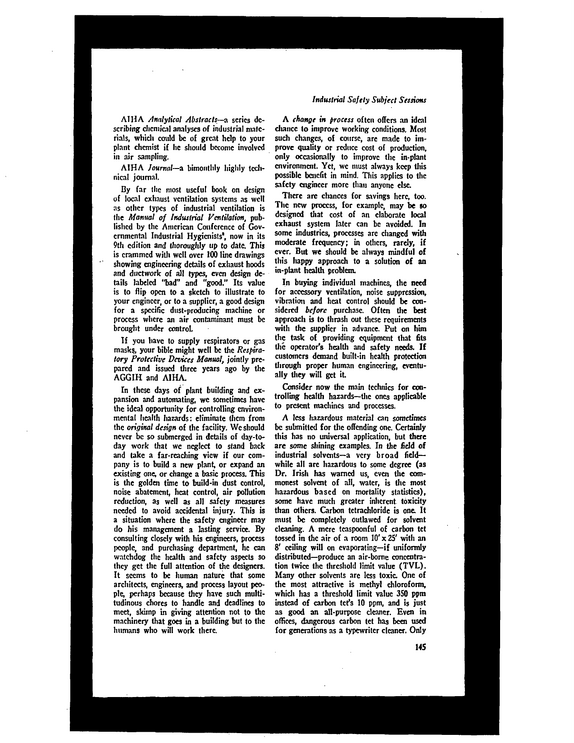
Industrial Safety Subject Sessions AIHA Analytical Abstracts--a scries de scribing chemical analyses of industrial mate rials, which could be of great help to your plant chemist if lie should become involved in air sampling.
refid# jmwjBRNLbJR38Qab707ak5OjO1 page
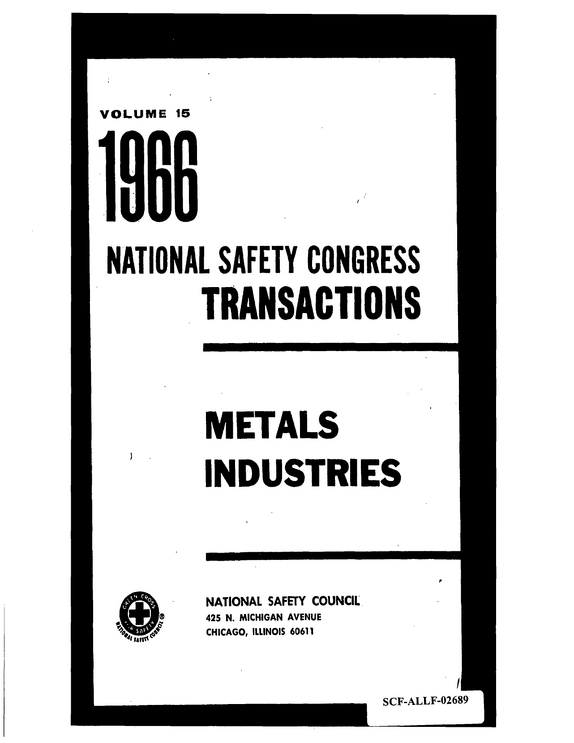
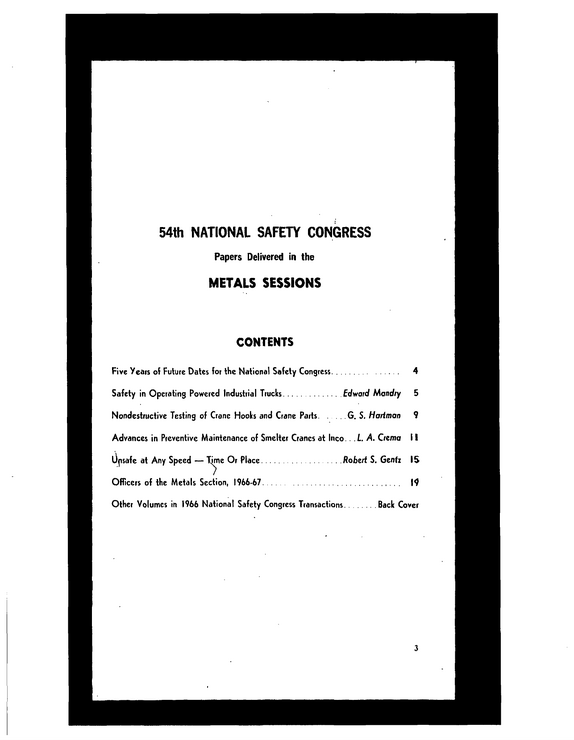
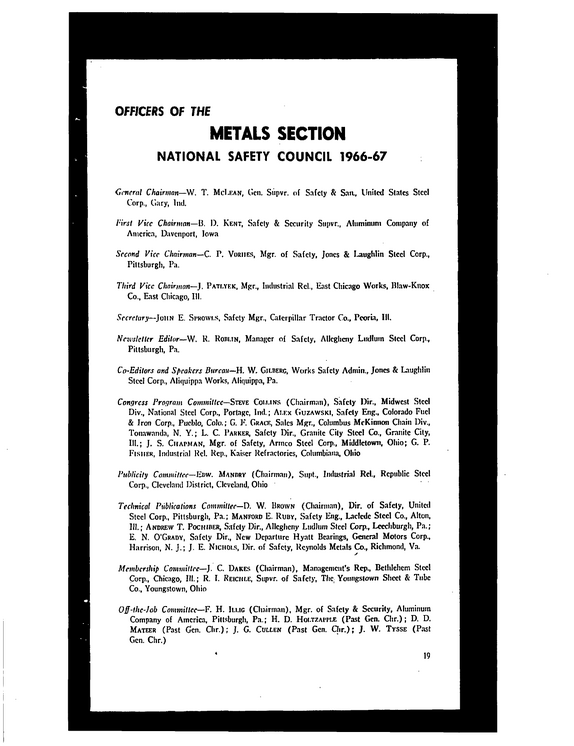
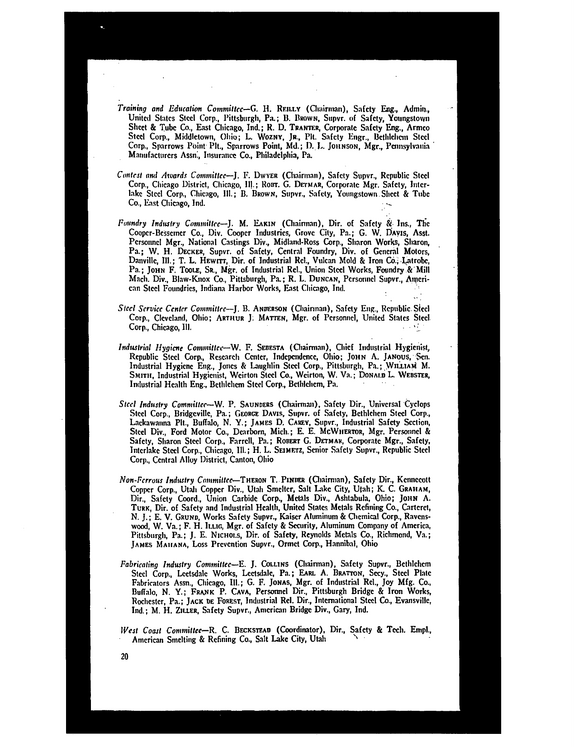
VOLUME 15 NATIONAL SAFETY CONGRESS TRANSACTIONS METALS INDUSTRIES NATIONAL SAFETY COUNCIL 425 N.
refid# Zb84ZNQqVp80dKy3nJNMaz6O5 pages
r t fee Industrial Hygiene Digest INDUSTRIAL HEALTH NEWS LITERATURE ABSTRACTS MEDICAL ENGINEERING CHEMICAL TOXICOLOGICAL LEGAL SEPTEMBER, 1966 (Vol. 30, No. 9) ofo INDUSTRIAL HYGIENE FOUNDATION MELLON INSTITUTE 4400 FIETH AVENUE PITTSBURGH, PA. 1S213 SC-ALL-12560 SCF-ALLF-02770 03122218 f PLAINTIFF'S i EXHIBIT I i i </ 1
refid# 10eY7mEOx5aMvjqdDO33Ja06m1 page
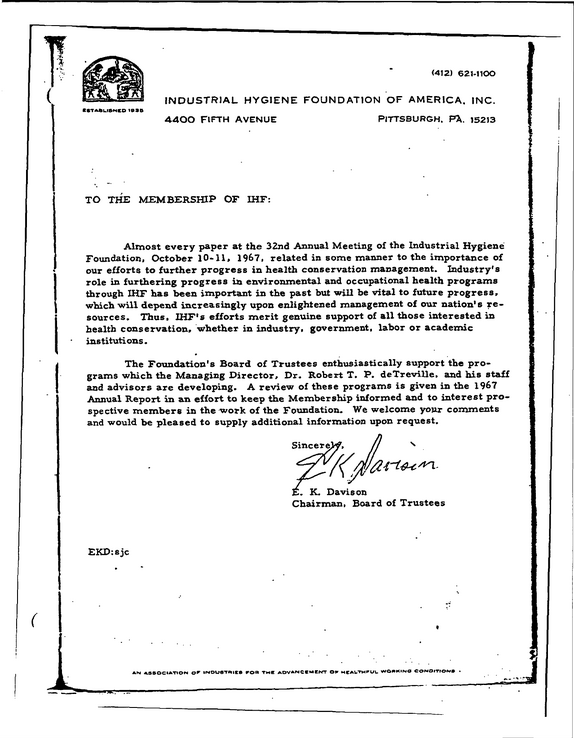
(412) 621-1100 ST&SUISHCO 1BSB INDUSTRIAL HYGIENE FOUNDATION OF AMERICA, INC. 4400 FIFTH AVENUE Pittsburgh, pfc. 15213 TO THE MEMBERSHIP OF IHF: Almost every paper at the 32nd Annual Meeting of the Industrial Hygiene Foundation, October 10-11, 1967, related in some manner to the importance of our efforts to further progress in health conservation management.
refid# kDBD6dvrQoO0EKmLJd0JKq3aV1 page
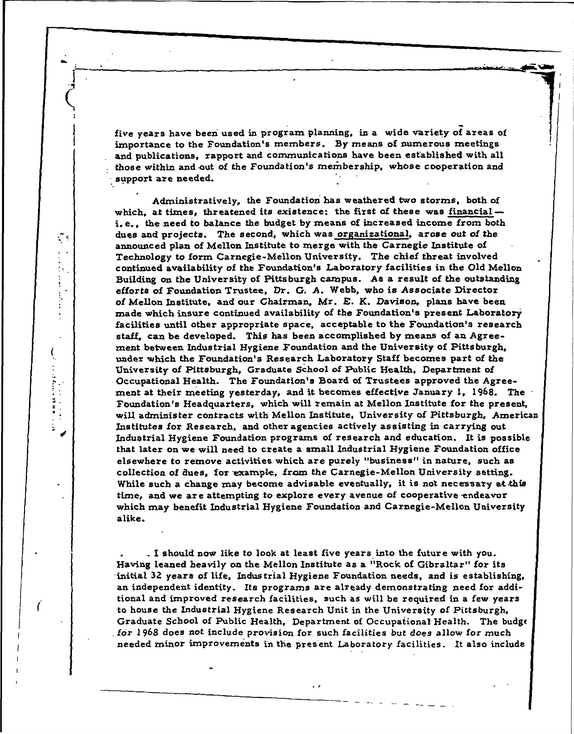
five years have been used in program planning, in a wide variety of areas of importance to the Foundation's members.
refid# b55YZ12vqE3XKDyrezk76pVLD1 page
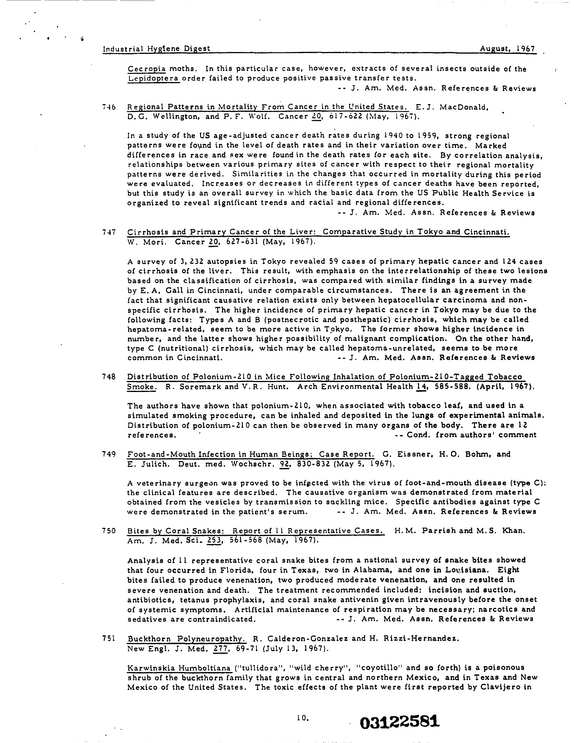
Industrial Hygiene Digest August, 1967 Cecropia moths.
refid# YGD35L3yz3VLGJ4KabOBqDk6N1 page
TABLE 4 ( QUESTIONNAIRE DATA ) EXPOSURE GROUP 1 "DYSPNEA OP BFFORT" AGE <30 30 - 49 50+ 21% 23% 36% 2 23% 18% 41% 3 15% 32% 27% TABLE 5 ( QUESTIONNAIRE DATA ) "WHEEZING" BXPOSURE GROUP <30 AGB 30-- 49 1 37% 19% 2 23% 18% 3 5% 11% 50+ 29% 22% 33% 9. 1H3
refid# 5kQ0BR1GyqDeqoDe93JYLRy9D1 page
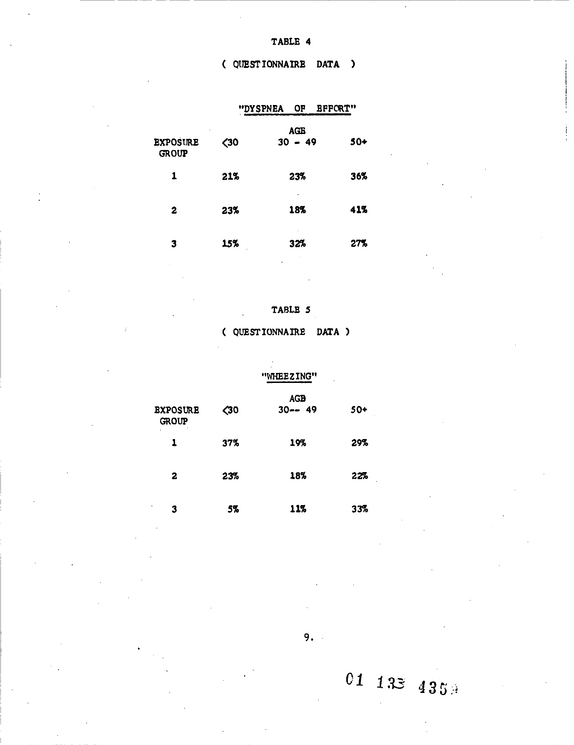
Fig 8-13 --``Walking safetv poster " Construction supenntendent lets workers select own safety message, pl.ice it on their own safety hat Courtesy Stone O Webster Engineering Cory Sixty-nine per cent of the respondents in the Council's poster survey preferred posters of 8'/> by 11V^ in and 17 by 23 in size Of these two sizes, the smaller was preferred six-to-one over the larger Types of posters Posters available from the National Safety Council, insurance companies, associations, and other sources fall into two broad cate gories general and special mdustrv(or special hazard) The general posters are concerned with such subjects as chance-taking, disregarding safety rules, forgetting to replace guards, and other human failures Special industry posters, as the term in dicates, have application only in specific industries, such as mining or logging Special hazard posters, for example on lifting, ladders, the storage or handling of flammable liquids, are useful in every industry where the particular hazards are encountered In some cases, a hazard is so serious that a special poster is developed because of the seventy and not the frequency of exposure The National Safety Council carries over WOO different safetv posters in stock at any one time These range from pocket-size pressure-sensitized stickers to billboardsize jumbo posters About 15 new posters are added each month Subject matter is roughly in proportion to the occurrence of certain types of accidents For example, more posters are concerned with materials handling than with chemicals and gases (For illustrations of the many posters available from the National Safety Council, see the CataloglPoster Directory) Other locations Posters and stickers can be mounted on deliverv trucks, industrial trucks, mail trucks and carts, in elevators, and even on doors Pocket cards or plastic pocket protectors, such as those available from the National Safety Council, might be called "walking safety posters " (See Fig 8-13 ) Other materials Safety messages need not be limited to printing and artwork They can be very effective when used m illuminated or changable signs, or even embossed on bncks (See Fig 8-14 ) One company paints a safety message on a plywood welding screen Homemade posters A company can develop its own posters to deal with special Fig 8-14 --Safety messages can even be embossed on bncks Courtesy Domtar Construction Materials Ltd 189
refid# zQ7g2qMy4DBZg0MY3dJq4Z5xg1 page
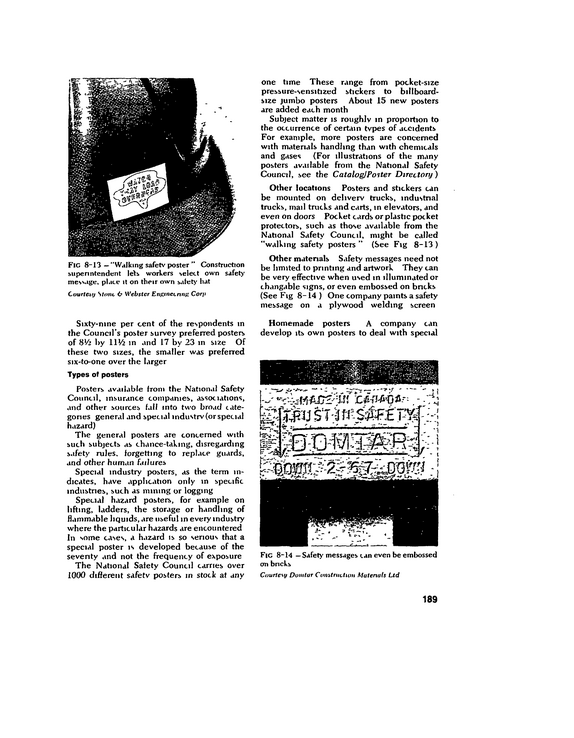
22 Personal protective equipment required7 (Protective glasses safety shoes safety hat safety belt).
refid# Jrd7qKbQnZ2qxp88xZ5L4qbwZ1 page
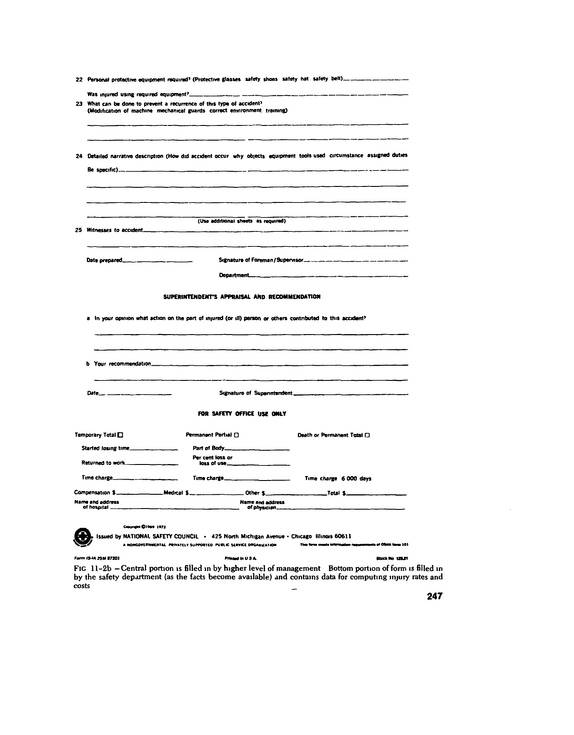
Fig 16-4 -- The new layout greatly reduced the hazards, incidental to materials handling in this transformer manufacturing operation handling of materials, many unnecessary movements, and result m bad housekeeping -- in itself a prolific source of accidents Insufficient headroom at aisles, platforms, pipelines, overhead conveyors, other parts of the structure, and other installations is disclosed in studying the models A vertical distance of at least 7 ft generally is specified between passageways and stairways, and overhead structures to provide ample clear ance Overhead cranes and conveyors re quire at least 24 m of vertical and hori zontal clearance Trucks and other vehicles require enough room for movement without endangering men and equipment and need space to back and tum near machines Aisles should be wide enough to permit trucks to pass without colliding For one-way traffic, aisles should be not less than 3 ft wider than the widest vehicles Aisles for two-way traffic should be not less than 3 ft wider than twice the width of the widest vehicle These minimum widths are exceeded considerably m some new build ings where, because of anticipated heavy traffic, aisles from 12 to 20 ft wide have been specified Safe layout of aisles requires that there be no blind comers and that adequate radius be provided to allow for vehicle turns A 6-ft radius is large enough for small industrial trucks Aisles should be clearly defined with ap proved markings of either traffic paint or strip ing material Follow ASI Standard Z53 1, Safety Color Code for Marking Physical Hazards and the Identification of Certain Equipment Plastic buttons that are glued or fastened with metal fasteners to the floor are used by many because of their durability 401
refid# gbvamwGONO94qJ5Exov310EJa1 page
Detailed engineering specifications should be acquired for each machine or structure For machinery, these give dimensions, weights, sizes of plant service connections, lubncation requirements, details on bearings, and power transmission or motor drive data For buildings they include data on general layout, services available, floor load capa cities, ceiling clearances, column spacing, and many other features After a supervisor has made an analysis of his maintenance responsibilities, an organi zation chart should be formulated for the selection and safe assignment of workers The safety man helps in this Such a chart gives the supervisor a comprehensive picture of his force, pointing out the status of trained keymen and reserves Outside specialists who can be called in for unusual or very hazardous jobs should be listed In layoff periods or m emergencies when men are needed in a hurry, this information is quite valuable Work control is necessary for efficient and safe maintenance operation and involves planning, scheduling, and follow-up of the job A smooth-flowing paper work system will help to control each job all the way Work plans should indicate the nature of each job, how it is to be done, the material needed, and the safety precautions required The type of records that should be kept will depend on plant operations, operating time of machines, number of maintenance crews, and schedules A work schedule is successful only if there is a follow-up system to see that it is being adhered to and to determine reasons for de lay Delays may be an indication of faulty materials or wrong procedures Where work schedules are rigid, it is better to hire ad ditional help than to increase the work tempo of the crew Equipment inspections An inspection schedule based on the po tential trouble points listed on maintenance records is essential to preventive mainten ance The schedule can be determined by the number of inspection reports turned m by regular full-time inspectors or by the men of the maintenance crews An inspector must know what to look for He must be something of an expert on, or at least thoroughly familiar with, the equipment under his care This knowledge is partic ularly important for electrical equipment inspectors Electrical equipment usually gives few obvious indications of impending trouble, and is likely to stop altogether with little advance warning Mechanical equip ment often warns of deterioration by such easily recognized signs as noise, unusual appearances, or substandard output But there are some warnings that are more subtle It is important that inspectors be equipped with suitable instruments for making their observations While there is no difficulty in recognizing burned contacts on a motor starter or in hearing the pounding of a worn gear, checking insulation resistance of a motor or measuring the wear on a shaft re quires the correct instruments Personal protective equipment Maintenance men should dress properly for their specific job Garments should be snug-fitting, with a few small pockets Breast pockets are often sewn closed to prevent items from dropping into machinery or in accessible places when the wearer leans over Rings, watch chains, wnstwatches, and other jewelry should not be wom Neckties and loose clothing should not be worn by maintenance men Loose rags must be kept clear of moving machinery If a man carries so few tools that he does not need a tool bag, he should wear a special belt fitted with tool earners To prevent back and spine injuries in case the worker should fall, tools should be earned at the side instead of m the back portion of the belt Gloves or hand leathers should be worn by a man handling rough or sharp objects Welding gloves, rubber gloves for electrical insulation, and rubber gloves for handling acids should be used as needed, but never worn around moving machinery Goggles should be m every maintenance tool kit Moreover, unless the repairman knows the exact conditions he is to work under, his equipment should include several tvpes of goggles to provide protection against flying objects and molten metal, injurious heat and light rays, dust and wind, and acid splashes When a man needs to work in high places or to enter a manhole, bin, or tank, he should wear a life belt, with the lifeline either at- 463
refid# q4oLpn5wMKDyojDqd21mkXxn1 page