will not slip from his grasp If this is not practical, he could use a rope sling or other device that will give him a positive grip Most strains and back injuries occur when lifting and setting down objects by hand It is important that those who do this work be trained in the proper lifting techniques if these injuries are to be reduced (See Fig 19-1, a model for use in training is shown m Chapter 10) 1 Consider the size, weight, and shape of the object to be earned Do not lift more than can be handled comfortably If neces sary, get help 2 Set feet solidly One foot can be slightly ahead of the other for increased effective ness Feet should be far enough apart to give good balance and stability (approxi mately the width of the shoulders) 3 Get as close to the load as possible Bend legs about 90 degrees at the knees Crouch, do not squat It takes about twice as much effort to get up from a squat 4 Keep the back as straight as possible It may be far from being vertical, but it should not be arched Bend at the hips, not the middle of the back 5 Grip the object firmly Maintain that gnp while lifting and carrying Before chang ing or adjusting this gnp, set the object down again 6 Straighten the legs to lift the object, and at the same time bnng the back to a vertical position Tucking your chin in helps keep your spine straight and firm 7 Never carry a load that you cannot see over or around Make sure the path of travel is clear Carry the object close to the body 8 Never turn at the waist to change direction or to put an object down Turn the whole body and crouch down to lower the object Gnp the object firmly, keep it close, and keep the back straight (not arched) To keep hands from being pinched against the floor, put one comer of a box or similar object down first, so that the fingers can be removed from under the sides Here are some techniques for specific situa tions 1 If the object is too heavy to be handled by one person, he should get help 2 Before lifting a load to be earned, the worker should consider the distance to be traveled and the length of time he will have to maintain the gnp He should recognize the fact that his gnpping power may tire if he has to carry the load a long distance, especially if he has to climb stairs or ramps 3 To place an object on a bench or table, first set it on edge and push it far enough onto the support to be sure it will not fall Release it gradually as you set it down Move it in place by pushing with the hands and body from m front of the object This method prevents fingers from getting pinched 4 It is especially important that an object placed on a bench or other support be sec urely set so that it will not fall, tip over, or roll off Supports should be correctly placed and strong enough to carry the load Heavy objects, like lathe chucks, dies, and other jigs and fixtures, should be stored at approximately waist height 5 To raise an object above shoulder height, lift it first to waist height Rest the edge of the object on a ledge, stand, or hip Shift hand position so object can be boosted after knees are bent Straighten out knees as object is lifted or shifted to the shoulders 6 To change direction, lift the object to car rying position, and turn the entire body, including the feet Do not twist your body In repetitive work, the person and the material should both be positioned so that the person will not have to twist his body when moving the material 7 To deposit an object manually in a tight space, it is safest to slide it into place with the hands m the clear, rather than to lift it Team lifting and carrying When two or more men must carry a sin gle object, they should adjust the load so that it ndes level and so that each carries an equal part of the load Test lifts can be made before proceeding When two men carry long seebons of pipe or lumber, they should carry on the same shoulder and walk m step Shoulder pads will prevent cutting of the shoulders and help to reduce fatigue 505
refid# KJXzYaqB1w1pGmO8yGLZNYrv01 page
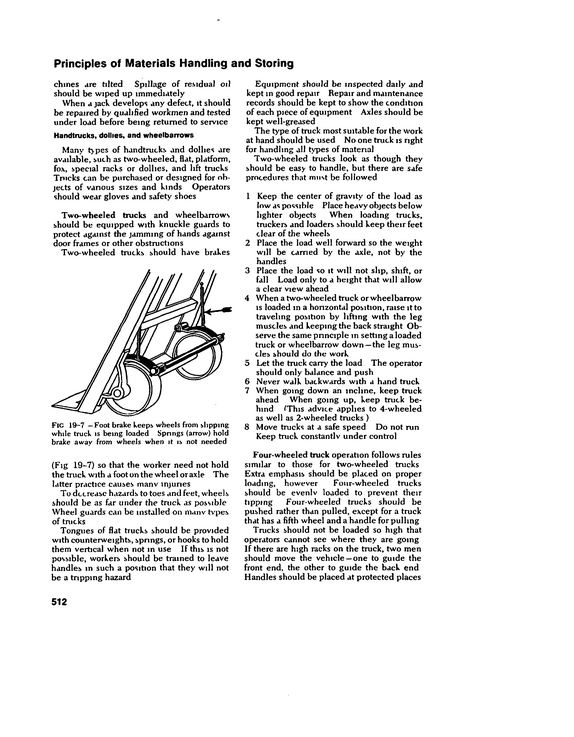
Principles of Materials Handling and Storing chines are tilted Spillage of residual oil should be wiped up immediately When a jack develops any defect, it should be repaired by qualified workmen and tested under load before being returned to service Handtrucks, dollies, and wheelbarrows Many t>pes of handtrucks and dollies are available, such as two-wheeled, flat, platform, fox, special racks or dollies, and lift trucks Trucks can be purchased or designed for ob jects of various sizes and kinds Operators should wear gloves and safety shoes Two-wheeled trucks and wheelbarrows should be equipped with knuckle guards to protect against the jamming of hands against door frames or other obstructions Two-wheeled trucks should have brakes Fig 19-7 --Foot brake keeps wheels from slipping while truck is being loaded Springs (arrow) hold brake away from wheels when it is not needed (Fig 19-7) so that the worker need not hold the truck with a foot on the wheel or axle The latter practice causes manv injuries To decrease hazards to toes and feet, wheels should be as far under the truck as possible Wheel guards can be installed on manv types of trucks Tongues of flat trucks should be provided with counterweights, springs, or hooks to hold them vertical when not m use If this is not possible, workers should be trained to leave handles in such a position that they will not be a tripping hazard Equipment should be inspected daily and kept in good repair Repair and maintenance records should be kept to show the condition of each piece of equipment Axles should be kept well-greased The type of truck most suitable for the work at hand should be used No one truck is right for handling all types of material Two-wheeled trucks look as though they should be easy to handle, but there are safe procedures that must be followed 1 Keep the center of gravity of the load as low as possible Place heavy objects below lighter objects When loading trucks, truckers and loaders should keep their feet clear of the wheels 2 Place the load well forward so the weight will be carried by the axle, not by the handles 3 Place the load so it will not slip, shift, or fall Load only to a height that will allow a clear view ahead 4 When a two-wheeled truck or wheelbarrow is loaded in a horizontal position, raise it to traveling position by lifting with the leg muscles and keeping the back straight Ob serve the same principle in setting a loaded truck or wheelbarrow down--the leg mus cles should do the work 5 Let the truck carry the load The operator should only balance and push 6 Never walk backwards with a hand truck 7 When going down an incline, keep truck ahead When going up, keep truck be hind (This advice applies to 4-wheeled as well as 2-wheeled trucks ) 8 Move trucks at a safe speed Do not run Keep truck constantly under control Four-wheeled truck operation follows rules similar to those for two-wheeled trucks Extra emphasis should be placed on proper loading, however Four-wheeled trucks should be evenlv loaded to prevent their tipping Four-wheeled trucks should be pushed rather than pulled, except for a truck that has a fifth wheel and a handle for pulling Trucks should not be loaded so high that operators cannot see where they are going If there are high racks on the truck, two men should move the vehicle --one to guide the front end, the other to guide the back end Handles should be placed at protected places 512
refid# a4JazOxXXNNmmOmJzGX9Ga5V91 page
Elevators and Plant Railways pole to move cars bv a locomotive is dangerous under any circumstances and is not recom mended Safe practices It is vital that transportation personnel--as well as all other employees --observe safe practices They can be guided by the very same safety rules observed by all large rail road systems (See Association of American Railroads, Safety Rules for various services ) When plant railway safety problems arise, help and suggestions can be sought from the safety men and operating officers of a plant's connecting railway line Safety meetings and other educational ac tivities should be used to inform plant per sonnel about railway hazards To include all the safe practices required for the safe operation of railway equipment would require a book in itself However, a few of the more important ones are included here 1 Stop and look both ways before crossing any track 2 Expect trains or cars to move at any time, on any track, in either direction 3 Step over rails when crossing tracks Never step, walk, or sit on any rail 4 Never go between moving cars (or cars that may move) for the purpose of adjust ing couplers or for any other purpose (The once common practice of kicking couplers to align them is particularly dangerous ) 5 Give a hand or lamp stop signal and re ceive an acknowledgment of the signal before going between standing engines or cars 6 To close a boxcar door, place one hand on the door handle and the other on the back end of the door 7 Step down from cars --do not jump 8 Never attempt to ride the leading foot board of an engine (This rule applies to all employees, including switchmen ) References American Society of Mechanical Engineers, 345 East 47th St, New York, N Y 10017 ASME Boiler and Pressure Vessel Code, Section III, "Boilers of Locomotives," and Section VIII, "Unfired Pressure Vessels " American Standards Institute, 1430 Broadway, New York, N Y 10018 American Standard Practice for the Inspection of Elevators (Inspectors' Manual), A17 2 Safety Standard for Elevators, Dumbwaiters, Escalators, and Moving Walks, A17 1 (Also published bv American Society of Mechanical Engineers ) Safety Standard for Manlifts, A90 1 Association of American Railroads, 59 East Van Buren Street, Chicago, 111 60605 Engineering Division (American Railwav Engineering Association) Manual of Recommended Practice Safets Section, American Railroads Bldg , 1920 L St N\V , Washington, D C 20036 Safety Rules Governing Maintenance of Equipment and Stores Employees Safety Rules Coverning Maintenance of Way and Structures Employees Safety Rules Governing the Care, Maintenance and Operation of Mechanized Material Handling Equipment Used in Railway Operations Safety Rules Governing Tram, Engine, and Other Transportation Employees Federal Railroad Administration, U S Dept of Transportation, Washington, D C 20590 Laws, Rules and Instructions for Inspection and Testing in Steam Locomotives and Tenders and Their Appurtenances National Bureau of Standards, U S Department of Commerce, Washington, D C 20234 Na tional Electrical Safety Code, NBS Handbook H30 Also adopted as AS1 Standard C2 608
refid# xzQd2j522jj8rLvOkvRdXQrOm1 page
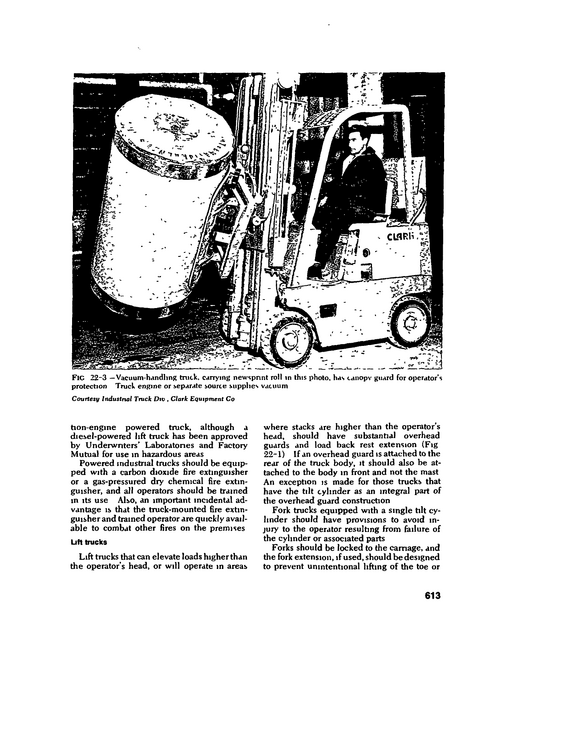
FlC 22-3 --Vacuum-handling truck, carrying newsprint roll m this photo, has canopy guard for operator's protection Truck engine or separate source supplies vacuum ,Courtesy Industrial Truck Dw Clark Equipment Co tion-engine powered truck, although a diesel-powered lift truck has been approved by Underwriters' Laboratories and Factory Mutual for use in hazardous areas Powered industrial trucks should be equip ped with a carbon dioxide fire extinguisher or a gas-pressured dry chemical fire extin guisher, and all operators should be trained in its use Also, an important incidental ad vantage is that the truck-mounted fire extin guisher and trained operator are quickly avail able to combat other fires on the premises Lift trucks Lift trucks that can elevate loads higher than the operator's head, or will operate in areas where stacks are higher than the operator's head, should have substantial overhead guards and load back rest extension (Fig 22-1) If an overhead guard is attached to the rear of the truck body, it should also be at tached to the body in front and not the mast An exception is made for those trucks that have the tilt cylinder as an integral part of the overhead guard construction Fork trucks equipped with a single tilt cy linder should have provisions to avoid in jury to the operator resulting from failure of the cylinder or associated parts Forks should be locked to the carnage, and the fork extension, if used, should be designed to prevent unintentional lifting of the toe or 613
refid# NNKmqGezBX4Vra0RxJLZddVDg1 page
Local Exhaust Systems Control ot Hazardous Processes Role of the safety professional Local Exhaust Systems Parts of a local exhaust system Hoods Ducts Air cleaners--general Air cleaner efficiency Dust arresters Air cleaners for radioactive dusts Air cleaners for fumes and smokes Air cleaners for gases and vapors Fans Fire prevention considerations Checking performance Exhausts for Special Operations Open-surface tanks Spray booths Fume control for electric welding Dust control in foundries Grinding operations Woodworking Cast iron machining Oil mist Melting furnaces Materials conveying Internal combustion engine ventilation Fog removal Kitchen range hoods Recirculation of "cleaned" air References Chapter 29 S52 854 881 894 851
refid# 1gqVXVwVgzR2QjnpJkag3n09K1 page
Local Exhaust System useful material is held to a minimum (Fig 29-19) Internal combustion engine ventilation Gasoline, diesel, and natural gas engines are being used in increasing numbers and sizes inside factory buildings They are run not only in garages, where maintenance checks and repairs are made, but also in ware houses, storage spaces, loading docks, aisleways, and other indoor areas They are being used as drives for air conditioning and electric generating equipment Their products of combustion contain toxic materials alde hydes, carbon monoxide, and nitrogen oxides The threshold limit for aldehydes in air is only 5 parts per million (ppm) They may be generated if the engine is m poor operating condition, is burning oil, or has a smoky ex haust Usually, however, they are of less importance, from the industrial hygiene standpoint, than the carbon monoxide re leased For an 8-hour exposure, the permissible limit of carbon monoxide gas in air is 50 ppm, but a ventilating system should be designed to keep a much lower level of carbon mon oxide (CO) This value should not be over 250 ppm of CO for one hour's exposure Exhaust gases as released from a gasoline engine contain from 1 to over 10 per cent CO (1 per cent = 10,000 ppm) If the engine is operating at full rated horsepower, its exhaust gases will contain about 3 per cent CO When idling, they may contain over 10 per cent Gasoline engines are built m many sizes, ranging from fractional to more than 200 hp Lift trucks commonly have a maximum delivery of 35 to 50 hp Since the engine normally discharges about one cubic foot per minute of exhaust gases per operating horse power, a lift truck when operating near its maximum rated horsepower would release 0 03 times 50 or 1 5 cfm CO The quantity of fresh air that would be needed to dilute this CO output so the concentration would be be low the threshold limit value would depend on many factors (See "References" at end of this chapter Dept of National Health and Welfare, Michigan Health Department, and Milton Shembaum) Fully as important as the ventilation rate is the distribution of the incoming fresh air throughout the building A warehouse, for example, may have a central runway, with ware piled on each side in bays Dead-end alleys or aisles may lead into these bays and sometimes these constitute stagnant pockets The CO concentration may build up to exces sive levels m an aisle when a truck is doing a stacking operation there, and still be negli gible along the central runway Such a situa tion can best be solved by introducing the fresh air by a duct having discharge grilles m the pocketed regions, rather than along the central runway The latter generally receives adequate ventilation from the building doors Improvement is sometimes made by ex tending the tailpipe of a warehouse truck up ward so it discharges vertically at a point above the operator's head This solution is effective, too, m a situation where a dump truck backs up to a pit hopper, at the bottom of which there may be a conveyor Some times a man stands across the pit where the conveyor controls are located and he can get the full blast of the truck exhaust A vertical discharge pipe would prevent this There are areas where it may not be prac tical or economical to ventilate for the preven tion of objectionable concentrations of CO -- such an area is frozen food storage rooms Electric trucks are recommended for these areas Finally, there is the garage which has fixed automobile repair stations Here the answer is a local exhaust system Three-inch flexible ducts are fitted over the tailpipes The flex ible ducts join 4-m branches, which in turn are connected to a header located below floor level or overhead Exhaust requirements are shown in Table 29-G The fan should be capable of exhausting the required air volume at l'/ in static pres sure, water gauge For general garage ventilation, where cars are in motion or are idling outside of the re pair stall, the following ventilation should be provided to dilute the carbon monoxide Per running auto--5,000 cfm, Per running truck --10,000 cfm (or more),' Per horsepower for diesel--75 cfm Air sampling.
refid# 7OYb7pMJ0bVGkYxdGmOXRKp0o1 page
tion The danger is particularly great in hot weather when he is sweaty He should develop the habit of keeping his body insulated from both the work and the metal electrode and holder He should never permit the bare metal part of an elec trode, the electrode insulation, or any metal part of the electrode holder to touch either his bare skin or any wet covering on his body Consistent use of well insulated electrode holders and cables, dry clothing on the hands and body, and insulation from ground will be helpful in preventing contact Some specific precautions for prevention of electnc shock are 1 In confined places, cover or arrange cables to prevent contact with falling sparks 2 Never change electrodes with bare hands or wet gloves, or when standing on wet floors or grounded surfaces 3 Ground the frames of welding units, port able or stationary, m accordance with the National Electrical Code With a small welding unit, a primary cable containing an extra conductor, one end of which is attached to the frame of the welding unit, can be used By means of the proper po larized plug, this ground connection can be earned back to the permanently grounded connection in the receptacle of the power supply 4 Arrange receptacles of power cables for portable welding units so that it is impos sible to remove the plug without opening the power supply switch, or use plugs and receptacles which have been approved to break full load circuits of the unit 5 If a cable (either work lead or electrode lead) becomes wom, exposing bare con ductors, cover the exposed portion with rubber, plastic, or friction tape equivalent to the cable covenng 6 Keep welding cables dry and free of grease and oil to prevent premature breakdown of the insulation 7 Suspend cables on substantial overhead supports if the cables must be run some distance from the welding unit Protect cables that must be laid on the floor or ground so that they will not interfere with safe passage or become damaged or en tangled 8 Take special care to keep welding cables away from power supply cables or hightension wires Gas-shielded arc welding Gas-shielded arc welding (Fig 31-8) is used for joining all types of metals and cast ings In gas-shielded methods, only one electrode is used A gas or gas mixture is in troduced through the torch to surround the electrode and the welding point like a shield The gas cone protects the molten weld pud dle from the atmosphere and stops oxidation of the base metal The electrode conducts either alternating or direct current to provide heat Tungsten arc In gas-shielded tungsten arc welding, the electrode does not melt and is not used for filler metal The electrode is tungsten, which is highly resistant to heat and non-consumable m the welding process Metal arc.
refid# aDyq6eJn3xye5doydama4Va791 page
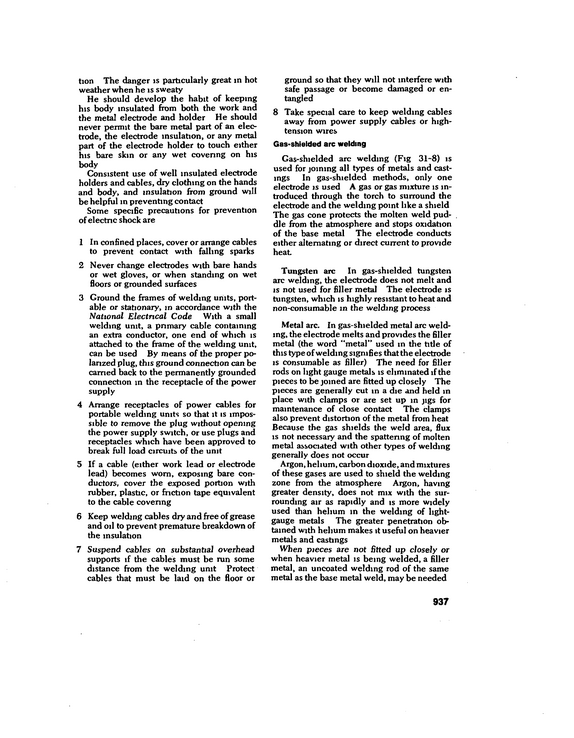
Welding and Cutting TABLE 31-B FILTER LENS SHADE NUMBERS FOR VARIOUS WELDING AND CUTTING OPERATIONS (WELDER AND HELPERS) Type of Operation Recommended Shade Number Resistance welding, and for protection against stray light from nearby welding and cutting (if persons are out of the danger zone) Clear or filters up to No 2 Torch brazing or soldering 3 to 4 Light oxygen cutting and gas welding (to '/a in ) 4 or 5 Oxygen cutting, medium gas welding (Vs to 'A in ) and arc welding up to 30 amps 5 or 6 Heavy gas welding (over '/* in) and arc welding and cutting from 30 to 75 amps 6 or 8 Arc welding and cutting from 75 to 200 amps 10 Arc welding and cutting from 200 to 400 amps 12 Arc welding and cutting exceeding 400 amps 14 NOTE Flash goggles should be worn under all arc welding helmets particularly for gas-shielded metal arc welding Adapted from Welding Handbook, 5th ed American Welding Society items should conform to ASI Standard Z2 1, Safety Code for Head, Eye, and Respiratory Protection Table 31-B is a guide for select ing the correct filter lens for various welding and cutting operations Goggles or spec tacles should have side shields Guidance for lens care is given in Chapter 38, "Personal Protective Equipment " Protective clothing Some of the items of protective clothing needed by welders (Fig 31-12) are 1 Flame-resistant gauntlet gloves, except on very light work 2 Aprons of leather, asbestos, or other flameresistant material to withstand radiated heat and sparks 3 For heavy work, fire-resistant leggings, high boots, or similar protection 4 Safety shoes, wherever heavy objects are handled Low-cut shoes with unprotected tops should not be used because of the spark hazard 5 For overhead work, capes or shoulder covers of leather or other suitable mate rial Skull caps of leather or flame-resistant fabric may be worn under helmets to prevent head bums Also, for overhead welding, ear protection (wool or rubber plugs or wire screen protectors) is some times desirable 6 Safety hats or other head protection against sharp or heavy falling objects Operators and other persons working with inert-gas shielded arc welding should keep all parts of the body which could be exposed to the ultraviolet and infrared radiation covered to protect against skin bums and other types of injuries Dark clothing, partic ularly a dark shirt, is preferable to lightcolored clothing in order to reduce reflection to the operator's face underneath the helmet Cotton clothing disintegrates m from one day to two weeks, presumably because of the high ultraviolet radiation from arc welding and cutting Wool or leather clothing, there fore, is preferable to cotton because it is more resistant to deterioration For gas-shielded arc welding, woolen cloth ing is also preferable to cotton It is not readily ignited and protects the welder from changes m temperature Cotton clothing, if used, should be chemically treated to reduce flammabilitv In either case, clothing should be thick enough to keep radiation from pene trating it Outer clothing should be reasonably free from oil and grease Sleeves and collars should be kept buttoned Aprons and overalls should have no pockets, in which sparks could be caught, on the front of them For the same reason, trousers or overalls should not have tumed-up cuffs 944
refid# jyvgwz0knvwBoQ1qDN1Myzxay1 page
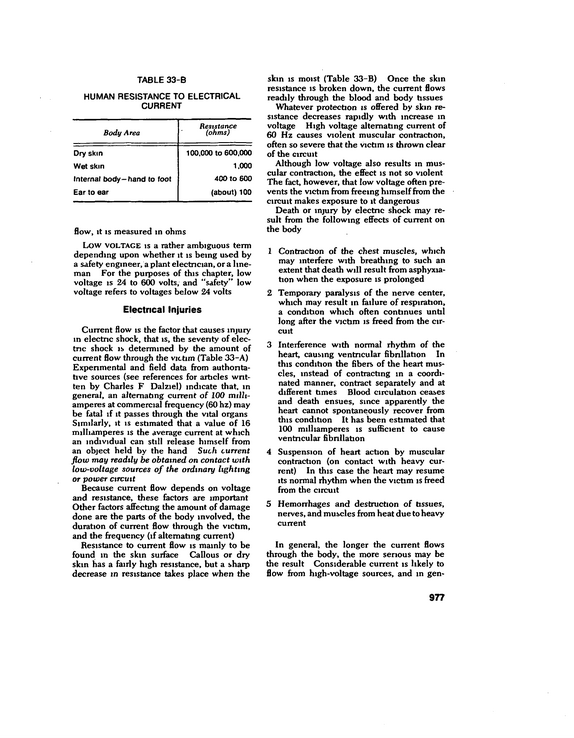
TABLE 33-B HUMAN RESISTANCE TO ELECTRICAL CURRENT Body Area Resistance (ohms) Dry skin Wet skin Internal body--hand to foot Ear to ear 100,000 to 600,000 1,000 400 to 600 (about) 100 flow, it is measured in ohms Low VOLTAGE is a rather ambiguous term depending upon whether it is being used by a safety engineer, a plant electrician, ora line man For the purposes of this chapter, low voltage is 24 to 600 volts, and "safety" low voltage refers to voltages below 24 volts Electrical Injuries Current flow is the factor that causes injury in electric shock, that is, the seventy of electnc shock is determined by the amount of current flow through the victim (Table 33-A) Expenmental and field data from authontative sources (see references for articles wntten by Charles F Dalziel) indicate that, m general, an alternating current of 100 milliamperes at commercial frequency (60 hz) may be fatal if it passes through the vital organs Similarly, it is estimated that a value of 16 milliamperes is the average current at which an individual can still release himself from an object held by the hand Such current flow may readily be obtained on contact with low-voltage sources of the ordinary lighting or power circuit Because current flow depends on voltage and resistance, these factors are important Other factors affecting the amount of damage done are the parts of the body involved, the duration of current flow through the victim, and the frequency (if alternating current) Resistance to current flow is mainly to be found m the skin surface Callous or dry skin has a fairly high resistance, but a sharp decrease m resistance takes place when the skin is moist (Table 33-B) Once the skin resistance is broken down, the current flows readily through the blood and body tissues Whatever protection is offered by skin re sistance decreases rapidly with increase m voltage High voltage alternating current of 60 Hz causes violent muscular contraction, often so severe that the victim is thrown clear of the circuit Although low voltage also results m mus cular contraction, the effect is not so violent The fact, however, that low voltage often pre vents the victim from freeing himself from the circuit makes exposure to it dangerous Death or injury by electric shock may re sult from the following effects of current on the body 1 Contraction of the chest muscles, which may interfere with breathing to such an extent that death will result from asphyxia tion when the exposure is prolonged 2 Temporary paralysis of the nerve center, which may result in failure of respiration, a condition which often conbnues until long after the vicbm is freed from the cir cuit 3 Interference with normal rhythm of the heart, causing ventricular fibnllabon In this condibon the fibers of the heart mus cles, instead of contrachng in a coordi nated manner, contract separately and at different bmes Blood circulabon ceases and death ensues, since apparently the heart cannot spontaneously recover from this condition It has been esbmated that 100 milliamperes is sufficient to cause ventricular fibnllabon 4 Suspension of heart acbon by muscular contraction (on contact with heavy cur rent) In this case the heart may resume its normal rhythm when the vicbm is freed from the circuit 5 Hemorrhages and destruction of bssues, nerves, and muscles from heat due to heavy current In general, the longer the current flows through the body, the more serious may be the result Considerable current is likely to flow from high-voltage sources, and in gen- 977
refid# MJZ6qq6wE2eBGObm2nLYL6JOV1 page
being made for locking the switch "off" and tagging it This precaution will prevent service interiuptions in the main circuit when power must he shut off in the branch circuit, and it will also prevent accidental starting of extra equipment that is tapped in Employee Training Few plants experience difficulty in selec tion and installation, but in maintenance and use of electrical equipment, deviation from safe practices is sometimes tolerated, with the usual result that unnecessary hazards are created and men are injured and killed Therefore, for maximum effectiveness, the safety program should include thorough training of all employees who work with the electrical installation of the plant or operate electrical equipment fn addition to instruc tions on the hazards of electricity, employees should be trained in first aid, the use of warning signs, guards, and other protective devices, and m safe operational procedures It is essential that they be trained in the mouth-to-mouth method of resuscitation and that distribution employees, especially, be trained in the pole-top method of resuscita tion The training program should consist not merely of generalization and indefinite rec ommendations, it should be based on the plant's electrical system and applied spe cifically to plant operations Supervisors should be given such instruc tions as may be necessary to acquaint them with the plant's electrical hazards, and they should be required to maintain close super vision over all operations which involve the use of electrical equipment They should en courage employees to report immediately any electrical defects observed and this equip ment should be repaired or replaced at once It is recommended that members of the plant safety department familiarize them selves with the codes and standards which apply to their equipment and operation and that someone from the electrical mainte nance staff be an active member of the plant safety committee The electrical mainte nance crew should consist of qualified elec tricians and other technically trained per sonnel according to the type of electrical equipment required in the plant References American Standards Institute, 1430 Broadway, New York, N Y 10018 Definitions and Ceneral Standards for Wire and Cables, C8 1 Dimensions of Caps, Plugs and Receptacles, C73 (Also N'EM ^ WD 1- 1965 ) Manual and Automatic Station Control, Supervisory and Associated Telemetering Equipment, C37 2 Relays and Relay Systems Associated with Electric Power Apparatus, C37 Requirements for Metallic and Associate Coverings for Insulated Cables C8 15 (Also IPCEA S-54-40I-I957 and NEMA WC2-1958 ) Safety Rules for the Operation of Electric Equipment and Lines C2 4 (Also NBS Hand book H34-I938 ' Specifications for Rubber Insulating Tape C59 6 (Also ASTM Dl 19 ) Specifications for Weather-Resistant Wire and Cable (URC Type ) C8 18 Specifications for Rubber Protective Equipment for Electrical Workers J6 Dalziel, Chailes F Effect of Electric Current on Man " Electrical Engineering, Febmarv 1941 ` Scientific Facts Concerning Electrical Hazards '' National Safety News, October 1947 "Electricity --Good and Faithful Servant '' National Safety News, September 1961 MeElrov, Frank E "Check Up on Your Electrical Outlets ' Cathohc Building and Mainte nance 15 92-98 (July-August 1963) 1007
refid# R26653O2vj8rG93jG0kLvdN7X1 page
standing to windward A cover should be removed with the man facing the dome With feet well braced, he should use short, vigorous pushes on the bar The cover (if not provided with a chain) and loose tools should be removed to the walk platform or other safe place so that they will not fall On the bolted type of dome cover, all nuts should be unscrewed one turn and the cover lifted to break adhesion which may exist between the cover and the dome ring If there is a sound of escaping vapors, the dome should be tightened and the venting operation repeated All dirt, cinders, and debris should be re moved from around the interior type of dome cover before the yoke is unscrewed When the car must be unloaded through the bottom outlet valve, dome covers should be adjusted to allow for venting The screw type should be screwed down just enough to ex pose the Vfc-m vent holes m the threaded por tion of the cover A small, thin wood block should be placed under the bolted type of cover, and the in terior type of dome cover should be tightened up in the yoke to within VS> in of the closed position An asbestos or metal cover or wet burlap or canvas should be placed over the tank manhole to protect against entrance of sparks or other source of ignition Unloading and loading connections The safest method of unloading tank cars is through the dome Some states prohibit bottom unloading Where a car has only bot tom unloading, the tank's outlet valve must be closed before the outlet chamber cap or plug is removed A pail or tub should be placed under the outlet chamber and the 2-m outlet cap unscrewed The condition of the outlet valve should be checked, and if there is no senous leak, the unloading should proceed If the plug does not loosen readilv with a 48-inch wrench, the bottom outlet cap or plug can be tapped to loosen it If the valve leaks so badly that a connection cannot be made without spilling the product, the car should be unloaded from the top In cold weather the outlet chamber, if the chamber or valve is frozen or blocked with frozen liquid, should be carefully examined for cracks If a crack is not found, the con nection for unloading should be made and the outlet chamber wrapped with burlap or other rags, and hot water or steam applied The connection from the car to the storage tank should be carefully checked for proper condition before the car valve is opened The storage tank should be watched to pre vent overflow, and the hose and unloading line should be checked frequently The tank car should be examined before loading lines are disconnected to make certain that it is completely empty A workman should be present throughout the entire loading or unloading operation and while a car is connected If it is neces sary to discontinue operations before they are completed, the outlet valve should be closed and the dome cover and outlet chamber cap replaced Tank cars should not be allowed to stand with loading or unloading connections at tached after operations are completed If flammable liquids are spilled, spill areas should be covered with fresh dry sand or dirt Never flush spills into public sewers and drainage systems, or natural waterways When heater pipes are used for unloading, the steam should be applied slowly until it begins to exhaust at the outlet pipe Steam pressure should not exceed that needed to bring the contents to the desired tempera ture and should never be high enough to cause the contents to overflow Care also must be exercised to avoid ex ceeding the flash temperature of "cut-backs" or additives introduced into various heavy products --for example, the addition of naph tha to residual asphalt Overheating these products containing certain additives can release dangerous quantities of flammable vapors Placards Shipping cards and Dangerous or Flam mable placards should be provided and then removed after operations are completed They should then be replaced with DANGER OUS-EMPTY placards Defect cards or forms of any kind which have been attached to a car by railroad employees should not be removed Placards, rags, waste, and blocks should not be disposed of in the tank or car body 1023
refid# R26r7z2xxMEy7bknDb8vp4nm81 page
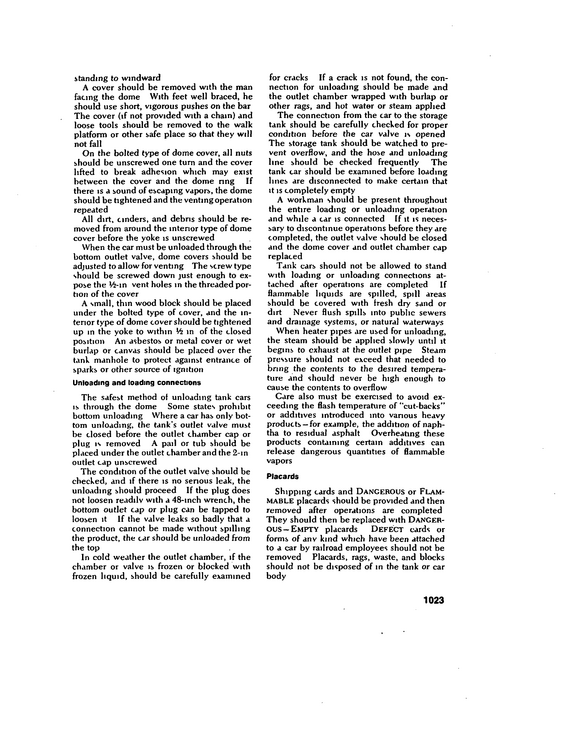
Fir 36-9 -- Proportioner permits operator to varv percentage of foam-producing concentrate are listed by Underwriters' Laboratories, Inc , are siphoned through a proportioner at rates not exceeding 2 per cent by volume The reflective white opaque surface formed by the air bubbles and wet-water particles makes this agent a good medium for protec tion from exposure fires The cellular struc ture of the foam also retards heat conduction, thus affording insulation As the foam blanket absorbs the heat and breaks down, the wet water released from the air bubbles car ries the heat away from the protected surface Mixing wetting agents with other wetting agents or with mechanical or chemical foam is not recommended, since it may neutralize the effect of the agents and thus destroy the fire fighting properties High expansion foam, using wetting agents in ratios as high as 1000 to 1, has been devel oped These foams have a water content ranging from 0 2 to 10 oz/cu ft, and are effec tive in fighting fires in inaccessible places, such as coal mines and building basements High expansion foams can also be used in total flooding systems designed to fill en closed spaces, such as rooms or buildings The systems are suitable for hazards involv ing flammable liquids and ordinary combus tibles, if properly designed for the specific hazard and area Wet water The wet water principle can also be used without generating foam In liquid form, wet water has the same general extinguishing properties as plain water However, its cool ing ability is increased, and there is a greater penetration of porous surfaces because of its reduced surface tension Carbon dioxide extinguishing systems Fixed (local or flood-type) C02 systems are often installed for the protection of rooms that contain electrical equipment, flammable liquid or gas processes, dry cleaning machin ery, and other exposures where fire can be ex tinguished by diluting the oxygen content of the air or where water must not be used be cause of electrical hazard or the nature of the 1089
refid# 2B5o3aZKmV905jMkvvOYmwEp1 page
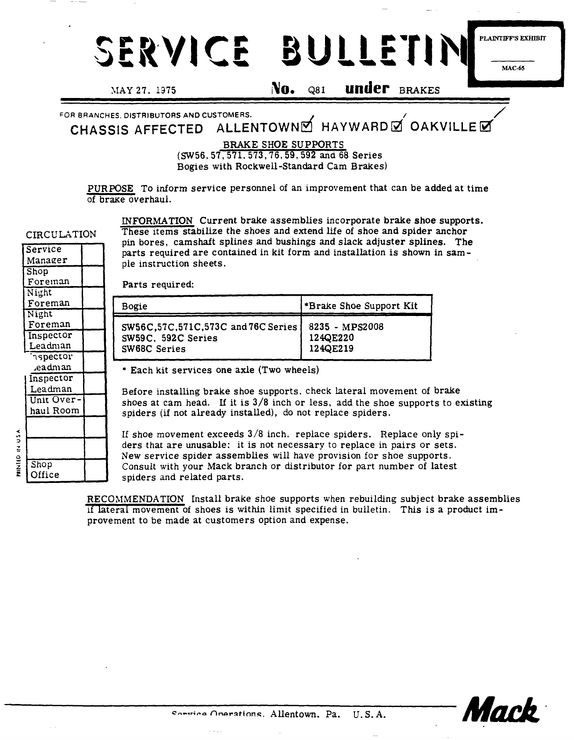
SERVICE BULLETIN PLAINTIFF'SEXHIBIT MAY 27. 1975 \0.
refid# aJrpOEj4zEyKO2bYXLdZMM86e3 pages
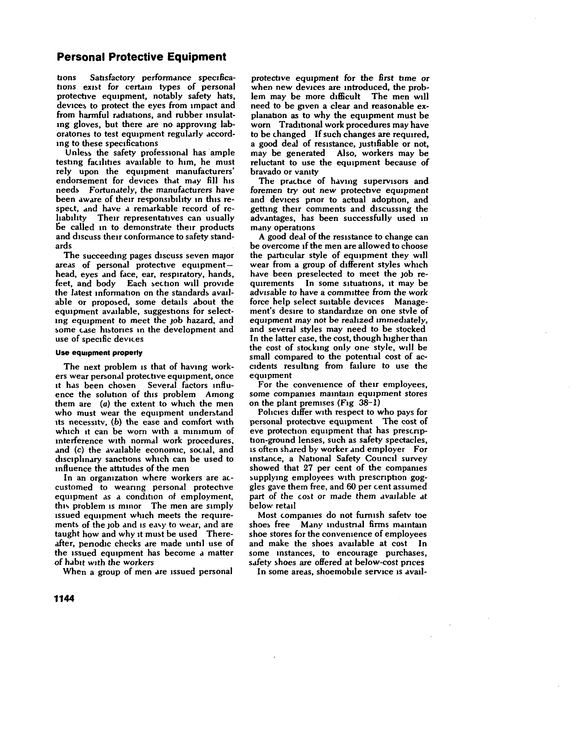
Personal Protective Equipment lions Satisfactory performance specifica tions exist for certain types of personal protective equipment, notably safety hats, devices to protect the eyes from impact and from harmful radiations, and rubber insulat ing gloves, but there are no approving lab oratories to test equipment regularly accord ing to these specifications Unless the safety professional has ample testing facilities available to him, he must rely upon the equipment manufacturers' endorsement for devices that may fill his needs Fortunately, the manufacturers have been aware of their responsibility in this re spect, and have a remarkable record of re liability Their representatives can usually Be called in to demonstrate their products and discuss their conformance to safety stand ards The succeeding pages discuss seven major areas of personal protective equipment-- head, eyes and face, ear, respiratory, hands, feet, and body Each section will provide the latest information on the standards avail able or proposed, some details about the equipment available, suggestions for select ing equipment to meet the job hazard, and some case histones in the development and use of specific devices Use equipment property The next problem is that of having work ers wear personal protective equipment, once it has been chosen Several factors influ ence the solution of this problem Among them are (a) the extent to which the men who must wear the equipment understand its necessity, (b) the ease and comfort with which it can be worn with a minimum of interference with normal work procedures, and (c) the available economic, social, and disciplinary sanctions which can be used to influence the attitudes of the men In an organization where workers are ac customed to weanng personal protective equipment as a condition of employment, this problem is minor The men are simply issued equipment which meets the require ments of the job and is easy to wear, and are taught how and why it must be used There after, periodic checks are made until use of the issued equipment has become a matter of habit with the workers When a group of men are issued personal protective equipment for the first time or when new devices are introduced, the prob lem may be more difficult The men will need to be given a clear and reasonable explanabon as to why the equipment must be worn Traditional work procedures may have to be changed If such changes are required, a good deal of resistance, justifiable or not, may be generated Also, workers may be reluctant to use the equipment because of bravado or vanity The practice of having supervisors and foremen try out new protective equipment and devices prior to actual adoption, and getting their comments and discussing the advantages, has been successfully used m many operations A good deal of the resistance to change can be overcome if the men are allowed to choose the particular style of equipment they will wear from a group of different styles which have been preselected to meet the job re quirements In some situations, it may be advisable to have a committee from the work force help select suitable devices Manage ment's desire to standardize on one stvle of equipment may not be realized immediately, and several styles may need to be stocked In the latter case, the cost, though higher than the cost of stocking only one style, will be small compared to the potential cost of ac cidents resulbng from failure to use the equipment For the convenience of their employees, some companies maintain equipment stores on the plant premises (Fig 38-1) Policies differ with respect to who pays for personal protecbve equipment The cost of eve protection equipment that has prescrip tion-ground lenses, such as safety spectacles, is often shared by worker and employer For instance, a National Safety Council survey showed that 27 per cent of the companies supplying employees with prescnphon gog gles gave them free, and 60 per cent assumed part of the cost or made them available at below retail Most companies do not furnish safetv toe shoes free Many industrial firms maintain shoe stores for the convenience of employees and make the shoes available at cost In some instances, to encourage purchases, safety shoes are offered at below-cost prices In some areas, shoemobile service is avail- 1144
refid# qa2K4qmkmYkoMNmBQXmz4979K1 page
a> J CO c s E "IOD; 3o. o w 7z*2 cOH ID & - c2 fc 8 *0 JL ffl O T5 Ql . k C>O 2 * SSi?
refid# rpr35dRboZ64dJEraMd3rMp5q1 page