Refine
Estimated Years UndatedClear
92,592 results foundRefine Search
ASBESTOS & HEALTH MEETINGS n S'

refid# B8N9qKyVVgzVbMmy870XbzdVk1 page
r*.
refid# G68eL1zNa3mN7ggaxL9E8zeaN1 page
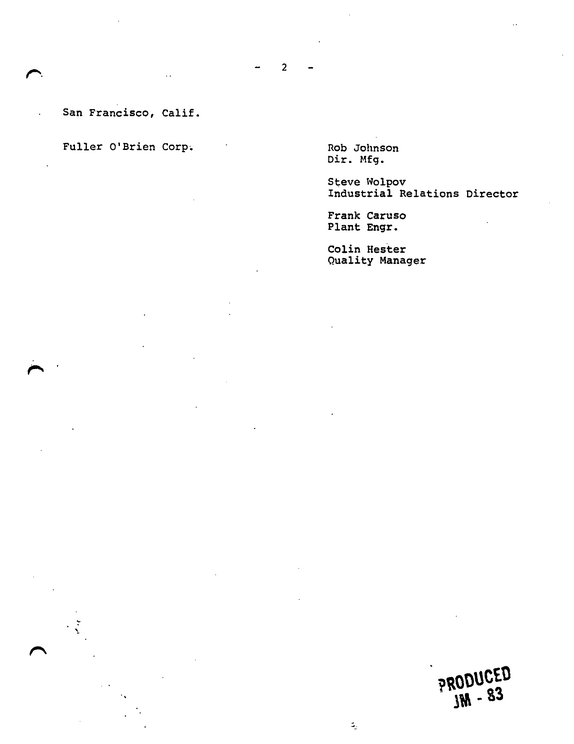
6--Accident Records and Injury Rates existing physical deficiency ) 4 Injury from an external event of such pro portions and character as to be beyond the control of the employer, such as a tornado, twister, hurricane, earthquake, flood, con flagration, or explosion originating outside of employment, or from an immediate sec ondary event, such as a fire, boiler explo sion, or falling electric wire (An injury would be repoi table, though, if the victim were a policeman, fireman, member of a disaster or emergency squad, utility line man, or other employee who is assigned duties m connection with such events An injury also would be reportable if it arose out of activities necessitated by an external event, such as fighting a fire, cleaning up debris, or repainng equipment ) Days charged Losses from woik injuries are evaluated m terms of days of disability, or inability to pro duce, either actual or potential These losses are referred to simply as "days charged " For the first three classes of injuries--death, perma nent total disability, and permanent partial disability--the number of days charged is a predetermined total For permanent partial disability, the predetermined total usually ex ceeds the actual time lost to reflect potential future losses of productive capacity The predetermined totals are referred to as "sched uled charges" This procedure is based on the philosophy of economic loss which reasons, for example, that a man who has a hand amputated will produce less dunng his remaining working years than a man who completely recovers from a hand injury, even though both injuries resulted in the same number of actual days lost at the time of the injury If both injuries resulted in, say, 60 days lost at the time of the injury, the injury from which the victim completely recovers would be chaiged only the 60 days, whereas the amputation would be charged 3000 days, the scheduled charge for this kind of injury Death and permanent total disabilities.
refid# LKLmyxe5OLey8nnRXQYz8gnEd1 page
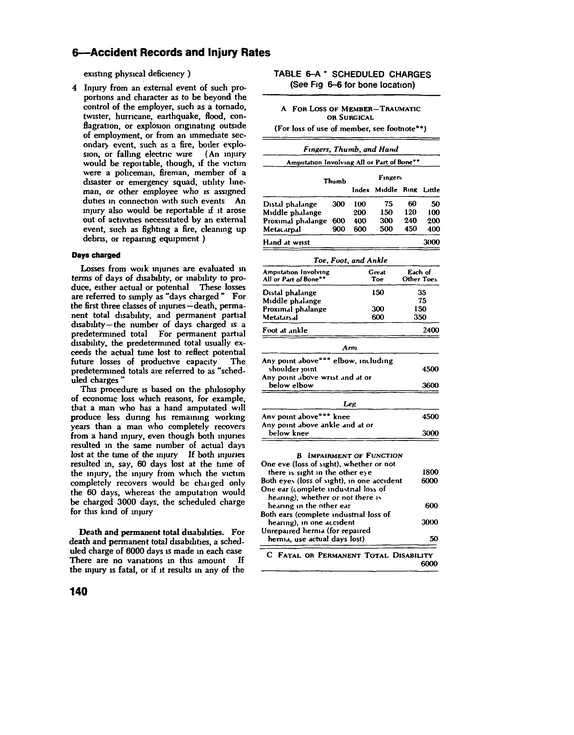
r ACCIDENT COSTS \ A PER 1,000 HOURS) $ 8.00 $6.00 $4:00 $ 2.Q0 V A SALES DIV.
refid# Ne4wE3B5D5k4O72Yj0ZVNgEKQ1 page
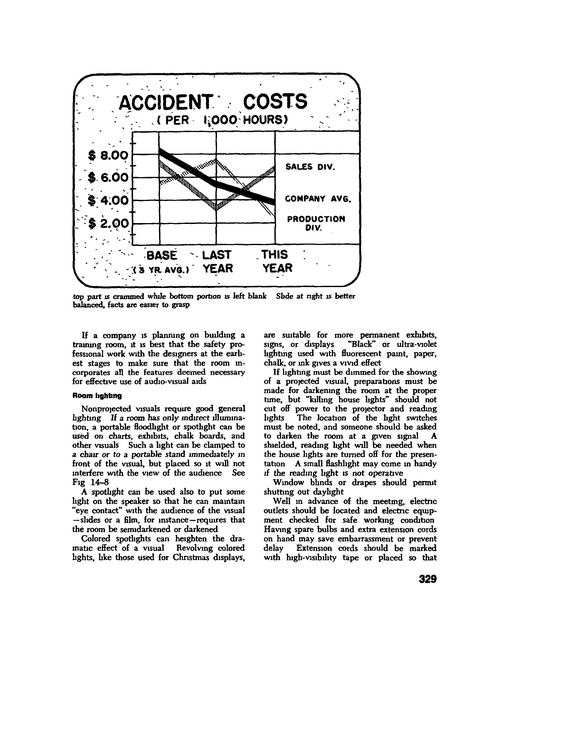
18--Planning for Emergencies IN CASE OF FIRE OR OTHER EMERGENCY ** KEEP YOUR HEAD--avoid panic and confusion KNOW THE LOCATION OF EXITS--be sure you know the safest way out of the build ing no matter where you are * KNOW THE LOCATION OF NEARBY FIRE EXTINGUISHERS-learn the proper way to use all types of extinguishers KNOW HOW TO REPORT A FIRE OR OTHER EMERGENCY-send in the alarm with out delay, notify the CHIEF OF EXIT DRILLS. * FOLLOW EXIT INSTRUCTIONS--stay at your work place until signaled or instructed to leave, complete all emergency duties assigned to you and be ready to march out rapidly according to plan is WALK TO YOUR ASSIGNED EXIT--maintain order and quiet, take each drill ser iously--It may be "the real thing " REMEMBER--IT IS PART OF YOUR JOB TO PREVENT FIRES Fic 18-2 --Sample emergency exit notice for general posting they could be used m light salvage operations Because wholehearted cooperation of per sonnel is necessary to the successful operation of an emergency plan, shop stewards or other representatives of labor should take part in the planning They must be made to see that whatever measures are taken are for the protection of the lives and jobs of the work ers as well as for protecting property Training of key people will be of little value unless it reaches down to all employees The better informed and prepared the work force, the less chance of panic and confusion during the emergency Provisions should be made for emergency reporting centers so that employees will know where to report should the disaster occur while the employees are away from the plant Repotting centers give employees a feeling of security and continuity, and aid the company in taking a "roll call " To facili tate these arrangements, each employee should carry an identification card which gives spe 450 cific instructions on where to report, list of other reporting centers, basic employment record, and designation of the employee's next of kin in case they must be contacted or receive money due him The reporting center will keep a duplicate record for each employee assigned to report there A one-plant company or a small company can consider using the home of a member of management, a supervisor, or an employee Training One of the most important functions of the director and his staff, on both the corporate and plant levels, is training Training for each type of disaster is essential in developing a disaster-control plan and keeping it func tioning Employees must be taught to realize that an emergency plan is vital and real--it cannot exist usefully if it remains a remote idea Training and rehearsals are time con suming, but they keep the program in good working order
refid# Ev7z1qg1a1ZRbx5YEk27q3xdV1 page
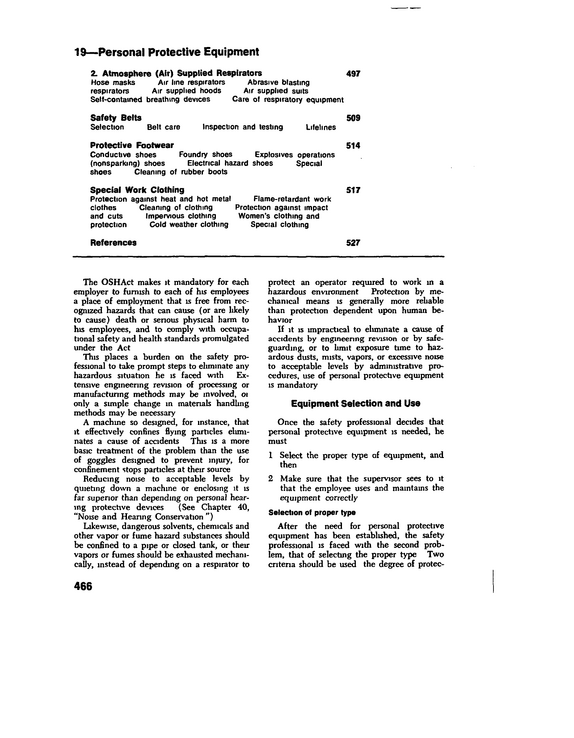
19--Personal Protective Equipment 2.
refid# 2Jx5DkE4EOQN9Yve97OJpjxBN1 page
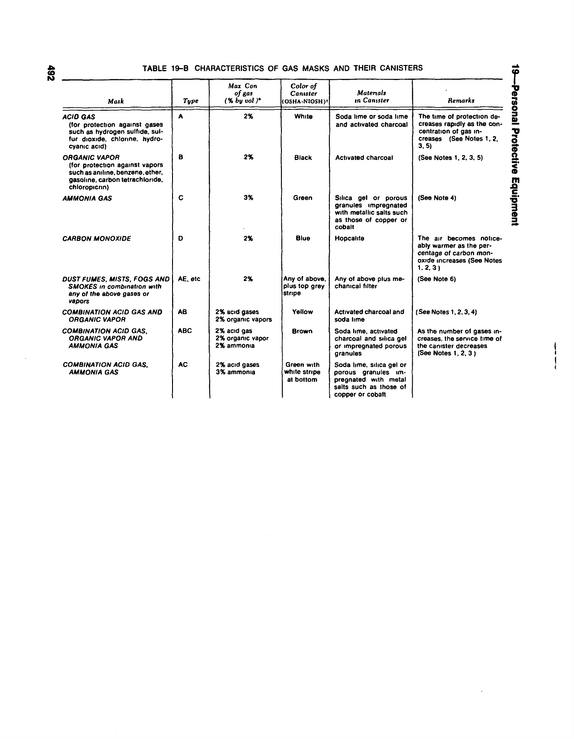
19--Personal Protective Equipment 492 TABLE 19-B CHARACTERISTICS OF GAS MASKS AND THEIR CANISTERS Mask ACID GAS (for protection against gases such as hydrogen sulfide, sul fur dioxide, chlorine, hydro cyanic acid) ORGANIC VAPOR (for protection against vapors such as aniline, benzene, ether, gasoline, carbon tetrachloride, chloropicrin) AMMONIA GAS Type A B C CARBON MONOXIDE D DUST FUMES, MISTS, FOGS AND SMOKES in combination ninth any o1 the above gases or vapors COMBINATION ACID GAS AND ORGANIC VAPOR COMBINATION ACID GAS.
refid# DMGYOGgnkMVrOezBzL5Kj3mXB1 page
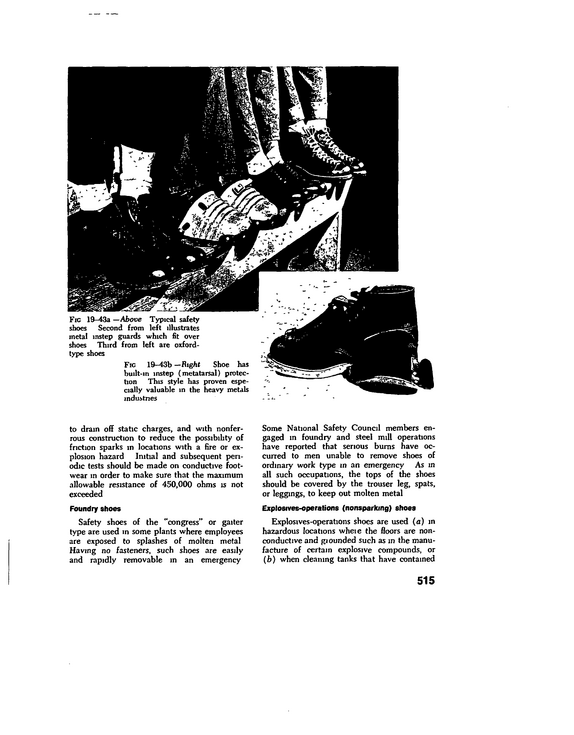
Fic 19-43a --Above Typical safety shoes Second from left illustrates metal instep guards which fit over shoes Third from left are oxfordtype shoes Fic 19-43b --Right Shoe has built-in instep (metatarsal) protec tion This style has proven espe cially valuable m the heavy metals industries to drain off static charges, and with nonferrous construction to reduce the possibility of friction sparks m locations with a fire or ex plosion hazard Initial and subsequent peri odic tests should be made on conductive foot wear in order to make sure that the maximum allowable resistance of 450,000 ohms is not exceeded Foundry shoes Safety shoes of the "congress" or gaiter type are used in some plants where employees are exposed to splashes of molten metal Having no fasteners, such shoes are easily and rapidly removable in an emergency Some National Safety Council members en gaged in foundry and steel mill operations have reported that serious bums have oc curred to men unable to remove shoes of ordinary work type m an emergency As m all such occupations, the tops of the shoes should be covered by the trouser leg, spats, or leggings, to keep out molten metal Exptosrves-operations (nonsparking) shoes Explosives-operations shoes are used (a) in hazardous locations wheie the floors are nonconductive and giounded such as in the manu facture of certain explosive compounds, or (b) when cleaning tanks that have contained 515
refid# BvMB5eXr3mX2DpmY8B72KmQwj1 page
'7?

refid# 99OxD8RVyBR3zz7nzzyOk6nZV45 pages
Blumberg No. 5113 i
refid# zxoqnraGQ6npBbw7Ed3ppOp31 page
in the vice ixfc dationa^ nUe' ers# n4 by in-| or bjf uippecT: _*.

refid# Y5yRV8bG7gQo36mYm7B1Nmnn11 pages
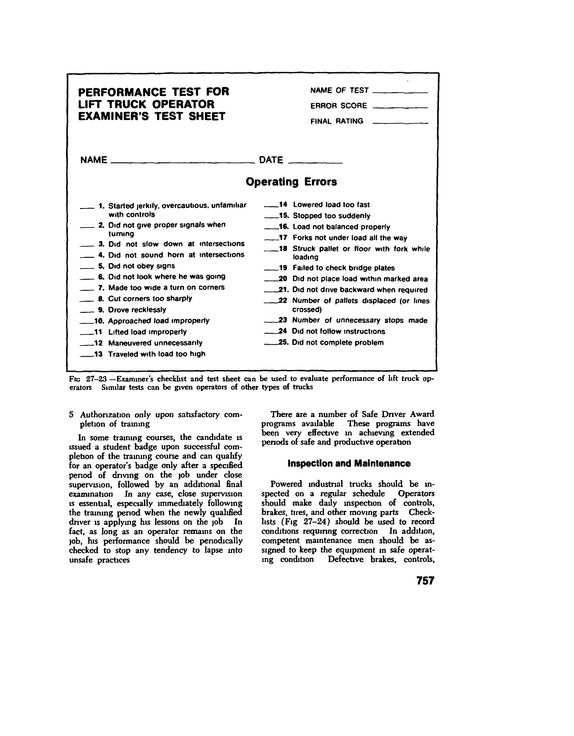
PERFORMANCE TEST FOR LIFT TRUCK OPERATOR EXAMINER'S TEST SHEET NAME OF TEST ERROR SCORE FINAL RATING NAME DATE Operating Errors ___ 1.
refid# M4YdaBzwVbOGx04XL1qzE2o7L1 page
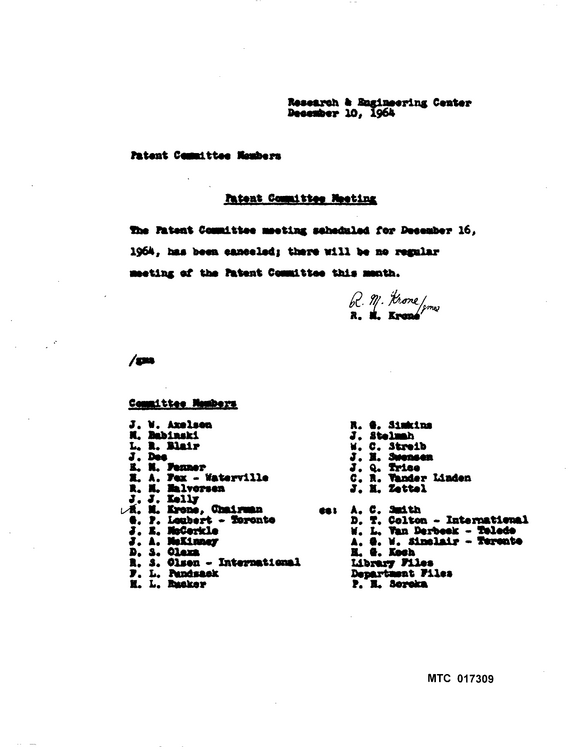
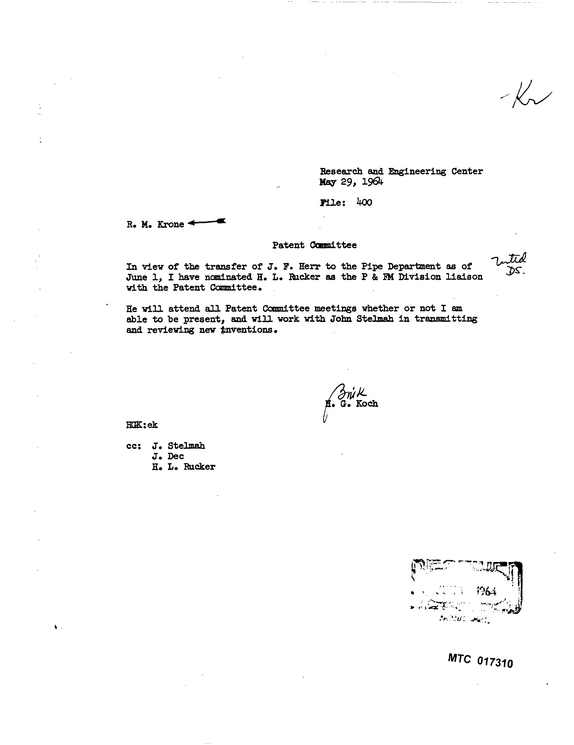
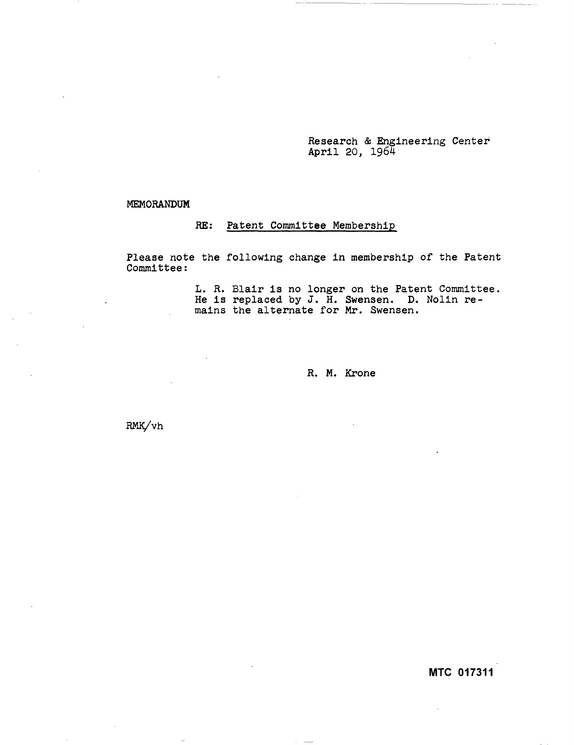
__ PATENT COMMITTEE 19^^ __ PATENT DEPARTMENT-ADMINISTRATIVE texlneerlng Center intent Ceamttee Restore fiaptffat ftt Ittoot temttet imIUi Mtetalad for OHMbtr 16, 1964, ban teen eeneeledj there mil te ne recelar toting ef the Intent Cea&ttee this tenth. a. a.

refid# 2jKaeXKOKZqBRXM25o4O357dR13 pages
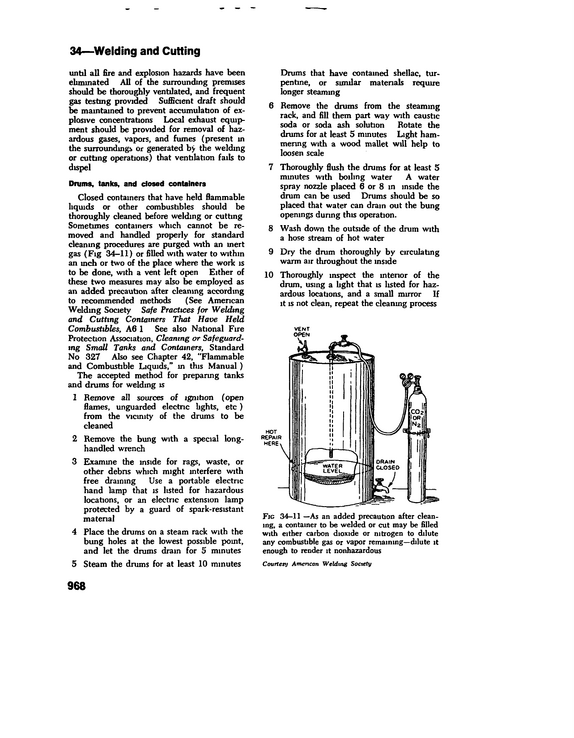
34--Welding and Cutting until all fire and explosion hazards have been eliminated All of the surrounding premises should be thoroughly ventilated, and frequent gas testing provided Sufficient draft should be maintained to prevent accumulation of ex plosive concentrations Local exhaust equip ment should be provided for removal of haz ardous gases, vapors, and fumes (present in the surroundings or generated by the welding or cutting operations) that ventilation fails to dispel Drums, tanks, and dosed containers Closed containers that have held flammable liquids or other combustibles should be thoroughly cleaned before welding or cutting Sometimes containers which cannot be re moved and handled properly for standard cleaning procedures are purged with an inert gas (Fig 34-11) or filled with water to within an inch or two of the place where the work is to be done, with a vent left open Either of these two measures may also be employed as an added precaution after cleaning according to recommended methods (See American Welding Society Safe Practices for Welding and Cutting Containers That Have Held Combustibles, A6 1 See also National Fire Protection Association, Cleantng or Safeguard ing Small Tanks and Containers, Standard No 327 Also see Chapter 42, "Flammable and Combustible Liquids," in this Manual ) The accepted method for preparing tanks and drums for welding is 1 Remove all sources of ignition (open flames, unguarded electric lights, etc) from the vicinity of the drums to be cleaned 2 Remove the bung with a special longhandled wrench 3 Examine the inside for rags, waste, or other debns which might interfere with free draining Use a portable electric hand lamp that is listed for hazardous locations, or an electric extension lamp protected by a guard of spark-resistant matenal 4 Place the drums on a steam rack with the bung holes at the lowest possible point, and let the drums dram for 5 minutes 5 Steam the drums for at least 10 minutes 968 Drums that have contained shellac, tur pentine, or similar materials require longer steaming 6 Remove the drums from the steaming rack, and fill them part way with caustic soda or soda ash solution Rotate the drums for at least 5 minutes Light ham mering with a wood mallet will help to loosen scale 7 Thoroughly flush the drums for at least 5 minutes with boiling water A water spray nozzle placed 6 or 8 in inside the drum can be used Drums should be so placed that water can dram out the bung openings during this operation. 8 Wash down the outside of the drum with a hose stream of hot water 9 Dry the drum thoroughly by circulating warm air throughout the inside 10 Thoroughly inspect the interior of the drum, using a light that is listed for haz ardous locations, and a small mirror If it is not clean, repeat the cleaning process VENT Fic 34-11 --As an added precaution after clean ing, a container to be welded or cut may be filled with either carbon dioxide or nitrogen to dilute any combustible gas or vapor remaining-dilute it enough to render it nonhazardous Courtesy American Welding Society
refid# jYjNDBabV9m6Do8vkgp8oqJN1 page
Aldrin (l,2,3,4,10,10-hexachloro-l,4,4a,5,8,8a - hexahydro - 1,4,5,8 - dimethanonaphthalene) is a chlorinated hydrocarbon insecticide with the effects on the liver and kidneys which are typical of the chlorinated hydrocarbons It is somewhat more toxic to warm-blooded forms of life than is DDT or chlordane and has a considerable tendency to accumulate in the body Aliphatic thiocyanates (lethanes, Thanite) --see Thiocyanates (aliphatic).
refid# YqGvJwMGewdvemYBM5bNKDE01 page