Refine
Estimated Years UndatedClear
92,592 results foundRefine Search
even if no treatment is given, including those which require use of an approved canister type gas mask This degree should include Matenals which under fire conditions would give off irritating combustion products, Matenals which on the skin could cause lrntation without destruction of tissue Q Materials which on exposure under fire conditions would offer no hazard beyond that of ordinary combustible matenal NFPA flammability hazards deal with the degree of susceptibility of matenals to burn ing, even though some matenals that bum under one set of conditions will not bum under others The form or condition of ma tenal, as well as its properties, affects the hazard The degrees of hazard are ranked according to the susceptibility of matenals to burning, as follows ^ Matenals which will rapidly or com pletely vaponze at atmosphenc pressure and normal ambient temperature or which are readily dispersed in air, and which will bum readily This degree should include Gaseous materials.
refid# VMpOvYgazx1YgBvZ7mQLKZVK1 page
Industrial Noise most often used for testing large numbers of persons It eliminates the need for a tech nician except to begin the test The subject controls the presentabon of sound and re cords his response Band pressure level of a sound for a specified frequency band is the sound pres sure level for the sound contained within the restricted band The reference pressure must be specified Bandwidth When applied to a bandpass filter, bandwidth is determined by the inter val of transmitted waves between the low and high cutoff frequencies Barotrauma An injury to the ear caused by a sudden alterabon in barometric pressure Bone conduction test A special test conducted by placing an oscillator on the mastoid process to determine the nervecanrying capacity of the cochlea and the eighth cranial (auditory) nerve Calibrate To check an audiometer for uniformity or accuracy It may be done bio logically, electronically, or acousbcally Cerumen Ear wax Cochlea The auditory part of the in ternal ear, shaped like a snail shell It con tains the basilar membrane on which the end organs of the auditory nerve are distributed Conduction deafness An impairment of hearing due to the failure of vibrahons to be transmitted to the cochlea This type of deafness can often be corrected medically or surgically Damage risk criterion The suggested base line of noise tolerance, which if not exceeded, should result in no hearing loss due to noise A damage nsk criterion may include in its statement a specificabon of such factors as time of exposure, noise level, and frequency, amount of hearing loss that is considered significant, percentage of the populabon to be protected, and method of measunng the noise DEAF The term used to describe a person who has lost his hearing before the speech patterns were established Deafened Refers to a person who has lost his ability to hear after normal speech patterns were established Decibel A dimensionless unit express ing the logarithmic raho of two amounts of pressure, power, or intensity, between a measured quanbty and a reference quanbty Diffuse sound field One in which the bine average of the mean-square sound pres sure is everywhere the same and the flow of energy m all directions is equally probable Displacement A vector quanbty that specifies the change of position of a body or particle and is usually measured from the mean position or position of rest In general it can be represented by a rotation vector or banslation vector, or both Ear defenders Plugs or muffs designed to keep noxious noise from the ear to pre serve hearing acuity Eustachian tube A structure about 2'/2 in long leading from the back of the throat to middle ear It equalizes the pressure of air m the middle ear with that outside the eardrum Filter A device for separating com ponents of a signal on the basis of their fre quency It allows components m one or more frequency bands to pass relabvely unatten uated, and it attenuates greatly components m other frequency bands Free sound field (free field) A field m a homogeneous, isotropic medium free from boundaries In practice it is a field in which the effects of the boundaries are negli gible over the region of interest Frequency (in cycles per second, or CPS, Hertz OR Hz) The hme rate of repe- bbon of a penodic phenomenon The fre quency is the reciprocal of the period It is sometimes called pitch or the highness or lowness of sound High frequencies damage more easily than low' frequencies m noiseinduced hearing loss Hearing conservation The prevention or minimizing of noise-induced deafness through the use of hearing protection devices and the control of noise through engineering methods HEARING LEVEL Formerly called "hearing loss," is the deviation m decibels of an m- 1518
refid# RjVQvw2veXnyeY5eK57L2Kq6a1 page
Index Breeching, boiler, 475 Breeder reactor, 1434 Bremsstrahlung, 1434, 1442 Bridge plates, see Docks, loading Bridges, foot, 392-394, 397 Brigades, emergency, 1132-1133 historical, 13 Brightness ratios, table of, 1582 Broaches, metal, 759-760 Bromine, 1333 Bromochloromethane, 1333 Bronchibs, 1322 Brucellosis, 1271 Brushes, scratch, 968-969 Bubble chamber, 1434 Bucket conveyors, 572-573 Buffing wheels, 780, 968-969 exhaust for, 1599-1600 Buildings construction, 420-436, 1489, 1573 cut-offs, 1051-1052 industrial, 391-392, 398-416 inspection of, 54-55, 452-453 location, 392-393, 398-400 Built-up scaffolds, 442-445 Bulldozers, (construction), see Graders, motor Bulldozers (forging), 849 Bulletin boards, 190-191, 253-254 Bulletins, safety contest, 179 Bump caps, 1146, 1148 Bureau of Labor Standards, 349, Bureau of Labor Statistics, 349-350 Bureau of Mines, 176. 347-348, 1295 respiratory equipment, 1164-1165, 1172, 1181 Bureau of Motor Carrier Safety, 352 Bureau of Public Roads, 351-352 Burlap, storing, 517 Bum-up, 1434 Burners, oil, 1041-1042, 1058 Burning (rubbish disposal), see Wastes Bums, 1322, 1442, 1448, 1553, 1556 chemical, 1323, 1556-1557 1,3-Butadiene, 1334 1- Butanol, 1334 2- Butanone, 1334 n-Butyl acetate, 1334 n-Butylamine, 1334 Butylithium, 1334 Butyraldehvdes, 1335 Buttons, safety, 195 Buzzers, signal, 1128 Byssmosis, 1270 c Cables (power lines), 406-407, 931-933, 935, 937, 1562-1564 Cadmium metal, toxicology, 1335 Cafeterias, industnal, 1217-1219 Caisson work, 1264-1265 Calcium, toxicology, 1335-1336 Calcium arsenate, 1336 Calcium carbide, 922, 1336 Calcium cyanamide, 1336 "California study" of office accidents, 374-380 Can Manufacturers Institute, Inc , 335 Canada government agencies, 362-363 Labour (Safety) Code, 363 private provincial agencies, 363-364 Canadian Standards Institute, 978 Cancer, 1269, 1448 Canisters, gas mask, 1166-1167, 1170-1172 Canopies roof, 459 vehicle, 1560-1561 ventilation, 863 Cans, waste, see Waste disposal Caps, bump, 1146, 1148, 1200 Carbohydrates, 1423 Carbon, 802 Carbon dioxide "buildup," 898, 915, 1265 extinguishing systems, 1089-1090 ' fire extinguishers, 1105 toxicology, 1336 Carbon disulfide, 1336 Carbon monoxide, 618, 632, 802, 811, 915, 1168, 1170, 1176-1177, 1259, 1304 toxicology, 1253, 1337 ventilation of, 890-891, 1259 Carbon tetrachloride, 1337, 1350-1351 Carboys, 519-521 Cars, see Elevators or Railroads Cartons handling, 503-506, 529-530 storage, 515-516 Cask (or coffin), 1434, 1435 Cast iron, dust control, 886 Castings, see Foundries Catalyst, 1322, 1423 Cell, human, 1447 radiation damage to, 1447-1450, 1458-1463 Cellulose, 1423 Cells, living, 1301, 1304, 1323, 1447-1450 Celsius-Fahrenheit conversion table, 1580-1581 Cerenkov radiation, 1434 Cerumen, 1518 Cesium-137, 1434, 1476-1479 Chain drives, guarding of, 681 Chain conveyors, 570 Chain hoists, 538, 1557 Chain reaction, 1434, 1456 Chains, 653-656 guarding, 674, 681 inspection, 55, 655-656 slings, 653-656 Chairs, office, 383-384 Chalk boards, 232-233 Charge number, 1434 1626

refid# zbdeQe664ze47BxN5k1xYKxDn1 page
_Gra legs -- would you know they're ,, ".u-.i .*> u - \ ,;r. .si- ri . : ' <<>, >f ,, I wearing Belle Sharmeer't Whisper Sheer support stockings?
refid# N2ab6NkMJ00zYDbBZb4OZ21Lp1 page
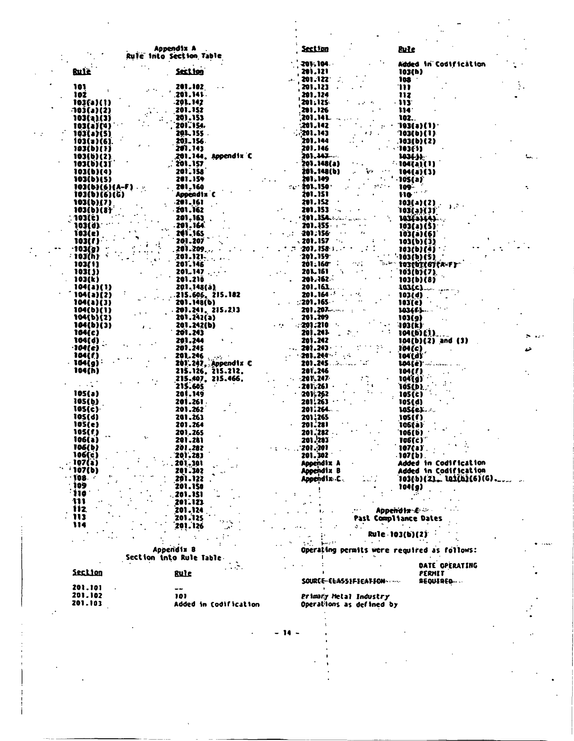
Appendix A Rule Into Sect Ion.
refid# DDDNB80rm7R8GbGx49DK20YZa1 page
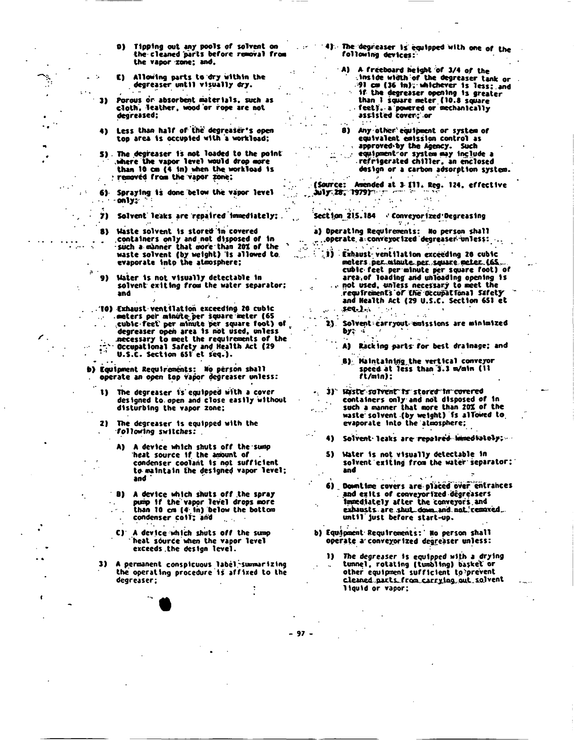
0) Tipping out Mjr pools of solvent on the- cleaned 'parts before rexoval fro* the vapor zone; and.
refid# yro1QoOayaV04w61G16J3Nejd1 page
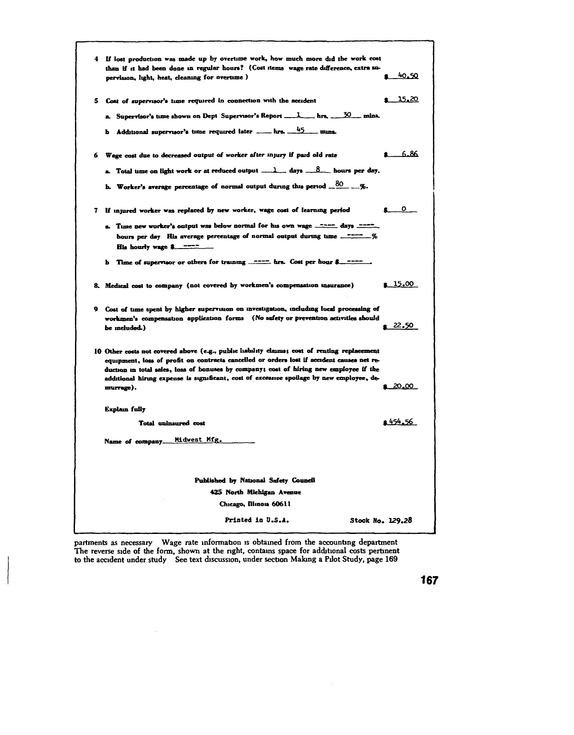
4 If lost production was made up by overtime work, how much more did the work coat tlmw (f it h*d been done in regular hours?
refid# NG37ywO6Lx3mL855L0LENyOng1 page
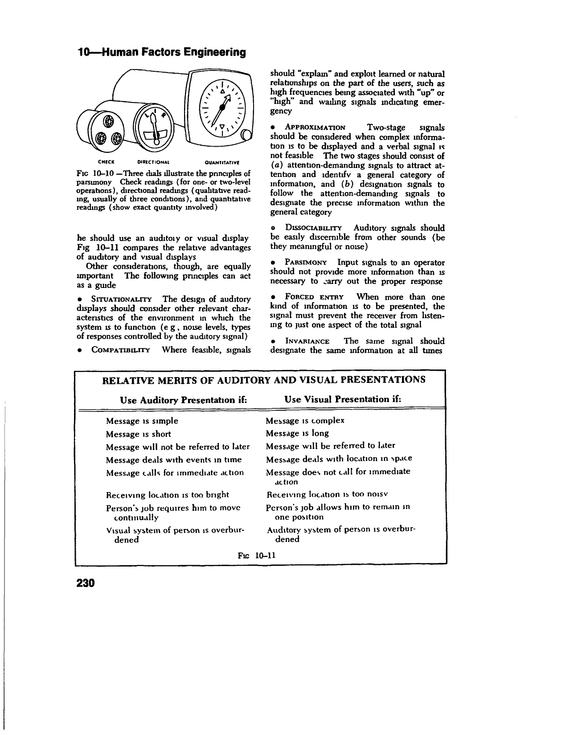
10--Human Factors Engineering Fic 10-10 --Three dials illustrate the principles of parsimony Check readings (for one- or two-level operations), directional readings (qualitative read ing, usually of three conditions), and quantitative readings (show exact quantity involved) he should use an auditoiy or visual display Fig 10-11 compares the relative advantages of auditory and visual displays Other considerations, though, are equally important The following principles can act as a guide Situationality The design of auditory displays should consider other relevant char acteristics of the environment m which the system is to function (e g, noise levels, types of responses controlled by the auditory signal) Compatibility Where feasible, signals should "explain" and exploit learned or natural relationships on the part of the users, such as high frequencies being associated with "up" or "high" and wailing signals indicating emer gency Approximation Two-stage signals should be considered when complex informa tion is to be displayed and a verbal signal is not feasible The two stages should consist of (a) attention-demanding signals to attract at tention and identify a general category of information, and (b) designation signals to follow the attention-demanding signals to designate the precise information within the general category o Dissociability Auditory' signals should be easily discernible from other sounds (be they meaningful or noise) Parsimony Input signals to an operator should not provide more information than is necessary to carry out the proper response Forced entry When more than one kind of information is to be presented, the signal must prevent the receiver from listen ing to just one aspect of the total signal Invariance The same signal should designate the same information at all tunes RELATIVE MERITS OF AUDITORY AND VISUAL PRESENTATIONS Use Auditory Presentation if: Use Visual Presentation if: Message is simple Message is short Message will not be referred to later Message deals with events in time Message calls for immediate action Receiving location is too bright Person's job requires him to move continually Visual system of person is overbur dened Message is complex Message is long Message will be referred to later Message deals with location in space Message does not call for immediate action Receiving location is too noisv Person's job allows him to remain m one position Auditory system of person is overbur dened Fic 10-11 230
refid# jmmrRko0Y2zDnYmbpdp7GD6vp1 page
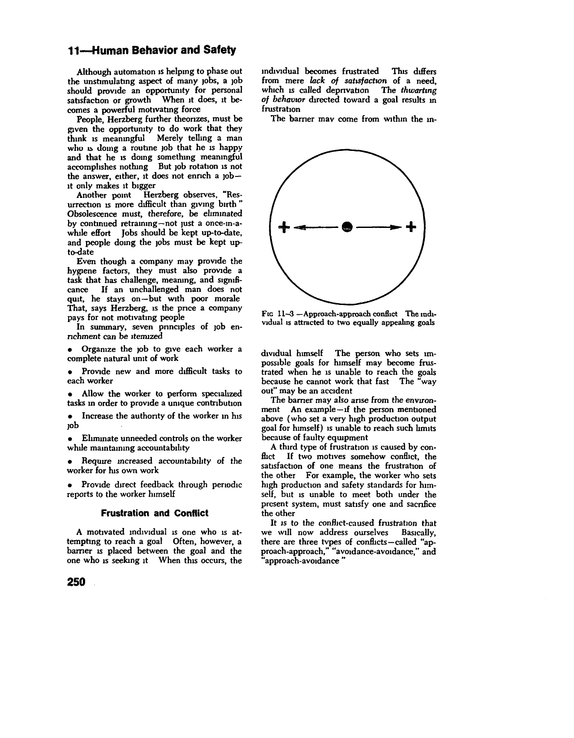
11--Human Behavior and Safety Although automation is helping to phase out the unstimulahng aspect of many jobs, a job should provide an opportunity for personal satisfaction or growth When it does, it be comes a powerful motivating force People, Herzberg further theorizes, must be given the opportunity to do work that they think is meaningful Merely telling a man who is doing a routine job that he is happy and that he is doing something meaningful accomplishes nothing But job rotation is not the answer, either, it does not ennch a job-- it only makes it bigger Another point Herzberg observes, "Res urrection is more difficult than giving birth " Obsolescence must, therefore, be eliminated by continued retraining--not just a once-in-awhile effort Jobs should be kept up-to-date, and people doing the jobs must be kept upto-date Even though a company may provide the hygiene factors, they must also provide a task that has challenge, meaning, and signifi cance If an unchallenged man does not quit, he stays on--but with poor morale That, says Herzberg, is the price a company pays for not motivating people In summary, seven principles of job en richment can be itemized Organize the job to give each worker a complete natural unit of work Provide new and more difficult tasks to each worker Allow the worker to perform specialized tasks in order to provide a unique contribution Increase the authority of the worker in his job Eliminate unneeded controls on the worker while maintaining accountability Require increased accountability of the worker for his own work Provide direct feedback through periodic reports to the worker himself Frustration and Conflict A motivated individual is one who is at tempting to reach a goal Often, however, a barrier is placed between the goal and the one who is seeking it When this occurs, the 250 individual becomes frustrated This differs from mere lack of satisfaction of a need, which is called deprivation The thwarting of behavior directed toward a goal results m frustration The barrier mav come from within the m- Fic 11-3-Approach-approach conflict The indi vidual is attracted to two equally appealing goals dividual himself The person who sets im possible goals for himself may become frus trated when he is unable to reach the goals because he cannot work that fast The "way out" may be an accident The barrier may also arise from the environ ment An example--if the person mentioned above (who set a very high production output goal for himself) is unable to reach such limits because of faulty equipment A third type of frustration is caused by con flict If two motives somehow conflict, the satisfaction of one means the frustration of the other For example, the worker who sets high production and safety standards for him self, but is unable to meet both under the present system, must satisfy one and sacrifice the other It is to the conflict-caused frustration that we will now address ourselves Basically, there are three tvpes of conflicts--called "ap proach-approach," "avoidance-avoidance," and "approach-avoidance "
refid# YrrdYJar0rjr92Vxm7kvX5NNO1 page
ground transparencies in a matter of seconds and at negligible cost by the dry-process copy method, diazo method, or photographic method Full-color transparencies can be made di rectly from day-coated stock originals such as magazines and brochures by means of a special color-lift-off film For repeated show ings of an important subject, the additional expense of full-color transparencies of original subjects might be justified Color can also be added by the use of tinted plastic overlay sheets, either loose sheets or self-adhering The latter can be cut to cover and add color to portions of the art work or can be cut to form interesting art or background designs The transparencies can be as large as 10 in square and can be mounted in cardboard frames "Commentator cues" or a scnpt can be added to the frame for convenient ref erence Unmounted plastic sheets or a large roll of plastic film, which can be rolled to the other side of the projector and either dis carded or rolled back for reference, also can be used.
refid# e73B1434exyO7JX7qbreQvLgg1 page
17--Building Construction and Maintenance design and installation prevents the direct application of radiant heat on to the con tainer Blower type or radiant heaters should not be directed toward any LP-gas container within 20 ft If two or more heater-container units (of either the integral or nonmtegrated type) are located in an unpartitioned area on the same floor, the container (s) of each unit should be separated by at least 20 ft The total water capacity of contamers manifolded together m an unpartiboned area should not be greater than 735 lb (nominal 300 lb LPgas capacity) These containers should also be separated by at least 20 ft On floors on which heaters are not con nected together for use, containers may be manifolded together for connection to heaters on another floor, provided that (a) the total water capacity of the containers connected to any one manifold is not greater than 2450 lb (nominal 1000 lb LP-gas capacity), and (b) where more than one manifold having a total water capacity greater than 735 lb (nommal 300 lb LP-gas capacity) is located m the same unpartitioned area, the manifolds should be separated by at least 50 ft LP-gas cylinders should not be refilled in side buildings or structures Cylinders should be stored outside of buildings, should stand on a firm and substantially level surface, and should be secured m an upright position Demolition o!
refid# 7Raq1z13XOBbwERMj40jq7rVe1 page
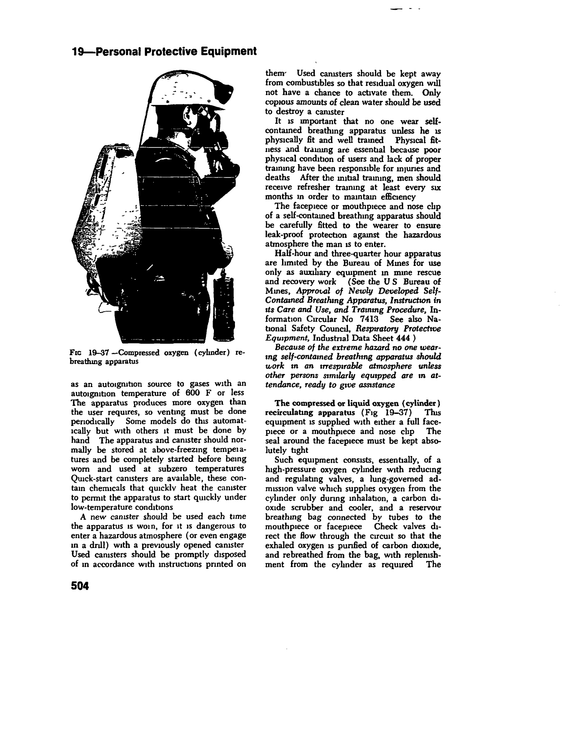
19--Personal Protective Equipment Fic 19-37 --Compressed oxygen (cylinder) rebreathing apparatus as an autoignition source to gases with an autoignition temperature of 600 F or less The apparatus produces more oxygen than the user requires, so venting must be done periodically Some models do this automat ically but with others it must be done by hand The apparatus and canister should nor mally be stored at above-freezing tempeiatures and be completely started before being worn and used at subzero temperatures Quick-start canisters are available, these con tain chemicals that quicklv heat the canister to permit the apparatus to start quickly under low-temperature conditions A new canister should be used each time the apparatus is woin, for it is dangerous to enter a hazardous atmosphere (or even engage m a drill) with a previously opened canister Used canisters should be promptly disposed of m accordance with instructions printed on them- Used canisters should be kept away from combustibles so that residual oxygen will not have a chance to activate them.
refid# Y9vwRyxvZw4z8MdwnjJqLOX2y1 page
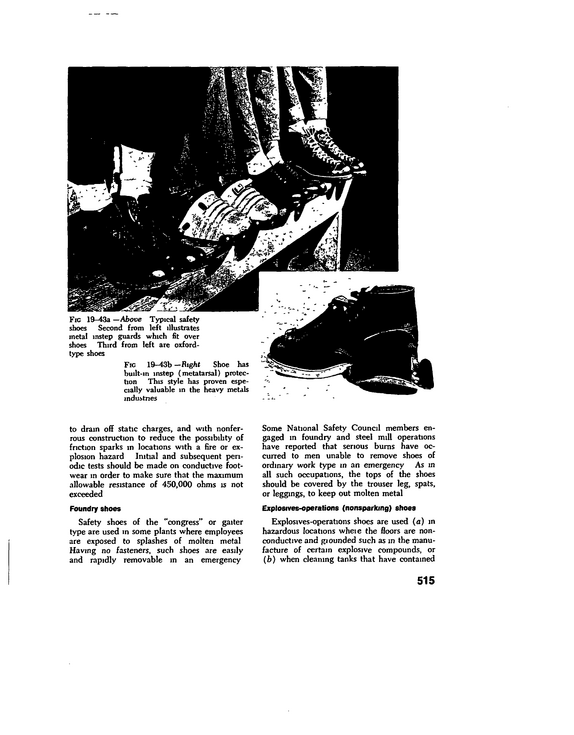
Fic 19-43a --Above Typical safety shoes Second from left illustrates metal instep guards which fit over shoes Third from left are oxfordtype shoes Fic 19-43b --Right Shoe has built-in instep (metatarsal) protec tion This style has proven espe cially valuable m the heavy metals industries to drain off static charges, and with nonferrous construction to reduce the possibility of friction sparks m locations with a fire or ex plosion hazard Initial and subsequent peri odic tests should be made on conductive foot wear in order to make sure that the maximum allowable resistance of 450,000 ohms is not exceeded Foundry shoes Safety shoes of the "congress" or gaiter type are used in some plants where employees are exposed to splashes of molten metal Having no fasteners, such shoes are easily and rapidly removable in an emergency Some National Safety Council members en gaged in foundry and steel mill operations have reported that serious bums have oc curred to men unable to remove shoes of ordinary work type m an emergency As m all such occupations, the tops of the shoes should be covered by the trouser leg, spats, or leggings, to keep out molten metal Exptosrves-operations (nonsparking) shoes Explosives-operations shoes are used (a) in hazardous locations wheie the floors are nonconductive and giounded such as in the manu facture of certain explosive compounds, or (b) when cleaning tanks that have contained 515
refid# BvMB5eXr3mX2DpmY8B72KmQwj1 page
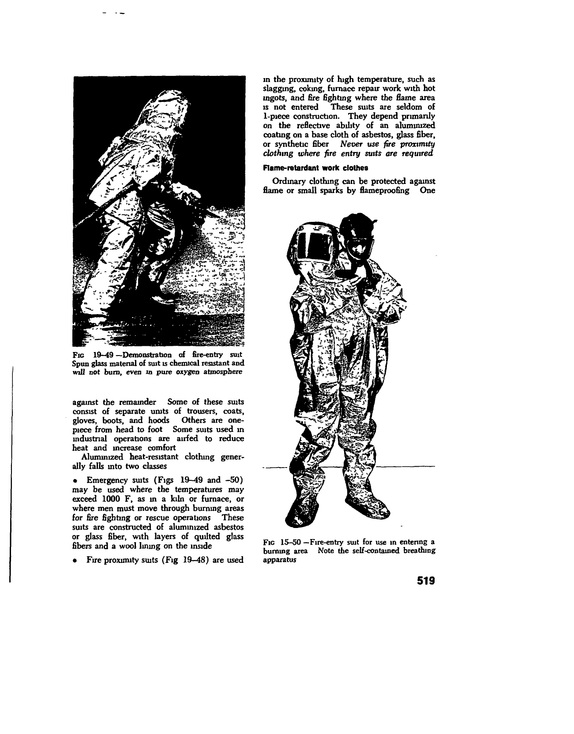
in the proximity of high temperature, such as slagging, coking, furnace repair work with hot ingots, and fire fighting where the flame area is not entered These suits are seldom of 1-piece construction.
refid# vVevJypNap1pkp6KYey22wG181 page
refid# 6wvBywkVOvqNNgeX45XeQe51R1 page