Refine
Estimated Years 1960-1969Clear
31,974 results foundRefine Search
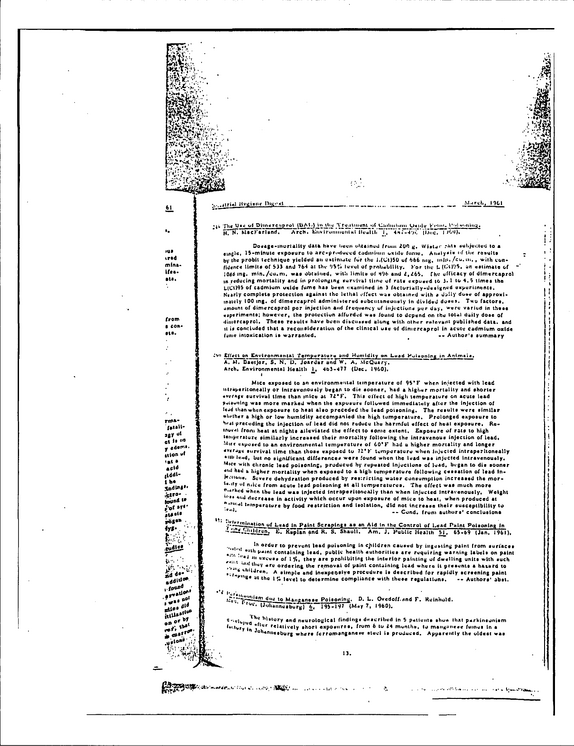
' x. x# X:X *'.' <.. f*v5*'r'^v sti.: . s*rwv'V"" 61 nil trad miniIfeaK. from con* t*. .Iri.l Hvuicnc OlK''l M.iri;!
refid# 1QLRM2mK6MwwZOv0eEdErRb2j1 page
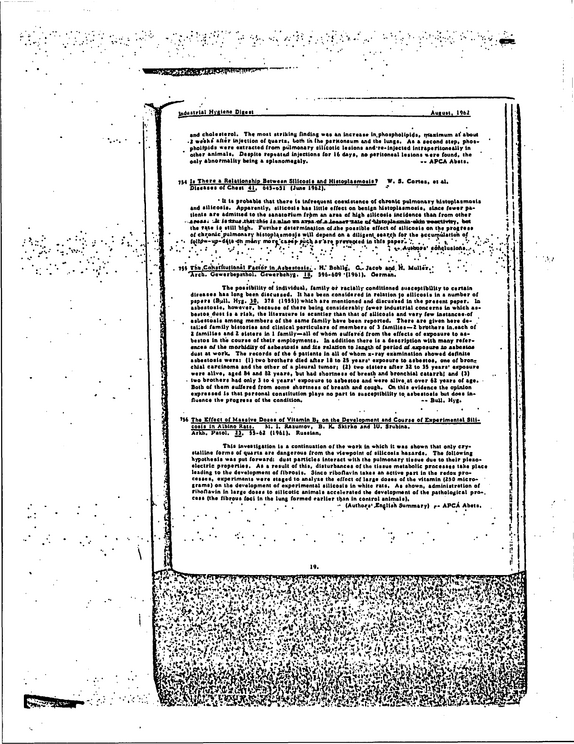
Industrial Hvfllane Digest Aumit, 1961 and cholesterol.
refid# jgrbORKMnGB6gXo5b612e3Qy1 page
* 'i t.
refid# zxrYegyVXkmkgoyv1LyYnbBm1 page
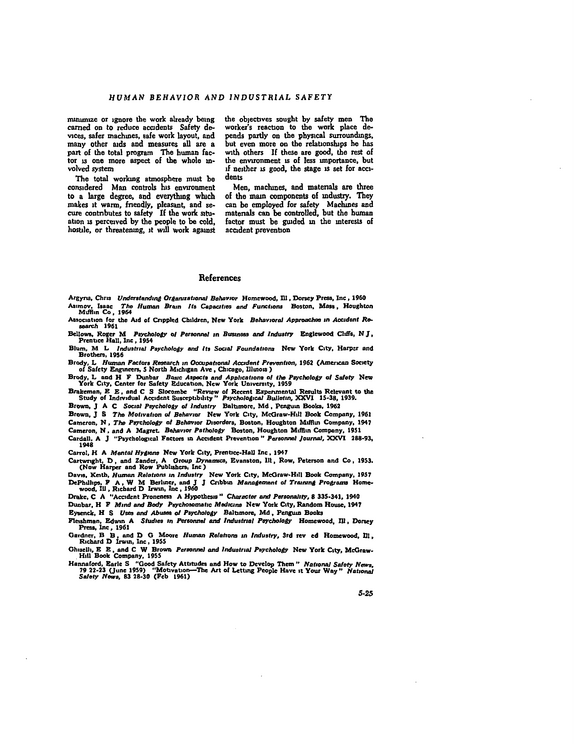
HUMAN BEHAVIOR AND INDUSTRIAL SAFETY minimize or ignore the work already being earned on to reduce accidents Safety de vices, safer machines, safe work layout, and many other aids and measures all are a part of the total program The human fac tor is one more aspect of the whole in volved system The total working atmosphere must be considered Man controls his environment to a large degree, and everything which makes it warm, fnendly, pleasant, and se cure contributes to safety If the work situ ation is perceived by the people to be cold, hostile, or threatening, it will work against the objectives sought by safety men The worker's reaction to the work place de pends partly on the physical surroundings, but even more on the relationships he has with others If these are good, the rest of the environment is of less importance, but if neither is good, the stage is set for acci dents Men, machines, and materials are three of the mam components of industry.
refid# 936BwpjGaKqZgaD5LzxYyaZM71 page
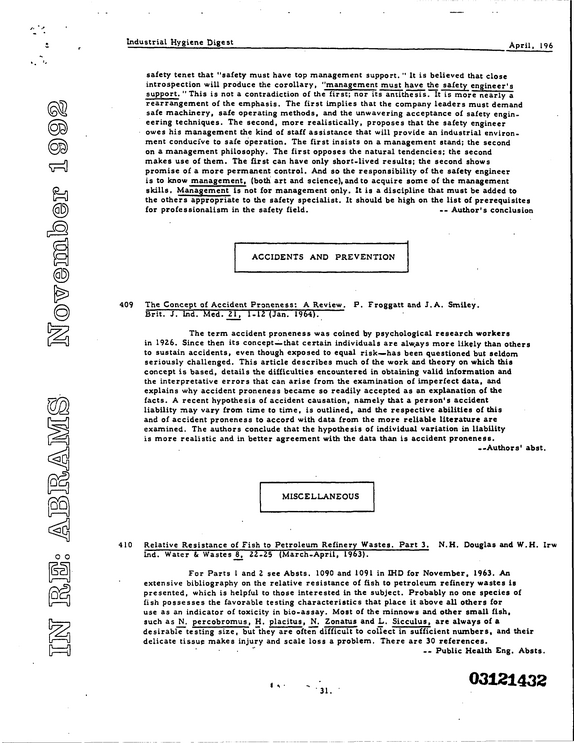
C=3 Industrial Hygiene Digest April, 196 safety tenet that "safety must have top management support. " It is believed that close introspection will produce the corollary, "management must have the safety engineer's support.
refid# ypQXw2v9Xp0L4xEM984njG8921 page
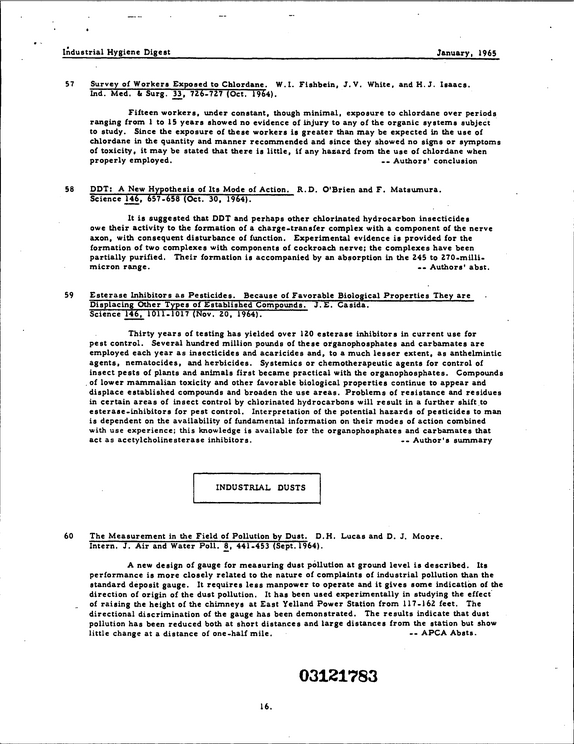
Industrial Hygiene Digest January, 1965 57 Survey of Workers Exposed to Chlordane.
refid# G6rN0kaZ6qMORmMnY28N2doYv1 page
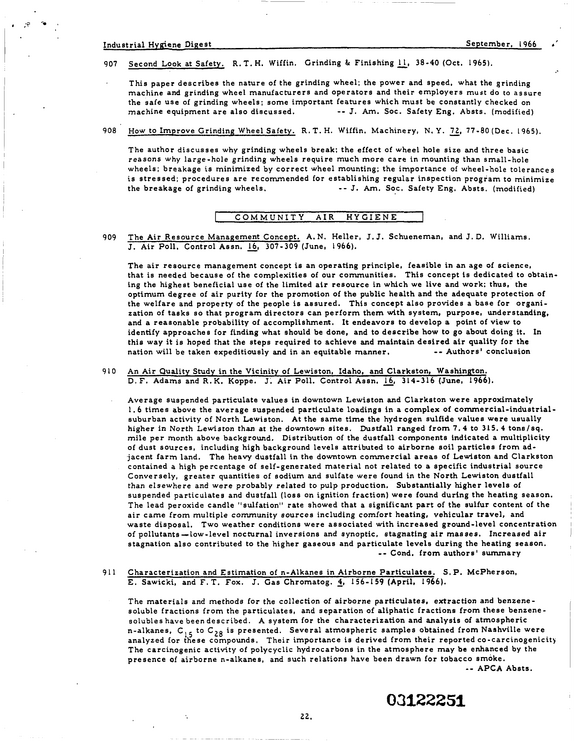
Industrial Hygiene Digest September. 1966 907 Second Look at Safety.
refid# JrNeVnp4M5QqvDoG0Zp7JaDdv1 page
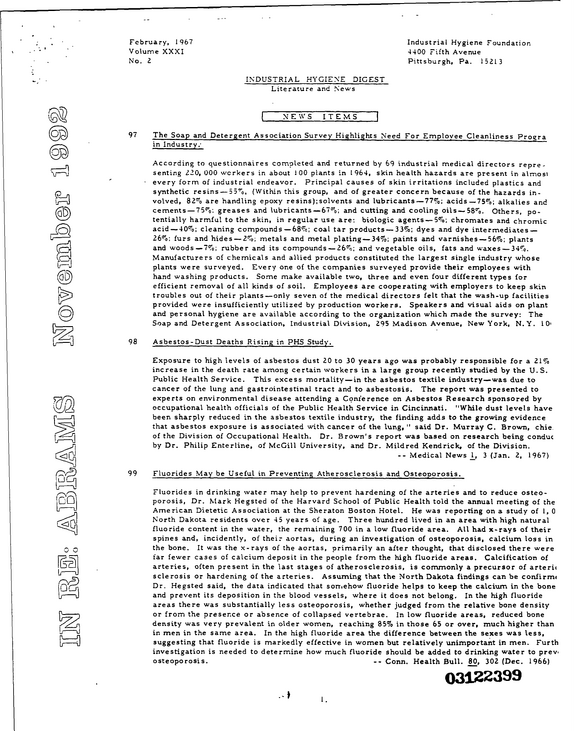
fel > j Q L--J C=3 February, 1967 Volume XXXI No. 2 INDUSTRIAL HYGIENE DIGEST Literature and News Industrial Hygiene Foundation 4400 Fifth Avenue Pittsburgh, Pa. 15213 NEWS ITEMS 97 The Soap and Detergent Association Survey Highlights Need For Employee Cleanliness Progra in Industry.- According to questionnaires completed and returned by 69 industrial medical directors repre senting 220, 000 workers in about 100 plants in 1964, skin health hazards are present in almost every form of industrial endeavor.
refid# 0q8jpnYYR81EB1yX0keedMvOO1 page
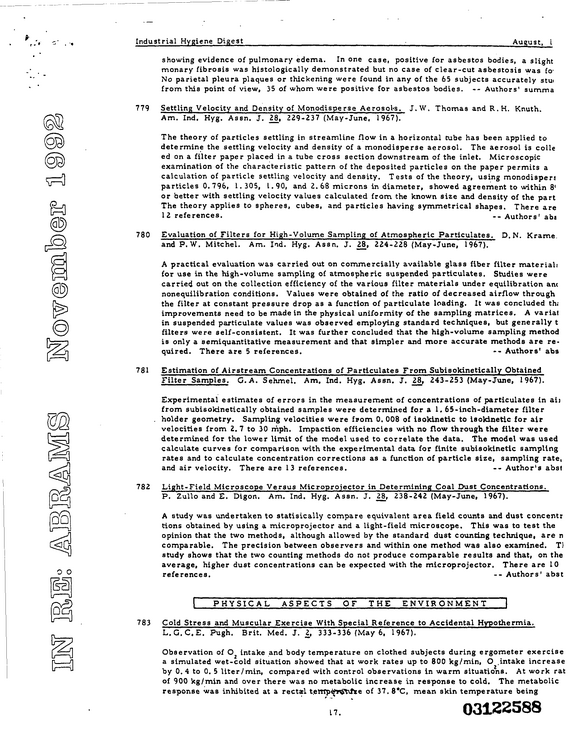
. v=3 fel c=a Industrial Hygiene Digest August, 1 showing evidence of pulmonary edema.
refid# 2JoEGeYqwGgQwBMmdrR6aby5L1 page
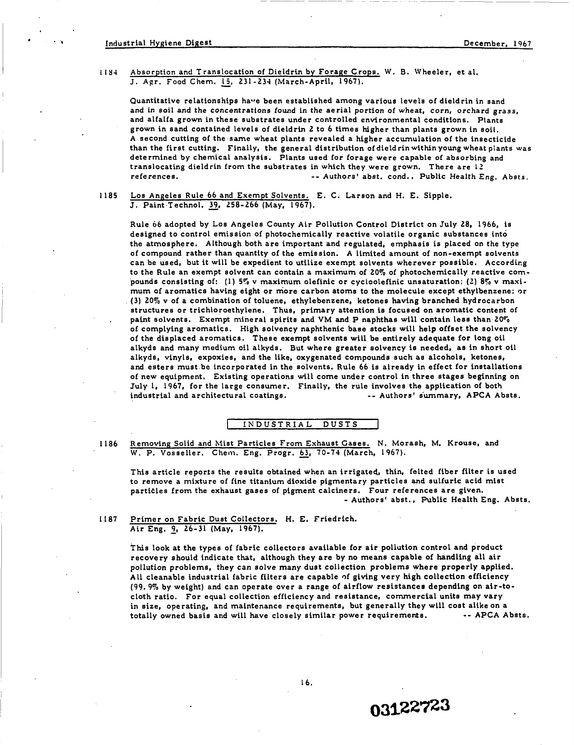
Industrial Hygiene Digest December, 1967 1184 Absorption and Translocation of Dieldrin by Forage Crops.
refid# ppjQjwZygEB5Lod5R043BBa871 page
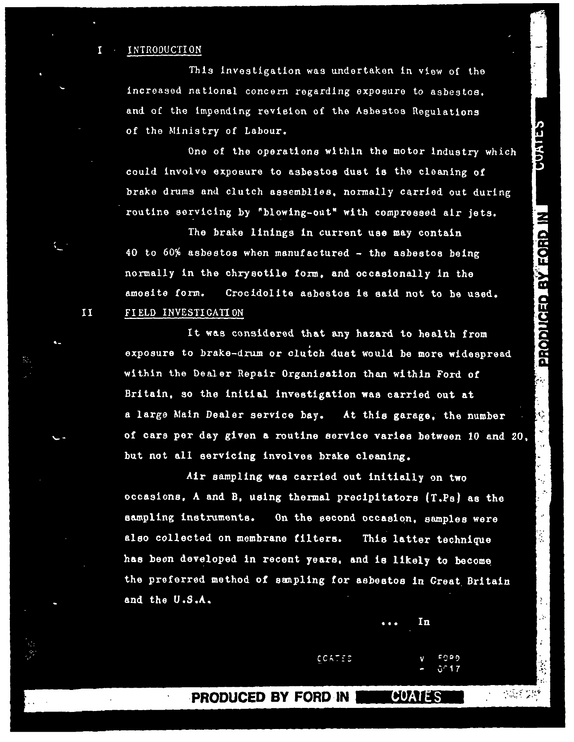
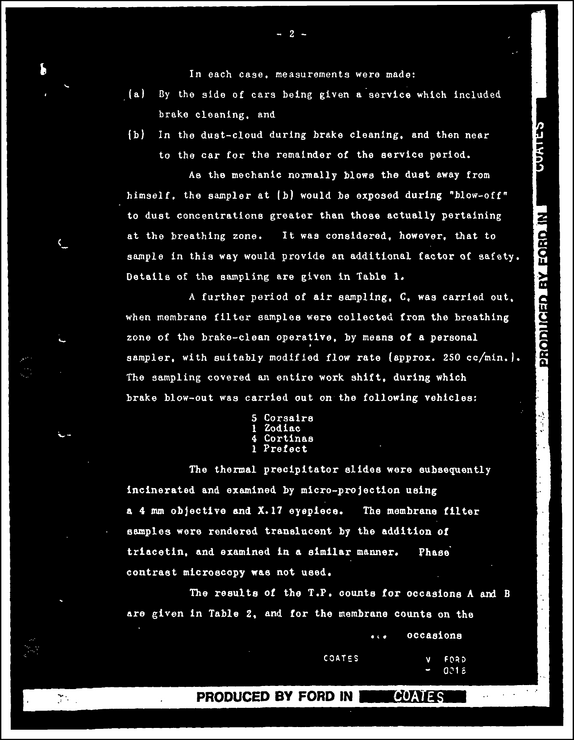
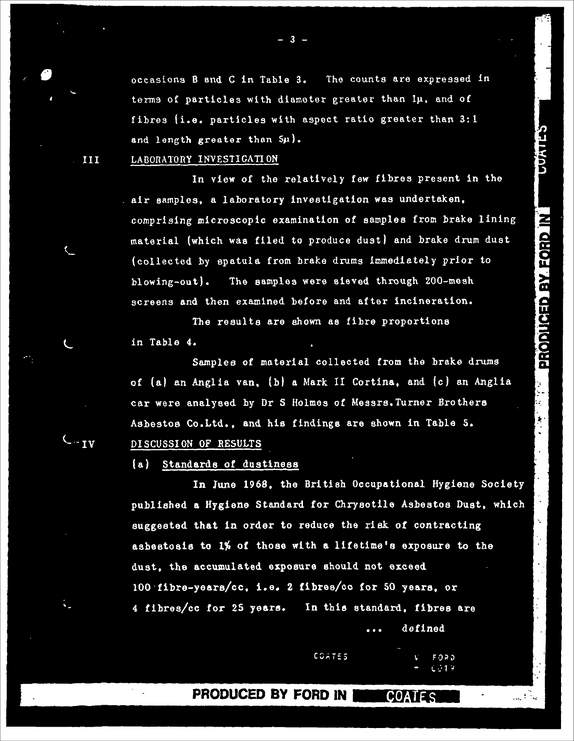
Exposure to Asbestos during the Servicing of Brakes of Passenger Cars July 1968 Dr D E Hickish - 1/163 Industrial Hygiene Specialist COATES PRODUCED BY FORD IN SCF-ALLF-03012 PLAINTIFF'S 4 EXHIBIT 1 WV-06336 PLAINTIFF'S EXHIBIT I INTRODUCTION .
refid# nm0MKOovJkV7yawRjxqzVMDDw12 pages
Inspection and Control Procedures c) Records, d) Packing and shipping, e) Employee training, /) Labeling, advertising, and sales litera ture, and g) Product liability claims-handlmg pro cedures To give the proper degree of importance to this management decision, the philosophy on reliability should be written out and adopted as a policy for guidance It naturally follows that communications must play a very important part in a product safety program and it must be recognized early in the program that everyone in the plant must be brought into the act Some companies have started such a program by means of a kick-off meeting so that all em ployees can be told of the importance of turn ing out a quality product that is safe All employees must be informed and sold on the purpose of the program, which is to reduce to a minimum the number of rejects and to turn out a safe product Zero defects programs.
refid# 7Q9zEeNoxdndqRpm5Db89VE61 page
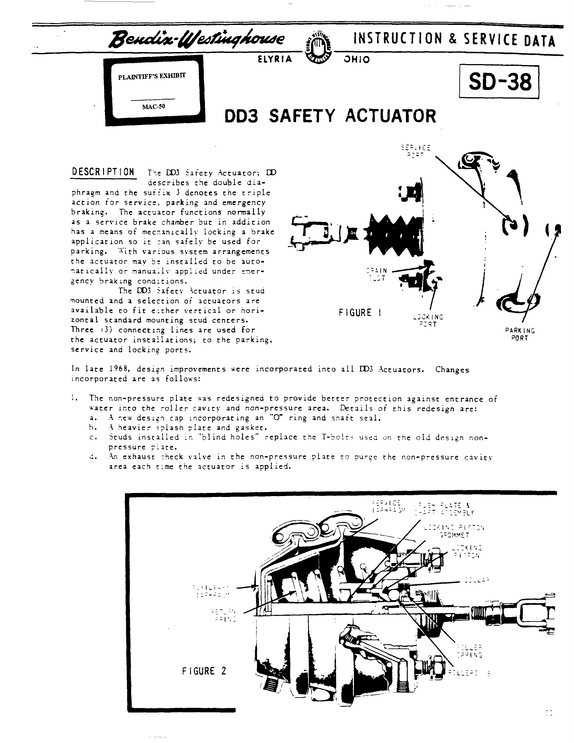
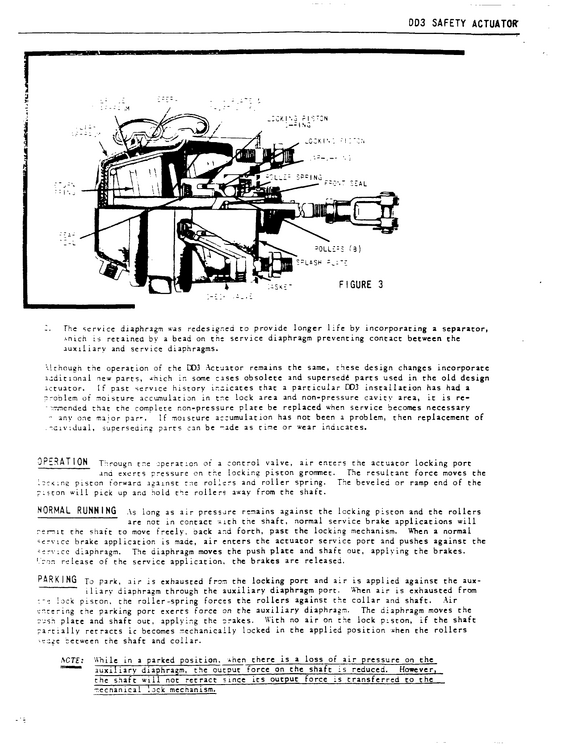
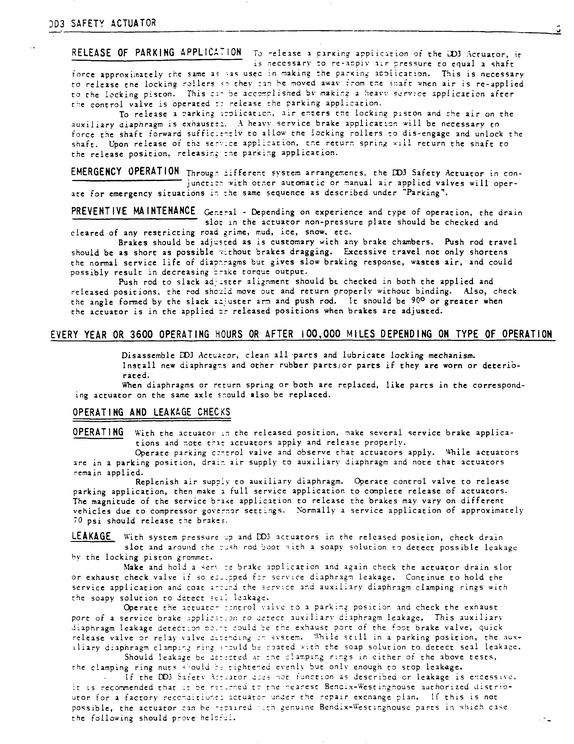
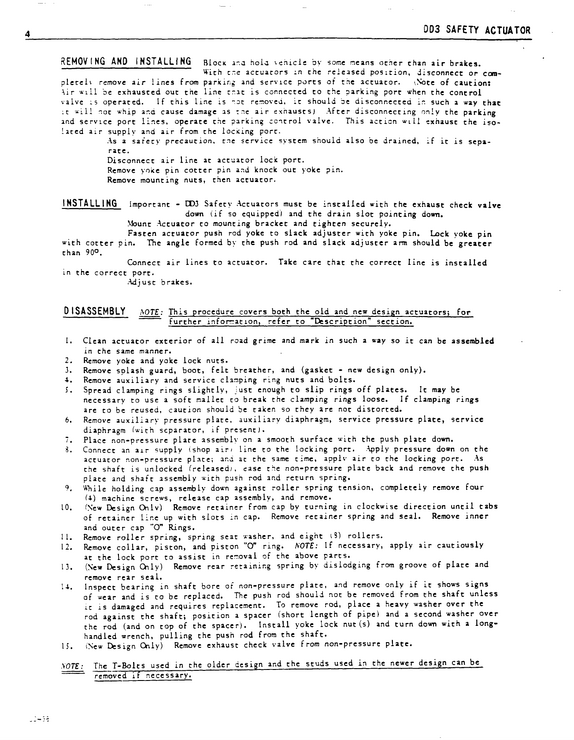
A INSTRUCTION & SERVICE DATA --' ELYRIA OHIO ZZZZZZZT""'' DD3 SAFETY ACTUATOR DESCRIPTION The CD3 Safety Actuator; CD* 1 describes the double dia phragm and the suffix 3 denotes the triple action for service, parking and emergency braking.
refid# pexDjb13Qz0LdwXdN8NK5ZwKj6 pages
tion of barriers and warning signs, stationing of attendants to keep personnel out of re stricted localities, and, in extreme cases, complete closing of the areas Safe exposure times and safe practices can be established through measurement and control, and by profiting from past experience Work with radiation can and should be so planned and managed that radiation ex posures of employees and of the general public are kept to a minimum No radio active matenals which can result in exposures above guide levels should be released through contaminated air or water, through loss of control over contaminated waste materials, equipment or shipments, or by employees unknowingly leaving the place of work with contamination on their persons, clothing, or shoes Consider the type of work involving radiation The literature on radiation protection is an invaluable aid (see "References" at the end of this chapter) It is important to realize that any one of a wide range of operations may be under discussion, and that safety measures applying in one case may be inappropriate for another The following examples point this out Processing of feed matenals for nuclear reactors and operations includes large-scale mining and processing of ores containing useful radioactive matenals Feed streams for separation and punfication involve tons of matenals, with a small percentage of radio active matenals which are then further proc essed and punfied The Atomic Energy Commission is closely associated with this Certain kinds of work involve appli cations using radiation from radium, thonum, and other naturally occurring matenals which are not controlled exclusively by the AEC Some of these matenals are used, for example, in luminous instrument dials, in gas mantles, in certain ceramic colors, and as radiation sources Radiation fields occur in the operation of such devices as industrial, fnedical, and dental X-ray machines and X-ray diffraction machines, and cyclotrons and other particle accelerators Relatively small amounts of radiation are emitted in electronic tubes, television receivers, and electron micro scopes (See NBS Handbooks 55, 76, 93 Protection Against Betatron-synchrotron Radiation up to 100 men.
refid# 6Rne6wVO7Yje1QN99EpemRbqd1 page
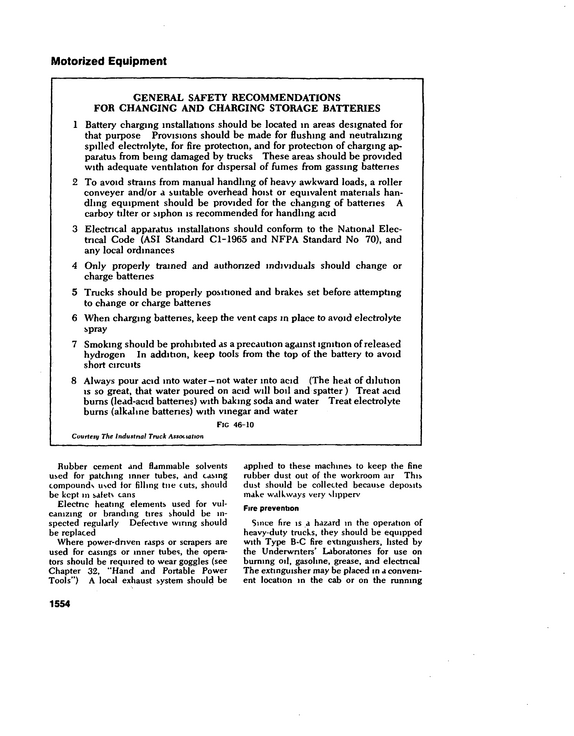
Motorized Equipment GENERAL SAFETY RECOMMENDATIONS FOR CHANGING AND CHARGING STORAGE BATTERIES 1 Battery charging installations should be located m areas designated for that purpose Provisions should be made for flushing and neutralizing spilled electrolyte, for fire protection, and for protection of charging ap paratus from being damaged by trucks These areas should be provided with adequate ventilation for dispersal of fumes from gassing batteries 2 To avoid strains from manual handling of heavy awkward loads, a roller conveyer and/or a suitable overhead hoist or equivalent materials han dling equipment should be provided for the changing of batteries A carboy tilter or siphon is recommended for handling acid 3 Electrical apparatus installations should conform to the National Elec trical Code (ASI Standard Cl-1965 and NFPA Standard No 70), and any local ordinances 4 Only properly trained and authorized individuals should change or charge batteries 5 Trucks should be properly positioned and brakes set before attempting to change or charge batteries 6 When charging batteries, keep the vent caps m place to avoid electrolyte spray 7 Smoking should be prohibited as a precaution against ignition of released hydrogen In addition, keep tools from the top of the battery to avoid short circuits 8 Always pour acid into water--not water into acid (The heat of dilution is so great, that water poured on acid will boil and spatter) Treat acid bums (lead-acid batteries) with baking soda and water Treat electrolyte burns (alkaline batteries) with vinegar and water Fig 46-10 Courtesy The Industrial Truck Association Rubber cement and flammable solvents used for patching inner tubes, and casing compounds used tor filling tne cuts, should be kept in satets cans Electnc heating elements used for vul canizing or branding tires should be in spected regularly Defective winng should be replaced Where power-dnven rasps or scrapers are used for casings or inner tubes, the opera tors should be required to wear goggles (see Chapter 32, "Hand and Portable Power Tools") A local exhaust system should be applied to these machines to keep the fine rubber dust out of the workroom air This dust should be collected because deposits make walkways very shpperv Fire prevention Since fire is a hazard m the operation of heavy-duty trucks, they should be equipped with Type B-C fire extinguishers, listed by the Underwriters' Laboratories for use on burning oil, gasoline, grease, and electrical The extinguisher may be placed in a conveni ent location in the cab or on the running 1554
refid# O153bJKR9JzygkjdLK67oD3KX1 page