REMOVING THE HAZARD FROM THE JOB "1 Operational job analysis should include a survey of the nature of the task, the work surroundings, the location of con trols and instruments, and the way the operator performs his dubes. "2 A functional concept of accidents is im plied, that is, the errors that may occur while the operator is working on the machine are anticipated The repetition or recurrence of near or real accidents clearly indicates a need for redesign "3 From the human limitations' point of view, it should be assumed that no worker is perfect In fact, he may be far below the ability adjudged by the machine designer If the worker's du ties are too complex, the cumulative burden is great when he reaches or ex ceeds his limits of attenbon and ability "4 A wide margin of safety should be pro vided to eliminate any possible situabon that places the operator near his maxi mum ability with regard to apbtude or effort, especially when adverse factors enter the picture '' Job Safety Analysis To uncover hazards that may have been overlooked in the layout of the plant and in the design of machinery, equipment, and processes, or may have developed after producbon was begun, a continuing program of acbvibes must be earned on One of the most important of these activities is job safety analysis Definition A job safety analysis is a procedure to make a job safe by 1 Identifying the hazards or potenba!
refid# qg1wx5wJOYqK9R4rw6RBvqG51 page
REMOVING THE HAZARD FROM THE JOB been installed He will be in frequent con sultation with the safety department in mak ing all purchases where safety u a factor He will also be particularly careful to see that every purchased machine complies fully with the safety regulations of the state in which it is to be operated The matter of price When considering plant purchases from the standpoint of safety, the item of cost cannot be minimized There is a constant struggle in the muid of the purchasing agent to reconcile quality, work efficiency, and safety with the price of an item Sometimes it may seem that the cost of an adequately safeguarded machine is out of all proportion to the cost of an unguarded machine plus the estimated cost of adding homemade safeguards But the experience of many industrial plants has proved again and again that the best time to safeguard a machine or process is in the design stage Safeguards planned and built as integral parts of a machine are the most efficient and durable The purchasing agent, through accident information supplied by the safety depart ment, will be famibar with the costs of spe cific accidents in the plant He will know that every accident has both direct and in direct costs He will remember specific ex amples of accidents and their costs Of course, the purchasing agent must be able to defend his judgment If he bas made a study of the accident experience of his plant over a period of years, and if he has familiarized himself with accident de tails and accident costs, he will be able to justify his decisions He will be firmly con vinced that the safety program of his plant is necessary for production efficiency and profit, and that the safety department, with which he is cooperating, is really a produc tion division, producing wealth by the elnnination of accident wastes These are arguments that must appeal to all execubves who are responsible for the success of the industrial organization.
refid# dY79LBQpodKVgxmMeVrZ2xk7R1 page
12CHAPTER SOURCES OF HELP FOR THE SAFETY MATS Service 12-2 Standards and specifications Q">"p* Fire protection ------------------------------------------------- 12-7 - - ------- 12-0 Insurance associations: insurance services__ ___ 12-11 Trade associationsI------------------------------------------------- 12-13 Professional mnniiw- - ------ - 12-19 U.S Government agencies_____________________ .... 12-24 Departments and bureaus in the states and possessions: labor offices . health and hygiene services------- - .. , - - .. 12-31 Conodion deportment, associations, and boards: governmental agencies private provincial agencies-- ------ - ----------- 12-39 International safety organisations_________________ ______________________________ 12-41 Educotionol Institutions: degree programs safety engineering courses offered as part of other degree programs cor respondence courses___________ __ __________ 12-43 Bibliography of safety and related periodicals* safety indus trial hygiene and medicine fire-__ . ... -- - -- 12*45 industrial accident prevention books___________ -------------------------------------------------- 12-46 The safety engineer frequently needs highly specialized or up-to-the-minute un published information as well as knowledge of the work and publications of trade asso ciations, public agencies, and private service organizations These sources are numerous and their charters of responsibility are varied As an aid in the safety man's search for information, this chapter categorizes sources and defines their funebons .A chart showing bow the various sources of infor mation can be tapped in order to find a solution to a safety problem is exhibited in Fig 12-1, shown on the next page.
refid# 0Y2zdno8wd4z70jdYyM210om1 page
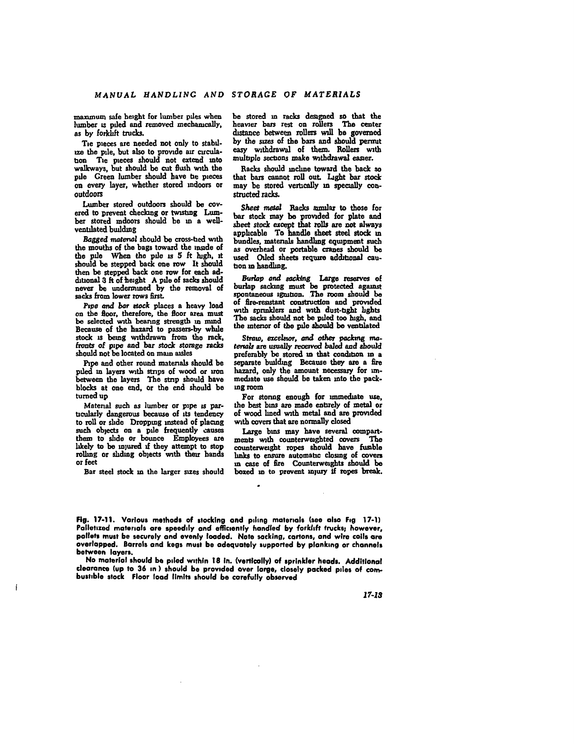
manual handling and storage of materials maximum safe height for lumber piles when lumber is piled and removed mechanically, as by forklift trucks.
refid# mqgGME6rXBa7rpVV5DBBRkB4Q1 page
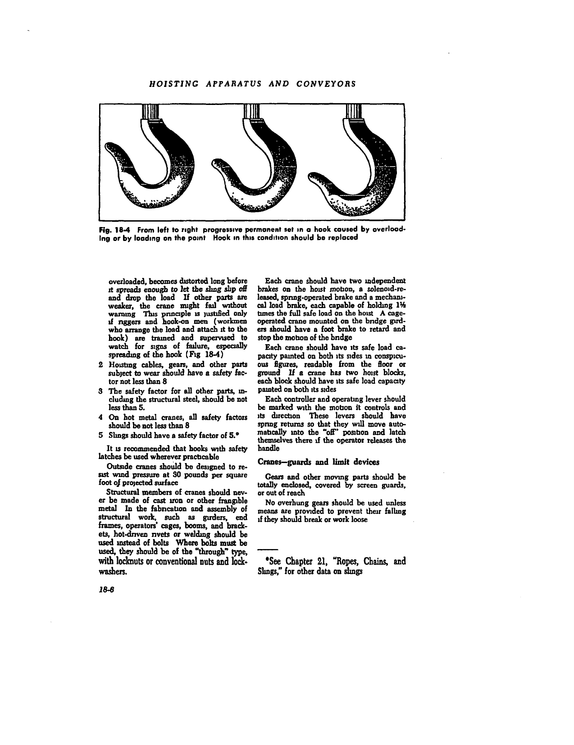
HOISTING APPARATUS AND CONVEYORS Fig. 18-4 From left to right progressive permanent set in a hook caused by overload ing or by loading on the point Hook in this condition should be replaced overloaded, becomes distorted long before it spreads enough to let the sling slip off and drop the load If other parts are weaker, the crane might fail without warning This principle is justified only if nggers and hook-on men (workmen who arrange the load and attach it to the hook) are trained and supervised to watch for signs of failure, especially spreading of the hook (Fig 18-4) 2 Hoisting cables, gears, and other parts subject to wear should have a safety fac tor not less than 8 3 The safety factor for all other parts, in cluding the structural steel, should be not less than 5. 4 On hot metal cranes, all safety factors should be not less than 8 5 Slings should have a safety factor of 5.* It is recommended that hoolcs with safety latches be used wherever practicable Outside cranes should be designed to re sist wind pressure at 30 pounds per square foot of projected surface Structural members of cranes should nev er be made of cast iron or other frangible metal In the fabrication and assembly of structural work, such as girders, end frames, operators' cages, booms, and brack ets, hot-dnven rivets or welding should be used instead of bolts Where bolts must be used, they should be of the "through" type, with locknuts or conventional nuts and lock- washers.
refid# Xzx9nY8YxozJZbzdoRdaKvv6x1 page
ELEVATORS AND PLANT RAILWAYS should meet the requirements of existing state laws for ladders except that an en closing cage should not be provided since the ladder should be accessible from either side throughout its entire run Inspections Every manlift should be tested and in spected at least every 30 days On discovery of a defect, the manlift should be put out of operation immediately and not used until re paired Each penodic inspection should cover, but not necessarily be limited to, the following items Steps Step fastenings Rail supports and fastenings Rollers and slides Belt and belt tension Handholds and fas tenings Floor landings Guardrails Electric switches Lubrication Warning signs and lights Signal equipment Dnve pulley Bottom (boot) pul ley and clearance Pulley supports Motor Driving mechanism Brake The safety mechanism of a manlift should be inspected daily for free operation and for accumulations of dirt and grease A man lift should be completely dismantled once every three years and defective or exces sively worn parts should be replaced General precautions The maximum speed of a manlift belt should not exceed 30 fpm and should be uniform on all mankfts throughout the plant If the lift carries a great deal of traffic, a maximum speed of 60 fpm is rec ommended Floors should be numbered m large fig ures in full view of both ascending and de scending nders A constantly illuminated sign, reading in block letters at least 2 in high "Top Floor--Get Off," should be con spicuously placed not more than 2 ft above the top landing, in full view of an ascending passenger If such a sign is not used, at least a 40-watt red light should be so lo cated immediately below the top landing as to shine in an ascending rider's face Signs carrying instructions for use of the manlift should be displayed prominently at each landing.
refid# RjjnY60Nd4nq5KV8jB957Ok5X1 page
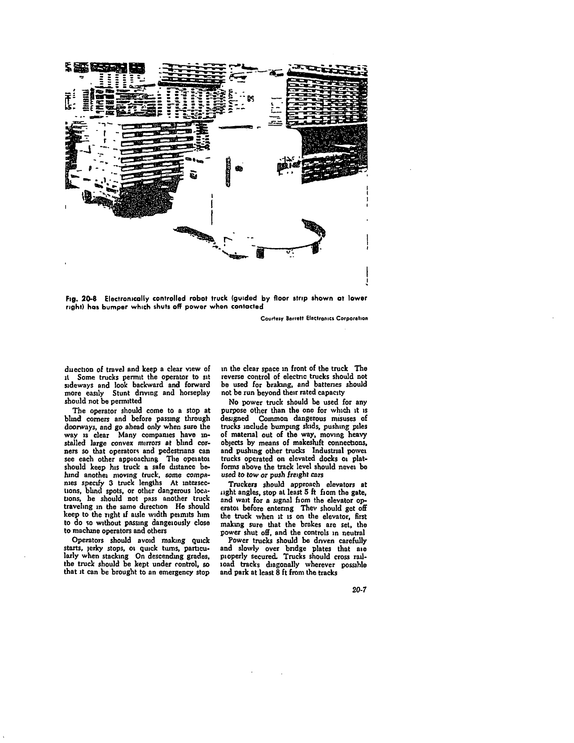
4~ - Fig. 20-8 Electronically controlled robot truck (guided by floor strip shown at lower right) has bumper which shuts off power when contacted Courtesy Barrett Electronics Corporation direction of travel end keep a clear view of it Some trucks permit the operator to sit sideways and look backward and forward more easily Stunt driving and horseplay should not be permitted The operator should come to a stop at blind comers and before passing through doorways, and go ahead only when sure the way is clear Many companies have in* stalled large convex mirrors at blind cor ners so that operators and pedestrians can see each other appioaching The opeiatoi should keep his truck a safe distance be hind anothei moving truck, some compa nies specify 3 truck lengths At intersec tions, blind spots, or other dangerous loca tions, he should not pass another truck traveling in the same direction He should keep to the right if aisle width peimits him to do so without passing dangeiously close to machine operators and others Operators should avoid making quick starts, jerky stops, 01 quick turns, particu larly when stacking On descending grades, the truck should be kept under control, so that it can be brought to an emergency stop in the clear space in front of the truck The reverse control of electric trucks should not be used for braking, and batteries should not be run beyond their rated capacity No power truck should be used for any purpose other than the one for which it is designed Common dangerous misuses of trucks include bumping skids, pushing piles of material out of the way, moving heavy objects by means of makeshift connections, and pushing other trucks Industrial powei trucks operated on elevated docks 01 plat forms above the track level should nevei be used to tow or push freight cars Truckers should approach elevators at right angles, stop at least 5 ft from the gate, and wait for a signal from the elevator operatoi before entenng Thev should get off the truck when it is on the elevator, first making sure that the brakes are set, the power shut off, and the controls in neutral Power trucks should be driven carefully and slowly over bndge plates that aie properly secured.
refid# oepJMYdN1e79mjGOEJnMKRQDr1 page
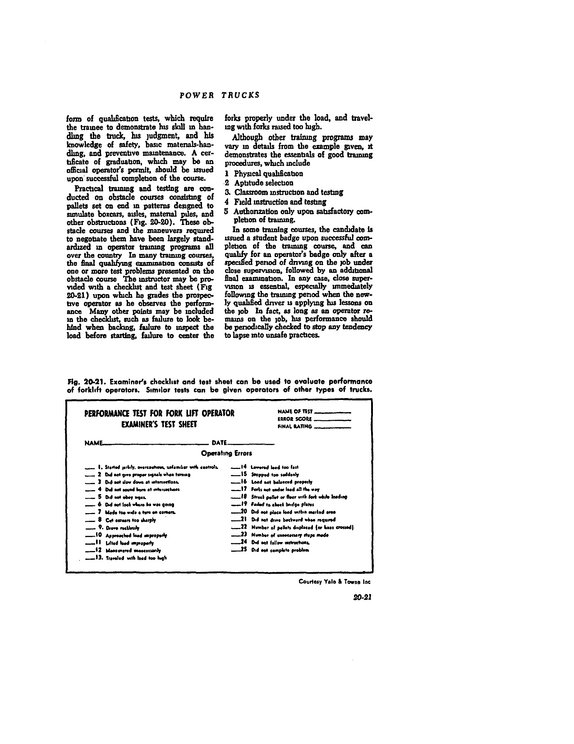
POWER TRUCKS foist of qualification tests, which require the trainee to demonstrate his skill in han dling the truck, his judgment, and his knowledge of safety, basic matenals-handling, and preventive maintenance.
refid# r69zeokOD5vYwvwk7Dm9GQn0a1 page
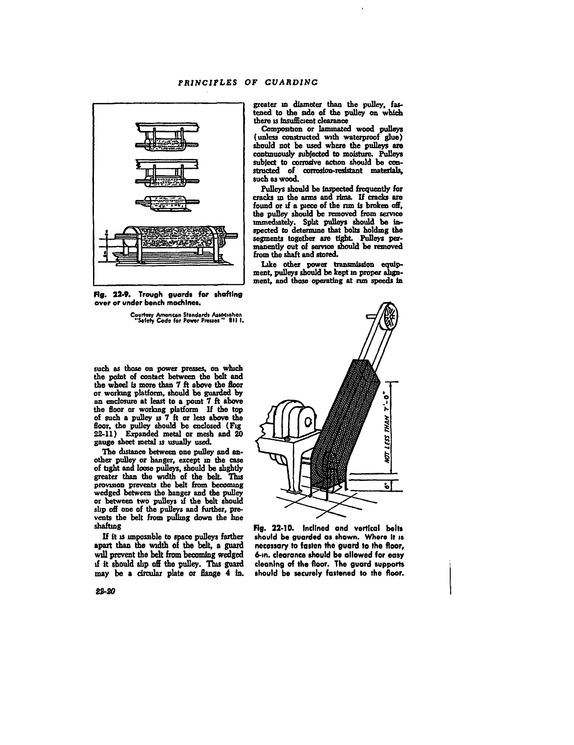
PRINCIPLES OF GUARDINC greater in diameter than the pulley, fas tened to the side of the pulley on which there is insufficient clearance Composition or laminated wood pulleys (unless constructed with waterproof glue) should not be used where the pulleys an continuously subjected to moisture.
refid# wq5Z0obGdqpO4or4eEbjZNed31 page
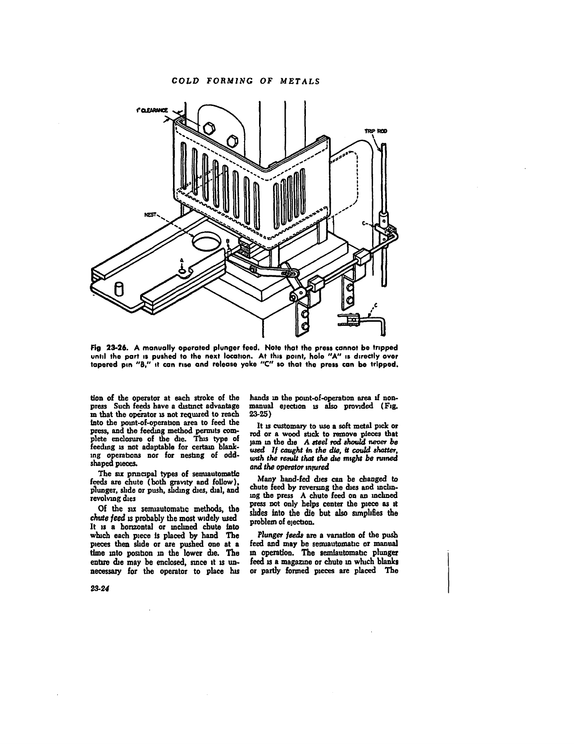
COLD FORMING OF METALS Fig 23-26.
refid# 1QRkgegwQYj3oo3boRnr8OVZK1 page
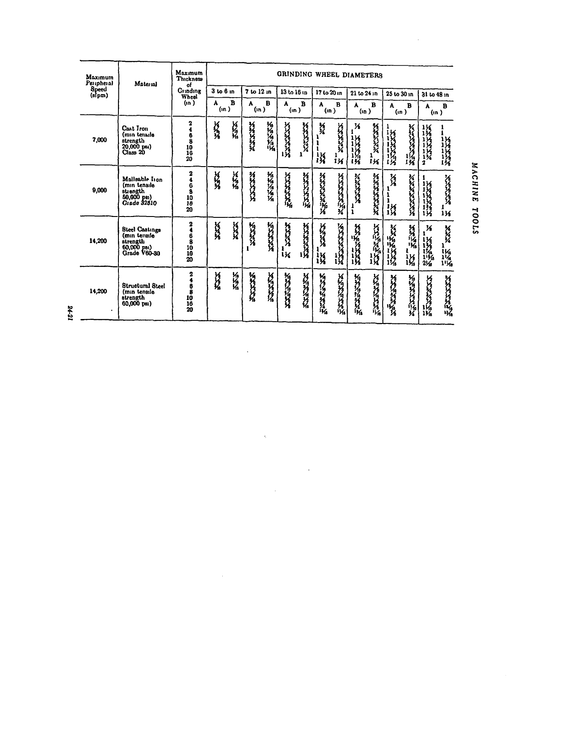
MACHINE TOOLS 34-21 Maximum Peupbeia) Speed (sipm) Material 7,000 Caitt Iron (ram temile strength 20,000 pai) Class 20 6,000 Malleable lion (min tenBile stiength 60,000 pn) Ciade 32610 14,200 Steel Castings (mm tensile strength 60,000 psi) Grade V60-30 14,200 Struetuml Steel (mm tensile strength 60,000 pa) Maximum Thickness of Gnnding Wheel (in ) 2 4 6 8 10 10 20 2 4 6 8 10 18 20 2 4 6 8 10 10 20 2 4 8 8 10 10 20 GRINDING WHEEL DIAMETERS 3 to 6 in AB (in) 7 to 12 in AB (in) 13 to 16 m AB (in) 17 to 20 in AB On) 21 to 24 in AB (in) 25 to 30 in AB (in ) 31 to 48 m AB (in ) VS H VS VS 1, K I g & ig ik VC.
refid# YjBakvEy37DJagLknoRrQD2bD1 page
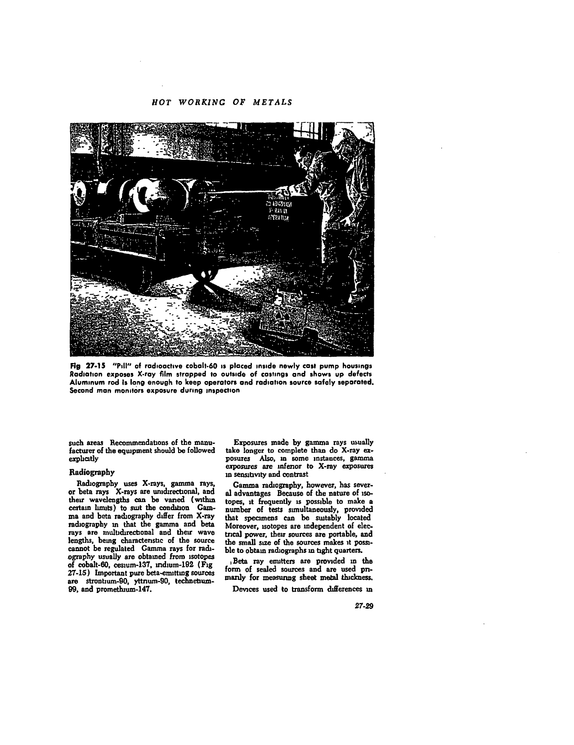
HOT WORKING OF METALS Fig 27*15 "Pill" of radioactive cobalt-60 is placed inside newly cast pump housings Radiation exposes X-ray film strapped to outside of castings and shows up defects Aluminum rod Is long enough to keep operators ond radiation source safely separated.
refid# v6qpq2E5r6NkeYZ9dDxxLoErb1 page
HAND AND PORTABLE POWER TOOLS from flying chips If a shield does not af ford positive protection to all exposed em ployees, they should wear goggles.
refid# zzqk8y2z5ZzJL387R1L1a4zDa1 page
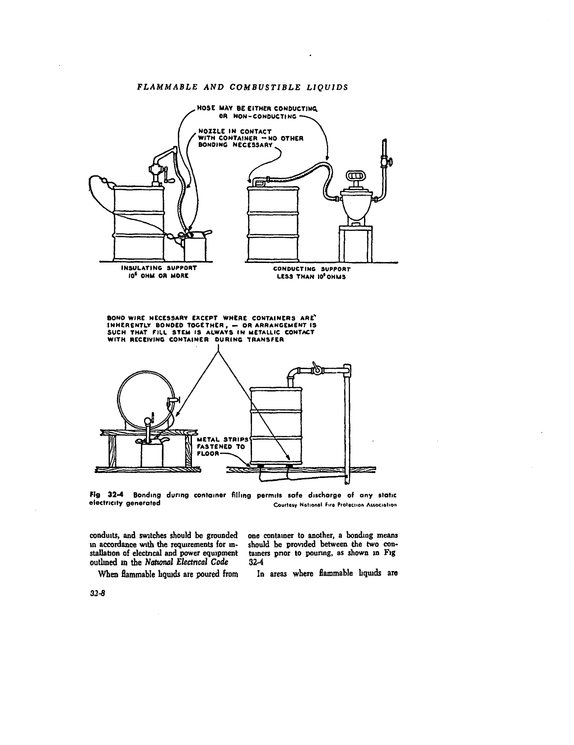
FLAMMABLE AND COMBUSTIBLE LIQUIDS BOND WIRE NECESSARY EXCEPT WHERE CONTAINERS ARE' INHERENTLY BONOEO TOGETHER, -- OR ARRANGEMENT IS SUCH THAT FILL STEM IS ALWAYS IN METALLIC CONTACT WITH RECEIVING CONTAINER DURING TRANSFER Fig 32-4 Bonding during container filling permits safe discharge of any static electricity generated Courtacy National Fire Protection Auociation conduits, and switches should be grounded m accordance with the requirements for in stallation of electrical and power equipment outlined in die National Electrtcal Code When flammable liquids are poured from one container to another, a bonding means should be provided between the two con tainers pnor to pounng, as shown in Fig 32-4 In areas where flammable liquids are 32-8
refid# B0XJD550ODOrwOnnozGonJ8m1 page
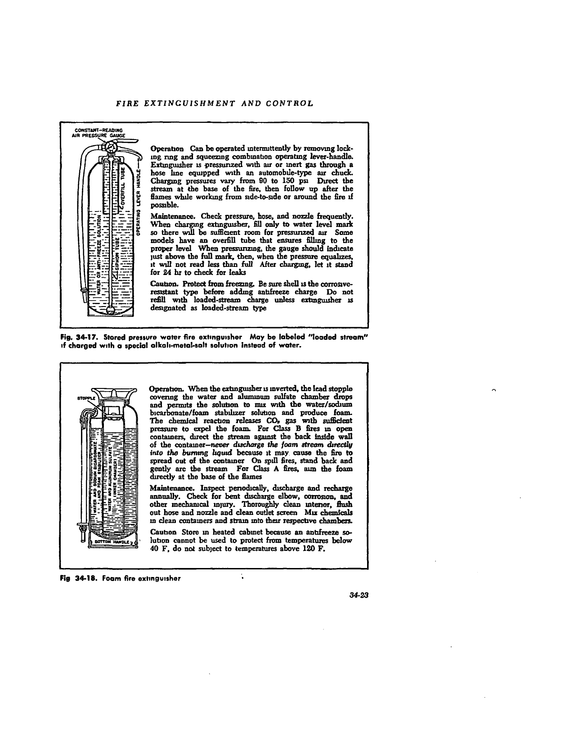
FIRE EXTINGUISHMENT AND CONTROL CONSTANT--READING AIR PRESSURE GAUGE Operation Can be operated intermittently by removing lock ing ring and squeezing combination operating lever-handle.
refid# LadjoQpX7mpZrvbJGk5n7jMw1 page