I 1969 National Safely Congress gaged in being a part of safety, by thinking and acting safely, otherwise, the supervisor's five-minute safety talk may just turn out to be another rest period.
refid# DMZBJJXVLvwDYXdnVQK2D8qaM1 page
2-- -- He said, "You have proved safe driving is a good investment I hope your example will be followed by every driver m the city.
refid# Xzn39jbKmEOGKbDjVJ32V4w0w1 page
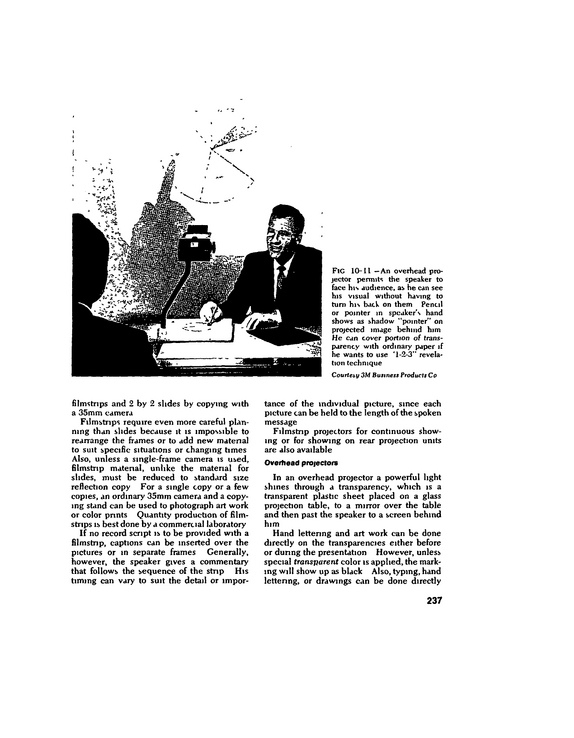
Fig 10-11 -- An overhead pro jector permits the speaker to face his audience, as he can see his visual without having to turn his back on them Pencil or pointer m speaker's hand shows as shadow "pointer" on projected image behind him He can cover portion of trans parency with ordinary paper if he wants to use `1-2-3" revela tion technique Courtesy 3M Business Products Co filmstrips and 2 by 2 slides by copying with a 35mm camera Filmstrips require even more careful plan ning than slides because it is impossible to rearrange the frames or to add new material to suit specific situations or changing times Also, unless a single-frame camera is used, filmstrip material, unlike the material for slides, must be reduced to standard size reflection copy For a single copy or a few copies, an ordinary 35mm camera and a copy ing stand can be used to photograph art work or color prints Quantity production of film strips is best done by a commercial laboratory If no record script is to be provided with a filmstrip, captions can be inserted over the pictures or m separate frames Generally, however, the speaker gives a commentary that follows the sequence of the strip His timing can vary to suit the detail or impor tance of the individual picture, since each picture can be held to the length of the spoken message Filmstrip projectors for continuous show ing or for showing on rear projection units are also available Overhead projectors In an overhead projector a powerful light shines through a transparency, which is a transparent plastic sheet placed on a glass projection table, to a mirror over the table and then past the speaker to a screen behind him Hand lettering and art work can be done directly on the transparencies either before or during the presentation However, unless special transparent color is applied, the mark ing will show up as black Also, typing, hand lettering, or drawings can be done directly 237
refid# aJLZ6L6ovgZzg8v8XpeLYdB5N1 page
savings are as meaningful to higher manage ment as those which use frequency and sever ity figures Facts about the costs of accidents may be used effectively m securing the active cooperation of foremen Foremen are usually cost conscious because they are expected to run their departments profitably Monthly reports showing the cost of accidents or the savings resulting from good accident records are an important motivation to achieve safe operating procedures Definition of work accidents for cost analysis Work accidents, for the purpose of cost analysis, are unintended occurrences arising out of employment These accidents fall into two general categories (a) accidents re sulting in work injuries and (b) accidents that cause property damage or interfere with production in such a manner that personal injury might result The inclusion of the no-injury accidents makes "work accident" roughly synonymous with the type of occurrences a safety depart ment strives to prevent Method for estimating To be of maximum usefulness, cost figures should represent as accurately as possible the specific experience of the company itself A fixed rabo of indirect to direct costs devel oped from experience represenbng many different companies in many different indus tries does not serve such a purpose Esti mated costs of accidents in general do not take into account differences in hazards from one industry to another or the more impor tant differences m safety performance from one company to another Since the distmcbons between "direct" and "indirect" costs are difficult to maintain they have been abandoned m favor of the more precise terms "insured" and "unin sured" costs Using these data, a company can estimate its accident cost with reasonable accuracy Insured costs Every organization paying compensation insurance premiums recognizes such expense as part of the costs of accidents In some cases, medical expenses, too, may be covered by insurance These costs are definite, and they are known They comprise the insured element of the total accident cost In addition to these costs, many other costs arise m connechon with accidents The cost of damaged equipment is easily idenhfied Others, such as wages paid to the injured em ployee for hours during which he is not pro ducing, are hidden These items comprise the uninsured element of the total accident cost Uninsured costs.
refid# 07nvd0Q1JOZ11MxOe37zXNzO1 page
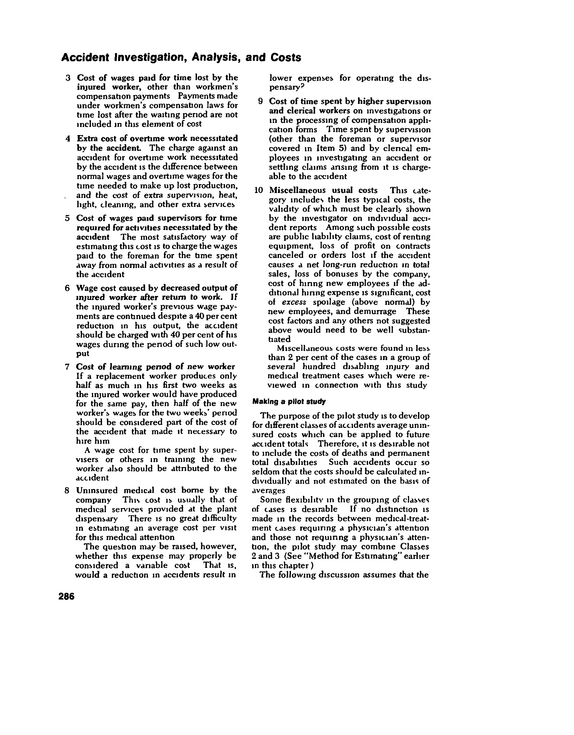
Accident Investigation, Analysis, and Costs 3 Cost of wages paid for time lost by the injured worker, other than workmen's compensation payments Payments made under workmen's compensation laws for time lost after the waiting period are not included m this element of cost 4 Extra cost of overtime work necessitated by the accident The charge against an accident for overtime work necessitated by the accident is the difference between normal wages and overtime wages for the time needed to make up lost production, and the cost of extra supervision, heat, light, cleaning, and other extra services 5 Cost of wages paid supervisors for time required for activities necessitated by the accident The most satisfactory way of estimating this cost is to charge the wages paid to the foreman for the time spent away from normal activities as a result of the accident 6 Wage cost caused by decreased output of injured worker after return to work.
refid# qkNQvQOz5Gnv8omX9oG2yQQa51 page
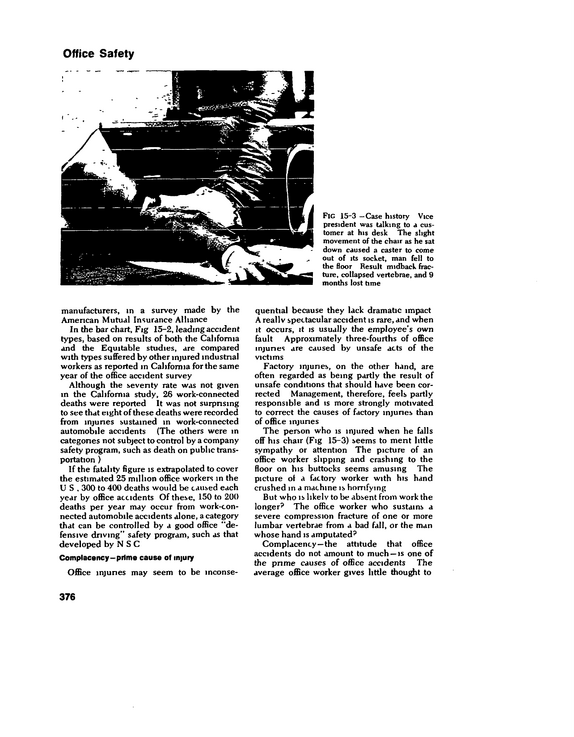
Office Safety FlC 15-3 --Case history Vice president was talking to a cus tomer at his desk The slight movement of the chair as he sat down caused a caster to come out of its socket, man fell to the floor Result midback frac ture, collapsed vertebrae, and 9 months lost time manufacturers, in a survey made by the American Mutual Insurance Alliance In the bar chart.
refid# jgrKzy97GoxrNvVreL7bRErDk1 page
industrial Buildings and Plant Layout Poison Ivy, Poison Oak, and Potson Sumac, Data Sheet 304 Tree Trimming, Data Sheet 244 Portland Cement Association, 5420 Old Orchard Rd , Skokie, 111 60076 (General) Sappington, C O Industrial Health Department Functions and Relationships Pittsburgh, Pa , Industrial Hygiene Foundation, 4400 Fifth Ave , Medical Senes Bulletin 8 U S Department of Transportation, Federal Highway Administration Bureau of Public.

refid# 93bwXXaO1mrkg3nQe2xJZJzxD1 page
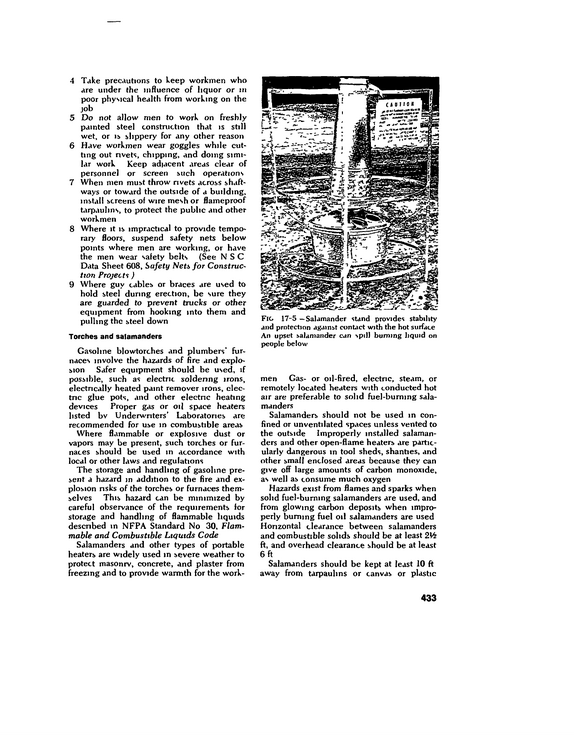
4 Take precautions to keep workmen who are under the influence of liquor or in poor physical health from working on the job 5 Do not allow men to work on freshly painted steel construction that is still wet, or is slippery for any other reason 6 Have workmen wear goggles while cut ting out nvets, chipping, and doing simi lar work Keep adiacent areas clear of personnel or screen such operations 7 When men must throw nvets across shaftways or toward the outside of a building, install screens of wire mesh or flameproof tarpaulins, to protect the public and other workmen 8 Where it is impractical to provide tempo rary floors, suspend safety nets below points where men are working, or have the men wear safety belts (See NSC Data Sheet 608, Safety Nets for Construc tion Projects ) 9 Where guy cables or braces are used to hold steel during erection, be sure they are guarded to prevent trucks or other equipment from hooking into them and pulling the steel down Torches and salamanders Gasoline blowtorches and plumbers' fur naces involve the hazards of fire and explo sion Safer equipment should be used, if possible, such as electric soldenng irons, electrically heated paint remover irons, elec tric glue pots, and other electric heating devices Proper gas or oil space heaters listed bv Underwriters' Laboratories are recommended for use m combustible areas Where flammable or explosive dust or vapors may be present, such torches or fur naces should be used in accordance with local or other laws and regulations The storage and handling of gasoline pre sent a hazard m addition to the fire and ex plosion risks of the torches or furnaces them selves This hazard can be minimized by careful observance of the requirements for storage and handling of flammable liquids described in NFPA Standard No 30, Flam mable and Combustible Liquids Code Salamanders and other types of portable heaters are widely used in severe weather to protect masonrv, concrete, and plaster from freezing and to provide warmth for the work- Fig 17-5 -- Salamander stand provides stability and protection against contact with the hot surface An upset salamander can spill burning liquid on people below men Gas- or oil-fired, electric, steam, or remotely located heaters with conducted hot air are preferable to solid fuel-burning sala manders Salamanders should not be used in con fined or unventilated spaces unless vented to the outside Improperly installed salaman ders and other open-flame heaters are partic ularly dangerous in tool sheds, shanties, and other small enclosed areas because they can give off large amounts of carbon monoxide, as well as consume much oxygen Hazards exist from flames and sparks when solid fuel-burning salamanders are used, and from glowing carbon deposits when impro perly burning fuel oil salamanders are used Horizontal clearance between salamanders and combustible solids should be at least 2V ft, and overhead clearance should be at least 6ft Salamanders should be kept at least 10 ft away from tarpaulins or canvas or plastic 433
refid# KJzk4GVMvdzbrvQk1oV7eMa8x1 page
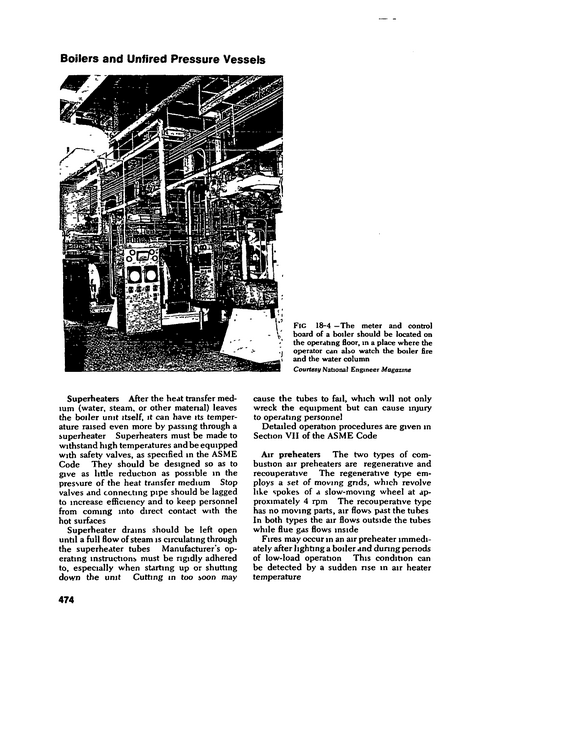
Boilers and Unfired Pressure Vessels Fig 18-4 --The meter and control board of a boiler should be located on the operating floor, in a place where the operator can also watch the boiler fire and the water column Courtesy National Engineer Magazine Superheaters After the heat transfer med ium (water, steam, or other material) leaves the boiler unit itself, it can have its temper ature raised even more by passing through a superheater Superheaters must be made to withstand high temperatures and be equipped with safety valves, as specified in the ASME Code They should be designed so as to give as little reduction as possible m the pressure of the heat transfer medium Stop valves and connecting pipe should be lagged to increase efficiency and to keep personnel from coming into direct contact with the hot surfaces Superheater drains should be left open until a full flow of steam is circulating through the superheater tubes Manufacturer's op erating instructions must be rigidly adhered to, especially when starting up or shutting down the unit Cutting in too soon may cause the tubes to fail, which will not only wreck the equipment but can cause injury to operating personnel Detailed operation procedures are given in Section VII of the ASME Code Air preheaters The two types of com bustion air preheaters are regenerative and recouperative The regenerative type em ploys a set of moving grids, which revolve like spokes of a slow-moving wheel at ap proximately 4 rpm The recouperative type has no moving parts, air flows past the tubes In both types the air flows outside the tubes while flue gas flows inside Fires may occur in an air preheater immedi ately after lighting a boiler and during periods of low-load operation This condition can be detected by a sudden rise in air heater temperature 474
refid# G6DaYkBo11nxBVDg8N6GBNEjr1 page
The workmen should see that jacks are well lubricated, but only at points where lubrica tion is specified, and should inspect them for broken teeth or faulty holding fixtures A jack should never be thrown or dropped upon the floor, such treatment may crack or distort the metal, thus causing the jack to break when a load is lifted It is important that the floor or ground sur face upon which the jack is placed be level and clean, and that the safe limit of floor load ing is not exceeded If the surface is earth, the jack base should be set on substantial heavy wood blocking, preferably hardwood, of sufficient size that the blocking will not turn over, shift, or sink If the surface is not perfectly level, the jack may be set on block ing, which should be leveled by substantial shims or wedges securely placed so that they cannot be crushed or forced out of place To prevent the load from slipping, no metalto-metal contact should be permitted be tween the jack head and the load A wood shim, preferably hardwood and longer and wider than the face of the jack head, should be placed between the jack head and the con tact surface of the load One-inch wood stock is suitable for this purpose (Fig 19-6) "Extenders" of wood or metal, intended to provide a higher nse where a jack cannot reach up to the load nor lift it high enough, should never be used Instead, a larger jack should be obtained or higher blocking--which is correspondingly wider and longer-- should be placed under the jack All lifts should be vertical with the jack cor rectly centered for the lift, the base on a per fectly level surface, and the head with its shim bearing against a perfectly level meeting surface When an emergency requires that the lifting force be applied at an angle, extra precautions must be taken which include 1 A base of blocking securely fastened to gether and to the ground to make an im movable surface at right angles to the lift for the jack base to rest on 2 Cleats on the blocking to prevent shifting of the jack base 3 A meeting surface at nght angles to the di rection of the lift for the jack head with its shim to bear against 4 Props or guys to the load to prevent its swinging sidewise when lifting begins When a jack handle is placed in the socket, the workman should make sure that the area is clear and that there is ample room for an unobstructed swing of the handle before he applies pressure A faulty movement m the load may cause the handle to pop up and strike another worker The man operating the handle should stand to one side so that if the handle kicks, it will not catch him m the body or face After the load is raised, metal horses or substantial heavy wooden horses or blocking should be placed under it for support m case the jack should let go A raised load should never be allowed to remain supported only by jacks The handles of the jacks should be removed and placed out of the way to prevent workers from walking into them When a jack is released, the worker should keep all parts of his body clear of the move ment of the handle A hydraulic jack which leaks oil should be taken out of service and repaired Hydraulic jacks may settle after raising a load It is, therefore, especially important to place block ing under a load that has been raised by such jacks Screw jacks have a tendency to twist when a heavy load causes the floating head of the jack to bind The base of a screw jack should be anchored as securely as possible so that the jack base will not twist and slip out from under the load when force is applied on the bars to raise the screw To raise a large piece of equipment with screw jacks, two or more jacks should be used The load should be equally distributed on each jack The jacks should be raised each a little at a time to keep the load level and the strain equal on each screw jack head Workmen using jacks should wear safety shoes and instep-guard protection because jack handles may slip and fall or parts of ma chinery or equipment may come loose and drop as the load is being lifted or shifted Waste or other wiping material should be fur nished to jack operators who should use it to remove oil from their hands and from the jack handles so that they will always have a firm gnp Oil that has collected in the bases of equip ment or machines to be jacked should be removed before the operation is begun to pre vent spillage when the equipment or ma- 511
refid# LJGEN0yapQkQ1V1eNYnXRBn971 page
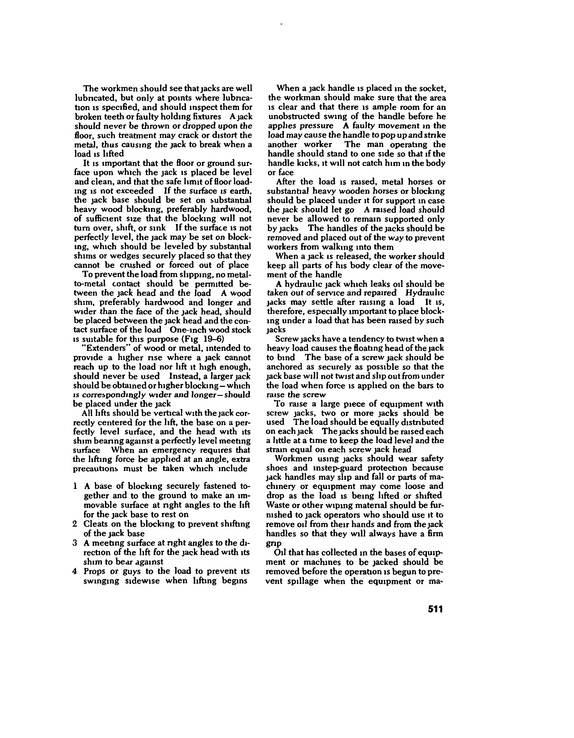
Cold Forming of Metals sides of enclosure should extend as far to SLOTS OR PLASTIC WINDOW IT MORE VISIBIUT/ OF DIE IS REQUIRED FlC 25-13 -- Die enclosure guard for strip or coil stock showing the vertical clearances required Courtery Liberty Mutual Insurance Co FlC 25-14 --Die guard made of preslotted mate rial can be easily fabricated in the shop Torque A twisting effort which produces or tends to produce rotation Trip or Trip device An auxiliary mecha nism, which may be manually, mechanically, or automatically operated, which starts, stops, or otherwise controls operation of the primary mechanism Point-of-operation guarding Some means of safeguarding press opera tors at the point of operation should be pro vided and used on every press The type of guard or protective device selected will be determined by the method of feeding and by the applicability of the guard or device to the specific operation Before a guard is built, the entire operation should be analyzed to determine how the processed piece can be best fed to the die, indexed or nested, and the piece and the 702
refid# eE7gz7VLGRQZ7LJ4XKe0Ek8y1 page
Cold Forming of Metals Air friction clutch presses On a press with air friction clutch/brake, the control performs the following functions 1 Provides that the press operator must hold both run buttons during the down stroke until the slide has descended to a point where there is no longer a hazard Re lease of any button during "holding time" should stop the slide 2 Allows the operator to release buttons after completion of "holding time" and press will complete stroke 3 On "single cycle" operation, it stops the slide at end of a stroke even though op erator holds control buttons depressed 4 Actuates clutch/brake air valve(s) so that friction brake will stop machine at top of stroke 5 Provides anti-repeat protection and pre vents repeat operation with any buttons tied down Starters for main drive motor should be the magnetic, reversing type This feature per mits backing up of the press m the event of a jam without the need for an electrician to change wiring Selector switches should re quire keys so that backing up can be done by authorized personnel only The clutch control should be provided with a main drive motor "forward interlock" so that the press can be run only when the motor is turning m the forward direction "Back ward" operation of the press is unsafe be cause there is no run button "holding time " This interlock also prevents "run" actuation of the clutch air valve before the motor is started or when the flywheel is coasting Starting the motor with the clutch engaged is unsafe since it may result m unexpected downward movement of the slide Inch or jog operation should normally bypass the interlock to allow power-off "inching ' Pressure switches should be provided on the compressed air system downstream from pressure regulators and shut-off valves to as sure that air is present for proper actuation of clutch-brake mechanisms and counterbal ance cylinders These switches should be normally open and wired in senes into the control circuit ahead of the main-dnve-motor starter and clutch/brake control 1 The clutch pressure switch assures that the correct air pressure is available before the machine is started This assures proper movement of the slide and protects clutch plates from excessive wear resulting from slippage 2 The counterbalance pressure switch pre vents a sudden drop of the slide dunng the instant between release of the brake and engagement of the clutch Proper counter balance pressure is also required for quick stopping of the slide dunng the downstroke, or prevention of drop back if the slide is stopped dunng the up stroke Jogging or inching of the slide is often re quired when setting up or trying out dies The use of two-hand inch buttons is preferred for these operations so that both hands must be out of the danger area Where a single button is used, it should be guarded so that it cannot be operated unintentionally The clutch/brake solenoid valve(s) should not be energized directly across the line through the contacts of a single relay, in such a way that faulty operation of this single relay will result in unintended energization of the valve(s) Protection can be accomplished through the use of multiple relays and/or energization of the valve(s) through push but ton switches and rotary limit switches The previous paragraph makes stopping a machine independent of operation of the valve or run relay Normally closed contacts of this relay should be incorporated into the circuit to check actual dropout of the relay The use of a multiple clutch control valve is recommended This is a relatively inex pensive means for reducing the possibility of press repeats due to malfunctioning of a single valve Press clutch control circuits can be either of two types 1 Grounded. with all coils connected to one side of the isolated secondary of a control transformer, and this side grounded to the machine frame, or 2 Ungrounded (double ended) with ground detector lights connected to each side of the line and a double break arrangement On multiple operator presses, complete operating stations not required should be 728
refid# OnD4pxzwxmbL1pJyZeE4GJoj1 page
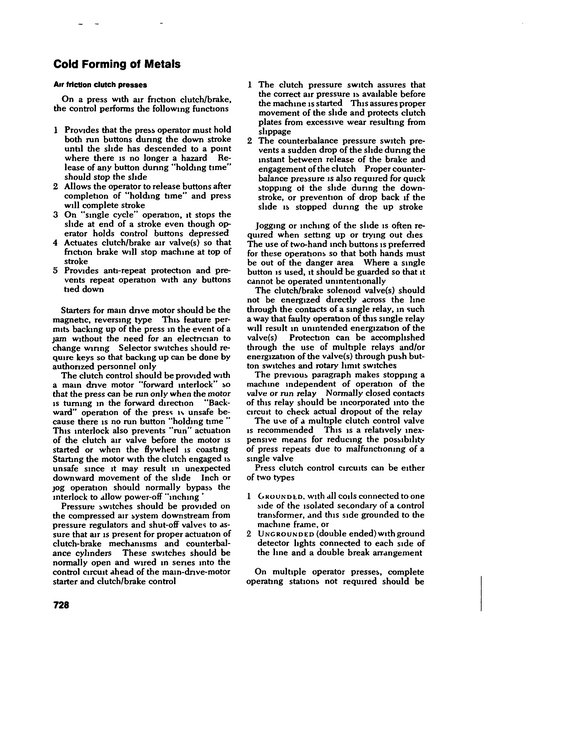
Machine Tools TABLE 26-E MINIMUM DIMENSIONS FOR TAPERED SAFETY FLANGES FOR WHEELS OPERATING BETWEEN 6500 AND 9500 PERIPHERAL FEET PER MINUTE Wheel Diam (in) Wheel Thick ness (in ) B (in) C Max On) Mm (in ) D (in) E (in ) J.
refid# 3JMbEq4Ybpn8d5n3o3v3DoKOx1 page
Hot Working of Metals mg area The scale guard should be moved back, and accumulated scale that would in terfere with safe footing should be removed Forgings should be moved away from the unit immediately and sent to the next work station If another set of forging equipment has been delivered, it should be placed nearby but not direcdy in the area where the ham mer crew will work Service personnel, such as truckers, crane men, and hookers, should be familiar with the proper procedure so that unnecessary handling can be elimi nated The hammer's main power switch or con trol must be shut off and locked before the die keys are loosened The top key is gen erally loosened first, usually with a mounted pneumatic ram (Fig 28-18) A light, well balanced ram suspended from a cross beam or from an overhead crane or chain fall can also be used successfully Using a manually held drift pin or a knock out on a die key after it has been loosened and driven to a position even with the face of the ram or the sow block is a hazardous operation A special type of adjustable knockout (Fig 28-23) that is held in position mechanically rather than manually should be used After the die keys have been driven out, the ram should be raised and propped at once The prop must be m good condition and must be placed on a clean surface On a gravity drop hammer, a jack should be used and a special prop may be required No attempt should be made to raise the hammer to propping level if the top die has a tendency to "hang " The die should be freed first within the shortest possible dis tance from the face of the bottom die The ram on an air drop hammer should be propped with special care After the prop is posi tioned securely under the ram, the power should be shut offand locked out Dies can be removed from the hammer by means of special die chains suspended from an overhead crane or chain fall Special platform trucks with winches are also em ployed for this operation They are practical and safe because the dies are winched out or pulled out horizontally directly onto the table of the truck Dumping the dies out of the hammer onto the floor should not be permitted After the dies have been removed from the hammer, the dowels must be extracted It is important that the two men who drive out the dowels have proper tools, usually a drift and a sledge These tools should be in good condition and have sound handles Because there is metal-to-metal contact, the men must be extremely careful After being removed, dies should be loaded on low steel pallets and taken from the vicinity as soon as possible If dies need repair or modification, the hammer man should notify his foreman The foreman can then send this information to the die servicing department so that the condition can be remedied before the next run Design of dies Hammer dies are usually made of chrome, nickel, or molybdenum stellitem--materials which have high resistance to heat, shock, and abrasion Die blocks are supplied com mercially m four different hardnesses Selecbon of the proper die steel m the correct range of hardness is of utmost importance in controlling checking and breakage of dies Size, amount of striking surface, and height are all pertinent factors m the safe design of dies The correct amount of striking surface must-be allowed in relation to the size of the die Too little striking surface may cause breakage or an undersized forging when the dies pound down Too much striking surface, especially if it is unbalanced, may cause a pull or misalignment Correct die height must be specified, es pecially for resinking forge dies Normal work level should be maintained for the benefit of the hammer man, and the height should never be below a specified minimum, to prevent the bottom of the cylinder from being knocked out Maximum and minimum operating heights should be labeled on each unit for use by the design engineer The dies must be made so that they meet in precise alignment Layout of the dies should provide for the major portion of the heavy forge work to be done m the center of the die under the center of the ram, where the maximum hammer force is transmitted Each impression m the die must be backed up with enough die material to reduce the 842
refid# dQ7QQva7d55gj9ZXaD5z6zOMR1 page
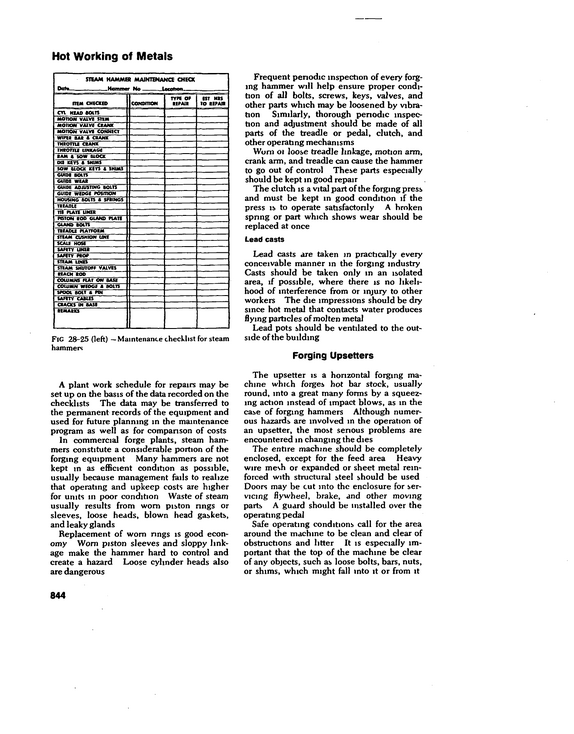
Hot Working of Metals 5IEAM HAMMS MAINTENANCE CHECK Dot*Hammer Nolocation__________________________ REM CHECKS CONDITION TYPE OP EST HIS REPAIR TO REPAS CYl HEAD 601TS MOTION VALVE STEM MOTION VALVE CKANX MOTION VALVE CONNECT WIPES BAB 4 CRANK THIOTTU CRANK THROTTLE LINKAGE RAM 4 SOW BLOCK DIE KEYS 4 SHIMS SOW BLOCK KITS 4 SHIMS GUIDE BOLTS GUIDE WEAR GUU)E ADJUSTING BOLTS GUIDE WEDGE POSITION HOUSING BOLTS 4 SPRINGS TREADLE TtS PLATE LINES PISTON ROD GLAND PLATE GLAND BOLTS TREADLE PLATFORM STEAM CUSHION UNE SCALE HOSE SAFETY LINER SAFETY PROP STEAM LINES STEAM SHUTOFF VALVES REACH ROD COLUMNS FIAT ON BASE COLUMN WEDGE 4 BOLTS SPOOL BOLT 4 PIN SAFETY CABLES CRACKS IN BASE remarks FlG 28-25 (left) -- Maintenance checklist for steam hammers Frequent periodic inspection of every forg ing hammer will help ensure proper condi tion of all bolts, screws, keys, valves, and other parts which may be loosened by vibra tion Similarly, thorough periodic inspec tion and adjustment should be made of all parts of the treadle or pedal, clutch, and other operating mechanisms Worn 01 loose treadle linkage, motion arm, crank arm, and treadle can cause the hammer to go out of control These parts especially should be kept in good repair The clutch is a vital part of the forging press and must be kept in good condition if the press is to operate satisfactorily A broken spring or part which shows wear should be replaced at once Lead casts Lead casts are taken m practically every conceivable manner in the forging industry Casts should be taken only in an isolated area, if possible, where there is no likeli hood of interference from or injury to other workers The die impressions should be dry since hot metal that contacts water produces flying particles of molten metal Lead pots should be ventilated to the out side of the building Forging Upsetters A plant work schedule for repairs may be set up on the basts of the data recorded on the checklists The data may be transferred to the permanent records of the equipment and used for future planning in the maintenance program as well as for comparison of costs In commercial forge plants, steam ham mers constitute a considerable portion of the forging equipment Many hammers are not kept m as efficient condition as possible, usually because management fails to realize that operating and upkeep costs are higher for units in poor condition Waste of steam usually results from worn piston rings or sleeves, loose heads, blown head gaskets, and leaky glands Replacement of wom nngs is good econ omy Worn piston sleeves and sloppy link age make the hammer hard to control and create a hazard Loose cylinder heads also are dangerous The upsetter is a horizontal forging ma chine which forges hot bar stock, usually round, into a great many forms by a squeez ing action instead of impact blows, as m the case of forging hammers Although numer ous hazards are involved m the operation of an upsetter, the most serious problems are encountered in changing the dies The entire machine should be completely enclosed, except for the feed area Heavy wire mesh or expanded or sheet metal rein forced with structural steel should be used Doors may be cut into the enclosure for ser vicing flywheel, brake, and other moving parts A guard should be installed over the operating pedal Safe operating conditions call for the area around the machine to be clean and clear of obstructions and litter It is especially im portant that the top of the machine be clear of any objects, such as loose bolts, bars, nuts, or shims, which might fall into it or from it 844
refid# dQdg6bYERkw2eyvZbj2Ej68J51 page