Accident Prevention Manual for Industrial Operations 6th edition National Safety Council Chicago, III. 60611
refid# 7RvnNrmanjywErjNvb85bNaBa1 page
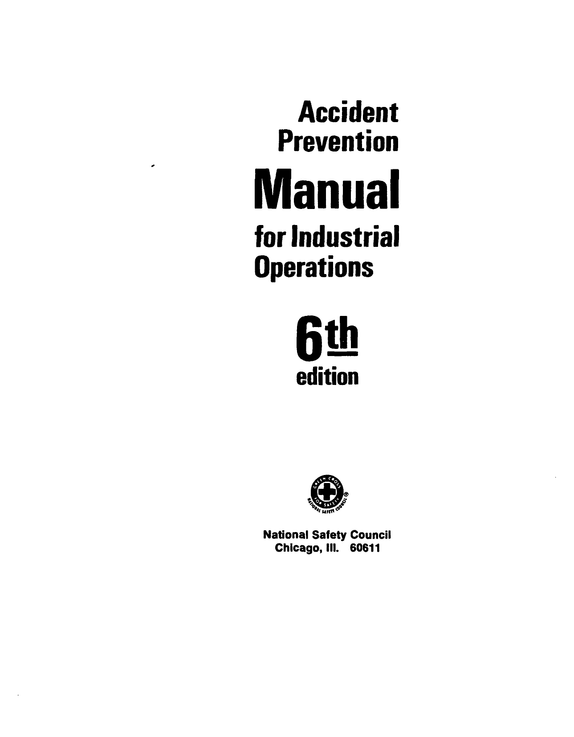
FlC 1-4 -Clippings from October 17,1913, issue of The Chicago Tribune There had also been progress on the tech nical side of the problem The railroads, which, perhaps, had suffered the most ad verse publicity from accidents, adopted the air brake and the automatic coupler well be fore the turn of the century Some progress was also made in such matters as guarding and fire prevention In the first decade of the 20th Century, two great industries, railroads and steel, began the first large-scale organized safety programs From this penod comes one of the great and histone documents of safety In 1906, Judge Elbert Gary, president of United States Steel Corporation, wrote "The United States Steel Corporation ex pects its subsidiary companies to make every effort practicable to prevent injury to its em ployees Expenditures necessary for such purposes will be authonzed Nothing which will add to the protection of the workmen should be neglected " The Association of Iron and Steel Electri cal Engineers, organized soon after this ancouncement, devoted considerable attention to safety problems m its industry 5
refid# RaXE5qKrzO4Do4dDNGx2234Mk1 page
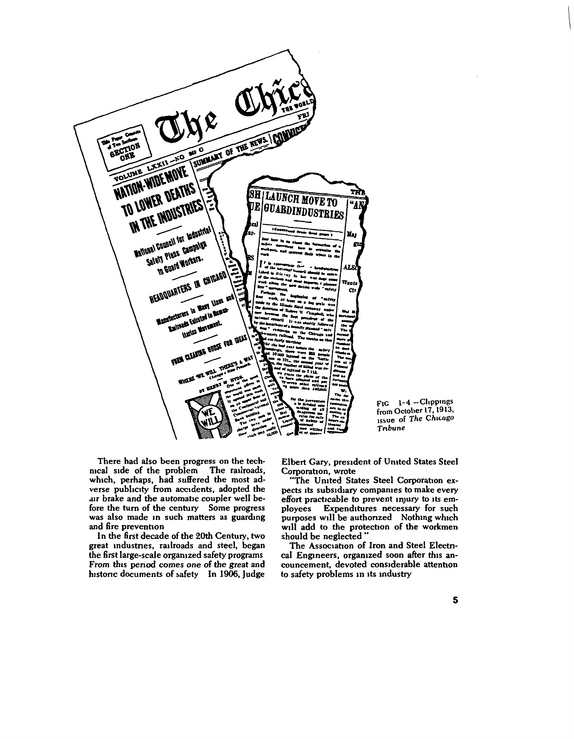
Organization and Committees of a suggestion system The men who operate the machines know the operation and con dition of those machines and are often better able to suggest practical improvements in guards and safe practices than are inspectors, committeemen, and others What is true about machine operators is also true of most of the other workers m a plant It requires only a little encouragement to secure from them valuable suggestions, the adoption of which will prevent many accidents Accident prevention is closeh allied to Educational opportunities As an educational force, safety committees cannot be surpassed Such committees, which often include individuals popular with employees, can help management develop and enforce safety rules Educational safety committee meetings allow members to learn about successful safety methods in other places and industries, and about aspects of the safety program not ordi narily handled by the committee The chair- FlC 2-6 -- Posters can stimulate employees' thinking about safety efficiency It is not strange, therefore, that many suggestions are valuable not only in the prevention of accidents, but also in lowenng the cost of production, improving conditions and methods, and bettering the health and increasing the happiness of employees A safety committee member should make, and encourage others to make, suggestions that will 1 Decrease the danger of accidents to them selves and their fellow workmen, and re duce risks of damage to equipment and materials 2 Eliminate fire hazards and increase the effectiveness of fire-extinguishing methods and equipment 3 Improve the sanitary conditions about the various shops and workplaces man or a committee usually arranges educa tional programs Here are some ideas Many good films are available Executives of the company and staff technical experts can be obtained as speakers Often an outside speaker can be brought in Meetings should not run more than an hour The program arrangers should judge critically to determine whether thev are interesting and beneficial Safeti is not served if time is wasted or if the members become bored The business meetings of the committee are educational, too, but their main purpose is to get specific safety matters attended to One important item of business should be a review of recommendations the committee has made and a report on action being taken If recommendations are not followed, the 40
refid# G6xkDLpy77remRqY4aBy1w5Mr1 page
Accident Records and Injury Rates partial disability and carries a scheduled charge of 50 days If a hemia is repaired, it is classified as a temporary total disability and the charge is only the actual number of cal endar days lost For permanent impairments affecting more than one part of the body, the total charge is the sum of the scheduled charges for the individual body parts impaired The total charge, however, shall not exceed 6000 days If an employee suffers a permanent partial injury to one part of the body and a tem porary total injury to another part in one accident, whichever charge is greater is used and determines the injury classification The charge for a permanent injury not identified in the schedule of charges (such as damage to internal organs, lungs, or back, or loss of speech) is a percentage of 6000 days corresponding to the percentage of per manent total disability which results from the injury This percentage is determined by the physician authorized to treat the case Definition of employment The Standard specifies that a work injury is one which arises out of and in the course of employment, l e, results from the work activity or environment of employment Employment is defined m the Standard as (a) all work or activity performed m carrying out an assignment or request of the employer, including incidental and related activities not specifically covered by the assignment or request, (b) any voluntary work or activity undertaken while on duty with the intent of benefiting the employer, or (c) any other activities undertaken while on duty with employer's consent or approval For statistical purposes, an employee is considered to be in the course of employment while he is 1 Riding m special, company-furnished transportation from a designated meeting place to a work place that is inaccessible to ordinary transportation The employee would be considered in the course of em ployment from the time he was picked up at such a meeting place until he was re turned to it 2 A member of a crew that does not have a regular place of employment, such as a public utility line crew, from the time he reaches a designated meeting place for the crew until he is dismissed from duty at the point where the crew disbands 3 Traveling in connection with his work, from the time his travel starts (either at his place ofwork or at his home), except a) During normal living activities, such as eating, sleeping and the like, b) During deviations from a reasonably direct route of travel, such as a side tnp for personal reasons, c) During other activities neither neces sitated by the travel nor in the interest of the employer 4 Being entertained by, or as, a customer or client for the purpose of transacting, discussing, or promoting business 5 Going from the entrance ofthe employer's premises to his place of work, or from his place of work to the exit of the employer's premises before or after working hours, or going from one part of the employer's premises to another for any purpose as sociated with his employment 6 Absent from company premises if such absence is authorized by the employer or his agent and is in the interest of the employer or his agent 7 Taking a coffee or other rest break 8 Going to or from washroom, toilet, or shower facilities before, during, or after working hours, using toilet facilities at any time, taking a shower or otherwise using washroom facilities on company premises before, during, or after working hours, if use of the facilities is occasioned by the employee's work 9 Engaged in company-sponsored athletic events for which he is paid directly or indirectly 10 Participating in or the victim of horse play during working hours 11 Engaged m a fight if the dispute involves performance of duties or is otherwise connected with emplovment or the pro tection of company property 12 Performing voluntary work with the in tention of benefiting the employer, either in emergencies such as fire or flood or in routine duties An employee is not considered to be in the course of employment while he is 262
refid# ozM5b5ZgwDGwgM3yxRXRLj8X1 page
Sources of Help The Women's Bureau develops policies and programs to promote the welfare of wageearning women and encourage better utiliza tion of womanpower Among its concerns are the conditions and safety provisions under which women work The bureau provides technical assistance, and consultative, ad visory, and information services Its program is an outreach operation which stimulates, in forms, interests, and involves national, state and local organizations and individuals in activities to achieve national objectives re lated to advancing the economic, legal, and civil status of women Bureau of Employment Security.
refid# omx2EN8ybg6EMMpo7LrK0dOBX1 page
Sources of Help itol Bldg , Bismarck 58501 Environmental Health and Engineering (Chief) Ohio Department of Health (Director of Health), 450 E Town St, P O Box 118, Columbus 43216 Division of Occupational Health (Chief), 1030 W King Ave , Columbus 43212 Oklahoma Department of Health (Commuaioner), 3400 N Eastern, Oklahoma City 73105 Environmental Health Services (Chief) Occupational and Radiological Health Division (Director) Oregon Board of Health (Health Officer), 1400 SW hifth Ave , Portland 97201 Occupational Health Section (Director) Workman's Compensation Board Accident Prevention Division (Chief), 216 Labor & Industncs Bldg , Salem 97310 Pennsylvania Department of Health (Secretary), Health and Wel fare Bldg, Harrisburg 17120 Division of Occupational Health (Director) Puerto Rico Department of Health (Secretary), Ponce de Leon Ave, 00908 Section of Occupational Health (Director) Environmental Health Program (Chief) Department of Labor Bureau of Work Accident Prevention (Director), 414 Barbosa Ave , San Juan 00917 Rhode Island Department of Health (Director), State Office Bldg , Providence 02903 Division ofOccupational Health (Chief) South Carolina Board of Health, Sims Bldg , Columbia 29201 Division of Sanitary Engineering (Director) South Dakota Department of Health (State Health Officer), State Capitol, Pierre 57501 Section of Occupational and Radiological Health (Chief) Division of Sanitary Engineering (Director) Tennessee Department of Public Health (Commissioner), Cordell Hull Bldg , Sixth Ave , N , Nashville 37219 Division of Industrial Health (Director) Bureau of Environmental Health Services (Di rector) Texas Department of Health (Commissioner of Health), 1100 West 49th St, Austin 78756 Division of Occupational Health and Radiation Control (Director) Division of Occupational Safety (Director) Utah Department of Health and Welfare (Director), 44 Medical Dr .Salt Lake City84113 Bureau ofDisease Prevention and Environmental Control, Radiation and Occupational Health Section (Chief) Vermont Department of Health (Commissioner), 115 Col chester Ave , Bur'mgtor 05401 Industrial Hygiene Division (Director), 32 Spald ing St, P O Box 607, Bane 05641 Virgin Islands Department of Health (Commissioner) Charlotte Amalie, St Thomas 00802 Section of Environmental Health, Division of Public Health Services (Director) Virginia Department of Health (Commissioner), Bank and Governor Sts , Richmond 23219 Bureau of Industrial Hygiene (Director), 109 Governor St, Richmond 23219 Washington Department of Labor and Industnes, 308 E 4th Ave , P O Box 207, Olympia 98501 Industrial Hygiene Section (Chief) Environmental Health Division (Director), Health Sciences Bldg , University of Washing ton, Seattle 98105 West Virginia Department of Health (Director), State Office Bldg No 1.1800E Washington St,Charleston25305 Bureau of Industrial Hygiene (Director) Wisconsin Department of Health and Social Services (Health Officer), P O Box 309, Madison 53701 Occupational Health Section (Chief) Wyoming Department of Public Health (Director), State Office Bldg, Cheyenne 82001 Division of Industrial Hygiene (Director) Canadian Departments, Associations, and Boards In all provinces of Canada there is a Work men's Compensation Board or Commission Some of these handle accident prevention directly In other provinces there are provi sions similar to Section 110 of the Quebec Workmen's Compensation Act, which stipu lates "that industnes included m any of the classes under Schedule I may form them selves into an Association for accident preven tion and formulate rules for that purpose Further, the Workmen's Compensation Com mission, if satisfied that an Association so formed sufficiently represents the employers in the industries included in the class, may 362
refid# K2ZkJ2ZBqY62OV3oVnqopLOx1 page
themselves carelessly, the supervisor should take some opportunity to point out that people should hold chairs in place with their hand before seating themselves Supervisors are just as responsible for training their people m the safe procedure as they are m training them for efficiency Supervisors should encourage employees to report all broken chairs, or missing casters, stuck drawers, cracked glass, and other hazards to the maintenance department for correction A policy of immediate correction of these defects should be followed Safety Organization in the Office The supervisor is, of course, the key person in the office safety program However, even the hardest-working supervisor will have difficulty maintaining full-time interest m safety all by himself The office safety com mittee can serve as a work horse in main taining interest in the accident prevention program, but it cannot substitute for good management Safety committee.
refid# yk6pzDbD4mnVgekgOD6GRBwoX1 page
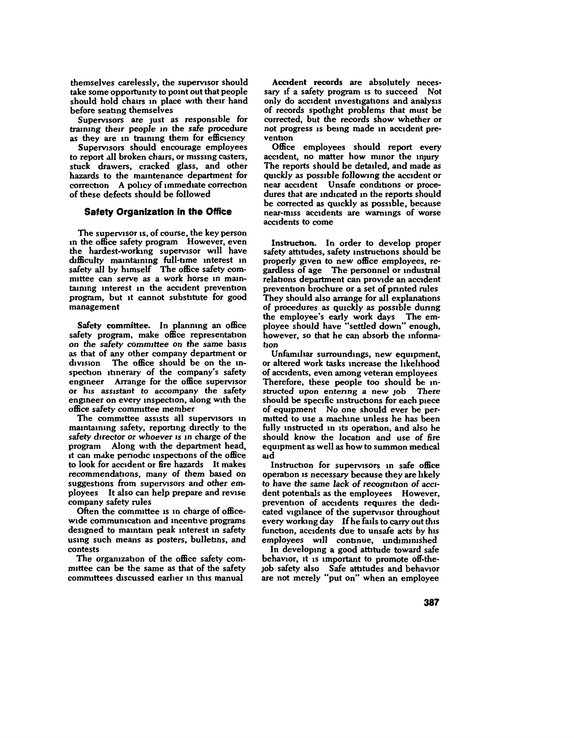
Building Construction and Maintenance Fig 17-16 -- How to tie a triple sliding hitch is shown in left photograph, hitch has been loosely tied to show clockwise lower turns and counterclockwise upper turns Dead end should be at least 12 in long Photograph at right shows appearance of hitch when pulled tight Dead end and live end of safetv strap are on same side of vertical portion connecting upper and lower turns Hitch must be tightened after every movement on the life line to which it is attached Courtesy Workmen's Compensation Board of Bnttsh Columbia 2 Inspect the raising and lowering mecha nism frequently 3 Remember that this is a light duty scaffold, designed primarily for operations involv ing men and hand tools, with a minimum of materials, so do not overload it 4 Be sure there are at least three turns of wire rope on drums at all times Do not lower the scaffold below this point 5 Equip the stage with toeboards and a guard rail, properly supported at both ends and in the center 6 Supply each man working on the swinging scaffold with a safety belt and a lifeline extending from roof to ground Each safety belt rope should be tied to the lifeline with a triple sliding hitch or with a mechanical rope grab (See Figs 17-15 and -16, and NSC Data Sheet 606, Fixed Ladders and Climbing Devices) Boatswain's chairs Boatswain's chairs should be erected with care by the men who will use them The seat should be not less than 2 ft long by 1 ft wide One-inch cleats should be nailed to the under side of each end of the chair and should pro ject at least 9 in m front of the seat The chair should be supported by a sling at tached to a suspension rope Ordmanlv, %-m rope, spliced into 6-m blocks, is used for support Where blow torches, cutting torches, or open flames are used, slings should be made of wire rope A safety belt secured to the tackle to prevent the man from falling out of the seat should be provided 'The slings should be at least %-in manila rope (or its equivalent in strength if a substitute must be used), doubled and passed through holes bored in the seat For information on other types of scaffolds, see ASI Standard A10 8, Safety Require ments for Scaffolding Hoists Material hoists and personnel hoists are made of tubular steel structural members Be sure to consult with tubular steel manu facturers or suppliers They may be erected in hoistwavs inside the building or m outside towers They are not usually designed for safe transportation of passengers, neither workmen nor others should be permitted to ride them Work in or on the hoistway while the hoist is in opera tion should not be permitted For additional information, be sure to check the latest ASI standards for personnel hoists and material hoists, also see Associated General Contrac- 448
refid# rBeVygZyLpevMpxjVNdYxK34G1 page
Principles of Guarding and Transmission Guards Engineer Hazards Out of the Job Automation Guard the Hazard Types of mechanical motion Materials Types of guards Educate Employees Safe practices Inspection and maintenance Lubrication Mechanical Power Transmission Equipment Guard rails and toeboards Prime movers Governors Fnction drives Couplings Collars Kevs and setscrews Cranks and connecting rods Tail rods or extension piston rods Shafting Pullevs Belts Belt tighteners Cears, sprockets, and chains Starting and stopping devices Designing Point-of-Operation Guards Test results Application of test findings construction Guard References 658 Chapter 24 659 660 670 671 683 688
refid# Gy2ZadDLL7zn383BjZeBBRXn1 page
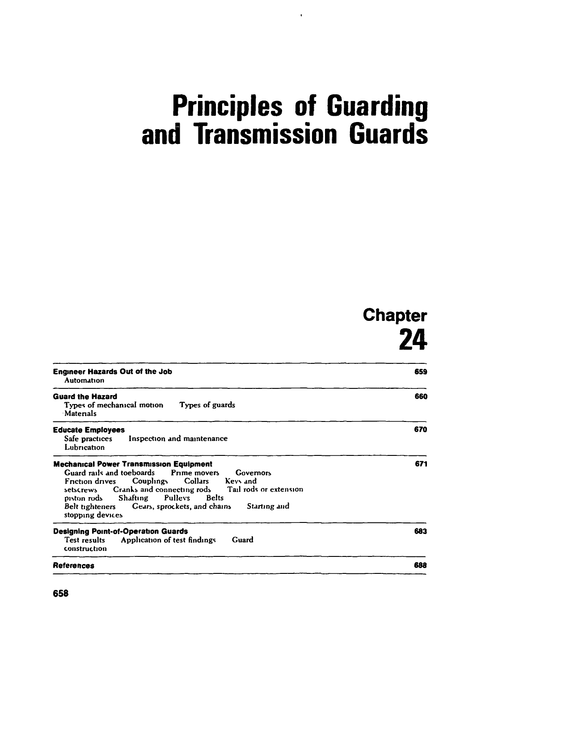
Cold Forming of Metals 720 FlC 25-30 - Mechanical methods for stripping finished pieces from power press dies
refid# NkjbdXjk3mdBxzbGDyXbD0gE1 page
Cold Forming of Metals Air friction clutch presses On a press with air friction clutch/brake, the control performs the following functions 1 Provides that the press operator must hold both run buttons during the down stroke until the slide has descended to a point where there is no longer a hazard Re lease of any button during "holding time" should stop the slide 2 Allows the operator to release buttons after completion of "holding time" and press will complete stroke 3 On "single cycle" operation, it stops the slide at end of a stroke even though op erator holds control buttons depressed 4 Actuates clutch/brake air valve(s) so that friction brake will stop machine at top of stroke 5 Provides anti-repeat protection and pre vents repeat operation with any buttons tied down Starters for main drive motor should be the magnetic, reversing type This feature per mits backing up of the press m the event of a jam without the need for an electrician to change wiring Selector switches should re quire keys so that backing up can be done by authorized personnel only The clutch control should be provided with a main drive motor "forward interlock" so that the press can be run only when the motor is turning m the forward direction "Back ward" operation of the press is unsafe be cause there is no run button "holding time " This interlock also prevents "run" actuation of the clutch air valve before the motor is started or when the flywheel is coasting Starting the motor with the clutch engaged is unsafe since it may result m unexpected downward movement of the slide Inch or jog operation should normally bypass the interlock to allow power-off "inching ' Pressure switches should be provided on the compressed air system downstream from pressure regulators and shut-off valves to as sure that air is present for proper actuation of clutch-brake mechanisms and counterbal ance cylinders These switches should be normally open and wired in senes into the control circuit ahead of the main-dnve-motor starter and clutch/brake control 1 The clutch pressure switch assures that the correct air pressure is available before the machine is started This assures proper movement of the slide and protects clutch plates from excessive wear resulting from slippage 2 The counterbalance pressure switch pre vents a sudden drop of the slide dunng the instant between release of the brake and engagement of the clutch Proper counter balance pressure is also required for quick stopping of the slide dunng the downstroke, or prevention of drop back if the slide is stopped dunng the up stroke Jogging or inching of the slide is often re quired when setting up or trying out dies The use of two-hand inch buttons is preferred for these operations so that both hands must be out of the danger area Where a single button is used, it should be guarded so that it cannot be operated unintentionally The clutch/brake solenoid valve(s) should not be energized directly across the line through the contacts of a single relay, in such a way that faulty operation of this single relay will result in unintended energization of the valve(s) Protection can be accomplished through the use of multiple relays and/or energization of the valve(s) through push but ton switches and rotary limit switches The previous paragraph makes stopping a machine independent of operation of the valve or run relay Normally closed contacts of this relay should be incorporated into the circuit to check actual dropout of the relay The use of a multiple clutch control valve is recommended This is a relatively inex pensive means for reducing the possibility of press repeats due to malfunctioning of a single valve Press clutch control circuits can be either of two types 1 Grounded. with all coils connected to one side of the isolated secondary of a control transformer, and this side grounded to the machine frame, or 2 Ungrounded (double ended) with ground detector lights connected to each side of the line and a double break arrangement On multiple operator presses, complete operating stations not required should be 728
refid# OnD4pxzwxmbL1pJyZeE4GJoj1 page
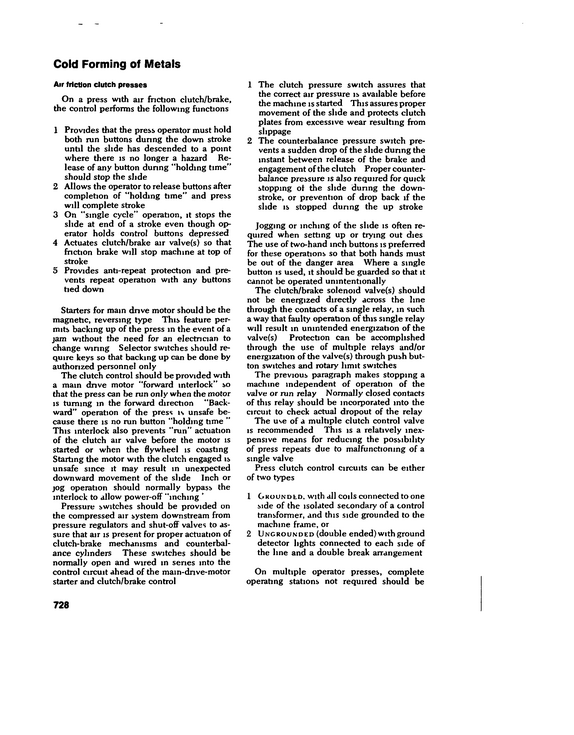
Flammable and Combustible Liquids from flammable vapors, dismantled, and removed from the premises Tanks that are not to be removed should have all flammable liquid removed and be filled with a nonshnnking inert solid material They should have all inlets and outlets capped Tanks taken out of service for less than 90 days should have fill line, gauge opening, and pump suction line capped, and be secured against tampering The vent line should be left open Common Uses of Flammable Liquids Industrial use of flammable liquids in volves ail the general precautions outlined m this chapter pertaining to static, toxicity, storage, housekeeping, explosion-proof elec trical installation, segregation and isolation of operations, ventilation, enclosure of op erations, grounding sources of ignition, and fire and explosion All rooms or portions of plants, and equip ment in them, m which flammable liquids or vapors are used or generated should be con structed, installed, and operated as recom mended by the National Fire Protection Association in its Flammable b Combustible Liquids Code, and as required by local ordinances The following paragraphs discuss several of the more common processes and items of equipment which use flammable liquids, and the precautions applying to each Dip tanks Dip tanks containing flammable liquids subject to ignition at ordinary temperatures and giving off flammable vapors present a severe fire and explosion hazard (See NFPA Standard No 34, Dip Tanks Con taining Flammable or Combustible Liquids ) Dipping operations should be conducted above grade in a detached one-story build ing of noneombustible construction or m a cutoff one-story section m as large a room as possible, adequately ventilated, away from sources of ignition, and conspicuously marked as a flammable liquid area Handling of flammable liquids in open containers can be hazardous and should be avoided The openings should be as small as possible and a cover should be provided FiC 34-17 --Cover for medium-sized dip tank can be hinged and gravity closing or should slide on tracks and be held open by a fusible link or other heat-actuated device Courtesy National Fire Protection Association The cover should be hinged and gravity closing or should slide on tracks and be held open by a fusible link or other heatactuated device (See Fig 34-17) The NFPA states, "Mechanical ventila tion shall be provided and the ventilating system arranged to move air from all direc tions toward the vapor area origin and thence to a safe outside location The ventilating system shall be so arranged that the failure of any ventilating fan shall automatically stop any dipping conveyor system " Tanks with capacities over 500 gal should have bottom drains unless the viscosity of 1040
refid# YD1mQqnL7mj9MLEyoG8mm0NOk1 page
TABLE 39-D MINIMUM FLOOR SPACE IN EATING AREAS Number of People SqFt per Person 25 or less 26 through 149 150 and over 13 12 11 From American Standard Z4 1 guishers should be installed for fire protec tion (Fig 39-5) Extinguishers containing carbon tetrachloride should be prohibited A fire blanket should be located near the ranges or in areas where clothing may be ignited Easily changeable racks for handtools, such as knives, cleavers, and saws, and storage racks or cabinets lor utensils should be pro vided m convenient places Controlling contamination of foods Incorporated communities have detailed sanitary regulations for the installation and operation of industrial food service facilities Regulations of the local authority having jurisdiction should be followed m detail In unincorporated areas with no local authority, the state code or the recommendations of the USPHS Food Service Sanitation Manual should be followed Perishable food and drinks, particularly custard-filled and cream-filled pastry, milk and milk products, egg products, fish, meat, shellfish, gravies, poultry, stuffing, sauces, dressings, and salads containing meat, should be kept at or below 40 F except while being prepared or served If foods ofthis kind have been permitted to stand for some time at room temperature after preparation, reheating them is not a sufficient protection against bacterial poisoning Many of the types of bactena which infect these foods produce a toxin that is not de stroyed by normal cooking temperatures If the bactena have grown in the food during room temperature storage, they will be killed by reheating, but the toxin will remain and food poisoning will result To prevent bactenal food poisoning, the following suggestions are made 1 Keep penshable foods under refrigeration until they are to be used 2 Keep hot foods hot (150 F or above) and cold foods chilled (40 F or below) 3 Remove leftover foods from food-warming devices immediately after the last feeding penod Never hold hot foods in warmers from one meal to the next 4 Place leftover food under refrigeration as quickly as possible 5 Instruct employees who handle food and utensils that they must wash their hands thoroughly with soap and water after using the restrooms and before handling foods 6 Eliminate flies, roaches, rodents, and other pests that may transmit disease Consult a professional exterminator if necessary 7 Never use galvanized or cadmium-plated containers for storage of moist or acid foods 8 Consult your local health authorities if you have questions on sanitation 9 Employees with open infections or com municable diseases, should not handle food As a further precaution against the transfer of infections, no first aid material should be permitted in the kitchen All conditions re quiring first aid should be seen immediately by the plant nurse or the physician, and the individual should continue on the job only at the doctor's discretion To prevent cross infections in large dining rooms, the proper cleaning, sanitizing, and storing of containers, utensils, glassware, dishes, and silverware are highly important Use of smg'e-service containers and uten sils, however, can eliminate washing and handling It is generally easier to sanitize utensils by machine washing than it is by hand washing if the machine is kept clean and m top operat ing condition In either case, one of the mam requirements in maintaining adequate sani tation is proper training of employees Utensils should be carefully scraped and preferably prerinsed before being put into 1219
refid# 6RKDE50K4LJdBOZRZEGZE38vg1 page
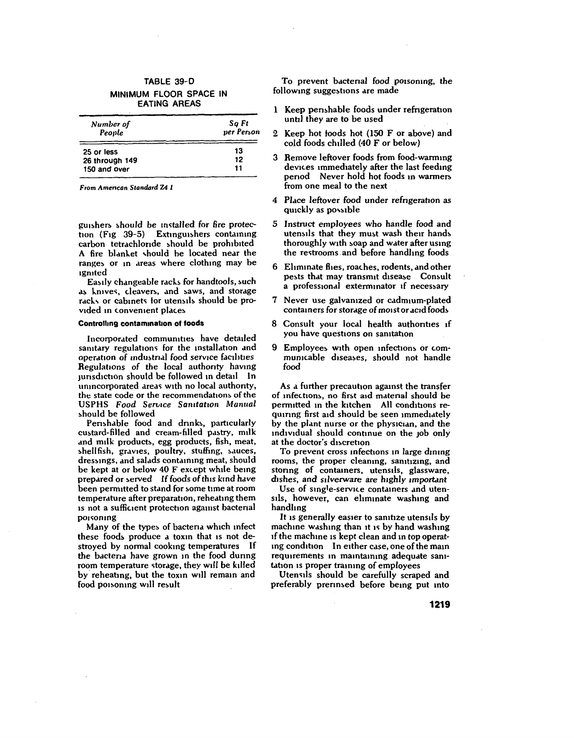
obvious A few measurements of "high" concentration, evaluated by an inadequately trained man may shut down an operation re sulting in considerable financial loss On the other hand, with insufficient attention to the limitations of these instruments, it is quite possible to get seemingly "safe" read ings and still have a real hazard leading to occupational disease and excessive work losses Direct-reading vs lab analysis There is no real qualitative distinction between direct-reading and laboratory ana lytical techniques, and in some cases they overlap For example, to measure die air borne concentration of hydrogen chlonde, the industrial hygienist could have the chem ist make up a solution containing known amounts of sodium hydroxide in a series of bubblers or impingers The contaminated air could be drawn through each bubbler at a measured rate for a fixed period of time and the samples returned to the laboratory There, the excess sodium hydroxide would be back-titrated by the chemist with hydro chloric acid and the air concentrations of hydrogen chloride calculated This is the laboratory analysis method However, the industrial hygienist could have the chemist make up a smaller quantity of sodium hydroxide in each bubbler and place an indicator m the solution In the field, the industrial hygienist could bubble air through the solution at a known rate and measure the time it took to obtain a color change in the bubbler From the volume of air drawn through, he could determine the air concentration of hydrogen chlonde by a very simple calculation This is es sentially a direct-reading method Both methods are adequate for measunng the. air concentration at the point of sampling In both methods, the reagents were pre pared by a trained chemist In one case the industnal hygienist took a sample for a fixed penod of time, and m the other he sam pled until he saw a color change Essentially, no difference in skills is required in the direct-reading method, he can now take his second sample with the bets about his first result already on hand This is the crucial difference between the methods and here is where the user of the direct-reading method must be wary He may be led on a trail of seeking higher or lower concentrations and away from his ob jective of measunng the man's exposure under truly representative conditions A certain impartiality, created by ignorance of the immediately preceding results, may help in obtaining a more representative sample On the other hand, a trained industnal hy gienist can utilize this progressively increas ing knowledge of results to sharpen the pre cision of sampling Safety professionals have been using directreading instruments for many years for de tecting combustible and explosive gases and have saved many lives as a result In the case of explosive gases, peak concentrations, not related to a man's exposure, must be mea sured Explosive limits are physical con stants which can be modified only within narrow limits, in contrast to threshold limit values which must be interpreted broadly With a full knowledge of the facts, the trained industnal hygienist is m a position to utilize the direct-reading instruments to considerable advantage He can take more samples, get closer to the breathing zone, screen out areas for more detailed study, search out specific sources of air contami nation, and adequately evaluate the workers' exposure Evaluating the Hazard Evaluation of environmental exposures re quires teamwork by several professional disciplines no single group can solve all the many problems presented by occupa tional disease For example, the engineer ordinarily collects atmospheric samples in the field for subsequent chemical analyses In many cases, however, the chemist must go into the field to assist with the collec tion of samples and to advise on the chem ical aspects of the particular problem under study The evaluation of an industnal health hazard requires some knowledge of toxi cology and an understanding of the con cepts involved in the use of threshold limit values and maximal acceptable concentra tions The following material in this section on 1283
refid# 83YKqxgXoozv0no363D8dmvd1 page
1313 Substance *' Heptane (n-heptane) Hexachloroethane--Skin * Hexachloronaphthalene-Skin Hexane (n*hexane) 2-Hexanone Hexone sec-Hexyl acetate Hydrazine--Skin Hydrogen bromide C Hydrogen chloride Hydrogen cyanide --Skin Hydrogen ftuonde Hydrogen peroxide 90% Hydrogen selemde Hydrogen sulfide Hydroqumone C Iodine Iron oxide fume Isomyl acetate Isoamyi alcohol Isobutyl acetate * Isobutyl alcohol Isophorone Isopropyl acetate Isopropyl alcohol Isopropylamine Isopropylether isopropyl giycidy!
refid# LpezBoOEQx4OBJVe2BeQV7GL71 page