Refine
Estimated Years UndatedClear
92,592 results foundRefine Search
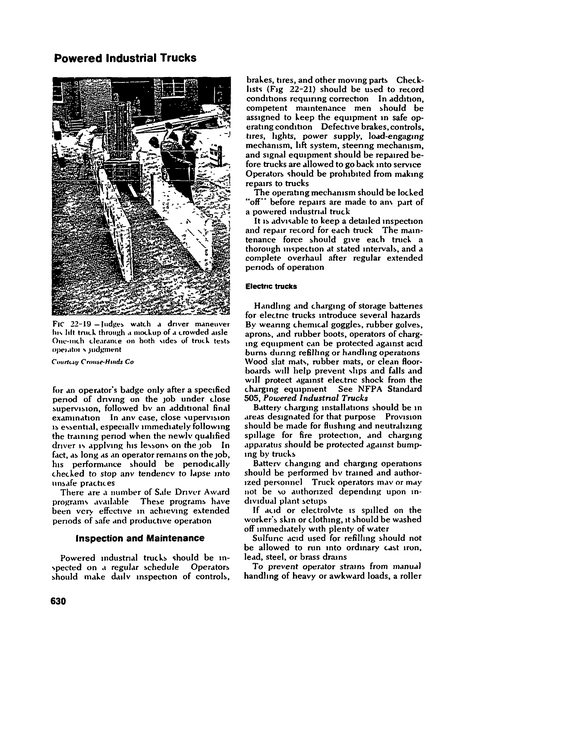
Powered Industrial Trucks brakes, tires, and other moving parts Check lists (Fig 22-21) should be used to record conditions requiring correction In addition, competent maintenance men should be assigned to keep the equipment in safe op erating condition Defective brakes, controls, tires, lights, power supply, load-engaging mechanism, lift system, steenng mechanism, and signal equipment should be repaired be fore trucks are allowed to go back into service Operators should be prohibited from making repairs to trucks The operating mechanism should be locked "off" before repairs are made to an\ part of a powered industrial truck It is advisable to keep a detailed inspection and repair record for each truck The main tenance force should give each tmek a thorough inspection at stated intervals, and a complete overhaul after regular extended periods of operation Electric trucks FlC 22-19 -- lodges watch a driver maneuver Ills lift truck through a niockup of a crowded aisle One-inch clearance on both sides of truck tests opeintoi s judgment Ciwrtay Croit&e-Hmds Co for an operator's badge only after a specified period of driving on the job under close supervision, followed bv an additional final examination In anv case, close supervision is essential, especially immediately following the training period when the newlv qualified driver is applying his lessons on the job In fact, as long as an operator remains on the job, his performance should be periodically checked to stop anv tendency to lapse into unsafe practices There are a number of Safe Driver Award programs available These programs have been very effective in achieving extended periods of safe and productive operation Inspection and Maintenance Powered industrial trucks should be in spected on a regular schedule Operators should make dailv inspection of controls.
refid# opZkbxbaY3wbjrMv95np4g8g1 page
the basic principles enumerated earlier For many years, most of the standard machinery manufacturers have designed first-class serv iceable guards for power transmitting parts of their equipment, which are available when specified on a purchase order A manufac turer's guards usually are designed to be an integral part of the machine and are therefore superior to homemade guards in appearance and in convenience of arrangement Few manufacturers provide satisfactory point-ofoperation guards Often the reason given for not buying the protective guards and controls available from the manufacturer is that purchase of a ma chine is a capital expense which is closely budgeted, whereas construction of a guard by the maintenance department is a maintenance item and therefore acceptable As a result, a large number of companies buy stnppeddown machinery and make guards after the machinery has been installed This is poor economy Machine guards can be provided by the manufacturer more cheaply because his costs are spread over a number of machines In addition, safety engineers frequently en counter delays m getting guards constructed by the maintenance department which is busy with routine duties and it is difficult for main tenance personnel to find time for building guards Too often new equipment is immediately placed in operation with no protection for the operator and nearby workers The hazards presented by an unguarded machine make a potent argument in favor of specifying inclu sion of all guards available from the manu facturer when a machine is ordered The advantages of securing as much built-in protection as possible from the manufacturer are 1 The additional cost of guards designed and installed by the manufacturer usually is less expensive than the installation of guards by the purchaser 2 Built-in guards conform closer to the ap pearance and operation of the machine 3 A built-m guard may strengthen the ma chine, may act as an exhaust duct or oil re tainer, or may serve some other functional purpose Substitution of direct-drive machines or individual motors for overhead line shaft trans mission decreases the hazards inherent in transmission equipment Speed reducers can replace multi-cone pulleys, and remote con trol oiling and adjustment devices make it unnecessary for employees to get too close to moving parts Point-of-operation guards Although the design and use of point-of-operation guards are discussed later in this chapter.
refid# OJJ6weQzvpq7B7RNKz7MrXROw1 page
Carbon monoxide Carbon monoxide (CO) is generated during some cycles m the operation of a cupola It is an explosion hazard if it gets into the wind boxes and blast pipes when the blowers are shut down To eliminate this hazard, ade quate natural or mechanical ventilation should be supplied in back of the cupola, and two or more tuyeres should be opened after shutdown The large amount of blast air in the cupola generally tames the carbon monoxide out the stack In some cases, it is burned in the stack before it can be discharged Sometimes, however, because of a high wind or an inver sion on a foggy or smoggy day, the draft may be so low that this gas may escape through the charging door into adjoining areas and even into the general foundry area Carbon monoxide gives no warning and thus may overcome workers before they are aware of its presence To prevent carbon monoxide from being picked up from the cupola stack by the suction of the ventilating system and earned back inside the plant, the ventilating suction should be located well awav from the cupola stack CO indicators, which are designed to light a red light, nng a bell, or sound a whistle, are comparatively inexpensive and easily in stalled, and should be provided about the cupola, on the charging floor especially, and wherever else there may be exposure to car bon monoxide They should not, of course, be considered a substitute for safe operating practices Both a light and a loud whistle should be hooked up to the indicator so that adequate warning will be given to people working on the charging floor as soon as car bon monoxide enters the area One or more gas masks of the type approved by the U S Bureau of Mines for protection against carbon monoxide should be readily accessible, should be kept in good condition, and the men should be trained to use them Gas masks may not be effective where the concentration of carbon monoxide is in excess of 2 per cent, as is sometimes possible in foundry work Moreover, gas masks give no protection against oxygen deficiency Under these conditions, hose masks with blowers, air-supplied respirators (masks or respirators supplied with air from an uncontaminated source), or oxygen-supplied gas masks should be provided (See Chapter 38 for details ) Blast gates Blast gates and explosion doors are used successfully to prevent damage from gas ex plosions They are sometimes placed in front of the tuyeres, so that they can be opened to admit fresh air when the blowers are shut down They should never be closed until the blast has entered the wind box and driven out all gas Blast gates should be provided in the air blast pipe that supplies air to the melting equipment They should be closed when the air supply fails or when the melting equip ment is shut down, in order to prevent the ac cumulation of combustible gases in the air supply system In the cupola, the blast gate may be omitted if alternate tuyeres are opened to permit air circulation Blast gates should be so located in relation to the cupola wind box that the duct volume will be kept to a minimum Motorized damp ers may be installed at centrifugal blowers so that they will close automatically when the air supply fails Positive-pressure blowers should be equipped with safety valves having liberal discharge areas If these are not provided, clogging of the cupola with slag or quick clos ing of the gate or damper may produce suffi cient pressure in the blast pipe to burst it Every cupola should have at least one safety-type tuyere, with a small channel l'lt or 2 m below the normal tuyere level This channel has a fusible plate that will melt through should the slag and iron rise to an unsafe level Tapping out Tapping out with safety requires skill and should be done only by experienced and de pendable men In "botting-up" the hole, the bott should not be thrust directly into the stream of molten metal or it will cause spattering To eliminate this, place the bott immediately over the stream of metal close to the hole and aim it down toward the hole at a sharp angle A supply of botts ready for use should be kept within convenient reach of the man who does the tapping When the cupola is tapped, the back end of the tapping bar should be held below the 811
refid# mB39X646NOg48Q8G3j6vy2R0d1 page
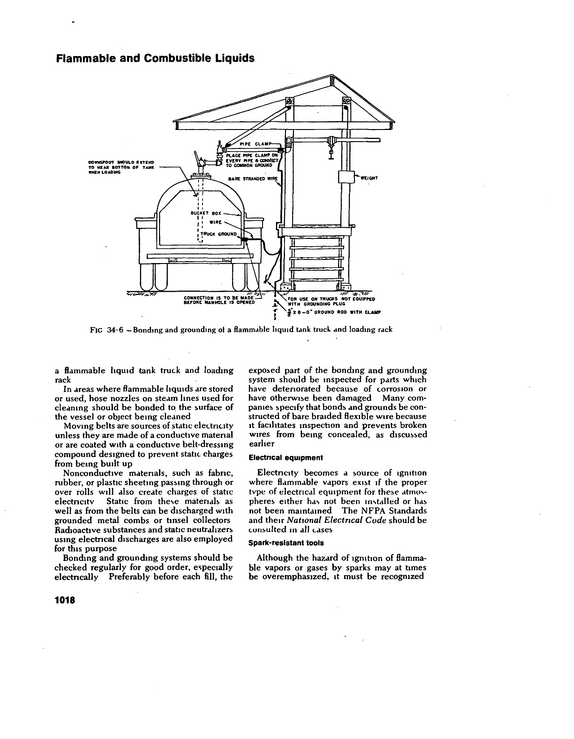
Flammable and Combustible Liquids FlC 34-6 -- Bonding and grounding ol a flammable liquid tank truck and loading rack a flammable liquid tank truck and loading rack In areas where flammable liquids are stored or used, hose nozzles on steam lines used for cleaning should be bonded to the surface of the vessel or object being cleaned Moving belts are sources of static electricity unless they are made of a conductive material or are coated with a conductive belt-dressing compound designed to prevent static charges from being built up Nonconductive materials, such as fabric, rubber, or plastic sheeting passing through or over rolls will also create charges of static electncitv Static from these materials as well as from the belts can be discharged with grounded metal combs or tinsel collectors Radioactive substances and static neutralizers using electrical discharges are also employed for this purpose Bonding and grounding systems should be checked regularly for good order, especially electrically Preferably before each fill, the exposed part of the bonding and grounding system should be inspected for parts which have deteriorated because of corrosion or have otherwise been damaged Many com panies specify that bonds and grounds be con structed of bare braided flexible wire because it facilitates inspection and prevents broken wires from being concealed, as discussed earlier Electncal equipment Electricity becomes a source of ignition where flammable vapors exist if the proper tvpe of electrical equipment for these atmos pheres either has not been installed or has not been maintained The NFPA Standards and their National Electrical Code should be consulted m al!
refid# Vj98gBxanm5Z5Bm80vNM7MQBN1 page
SUPREME COURT OF THE STATE OF NEW YORK SEVENTH JUDICIAL DISTRICT In Re: Seventh Judicial District Asbestos Litigation SEVENTH JUDICIAL DISTRICT ASBESTOS LITIGATION This Document Applies to: SUPREME COURT OF THE STATE OF NEW YORK COUNTY OF ONTARIO ANNE M.


refid# LKVVzJJgeVYy8R6KkdoeOMOMX7 pages
Brucellosis Brucellosis (undulant fever) has long been known as an infection produced by drinking unpasteunzed milk from cows suffering from Bang's disease (infectious abortion) Since it can also be contracted by handling the animals or their flesh and is also transmitted by swine and goats, it is an occupational ail ment of slaughterhouse workers as well as of farmers, although more common among the latter Here also, preventive measures are primarily proper testing and control of the animals to eradicate the disease Erysipelas The other major bacterial infection to which slaughterhouse workers and flsh handlers are subject is erysipelas, which seems to be es pecially virulent when contracted from the slime of fish Upper respiratory tract infections Workers exposed to dusts from vegetable fibers such as cotton, bagasse (sugar cane residues), hemp, flax, or grain may develop upper respiratory tract infections ranging from chronic irritation of the nose and throat to bronchitis, complicated by asthma, emphy sema or pneumonia, or a combination Dusts from many of these fibers may also be a source of allergens, histamine, and toxic metabolic products of microorganisms How ever, most of the cases of illness arising from handling these fibers have been reported in the foreign literature (See Kenneth F Maxy in "References ") Occupational Skin Diseases Industrial skin diseases account for about one half to two thirds of all compensation claims for occupational diseases These claims are scattered throughout all types of industry and sometimes appear where occu pational skin diseases may be least expected Types of dermatitis There are two general types of dermatitis primary irritation and sensitization Nearly all persons will suffer primary irri tation dermatitis from mechanical agents such as friction, from physical agents such as heat or cold, and from chemical agents such as acids, alkalis, irritant gases, and vapors Brief contact with a high concentration of a primary irritant or prolonged exposure to a low con centration will cause inflammation Allergy is not a factor in these conditions Sensitization dermatitis, on the other hand, is the result of an allergic reaction to a given substance The sensitivity becomes estab lished over a relatively long induction penod which may be a few days to a few months In most cases, it is ten days to a month After the sensitivity has become established, ex posure to even a small amount of the sensitiz ing material is likely to produce a severe reaction There are various grades of sensi tivity, and many people who are sensitized to the materials they are handling can con tinue to work with them without trouble if they simply take precautions against direct contact With severe sensitization, however, it may be difficult or impossible to control the exposure sufficiently to permit the individual to go on working with the material, or even allow the individual to be in the room where the material is handled Some substances can produce both primary irritation dermatitis and sensitization derma titis Among them are organic solvents, formaldehyde, chromic acid, and epoxy resin systems Causes of dermatitis Causes of occupational dermatitis are class ified under these main headings chemical agents, mechanical agents, physical agents, plant poisons, and biological agents Chemical agents are the predominant causes of dermatoses in manufactunng indus tries Table 41-C, therefore, is concerned only with these agents The information given includes the action of the listed chemi cals on the skm as either primary irritants or sensitizers The table is not, of course, ex haustive m any respect, but can provide quick reference data on some of the more common chemical lmtants Cutting oils and similar substances are especially important chemical agents because the oil dermatitis which they cause is prob ably of interest to a larger proportion of indus trial concerns than is any other single type of dermatitis (Text continues on page 1276 ) 1271
refid# LgMoKq40Jv6XmDgjnDnLyebO71 page
Energy The capacity for doing work Vanous forms include chemical energy, nuclear energy, kinetic energy and others Esters Organic compounds which may be made by interaction between an alcohol and an acid, and by other means Esters are noniomc compounds, including solvents and natural fats Ethane C2H6 A paraffinic hydrocarbon derived from petroleum or natural gas, im portant for organic synthesis Ethylene is derived from it Ethyl alcohol or ethanol C2HsOH Organic compound synthesized either from petroleum or natural gas or denved by a fer mentation process Wide use as a solvent and for chemical synthesis expand and contract greatly in response to changes in temperature and pressure, easily diffuses into other gases, readily and uni formly distributes itself throughout any con tainer Glycerol A clear, sweet, colorless, syrup-like liquid (solid at lower temperatures) denved in various ways by-product of soap manufacture, by fermentation or synthesis Used in medicines, soaps, antifreeze, as a solvent, or reagent and as humectant m foods and tobacco, to make explosives High energy FUEL or (HEF) Liquid or solid chemical propellant providing more energy than conventional fuels Vanous chemical fuels used in U S rocket and mis sile programs, e g, hydrocarbons, hydrogen, hydrazine, aniline, etc Ethylene C,H< Caseous olefinic com pound resulting from the cracking of either selected petroleum fractions or natural gas Wide use as starting material for numerous chemical reactions, notably manufacture of polyethylene and related plastics materials Ethylene glycol Clear, colorless, liquid Useful as humectant because it ab sorbs approximately twice its weight of water at room temperature and 100 per cent hu midity A major use antifreeze Among many other uses dye solvent, solvent for resins, drugs, other organic chemicals Highly toxic if ingested Fertilizer Plant food usually sold in mixed formula containing basic plant nu trients compounds of nitrogen, potassium, phosphorus, sulfur, and sometimes other minerals Flotation reagent Chemical used m flotation separation of minerals Added to pulverized mixture of solids and water and oil, it causes preferential nonwetting by water of certain solid particles, making possible the flotation and separation of unwet particles Gas A state of matter in which the ma terial has very low density and viscosity, can Hydrocarbons Organic compounds, composed solely of carbon and hydrogen Several hundred thousand molecular com binations of C and H are known to exist Basic building blocks ofall organic chemicals Main chemical industry sources of hydrocar bons are petroleum, natural gas and coal Hydrometallurgy Science of metal recovery by a process involving treatment of ores m an aqueous medium, such as acid or cyanide solution Inhibitor An agent which arrests or slows chemical action or a material used to prevent or retard rust or corrosion InorcaniC Term used to designate com pounds that generally do not contain car bon Source matter, other than vegetable or animal Examples sulfuric acid and salt Exceptions are carbon monoxide, carbon dioxide Intermediate A chemical formed as a "middle-step" m a senes of chemical reac tions, especially m the manufacture of or ganic dyes and pigments In many cases, it may be isolated and used to form a variety of desired products In other cases, the inter mediate may be unstable or used up at once 1425
refid# Eqm6xxN2z487v6G90pyjdkVaL1 page
1487, 1521-1529 see also Humans and Threshold limit values Eye protection, 943-944, 973, 1154-1164, 1229, 1267-1268, 1289 comfort and fit, 1159-1160 fountains, 1215, 1232-1233, 1556 supervision of, 1156 F Fabrics, flame proofing of, 1072, 1074, 1201-1202 Face protection, 1160, 1289 see also Eye protection Face velocity calculations, 857-858 Factors of safety, see Safety factors Factory Insurance Association, 320 Factory Mutual System, 320-321, 978, 1294 Fahrenheit-Celsius conversion table, 1580-1581 Failure mode and effect, 76 Fainting, 1323 Fallout, radioactive, 1436, 1449 shelters, 1125-1126 Fans air handling, 879-880 body cooling, 906 see also Ventilation Fasteners belt, 679 elevator rope 590 pallet, 624-625 wire rope, 647-650 Fault tree, 76 Federal Mediation and Conciliation Service, 354 Federal Railroad Administration, 352 Federal Safety Council, 354 Federal Specifications and Standards, 352-353 Feeding and ejecting devices, power press, 667, 668, 698, 715-722, 743 Feedwater, boiler, 475--476 Fellow servant rule, 290 Fertilizer, 1425 Fever, 1323 Fiber rope natural, 636 synthetic, 636-637 inspection, 637-640 care in use, 640 care in storage, 641 slings, 650-653 lifelines, 448, 1189-1190 Fibers, properties of, 636-639 Files, hand, 955-956 Filing cabinets, 384-386 Film badges, radiation, 1436, 1491-1492, 1494 Filmstrips, 236-237 Filters air, 875-877, 1168 hydraulic systems, 830 sound, 1518 water, 1210 Fingers, "dead" or "white," 1265-1266 Fire chemistry, 1059-1061 classification, 1056-1058, 1061 loss control, 1047-1074 Fire extinguishers portable, 1092-1109 carbon dioxide, 1105 classes of, 1092-1093 dry-chemical, 1102-1105 dry powder, 1105-1106 federal rules, 1106-1107 location of, 1093-1099, 1554-1555 maintenance of, 1108-1109 miscellaneous, 1107-1108 selection of, 1099-1100 water solution, 1100-1102 systems, 1077-1092 automatic, 513-515, 1054 foam, 1087-1089 hoses, 1085-1087 Fire prevention, 1047, 1064-1074 air cleaners, 880 contributory factors, 1056-1059 emergency planning, 1112-1113, 1129-1133 escalators, 598-599 foundry, 806 hazard identification, 990-993, 1062-1063 housekeeping, 1067-1068 industrial trucks, 631-633 inspection, 55, 1064 office, 386 radiation safety, 1458, 1493 storage tank, 1033 tank car, 1024 tank truck, 1025 vehicle repair shops, 1554-1555 welding, 1058 Fire protection, 1047-1056 college courses, 369 extinguisher squad, 1131 extinguishment, 1077-1109 fighters, training, 1107-1108, 1133 municipal, 1138-1139 organizations, 320-322 periodicals, 371 station house, 1133 see also Personal protective equipment Fire-resistant hydraulic fluids, 829-832 Fire-resistant construction, 1049-1052 Firing, boiler, 478 Firet aid, 1231-1232, 1234-1235 chemical bums, 1556-1557 disaster service, 1135-1136 kits, 1234-1235 reports, 244-245 rooms, 1234 training, 162, 1232 "Fish pole technique," 1470 Fission, atomic, 1436 1633
refid# rpqng8jLwY6DNX63GgyKqn2VG1 page
r' n ASBESTOS t HEALTH MEETINGS ALL0552-004

refid# rpj2O93Joop9zyy6n7q44x1Oa1 page
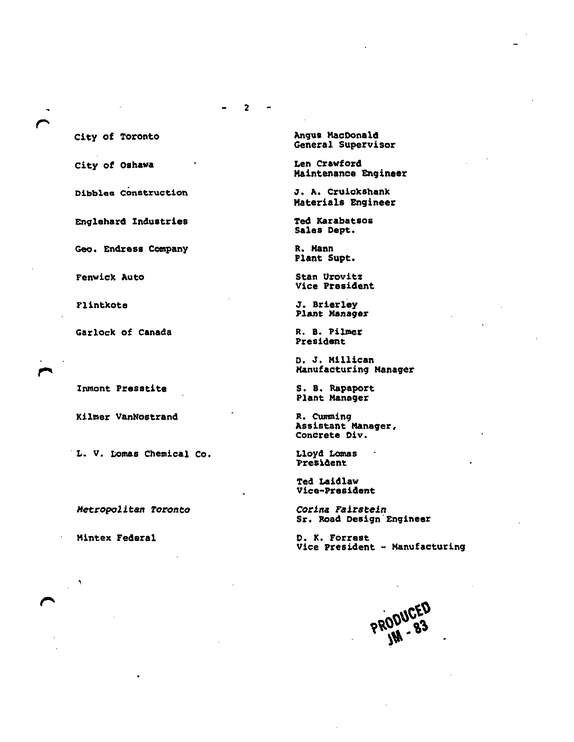
city of Toronto City of Oshawa Dibbles Construction Englehard Industries Geo.
refid# wg8Ez2kx46g0JaJbE87YnRK61 page
.'
refid# xDOpQx7GLkvamoODm5JBBqqm1 page
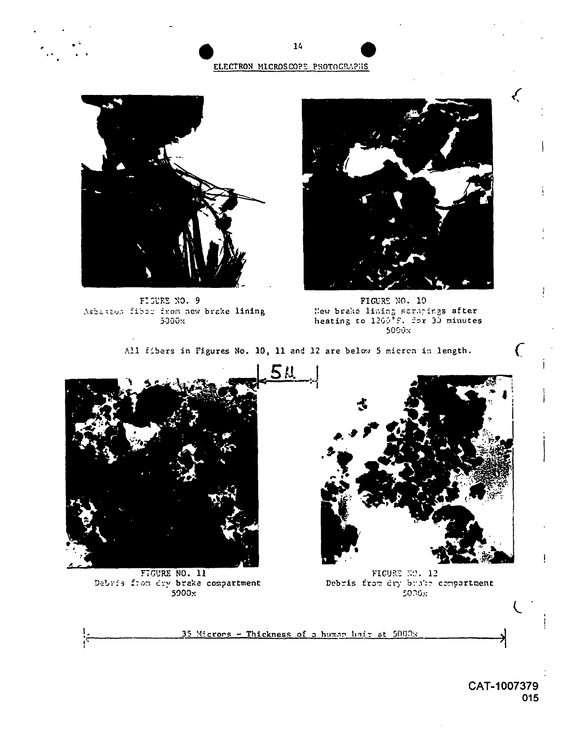
11> ELECTRON MICROSCOPE PHOTOGRAPHS < FIGURE NO. 9 Asbi ?
refid# nmzmBw71ZBdnKdjL2NxnQERk21 page
Among the most important of these skills are giving job instruction, supervising workers at work, determining accident causes, and building safety attitudes among workers Special courses may be given in these subjects On-the-Job Training On-the-job training (OJT) is widely used because the trainee can be producing while he is being trained Whether the supervisor does the instructing himself or has someone else do the teaching, the training should be carefully planned and organized Again the safety professional should be familiar with his organi zation's training program so that appropriate and correct safety training is integrated into it In too many cases, on-the-job training is a hit-or-miss procedure where the trainee is told to follow another worker around and leam his job In situations of this type, the worker may be too busy to do any training, or may not know good training procedures He may even be reluctant to tram another to do his work Remember, it is the supervisor's responsi bility to make sure the person doing the train ing can, m fact, train On-the-job training in cludes many techniques and approaches and there is no one method that will fit all situ ations Job safety analysis (JSA, discussed m the next section and in Chapter 5, "Removing the Hazard from the Job") is one method, job instruction training (JIT) is another, and overthe-shoulder coaching is still another widely used method These methods may be used separately or in combination depending upon the complexity of the job and the time ele ment Over-the-shoulder coaching Over-the-shoulder coaching is perhaps the most flexible and direct of the three training methods In coaching, the trainee is expected to develop and apply his stalls in typical work situations under the guidance of a qualified person The person to whom the trainee has been assigned should be one who knows the job thoroughly, is a safe operator, and has the patience, time, and desire to help others (See Fig 9-3 ) The advantages of training of this type are 1 The worker is more likely to be highly moti vated because the guidance is personal 2 The instructor can identify specific perform ance deficiencies and take immediate and proper corrective action 3 Results of the training are readily apparent since real equipment is being used and finished work can be judged by existing standards 4 The training is practical and realistic and can be apphed at the proper time Timing is important, not only do the trainees like to get help when needed, but also the instructor can judge the trainee's progress con tinually so he can present the next unit or phase of instruction when the trainee is ready To help keep track of the progress of each individual, a training chart is valuable On the top of the chart are listed the various tasks required of a person in a particular job classifi cation By observation and direct discussions, the instructor can determine whether the em ployee is qualified to perform the tasks neces sary to fill the job The instructor determines the degree of skill and knowledge of the trainee and estimates his training needs He makes notes and comments on the chart Such a chart prevents neglecting training that is important, it also prevents unnecessary train ing (See Fig 9--4, next page ) Job safety analysis A job safety analysis (JSA) is a procedure to make a job safe by 1 Identifying the hazards or potential acci dents associated with each step of a job, and 2 Developing a solution for each hazard that will either eliminate or control the exposure Benefits of JSA.
refid# OzgzKEdqrzLgrNx46Mg7EMJyM1 page
cal!
refid# 8RVBxJ8vkYnMdonGw52V2j8bo1 page
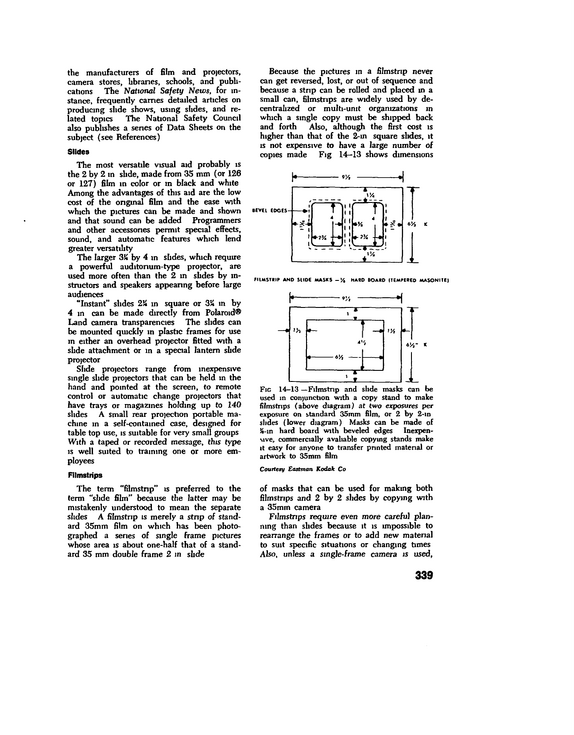
the manufacturers of film and projectors, camera stores, libraries, schools, and publi cations The National Safety News, for in stance, frequently carries detailed articles on producing slide shows, using slides, and re lated topics The National Safety Council also publishes a senes of Data Sheets on the subject (see References) Slides The most versatile visual aid probably is the 2 by 2 m shde, made from 35 mm (or 126 or 127) film in color or m black and white Among the advantages of this aid are the low cost of the ongmal film and the ease with which the pictures can be made and shown and that sound can be added Programmers and other accessones permit special effects, sound, and automatic features which lend greater versatility The larger 35* by 4 in slides, which require a powerful auditonum-type projector, are used more often than the 2 m slides by in structors and sjieakers appeanng before large audiences "Instant" slides 211 m square or 351 in by 4 m can be made directly from Polaroid Land camera transparencies The slides can be mounted qmckly in plastic frames for use m either an overhead projector fitted with a shde attachment or in a special lantern shde projector Shde projectors range from inexpensive single slide projectors that can be held m the hand and pointed at the screen, to remote control or automatic change projectors that have trays or magazines holding up to 140 slides A small rear projection portable ma chine in a self-contained case, designed for table top use, is suitable for very small groups With a taped or recorded message, this type is well suited to training one or more em ployees Filmstrips The term "filmstnp" is preferred to the term "shde film" because the latter may be mistakenly understood to mean the separate shdes A filmstrip is merely a strip of stand ard 35mm film on which has been photo graphed a series of single frame pictures whose area is about one-half that of a stand ard 35 mm double frame 2 in shde Because the pictures in a filmstrip never can get reversed, lost, or out of sequence and because a strip can be rolled and placed in a small can, filmstrips are widely used by de centralized or multi-unit organizations in which a single copy must be shipped back and forth Also, although the first cost is higher than that of the 2-rn square shdes, it is not expensive to have a large number of copies made Fig 14--13 shows dimensions h----------------------*1 FILMSTRIP AND SLIDE MASKS - HARD BOARD (TEMPERED MASONITE) (------------------------- H Fig 14-13 --Filmstnp and slide masks can be used m conjunction with a copy stand to make filmstnps (above diagram) at two exposures per exposure on standard 35mm film, or 2 by 2-m slides (lower diagram) Masks can be made of K-in hard board with beveled edges Inexpen sive, commercially available copying stands make it easy for anyone to transfer pnnted material or artwork to 35mm film Courtesy Eastman Kodak Co of masks that can be used for making both filmstnps and 2 by 2 shdes by copying with a 35mm camera Filmstnps require even more careful plan ning than shdes because it is impossible to rearrange the frames or to add new material to suit specific situations or changing times Also, unless a single-frame camera is used. 339
refid# 6B3y3Z9njgJbJ2EQjQ2mknwz61 page