Refine
Estimated Years UndatedClear
92,592 results foundRefine Search
in diameter, but which were of much lower density than the ferritin gran ules of normal asbestos bodies (Figures 1 and 2).
refid# 4v5QEDXkJzKp3NyjXrq9qXy111 page
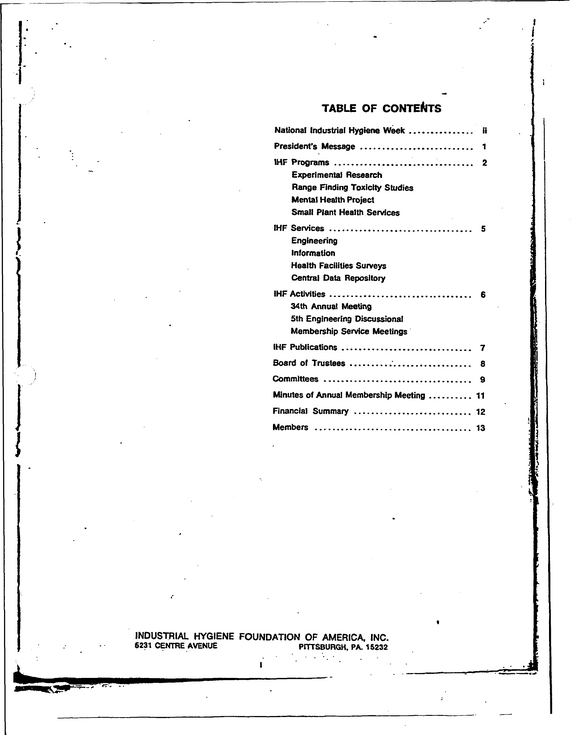
TABLE OF CONTENTS National Industrial Hygiene Week........................... ii President's Message................................................ 1 tHF Programs...........................................
refid# qGnqz1mQ4Ly7547DjZkgpvzK1 page
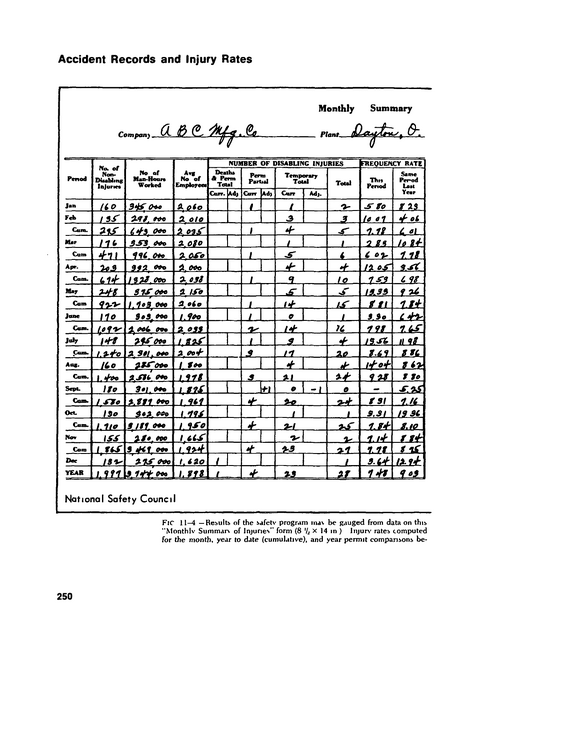
Accident Records and Injury Rates Company, a&<?.
refid# jBr08D0qM1Ma8YvjLQL79wmg21 page
Accident Investigation, Analysis, and Costs Accident Investigation and Analysis Successful accident prevenbon requires a minimum of four fundamental activities 1 A study of all working areas to detect and eliminate or control physical or environ mental hazards which contribute to accidents 2 A study of all operahng methods and pracbces 3 Education, instrucbon, training, and dis cipline to minimize human factors which contribute to accidents 4 For cause analyses, a thorough mvestigabon of at least every accident which re sults in a disabling injury to determine contnbubng circumstances Accidents that do not result m personal injury (so-called "near-accidents" or "near-misses") are warnings They should not be ignored The fourth activity, cause analysis, is a secondary defense against hazards which may have been overlooked in die first three In connecbon with this acbvity, an mvesbgabon should be made of every accident which results in a disabling injury Accidents resulhng m nondisabling injuries, or no in juries, and also "near-accidents," should be investigated if time and facilibes permit, especially if there is frequent recurrence of certain types of nondisabling injuries, or if the frequency of accidents is high in certain areas or operations Purpose of investigation Accident investigabon is a device for prevenhng accidents Investigabon must be for fact finding, notfault finding Otherwise, they may do more harm than good This is not to say that responsibility may not be fixed where personal failure has caused injury, or that such persons should be ex cused from the consequences However, the investigation itself is concerned only with the facts, and the invesbgating indi vidual, board, or committee is best kept free from involvement with the consequences The pnncipal purposes of an accident invesbgation are 1 To learn accident causes so that similar accidents may be prevented by mechani cal improvement, better supervision, or employee training 2 To determine the "change" or deviabon that produced an "error," that, in turn, resulted in an accident (systems safety analysis) 3 To publicize the particular hazard among employees and their supervisors, and to direct attenbon to accident prevenbon in general 4 To determine tacts bearing on legal lia bility An mvesbgabon undertaken solely for this purpose, though, will seldom give enough information for accident preventbon purposes On the other hand, an invesbgation for prevenbve purposes may disclose facts which are important m de termining liability In the following discussion, the mvesbgabon is considered from the standpoint of accident prevenbon, not liability Persons making the investigation Depending on the nature of the accident and other condihons, the invesbgation may be made by the supervisor or foreman, the safety engineer or inspector, the workmen's safety committee, the general safety com mittee, or an engineer from the insurance company If the accident involves special features, consultation with an engineer from the state labor department or U S Bureau of Mines, or with a union representative, may be warranted The supervisor or foreman The supervisor or foreman should make an immediate report of every disabling injury and other accidents he may be directed to investigate He is on the scene, he probably knows more about the accident than anyone else, and it is up to him, m most cases, to put into effect whatever measures may be adopted to prevent similar accidents Fig 11-2 in the previous chapter illustrates one form that can be used to record the findings of an accident invesbgation This chapter was revised by the Statistical and Industrial Department staffs, based upon reviews by selected members of the National Safety Council 268
refid# 4aka1JwbxJyLo7BzKRZgZMp3x1 page
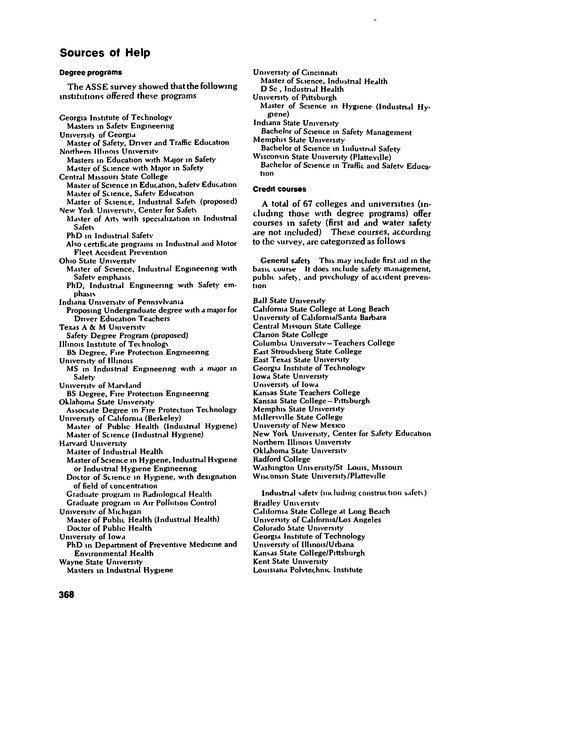
Sources of Help Degree programs The ASSE survey showed that the following institutions offered these programs Ceorgia Institute of Technology Masters in Safetv Engineering Universit> of Ceorgia Master of Safety, Driver and Traffic Education Northern Illinois Universitv Masters in Education with Major in Safety Master of Science with Major in Safety Central Missouri State College Master of Science m Education, Safetv Education Master of Science, Safetv Education Master of Science, Industrial Safetv (proposed) New York Universitv, Center for Safet\ Master of Arts with specialization in Industrial Safety PhD m Industrial Safetv Also certificate programs in Industrial and Motor Fleet Accident Prevention Ohio State Universitv Master of Science, Industrial Engineering with Safetv emphasis PhD, Industrial Engineering with Safety em phasis Indiana University of Pennsylvania Proposing Undergraduate degree with a major for Driver Education Teachers Texas A & M Universitv Safety Degree Program (proposed) Illinois Institute of Technology BS Degree, Fire Protection Engineenng University of Illinois MS in Industrial Engineenng with a major m Safety Universitv of Maryland BS Degree, Fire Protection Engineenng Oklahoma State University Associate Degree in Fire Protection Technology University of California (Berkeley) Master of Public Health (Industnal Hygiene) Master of Science (Industrial Hygiene) Harvard University Master of Industrial Health Master of Science in Hygiene, Industnal Hvgiene or Industrial Hygiene Engineenng Doctor of Science in Hygiene, with designation of field of concentration Graduate program in Radiological Health Graduate program in Air Pollution Control University of Michigan Master of Public Health (Industrial Health) Doctor of Public Health University of Iowa PhD in Department of Preventive Medicine and Environmental Health Wayne State University Masters m Industnal Hygiene University of Cincinnati Master of Science, Industnal Health D Sc , Industrial Health University of Pittsburgh Master of Science in Hygiene (Industnal Hy giene) Indiana State University Bachelor of Science in Safety Management Memphis State University Bachelor ol Science in Industnal Safety Wisconsin State University (Platteville) Bachelor of Science in Traffic and Safetv Educa tion Credit courses A total of 67 colleges and universities (in cluding those with degree programs) offer courses in safety (first aid and water safety are not included) These courses, according to the survey, are categorized as follows General safety This may include first aid in the basic course It does include safety management, public safety, and psychology of accident preven tion Ball State University California State College at Long Beach University of Califomia/Santa Barbara Central Missouri State College Clarion State College Columbia Universitv --Teachers College East Stroudsberg State College East Texas State University Ceorgia Institute of Technology Iowa State University University of Iowa Kansas Stite Teachers College Kansas State College --Pittsburgh Memphis State University Millersville State College University of New Mexico New York University, Center for Safety Education Northern Illinois University Oklahoma State University Radford College Washington University/St Louis, Missouri Wisconsin State University/Platteville Industnal safetv (including construction safets) Bradley University California State College at Long Beach University of California/Los Angeles Colorado State University Georgia Institute of Technology University of llhnois/Urbana Kansas State College/Pittsburgh Kent State University Louisiana Polytechnic Institute 368
refid# pm89Rx8XL5o4MNZvOpaejwBDB1 page
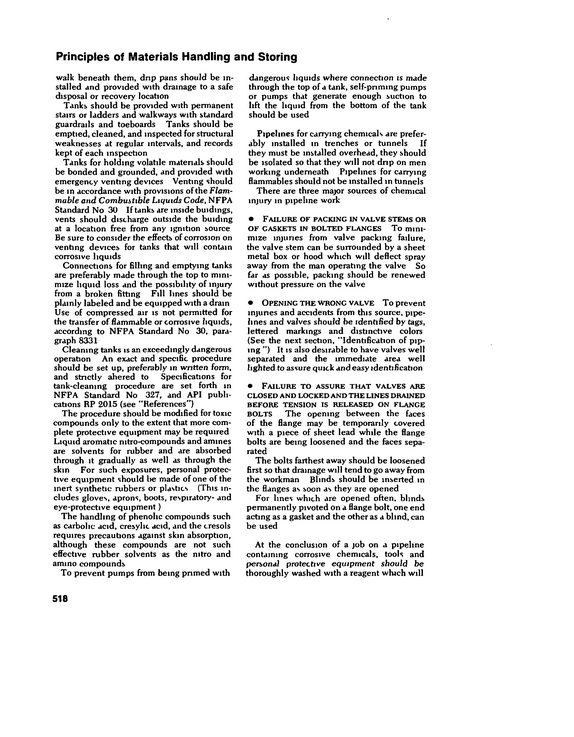
Principles of Materials Handling and Storing walk beneath them, drip pans should be in stalled and provided with drainage to a safe disposal or recovery location Tanks should be provided with permanent stairs or ladders and walkways with standard guardrails and toeboards Tanks should be emptied, cleaned, and inspected for structural weaknesses at regular intervals, and records kept of each inspection Tanks for holding volatile materials should be bonded and grounded, and provided with emergency venting devices Venting should be in accordance with provisions of the Flam mable and Combustible Liquids Code, NFPA Standard No 30 If tanks are inside buidings, vents should discharge outside the buiding at a location free from any ignition source Be sure to consider the effects of corrosion on venting devices for tanks that will contain corrosive liquids Connections for filling and emptying tanks are preferably made through the top to mini mize liquid loss and the possibility of injury from a broken fitting Fill lines should be plainly labeled and be equipped with a drain Use of compressed air is not permitted for the transfer of flammable or corrosive liquids, according to NFPA Standard No 30, para graph 8331 Cleaning tanks is an exceedingly dangerous operation An exact and specific procedure should be set up, preferably m written form, and strictly ahered to Specifications for tank-cleaning procedure are set forth m NFPA Standard No 327, and API publi cations RP 2015 (see "References") The procedure should be modified for toxic compounds only to the extent that more com plete protective equipment may be required Liquid aromatic mtro-compounds and amines are solvents for rubber and are absorbed through it gradually as well as through the skin For such exposures, personal protec tive equipment should be made of one of the inert synthetic rubbers or plastics (This in cludes gloves, aprons, boots, respiratory- and eye-protective equipment) The handling of phenolic compounds such as carbolic acid, cresylic acid, and the cresols requires precautions against skin absorption, although these compounds are not such effective rubber solvents as the nitro and amino compounds To prevent pumps from being pnmed with dangerous liquids where connection is made through the top of a tank, self-pnming pumps or pumps that generate enough suction to lift the liquid from the bottom of the tank should be used Pipelines for carrying chemicals are prefer ably installed in trenches or tunnels If they must be installed overhead, they should be isolated so that they will not dnp on men working underneath Pipelines for carrying fiammables should not be installed m tunnels There are three major sources of chemical injury m pipeline work Failure of packing in valve stems or OF GASKETS IN BOLTED FLANGES To mini mize injuries from valve packing failure, the valve stem can be surrounded by a sheet metal box or hood which will deflect spray away from the man operating the valve So far as possible, packing should be renewed without pressure on the valve Opening the wrong valve To prevent injuries and accidents from this source, pipe lines and valves should be identified by tags, lettered markings and distinctive colors (See the next section, "Identification of pip ing ") It is also desirable to have valves well separated and the immediate area well lighted to assure quick and easy identification Failure to assure that valves are CLOSED AND LOCKED AND THE LINES DRAINED BEFORE TENSION IS RELEASED ON FLANGE BOLTS The opening between the faces of the flange may be temporarily covered with a piece of sheet lead while the flange bolts are being loosened and the faces sepa rated The bolts farthest away should be loosened first so that drainage will tend to go away from the workman Blinds should be inserted in the flanges as soon as they are opened For lines which are opened often, blinds permanently pivoted on a flange bolt, one end acting as a gasket and the other as a blind, can be used At the conclusion of a job on a pipeline containing corrosive chemicals, tools and personal protective equipment should be thoroughly washed with a reagent which will 518
refid# LK5G9yY0LwVeM2wO8KjvmkJLg1 page
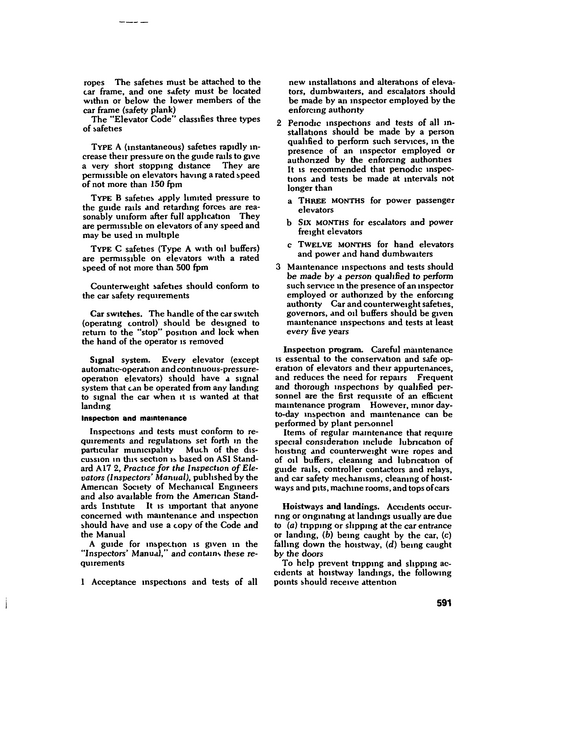
ropes The safeties must be attached to the car frame, and one safety must be located within or below the lower members of the car frame (safety plank) The "Elevator Code" classifies three types of safeties Type A (instantaneous) safeties rapidly in crease their pressure on the guide rails to give a very short stopping distance They are permissible on elevators having a rated speed of not more than 150 fpm Type B safeties apply limited pressure to the guide rails and retarding forces are rea sonably uniform after full application They are permissible on elevators of any speed and may be used in multiple Type C safeties (Type A with oil buffers) are permissible on elevators with a rated speed of not more than 500 fpm Counterweight safeties should conform to the car safety requirements Car switches.
refid# jNwae90nEjN5KN0qL0mBwjqN1 page
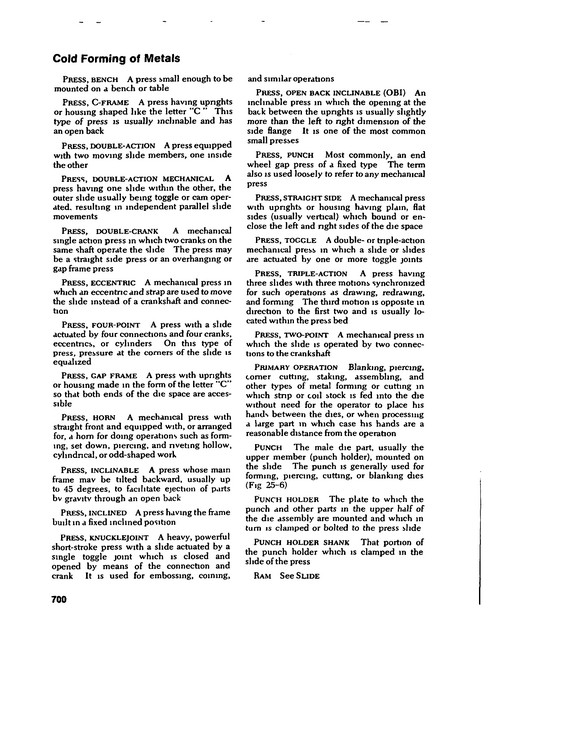
Cold Forming of Metals PRESS, bench a press small enough to be mounted on a bench or table Press, C-FRAME A press having uprights or housing shaped like the letter "C " This type of press is usually inclinable and has an open back Press, double-action A press equipped with two moving slide members, one inside the other Press, double-action mechanical A press having one slide within the other, the outer slide usually being toggle or cam oper ated, resulting m independent parallel slide movements PRESS, DOUBLE-CRANK A mechanical single action press in which two cranks on the same shaft operate the slide The press may be a straight side press or an overhanging or gap frame press Press, eccentric A mechanical press in which an eccentric and strap are used to move the slide instead of a crankshaft and connec tion Press, four-point A press with a slide actuated by four connections and four cranks, eccentrics, or cylinders On this type of press, pressure at the comers of the slide is equalized Press, gap frame A press with uprights or housing made in the form of the letter "C" so that both ends of the die space are acces sible Press, horn A mechanical press with straight front and equipped with, or arranged for, a horn for doing operations such as form ing, set down, piercing, and riveting hollow, cylindrical, or odd-shaped work PRESS, INCLINABLE A press whose mam frame mav be tilted backward, usually up to 45 degrees, to facilitate ejection of parts bv gravity through an open back Press, inclined A press having the frame built in a fixed inclined position Press, knucklejoint A heavy, powerful short-stroke press with a slide actuated by a single toggle joint which is closed and opened by means of the connection and crank It is used for embossing, coining, and similar operations Press, open back inclinable (OBI) An inclinable press in which the opening at the back between the uprights is usually slightly more than the left to nght dimension of the side flange It is one of the most common small presses Press, punch Most commonly, an end wheel gap press of a fixed type The term also is used loosely to refer to any mechanical press Press, straight side A mechanical press with uprights or housing having plain, fiat sides (usually vertical) which bound or en close the left and nght sides of the die space Press, toggle A double- or triple-action mechanical press in which a slide or slides are actuated by one or more toggle joints Press, triple-action A press having three slides with three motions synchronized for such operations as drawing, redrawing, and forming The third motion is opposite in direction to the first two and is usually lo cated within the press bed Press, two-point A mechanical press m which the slide is operated by two connec tions to the crankshaft Primary operation Blanking, piercing, comer cutting, staking, assembling, and other types of metal forming or cutting in which stnp or coil stock is fed into the die without need for the operator to place his hands between the dies, or when processing a large part m which case his hands are a reasonable distance from the operation Punch The male die part, usually the upper member (punch holder), mounted on the slide The punch is generally used for forming, piercing, cutting, or blanking dies (Fig 25-6) Punch holder The plate to which the punch and other parts m the upper half of the die assembly are mounted and which in turn is clamped or bolted to the press slide Punch holder shank That portion of the punch holder which is clamped m the slide of the press Ram See Slide 700
refid# NEq4qq173GmBNkY2nvyxdz4QE1 page
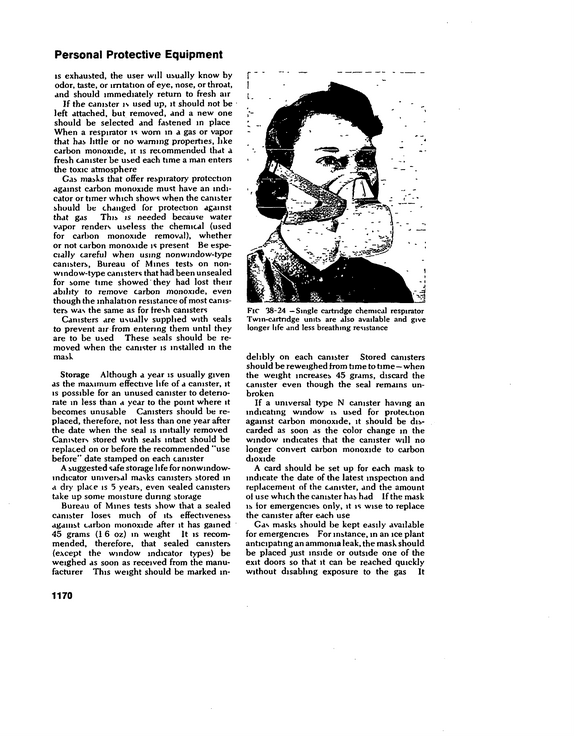
Personal Protective Equipment is exhausted, the user will usually know by odor, taste, or irritation of eye, nose, or throat, and should immediately return to fresh air If the canister is used up, it should not be left attached, but removed, and a new one should be selected and fastened in place When a respirator is wom in a gas or vapor that has little or no warning properties, like carbon monoxide, it is recommended that a fresh canister be used each time a man enters the toxic atmosphere Gas masks that offer respiratory protection against carbon monoxide must have an indi cator or timer which shows when the canister should be changed for protection against that gas This is needed because water vapor renders useless the chemical (used for carbon monoxide removal), whether or not carbon monoxide is present Be espe cially careful when using nonwmdow-type canisters.
refid# bjyr6y4k5dQRjpZavJg3bjyy1 page
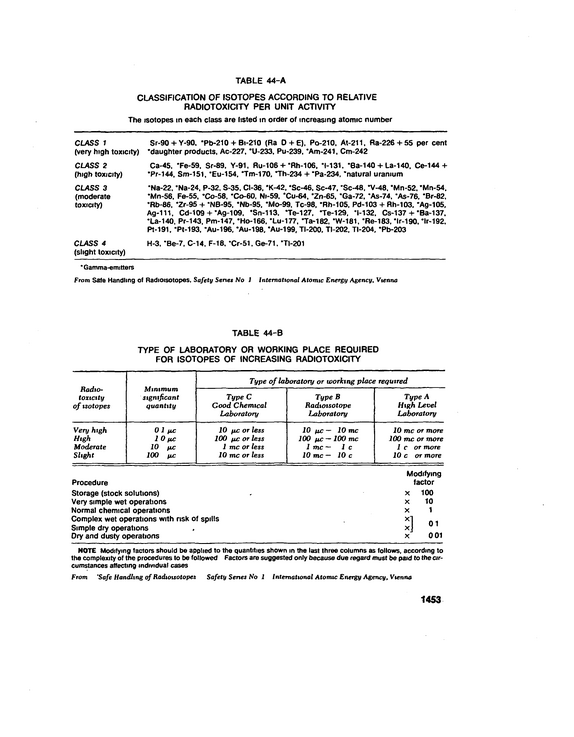
TABLE 44-A CLASSIFICATION OF ISOTOPES ACCORDING TO RELATIVE RADIOTOXICITY PER UNIT ACTIVITY The isotopes in each class are listed in order of increasing atomic number CLASS 1 Sr-90 + Y-90.
refid# dDnGdKJXxmabw5y1nx2jVm3rQ1 page
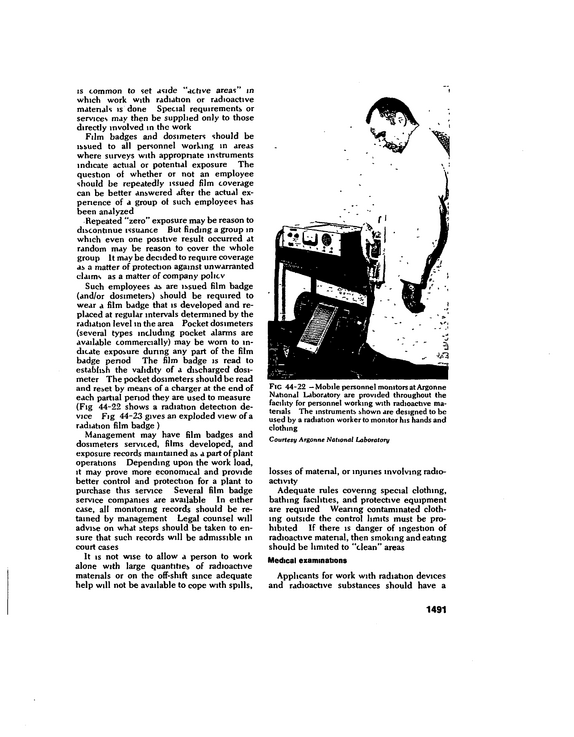
is common to set aside "active areas" in which work with radiation or radioactive materials is done Special requirements or services may then be supplied only to those directly involved in the work Film badges and dosimeters should be issued to all personnel working m areas where surveys with appropriate instruments indicate actual or potential exposure The question o!
refid# O1OK3VmBqZGgDRpOxJbwM6q5X1 page
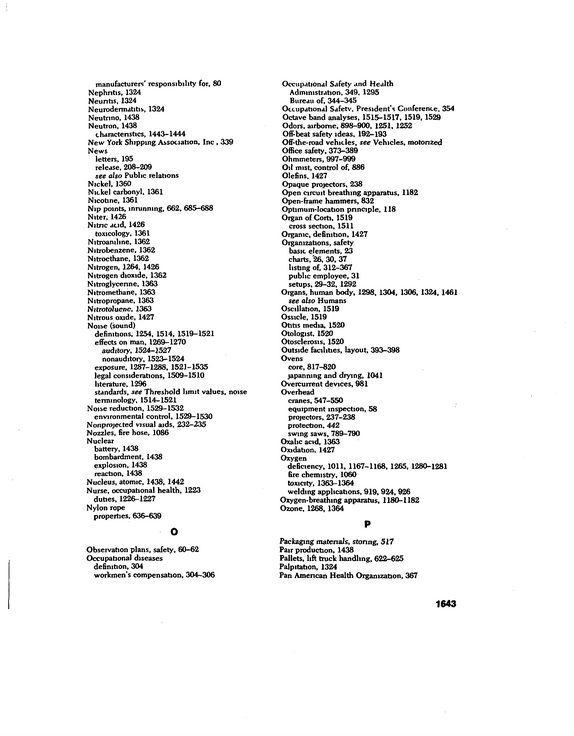
manufacturers' responsibility for, 80 Nephritis, 1324 Neuritis, 1324 Neurodermatitis, 1324 Neutrino, 1438 Neutron, 1438 characteristics, 1443-1444 New York Shipping Association, Inc , 339 News letters, 195 release, 208-209 see also Public relations Nickel, 1360 Nickel carbonyl, 1361 Nicotine, 1361 Nip points, inrunning, 662, 685-688 Niter, 1426 Nitnc acid, 1426 toxicology. 1361 Nitroaniline, 1362 Nitrobenzene, 1362 Nitrocthane, 1362 Nitrogen, 1264, 1426 Nitrogen dioxide, 1362 Nitroglycerine, 1363 Nitromethane, 1363 Nitropropane, 1363 Nitrotoluene, 1363 Nitrous oxide, 1427 Noise (sound) definitions, 1254, 1514, 1519-1521 effects on man, 1269-1270 auditory, 1524-1527 nonauditory, 1523-1524 exposure, 1287-1288, 1521-1535 legal considerations, 1509-1510 literature, 1296 standards, see Threshold limit values, noise terminology, 1514-1521 Noise reduction, 1529-1532 environmental control, 1529-1530 Nonprojected visual aids, 232-235 Nozzles, fire hose, 1086 Nuclear battery, 1438 bombardment, 1438 explosion, 1438 reaction, 1438 Nucleus, atomic, 1438, 1442 Nurse, occupational health, 1223 duties, 1226-1227 Nylon rope properties, 636-639 o Observation plans, safety, 60-62 Occupational diseases definition, 304 workmen's compensation, 304-306 Occupational Safety and Health Administration, 349, 1295 Bureau of, 344-345 Occupational Safety, President's Conference, 354 Octave band analyses, 1515-1517, 1519, 1529 Odors, airborne, 898-900, 1251, 1252 Off-beat safety ideas, 192-193 Off-the-road vehicles, see Vehicles, motorized Office safety, 373-389 Ohmmeters, 997-999 Oil mist, control of, 886 Olefins, 1427 Opaque projectors, 238 Open circuit breathing apparatus, 1182 Open-frame hammers, 832 Optimum-location principle, 118 Organ of Corti, 1519 cross section, 1511 Organic, definition, 1427 Organizations, safety basic elements, 23 charts, 26, 30, 37 listing of, 312-367 public employee, 31 setups, 29-32, 1292 Organs, human body, 1298, 1304, 1306, 1324, 1461 see also Humans Oscillation, 1519 Ossicle, 1519 Otitis media, 1520 Otologist, 1520 Otosclerosis, 1520 Outside facilities, layout, 393-398 Ovens core, 817-820 japanning and drying, 1041 OvercurTent devices, 981 Overhead cranes, 547-550 equipment inspection, 58 projectors, 237-238 protection, 442 swing saws, 789-790 Oxalic acid, 1363 Oxidation, 1427 Oxygen deficiency, 1011, 1167-1168, 1265, 1280-1281 fire chemistry, 1060 toxicity, 1363-1364 welding applications, 919, 924, 926 Oxygen-breathing apparatus, 1180-1182 Ozone, 1268, 1364 P Packaging materials, storing, 517 Pair production, 1438 Pallets, lift truck handling, 622-625 Palpitation, 1324 Pan American Health Organization, 367 1643
refid# zQkmo5pOLp9oBdBvo65xvKkn61 page
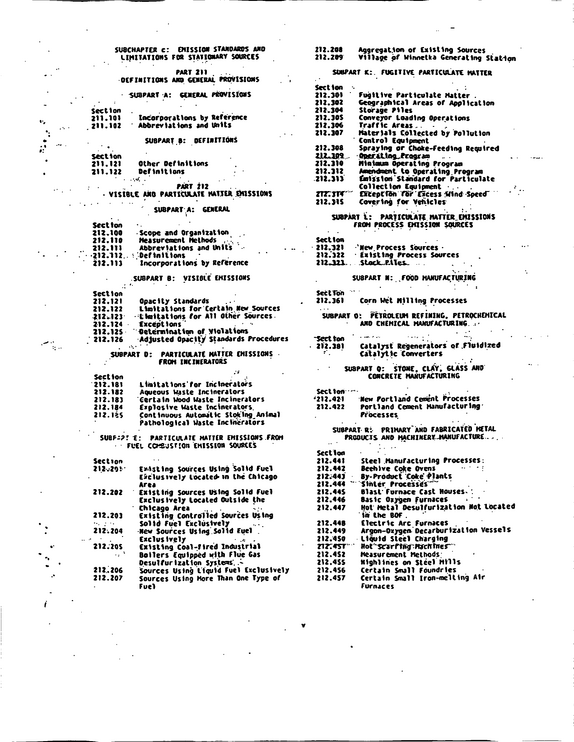
SUBCHAPTER c: EMISSION STANDAROS AMO LIMITATIONS FOR STATIONARY SOURCES PART 211 DEFINITIONS AND GENERAL PROVISIONS SUBPART a: GENERAL PROVISIONS Section 211.101 Incorporations by Reference 211.102 ' Abbreviations and Wilts SU8PARTO: DEFINITIONS Section 211.121 211.122 Other Definitions Definitions PAiRT *12 - VISIBLE AMO PARTICULATE HATTER EMISSIONS Section 212.100 212.110 212.111 *12.112,. 212.11) ' SUBPART'A: GENERAL I Scope and Organization Measurement Methods , .
refid# wDeL8NRg218BMGRK29nZxqwMD1 page
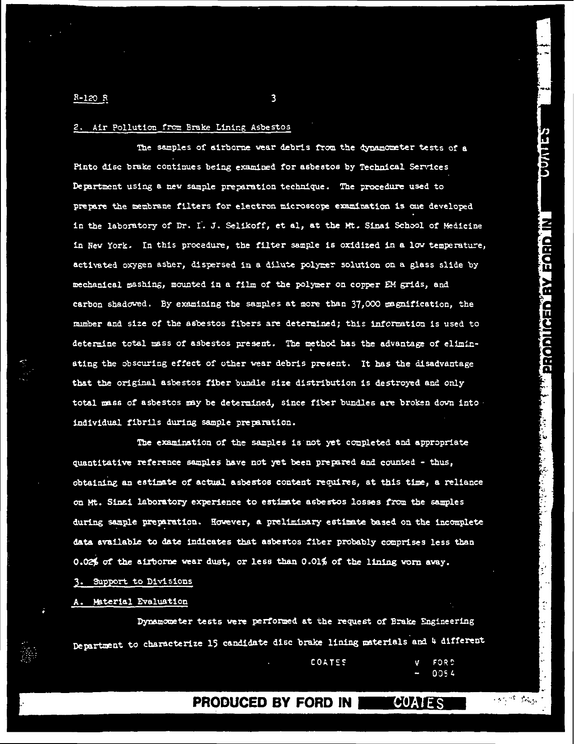
R-120 r 3 2.
refid# 2Jkz6DvZyOxvDakXenoYm5Oba1 page
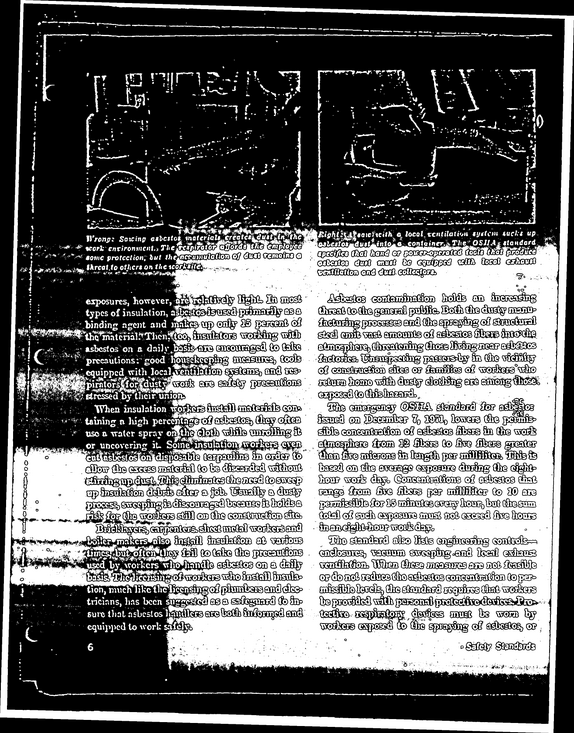
Tnl su .* I . *',*** |A "_* *.
refid# Exn46boexbw8ZrXvNqObrQKzR1 page