Refine
Estimated Years UndatedClear
92,592 results foundRefine Search
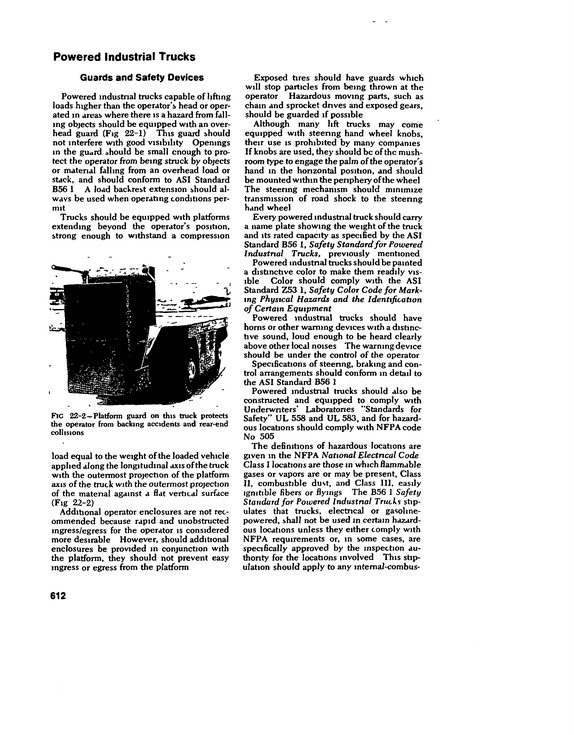
Powered Industrial Trucks Guards and Safety Devices Powered industrial trucks capable of lifting loads higher than the operator's head or oper ated in areas where there is a hazard from fall ing objects should be equipped with an over head guard (Fig 22-1) This guard should not interfere with good visibility Openings m the guard should be small enough to pro tect the operator from being struck by objects or material falling from an overhead load or stack, and should conform to ASI Standard B56 1 A load backrest extension should al ways be used when operating conditions per mit Trucks should be equipped with platforms extending beyond the operator's position, strong enough to withstand a compression FlC 22-2--Platform guard on this truck protects the operator from backing accidents and rear-end collisions load equal to the weight of the loaded vehicle applied along the longitudinal axis ofthe truck with the outermost projection of the platform axis of the truck with the outermost projection of the material against a flat vertical surface (Fig 22-2) Additional operator enclosures are not rec ommended because rapid and unobstructed ingress/egress for the operator is considered more desirable However, should additional enclosures be provided in conjunction with the platform, they should not prevent easy ingress or egress from the platform Exposed tires should have guards which will stop particles from being thrown at the operator Hazardous moving parts, such as chain and sprocket drives and exposed gears, should be guarded if possible Although many lift trucks may come equipped with steering hand wheel knobs, their use is prohibited by many companies If knobs are used, they should be of the mush room type to engage the palm of the operator's hand m the horizontal position, and should be mounted within the periphery ofthe wheel The steering mechanism should minimize transmission of road shock to the steering hand wheel Every powered industrial truck should carry a name plate showing the weight of the truck and its rated capacity as specified by the ASI Standard B56 I, Safety Standardfor Powered Industrial Trucks, previously mentioned Powered industrial trucks should be painted a distinctive color to make them readily vis ible Color should comply with the ASI Standard Z53 1, Safety Color Code for Mark ing Physical Hazards and the Identification of Certain Equipment Powered industrial trucks should have horns or other warning devices with a distinc tive sound, loud enough to be heard clearly above other local noises The warning device should be under the control of the operator Specifications of steering, braking and con trol arrangements should conform m detail to the ASI Standard B56 1 Powered industrial trucks should also be constructed and equipped to comply with Underwriters' Laboratories "Standards for Safety" UL 558 and UL 583, and for hazard ous locations should comply with NFPA code No 505 The definitions of hazardous locations are given in the NFPA National Electrical Code Class I locations are those m which flammable gases or vapors are or may be present.
refid# 2j6YGgVJ3aBDg966Jk243a4Er1 page
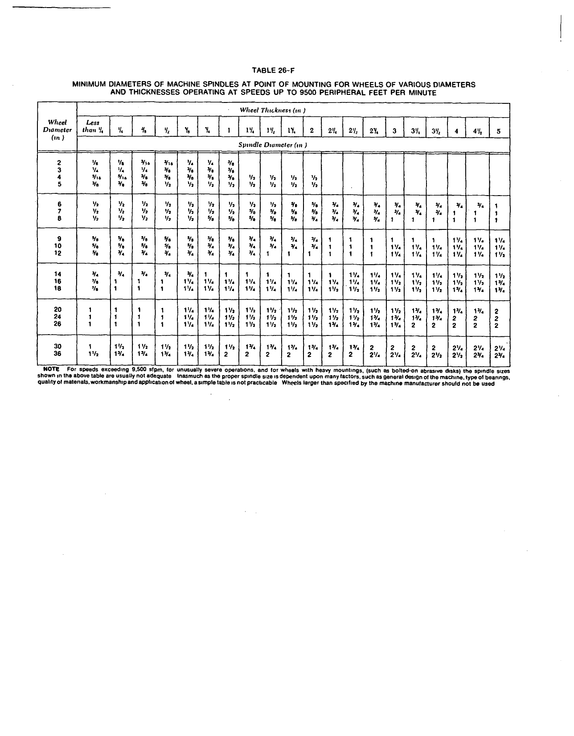
TABLE 26-F MINIMUM DIAMETERS OF MACHINE SPINDLES AT POINT OF MOUNTING FOR WHEELS OF VARIOUS DIAMETERS AND THICKNESSES OPERATING AT SPEEDS UP TO 9500 PERIPHERAL FEET PER MINUTE Wheel Diameter On ) Less than V.
refid# gbBQxjo4bXDymjyz6drgNLDrN1 page
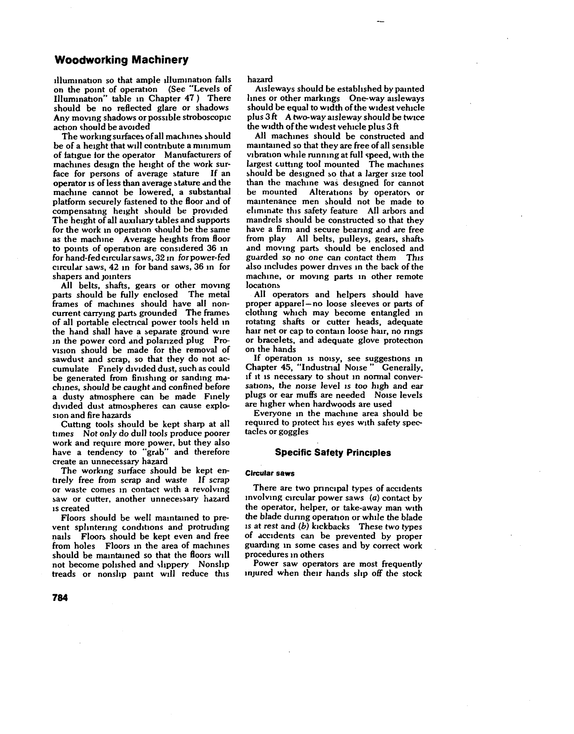
Woodworking Machinery illumination so that ample illumination falls on the point of operation (See "Levels of Illumination" table in Chapter 47) There should be no reflected glare or shadows Any moving shadows or possible stroboscopic action should be avoided The working surfaces ofall machines should be of a height that will contribute a minimum of fatigue for the operator Manufacturers of machines design the height of the work sur face for persons of average stature If an operator is of less than average stature and the machine cannot be lowered, a substantial platform securely fastened to the floor and of compensating height should be provided The height of all auxiliary tables and supports for the work in operation should be the same as the machine Average heights from floor to points of operation are considered 36 in for hand-fed circular saws, 32 in for power-fed circular saws, 42 m for band saws, 36 in for shapers and jointers All belts, shafts, gears or other moving parts should be fully enclosed The metal frames of machines should have all noncurrent carrying parts grounded The frames of all portable electrical power tools held in the hand shall have a separate ground wire m the power cord and polanzed plug Pro vision should be made for the removal of sawdust and scrap, so that they do not ac cumulate Finely divided dust, such as could be generated from finishing or sanding ma chines, should be caught and confined before a dusty atmosphere can be made Finely divided dust atmospheres can cause explo sion and fire hazards Cutting tools should be kept sharp at all times Not only do dull tools produce poorer work and require more power, but they also have a tendency to "grab" and therefore create an unnecessary hazard The working surface should be kept en tirely free from scrap and waste If scrap or waste comes m contact with a revolving saw or cutter, another unnecessary hazard is created Floors should be well maintained to pre vent splintering conditions and protruding nails Floors should be kept even and free from holes Floors m the area of machines should be maintained so that the floors will not become polished and slippery Nonslip treads or nonslip paint will reduce this hazard Aisleways should be established by painted lines or other markings One-way aisleways should be equal to width of the widest vehicle plus 3 ft A two-way aisleway should be twice the width of the widest vehicle plus 3 ft All machines should be constructed and maintained so that they are free of all sensible vibration while running at full speed, with the largest cutting tool mounted The machines should be designed so that a larger size tool than the machine was designed for cannot be mounted Alterations by operators or maintenance men should not be made to eliminate this safety feature All arbors and mandrels should be constructed so that they have a firm and secure bearing and are free from play All belts, pulleys, gears, shafts and moving parts should be enclosed and guarded so no one can contact them This also includes power drives in the back of the machine, or moving parts m other remote locations All operators and helpers should have proper apparel--no loose sleeves or parts of clothing which may become entangled in rotating shafts or cutter heads, adequate hair net or cap to contain loose hair, no rings or bracelets, and adequate glove protection on the hands If operation is noisy, see suggestions in Chapter 45, "Industrial Noise " Generally, if it is necessary to shout m normal conver sations, the noise level is too high and ear plugs or ear muffs are needed Noise levels are higher when hardwoods are used Everyone in the machine area should be required to protect his eyes with safety spec tacles or goggles Specific Safety Principles Circular saws There are two pnncipal types of accidents involving circular power saws (a) contact by the operator, helper, or take-away man with the blade during operation or while the blade is at rest and (b) kickbacks These two types of accidents can be prevented by proper guarding in some cases and by correct work procedures m others Power saw operators are most frequently injured when their hands slip off the stock 784
refid# EvV1y5NLM4R5nwXmEeeqmNOnx1 page
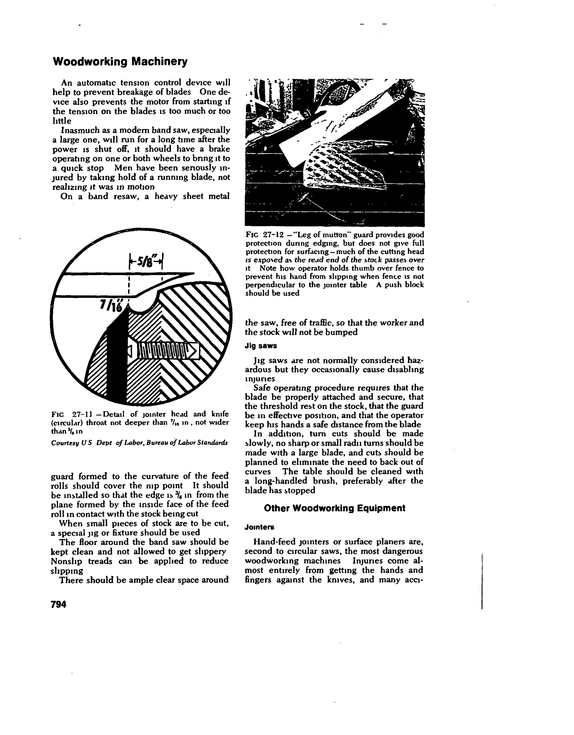
Woodworking Machinery An automatic tension control device will help to prevent breakage of blades One de vice also prevents the motor from starting if the tension on the blades is too much or too little Inasmuch as a modem band saw, especially a large one, will run for a long time after the power is shut off, it should have a brake operating on one or both wheels to bring it to a quick stop Men have been seriously in jured by taking hold of a running blade, not realizing it was m motion On a band resaw, a heavy sheet metal Fic 27-12 --"Leg of mutton" guard provides good protection during edging, but does not give full protection for surfacing--much of the cutting head is exposed as the read end of the stock passes over it Note how operator holds thumb over fence to prevent his hand from slipping when fence is not perpendicular to the jointer table A push block should be used Fic 27-11 --Detail of jointer head and knife (circular) throat not deeper than Vn m , not wider than % in Courtesy U S Dept of Labor, Bureau ofLabor Standards guard formed to the curvature of the feed rolls should cover the nip point It should be installed so that the edge is % in from the plane formed by the inside face of the feed roll in contact with the stock being cut When small pieces of stock are to be cut, a special jig or fixture should be used The floor around the band saw should be kept clean and not allowed to get slippery Nonslip treads can be applied to reduce slipping There should be ample clear space around the saw, free of traffic, so that the worker and the stock will not be bumped Jig saws Jig saws are not normally considered haz ardous but they occasionally cause disabling injuries Safe operating procedure requires that the blade be properly attached and secure, that the threshold rest on the stock, that the guard be in effective position, and that the operator keep his hands a safe distance from the blade In addition, turn cuts should be made slowly, no sharp or small radii turns should be made with a large blade, and cuts should be planned to eliminate the need to back out of curves The table should be cleaned with a long-handled brush, preferably after the blade has stopped Other Woodworking Equipment Jointers Hand-feed jointers or surface planers are, second to circular saws, the most dangerous woodworking machines Injuries come al most entirely from getting the hands and fingers against the knives, and many acci- 794
refid# jmV7Zw73M73dODZV04jzgkD151 page
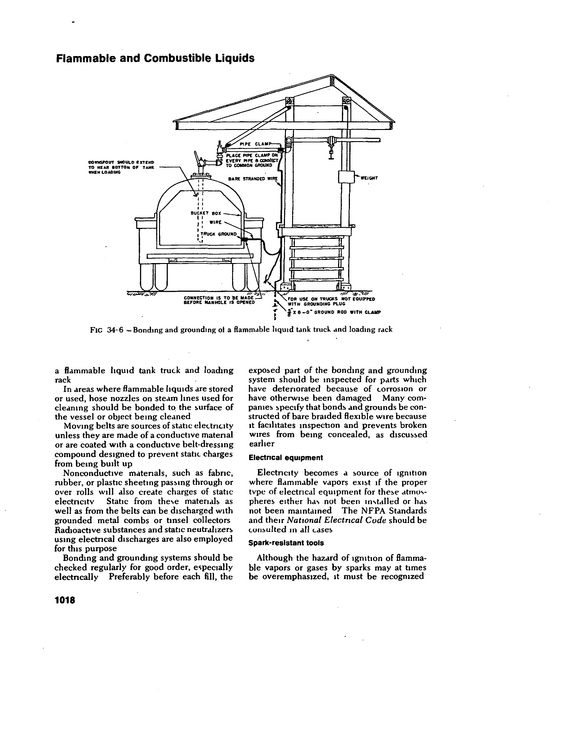
Flammable and Combustible Liquids FlC 34-6 -- Bonding and grounding ol a flammable liquid tank truck and loading rack a flammable liquid tank truck and loading rack In areas where flammable liquids are stored or used, hose nozzles on steam lines used for cleaning should be bonded to the surface of the vessel or object being cleaned Moving belts are sources of static electricity unless they are made of a conductive material or are coated with a conductive belt-dressing compound designed to prevent static charges from being built up Nonconductive materials, such as fabric, rubber, or plastic sheeting passing through or over rolls will also create charges of static electncitv Static from these materials as well as from the belts can be discharged with grounded metal combs or tinsel collectors Radioactive substances and static neutralizers using electrical discharges are also employed for this purpose Bonding and grounding systems should be checked regularly for good order, especially electrically Preferably before each fill, the exposed part of the bonding and grounding system should be inspected for parts which have deteriorated because of corrosion or have otherwise been damaged Many com panies specify that bonds and grounds be con structed of bare braided flexible wire because it facilitates inspection and prevents broken wires from being concealed, as discussed earlier Electncal equipment Electricity becomes a source of ignition where flammable vapors exist if the proper tvpe of electrical equipment for these atmos pheres either has not been installed or has not been maintained The NFPA Standards and their National Electrical Code should be consulted m al!
refid# Vj98gBxanm5Z5Bm80vNM7MQBN1 page
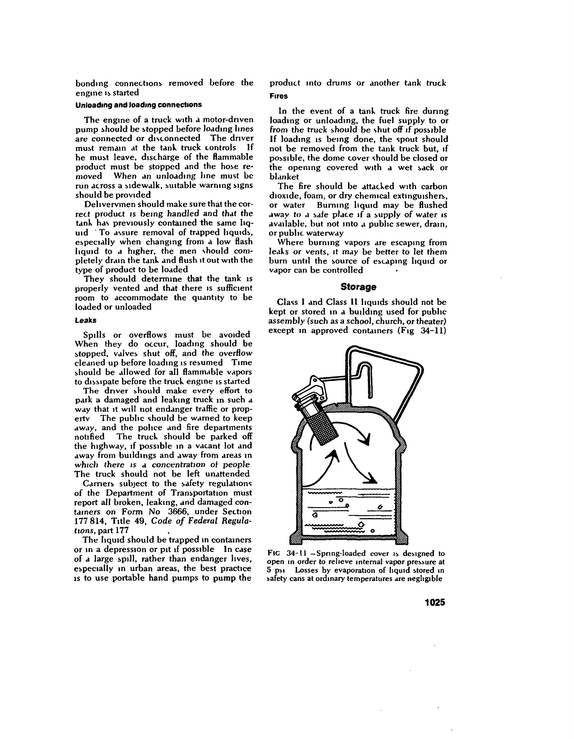
bonding connections removed before the engine is started Unloading and loading connections The engine of a truck with a motor-driven pump should be stopped before loading lines are connected or disconnected The driver must remain at the tank truck controls If he must leave, discharge of the flammable product must be stopped and the hose re moved When an unloading line must be run across a sidewalk, suitable warning signs should be provided Delivervmen should make sure that the cor rect product is being handled and that the tank has previously contained the same liq uid ` To assure removal of trapped liquids, especially when changing from a low flash liquid to a higher, the men should com pletely drain the tank and flush it out with the type of product to be loaded They should determine that the tank is properly vented and that there is sufficient room to accommodate the quantity to be loaded or unloaded Leaks Spills or overflows must be avoided When they do occur, loading should be stopped, valves shut off, and the overflow cleaned up before loading is resumed Time should be allowed for all flammable vapors to dissipate before the truck engine is started The driver should make every effort to park a damaged and leaking truck in such a way that it will not endanger traffic or prop erty The public should be warned to keep away, and the police and fire departments notified The truck should be parked off the highway, if possible in a vacant lot and away from buildings and away from areas in which there is a concentration of people The truck should not be left unattended Carriers subject to the safety regulations of the Department of Transportation must report all broken, leaking, and damaged con tainers on Form No 3666, under Section 177 814, Title 49, Code of Federal Regula tions, part 177 , The liquid should be trapped in containers or in a depression or pit if possible In case of a large spill, rather than endanger lives, especially in urban areas, the best practice is to use portable hand pumps to pump the product into drums or another tank truck Fires In the event of a tank truck fire during loading or unloading, the fuel supply to or from the truck should be shut off if possible If loading is being done, the spout should not be removed from the tank truck but, if possible, the dome cover should be closed or the opening covered with a wet sack or blanket The fire should be attacked with carbon dioxide, foam, or dry chemical extinguishers, or water Burning liquid may be flushed away to a safe place if a supply of water is available, but not into a public sewer, drain, or public waterway Where burning vapors are escaping from leaks or vents, it may be better to let them burn until the source of escaping liquid or vapor can be controlled Storage Class 1 and Class II liquids should not be kept or stored in a building used for public assembly (such as a school, church, or theater) except in approved containers (Fig 34-11) FlC 34-11 --Spring-loaded cover is designed to open m order to relieve internal vapor pressure at 5 psi Losses by evaporation of liquid stored in safety cans at ordinary temperatures are negligible 1025
refid# YjBG9QvnK7EVyEe0JwLZOMrGN1 page
breakers, using wrong fuses, bypassing fuses, and installing equipment without authoriza tion Electrical installations and all electrical equipment should be periodically inspected and tested to assure continued satisfactory performance and to detect deficiencies Smoking Carelessly discarded cigarettes, pipe em bers, and cigars are a major source of fire Although it might be desirable to eliminate smoking completely in a plant, such a rule is difficult to enforce It is better to allow smok ing at specified times and in a safe place where supervision can be maintained than to have it done surreptitiously in out-of-theway places Smoking shofild be prohibited in wood working shops, textile mills, flour mills, grain elevators, and places where flammable liq uids or combustible products are manufac tured, stored, or used Even m these opera tions, enclosed or removed areas can be set aside to allow workmen to satisfy their smoking needs in a safe manner "No smoking" areas should be marked with conspicuous signs and their exclusive use ngidlv enforced everyone, including super visors and visitors, should adhere to the reg ulation It mav be necessary to use more than signs to draw attention to the "no smok ing" areas Lines drawn on the floor or illu minated barriers placed around areas or proc esses have been effective In manv high-hazard occupancies, smoking is permitted in special fire-safe rooms or during periods when there is no exposure In such cases, instructions or warning signs to that effect should be posted Where the exposure is severe, emplovees should even be prohibited from carrying matches, lighters, and sometimes smoking material of any kind into the danger areas In any case, the use of "safety" matches should be encouraged, and smoking should be allowed only in fire-safe areas Where carrying matches into the plant is prohibited, special lighters should be provided in smok ing rooms Even in plants where there is little fire hazard, employees should be encouraged to discard matches and smoking materials in a safe container rathei than on the floor This practice will discourage employees from throwing matches and cigarettes into places which may not be free of hazards Fnction Excessive heat generated by friction causes a very high percentage of industrial fires.
refid# XkQ04kQ7Owbj36womzryMMjB1 page
has proven that women are capable of per forming all emergency duties Because wholehearted cooperation of the entire plant personnel is necessary to the successful operation of an emergency plan, shop stewards or other representatives of labor should take part m the planning They must be made to see that whatever measures are taken are for the protection of the lives and jobs of the workers as much as for saving the property of the owners Training of key people will be of little value unless it reaches down to all employ ees Much of this general training for self protection can be done with existing litera ture which can be given to the employee The better informed and prepared the work force, the less chance of panic and confusion during the emergency An additional duty of the program director is to provide information and materials to the employees to prepare them to be selfsufficient, and assist m making survival plans for their homes Pnnted plan For emergency action planning to be fully effective, the plan should be available in pnnted form to those responsible for its execution This pnnted plan should in clude the company policy statement regard ing civil defense plans, a descnption of warn ing and communication procedures, the nature and responsibility of each of the company service departments, drawings showing floor plans, shelter locations, and a list of avail able emergency equipment The plan should be reviewed and updated periodically Cop ies should be retained in the safety depart ment office, and m other strategic locations Some companies include a copy of the pro cedural checklist portion of the plan on their emergency trucks Detailed instructions can be given to key persons, and it is also desirable to issue in dividual instruction notices to each employee or occupant outlining details of exit duties All new employees should be properly in structed about exit regulations and assigned to the appointed floor captain and monitor Corporate planning After a disaster, particularly a nuclear attack, a company may find that some or all of its management team is incapacitated, a major part of the staff not available, office facilities damaged, corporate records destroyed, and operating funds non-existing These are essentia) elements to any business Advance planning is necessary if they are to be avail able to the company after such a disaster One significant place to start is the cor porate bylaws They must be tailored for an emergency That is, most bylaws spe cifically spell out the duties and functions of the company's board of directors, these lim itations may make it legally impossible for a company to conduct any business if several of the directors are incapacitated Emer gency succession to key management posi tions may also require bylaw changes An important consideration is filling any suddenly vacated top management position Who will assume the leadership?
refid# Rj3VnnvepkmbX1D49oBQDdE481 page
Personal Protective Equipment discarding them Use of sweatbands helps prevent eye irri tation, aids visibility, and eliminates work interruptions for face mopping Sweatbands are usually made of a soft, light, highly absorbent cellulose sponge An elastic band holds the sweatband in place on the wearer's forehead so that it does not inter fere with glasses or goggles Evaporation from the exposed surface produces a cooling effect which adds to comfort Face protection Face shields are available in a wide variety of types to protect the face and neck from fly ing particles, sprays of hazardous liquids, splashes of molten metal, and from hot solu tions--see Fig 38-3a and -3d and Fig 38-15 In addition, they may be used to provide anti glare protection where required As a general rule, they should be worn over suitable basic eye protection Three basic styles of face shields include headgear without crown protectors, with crown protectors, and with crown and chm protectors Each of the three is available with one of these replaceable window styles Clean transparent, Tinted transparent.
refid# 7MqQnJX6w2bZB92OYa2E6YD1j1 page
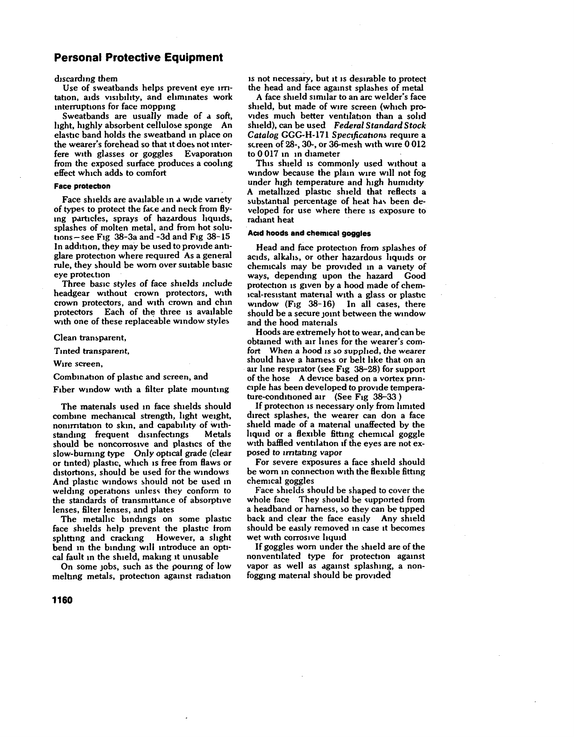
1272 Irritant orAnent ACIDS Acetic Carbolic Chromic Cresylic Formic Hydrochloric Hydrofluoric Lactic Nitric Oxalic Picric Sulfuric Prtmary Irritants Sensitizers TABLE 41 -C CHEMICAL CAUSES OF SKIN AFFECTIONS Manifestations of Irritating Actton on the skin (More important dam ages may result in other organs) Typical Occupations, Trades, or Processes Where Exposure May Occur X Dermatitis and ulcers Manufactunng acetate rayon, pnnting and dyeing, hat makers X Irritation and erosion of skin, eczema, Carbolic acid makers, disinfectant, dye, anesthesia pharmaceuticals, plastic manufacturing X X Skin ulcers ("chrome holes"), inflamma Platers, manufactunng chemicals and tion and perforation of nasal septum dyestuffs X Irritation and erosion of skin, anesthesia Processing, disinfectants, coal tar. and cresylic acid X Blisters and ulcerations Formic acid workers, mordanters, makers of cellulose formate and airplane dope X Irritation and ulceration of skin Bleachers, picklers (metals), refiners (metals), tinners, chemical makers X Severe skin burns, erosion, ulcers, blisters Enamel manufactunng, etchers, hydrofloric acid makers, antimony fluoride extractors X Ulcers (if strong solutions are used) Dyeing, felt hat industry X Severe skin bums and ulcers Nitric acid and soda workers, electro- platers, metal refiners, acid dippers, m- trators X Local caustic action on skin, bluish dis Tannery workers, blueprint paper mak coloration and brittleness of nails ers, oxalic acid makers X Red rash, itching skin, yellow discolora Tannery and explosive workers, picric tion of skin and hair which is neither a acid and dye makers, dyers dermatitis nor a dermatosis X Corrosive action on skin, severe inflam Nitrators, picklers (metals), acid dip mation of mucous membranes pers, chemical manufacturing
refid# 61KpVrKybZp21EZEyKakzeM11 page
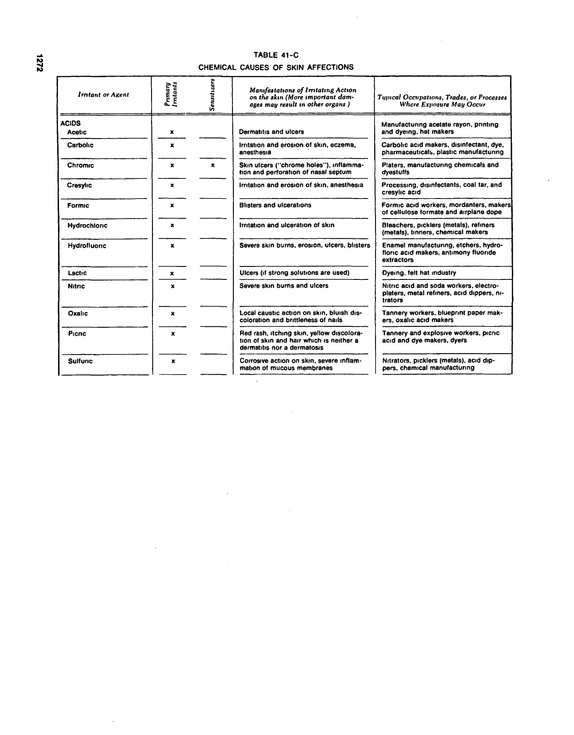
1407 ethylene glycol 202 monoethyl ether 18 140 460 275 ethyleneglycol 124 monoethyl ether acetate 1 71 715 313 ethyleneglycol 115 25 198 551 192 monomethyl ether ethylene lmine 3 6 46 132 ethylene oxide <0 3 100 804 51 ethylidine dichlonde 22 135 ferrosihcon fluondes fluonne formaldehyde gas 7 0 73 806 -3 formic acid 156 1114 213 fuel oil No 2 100 fuel oil No 4 130 'Open cup flash point The higher the number, the slower the evaporation rate t Number in this column refers to date of publication in AlHA Journal 34 24 41 281 -- 32 4 6-63 12-65 21 1 -- 6-57 333 243 230 SD-38 C-55 2-65 12-58 352 442 4 03 C-61 - 4 - 342 SD-1 32 0 020 020 8-65 12-65 4-65
refid# 2Jo0pa0aprronNoENp2Vx802g1 page
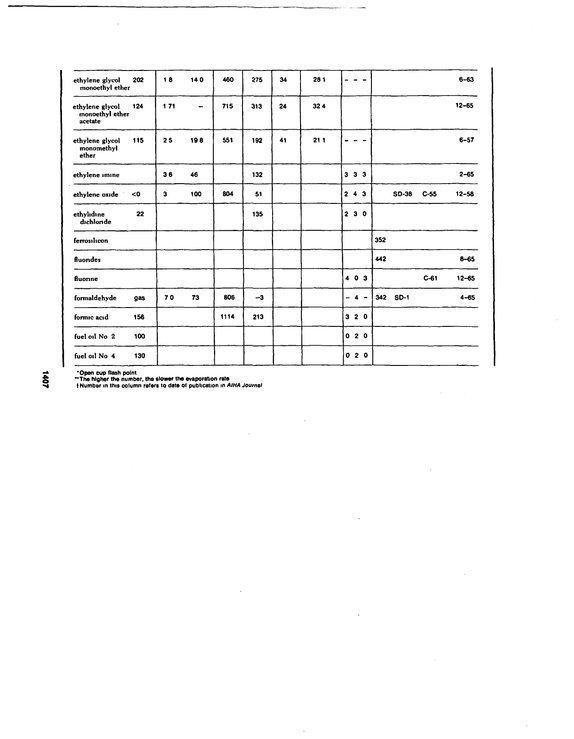
1421 tnorthocresylphosphate turpentine 460 95 08 - 770 488 300 18 uranium vinyl acetate 18 26 134 161 35 vinyl chlonde gas 4 22 882 7 vinyhdene chlonde monomer 5* 56 11 4 856 99 vinyl propionate 34* 203 oxylene 90 1 0 60 867 292 27 m-xylene 84 1 1 70 982 282 27 p-xylene 81 1 1 70 984 281 27 zinc 0 48 oz/cu ft 860 zirconium 019 - oz/cu ft 410 'Open cup flash point "The higher the number, the slower the evaporation rate t Number in this column refers to date of publication in AlHA Journal C-50 10-63 375 1 3 0 367 (approx) C-54 C-69 33 2 3 2 SD-75 242 SD-56 242 C-14 6-67 4-58 8-64 232 92 2 3 0 204 C-77 6-57 92 2 3 0 204 C-77 6-57 99 2 3 0 204 C-77 6-57 0 1 1 267 9-56 (oxide) 1 4 1 382 SD-92 C-74 10-58
refid# Ed6Nq3ZXwdx74MvD6m02NqkaN1 page
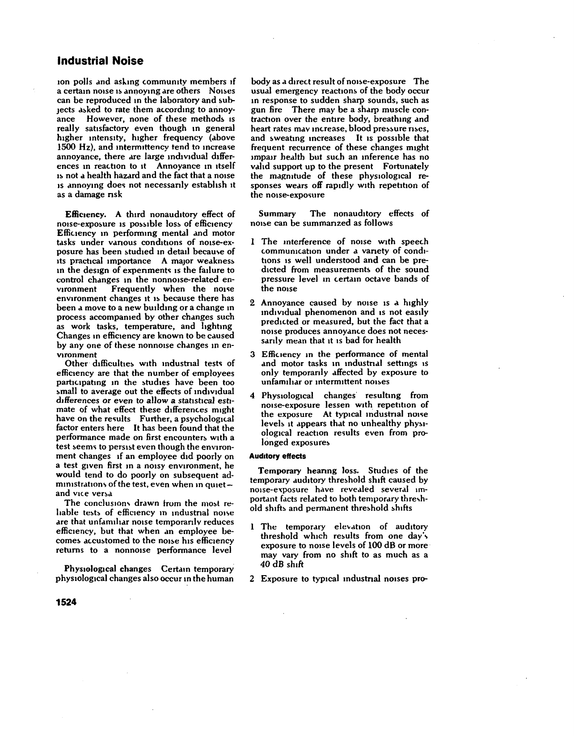
Industrial Noise ion polls and asking community members if a certain noise is annoying are others Noises can be reproduced in the laboratory and sub jects asked to rate them according to annoy ance However, none of these methods is really satisfactory even though in general higher intensity, higher frequency (above 1500 Hz), and mtermittency tend to increase annoyance, there are large individual differ ences m reaction to it Annoyance m itself is not a health hazard and the fact that a noise is annoying does not necessarily establish it as a damage nsk body as a direct result of noise-exposure The usual emergency reactions of the body occur in response to sudden sharp sounds, such as gun fire There may be a sharp muscle con traction over the entire body, breathing and heart rates mav increase, blood pressure nses, and sweating increases It is possible that frequent recurrence of these changes might impair health but such an inference has no valid support up to the present Fortunately the magnitude of these physiological re sponses wears off rapidly with repetition of the noise-exposure Efficiency.
refid# npBKZODqbOjnjKMaO6m8aOYQG1 page
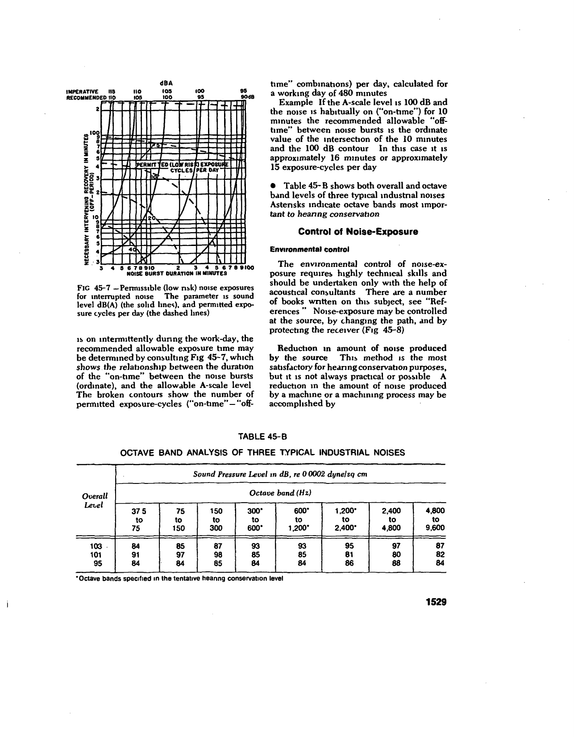
dBA IMPERATIVE IIS 110 103 100 98 FIG 45-7 --Permissible (low nsk) noise exposures for interrupted noise The parameter is sound level dB(A) (the solid lines), and permitted expo sure cycles per day (the dashed lines) is on intermittently during the work-day, the recommended allowable exposure time may be determined by consulting Fig 45-7, which shows the relationship between the duration of the "on-time" between the noise bursts (ordinate), and the allowable A-scale level The broken contours show the number of permitted exposure-cycles ("on-time"--"off- time" combinations) per day, calculated for a working day of 480 minutes Example If the A-scale level is 100 dB and the noise is habitually on ("on-time") for 10 minutes the recommended allowable "oFtime" between noise bursts is the ordinate value of the intersection of the 10 minutes and the 100 dB contour In this case it is approximately 16 minutes or approximately 15 exposure-cycles per day Table 45-B shows both overall and octave band levels of three typical industrial noises Asterisks indicate octave bands most impor tant to hearing conservation Control of Noise-Exposure Environmental control The environmental control of noise-exposure requires highly technical skills and should be undertaken only with the help of acoustical consultants There are a number of books written on this subject, see "Ref erences " Noise-exposure may be controlled at the source, by changing the path, and by protecting the receiver (Fig 45-8) Reduction m amount of noise produced by the source This method is the most satisfactory for hearing conservation purposes, but it is not always practical or possible A reduction in the amount of noise produced by a machine or a machining process may be accomplished by TABLE 45-B OCTAVE BAND ANALYSIS OF THREE TYPICAL INDUSTRIAL NOISES Sound Pressure Level in dB, re 0 0002 dynelsq cm Overall Level 37 5 to 75 Octave band (Hz) 75 150 300* 600* 1,200* to to to to to 150 300 600* 1,200* 2.400* 103 84 101 91 95 84 85 87 93 97 98 85 84 85 84 'Octave bands specified in the tentative heanng conservation level 93 85 84 95 81 86 2,400 to 4,800 97 80 88 4,800 to 9,600 87 82 84 1529
refid# n9jQOmKbvmj51Gm7okNo4QLnR1 page
PART II: DEFCSIT. 201 .
refid# 6BmR3B4VVwy0d2mpzQ65pKEQo1 page