Refine
Estimated Years 2000-2009Clear
6,589 results foundRefine Search
C.
refid# 4JYYj3M9kp9Ozpq9Z5b4JMkQQ1 page
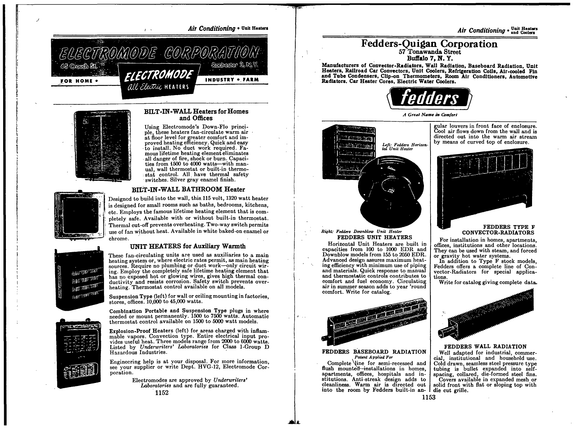
Ah Conditioning vmt Heater* Air Conditioning Unit Heaters and Coolers Fedders-Quigan Corporation 57 Tonawanda Street Buffalo 7, N.
refid# 067MEeYQ8nZ84L3OV33m7me3O1 page
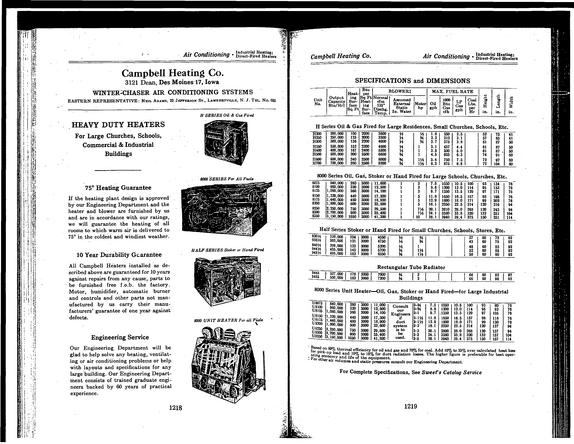
Air Conditioning Industrial Heating; Direct-Fired Heaters Campbell Heating Co. 3121 Dean, Des MoinesT?
refid# Xy9xKpr5b50p5vadOZvXpavg1 page
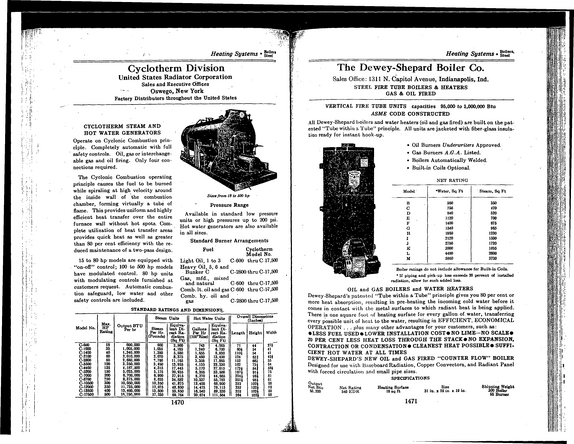
Heating Systems st^f Cyclotherm Division United States Radiator Corporation Sales and Executive Offices Oswego, New York Factory Distributors throughout the United States CYCLOTHERM STEAM AND HOT WATER GENERATORS Operate on Cyclonic Combustion prin ciple.
refid# 1Qmkz0oKgDQnxQBqE7qX5q6wX1 page
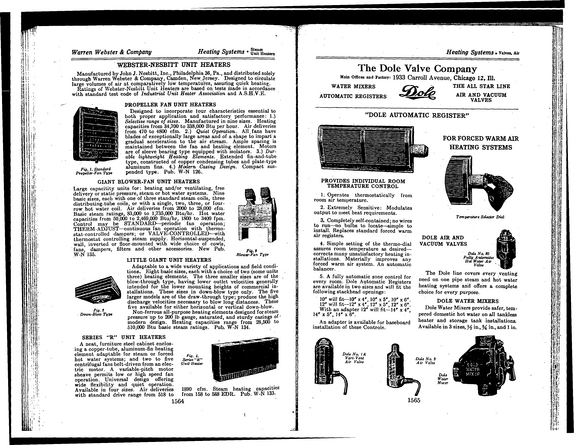
Warren Webster & Company Heating Systems Steam Unit Heaters WEBSTER-NESBITT UNIT HEATERS Manufactured by John J.
refid# LVG0wzON5vN3JNx5Ee5k45xg1 page
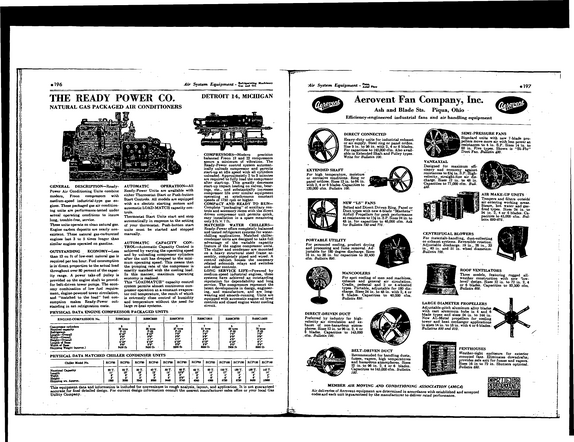
196 Air System Equipment Cm ui Oa THE READY POWER CO.
refid# JwJG0aznnK3dX5nzno166eyB1 page
Local Exhaust System exhaust volume of 50 cu ft for each pound of wood refuse handled The arrester used to collect woodworking scrap is traditionally the cyclone It is ade quate for chips, shaper cuttings, boring scraps, sawdust, and other relatively large size par ticles Sanders release especially fine dust and unless it goes into an air stream which is already carrying chips and shavings from other types of machines, it is too fine to be trapped by the usual cyclone The cyclone may be followed by a cloth collector which removes the fine dust and often allows the air to be recirculated Cast iron machining Dust from cast iron machining has been receiving an increasing amount of attention, not so much because of any health hazard, but because it is a distinct annoyance the operator's clothing and skin are coated with gray and rust-colored powder, and machinery, motors, and controls eventually require un due maintenance Higher machining speeds and multiple-operation machine tools have steadily raised the concentration of fine dust per unit of floor space Usually, no effort is made to carry off the chips, although some will be caught The exhaust systems are aimed at removing the fine air-floated dust Fortunately, because of the small particle size of the dust, it can be brought into the hood by mass air movement, even though the actual air velocity is rela tively low Hood designs vary according to the machine tool, the part being finished, and the opera tion performed Usually, small hoods with face velocities of 400 to 2000 fpm can be de signed, and placed most advantageously after watching the machining operation and ob serving the exact point of dust release As always, the hood should be close to this point, and should surround it as much as possible On the other hand, it cannot inter fere too much with the operator's line of vision, movement of the machine tool parts, or the placing or removal of work At times it will be possible to enclose much of the work ing area, in which case the total rate of air flow can be set to assure an indraft through the remaining openings of 100 to 150 fpm Transparent plastic windows and doors allow the machinist to watch the work With local hoods, and branch sizes of 4 to 6 m , exhausting 400 to 800 cfm will often be sufficient Many modem machines, how ever, require 8- or 10-in branches capable of handling 1500 or 2400 cfm Except where only a few isolated machines are to be hooded, central systems --as contrasted with unit col lectors -- seem to be preferred because of their lower maintenance and more uniform air flow Oil mist Oil mist is a problem m shops where oil is used as a coolant as rooms can become filled with an oil haze, floors soaked with oil present a slipping hazard, and condensation on walls and ceilings becomes a fire hazard Hood sides must act as splash guards, be cause air flow alone will not arrest the oil thrown from the operation The hood must incorporate such splash guards, but still per mit the machine to be serviced and the opera tion observed when required A few manu facturers have provided their machine tools with plastic enclosures that meet these re quirements Although all should do so, too often the "built-m" hood is omitted Ingenuity will show the way for attaching hoods to most machines, but all are different Usually, an exhaust volume of 400 to 600 cfm will provide the recommended 100 to 150 fpm indraft Sometimes, when considerable heat is generated or where the hooding fails in being a complete enclosure, 1000 to 1500 cfm must be exhausted Duct velocities of 2500 fpm are ample Duct joints should be tight to prevent oil leakage and ducts should be pitched to allow condensed oil to flow back to the machine or to a special collector Electrostatic precipitators and wet (oilfilled) centrifugal collectors are sold as ar resters for oil mist exhaust systems To elimi nate ductwork, units small enough to mount directly on the machine are available An additional bonus collection and reuse, of oil may offer considerable savings Melting furnaces The design of hoods for metallurgical melt ing furnaces depends on the type of furnace and the metal being melted The fumes may constitute a health hazard to the operator or a source of community air pollution The tilting crucible furnace is often 886 \ /
refid# 8OBEKbBkpwDankyyJYwqe0yD51 page
IN RE: BALTIMORE CITY * IN THE ASBESTOS LITIGATION * CIRCUIT COURT * FOR BALTIMORE CITY * Consolidated No. 24X000003 81 Jfc sfic * * sj CHARLES CARGILE, et al.



refid# jBVZO7Z9MLYBYXzY4220VqoZp59 pages
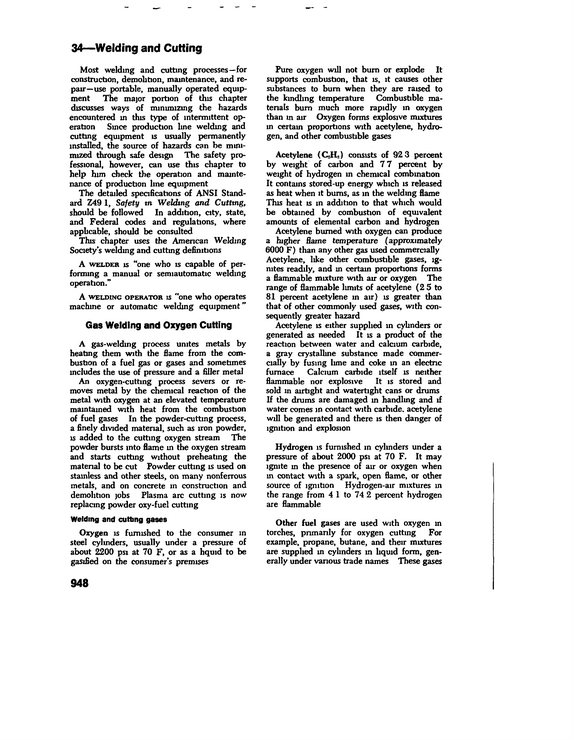
34--Welding and Cutting Most welding and cutting processes--for construction, demolition, maintenance, and re pair-use portable, manually operated equip ment The major portion of this chapter discusses ways of minimizing the hazards encountered in this type of intermittent op eration Since production line welding and cutting equipment is usually permanently installed, the source of hazards can be mini mized through safe design The safety pro fessional, however, can use this chapter to help him check the operation and mainte nance of production line equipment The detailed specifications of ANSI Stand ard Z49 1, Safety in Welding and Cutting, should be followed In addition, city, state, and Federal codes and regulations, where applicable, should be consulted This chapter uses the American Welding Society's welding and cutting definitions A welder is "one who is capable of per forming a manual or semiautomatic welding operation."
refid# vEqK11yOb5kXK8X8dOgyeZGY1 page
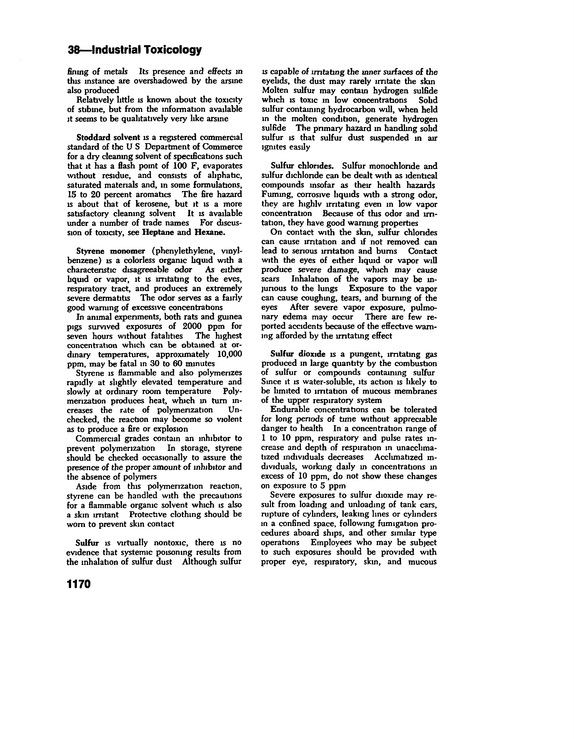
38--Industrial Toxicology fining of metals Its presence and effects m this instance are overshadowed by the arsine also produced Relabvely little is known about the toxicity of stibine, but from the information available it seems to be qualitatively very like arsine Stoddard solvent is a registered commercial standard of the U S Department of Commerce for a dry cleaning solvent of specifications such that it has a flash point of 100 F, evaporates without residue, and consists of aliphatic, saturated materials and, m some formulations, 15 to 20 percent aromatics The fire hazard is about that of kerosene, but it is a more satisfactory cleaning solvent It is available under a number of trade names For discus sion of toxicity, see Heptane and Hexane.
refid# o90bQ8359852yRJeXKjoagJYE1 page
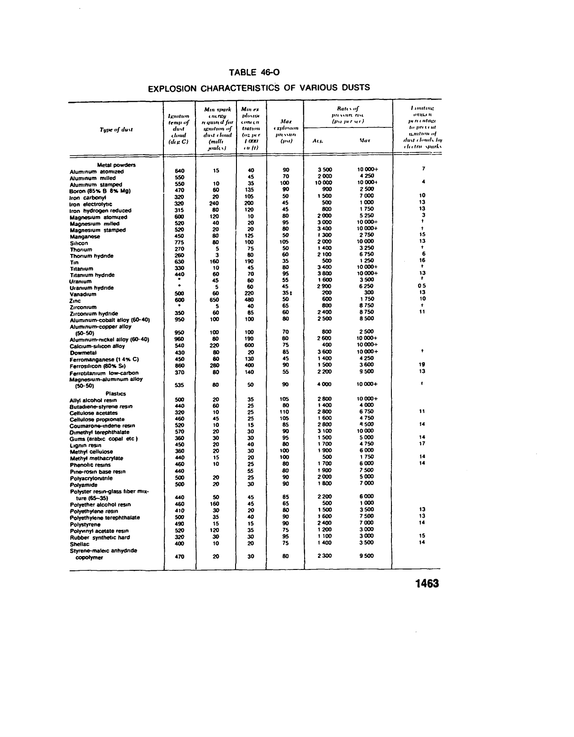
TABLE 46-0 EXPLOSION CHARACTERISTICS OF VARIOUS DUSTS Tyj>e of dust Metal powders Aluminum atomized Aluminum milled Aluminum stamped Boron (85% B 8% Mg) Iron carbonyl Iron electrolytic Iron hydrogen reduced Magnesium atomized Magnesium milled Magnesium stamped Manganese Silicon Thorium Thorium hydnde Tin Titanium hydnde Uranium Uranium hydnde Vanadium Zirconium Zirconium hydride Aluminum-cobalt alloy (60-40) Aluminum-copper alloy (50-50) Aluminum-nickel alloy (60-40) Calcium-silicon alloy Dowmetai Ferromanganese (1 4% C) Ferrosilicon (80% Si) Ferrotitanium tow-carbon Magnesium-alummum alloy (50-50) Plastics Allyl alcohol resin Butadiene-styrene resin Cellulose acetates Cellulose propionate Coumarone-mdene resin Dimethyl terephthaJate Gums (arabic copal etc) Lignin resin Methyl cellulose Methyl methacrylate Phenolic resins Pme-rosin base resin Polyacrylonitrile Polyamide Polyster resm-glass fiber mix- ture (65-35) Polyether alcohol resin Polyethylene resin Polyethylene terephthaiste Polystyrene Polyvinyl acetate resin Rubber synthetic hard Shellac Styrene-maleic anhydnde copolymer fj'rtilK'n temp of dust tloud (din C) Min tfHirk tturuy nqumd for tUmtwn of ttust </m/ (mtlit joule s) Mm ex ldo\UM tonim trahim (oz ih r t (KKt it!
refid# eEy3vz0g136e96YK5g9ayDXg1 page
from disclosure because of a privilege claimed for any reason?

refid# Z8kgKq0Kq3JGDw9MJxww5b5nO1 page
4|J- 15:05 POLSINELLI SUALTON SELTE (FftI)3H 231 I7H P.
refid# VJ246rVEEroERVrzGEVVdQ18g1 page
Michael J.

refid# ypNEXmkqYoy2GV1n3OrjLQ93r1 page
14256997033 2002-02-26 19:09:21 (GMT), page 22 21 The QAMA McGill researchers have also claimed that even if fiber mined from Canada causes mesothelioma and lung cancer, studies show that the dose required to induce these diseases is so high that there is no practical risk to current workers.
refid# 8rVXab6yeB5GdROY8bajLEDe1 page