Refine
Estimated Years UndatedClear
2,978 results foundRefine Search
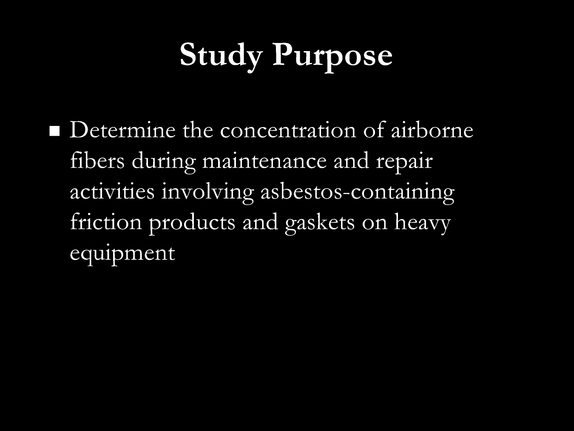
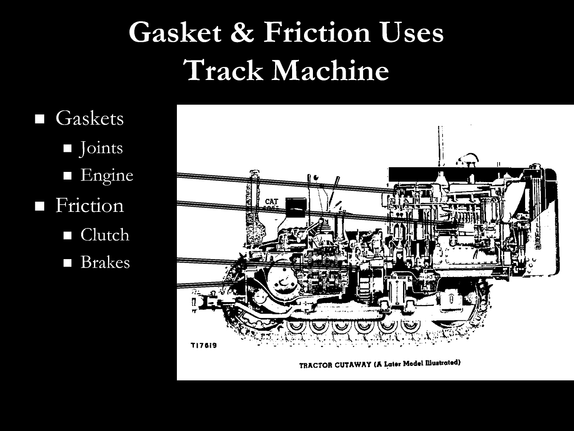
FILE NAME: Z< DATE: DOC#: Z< DOCUMENT DESCRIPTION WWdWZZ/,Z ZZZD Airborne Asbestos Fiber Exposure Assessment of Heavy Equipment Mechanics - P0110 - American Industrial Hygiene 65th Annual Conference and Exposition May 2005, Anaheim, California F.W.

refid# OEB6yOqmXdKaa6vRXER5a2wK37 pages
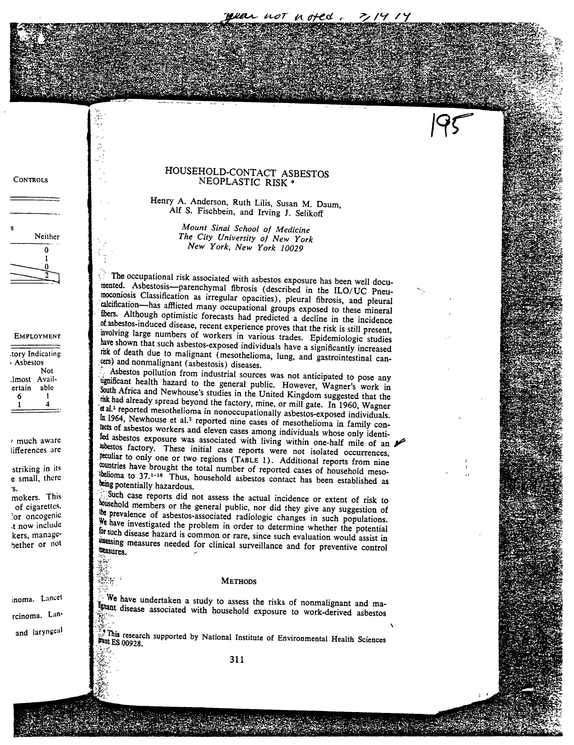
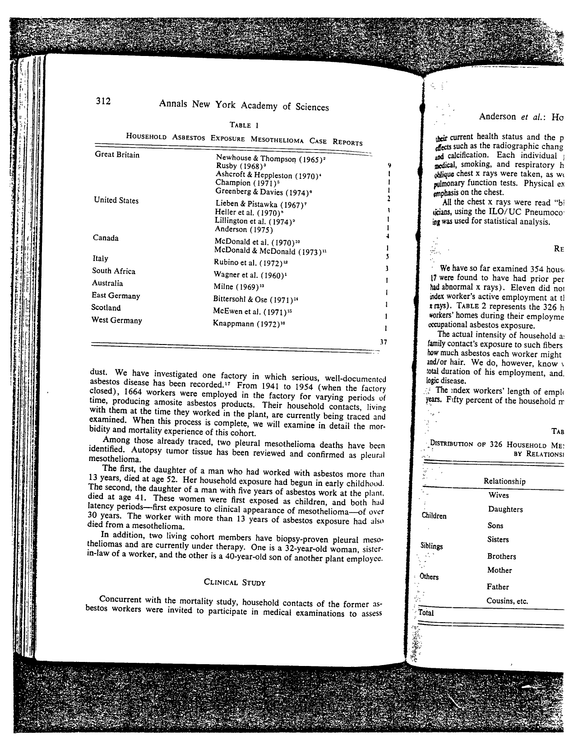
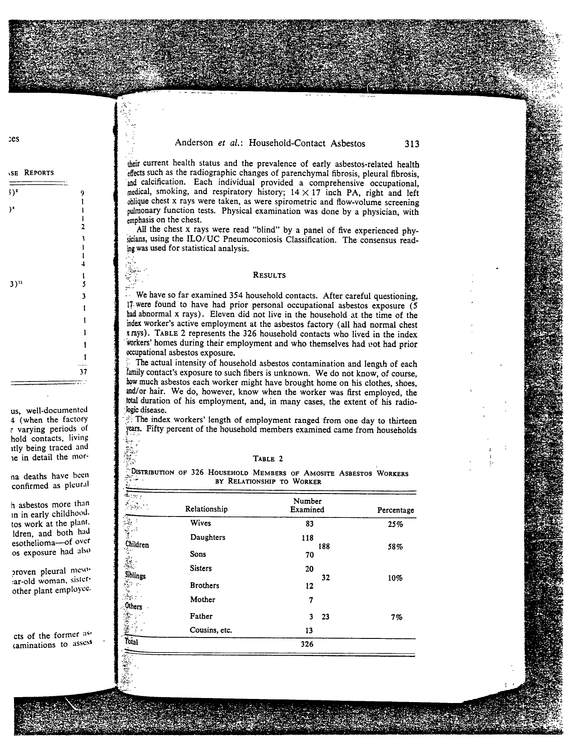
FILE NAME: Household Contact (HC) DATE: 0000 DOC#: HC023 DOCUMENT DESCRIPTION: Medical Journal Article - Household-Contact Asbestos Neoplastic Risk t ffi-c ^ /V /y C ontrols Neither E mployment tory Indicating i Asbestos Not .lmost Availertain able ' much aware lifferences arc striking in its e small, there s. mokers.
refid# XREoM1ry3V4YbNrbMJNp33BjB14 pages
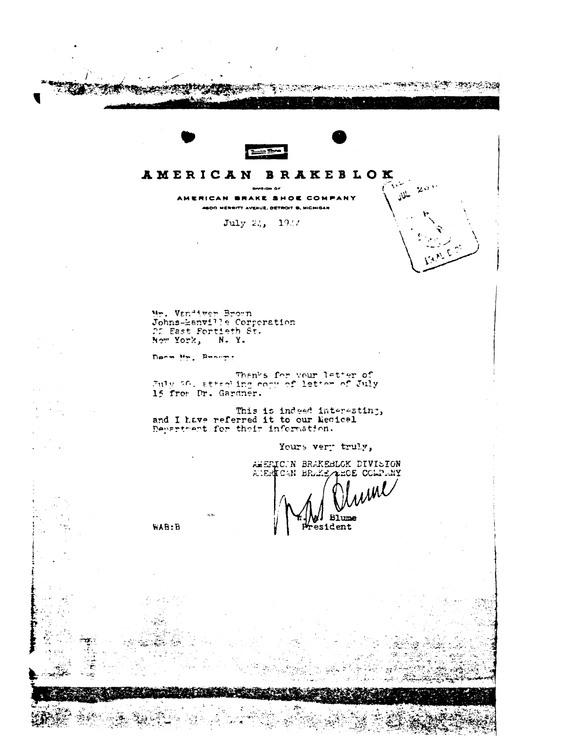
FILE NAME: Saranac (SAR) DATE: 0000 DOC#: SAR032 DOCUMENT DESCRIPTION: Letter from American Brakeblock to Vandiver Brown, J-M RE Letter from Dr.
refid# p2MEvOvzDmzMbwnqpJ4jj30Yj2 pages
FILE NAME: Westinghouse (WH) DATE: 0000 DOC#: WH113 DOCUMENT DESCRIPTION: Conference Proceedings - National Safety Congress - The Control of Fumes in Shipyards /\

refid# g2pgNEm0B4Go4ejgb7VGbgoNa14 pages
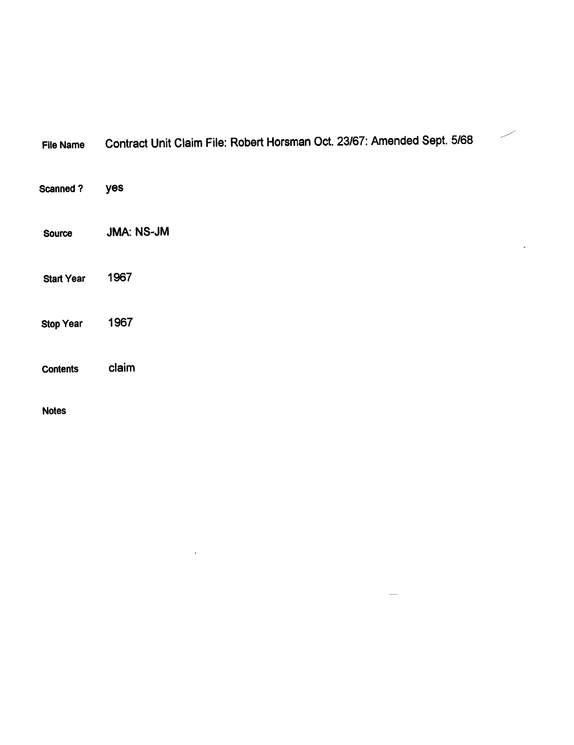
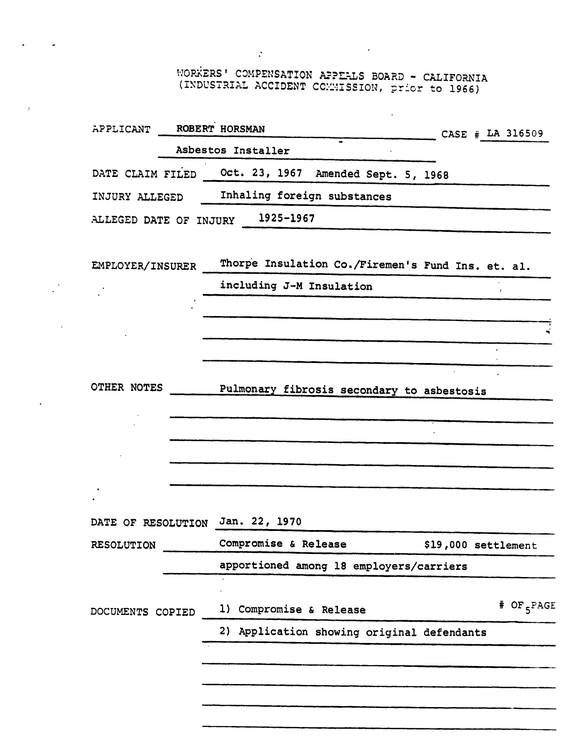
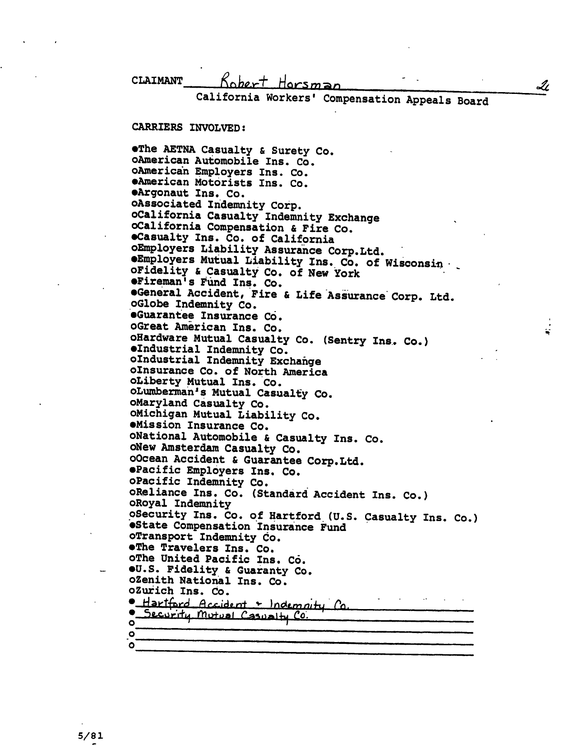
FILE NAME: DDd DATE: DOC#: Dd OCUMENT DESCRIPTION:t,Z&Z:D File Name Contract Unit Claim File: Robert Horsman Oct. 23167: Amended Sept. 5168 Scanned?

refid# 15GyNQrYBpBvmNJpOR4EeJq7d14 pages
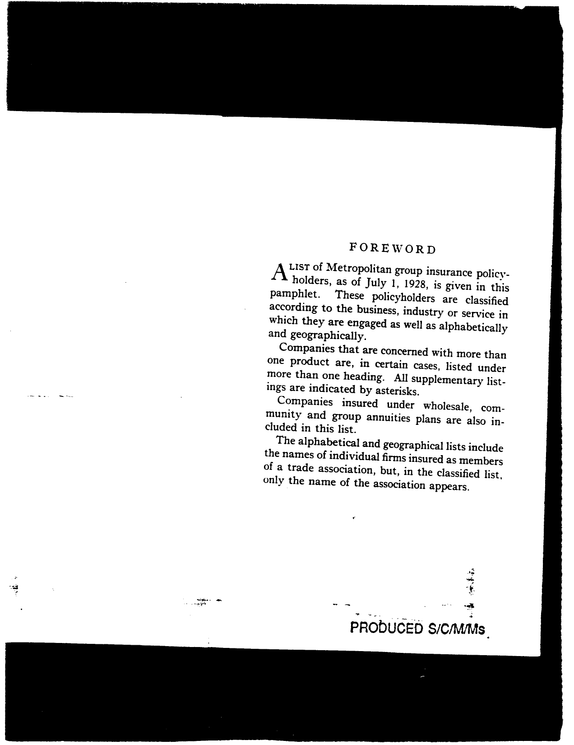
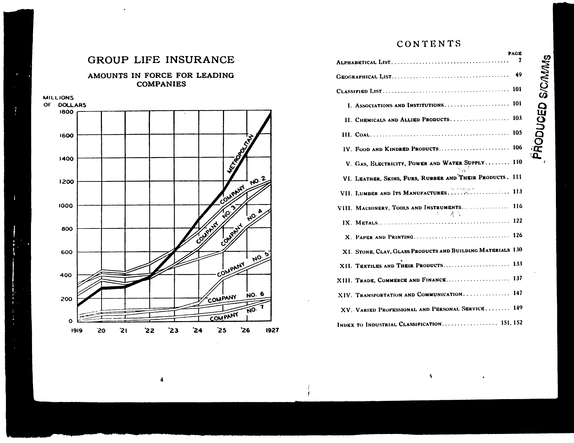
FILE NAME: Metropolitan Life (ML) DATE: : DOC#: ML DOCUMENT DESCRIPTION:>ZDZZ'Z/ WZZ

refid# ObokQm61Q377YG1ewaXJ3zzK78 pages
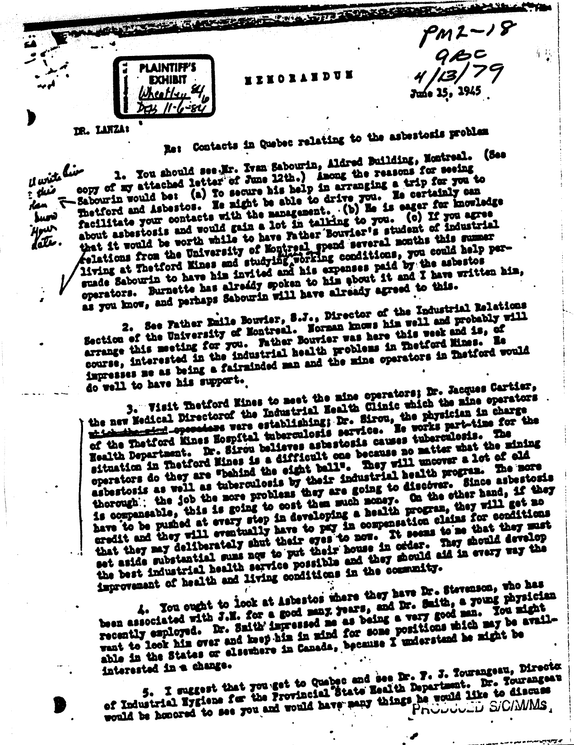
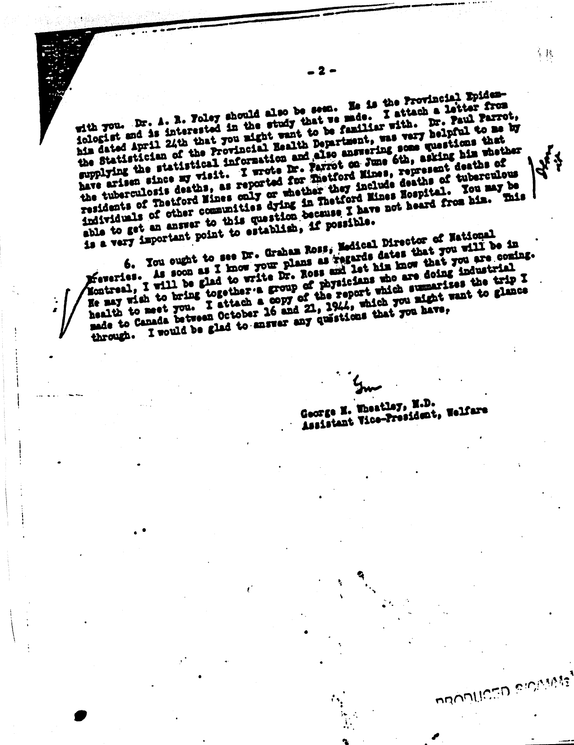
FILE NAME: DZZ>D> DATE: DOC#: D> DOCUMENT DESCRIPTION:>Z>Zt

refid# NNkE84qr4obQmdxV0O3ReKv4g3 pages
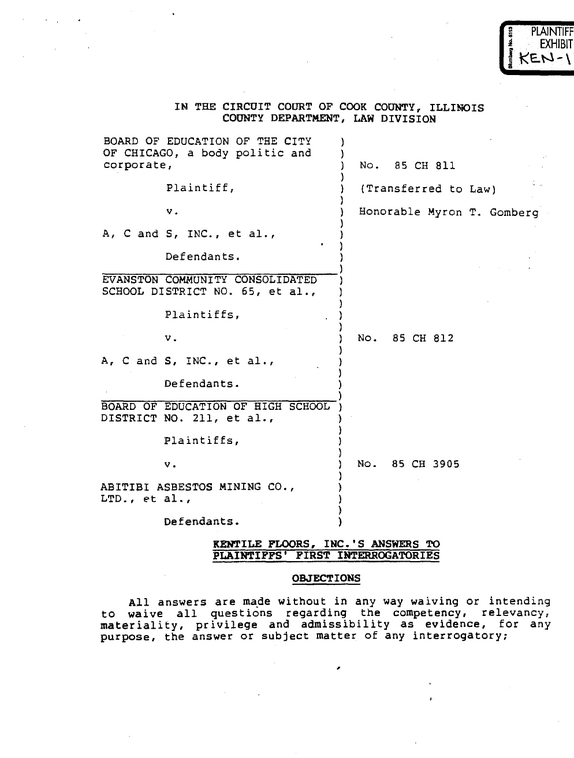
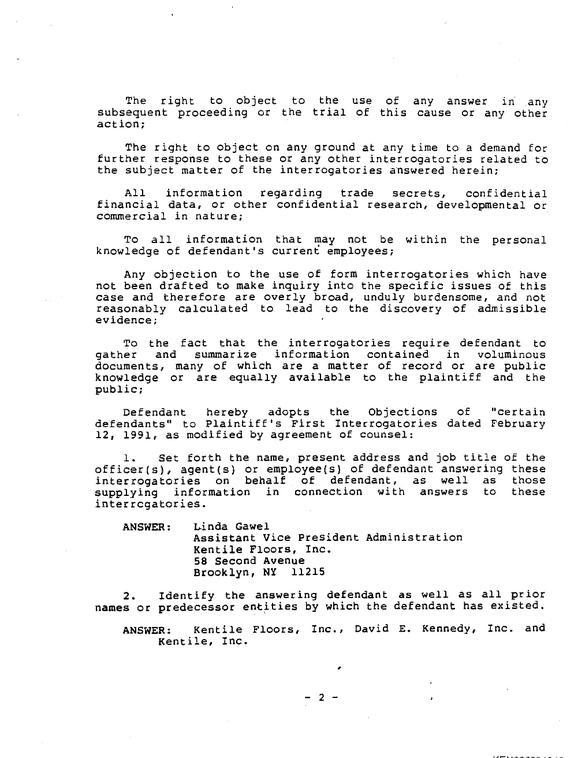
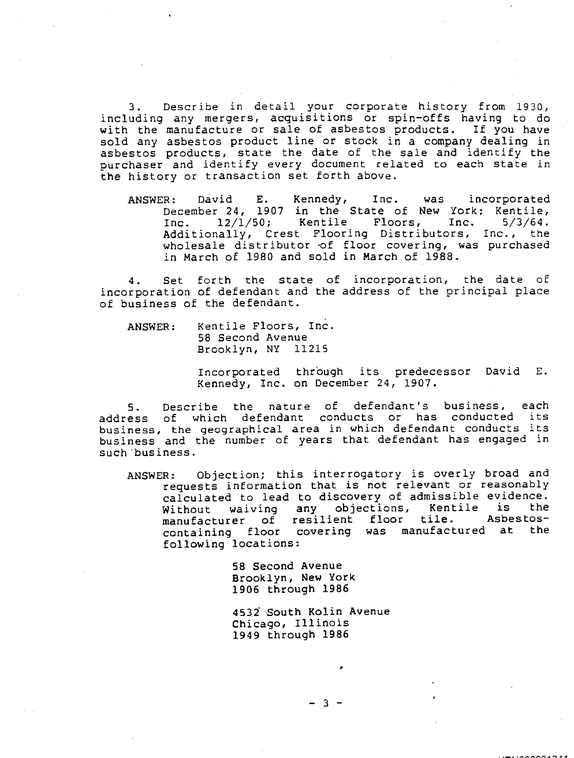
FILE NAME: Kentile (KEN) DATE: 0000 DOC#: KEN010 DOCUMENT DESCRIPTION: Kentile Answers to Plaintiffs First Interrogatories f KE-Vi'V PLAINTIFF i EXHIBIT IN THE CIRCUIT COURT OF COOK COUNTY, ILLINOIS COUNTY DEPARTMENT, LAW DIVISION BOARD OF EDUCATION OF THE CITY OF CHICAGO, a body politic and corporate, ) ) ) No. 85 CH 811 Plaintiff, ) ) (Transferred to Law) " ) v. ) Honorable Myron T.
refid# oe1ND56101Q16Xjba0n97jDeg20 pages
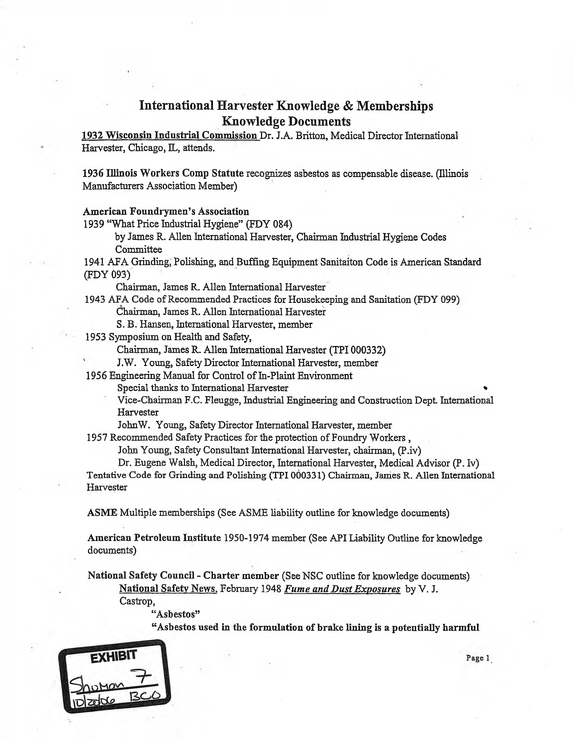
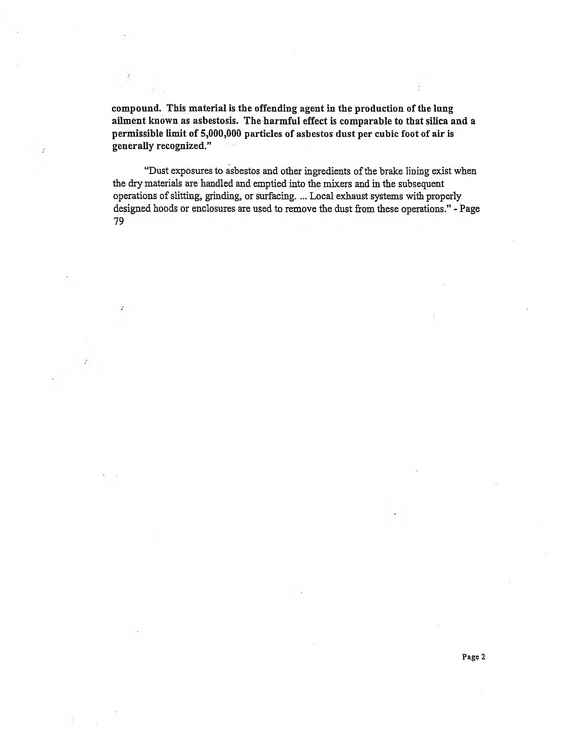
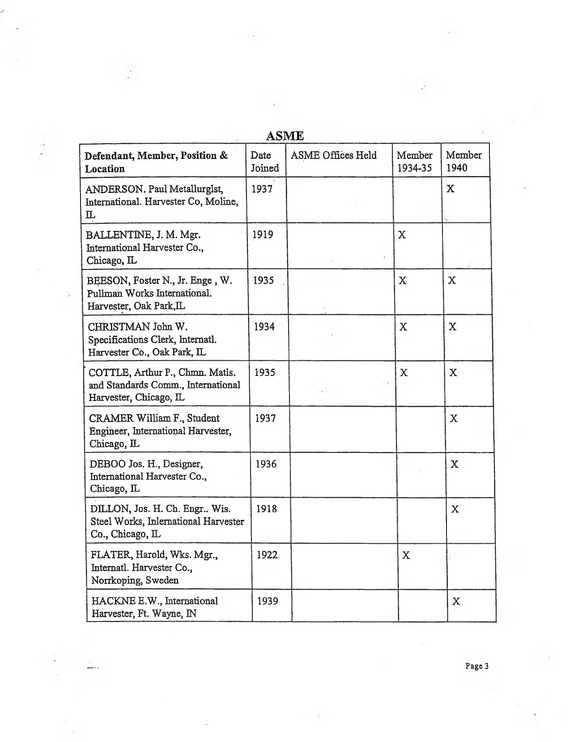
FILE NAME: International Harvester (INTH) DATE: 0000 DOC#: INTH001 DOCUMENT DESCRIPTION: List of Knowledge Documents from INTH International Harvester Knowledge & Memberships Knowledge Documents 1932 Wisconsin Industrial Commission Dr.

refid# agODL8nxK9goE9NOm14Qkjga10 pages
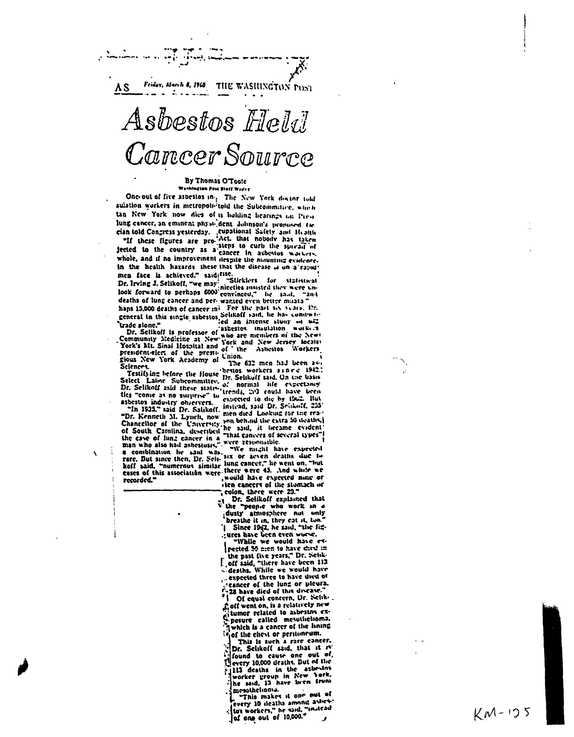
refid# zZ25QZaaQX7656mejZ1dK2Vg2 pages
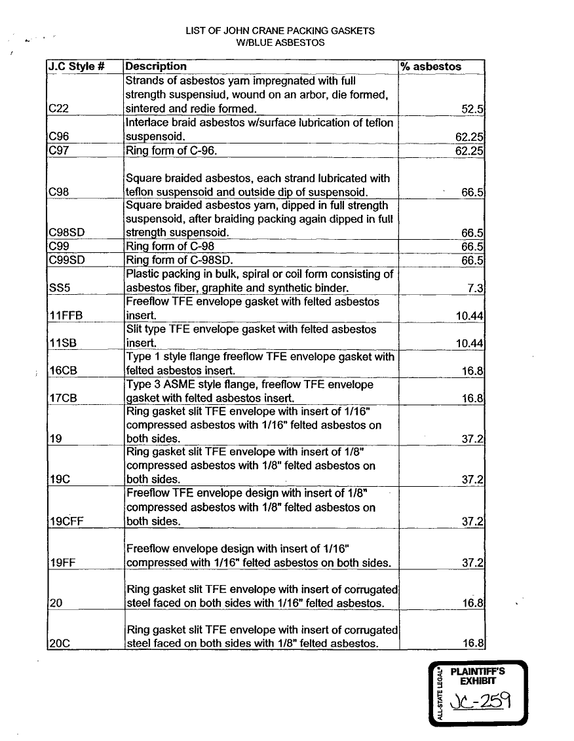
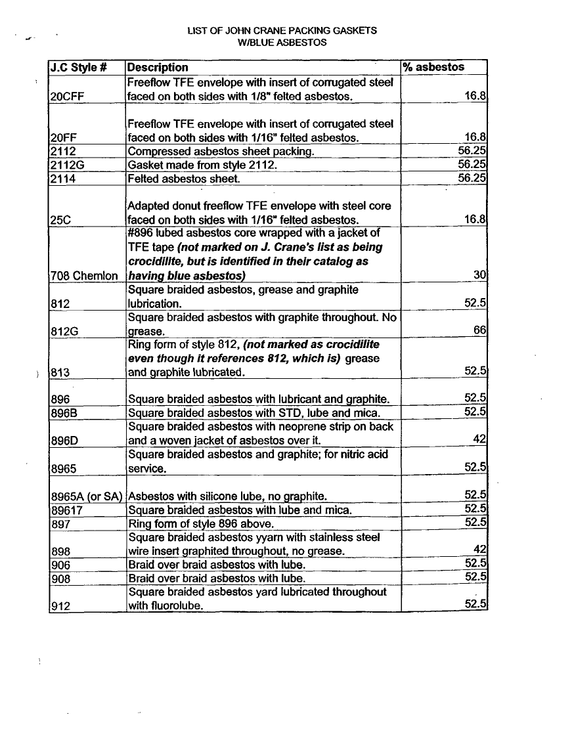
FILE NAME: John Crane (JC) DATE: 0000 DOC#: JC052 DOCUMENT DESCRIPTION: List of Crane Gaskets with Blue Asbestos J.C Style # C22 C96 C97 C98 C98SD C99 C99SD SS5 11FFB 11 SB 16CB 17CB 19 19C 19CFF 19FF 20 20C LIST OF JOHN CRANE PACKING GASKETS W/BLUE ASBESTOS D e s c rip tio n S trands o f asbestos y a m im pregnated with full strength suspensiud, w ound on an arbor, die form ed, sintered and redie form ed.
refid# k6461BjEb5pq6RbdjbYynJB0b3 pages
FILE NAME: Kubota (KUB) DATE: 0000 DOC#: KUB010 DOCUMENT DESCRIPTION: Protecting Employees l-7e PMK Privileged & Confidential/Draft 07/11/29 I / e) Automated 4th Pipe Manufacturing Machine (Kubota Monthly News Letter 66.10) Since September 1, the 4th pipe manufacturing machine has been in operation with some operations automated.
refid# 0gjRMXqzO19oZ0e34YdERe75n6 pages
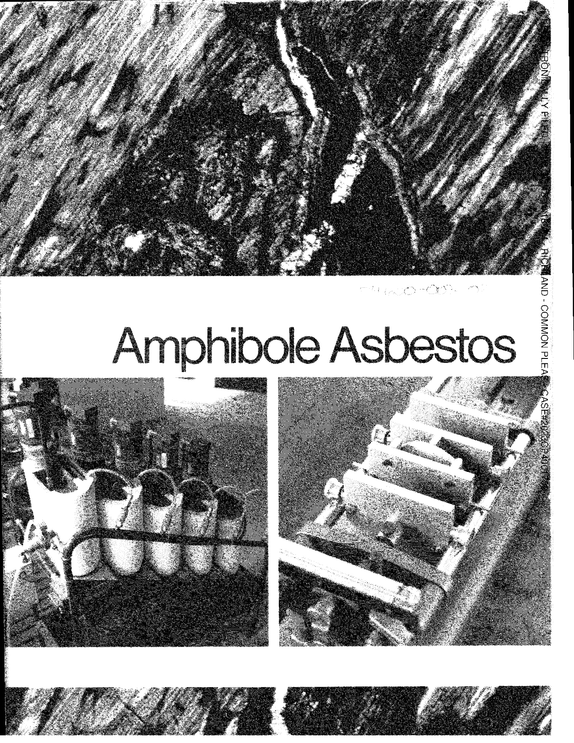
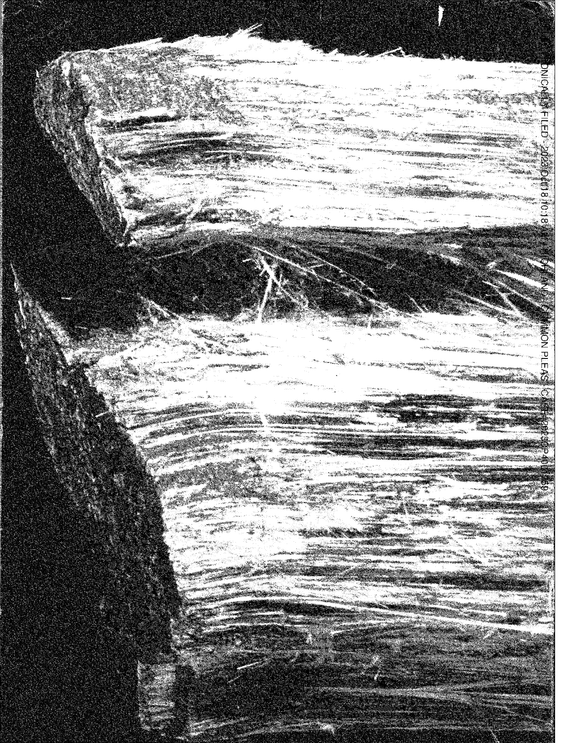
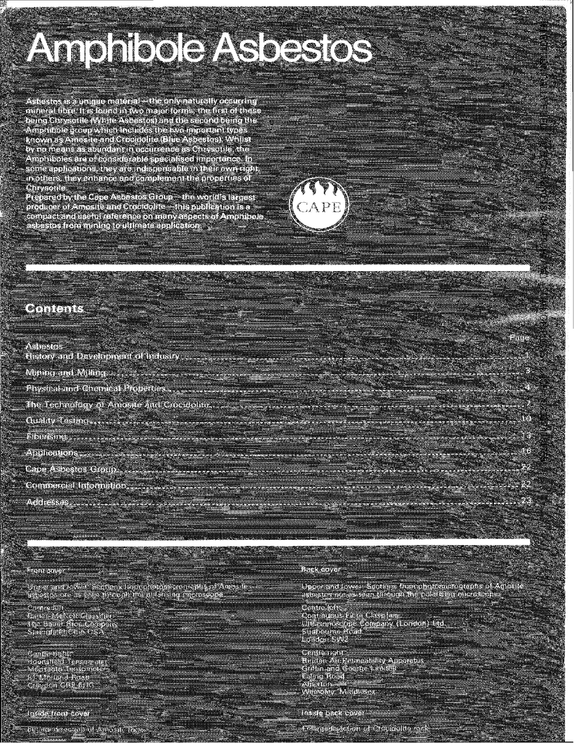
FILE NAME Cape Asbestos CAPE DATE 0000 DOC CAPE104 DOCUMENT DESCRIPTION Cape Document - Informational Publication on Amphibole Asbestos Legal - Tibbs Case Exhibit 2 Ferwcnaesigy: ELECTRONICALLY Asbestos History and Development stone which is combed and woven Asbestos has been known and used for its unique properties for many centuries Early Greek and Roman writings make many references to the material and mention specific sources including mines which at that time had already been worked out The essential characteristic of asbestos is that it will not burn but its name is a contradiction A Greek word it means inextinguishable or once burning cannot be quenched The paradox is perhaps explained by the use of asbestos in lamp wicks the most famous example being in the woven material used in the perpetual lamps of the Vestal Virgins Throughout industry however the fame of asbestos has been largely based on its incombustibility Plutarch who lived in the first century A.D. refers to rock yielding soft petrous filaments like yarn which are made into towels nets and women's head coverings which cannot be burned by fire but if any become soiled by use their owners throw them into a blazing fire and take them out bright and clean ELCTRONIALY The machine miniature stampers used by FILED Jacob Christian Schaffer - 1718- 1790 to 2023 produce Oct 10:18 AM - New asbestos discoveries RICHLAND Although some of the earlier accounts may have referred to the use of other varieties of asbestos it was clearly Chrysotile or White asbestos which figured largely in the early history But some time between 1803 1803 and 1806 a German geologist called Lichtenstein COM ON travelling near the village of Prieska in the Orange River Valley in South Africa came upon a mass of asbestos which was lavender blue in colour Apart from PLEAS its colour it had a different texture from Chrysotile and belonged to the Amphibole group of minerals It was named Crocidolite recorded and then forgotten - Almost ninety years were to pass before the material was mined commercially In the Middle Ages the Emperor Charlemagne is said to have impressed an enemy and prevented a war by exhibiting strange powers he threw his tablecloth into the fire and recovered it cleaned and unharmed Undoubtedly it was woven asbestos In 1250 the Venetian explorer Marco Polo records that he was shown unburnable cloth in Siberia and he learned of the existence of asbestos mines in the area References are also found in history to exploitation of other asbestos properties Archaeological finds dating back over 2,500 years show very early uses of fine asbestos fibre for reinforcing lightly fired pottery And a Greek doctor about 28 B.C. noted that if a tree is surrounded with linen made of asbestos the noise of the blows given by the axe will be deadened thereby and the tree may be cut down without making a noise Recognition even then of the acoustic insulation pro- perties of asbestos So through the centuries asbestos has been widely known and used But it remained an object more of curiosity and superstition than of practical value right up until 19th century 7 Long before this in 1847 immense deposits of Chry- 203CP41759 sotile asbestos had been discovered in Quebec by Sir William Logan the first Director of Geological Survey in Canada Once again it was a discovery too early for commercial exploitation Even as late as the 1870's asbestos was still a material for tricks and spectacles At that time asbestos was produced in Italy but its cost made any possible scale use uneconomic Mining of the rich Quebec deposits finally started at the beginning of the 1880's and since then there has been continual expansion Canada and Russia are today the largest producers of Chrysotile asbestos fibre Pee The Cape Asbestos Company Meanwhile the end of the 19th century saw development of that other major type of asbestos Amphibole Francis Oats a director of De Beers Consolidated Mines Ltd. the company controlling the diamond mines of South Africa formed in 1891 the Cape Mineral Syndicate to exploit Crocidolite which had recently been discovered in the Orange River Valley On December 28 1893 The Cape Asbestos Company Limited was incorporated in London its objective being to take over the Cape Mineral Syndicate's mining operations to manufacture in London and to acquire an Italian asbestos insulation factory as an outlet for Blue asbestos ELECTRONICAL Y The early days of the Cape Asbestos Company Limited were not rosy and for the years up to 1905 losses were reported far more often than profits During this period there was a year shutdown on mining because production far exceeded demand and Boer War which lasted from 1899 to 1902 led to yet another shutdown In the meantime the Italian factory carried on manufacture using white asbestos from other sources but fierce competition in white asbestos goods made profitable operation impossible Further setbacks followed some commercial some due to a severe three drought in South Africa that paralysed production and communications But the Company's confidence and persistence were rewarded By 1911. the directors were able to declare confidently that the value of the Company's land in South Africa was increasing and from then on profits were regularly being shown After the first world war fears were expressed that the Company's Blue asbestos mines might give out entirely in few years These fears have of course proved to be groundless but following investigations into alternative sources of supply the Company acquired in 1925 a number of mines in the Transvaal producing a coloured amphibole asbestos This had been discovered in 1907 at site called Amosa the initial letters of Asbestos Mines of South Africa The mineral became known as Amosite It had long stiff rigid fibres and whilst unsuitable for easy spinning proved itself ideal for the manufacture of insulating materials The world's supply of Amosite asbestos still comes largely from the South African mines of the Cape Group ELCTRONIAY Growth of asbestos cement industry Just before the turn of the century there took place one of the most significant events in asbestos history a FILED development that more than any other created a vast world market for the new raw material Ludwig - 2023 Hatschek the owner of a paper and board making plant at V^cklabrucknear Vienna began experimenting Oct with cement added to an asbestos millboard At about 80 cement and 20 fibre he discovered he had made 18 a new product 10:18 The original asbestos cement was a flat sheet about cm x 40 cm forerunner of the many sizes and types of asbestos cement products now made and used all AM over the world - Manufacture began first in Austria then in 1903 in RICHLAND Switzerland followed by Belgium in 1905.
refid# x161XenVLNjjdQryVVG8OvjwE29 pages
FILE NAME Talc TALC DATE 0000 DOC TALC055 DOCUMENT DESCRIPTION Unpublished Report - Pfizer Pfizer's position as a supplier of talc to many industries caused us to seek a reliable method to identify and detect asbestos and asbestiform minerals possibly present in talc Ideally we wanted the technique to be simple and direct but above all it must be positive and unambiguous Talc is a naturally occurring hydrous magnesium silicate and you have been given the formulas from various and sundry people this morning and this afternoon and is derived from minerals containing various amounts of tremolite chlorite i chrysotile and a group of chrysotile minerals called amphiboles or asbestiform minerals Chief among these are anthophyllite amosite crocidolite and actinolite From their chemical formulas which you can find in the reference you can see the close chemical similarity between talc and these asbestos type minerals It becomes particularly difficult to analyze for these when one considers that the degree of replacement of one ion for another is seldom in exact proportion Often the best that you can do is say that this particular material is for example like anthophyllite or most like anthophyllite We investigated the currently available methods and methodology for detecting asbestos and tremolite and the asbestiform minerals in the presence of talc The three most likely candidates that we came up with were light microscopy ray diffraction and t transmission electron microscopy Samples of pure talc and tremolite | were obtained from various deposits owned by Pfizer Samples of very pure and very carefully characterized asbestos minerals were obtained from the International Union Against Cancer in the United Kingdom The tales and asbestiform minerals were obtained in the pure as received state their characteristics noted and mixtures made to determine if the detection of asbestiform minerals was possible at low levels and if so what might the minimum detection levels be Experimentally we started with ray diffraction We obtained patterns for all of the minerals and mixtures used in the study employing the conventional ray techniques of scanning at rates of from 0.5 to 1 degrees 2 theta per minute These samples were then subjected to scrutiny by optical and electron microscopy When we did this we found that sometimes mixtures and mineral species shown to be free of asbestos minerals by the conventional ray diffraction techniques mentioned above and the light microscope also exhibited very large percentages of % or more of tremolite and asbestos minerals when viewed in the transmission electron microscope We sought to find out the reason for this paradox which then enabled us to develop reliable techniques for detecting tremolite and the asbestiforms at 0.25 to 0.5 by ray diffraction Even lower levels than these could be detected by electron microscopy The first table Table I shows the d spacing for talc chlorite tremolite and the asbestiform minerals These are for pure minerals and can shift by as much as 0.2 to 0.3 angstroms depending on the sample preparation You can see the problem that is going to present itself when you consider that you are really dealing with three specific items You are dealing with talc you are dealing with chrysotile asbestos and then you are dealing with tremolite with a last difficulty thrown in -- chlorite We'll get to the chlorite in a few minutes What we did is use an ordinary step scanning diffractometer which moved the counter .05 degrees 2 theta and the intensity of the X radiation at each step was measured for approximately 2 to 4 minutes We then plotted the intensity of this versus 2 theta over the area of interest - roughly 13 degrees to 9 degrees 2 theta shown in figure 1 This is the type of output we obtained when we examined talc from our Montana deposit The general upward slope as you go lower in degrees is caused by the measuring device entering the primary beam of the ray tube We established calibration curves by integrating the areas under these curves and the appropriate ray diffraction peak samples with as little as 0.1 and as much as 10 additions of the species under investigation were examined We extrapolated these curves to % and we got the minimum background with the minimum amount detectable using the standardized formula of 3 times the square root of background level at that point For tremolite in talc the minimum detectable level was found to be 0.25 For chrysotile and other asbestiform minerals the minimum detectable level by this method is 0.5 but this can only be achieved in the absence of chlorite Referring back to the first figure the chlorite tends to mask the presence of chrysotile asbestos because it is so close to chrysotile asbestos in its major diffraction peak The consequance of this is that when you have chrysotile asbestos or when you have chlorite you can't be sure exactly which of the two you have If you have a small amount of chlorite it will very effectly mask the presence of the chrysotile asbestos One of the ways out of the dilemma that presented itself to us at this time was the fact that chlorite is acid soluble so we thought what we would do in this case was to acid wash the talc containing the chlorite get rid of the chlorite and then examine it for chrysotile asbestos and in fact the chrysotile asbestos peak and the chlorite peak both did disappear only The problem was that when we looked at these samples in the electron microscope the presence of the chrysotile fibers was still found This is explained by the fact that chrysotile asbestos is in fact partially soluble in hydrochloric acid It is a diffusion controlled reaction and as the magnesium ions depart from the crystal structure you are left with a shell of silicon which is amorphous to the ray beam - the ray beam does not see it The electron microscope does pick it out Figure 2 demonstrates the difference in ray intensity one gets over the same angular region when one adds % tremolite or % tremolite The same type of of the other plot is available when asbestiform minerals one adds Figure 3 chrysotile asbestos or any is the calibration plot that we obtained for chrysotile Therefore we can put a pretty good handle on the percent asbestos or tremolite or asbestiform mineral that we are going to find Figure 4 is the calibration curve obtained for tremolite So you can see that it is a fairly sensitive technique and is easily performed Table 2 shows the selected area electron diffraction maxima for talc tremolite chrysotile anthophyllite We use these for the positive identification amosite of these minerals Transmission electron microscopy is employed in this 2 identification We need to have this type of information because we need to be unambiguous about our analysis We want to know for sure what we are looking at The electron microscope has the ability to single out individual particles and by virtue of selected area electron diffraction we can derive the same type of data as an ray diffraction unit except we are quite a bit more sensitive here By virtue of its ability to examine these individual fibers and particles at very high magnification the transmission electron microscope has been found by us to provide the technique ancillary to ray diffraction that is needed to complete the unambiguous detection of the identification of asbestiform minerals The morphology of the asbestiform minerals and tremolite is generally described as acicular or fibrous This immediately serves to isolate it from the platy tale matrix even in the presence of chlorite since chlorite fortunately closely resembles the morphology of talc The chlorite is platy the talc is platy so that eliminates immediately the problem of detecting fibers since the investigator disregards all platy particles and looks only for fibers Now if a careful examination of approximately 100 different fields of view fails to reveal any fibrous material then we feel that talc is free of tremolite chrysotile and the asbestiform minerals The problem of particle curling was mentioned earlier One of the uses for selected area electron diffraction is to diffract from curled up plates You can tell that the diffraction pattern is no different from that of the plate from which this material starts to curl With the transmission electron microscope you are looking right into the particle you see it and then you diffract from the pseudo fiber of curled up talc and you find that its pattern is identical to that of the main talc body Therefore there is no difference mineralogically between the two The talc pseudo fiber can just as likely unroll as it can roll up Now at first we had a little problem with our talcs because when we used the Montana material we couldn't find any fibers we couldn't find any chrysotile we couldn't find any tremolite we couldn't find anything but a small bit of chlorite This prompted us to spike some samples and we did this by adding a weighed amount of chrysotile asbestos in one case for example to a weighed amount of our talc and we were able to construct calibration curves similar to the type that we used in the ray diffraction work and we found for example that with % addition of chrysotile asbestos to the Montana talc we would find on the average in the 100 fields of view 6 fibers with a standard deviation of approximately 1-1 fibers and it also followed a Guasian distribution which made us feel a good deal better about the homogeneity of the sample These samples were prepared by slurrying the dry powders in a Waring blender with isoprophyl or ethyl alcohol for five minutes and then allowing them to dry and then just simply crumbling them up We also used 0.1 and 0.5 asbestos and up to % Figure 6 is a typical example of Montana talc The micron marker is 1 micron and these are all platy materials There have been no fibers identified in this material Figure 5 shows a
refid# YDa7Y2MajvGJR52rMD6EOnEL89 pages
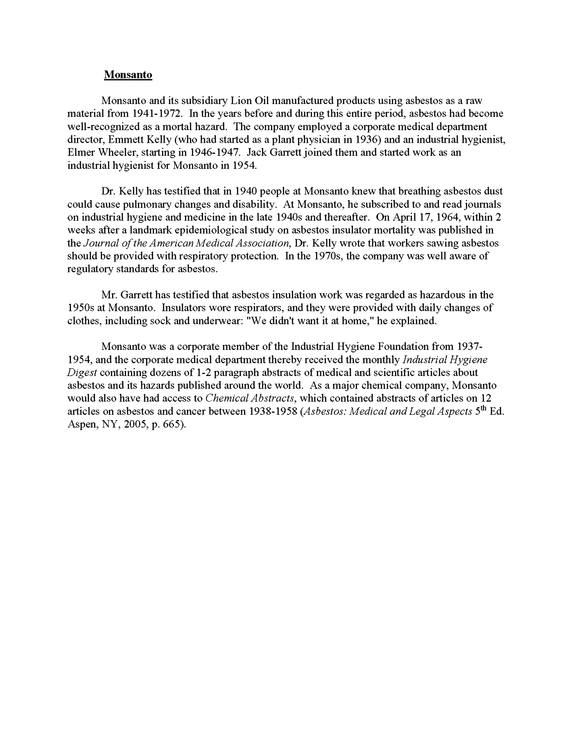
FILE NAME Monsanto MON DATE 0000 DOC MON000 DOCUMENT DESCRIPTION Barry Castleman Report on Monsanto Monsanto Monsanto and its subsidiary Lion Oil manufactured products using asbestos as a raw material from 1941-1972 In the years before and during this entire period asbestos had become recognized as a mortal hazard The company employed a corporate medical department director Emmett Kelly who had started as a plant physician in 1936 and an industrial hygienist Elmer Wheeler starting in 1946-1947 Jack Garrett joined them and started work as an industrial hygienist for Monsanto in 1954 Dr.
refid# MJmqE73rm56k8mxM9ydK8egex2 pages