Refine
Estimated Years 2010-2019Clear
343 results foundRefine Search
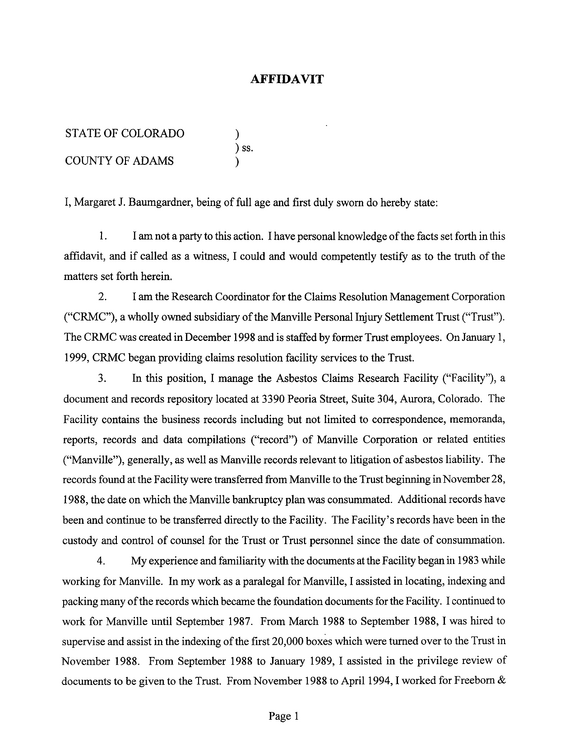
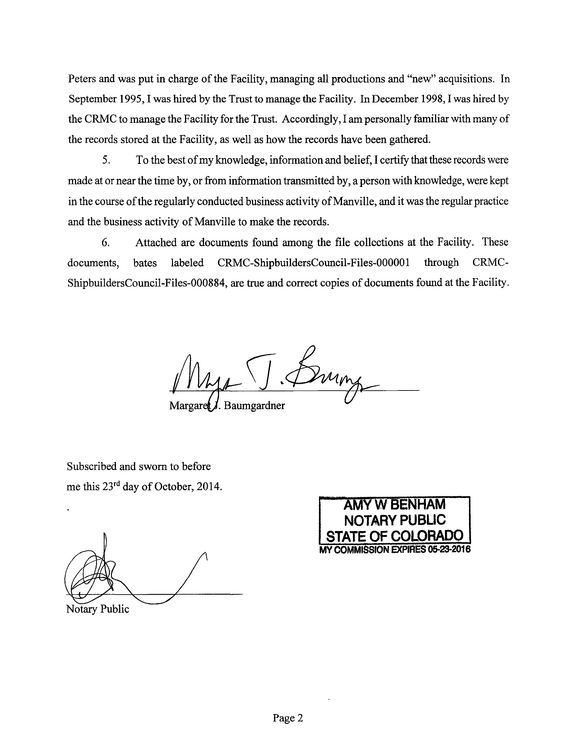
FILE NAME: Avondale (AVD) DATE: 2014 Oct 23 DOC#: AVD104 DOCUMENT DESCRIPTION: Legal - Affidavit of MJ Baumgardner RE Johns Manville Documents AFFIDAVIT STATE OF COLORADO ) ) ss.
refid# 9304kYOG3nEVpy1QgEaX0xbGD3 pages
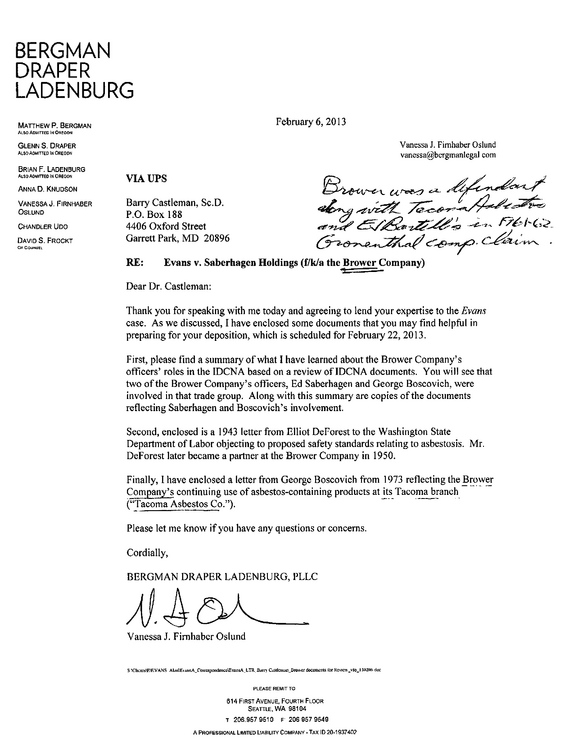
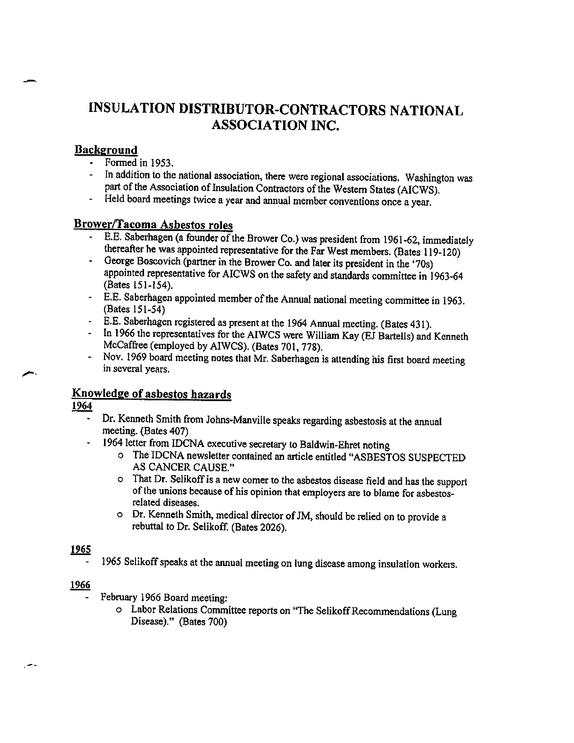
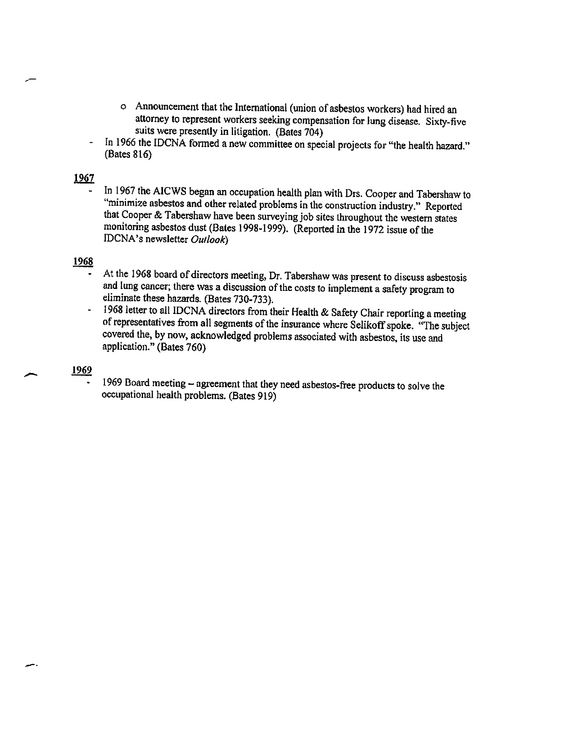
FILE NAME Insulation Contractors & Distributors ICD DATE 2013 Feb 6 DOC ICD049 DOCUMENT DESCRIPTION Letter to Barry Castleman with Attorney Notes from Bergman Draper Ladenburg Insulation Contractors National Assoc Inc.
refid# 85EYzLgaodR8r2NxknvOdnyyo4 pages
FILE NAME Talc TALC DATE 2014 DOC TALC147 DOCUMENT DESCRIPTION Journal Article - Asbestos in Commercial Cosmetic Talcum Powder as a Cause of Mesothelioma in Women Asbestos in commercial cosmetic talcum powder as a cause of mesothelioma in women Ronald E.
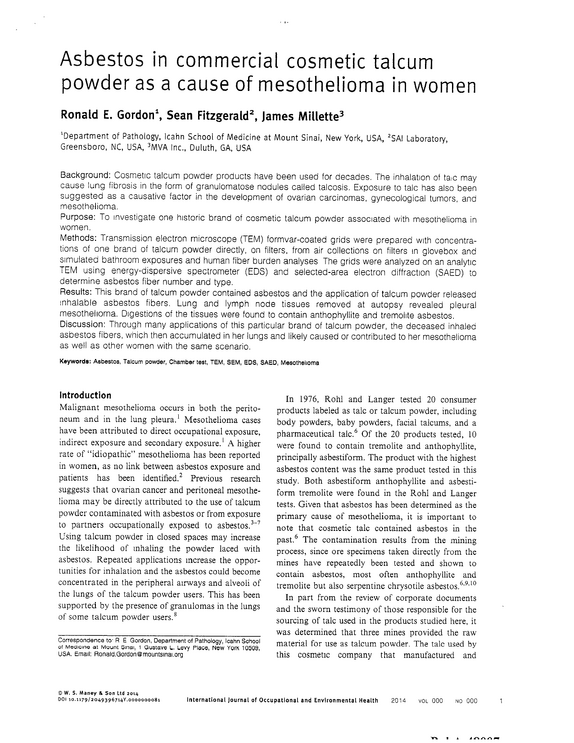
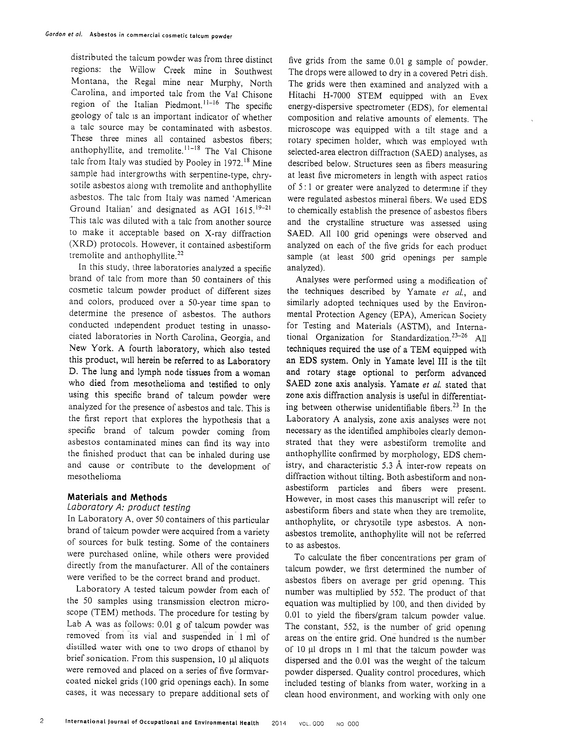
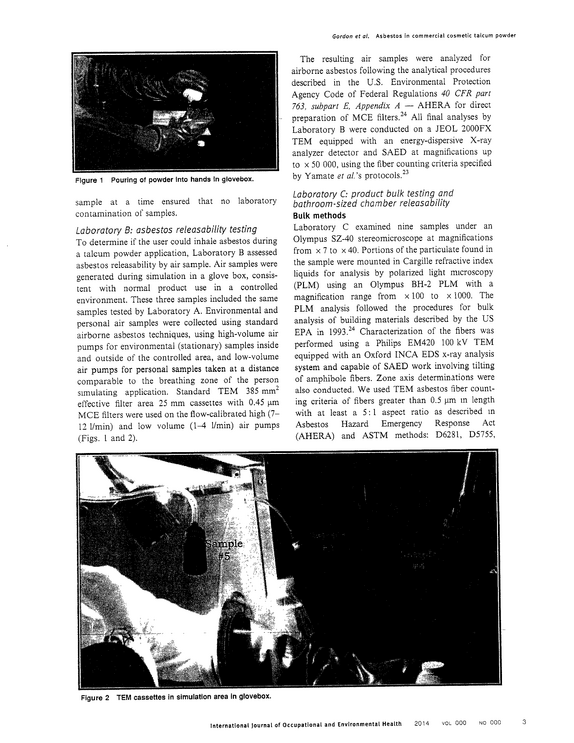
refid# MMVd97v9k159jMjndBe9Rm4ka16 pages
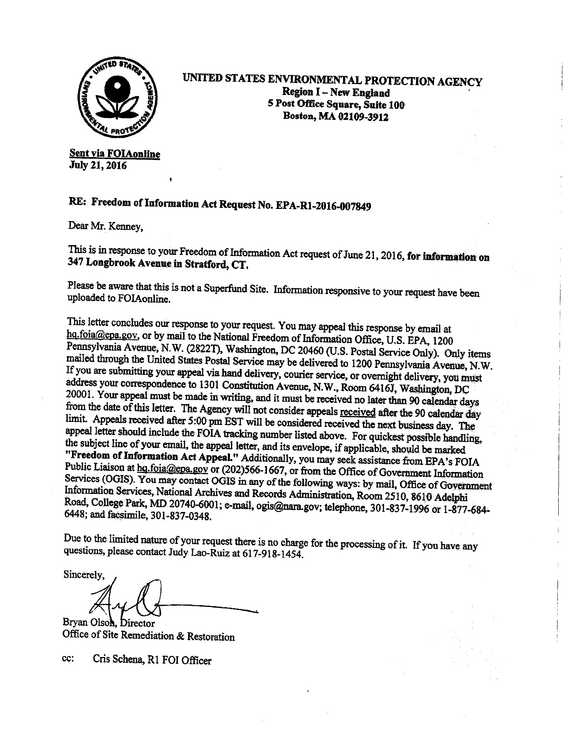
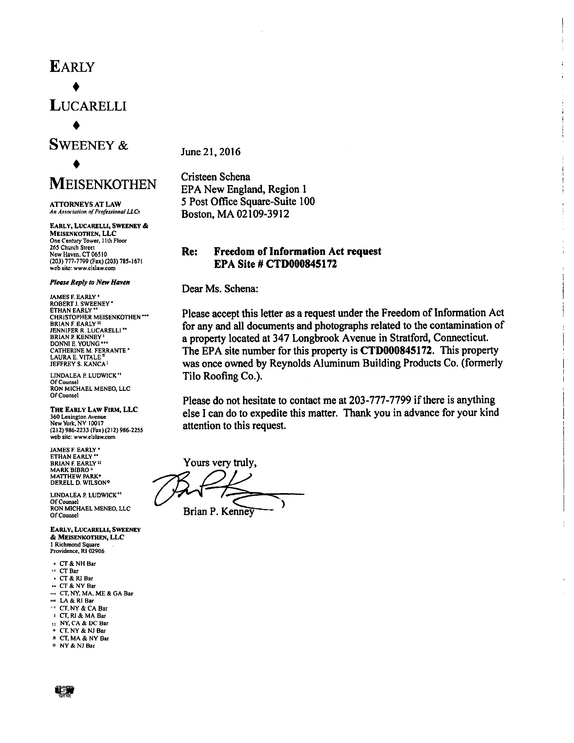
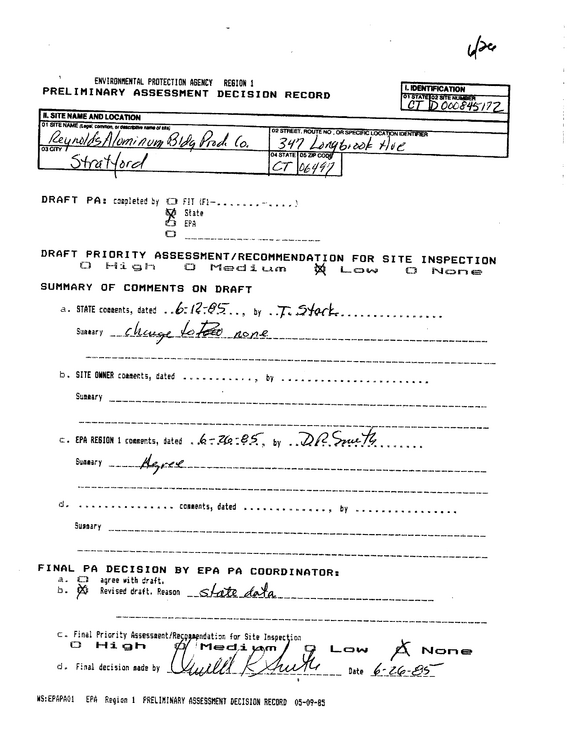
FILE NAME TILO TIL DATE 2016 DOC TIL027 DOCUMENT DESCRIPTION Results of EPA Freedom of Information Act Request \ UNITED STATES ENVIRONMENTAL PROTECTION AGENCY Region I- I- New England 5 Post Office Square Suite 100 Boston MA 02109-3912 Sent via FOIAonline July 21 2016 RE Freedom of Information Act Request No.
refid# qa5L3OoZ81v98NdoO6EZ25ngR40 pages
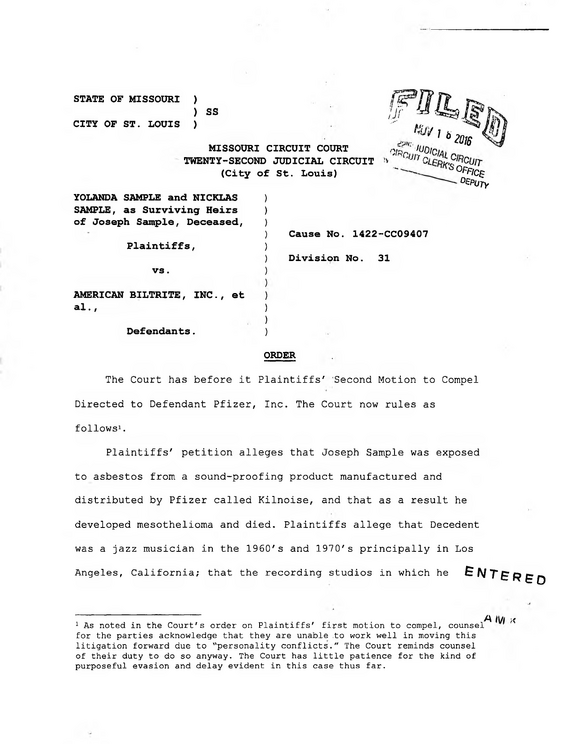
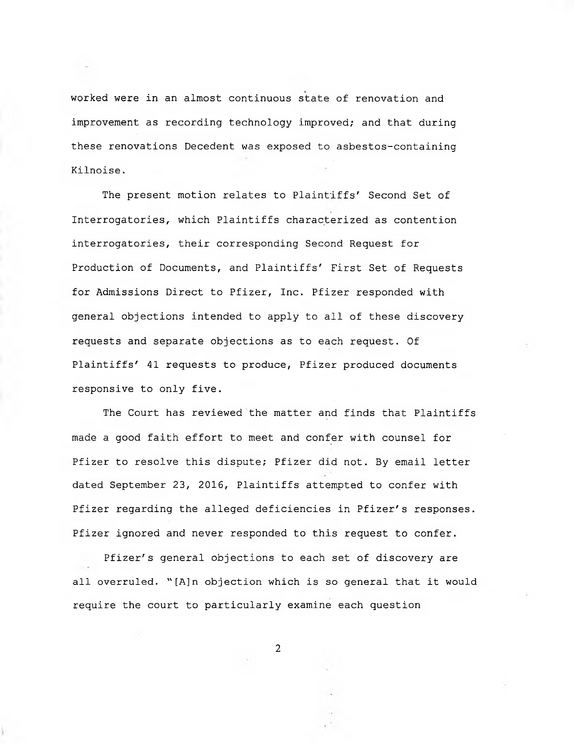
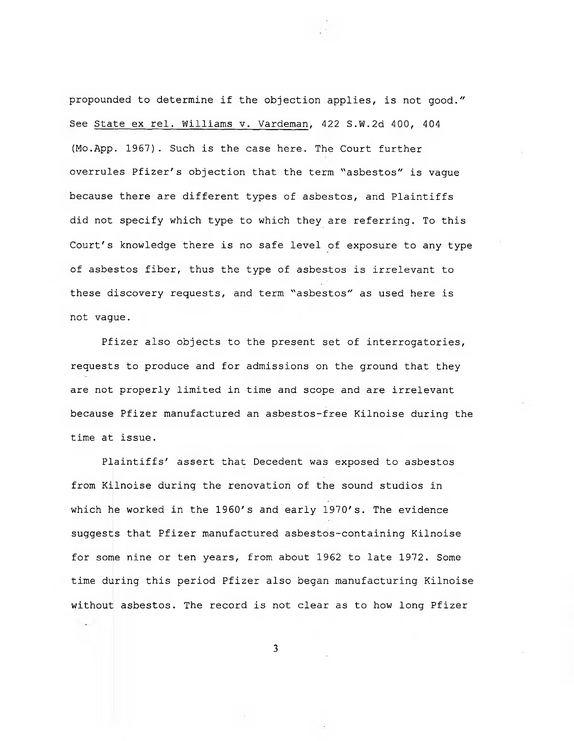
FILE NAME: Pfizer (PFIZ) DATE: 2016 DOC#: PFIZ052 DOCUMENT DESCRIPTION: Legal - Order [Sample vs.
refid# KRr7MBJ2y9qGgpjyV6Qb8O31Q12 pages
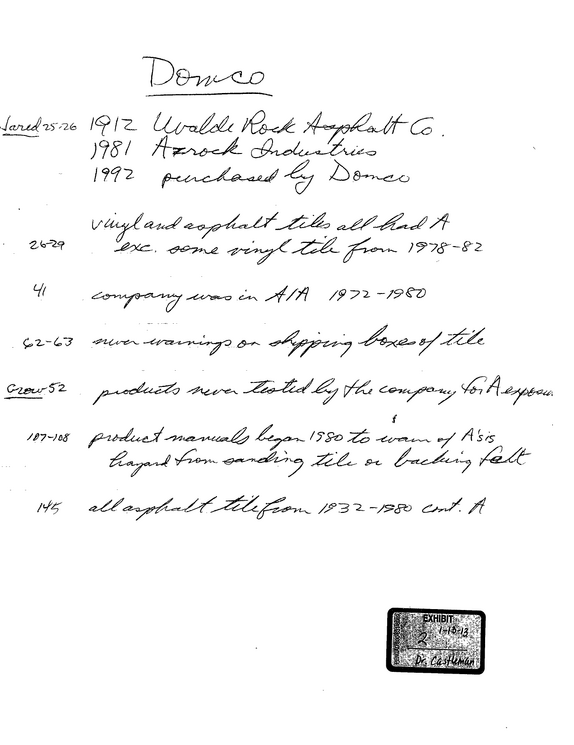
FILE NAME: Azrock-Domco (AZD) DATE: 2013 DOC#: AZD006 DOCUMENT DESCRIPTION: Barry Castleman Notes on Domco Hi ^ 2 .-4 7 G 'Z& n jr'^ }2. / 7-J0 # - stss.
refid# bBVJg806RZbY65Y9Q4gw4kgDo2 pages
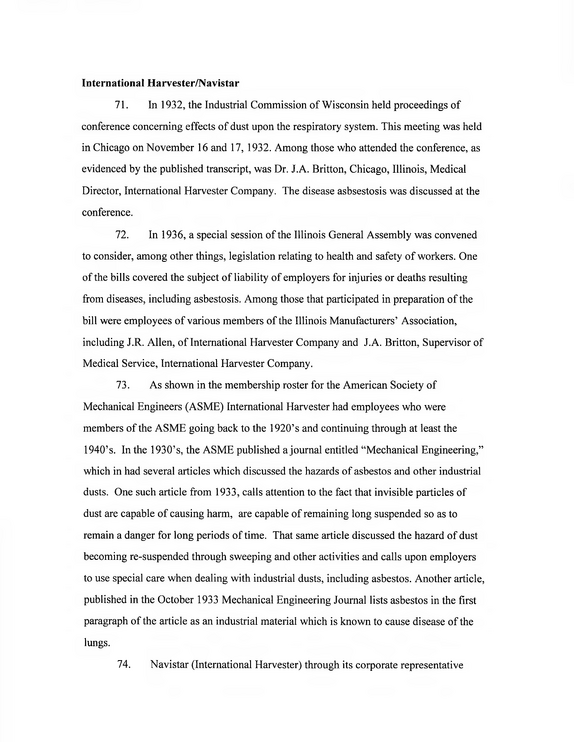
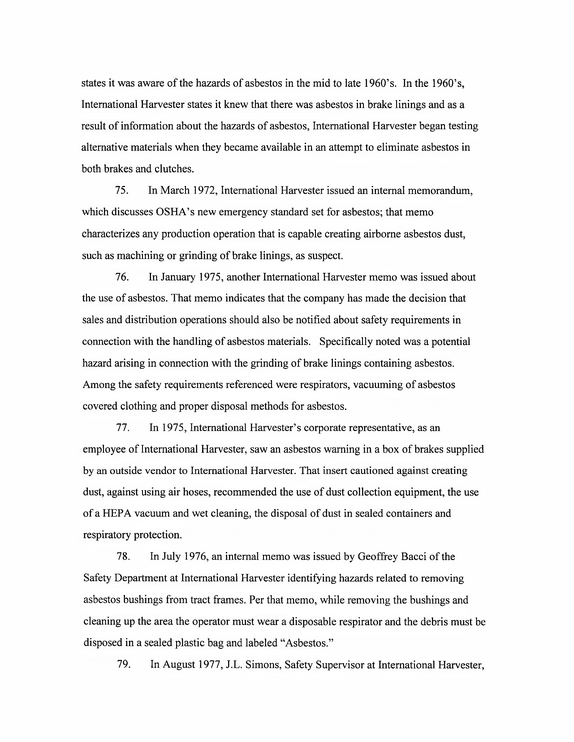
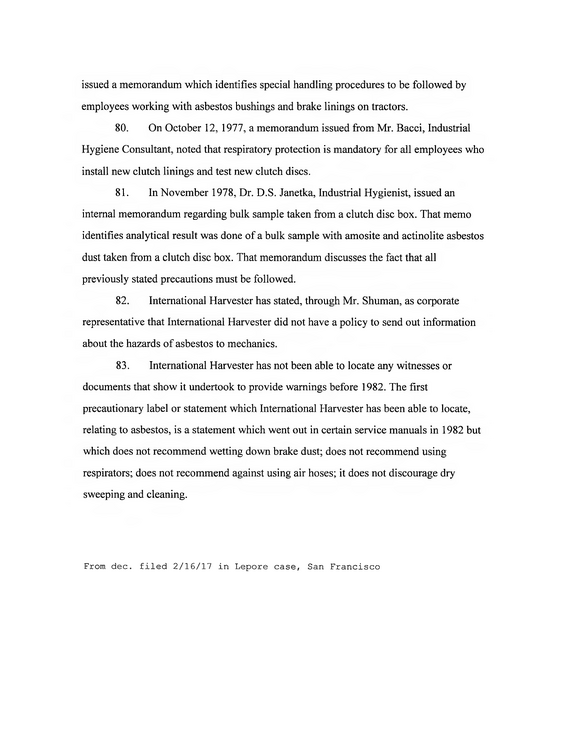
FILE NAME: International Harvester (INTH) DATE: 2017 DOC#: INTH057 DOCUMENT DESCRIPTION: Barry Castleman Summary International Harvester/Navistar 71.
refid# 8kmEzOOg66bnn3YmDb26BJDK6 pages
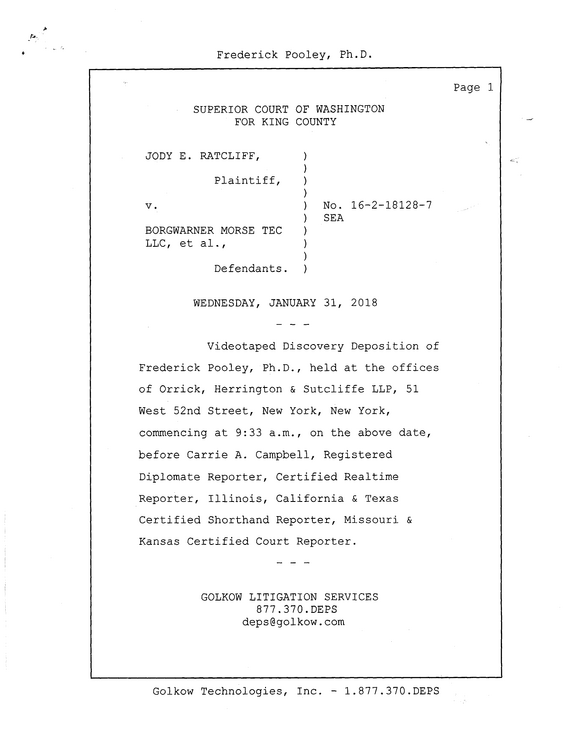
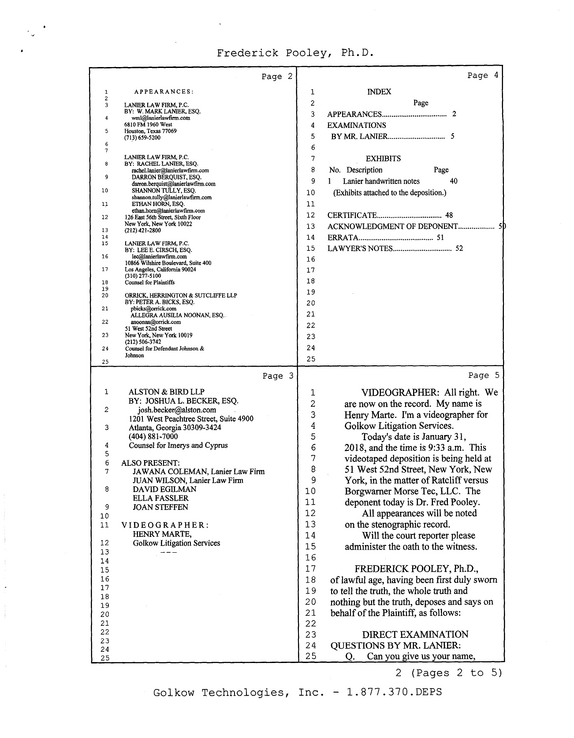
FILE NAME: Johnson & Johnson (JAJ) DATE: 2018 Jan 31 DOC#: JAJ021 DOCUMENT DESCRIPTION: Legal - Deposition of Frederick Pooley, Ph.D.
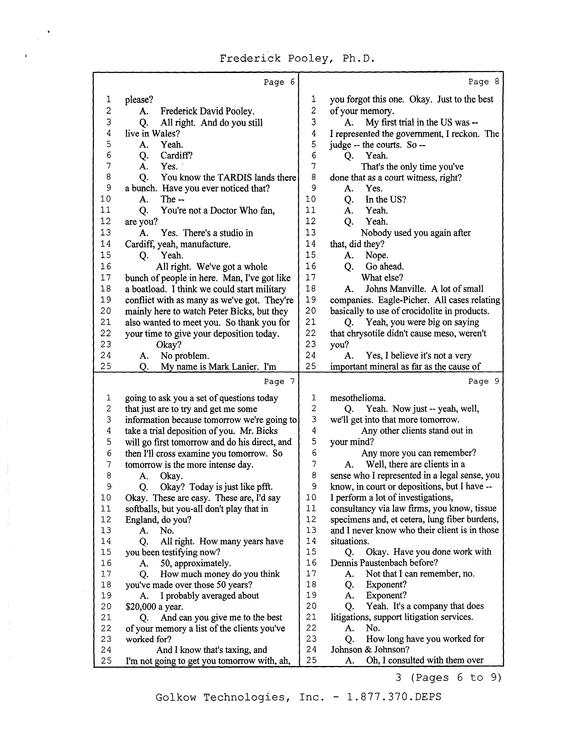
refid# 99xENw1yggEB6oqQd4pVog8L20 pages
FILE NAME Paccar PAC DATE 2012 Jan 4 DOC PAC017 DOCUMENT DESCRIPTION Legal - Paccar's Responses to Plaintiffs Standard Friction Interrogatories Prince v A.W.

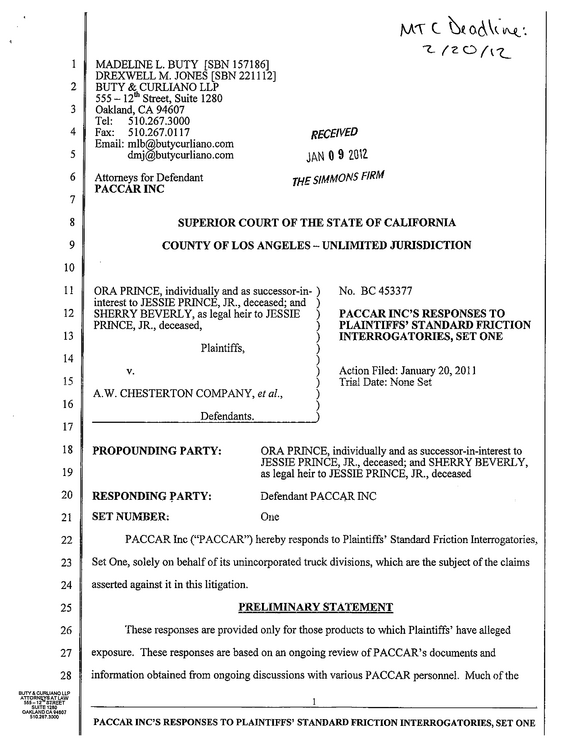
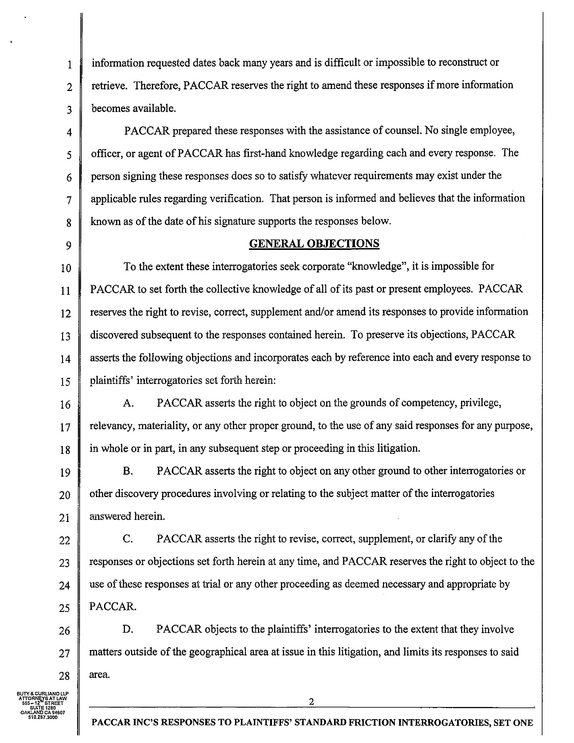
refid# 5kwEj1BGnepwGx2YxGzJq8owV27 pages
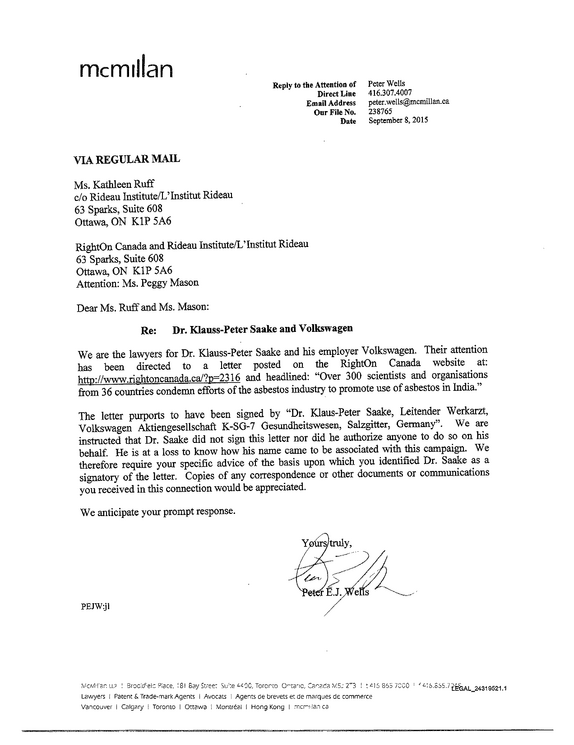
FILE NAME: Volkswagon (VK) DATE: 2015 Sept 8 DOC#: VK005 DOCUMENT DESCRIPTION: Letter to Institute Rideau RE Dr.
refid# rxxjqZwmp3Y5QbmQ52wxKdYDJ2 pages
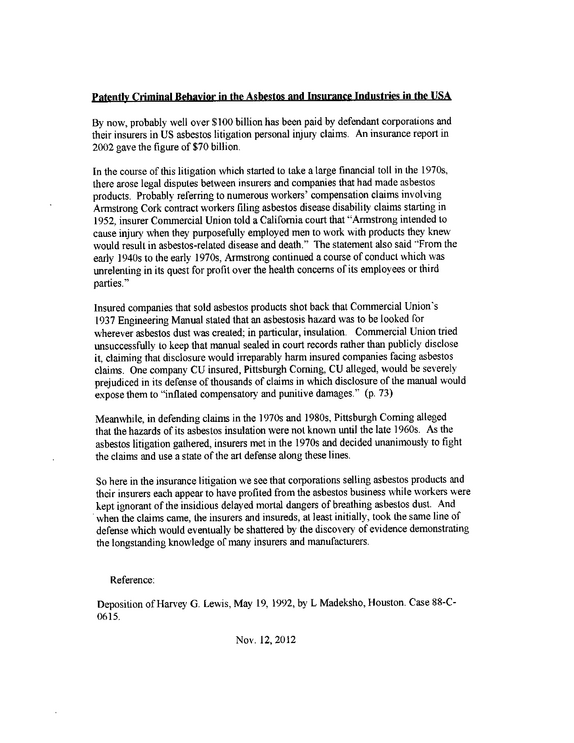
FILE NAME Insurance Industry INS DATE 2012 DOC INS078 DOCUMENT DESCRIPTION Paper - Patently Criminal Behavior in the Asbestos and Insurance Industries in the USA Written by Barry Castleman Patently Criminal Behavior in theAsbestos and Insurance Industries Industries thtehe USA By now probably well over 100 billion has been paid by defendant corporations and their insurers in US asbestos litigation personal injury claims An insurance report in 2002 gave the figure of 70 billion In the course of this litigation which started to take a large financial toll in the 1970s there arose legal disputes between insurers and companies that had made asbestos products Probably referring to numerous workers compensation claims involving Armstrong Cork contract workers filing asbestos disease disability claims starting in 1952 insurer Commercial Union told a California court that Armstrong intended to cause injury when they purposefully employed men to work with products they knew would result in asbestos disease and death The statement also said From the early 1940s to the early 1970s Armstrong continued a course of conduct which was unrelenting in its quest for profit over the health concerns of its employees or third parties Insured companies that sold asbestos products shot back that Commercial Union's 1937 Engineering Manual stated that an asbestosis hazard was to be looked for wherever asbestos dust was created in particular insulation Commercial Union tried unsuccessfully to keep that manual sealed in court records rather than publicly disclose it claiming that disclosure would irreparably harm insured companies facing asbestos claims One company CU insured Pittsburgh Corning CU alleged would be severely prejudiced in its defense of thousands of claims in which disclosure of the manual would expose them to inflated compensatory and punitive damages p 73 Meanwhile in defending claims in the 1970s and 1980s Pittsburgh Corning alleged that the hazards of its asbestos insulation were not known until the late 1960s As the asbestos litigation gathered insurers met in the 1970s and decided unanimously to fight the claims and use a state of the art defense along these lines So here in the insurance litigation we see that corporations selling asbestos products and their insurers each appear to have profited from the asbestos business while workers were kept ignorant of the insidious delayed mortal dangers of breathing asbestos dust And when the claims came the insurers and insureds at least initially took the same line of defense which would eventually be shattered by the discovery of evidence demonstrating the longstanding knowledge of many insurers and manufacturers Reference Deposition of Harvey G.
refid# rBe126KBr9XoGz0a1pQQZYbrJ2 pages
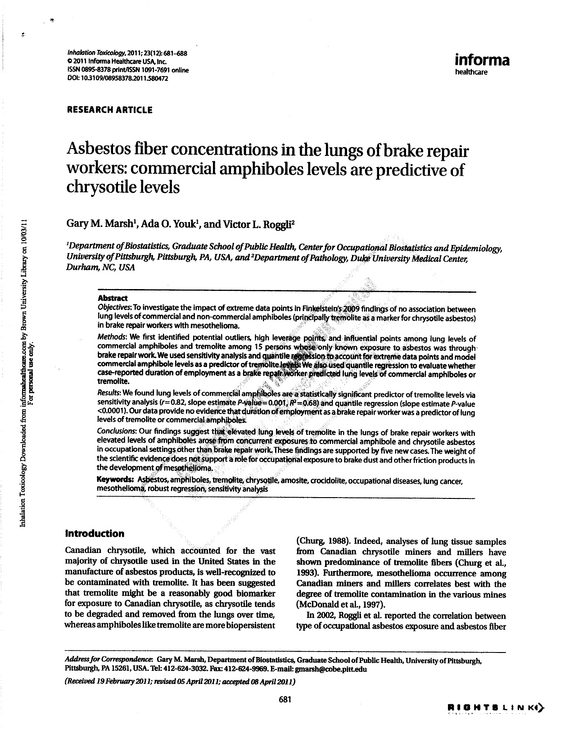
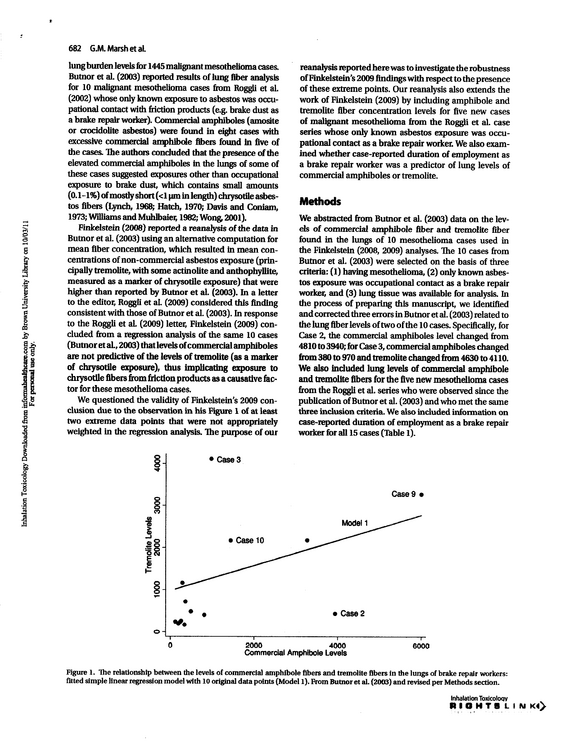
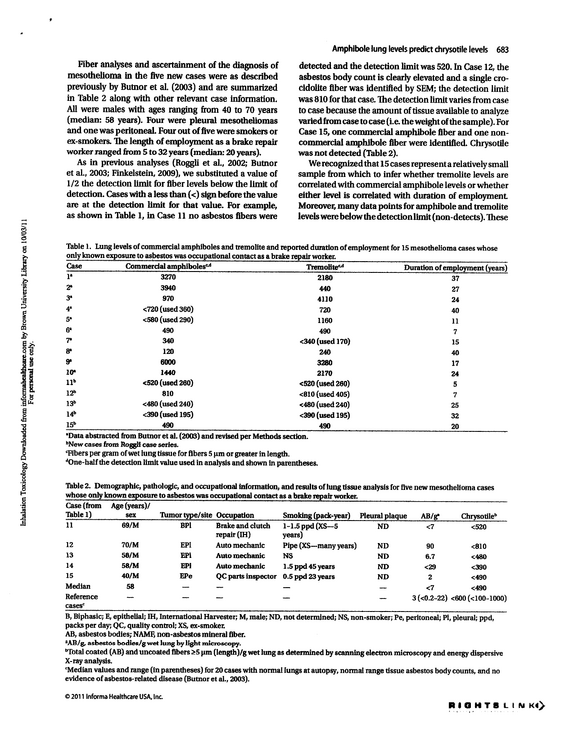
FILE NAME Brakes BRK DATE 2011 DOC BRK218 DOCUMENT DESCRIPTION Journal Article - Asbestos Fiber Concentrations in the Lungs of Brake Repair Workers t Inhalation Toxicology 2011 23 681 688 '2011 Informa Healthcare USA Inc.
refid# X7g7b6zkYdaYwO33v4jggw16G9 pages
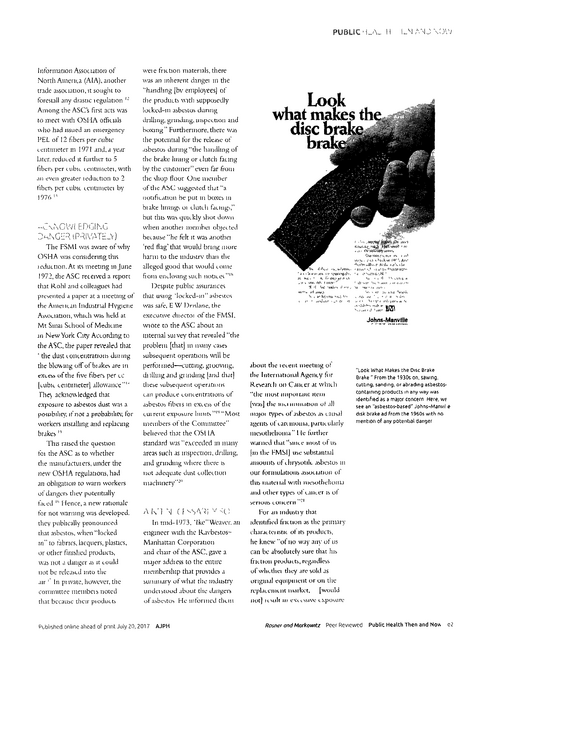
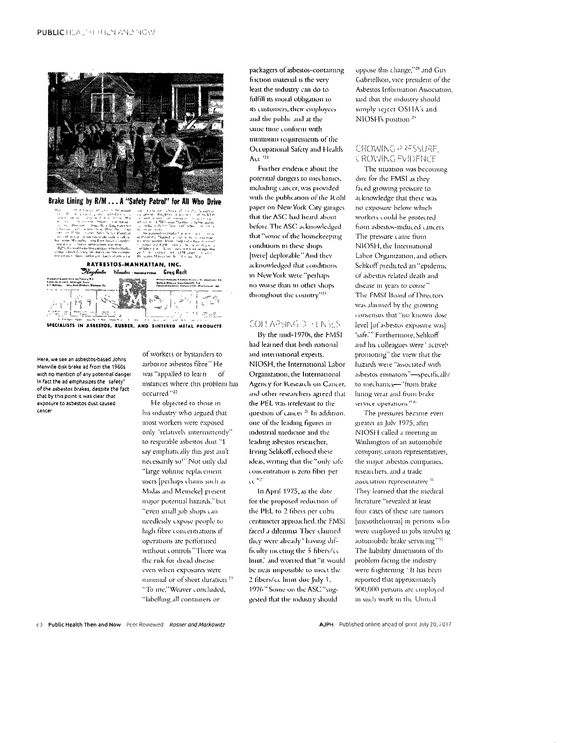
FILE NAME Brakes BRK DATE 2017 DOC BRK257 DOCUMENT DESCRIPTION Journal Article - The Brake Industry's Impact on Asbestos Regulation in the 1970s PUBLIC H_A_H HENAND HENAND NOW Ain't Necessarily So The Brake Industry's Impact on Asbestos Regulation in the 1970s David Rosner PhD MPH and Gerald Markowitz PhD Ys ODORING ADA NO foe Pestate Pestate Pestate asbestos a #ledSimiore #ledSimiore #ledSimiore la koku^Agencies Agencies Kedil 68 get a dere dere fl- - - KES Ac h OMES CE every every every every every aC 22 ae LOOT CLS WS Se Leah La os 4 5 * Get the err oT Dap tor ean 94rton 94rton 94rton McS McS McS McS McS McS SET at Sys e soot 0409fleur 0409fleur 0409fleur smp 2 OR KO) OEY ane ah ta cre Co ft TE ABC SS << A >>>>> >>>>> Pec Heach P wet or anval anval p20 p20 2017 < plecaMKOY plecaMKOY plecaMKOY plecaMKOY plecaMKOY plecaMKOY AN OC > C A 120 / 70 At the end of 2016 the US At Protection Agency EPA proposed asbestos the cause of fibrotic lung disease and cancer as one of the 10 industrial chemicals to be evaluated under the newly revised Toxic Substances Control Act Under the new act a risk evaluation ofasbestos is to be completed within three years and if asbestos is found to be an unreasonable risk to humans and the envirominent the EPA is required to mitigate that risk possibly through a 2 ban within two more years By 1970 asbestos was used in some 3000 products such as roof shingles floor tiles house siding ironing boards and particularly in brakes among other consumer items Today this carcinogenic material is banned in the United States in a few products including corrugated paper and flooring felt but it is still legal in brakes and clutches and a host of construction and Industrial materials such as vinyl floor tile 100fing materials and coment pipe among others Consequently it in mullions of honics gas stations and repair shops across the country Historians have documented one major reason for the delay in banning this known carcinogen private industry trade groups stifled earlier efforts 1 at regulation Here we look at the specific efforts of one such group the Fiction Materials Standards Institute FMSI to forestall the regulation of asbestos used in brakes and clutches one ofthe oldest sources of asbestos exposure We examine the industry's reaction to the newly created Occupational Safety and Health Administration's OSHA dramatic reduction ofthe Permissible Exposure Limit PEL in the early 1970s There is literature that addresses the current medical and epidemiological evidence ofthe 5 dangers from asbestos brakes Heie however using internal corporate documents most of which have not been previously reviewed but are now available " at toxicdocs org we explore what the industry understood about the dangers to mechanics from asbestos The concern about asbestos in brakes reflects the broader acknowledgment of the impact of industrial toxins on workers and consumers in the 20th century In the early 1930s ERA Merewether identified the dust produced by the sawing grinding and turning in the diy state of articles composed wholly or partly of asbestos such as motor car brake and clutch linings when mhaled as a cause of asbestosIS the fibrotic condition that slowly > strangles affected workers Merewether's Merewether's early observation that any material that contained asbestos could prove to be a hazard was affirmed affirmed in the immediate postwar period as officials noted that asbestos has been incorporated into protective clothing biake linings cements and other forms of insulation and that exposure to asbestos dust caused by the breakdown of the native muneral was also associated with of " cancer the lung By the mid1960s asbestos was associated with asbestosis lung cancer and mesothelioma a cancer of the lining ofthe lung and abdominal cavity leading the British Ford Motor Company to host a conference in 1969 o the possible dangers presented to brake mechanics and those installing or replacing brake 10 linings In 1970 the Occupational Safety and Health Act establishing OSHA and the National Institute of Occupational Safety and 11 Health NIOSwH as passed Almost immediately the FMSI established an Asbestos Study Committee ASC which focused on the possible impact of OSHA regulations on brake and clutch manufacturers Working with the Asbestos e1 Public Health Then and Now Peer Reviewed Rosner and Markowitz AJPH Published online ahead of print July 20 017 PUBLIC LAm 11 NOW NOW Information Association of North America AIA another trade association it sought to forestall any drastic regulation Among the ASC's first acts was to meet with OSHA officials who had issued an emergency PEL of 12 fibers per cubic centimeter in 1971 and a year later reduced it further to 5 fibers per cubic centimeter with an even greater reduction to 2 fibers per cubic centimeter by 1976 mA NOWLEDGING NOWLEDGING DANGER PRIVATELY The FSMI was aware of why OSHA was considering this reductioAnt its meeting in June 1972 the ASC received a report that Rohl and colleagues had presented a paper at meeting of the American Industrial Hygiene Association which was held at Mt Sinai School of Medicine in New York City According to the ASC the paper revealed that the dust concentrations during the blowing off of brakes are in excess of the five fibers per cc cubic centimeter allowance They acknowledged that exposure to asbestos dust was a possibility if not a probability for workers installing and replacing brakes This raised the question for the ASC as to whether the manufacturers under the new OSHA regulations had an obligation to warn workers of dangers they potentially faced to Hence a new rationale for not warning was developed they publically pronounced that asbestos when locked in to fabrics lacquers plastics or other finished products was not a danger as it could not be released into the air In private however the committee members noted that because their products were friction materials there was an inherent danger in the handling by employees of the products with supposedly locked asbestos during drilling grinding inspection and boxing Furthermore there was the potential for the release of asbestos during the handling of the brake lining or clutch facing by the customer even far from the shop floor One member of the ASC suggested that " notification be put boxes brake linings on clutch facings but this was quickly shot down when another member objected because he felt it was another red flag that would bring more harm to the industry than the alleged good that would come from enclosing such notices Despite public assurances that using locked asbestos was safe EW Drislane the executive director of the FMSI wrote to the ASC about an internal survey that revealed the problem that in many cases subsequent operations will be performed grooving diilling and grinding and that these subsequent operations can produce concentrations of asbestos fibers in excess of the current exposure limits Most members of the Committee believed that the OSHA standard was exceeded in many areas such as inspection drilling and grinding where there is not adequate dust collection " machinery ANIN PSSARY PSSARY SO In 1973 Ike Weaver an engineer with the RavbestosManhattan Corporation and chair of the ASC gave a major address to the entire membership that provides a summary of what the industry understood about the dangers of asbestos He informed them HOWARD, 2h My 4 Og ome, wpb Pas Retimsh EP tty, ***** ***** ***** 336 336 VOR 8 ged F Bag t^" *** *** *** mange em ad KA Xe at bf rom sat be " tebe un ERB HO A det Oe yore P42 OSaakas MA // Bee B allay Adthe ayes bas ater < > the Oregeee eage Sf we Str Reo FE ****** ****** ****** af ake OPK S gest 9 er eege maxx maxx gig~ ty > das et see stat wade a xxxxx xxxxx *** Wet Segesta we sSaey seach Segesta Segesta /,, Manville about the recent meeting of the International Agency for Research on Cancer at which the most important item was the incimination of all major types ofasbestos as causal agents of carcinoma particularly particularly " mesothelioma He further warned that since most of us in the FMSI use substantial amounts of chrysotik asbestos in our formulations association of this material with mesothelioma and other types of cancer is of 1121 serious concern For an industriyndustry that identified friction as the primary characteristic ofits products he knew of no way any ofus can be absolutely sure that his friction products regardless of whether they are sold as original equipment or on the replacement market would not result in excessive exposure Look What Makes the Disc Brake Brake From the 1930s on sawing cutting sanding or abrading asbestoscontaining products in any way was identified as a major concern Here we see an asbestos Manvil e disk brake ad from the 1960s with no mention of any potential danger Published online ahead of print July 2017 AJPH Rosner and Markowitz Peer Reviewed Public Health Then and Now = -- -- PUBLICIDA PUBLICIDA LH NAND NAND NOW ** eS Fear wt aoe fox Qtnaal >> se di form BE y Sy 8 hadt eas ---- S ios Booger BS ohaty ase CBee x / / /, // /, / / /,, /fiR/F /ap ok vix sts sts ey ange INDO ee of ok * Car Gk ade ed awed a ifs ***** ***** hy matty SONI?
refid# 6a2gOMy3vdk8gxx4DEL5NkY16 pages
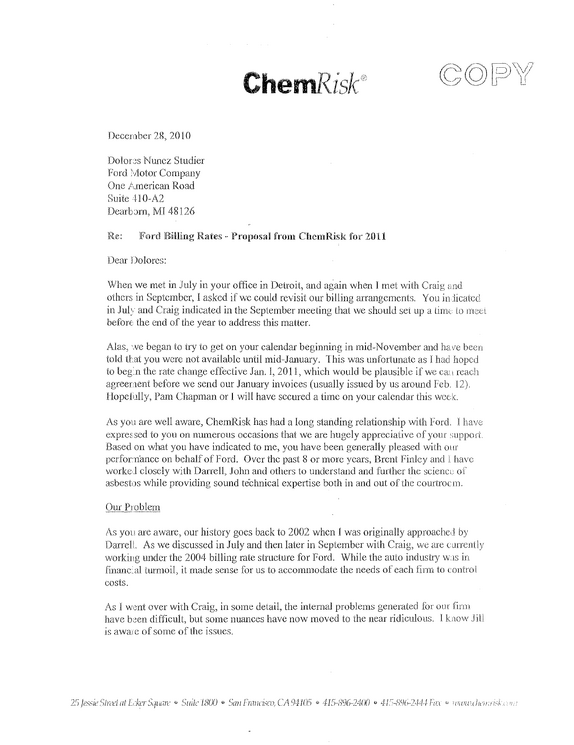
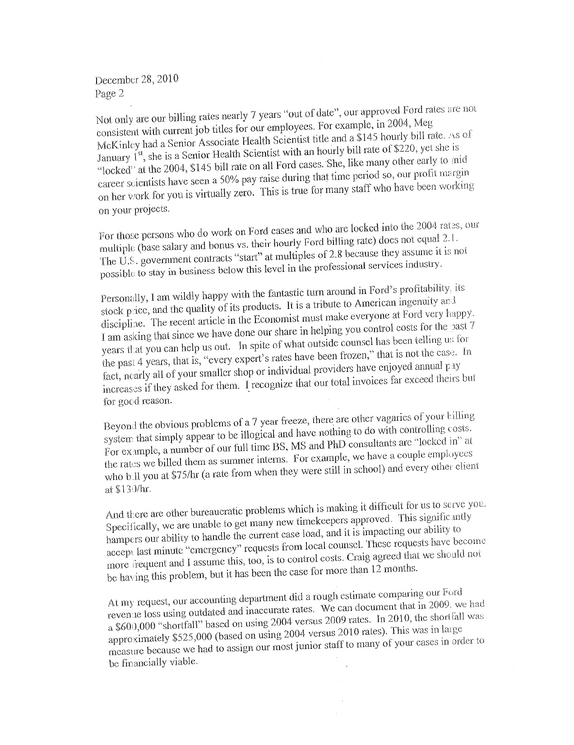
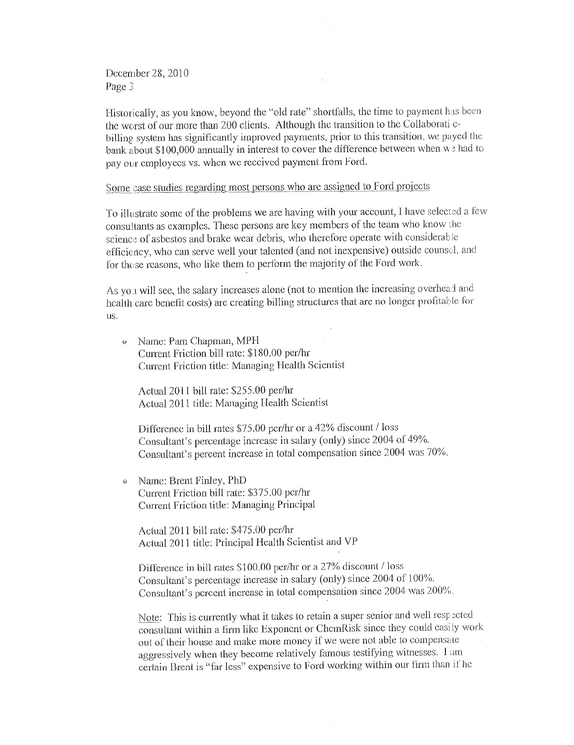
FILE NAME: Ford (FD) DATE: 2010 Dec 28 DOC#: FD238 DOCUMENT DESCRIPTION: Letter to Ford from ChemRisk RE Ford Billing Rates ChemRisk'" IT December 28, 2010 Dolores Nunez Studier Ford Motor Company One American Road Suite 410-A2 Dearborn, M I 48126 Re: Ford Rilling Rates - Proposal from C hem R isk for 2011 Dear Dolores: When we met in July in your office in Detroit, and again when I met with Craig and others in September, I asked if we could revisit our billing arrangements.
refid# vVaOpqL11jgLegOdpdmZEEM8634 pages
FILE NAME: Talc (TALC) DATE: 2014 DOC#: TALC118 DOCUMENT DESCRIPTION: Journal Article - Asbestos Commercial Cosmetic Talcum Powder as a Cause of Mesothelioma in Women Asbestos in commercial cosmetic talcum powder as a cause of mesothelioma in women Ronald E.
refid# 1vwj1b69mJXvKkznbxBGEa1m16 pages