Personal protective equipment Reliance may at times be placed on personal protective equipment Items of personal protective equipment, such as respirators, can minimize the expo sure for the workman --but they are generally satisfactory only for intermittent or emergency use They are a last line of defense Other means should be employed for health pro tection around harmful processes that are earned on routinely and continuously Respiratory protective equipment should not be relied on too strongly for several reasons the proper type may not be provided, the employee may not wear it, respirators may not be properly cleaned and serviced, facepiece fit may be poor, permitting un filtered air to be breathed, and chemical cartndge respirators or gas masks may be worn without regard to the real danger--oxy gen deficiency Scrupulously avoid these pitfalls m order to be sure that respirators will give adequate protection on intermittent or emergency jobs Selection, use, and care of respirators are discussed m Respiratory Protective Devtces Manual of the American Industrial Hygiene Association Exhaust ventilation may be a necessity where the other control techniques are impracticable Role of the safety professional The purpose of this and the next chapter of the Manual is not to make a ventilating en gineer out of the safety professional, but to place before him the basic principles of air flow so he can better understand how to use ventilation more effectively Since the prune purpose of local exhaust ventilation is the protection of health, he has a vital interest in it In a plant that employs an industrial hy gienist, chemical engineer, and fire protec tion engineer, the safety engineer's interest in ventilation is at a minimum Industrial hygienists have led m developing the art of design of exhaust ventilation for the control of plant air contaminants They have per fected instruments and analytical procedures for air sampling to leam the nature of the air contaminant and to see if it is under control The safety professional is relieved of responsi bility m these areas if an industrial hygienist is at hand But most plants, especially those of medium or small size, do not employ an industrial hygienist, chemical engineer, or fire protec tion engineer, although they may have a parttime or full-time safety professional Of necessity, these persons must acquire some understanding of potential hazards to per sonnel, to plant property, and to the com munity that may result from release of haz ardous air contaminants In the absence of other plant specialists, professional advice can be obtained from several sources The safety professional may often get good advice from the work men's compensation insurance carrier or fire insurance earner for the plant Advice may be obtained through the state or local depart ment of health or the state department of labor, one or the other of which in most states maintains an industrial hygiene service and a fire prevention bureau If his unit is part of a multiplant corporation, the safety professional should consult with his home office The supplier of materials that are suspected of being toxic can be con sulted Professional services can be secured by employing a pnvate consultant who is a specialist in industrial hygiene, ventilation, toxicology, or fire prevention Regardless of whether the plant is large or small, exhaust systems would normally be designed by or under supervision of the plant engineer But because they are in stalled for protection of health or prevention of fire and are usually not part of the produc tion equipment or power systems of the plant, the plant engineer may not take full responsi bility for their satisfactory performance On the other hand, the safety engineer, who does have an interest in a safe workplace, is generally unfamiliar with the engineering principles of exhaust systems Consequendy, m the absence of an industrial hygienist, neither the plant engineer nor the safety engineer pays much attention to such venti lating systems Therefore, m the absence of an industrial hygiene engineer, the safety professional can make a real contribution to health and safety by familiarizing himself with ventilation fundamentals With this Manual as a guide, and with such assistance as he needs from the industrial hygiene profession secured from 853
refid# 6wXD70jw6w8JD984epMVwD7bo1 page
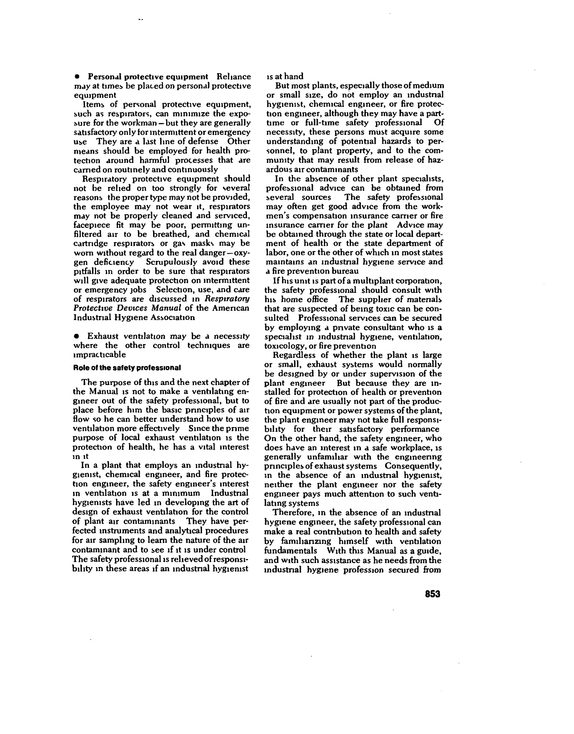
Fig 33-1 -- Expanded metal cover, guard rails, and substantial gate guard this equipment Arrange ment encourages easy maintenance conductors is reduced to a minimum When an interlock is used as a safety de vice, it should be fail-safe, that is, steps must be taken to assure that failure of this device will not jeopardize the safety of personnel depending upon it Interlocks selected should meet the following standards 1 Fail-safe features Failure of the inter lock mechanism.
refid# QXewkLzRe9dp0wq5QGMOjoppv1 page
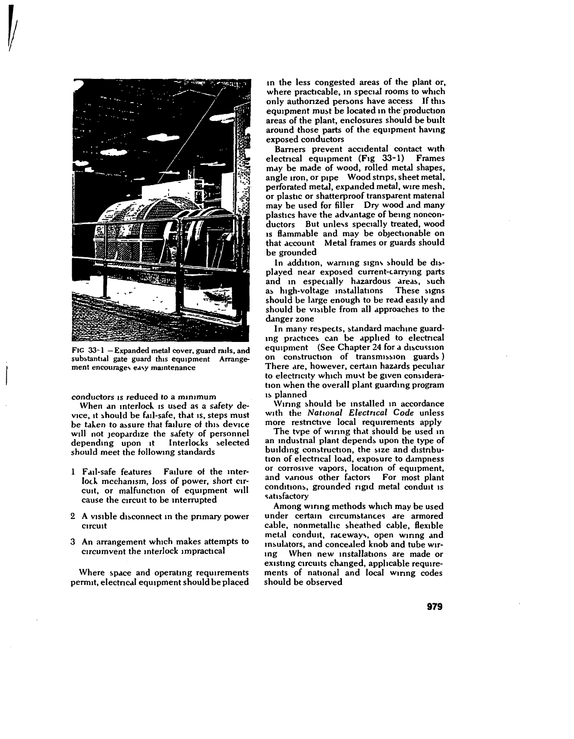
Electrical Hazards The receiver slots are arranged to prevent reversal of polarity if the grounding plug is moved from one side of the duplex receptacle to the other Each opening is different in size or shape to prevent accidental misalign ment of either the polanzed or standard blades Misalignment could energize the grounding equipment so that the current would enter the frame of the tool For complete continuity of the ground cir cuit, three-conductor extension cables with properly attached polanzed plugs and recep tacles should be available These extensions can then be used to continue the ground path when tool cables are too short to reach the grounding receptacle Fig 33-5 --Standard receptacle and plug recom mended by the National Electrical Manufacturers Association The receptacle is designed to receive a plug having three blades --a U-shaped or round grounding blade with two standard parallel polar ized blades This type of fixture also permits use of the nonpolarized standard plug receptacles The workman neglected to attach the ground wire of his adapter and, when the tool case became charged, he was electrocuted Since an early lack of standardization in the design of plugs and receptacles and m their application led to confusion, ASI Standard C73, Dimensions of Caps, Plugs, and Recep tacles, was set up This standard specifies that a receptacle similar in size and shape to the ordinary two-hole type be designed to re ceive a plug having three blades, a U-shaped or round grounding blade and two standard parallel polarizing blades (Fig 33-5) A receptacle of this type will permit use of the polarized or nonpolarized standard plug for such tools as soldering irons, timers, test ing equipment, and others that do not require grounding 988 Maintenance of grounds.
refid# 2RrqnJ4rzXLvEq3KR116zQb0L1 page
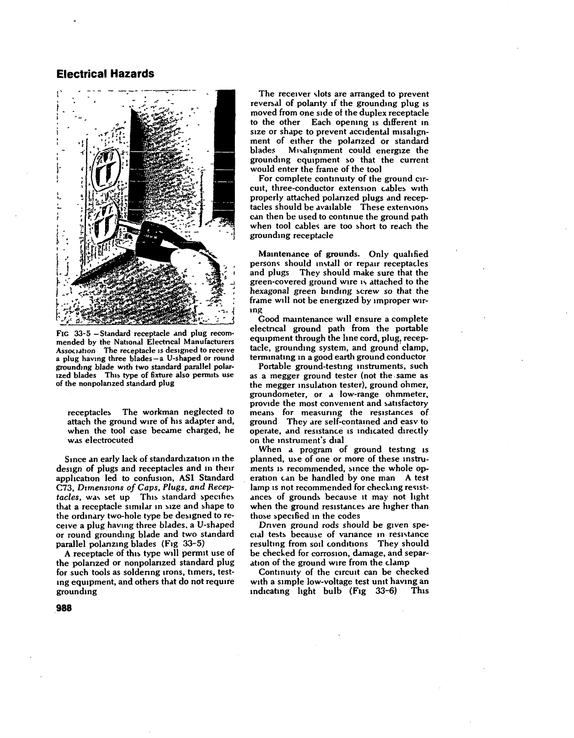
FlC 35-4 --Noncombustible building with low-hazard metal working occupancy Courtesy National Ftre Protection Assn This type building dominates in congested areas of large cities Its occupancy should be limited to light or moderate hazards, use of highly combustible interior finishes should be minimized Even when sheathed, ordinary construc tion (unlike fire-resistive or noncombustible constiuction) still has combustible materials tn concealed wall and ceiling spaces Fire frequently originates in these concealed spaces or enters into them through openings and then spreads rapidly throughout the en tire building, unless the budding is safe guarded by fire-stopping or other means Wood frame construction consists primarily of wood exterioi walls, partitions, floors, and roofs (Fig 35-5) Extenor walls mav be sheathed with brick veneer, stucco, or metalclad, cement-asbestos, or asphalt siding Although generally inferior to other types of construction from a fire safety standpoint.
refid# pmBgLM95oRGapE9p3e2ODD4EE1 page
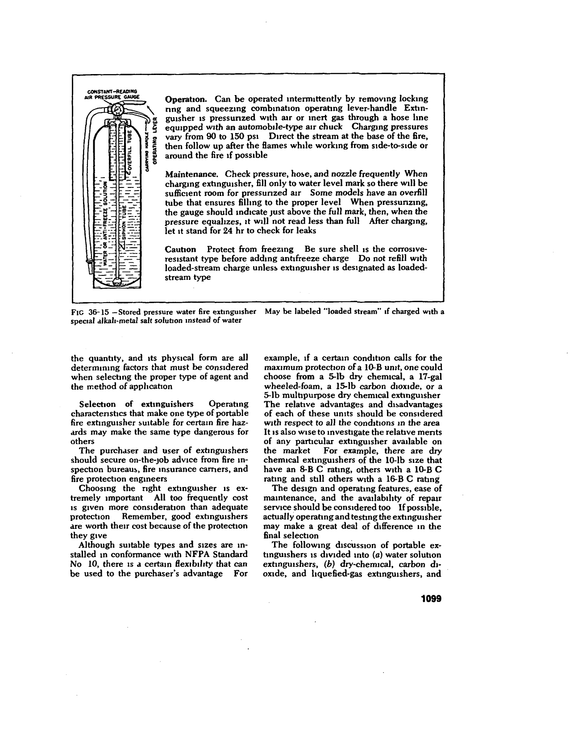
CONSTANT--READ1N8_ Operation.
refid# NNpN68BL1jv2ejMqoELqQ27ap1 page
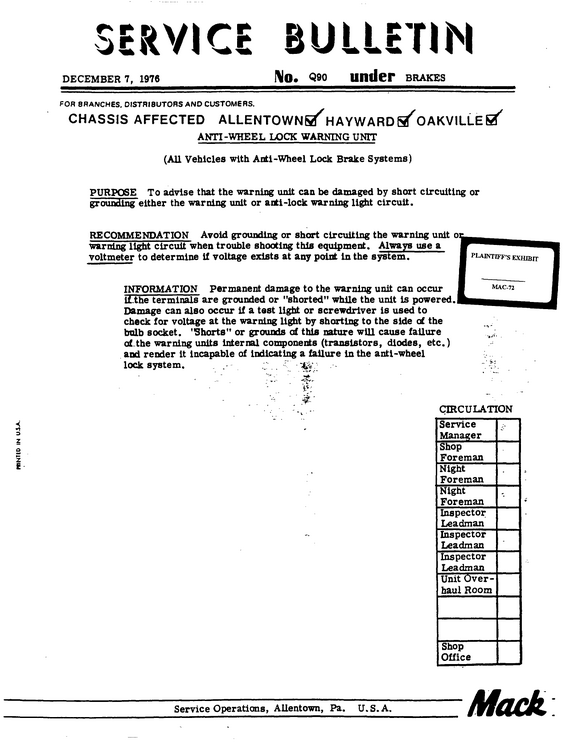
BULLETIN DECEMBER 7, 1976 No.
refid# EvELd2qRp9GyDzRzaD2b3bYVn1 page
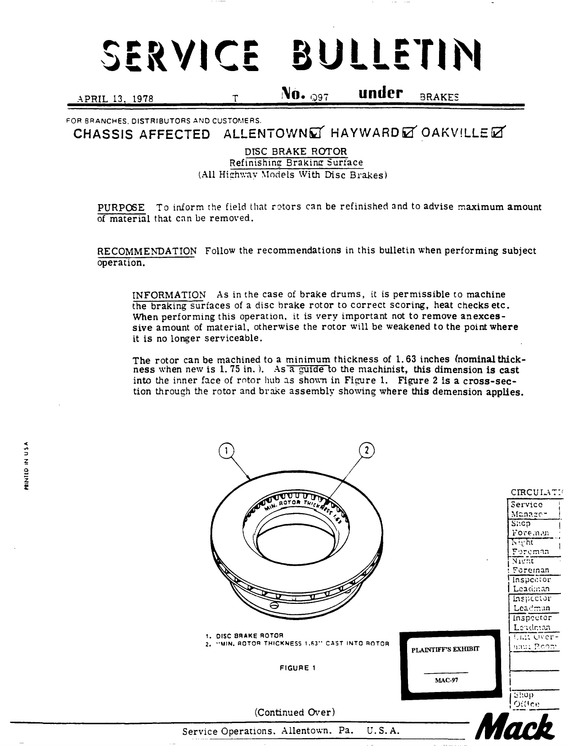
'j ERVICE BULLETIN APRIL 13. 1978 T \o.
refid# aDBD8EDN19JvVknaJbRN2D7Bb1 page
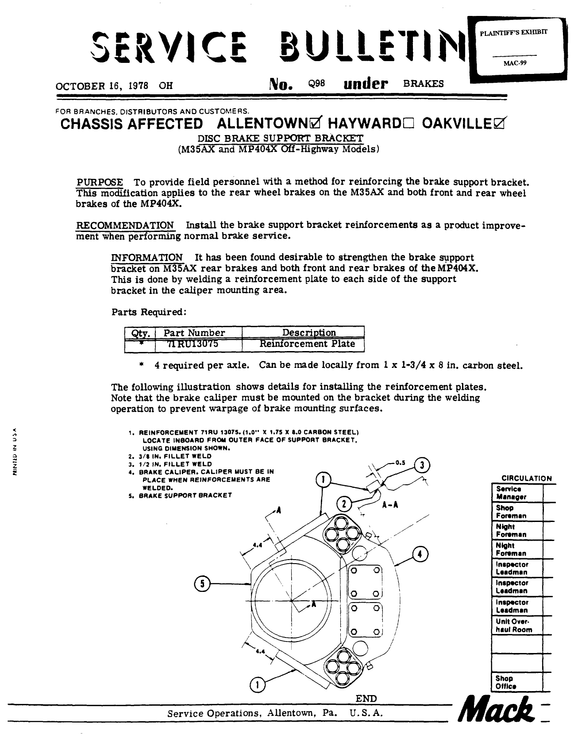
SERVICE OCTOBER 16, 1978 OH FOR BRANCHES.
refid# aD4RvyDznd9rRKq3qBxzOw4VX1 page
Personal Protective Equipment In the selection of a belt for general in dustrial use, the job requirements must be considered and matched against the types of belts available If the only purpose of the belt is to stop a workman in case of a fall, then a waist belt with a single D-ring may be satisfactory This single D-nng may be at tached for positioning at any point on the belt, for the belt can be turned to dilferent positions after being buckled on the wearer Where possible, safety harness and chestwaist belts are preferable because they do a better job of absorbing impact and keeping a man upright m case of a fall If a belt is to furnish support to a man while he is working, it should have adequate means for such support A belt for a man who will lean back in it as he works on a sloping roof or hillside should have two D-nngs, one on each side of his belt, (Fig 38-40), to which a throw rope or lanyard can be attached and connected to a suitable anchorage If the belt is to be used much for support ing the entire weight of a man vertically while he works, as m raising or lowering him along the wall of a building, a boatswain's suspension harness may be used In this tvpe of belt, one strap is used as a seat, sometimes with a board to make it more comfortable Leg straps and a strap around the man's waist prevent him from falling out of the seat An industrial belt used to hoist a man out of a tank is usually subjected only to a static load Such a belt should be of either the shoulder harness, chest-waist, or parachute type with the D-nng so placed as to hold a man in a relatively erect position In a window cleaner's belt, separate ropes should be used for the service and safety lines (Fig 38-38) The service rope, which supports the man while he works, must be shorter than the safety rope so that the former will be taut and the safety rope slack Thus, all wear will be placed upon the service rope, and the safety rope will retain its full strength for use in stopping a fall The safety rope should contain a shock absorber which will reduce the loading in the event of a fall, thus relieving strain on the building anchor, waist belt, and man There should be a device m the belt to re lease the service rope in case of a fall and bring into play the shock-absorbing safety rope Belt care Dirt adhering to leather safety belts should be brushed off carefully so as not to scratch the leather The belt should then be washed with warm water and either saddle soap or castile soap After a rinse in clean warm water, it should be dned at room temperature Before becoming completely dry, a leather belt should be oiled with neatsfoot, castor, soy bean, or a compound oil, never a mineral oil A leather belt which has been unused and not oiled for a year or two is much weaker than one which has been regularly used and also adequately oiled over the same period, although the unused belt will look newer and stronger Leather belts should not be exposed to ex cessive heat, such as from a radiator, because they may be permanently damaged by a tem perature as low as 150 F Any heat painful to a man will damage leather Cotton or linen webbing belts should be washed in soapy water, nnsed, and dned by moderate heat They are not damaged by temperatures up to 212 F If a belt is to be subjected to unusual conditions of use the manufacturer should be consulted as to its care Synthetic fiber belts should not be exposed to excessive heat that might soften or melt the fibers, or to chemicals that might affect the composition of the fiber Inspection and testing Wearers of life belts should inspect them before each use (Fig 38-39) At least every one to three months they should be examined by a trained inspector Leather belts espe cially must be watched for cuts or scratches on either side of the strap A deep cut of any considerable length, crosswise to the belt, warrants discard However, cuts running lengthwise do not seriously affect strength Fabric belts should not be used if consid erable portions of the outer fibers are cut or wom through Belt hardware should be examined and wom parts replaced Each belt rivet should be examined to be certain that it is secure No nvet should be used m a web belt which may be subjected to impact loading Safety belts m service should not be tested Any service test to prove whether the belt 1188
refid# XRKp1497q0q6rXnkmKxxzE4jR1 page
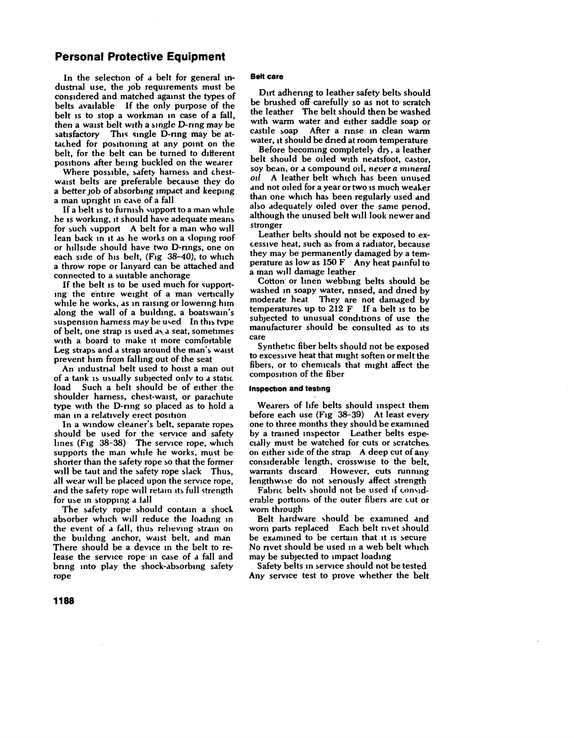
could take the maximum impact loading which might be required of it would very likely so damage the belt as to render it un safe for use Therefore, only sample belts and wom or doubtful belts should be tested, and these should always be tested to destruc tion to determine their safety They should be kept as samples and used only to help judge the safety of other belts In judging the safety of a belt, the following vital, and to some extent conflicting, factors must be considered 1 Sufficient strength to stop the wearer after a maximum free fall 2 A shock absorber to limit the impact load ing and prevent injury to the wearer or failure of the anchorage, life line, or belt 3 Short enough stopping distance to prevent the wearer from striking some dangerous obstruction before he stops 4 Sufficient margin on all these factors, so far as possible, to cover all unknowns such as weight of the wearer, distance of his fall, his physical fitness, the distance to any damaging obstruction, variations in the strength or elasticity of materials, and deterioration of matenals due to wear or other causes The primary caution regarding the use of safety belts, as with other personal protective equipment, is to see that they are wom and used correctly Since a safety belt is worth less unless it is being wom at the time that a fall is possible It should also be securely buckled and wom tight enough to prevent any possibility of the man's slipping out of it Lifelines For most lifelines, manila rope of 3I, in diameter or nylon rope of 'I, in diameter is recommended Nylon is more resistant to wear or abrasion than is manila and is also more resistant to some chemicals Ropes made of other synthetic fibers such as Dacron, polyethylene, and polypropylene have char acteristics that make them very good per formers in certain applications In a lifeline where shock loading strength and high energy absorption is paramount, nylon is superior Knots reduce the strength of all ropes Re- FlC 38-40 -- Multipurpose safety belt with two D-nngs can be wom about the waist or slipped down around the buttocks for work on inclines cent tests have shown that manila lifelines of V2 m diameter, when knotted around a bar or other anchorage, are not strong enough at the knots to be safe for general use unless a shock absorber of low load limit is used How much a knot reduces strength depends upon the type of knot or hitch used and the amount of moisture in the rope Moisture increases the strength of a rope in a knot or around a sharp bend, and dryness greatly diminishes its strength at such points In some cases, a knot will reduce the tensile strength of a rope to less than halfof its break ing strength If rope is spliced into snaps and D-nngs instead of knotted (Fig 38-40), the splice will retain approximately 90 per cent of the break ing strength of the rope Breaking strength is always measured in a straight line pull on the rope Manila rope of '/.
refid# zzd8bmJ0v4ajb4eYZQp6vgOyz1 page
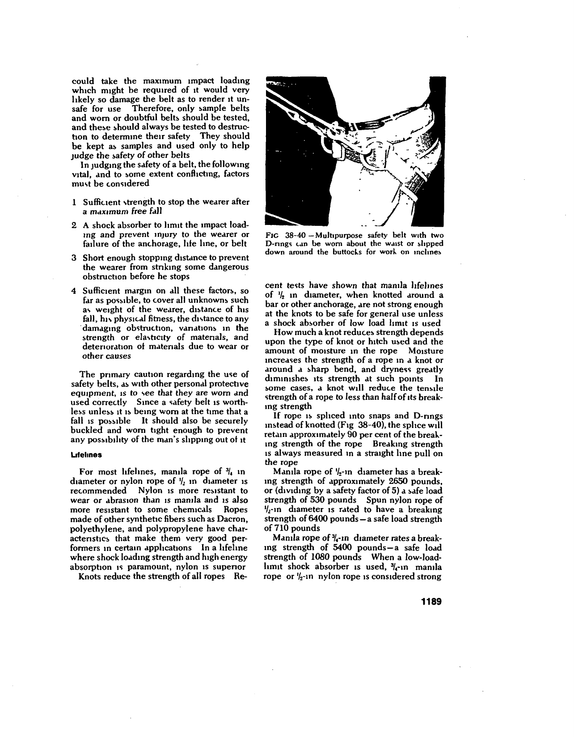
zations make examinations and record the findings, particularly where operations in volve definite exposure to health hazardous substances, such as lead, benzene (benzol), silica, and asbestos dust, or to harmful noise Laboratory tests Minimum urine and blood tests are inexpensive and a good in vestment in detecting liver and kidney dis ease, diabetes, anemia, etc Where there is to be an exposure to toxic substances, ap propriate laboratory tests may be indispen sable Chest X ray.
refid# 4QJ9D2oMkJvv56NXrmVamdgwx1 page
anism of women dunng pregnancy, pregnant women might be adversely affected by ex posure to concentrations of toxic substances which would otherwise be safe Chemical substances, such as carbon monoxide, chloro form, phosphorus, and mercury, and ionizing radiations which pass through the placenta, may produce harmful effects on the fetus and lead to abortion Pregnancy limits the ability of women to do physical work, since a pregnant woman tires more readily, has poorer balance, may be adversely affected by industrial poisons, and is unable to respond normally to the physiological demands of strenuous physical work Placement ot women State and Federal laws and regulations governing employment of women m industry should be studied carefully before female employees are placed, and should be rechecked before women are transferred to other types of work or are placed on dif ferent shifts Seating, night work, home work, wages, hours, age, and lifting or carry ing heavy weights are some of the items reg ulated The examining physician, at the time of employment, should furnish enough infor mation to help place the applicant most ad vantageously from the standpoint of her health and safety Periodic examinations and medical histones have indicated that properly trained women are capable of performing safely most types of work except those in volving heavy muscular strain --women gen erally have one third the muscular strength of men Methods for the prevention of mdustna!
refid# 0po6aqkwkZbqdokroaEk437J1 page
Industrial Hygiene mg instruments may be affected by improper maintenance, component unreliability, lack of calibration, poisoning of the catalysts by interfering substances m the atmosphere, changes m airflow rates and volumes, and weak batteries For these reasons, a routine schedule of maintenance and calibration is necessary The colorimetric tubes and papers present a somewhat different problem They are de ceptively simple to operate Air is usually drawn through the tube with a squeeze bulb so this means no motor to fail or battery to replace However, there have been and still are variations from one tube to another due to manufacturing conditions which have not been controlled Practically all tubes have been improved as experience has been gained by users and makers, and some tubes have been withdrawn from production One form of variability which has been troublesome, but is obvious to the user, is that produced by nonuniformity in particle size of the media (usually silica gel) which supports the reacting chemical The result in some tubes is that in transportation the gel fractionates into various sizes by gravity and the line between stain and no stain is not sharp but stretches irregularly across the tube and may extend much further up one side than the other, thus making it impossible to obtain an accurate reading The tubes also vary considerably m their degree of chemical stability, although their useful storage life can often be prolonged considerably bv storage in the refrigerator The purchaser may not know how long the tubes have been on the supplier's shelf and what have been the storage conditions, un less the manufacturer puts an expiration date on the tubes.
refid# Y9MKxrqnMa1VxvbeD7X1NRRoO1 page
Lead, when taken into the body, may be deposited in the bones When the intake of lead stops, the stored portion is excreted until it is virtually eliminated from the system In chronic poisoning the excretion rate usually rises until it balances the absorption rate In the case of lead poisoning, biochemical tests performed on the body fluids would indicate the amount that is being circulated in the blood, excreted in the unne, or stored in the bones if an autopsy was made An important difference between inhalation as route of entry and ingestion or skin absorp tion is that through inhalation the material enters the arterial blood directly, whereas with ingestion or skin absorption the material enters the venous blood and is earned through the nght portion of the heart where it is then diluted by the entire venous system and passed through the lungs and then pumped by the left portions of the heart to the brain and other organs Reactive gases and vapors are altered with in the body and are eliminated to a large ex tent in forms other than those in which they are absorbed The toxicological action may be exerted either by the substance in its ongmal form or by its detoxification products Nonreactive gases and vapors are not al tered to any appreciable extent m the body and are eliminated in the same chemical form m which they are absorbed The aliphatic hydrocarbons, such as propane and heptane, are examples of that type Mode of action Industrial poisoning may be classified as one of three types acute, subacute, or chronic The classification is based on the rate of in take of harmful materials, rate of onset of symptoms, and the duration of symptoms Typically, acute poisoning is character ized by rapid absorption of the offending ma terial and the exposure is sudden and severe For example, inhaling high levels of carbon monoxide or swallowing a large quantity of cyanide compound will produce acute poi soning The death or survival of a victim through the critical period occurs suddenly Generally, acute poisoning results from a single dose which is rapidly absorbed and damages one or more of the vital physiologi cal processes The development of cancer long after recovery from acute radiation dam age is called a delayed acute effect Frequently repeated and extended ex posures, over a period of several hours or days, results in subacute effects, depending on the dose rate Chronic poisoning is concerned with the continued absorption over a long period of time of a harmful material in small doses, each dose, if taken alone, would barely be effective Chronic poisoning is character ized by the harmful materials remaining m the tissues, continually injuring some body process The rate of intake exceeds the rate of excretion or detoxification, thus chronic poisoning can also be produced by exposure to a harmful material which produces irrevers ible damage, so the injury accumulates, rather than the poison The symptoms in chronic poisoning are usually different than those seen in acute poisoning by the same toxic agent It is readily apparent that not all individuals react m the same manner to the same amount of a harmful material According to Stokmger (see "References"), "The atypical, or idiosyncratic, response to chemicals has al ways been a cause for unusual concern in those responsible for the control of hazard ous exposures to individuals " Predictive tests can be used in pre-employment place ment examinations to screen out the hypersusceptible individuals against future in jurious exposure to the company's products Type of harmful effects Narcosis, lmtation of the respiratory tract, and asphyxiation characterize the acute effect produced upon exposure to toxic gases, vapors, and fumes All organic solvents, upon extended high level exposures, are capable of producing a gradual conbnuous paralysis of the central nervous system, which is expressed m loss of consciousness, or vol untary movements Death may result from respiratory failure Many symptoms of narcosis and asphyxia tion are quite similar in that the primary effect m each is to impair the functioning of the brain--in narcosis by direct action and in asphyxiation by denying the brain sufficient oxygen Mild exposure to chemical agents producing asphyxiation and narcosis are 1303
refid# aJMvoNBQNDmMj322o9j1kO6m91 page
even if no treatment is given, including those which require use of an approved canister type gas mask This degree should include Matenals which under fire conditions would give off irritating combustion products, Matenals which on the skin could cause lrntation without destruction of tissue Q Materials which on exposure under fire conditions would offer no hazard beyond that of ordinary combustible matenal NFPA flammability hazards deal with the degree of susceptibility of matenals to burn ing, even though some matenals that bum under one set of conditions will not bum under others The form or condition of ma tenal, as well as its properties, affects the hazard The degrees of hazard are ranked according to the susceptibility of matenals to burning, as follows ^ Matenals which will rapidly or com pletely vaponze at atmosphenc pressure and normal ambient temperature or which are readily dispersed in air, and which will bum readily This degree should include Gaseous materials.
refid# VMpOvYgazx1YgBvZ7mQLKZVK1 page