Chemical Section maintenance.
refid# ymE6edDd6EK5Q4EZp8KB2OdN21 page
First Edition 1946 Second Edition 1951 Third Edition 1955 Fourth Edition 1959 Fifth Edition 1964 Sixth Edition, Third printing, 1973 Copyright 1969 National Safety Council All Rights Reserved No portion of this book mav be reproduced bv anv process without written permission of the National Safety Council, 425 North Michigan Ave , Chicago, 111 60611 International Standard Book Number 0-87912-023-1 Library of Congress Catalog'Card Number 74-76751 Printed in the United States of America 8M107308 Stock No 12136
refid# bVQJZBweJ9v7EBwQ3a9jqJED1 page
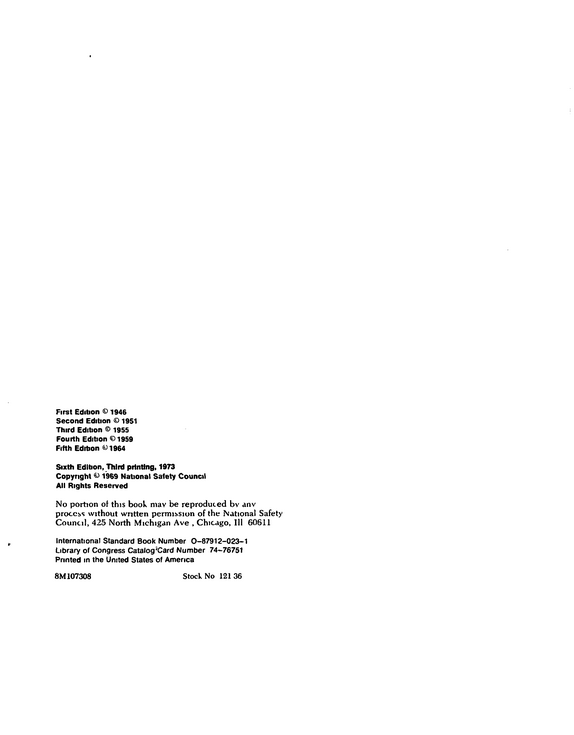
Industrial Safety The elimination of accidents is vital to the public interest Accidents produce economic and social loss, impair individual and group productivity, cause inefficiency and retard the advancement of standards of living Philosophy of Industrial Accident Prevention accidents and injuries m this relatively short period of time has exceeded the highest ex pectations of the early safety pioneers In less than one lifetime, safety has become a vital part of industry Expenence has shown that there is no There is no question that accidents are costly to industry and society Today, failure to try to prevent injuries to employees is indefensible The practical and moral aspects of accident prevention are inter-related because accidents result both in a waste of manpower and re sources, and m physical and mental anguish In Medieval days, the master craftsman probably tried to instruct his apprentices and journeymen to work skillfully and safely, be cause he could see the value of high quality and uninterrupted production But it took the Industrial Revolution to create the condi tions which led to the development of acci dent prevention as a specialized field The industrial safety philosophy was de veloped as a result of the tremendous forces of production which were released Without a deterrent to counter this waste of manpower and resources, the number of accidents and injuries would have challenged the imagina tion Although the changes m social responsi bility change more slowly than technology, enlightened industrial management had ac cepted the responsibility for preventing acci dents by the first decade of the 20th Century By 1910, the National Association of Manu facturers was studying the experience ofwork men's compensation laws in Europe This "new" line of thinking held the employer re sponsible for a share of the economic loss suffered by the employee because of an ac cident It was a rather short step from this to the realization that a large proportion of accidents could be prevented and that the same in dustrial brain power that could produce vast quantities of goods could also be used for ac cident prevention Industry soon discovered that production and safety were related From this beginning grew the safety move ment as it is known today The progress in reducing the number of FlC 1-1 --Give the man a cigar or (in summer) a fly swatter1 This 1913 display used by the Joliet Works of Illinois Steel Company, the first plant to organize a safety committee, offers a vanetv of safety incentives watch fobs, paper weights, cigars, and a calendar hazard or operation which cannot be over come by practical safety measures The future may introduce a type of unavoidable accident, but history indicates that all barriers can and will be surmounted In summary, here are the reasons for the Excerpt from National Safety Council policy This chapter was revised by R G Belknap, based upon reviews by selected members of the National Safety Council 2
refid# G5LKNNVJYm52raOgwL1wwJ36q1 page
Industrial Safety TREND OF ACCIDENTAL WORK DEATHS HAS BEEN DOWN In discussing safety in industrial operations, I have often heard it stated that the cost of adequate health and safety measures would be prohibitive and that `we can't afford it ' "My answer to that is quite simple and quite direct It is this 'If we can't afford safety, we can't afford to be tn business A by-product of organized safety activity has been increased interest in safety engi neering on the part of schools of higher learn ing A number of schools now offer advanced courses in this subject, and are contributing to a higher standard of knowledge among professionals in the field (See Chapter 14 ) The World War II labor shortage dramat ically brought home to management the mag nitude and seriousness of the problem of off-the-job accidents to industrial employees Interest in off-the-job safety has been heightened in recent years by the passage of numerous state laws on compulsory insurance which, in effect, make the employer finan cially responsible for all illnesses and injuries to workers, whether they originate on or off the job Today, an increasing number of em ployers are including off-the-job safety in their overall safety program From the earliest days of industrial safety work, it has never been possible to make a dear separation between health and accident hazards Is dermatitis an accident or a dis ease'1 What about hernias and heart trouble?
refid# N5ZpjoejR2jxw53QXZVqMqQy1 page
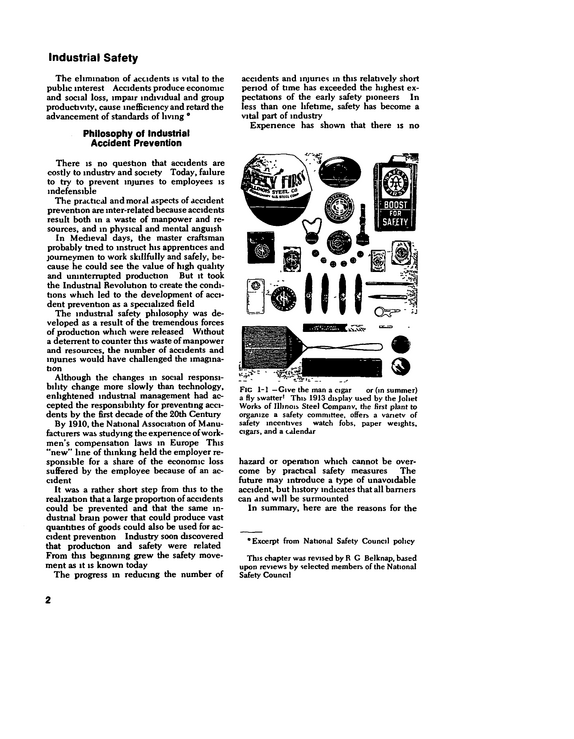
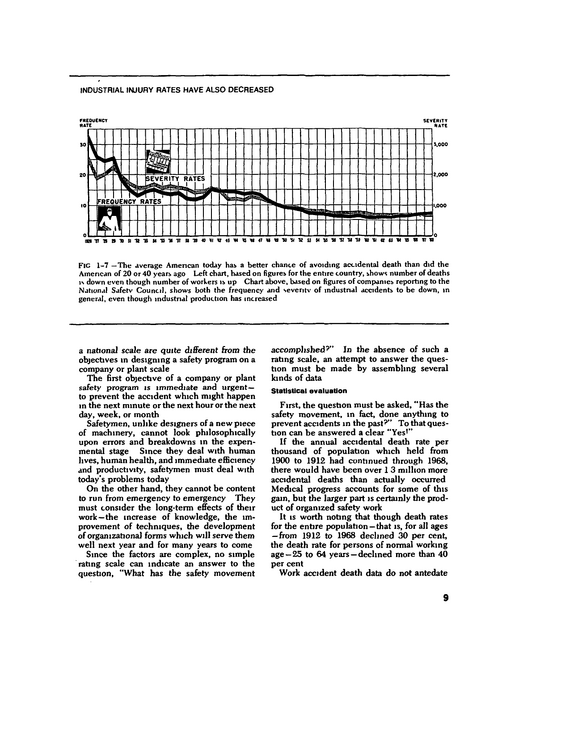
INDUSTRIAL INJURY RATES HAVE ALSO DECREASED FREQUENCY rate SEVERITY rate Fig 1-7 --The average American today has a better chance of avoiding accidental death than did the American of 20 or 40 years ago Left chart, hased on figures for the entire country, shows number of deaths is down even though number of workers is up Chart above, based on figures of companies reporting to the National Safetv Council, shows both the frequency and seventv of industrial accidents to be down, in general, even though industnal production has increased a national scale are quite different from the objectives in designing a safety program on a company or plant scale The first objective of a company or plant safety program is immediate and urgent-- to prevent the accident which might happen in the next minute or the next hour or the next day, week, or month Safetymen, unlike designers of a new piece of machinery, cannot look philosophically upon errors and breakdowns in the experi mental stage Since they deal with human lives, human health, and immediate efficiency and productivity, safetymen must deal with today's problems today On the other hand, they cannot be content to run from emergency to emergency They must consider the long-term effects of their work--the increase of knowledge, the im provement of techniques, the development of organizational forms which will serve them well next year and for many years to come Since the factors are complex, no simple rating scale can indicate an answer to the question, "What has the safety movement accomplished?"
refid# Xz4bdL77EzQ1O777v4m14xnNJ1 page
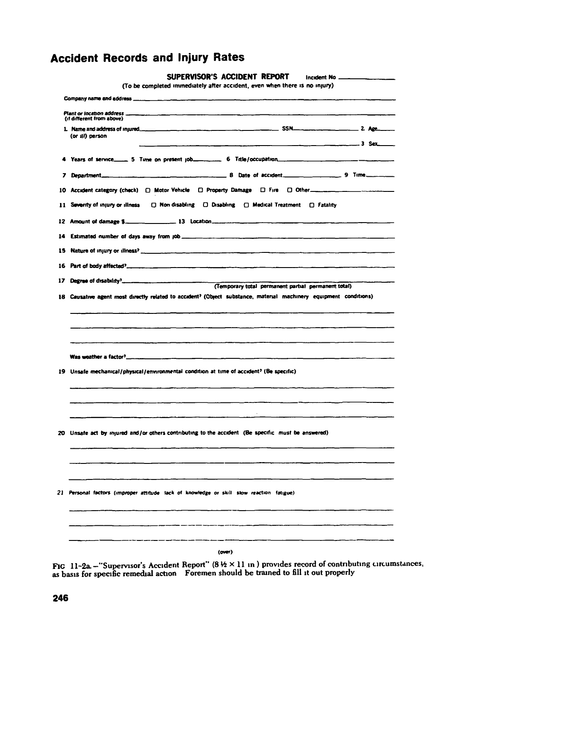
Accident Records and Injury Rates SUPERVISOR'S ACCIDENT REPORT modem No______________ (To be completed immediately after accident, even when there is no injury) Company name and address____ -- - - ----- -- Plant or location address (if different from above) - L Name and address of injuredSSN------------------------------------ Z Age.
refid# pmxgN0DB9bZGoDOem32z8y4bj1 page
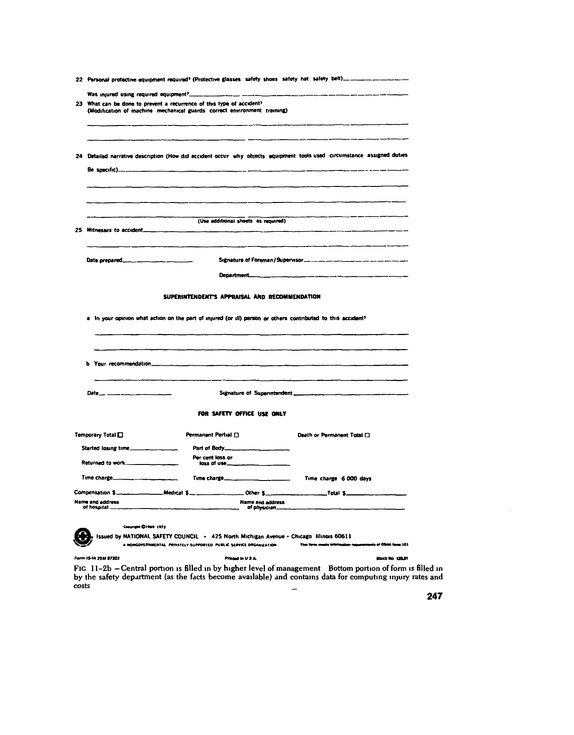
22 Personal protective equipment required7 (Protective glasses safety shoes safety hat safety belt).
refid# Jrd7qKbQnZ2qxp88xZ5L4qbwZ1 page
Accident Records and Injury Rates of materials on bulletin boards is one of the best ways to maintain the interest of employ ees in safety Accident records furnish many items, such as the following No-injury records Unusual accidents Charts showing reductions in acci dents Simple tables comparing depart mental records Standings in contests Frequent causes of accidents Reports to National Safety Council.
refid# ZJ7D4bYayoJe8QDDKOaX7JEn71 page
Walls and other surfaces should conserve light, while avoiding annoying reflections If offices depend largely on daylight, em ployees engaged in the visual tasks should be located near windows North light is pre ferred by draftsmen and artists Window ventilation is often unsatisfactory compared with comfort ("air") conditioning Persons near windows may feel cold, those farther away may be warm Where there are large interior spaces, forced ventilation is needed, usually, if the space is to be used for office purposes All mechanical ventilation and air con ditioning systems require careful planning and installation by experts Private offices, installed around the outer walls of a large office space should not cut off light and ven tilation from the other employees Fans in offices should be placed where they cannot fall on anybody and they probably should be secured in place Adequate ventilation should be supplied for duplicating machines, particularly spirit duplicating machines, or others that use ammonia, methanol, or other toxic liquids Concentrations of methanol around poorly ventilated duplicating machines can reach 200-300 ppm If the duplicating processes are confined to a separate small room, this usually means that mechanical ventilation is necessary Noise in offices should be held to a maxi mum of 40 decibels at the speech interference levels That is, the average of the reading m the three octave bands between 600 and 4800 Hertz (Hz) (cycles per second) should be less than 40 dB Acually, it is desirable that the noise level not be louder than 35 to 40 decibels (dB) m any audible band (16 to 12,000 Hz) Sound-absorging materials should be used on ceilings even where normal noise is not excessive, and noisy machines should be segregated A level of 20 to 30 dB would be classed as a very quiet office, and this level is suitable for a confer ence room Electrical.
refid# VK0bQg5RyRbMqjmMXyw5xX3xp1 page
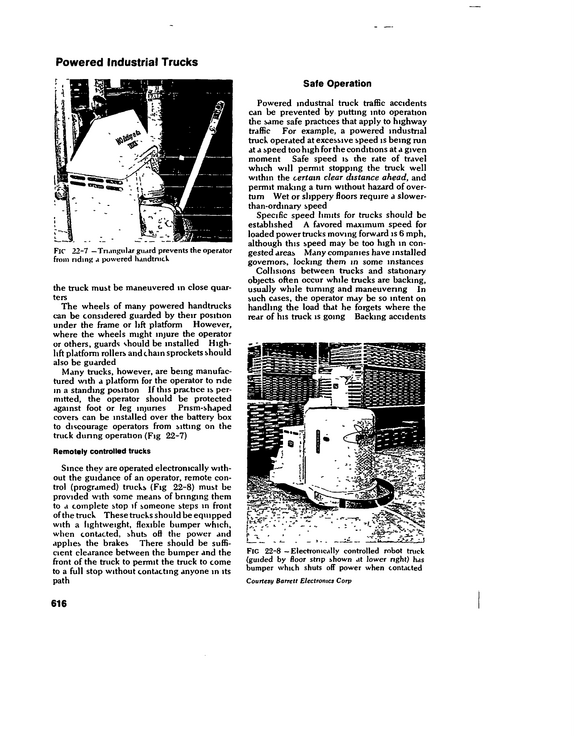
Powered Industrial Trucks Safe Operation FjC 22-7 --Triangular guard prevents the operator from riding a powered handtruck the truck must be maneuvered in close quar ters The wheels of many powered handtrucks can be considered guarded by their position under the frame or lift platform However, where the wheels might injure the operator or others, guards should be installed Highlift platform rollers and chain sprockets should also be guarded Many trucks, however, are being manufac tured with a platform for the operator to nde in a standing position If this practice is per mitted, the operator should be protected against foot or leg injuries Pnsm-shaped covers can be installed over the battery box to discourage operators from sitting on the truck during operation (Fig 22-7) Remotely controlled trucks Since they are operated electronically with out the guidance of an operator, remote con trol (programed) trucks (Fig 22-8) must be provided with some means of bringing them to a complete stop if someone steps m front of the truck These trucks should be equipped with a lightweight, flexible bumper which, when contacted, shuts off the power and applies the brakes There should be suffi cient clearance between the bumper and the front of the truck to permit the truck to come to a full stop without contacting anyone m its path Powered industrial truck traffic accidents can be prevented by putting into operation the same safe practices that apply to highway traffic For example, a powered industrial truck operated at excessive speed is being run at a speed too high for the conditions at a given moment Safe speed is the rate of travel which will permit stopping the truck well within the certain clear distance ahead, and permit making a turn without hazard of over turn Wet or slippery floors require a slowerthan-ordinary speed Specific speed limits for trucks should be established A favored maximum speed for loaded power trucks moving forward is 6 mph, although this speed may be too high in con gested areas Many companies have installed governors, locking them in some instances Collisions between trucks and stationary objects often occur while trucks are backing, usually while turning and maneuvering In such cases, the operator may be so intent on handling the load that he forgets where the rear of his truck is going Backing accidents Fig 22-8 --Electronically controlled robot tnick (guided by floor stnp shown at lower right) has bumper which shuts off power when contacted Courtesy Barrett Electronics Corp 616
refid# NEgeK7jj6MD936epo2X41kwDR1 page
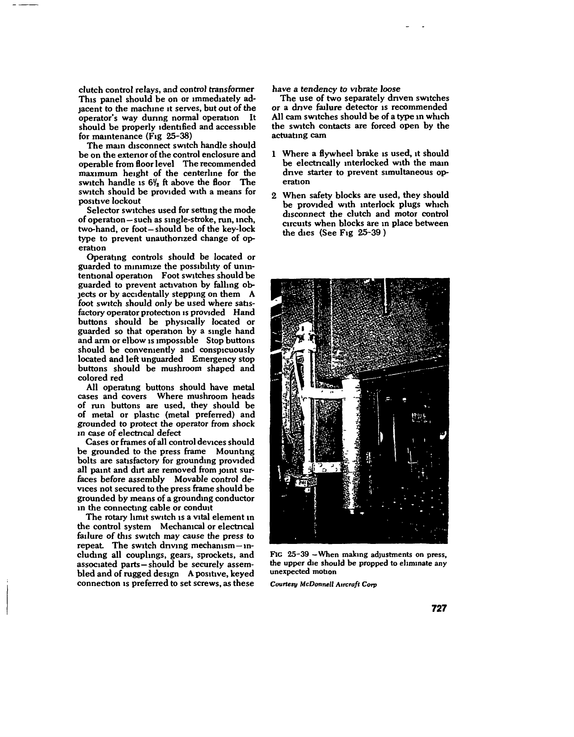
clutch control relays, and control transformer This panel should be on or immediately ad jacent to the machine it serves, but out of the operator's way during normal operation It should be properly identified and accessible for maintenance (Fig 25-38) The main disconnect switch handle should be on the extenor of the control enclosure and operable from floor level The recommended maximum height of the centerline for the switch handle is 6% ft above the floor The switch should be provided with a means for positive lockout Selector switches used for setting the mode of operation --such as single-stroke, run, inch, two-hand, or foot--should be of the key-lock type to prevent unauthonzed change of op eration Operating controls should be located or guarded to minimize the possibility of unin tentional operation Foot switches should be guarded to prevent activation by falling ob jects or by accidentally stepping on them A foot switch should only be used where satis factory operator protection is provided Hand buttons should be physically located or guarded so that operation by a single hand and arm or elbow is impossible Stop buttons should be conveniently and conspicuously located and left unguarded Emergency stop buttons should be mushroom shaped and colored red All operating buttons should have metal cases and covers Where mushroom heads of run buttons are used, they should be of metal or plastic (metal preferred) and grounded to protect the operator from shock m case of electrical defect Cases or frames of all control devices should be grounded to the press frame Mounting bolts are satisfactory for grounding provided all paint and dirt are removed from joint sur faces before assembly Movable control de vices not secured to the press frame should be grounded by means of a grounding conductor in the connecting cable or conduit The rotary limit switch is a vital element in the control system Mechanical or electrical failure of this switch may cause the press to repeat The switch driving mechanism--in cluding all couplings, gears, sprockets, and associated parts--should be securely assem bled and of rugged design A positive, keyed connection is preferred to set screws, as these have a tendency to vibrate loose The use of two separately driven switches or a drive failure detector is recommended All cam switches should be of a type in which the switch contacts are forced open by the actuating cam 1 Where a flywheel brake is used, it should be electrically interlocked with the mam drive starter to prevent simultaneous op eration 2 When safety blocks are used, they should be provided with interlock plugs which disconnect the clutch and motor control circuits when blocks are m place between the dies (See Fig 25-39 ) Fig 25-39 --When making adjustments on press, the upper die should be propped to eliminate any unexpected motion Courtesy McDonnell Aircraft Corp 727
refid# NNBw9zXGGmV3w1w6JwN2rD1eb1 page
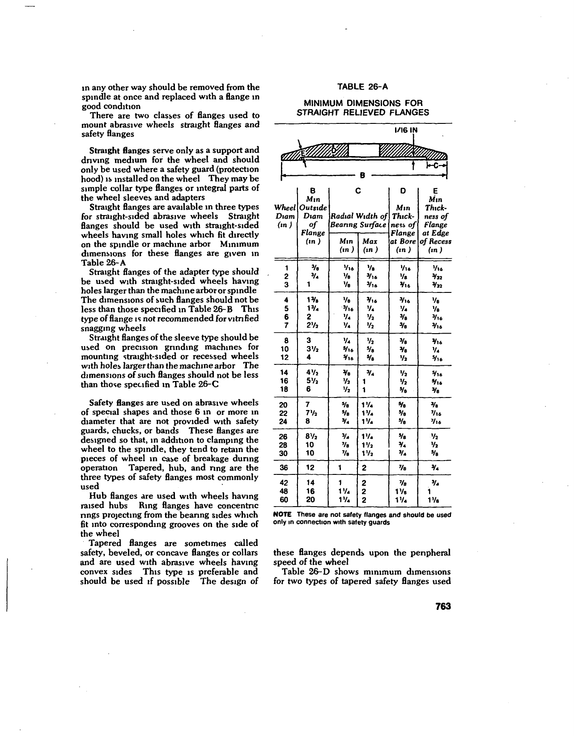
in any other way should be removed from the spindle at once and replaced with a flange in good condition There are two classes of flanges used to mount abrasive wheels straight flanges and safety flanges Straight flanges serve only as a support and driving medium for the wheel and should only be used where a safety guard (protection hood) is installed on the wheel They may be simple collar type flanges or integral parts of the wheel sleeves and adapters Straight flanges are available in three types for straight-sided abrasive wheels Straight flanges should be used with straight-sided wheels having small holes which fit directly on the spindle or machine arbor Minimum dimensions for these flanges are given in Table 26-A Straight flanges of the adapter type should be used with straight-sided wheels having holes larger than the machine arboror spindle The dimensions of such flanges should not be less than those specified in Table 26-B This type of flange is not recommended forvitrified snagging wheels Straight flanges of the sleeve type should be used on precision grinding machines for mounting straight-sided or recessed wheels with holes largerthanthemachinearbor The dimensions of such flanges should not be less than those specified in Table 26-C Safety flanges are used on abrasive wheels of special shapes and those 6 in or more in diameter that are not provided with safety guards, chucks, or bands These flanges are designed so that, in addition to clamping the wheel to the spindle, they tend to retain the pieces of wheel in case of breakage dunng operation Tapered, hub, and nng are the three types of safety flanges most commonly used Hub flanges are used with wheels having raised hubs Ring flanges have concentric rings projecting from the bearing sides which fit into corresponding grooves on the side of the wheel Tapered flanges are sometimes called safety, beveled, or concave flanges or collars and are used with abrasive wheels having convex sides This type is preferable and should be used if possible The design of TABLE 26-A MINIMUM DIMENSIONS FOR STRAIGHT RELIEVED FLANGES 1/16 IN B C DE Min Mm Wheel Outside Mm Thick Diam Diam Radial Width of Thick ness of On ) of Bearing Surface ness of Flange Flange Flange at Edge On ) Mm Max at Bore of Recess On ) On) On ) On) 1 3/e 2 3/ 31 '/, Vo Vio V.6 Vo 3/i Vo Vjj Vo Vio V.6 Vjj 4 1 Vs 5 IV4 62 7 2'h Vo Vi V.o Vo 3/l6 V* V4 Vo 'U Vj Vo V16 'U 'h Vo Vl6 83 'U 'h Vo Vl6 10 2'h Vl6 5/e Vo 'U 12 4 Vo Vj Vio 14 4Vi Vo V4 Vj Vio 16 5'/j 'h 1 Vj Vio 18 6 'h 1 Vo Vo 20 7 5/o IV4 Vo Vo 22 Vh 5/o IV4 Vo 7/l6 24 8 V4 IV4 Vo 7/l6 26 8'h 3/o V/4 Vo Vj 28 10 7/o V/j V Vj 30 10 7/o Vh V4 Vo 36 12 12 7/o y* 42 14 48 16 60 20 1 1V4 1'/4 2 2 2 7/o Vo 1V0 1 1V4 IVo NOTE These are not safety flanges and should be used only in connection with safety guards these flanges depends upon the peripheral speed of the wheel Table 26-D shows minimum dimensions for two types of tapered safety flanges used 763
refid# 4Ly0nwaYQ08NekrkoMbVpm4N1 page
Hot Working of Metals clothing, not coarse-textured or fuzzy clothing They should brush it frequently 3 Goggles or a full fiber helmet with at tached plastic face shield should be worn A skull cap may be worn under the helmet Leather gloves with long gauntlets are recommended 4 Machine tools must be sharp and properly ground for magnesium alloys, or they may cause fire from friction 5 Use only neutral mineral oils and greases for cooling and lubrication Animal or vegetable oils, acid-containing mineral oils, or oil-water emulsions can be hazard ous Chipping Where castings are cleaned or chipped, tables, benches, and jigs or fixtures specifi cally designed and shaped to hold the par ticular casting should be provided Screens or partitions should be installed to protect other employees from flying chips These areas should be provided with hoods and exhaust systems to remove dust and workers should wear eye and face protection Welding Welding is done in a foundry to a consider able extent m the cleaning or reclaiming of castings The safe practices given m Chapter 31, "Welding and Cutting," should be fol lowed Sand is plentiful in all foundries and is one of the best noncombustible materials It can be spread on the floor to a depth of 2 in in areas where welding operations are con ducted, to help prevent fire Powder washing, a method in which a stream of powdered iron oxide is introduced into the gas flame to intensify the heat pro duced, should be done according to the same safe practices as other welding and cutting of carbon steel or cast iron However, when this method is used to clean or cut sprues, gates, and risers from alloyed castings, ex haust ventilation is recommended Power presses Power presses have wide application m finishing departments offoundries Sufficient aisle space, good housekeeping, and effective lighting should be provided for safety m power press operation Machines should be fully guarded and maintained in good work ing order Operators should be carefully selected and should be trained in efficient and safe operation of the machine Mechani cal feed and ejection equipment should be used where practical These topics are fully discussed in Chapter 25, "Cold Forming of Metals " Nondestructive Testing Visual observation, even with magnifica tion, cannot locate all small, below-the-surface defects in cast and forged metals Proper nondestructive testing will, however, reveal all such defects positively without damage to the parts being tested Nondestructive test ing methods will locate defects inherent in the metal (nonmetallic inclusions, shrinkage, porosity), defects that result from processing (high residual stresses, cracks and checks caused by handling, spruing, or gnnding of castings and forgings), and m-service defects (sharp changes in section, corrosion, erosion) The types of testing most commonly used for forged and cast metals are 1 Magnetic particle 2 Penetrant 3 Ultrasonic 4 Tnboelectnc 5 Electromagnetic 6 Radiographic These methods, as well as other applic able to nonmetallic substances, are fully dis cussed in N S C Data Sheet 488, Nonde structive Testing ofMaterials Recommendations for installation, inspec tion, and maintenance of the electrical equip ment used m many ofthese testing procedures are given in Chapter33, "Electrical Hazards " Magnetic particle methods Magnetic particle inspection is the most widely used test method It utilizes magne tism to attract and hold very fine magnetic particles right on the part itself If a defect is present, it interrupts the magnetic field and is clearly shown by the pattern made by the particles The part is magnetized in suitable directions by AC line voltages trans formed to low-voltage (4 to 18 volts), highamperage AC, half-wave current, or threephase full-wave current 826
refid# VZb3N2dMaNZ1VY381wBJgg6j1 page
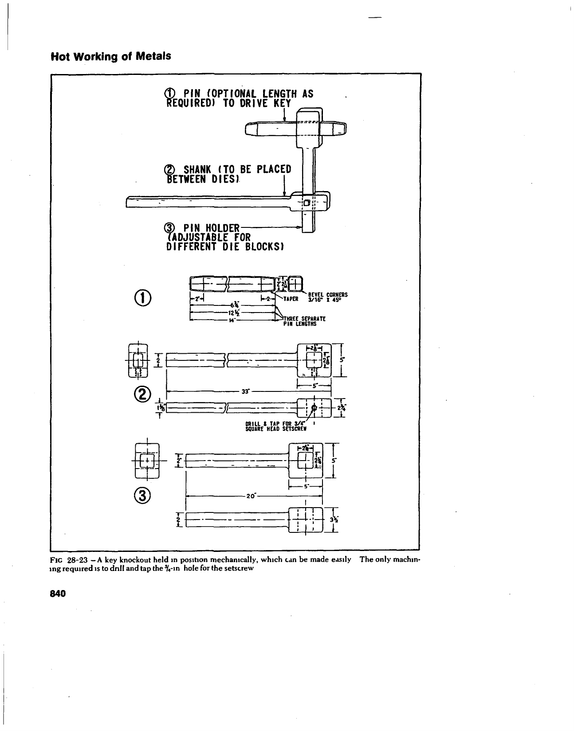
Hot Working of Metals % PIN (OPTIONAL LENGTH AS EQUIRED) TO DRIVE KEY n - --> _ P (2) SHANK (TO BE PLACED BETWEEN DIES) -:0- PIN HOLDER-----------(ADJUSTABLE FOR DIFFERENT DIE BLOCKS) -tjdk -20 - unx -IlD-L FlC 28-23 -- A key knockout held m position mechanically, which can be made easily The only machin ing required is to drill and tap the %-in hole for the setscrew 840
refid# 7aM15d48BmyRmm3E53bbnBjB1 page
Hot Working of Metals Handling Steel Plate for Fabrication, 565 Mechanical Forging Presses, 560 Method of Locking Out Electric Switches, 237 Setup and Removal of Forging Hammer Dies, 467 Steam Drop Hammers, 450 Upsetters, 466 United Auto Workers, 8000 E Jefferson Ave , Detroit, Mich 48214 (General) Foundries American Foundrymen's Society, Coif Rd , Des Plaines, 111 60016 Engineering Manual for Control of In-Plant Environment m Foundries Health Protection in Foundry Practice Safety in Metal Casting Recommended Practices for Crtnding, Polishing, and Buffing Equipment American Standards Institute 1430 Broadway New York, N Y 10016 Safety Code for Floor and Wall Openings, Railings, and Toe Boards, A12 1 Ventilation Control of Grinding, Polishing, and Buffing Operations Z43 1 National Safety Council, 425 North Michigan Ave , Chicago, HI 60611 Industrial Data Sheets Coated Abrasives, 452 Jet Tapping of Open Hearth Furnaces, 394 Magnesium, 426 Mullers and Other Pan-Type Mixers, 526 U S Department of Health, Education, and Welfare, Public Health Service, 404 N Fairfax Dr, Arlington, Va 22203 Hydraulic fluids Joint Industries Conference, 2139 Wisconsin Ave, Washington, D C 20007 JIC Hydraulic Standards for Industrial Equipment National Safety Council, 425 North Michigan Ave , Chicago, 111 60611 Industrial Data Sheets Fire-Resistant Water-tn-Oil Emulsion Hydraulic Fluids, 543 Hydraulic Fluids, 471 U S Bureau ol Mines, Department of the Intenor Schedule 30, "Fire-Resistant Hydraulic Fluids," Code of Federal Regulations, Title 30, Mineral Resources, Part 35, Subchapter E Available from Superintendent of Documents, U S Covemment Pnnting Office, Washington, DC 20402 Nondestructive testing McMaster, Robert Nondestructive Testing Handbook New York, Ronald Press National Safety Council, 425 North Michigan Ave , Chicago, III 60611 Industnal Data Sheets Beta Ray Sealed Sources, 461 Nondestructive Testing of Materials, 488 850
refid# pmvn2x7aappJ8Y7q0Rj4QdvD71 page