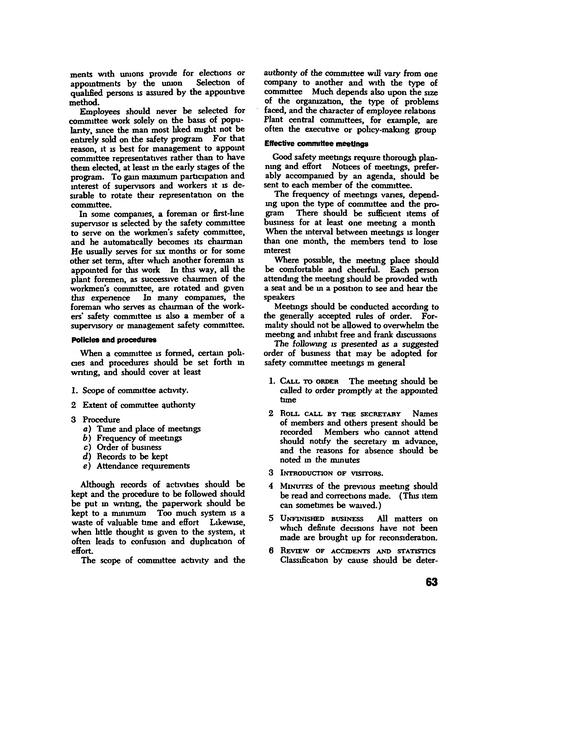
ments with unions provide for elections or appointments by the union Selection of qualified persons is assured by the appointive method.
refid# 9JV9dYeV3wJrdneJpwNpOO5Mp1 page
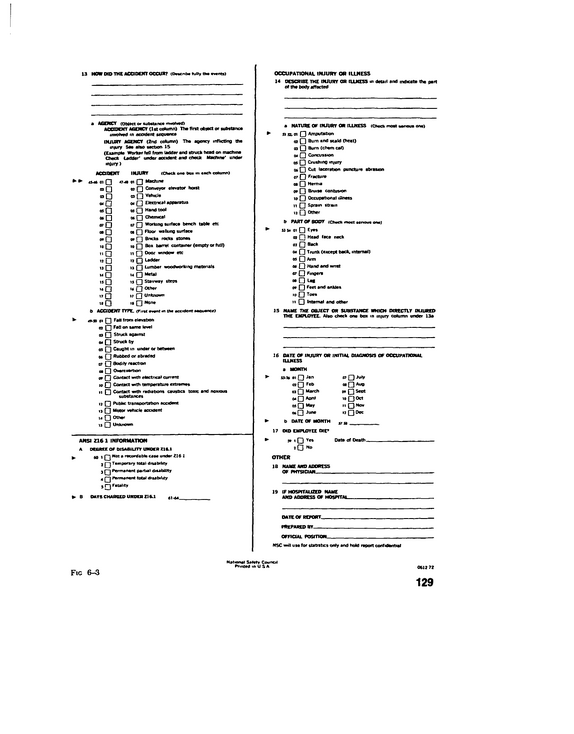
13 HOW DID THE ACCIDENT OCCUR?
refid# 6BogDkz5eX8Vy23QyjOvR7N241 page
which a sufficiently large number of accidents has occurred to be representative can be esti mated with considerable accuracy by multi plying the average uninsured cost per case for each of the four classes by the number of cases occurring in that class during the penod If any deaths, permanent total disabilities, or extraordinarily extensive property damage accidents have occurred, the specific unin sured costs of these should be added to the estimated costs of the four classes of accidents To these uninsured cost totals should be added the cost of workmen's compensation and insured medical expense For companies which are self-insured, this will be the total amount paid out m settlement of claims plus all expenses of administering the insurance For companies not carrying their own in surance, it will be the amount of their in surance premiums The method will have to be modified in accordance with the recordkeeping systems of different companies For example, most selfinsurers will find it impossible to separate compensated medical expense from dispensary care In that case, these items should be combined into one, and the dispensary cost omitted from the analysis of noncompensated costs on the data sheets For an illustration of the development of a final cost estimate, see the example in Tables 7-B and -C References Amencan National Standards Institute, 1430 Broadway, New York, N Y 10018 Standard Method of Recording Baste Facts Relating to die Nature and Occurrence of Work Injuries, Z16 2-1969 Firenze, Robert J Guide to Occupational Safety ir Health Management Dubuque, la, Kendall/Hunt Publishing Co, 1973 Sunonds, Rollin H, and Grimaldi, John V Safety Management--Accident Cost and Control Homewood, 111, Richard D Irwin, Inc, 1963 171
refid# M7kzJKODdmQyLOamr9DGjdpx1 page
8--Workmen's Compensation Insurance account the general occupational classifica tions ot industrial activities of the insured About 15 percent of the employers, paying about 85 percent of the premiums, are ex perience rated That is, their premiums are modified to reflect their loss experience in the past relative to others m the same class Also, the statistical reliability of that experience is taken into account, the larger the business, the more credible its experience Since em ployers with a small number of workers are likely to experience volatile changes m injury rates from year to year, only employers of large numbers arc expenence rated Another factor in the premium setting pro cedure is that discounts are given according to the size of the risk, this is an advantage to large companies Their rates thus reflect the economies of scale which result from spread ing certain fixed costs over a larger amount of premium Finally, large companies by retrospective rating may have their premiums adjusted at the end of a policy year to match their actual expenence Most insurers use rates developed by a rating bureau In some states, the rates de veloped by the bureau are mandatory, in others, advisory only Almost half the pre miums are written on a participating basis Participating policyholders receive periodic dividends that reflect insurer expenence and sometimes their own Financing self-insured benefits Firms that cover workmen's compensation risks through pnvate insurance companies or state funds pay a premium in advance In contrast, self-insurers have several options for financing They may simply pay for liabili ties as they are experienced, directly from operating funds, or they may provide some advance funding m one or more ways In those states requiring deposits of funds by selfinsurers, part or all of the funding for out standing liabilities is provided for in advance mandatonly Even if not requned, a selfinsurer may set aside reserves, or even formally insure its risk through a wholly owned sub sidiary insurance company created for this purpose Such advance funding prevents severe dis ruptions in cash flow from unforeseen loss experience oi accumulated liabilities Insurer administrative costs One of the recurring issues in evaluating workmen's compensation is the financial ef ficiency of the insurance mechanism for pro viding benefits A major part of the issue is the comparison between private and state fund insurance The premiums collected by pnvate insurers aie used not only to pay benefits but also for expenses associated with claims such as in vestigation and legal fees, for sales, supervi sion, and collection, for administration, for safety programs, and for taxes, licenses, and other mandatory fees as well as for earnings In 1970, stock insurers that do not pay divi dends to policyholders had expenses totaling 31 percent of premiums earned, their under writing gain was 5 percent of premiums paid For stock insurers that pay dividends to pol icyholders, the expense ratio was 25 percent, the underwriting gain, 14 percent Mutual insurers had an expense ratio of 24 percent and an underwriting gain of 13 percent The dividend-paying stocks and mutuals returned part of their underwriting gam to their policy holders In addition to their underwriting gains, these insurers had investment profits State funds have much the same costs as private insurers with these exceptions lower (or no) taxes and fees to the state govern ment, no margin for private profit, and lower selling costs Consequently, although the variation among individual funds is great, ex penses have averaged less than 10 percent of total premiums paid, well below the ratio for pnvate insurers Some state funds incur smaller expenses for administrative and legal services, which may be financed from other government funds On the other hand, state funds m some instances may insure greater proportions of high-nsk companies than pnvate earners and incur proportionately heavier charges for benefits Other administrative costs Another aspect of financing workmen's com pensation relates to the cost of supporting the public agenev that administers the program The cost of operating the industrial commis sion (or other admimstenng agency) is borne either by assessments upon insurers and selfinsurers or through appropnations from public 184
refid# Yj24Lqm6rGE1D4YMv1xx9Rj4y1 page
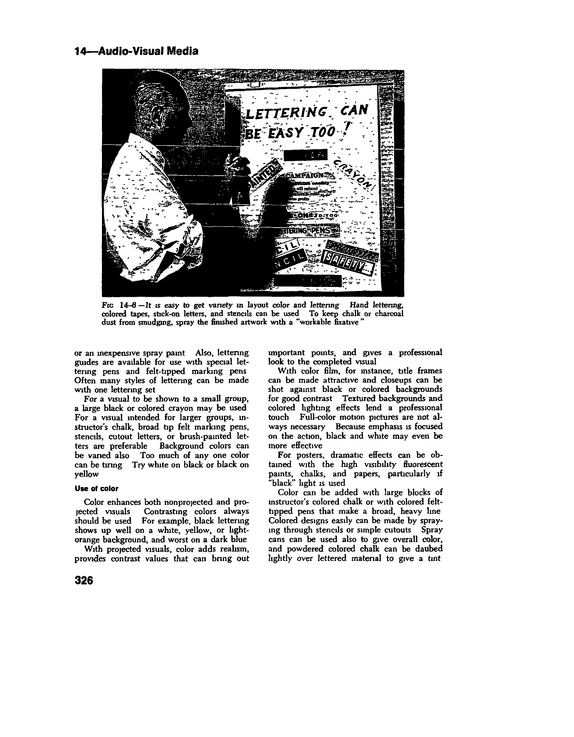
14--Audio-Visual Media Fig 14-6 --It is easy to get variety in layout color and lettering Hand lettering, colored tapes, stack-on letters, and stencils can be used To keep chalk or charcoal dust from smudging, spray the finished artwork with a "workable fixative " or an inexpensive spray paint Also, lettering guides are available for use with special let tering pens and felt-tapped marking pens Often many styles of lettering can be made with one lettering set For a visual to be shown to a small group, a large black or colored crayon may be used For a visual intended for larger groups, in structor's chalk, broad tip felt marking pens, stencils, cutout letters, or brush-painted let ters are preferable Background colors can be varied also Too much of any one color can be tinng Try white on black or black on yellow Use of color Color enhances both nonprojected and pro jected visuals Contrasting colors always should be used For example, black lettering shows up well on a white, yellow, or bghtorange background, and worst on a dark blue With projected visuals, color adds realism, provides contrast values that can bnng out 326 important points, and gives a professional look to the completed visual With color film, for instance, title frames can be made attractive and closeups can be shot against black or colored backgrounds for good contrast Textured backgrounds and colored lighting effects lend a professional touch Full-color motion pictures are not al ways necessary Because emphasis is focused on the action, black and white may even be more effective For posters, dramatic effects can be ob tained with the high visibility fluorescent paints, chalks, and papers, particularly if "black" light is used Color can be added with large blocks of instructor's colored chalk or with colored felttapped pens that make a broad, heavy line Colored designs easily can be made by spray ing through stencils or simple cutouts Spray cans can be used also to give overall color, and powdered colored chalk can be daubed lightly over lettered material to give a tint
refid# 65EXYbBoB7ob9kxng18JpwXg1 page
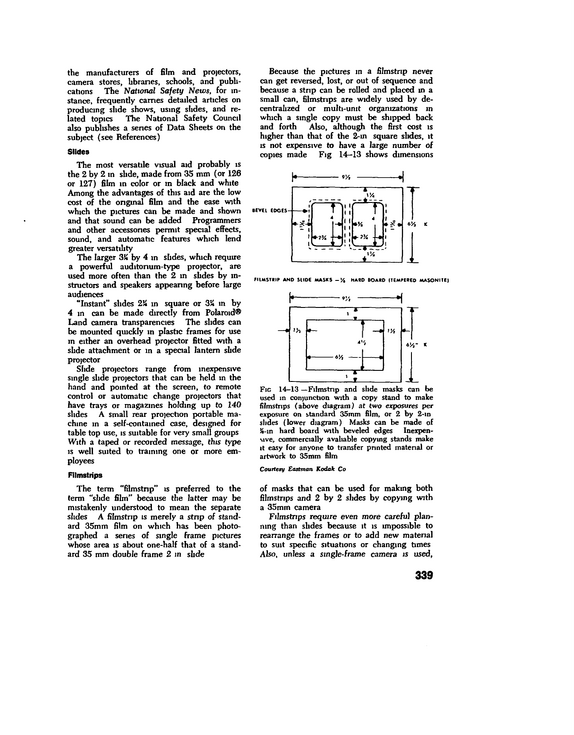
the manufacturers of film and projectors, camera stores, libraries, schools, and publi cations The National Safety News, for in stance, frequently carries detailed articles on producing slide shows, using slides, and re lated topics The National Safety Council also publishes a senes of Data Sheets on the subject (see References) Slides The most versatile visual aid probably is the 2 by 2 m shde, made from 35 mm (or 126 or 127) film in color or m black and white Among the advantages of this aid are the low cost of the ongmal film and the ease with which the pictures can be made and shown and that sound can be added Programmers and other accessones permit special effects, sound, and automatic features which lend greater versatility The larger 35* by 4 in slides, which require a powerful auditonum-type projector, are used more often than the 2 m slides by in structors and sjieakers appeanng before large audiences "Instant" slides 211 m square or 351 in by 4 m can be made directly from Polaroid Land camera transparencies The slides can be mounted qmckly in plastic frames for use m either an overhead projector fitted with a shde attachment or in a special lantern shde projector Shde projectors range from inexpensive single slide projectors that can be held m the hand and pointed at the screen, to remote control or automatic change projectors that have trays or magazines holding up to 140 slides A small rear projection portable ma chine in a self-contained case, designed for table top use, is suitable for very small groups With a taped or recorded message, this type is well suited to training one or more em ployees Filmstrips The term "filmstnp" is preferred to the term "shde film" because the latter may be mistakenly understood to mean the separate shdes A filmstrip is merely a strip of stand ard 35mm film on which has been photo graphed a series of single frame pictures whose area is about one-half that of a stand ard 35 mm double frame 2 in shde Because the pictures in a filmstrip never can get reversed, lost, or out of sequence and because a strip can be rolled and placed in a small can, filmstrips are widely used by de centralized or multi-unit organizations in which a single copy must be shipped back and forth Also, although the first cost is higher than that of the 2-rn square shdes, it is not expensive to have a large number of copies made Fig 14--13 shows dimensions h----------------------*1 FILMSTRIP AND SLIDE MASKS - HARD BOARD (TEMPERED MASONITE) (------------------------- H Fig 14-13 --Filmstnp and slide masks can be used m conjunction with a copy stand to make filmstnps (above diagram) at two exposures per exposure on standard 35mm film, or 2 by 2-m slides (lower diagram) Masks can be made of K-in hard board with beveled edges Inexpen sive, commercially available copying stands make it easy for anyone to transfer pnnted material or artwork to 35mm film Courtesy Eastman Kodak Co of masks that can be used for making both filmstnps and 2 by 2 shdes by copying with a 35mm camera Filmstnps require even more careful plan ning than shdes because it is impossible to rearrange the frames or to add new material to suit specific situations or changing times Also, unless a single-frame camera is used. 339
refid# 6B3y3Z9njgJbJ2EQjQ2mknwz61 page
16--Industrial Buildings and Plant Layout 230- and 250-volt circuits are available in wattages from 100 to 1500 Some types are available m 260, 277, and 300-volt design High-voltage lamps necessarily have filaments that are less rugged, require more supports and are considerably less efficient than those of equal wattage 120-volt lamps "Infrared" lamps are available in vanous types and sizes up to 1000 watts These lamps are used m baking, drying, and heat processing, as well as for therapeutic pur poses They also have fire protection value a great amount of heat can be exchanged without Same Such lamps cannot be used in hazardous locahon applications Fluorescent lamps.
refid# JNOJNyDmvbbGdzd9Emr35oZX1 page
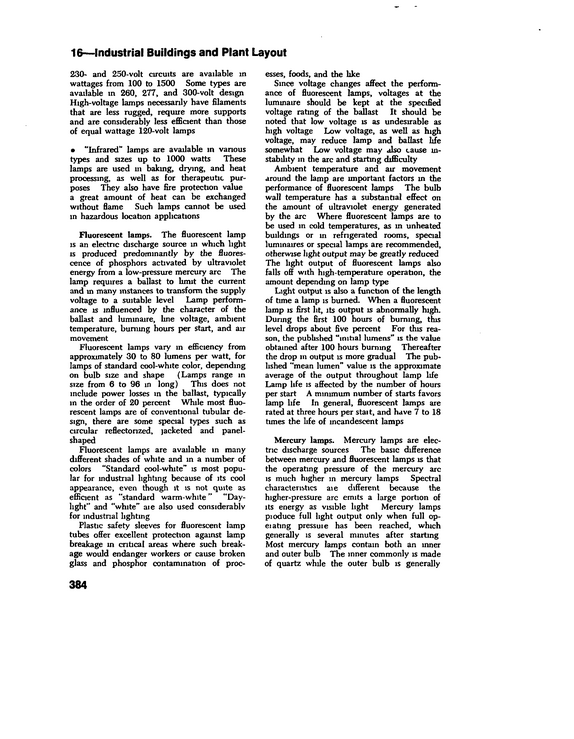
19--Personal Protective Equipment Fic 19-55 --Various types of thermal knit cotton materials used for regular style cold weather underwear Note the air pockets which give materials their insulating properties clothing are much moie desirable For protection against exposure to oil and the various other compounds which rapidly attack ordinary rubber, all the equipment dis cussed can be obtained in plastic and synthetic rubbers Women's clothing and protection Women require practically the same safety features m protective clothing and equip ment as men do, but styles of clothing may differ considerably m appearance It is desirable to have women wear the same type of dress, uniform, or smock Sknts and loose, frilly clothing are easily caught in moving machinery Where this danger is present, slacks and short-sleeved shirts are commonly wom Tie strings for aprons should be of a type that can be easily broken The possibility of senous scalp injury is 524 present when women work near moving ma chinery Hair covering is desirable for clean liness, particularly m food products industries Caps to be used near sparks or flame should be flame-resistant A cap should have a stiff brim long enough and rigid enough to provide some warning before the head itself comes m contact with moving objects Any fad of wearing cap visors turned up should be com batted When stnng-tied caps are wom, the bow in the back should be tucked under the cap Hair-nets and turbans do not give suf ficient protection against moving machinery Additional details on women's caps were given under Hair Protection Shoes with high or run-over heels, sneakers, and toeless shoes or sandals are not suitable for factory work, particularly where heavy materials or hot liquids are handled Many companies require women employees to wear
refid# jgEXpy9d9QarxRk9kb0mV3dQ21 page
&*&**& 'WTSROTlAl r'UtU.
refid# emJBK813VZL74ZLBj6EKN4br430 pages
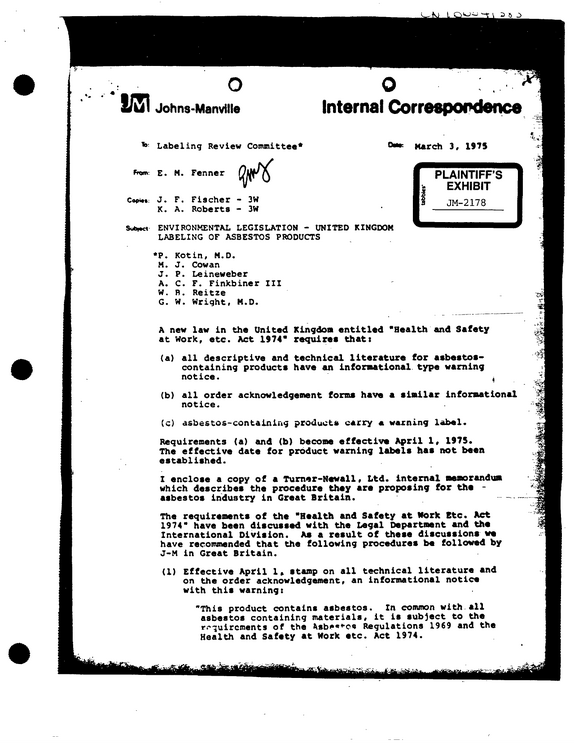
m Johns-Manville Internal Correspondence Labeling Review Committee* O"** March 3, 1975 E.
refid# gaB03XZDvp1DY2Rp7VwJ0pYGa1 page
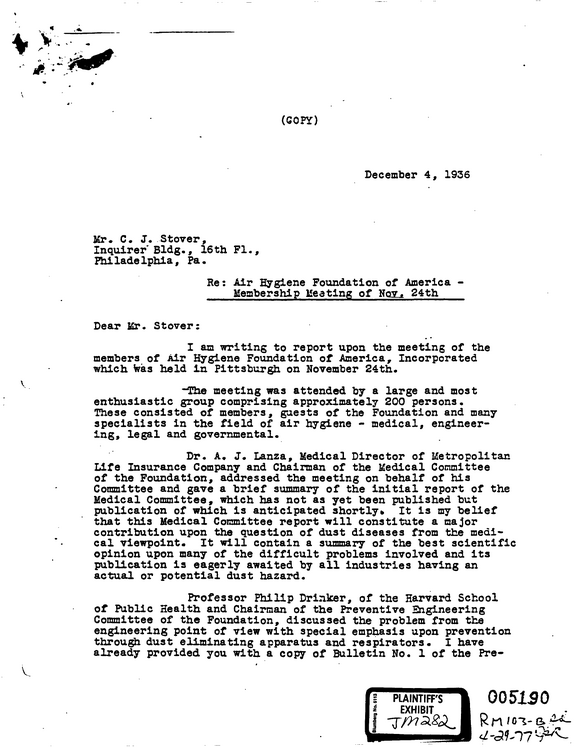
(COPY) December 4, 1936 Mr.
refid# J3d98RwoqwpjVy7bNzwMxGmqX3 pages
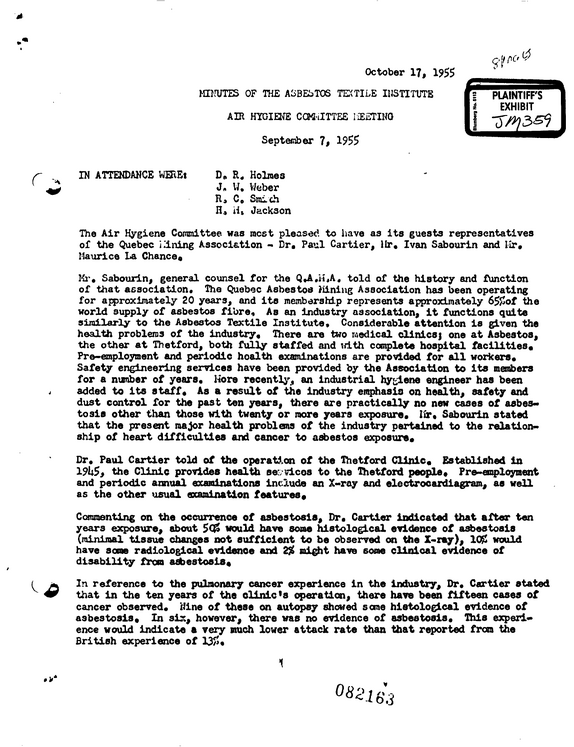
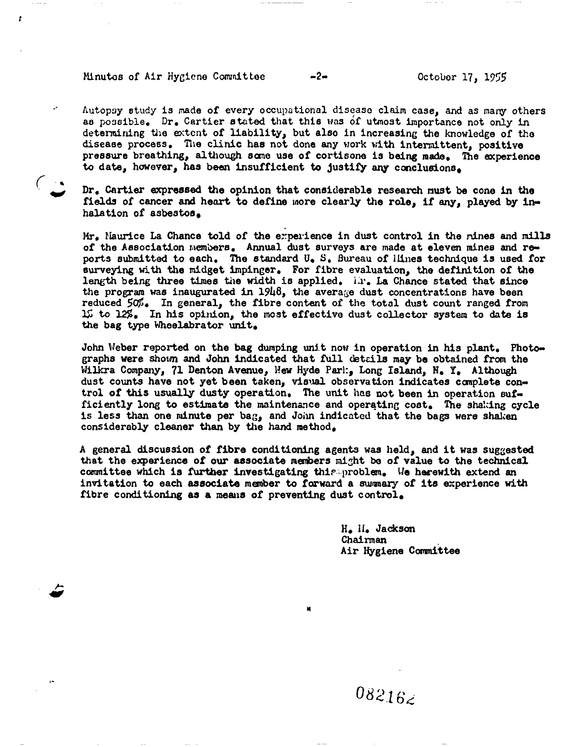
October 17, 1955 MINUTES OF THE A3BELT0S TEXTILE INSTITUTE AIR HYGIENE COMMITTEE MEETING September 7, 1955 IN ATTENDANCE WIRE* D, R.
refid# aJEyB239aJ1nzZ8EjwpnZqroM12 pages
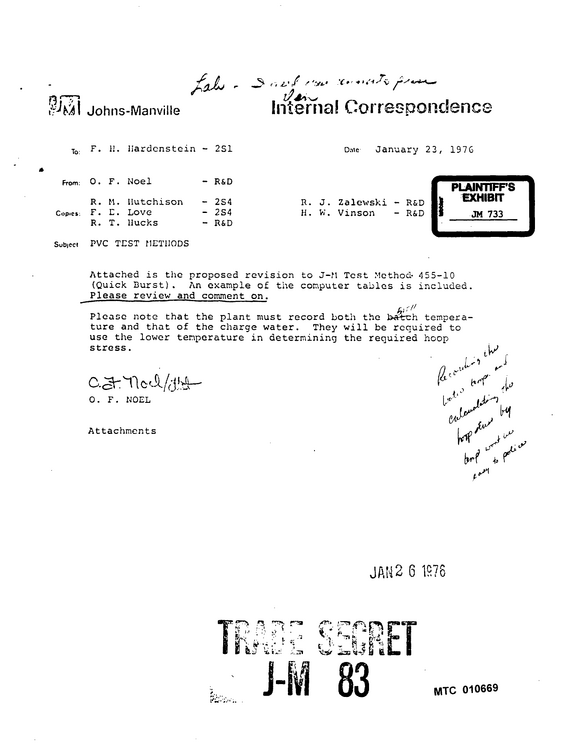
M* Johns-Manville r Interna!

refid# rN7zyxvYjpX0dzny9k933q0a2 pages
DOCUMENTS PULLED AS PRODUCIBLE DURING PRIVILEGE REVIEW PRIVILEGE BOX f____ > .M PO- PRODUCTION BOX f T){3- \i PILE ____________ PILE NAME C^rl-il.

refid# QX1VJx0ed4r2NwnQKrw56xNpk4 pages
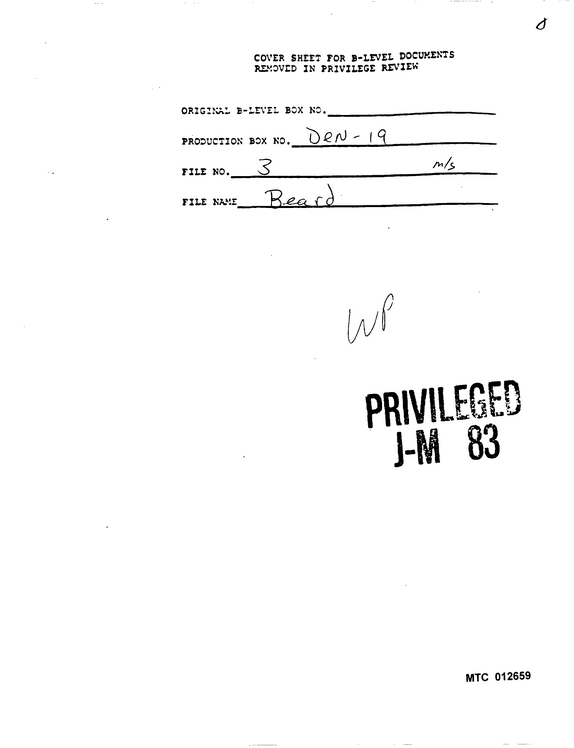
COVER SHEET FOR B-LEVEL DOCUMENTS REMOVED IN PRIVILEGE REVIEW ORIGINAL B-LEVEL BOX NO._____________ PRODUCTION BOX KO.
refid# 0gr24exK6DQxQywVBoQwdMRam11 pages