being made for locking the switch "off" and tagging it This precaution will prevent service interiuptions in the main circuit when power must he shut off in the branch circuit, and it will also prevent accidental starting of extra equipment that is tapped in Employee Training Few plants experience difficulty in selec tion and installation, but in maintenance and use of electrical equipment, deviation from safe practices is sometimes tolerated, with the usual result that unnecessary hazards are created and men are injured and killed Therefore, for maximum effectiveness, the safety program should include thorough training of all employees who work with the electrical installation of the plant or operate electrical equipment fn addition to instruc tions on the hazards of electricity, employees should be trained in first aid, the use of warning signs, guards, and other protective devices, and m safe operational procedures It is essential that they be trained in the mouth-to-mouth method of resuscitation and that distribution employees, especially, be trained in the pole-top method of resuscita tion The training program should consist not merely of generalization and indefinite rec ommendations, it should be based on the plant's electrical system and applied spe cifically to plant operations Supervisors should be given such instruc tions as may be necessary to acquaint them with the plant's electrical hazards, and they should be required to maintain close super vision over all operations which involve the use of electrical equipment They should en courage employees to report immediately any electrical defects observed and this equip ment should be repaired or replaced at once It is recommended that members of the plant safety department familiarize them selves with the codes and standards which apply to their equipment and operation and that someone from the electrical mainte nance staff be an active member of the plant safety committee The electrical mainte nance crew should consist of qualified elec tricians and other technically trained per sonnel according to the type of electrical equipment required in the plant References American Standards Institute, 1430 Broadway, New York, N Y 10018 Definitions and Ceneral Standards for Wire and Cables, C8 1 Dimensions of Caps, Plugs and Receptacles, C73 (Also N'EM ^ WD 1- 1965 ) Manual and Automatic Station Control, Supervisory and Associated Telemetering Equipment, C37 2 Relays and Relay Systems Associated with Electric Power Apparatus, C37 Requirements for Metallic and Associate Coverings for Insulated Cables C8 15 (Also IPCEA S-54-40I-I957 and NEMA WC2-1958 ) Safety Rules for the Operation of Electric Equipment and Lines C2 4 (Also NBS Hand book H34-I938 ' Specifications for Rubber Insulating Tape C59 6 (Also ASTM Dl 19 ) Specifications for Weather-Resistant Wire and Cable (URC Type ) C8 18 Specifications for Rubber Protective Equipment for Electrical Workers J6 Dalziel, Chailes F Effect of Electric Current on Man " Electrical Engineering, Febmarv 1941 ` Scientific Facts Concerning Electrical Hazards '' National Safety News, October 1947 "Electricity --Good and Faithful Servant '' National Safety News, September 1961 MeElrov, Frank E "Check Up on Your Electrical Outlets ' Cathohc Building and Mainte nance 15 92-98 (July-August 1963) 1007
refid# R26653O2vj8rG93jG0kLvdN7X1 page
standing to windward A cover should be removed with the man facing the dome With feet well braced, he should use short, vigorous pushes on the bar The cover (if not provided with a chain) and loose tools should be removed to the walk platform or other safe place so that they will not fall On the bolted type of dome cover, all nuts should be unscrewed one turn and the cover lifted to break adhesion which may exist between the cover and the dome ring If there is a sound of escaping vapors, the dome should be tightened and the venting operation repeated All dirt, cinders, and debris should be re moved from around the interior type of dome cover before the yoke is unscrewed When the car must be unloaded through the bottom outlet valve, dome covers should be adjusted to allow for venting The screw type should be screwed down just enough to ex pose the Vfc-m vent holes m the threaded por tion of the cover A small, thin wood block should be placed under the bolted type of cover, and the in terior type of dome cover should be tightened up in the yoke to within VS> in of the closed position An asbestos or metal cover or wet burlap or canvas should be placed over the tank manhole to protect against entrance of sparks or other source of ignition Unloading and loading connections The safest method of unloading tank cars is through the dome Some states prohibit bottom unloading Where a car has only bot tom unloading, the tank's outlet valve must be closed before the outlet chamber cap or plug is removed A pail or tub should be placed under the outlet chamber and the 2-m outlet cap unscrewed The condition of the outlet valve should be checked, and if there is no senous leak, the unloading should proceed If the plug does not loosen readilv with a 48-inch wrench, the bottom outlet cap or plug can be tapped to loosen it If the valve leaks so badly that a connection cannot be made without spilling the product, the car should be unloaded from the top In cold weather the outlet chamber, if the chamber or valve is frozen or blocked with frozen liquid, should be carefully examined for cracks If a crack is not found, the con nection for unloading should be made and the outlet chamber wrapped with burlap or other rags, and hot water or steam applied The connection from the car to the storage tank should be carefully checked for proper condition before the car valve is opened The storage tank should be watched to pre vent overflow, and the hose and unloading line should be checked frequently The tank car should be examined before loading lines are disconnected to make certain that it is completely empty A workman should be present throughout the entire loading or unloading operation and while a car is connected If it is neces sary to discontinue operations before they are completed, the outlet valve should be closed and the dome cover and outlet chamber cap replaced Tank cars should not be allowed to stand with loading or unloading connections at tached after operations are completed If flammable liquids are spilled, spill areas should be covered with fresh dry sand or dirt Never flush spills into public sewers and drainage systems, or natural waterways When heater pipes are used for unloading, the steam should be applied slowly until it begins to exhaust at the outlet pipe Steam pressure should not exceed that needed to bring the contents to the desired tempera ture and should never be high enough to cause the contents to overflow Care also must be exercised to avoid ex ceeding the flash temperature of "cut-backs" or additives introduced into various heavy products --for example, the addition of naph tha to residual asphalt Overheating these products containing certain additives can release dangerous quantities of flammable vapors Placards Shipping cards and Dangerous or Flam mable placards should be provided and then removed after operations are completed They should then be replaced with DANGER OUS-EMPTY placards Defect cards or forms of any kind which have been attached to a car by railroad employees should not be removed Placards, rags, waste, and blocks should not be disposed of in the tank or car body 1023
refid# R26r7z2xxMEy7bknDb8vp4nm81 page
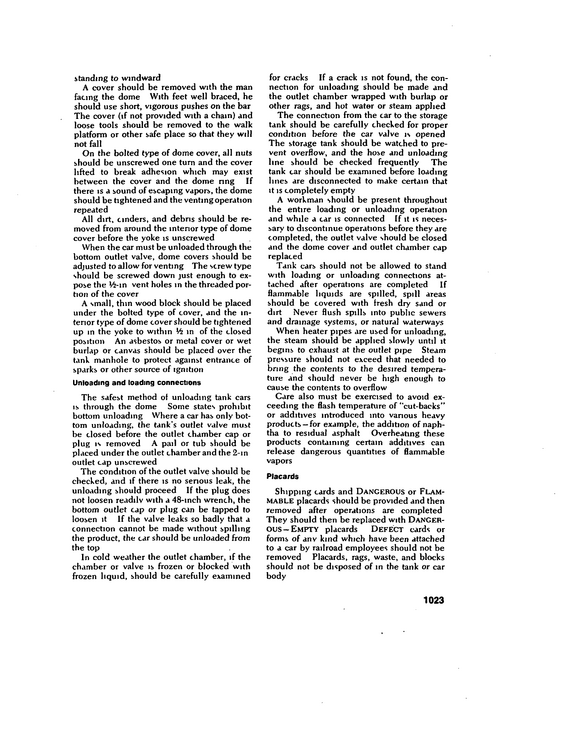
Fir 36-9 -- Proportioner permits operator to varv percentage of foam-producing concentrate are listed by Underwriters' Laboratories, Inc , are siphoned through a proportioner at rates not exceeding 2 per cent by volume The reflective white opaque surface formed by the air bubbles and wet-water particles makes this agent a good medium for protec tion from exposure fires The cellular struc ture of the foam also retards heat conduction, thus affording insulation As the foam blanket absorbs the heat and breaks down, the wet water released from the air bubbles car ries the heat away from the protected surface Mixing wetting agents with other wetting agents or with mechanical or chemical foam is not recommended, since it may neutralize the effect of the agents and thus destroy the fire fighting properties High expansion foam, using wetting agents in ratios as high as 1000 to 1, has been devel oped These foams have a water content ranging from 0 2 to 10 oz/cu ft, and are effec tive in fighting fires in inaccessible places, such as coal mines and building basements High expansion foams can also be used in total flooding systems designed to fill en closed spaces, such as rooms or buildings The systems are suitable for hazards involv ing flammable liquids and ordinary combus tibles, if properly designed for the specific hazard and area Wet water The wet water principle can also be used without generating foam In liquid form, wet water has the same general extinguishing properties as plain water However, its cool ing ability is increased, and there is a greater penetration of porous surfaces because of its reduced surface tension Carbon dioxide extinguishing systems Fixed (local or flood-type) C02 systems are often installed for the protection of rooms that contain electrical equipment, flammable liquid or gas processes, dry cleaning machin ery, and other exposures where fire can be ex tinguished by diluting the oxygen content of the air or where water must not be used be cause of electrical hazard or the nature of the 1089
refid# 2B5o3aZKmV905jMkvvOYmwEp1 page
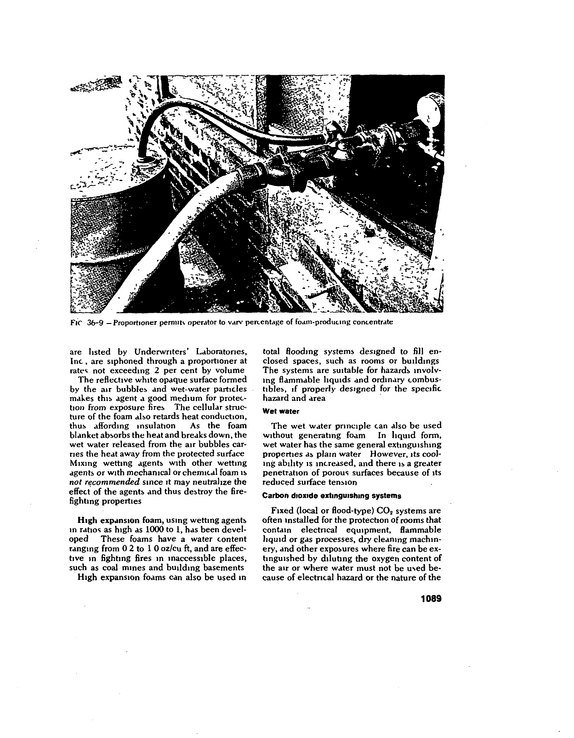
SERVICE BULLETIN PLAINTIFF'SEXHIBIT MAY 27. 1975 \0.
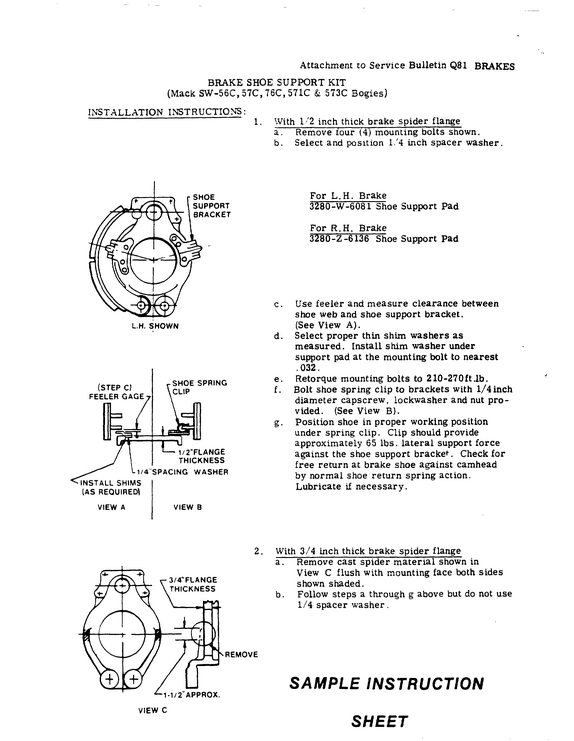
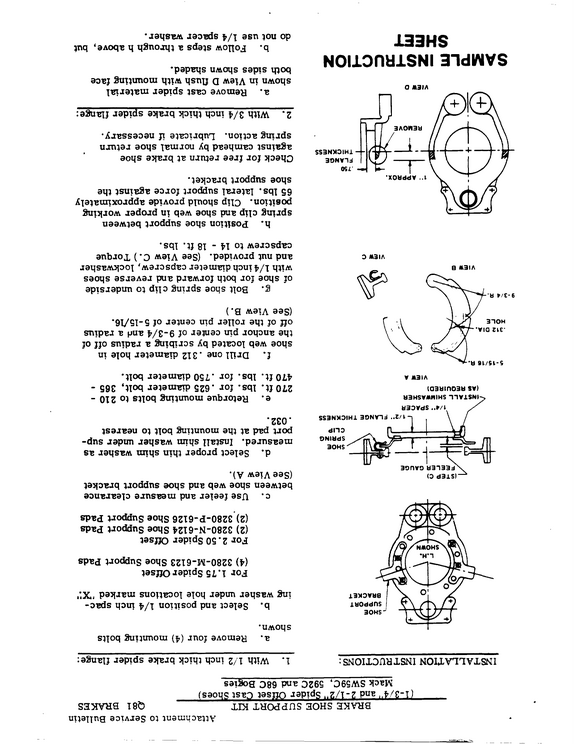
refid# aJrpOEj4zEyKO2bYXLdZMM86e3 pages
Personal Protective Equipment lions Satisfactory performance specifica tions exist for certain types of personal protective equipment, notably safety hats, devices to protect the eyes from impact and from harmful radiations, and rubber insulat ing gloves, but there are no approving lab oratories to test equipment regularly accord ing to these specifications Unless the safety professional has ample testing facilities available to him, he must rely upon the equipment manufacturers' endorsement for devices that may fill his needs Fortunately, the manufacturers have been aware of their responsibility in this re spect, and have a remarkable record of re liability Their representatives can usually Be called in to demonstrate their products and discuss their conformance to safety stand ards The succeeding pages discuss seven major areas of personal protective equipment-- head, eyes and face, ear, respiratory, hands, feet, and body Each section will provide the latest information on the standards avail able or proposed, some details about the equipment available, suggestions for select ing equipment to meet the job hazard, and some case histones in the development and use of specific devices Use equipment property The next problem is that of having work ers wear personal protective equipment, once it has been chosen Several factors influ ence the solution of this problem Among them are (a) the extent to which the men who must wear the equipment understand its necessity, (b) the ease and comfort with which it can be worn with a minimum of interference with normal work procedures, and (c) the available economic, social, and disciplinary sanctions which can be used to influence the attitudes of the men In an organization where workers are ac customed to weanng personal protective equipment as a condition of employment, this problem is minor The men are simply issued equipment which meets the require ments of the job and is easy to wear, and are taught how and why it must be used There after, periodic checks are made until use of the issued equipment has become a matter of habit with the workers When a group of men are issued personal protective equipment for the first time or when new devices are introduced, the prob lem may be more difficult The men will need to be given a clear and reasonable explanabon as to why the equipment must be worn Traditional work procedures may have to be changed If such changes are required, a good deal of resistance, justifiable or not, may be generated Also, workers may be reluctant to use the equipment because of bravado or vanity The practice of having supervisors and foremen try out new protective equipment and devices prior to actual adoption, and getting their comments and discussing the advantages, has been successfully used m many operations A good deal of the resistance to change can be overcome if the men are allowed to choose the particular style of equipment they will wear from a group of different styles which have been preselected to meet the job re quirements In some situations, it may be advisable to have a committee from the work force help select suitable devices Manage ment's desire to standardize on one stvle of equipment may not be realized immediately, and several styles may need to be stocked In the latter case, the cost, though higher than the cost of stocking only one style, will be small compared to the potential cost of ac cidents resulbng from failure to use the equipment For the convenience of their employees, some companies maintain equipment stores on the plant premises (Fig 38-1) Policies differ with respect to who pays for personal protecbve equipment The cost of eve protection equipment that has prescrip tion-ground lenses, such as safety spectacles, is often shared by worker and employer For instance, a National Safety Council survey showed that 27 per cent of the companies supplying employees with prescnphon gog gles gave them free, and 60 per cent assumed part of the cost or made them available at below retail Most companies do not furnish safetv toe shoes free Many industrial firms maintain shoe stores for the convenience of employees and make the shoes available at cost In some instances, to encourage purchases, safety shoes are offered at below-cost prices In some areas, shoemobile service is avail- 1144
refid# qa2K4qmkmYkoMNmBQXmz4979K1 page
a> J CO c s E "IOD; 3o. o w 7z*2 cOH ID & - c2 fc 8 *0 JL ffl O T5 Ql . k C>O 2 * SSi?
refid# rpr35dRboZ64dJEraMd3rMp5q1 page
Occupational Health Services Medical and surgical management in every case of industrial injury or disease should aim to restore the disabled worker to his former earning power and occupation as com pletely as possible and without unnecessary delay Concise, dependable medical re ports that are promptly submitted to those agencies entitled to them are a part of this obligation In the same way, equitable ad ministration of workmen's compensation rests on medical testimony which adheres closely to reasonable scientific deductions regarding the injury or its possible conse quences The industrial physician is responsible for maintenance and completeness of medical records Records and reports are a necessary part of an occupational medical program Comprehensive records must be kept and re ports rendered m order that management be guided in their continuing responsibility for health and safety, and the employees kept in formed of the degree of success of the safety program afforded by their cooperation Rec ords and reports are necessary to direct and evaluate preventive medical and safety engi neering techniques They are necessary to chart progress in the reduction of accidents The physician is also responsible for prop erly instructing nurses and other paramedical personnel (such as first-aiders) and directing their activities Their duties, therefore, should be described in clear, concisely writ ten directives, a copy of which should be posted in the medical department There must be no delegation of services requiring expert medical attention The industrial physician, nurse, and safety director should concur with management to plan for emergency handling of large num bers of seriously injured employees in the event of disaster, such as explosion, fire, or other catastrophe These plans should be coordinated with community plans for such events See "Planning for Emergencies," Chapter 37 Procedures should include selecting, train ing, and supervising auxiliary personnel, and should provide for 1 Selecting and training auxiliary nursing personnel 2 Selecting and training first aid workers 3 Transporting and canng for the injured 4 Transferring seriously injured to hospitals (where operating rooms and blood trans fusions are available, donors could be arranged for) 5 Coordinating these plans with the safety department, guards, police, road patrols, fire departments, and other interested community groups Duties of the occupational health nurse Occupational health nursing is a special ized branch of the nursing profession The position requires a registered professional nurse, who is licensed in the state where employed In addition, it is desirable that the occupational health nurse have some knowledge of workmen's compensation laws, insurance, health and safety laws, occupa tional diseases, sanitation, first aid, and rec ord keeping The occupational health nurse contributes the most when she works with the company physician who provides her with written di rectives that have been discussed between them, so they are mutually agreed upon and understood Working with the physician, the occupa tional health nurse can provide a variety of nursing services, such as initial care for in juries or illnesses, counseling, health educa tion, consultation about sanitary standards, and referral to community health agencies She also can participate in programs to eval uate employee health, such as health exam inations, or to prevent disease, such as im munizations When the physician is only located at the plant part time, the nurse is responsible to him on professional matters, and to a mem ber of management on administrative matters In this case, the nurse works with the safety director m planning and conducting accident prevention programs The occupational health nurse must main tain a confidential professional relationship with the employees m conformity with legal and ethical codes She may not divulge in formation contained in individual employee health records unless the employee gives his signed permission, the medical files are only accessible to medical personnel It must be clear that establishment of medi cal diagnosis and definition of treatment are 1226
refid# aBXw9ZqNnM4XKQp78X7XyG84a1 page
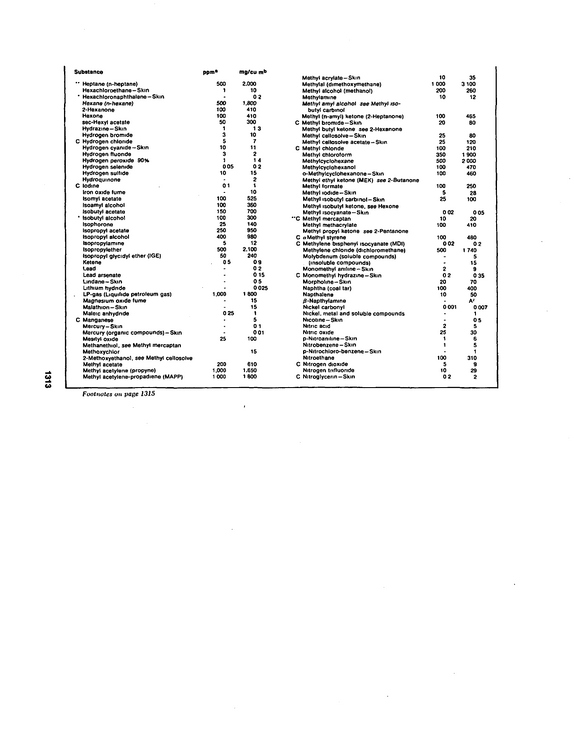
1313 Substance *' Heptane (n-heptane) Hexachloroethane--Skin * Hexachloronaphthalene-Skin Hexane (n*hexane) 2-Hexanone Hexone sec-Hexyl acetate Hydrazine--Skin Hydrogen bromide C Hydrogen chloride Hydrogen cyanide --Skin Hydrogen ftuonde Hydrogen peroxide 90% Hydrogen selemde Hydrogen sulfide Hydroqumone C Iodine Iron oxide fume Isomyl acetate Isoamyi alcohol Isobutyl acetate * Isobutyl alcohol Isophorone Isopropyl acetate Isopropyl alcohol Isopropylamine Isopropylether isopropyl giycidy!
refid# LpezBoOEQx4OBJVe2BeQV7GL71 page
Elements of Industrial Toxicology the eyes, nose, throat, and lungs Dichloromethane --see Methylene chlo ride.
refid# MM0Zzq8Ej93bRK4rGLJygK1j71 page
or into the pores of a concrete floor, the con tamination may become so great as to necessi tate replacement or sealing of the floor before the plant or laboratory can be safely used again Although it cannot be removed, mer cury can be sealed into such floors by cover ing them completely with an asphalt mastic, preferably after the vapor pressure of the mercury has been reduced by flooding the whole area with a lime sulfur spray To prevent such inconvenience, metallic mercury should be handled over impervious tables or containers with the surfaces de pressed and arranged to drain to a central point Spilled mercury can then be collected and returned to stock A number of volatile mercury compounds are used in seed disinfection Examples are ethyl mercury chloride and phosphate and the corresponding phenyl mercury com pounds These materials are highly toxic When used without adequate enclosure and dust control, they can rapidly produce severe mercurial intoxication These seed-treating compounds are also strong primary skin irri tants and will cause itching, burning, and blistering on direct contact Such irritations heal slowly The type of mercurv intoxication common to industry is characterized by a tremor of the hands, irritation of the mucous membranes of the mouth, excessive flow of saliva, and changes in the personality Poisoning by one of the volatile compounds may be more rapid so that personality changes are not so likely to be seen Inhalation of mercury vapor, usually in very high concentrations, mav produce metal fume fever, which may disappear with no other apparent symptoms, or may be followed by a pneumonitis or other symptoms of mercunalism The ordinary toxic dust respirator does not protect against intoxication by metallic mer cury or by the volatile seed-treating com pounds, since they are in the form of vapor rather than dust A gas mask offers some pro tection, but if enclosure and local exhaust are not possible, the only effective protection is a supplied air respirator See Industrial Data Sheet 203 and Hygtemc Gutde Mesityl oxide is a high-boiling, unsaturated ketone which is thought to be somewhat more toxic than the ketones of lower molecular weights Metal hydrides (primary types) are com pounds of hydrogen and the alkali metals sodium, potassium, lithium, magnesium, cal cium, and strontium Information on the health hazards of metal hydrides is limited Since they react with water to form caustic hydroxides, they are irritating to the eves, skin, and mucous membranes They also re lease a large amount of heat on reaction with the moisture of the skin See Industrial Data Sheet 462 and Hygienic Gutde Methanol (methyl alcohol) poisoning is usually produced bv swallowing the liquid or inhaling high concentrations of vapor in an enclosed place such as a tank The signs of poisoning include headache, nausea, vomit ing, violent abdominal pains, aimless and erratic movements, dilated pupils, sometimes delinum, and such eye symptoms as pain, tenderness on pressure, and occasionally blindness Direct action of the liquid or the vapor on the skin and mucous membranes may pro duce an irritation and inflammation One of the peculiarities of methanol poi soning is its exceptionally severe action on the optic nerve About one-half of all the serious cases of methanol poisoning result in some impairment of vision, which is usually permanent and may vary from dimness or blind spots scattered through the visual field to total blindness See Industrial Data Sheet 407 and Hygienic Guide Methoxychlor (2,2-di [ p-methoxypheny1 ] 1,1,1-tnchloroethane) is a synthetic insecti cide which is closely related to DDT m its action It is, however, about '/ to `/io as toxic as DDT Consequently, the hazard from in halation of the dust or mist of sprays of this insecticide is remote Methoxychlor is not absorbed through the intact skin in significant amounts, and does not seem to have any effect on the central nervous system In animal experiments, con tinued feeding of diets containing methoxy chlor m toxic concentration leads to loss of weight in the animals by their voluntary re striction of food intake and also to fatty m- 1357
refid# dD9q0w57xB2mzGapbDNY5rybB1 page
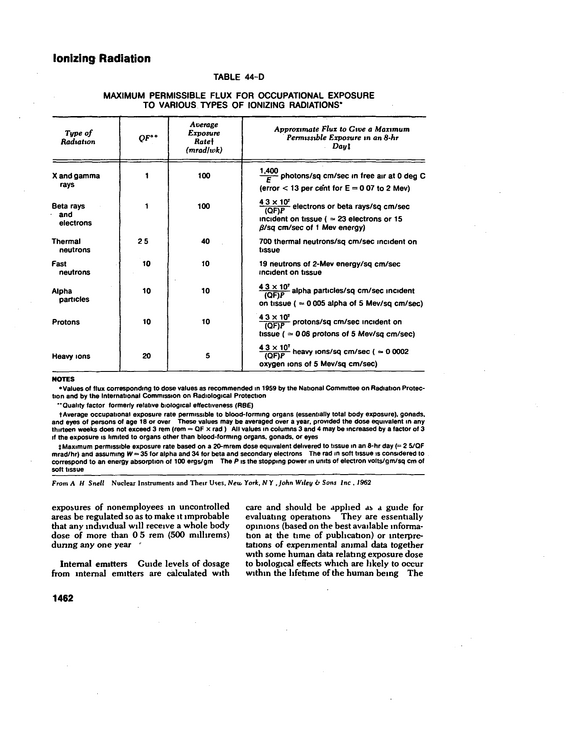
Ionizing Radiation TABLE 44-D MAXIMUM PERMISSIBLE FLUX FOR OCCUPATIONAL EXPOSURE TO VARIOUS TYPES OF IONIZING RADIATIONS* Type of Radiation QF` Average Exposure Rate\ (mradlwk) Approximate Flux to Give a Maximum Permissible Exposure in an 8-hr Dayt X and gamma rays Beta rays and electrons Thermal neutrons Fast neutrons Alpha particles Protons Heavy ions 1 1 25 10 10 10 20 100 100 40 10 10 10 5 1 '4g00 photons/sq cm/sec in free air at 0 deg C (error < 13 per cent for E = 0 07 to 2 Mev) 4 3 x 10* "(QF)P e,ectrons or 1)6,3 rays/sq cm/sec incident on tissue ( = 23 electrons or 15 /8/sq cm/sec of 1 Mev energy) 700 thermal neutrons/sq cm/sec incident on tissue 19 neutrons of 2-Mev energy/sq cm/sec incident on tissue 4 ~3|qxf)1pflT alpha particles/sq cm/sec incident on tissue ( = 0 005 alpha of 5 Mev/sq cm/sec) 43|qXpj1p07 protons/sq cm/sec incident on tissue ( = 0 06 protons of 5 Mev/sq cm/sec) 4 3 x 10⁷ heavy lons/sq cm/sec ( = 0 0002 oxygen ions of 5 Mev/sq cm/sec) NOTES `Values of flux corresponding to dose values as recommended in 1959 by the National Committee on Radiation Protec tion and by the International Commission on Radiological Protection " Quality factor formerly relative biological effectiveness (R6E) tAverage occupational exposure rate permissible to blood-forming organs (essentially total body exposure), gonads, and eyes of persons of age 18 or over These values may be averaged over a year, provided the dose equivalent in any thirteen weeks does not exceed 3 rem (rem = QF x rad) All values in columns 3 and 4 may be increased by a factor of 3 if the exposure is limited to organs other than blood-forming organs, gonads, or eyes t Maximum permissible exposure rate based on a 20-mrem dose equivalent delivered to tissue in an 8-hr day (= 2 5/QF mrad/hr) and assuming IV = 35 for alpha and 34 for beta and secondary electrons The rad in soft tissue is considered to correspond to an energy absorption of 100 ergs/gm The P is the stopping power in units of electron volts/gm/sq cm of soft tissue From A H Snell Nuclear Instruments and Their Uses, New York, N Y , John Wiley b Sons Inc , 1962 exposures of nonemployees in uncontrolled areas be regulated so as to make it improbable that any individual will receive a whole body dose of more than 0 5 rem (500 millirems) during any one year ' Internal emitters Guide levels of dosage from internal emitters are calculated with care and should be applied as a guide for evaluating operations They are essentially opinions (based on the best available informa tion at the time of publication) or interpre tations of experimental animal data together with some human data relating exposure dose to biological effects which are likely to occur within the lifetime of the human being The 1462
refid# v303NnxeBXQk2OjLDjJgoZvE1 page
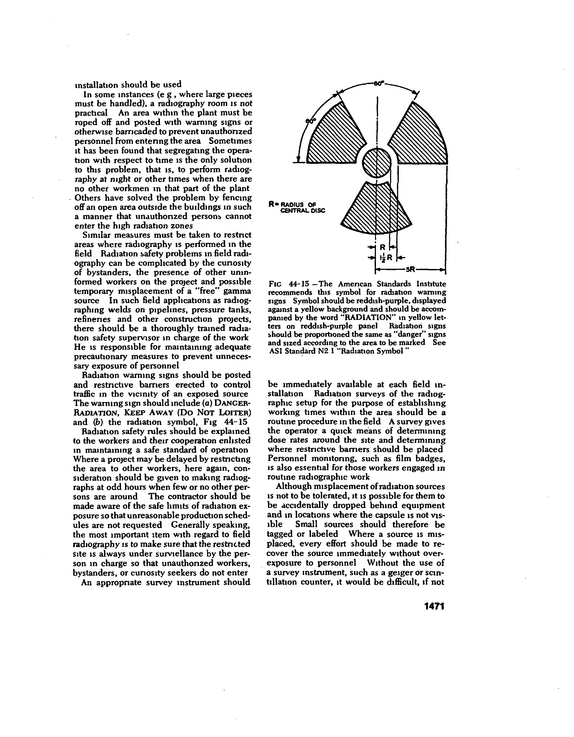
installation should be used In some instances (e g , where large pieces must be handled), a radiography room is not practical An area within the plant must be roped off and posted with warning signs or otherwise barricaded to prevent unauthorized personnel from entering the area Sometimes it has been found that segregating the opera tion with respect to time is the only solution to this problem, that is, to perform radiog raphy at night or other times when there are no other workmen m that part of the plant Others have solved the problem by fencing off an open area outside the buildings m such a manner that unauthorized persons cannot enter the high radiation zones Similar measures must be taken to restrict areas where radiography is performed in the field Radiation safety problems in field radi ography can be complicated by the curiosity of bystanders, the presence of other unin formed workers on the project and possible temporary misplacement of a "free" gamma source In such field applications as radiog raphing welds on pipelines, pressure tanks, refineries and other construction projects, there should be a thoroughly trained radia tion safety supervisor in charge of the work He is responsible for maintaining adequate precautionary measures to prevent unneces sary exposure of personnel Radiation warning signs should be posted and restrictive barriers erected to control traffic in the vicinity of an exposed source The warning sign should include (a) DangerRadiation, Keep Away (Do Not Loiter) and (b) the radiation symbol, Fig 44-15 Radiation safety rules should be explained to the workers and their cooperation enlisted m maintaining a safe standard of operation Where a project may be delayed by restricting the area to other workers, here again, con sideration should be given to making radiog raphs at odd hours when few or no other per sons are around The contractor should be made aware of the safe limits of radiation ex posure so that unreasonable production sched ules are not requested Generally speaking, the most important item with regard to field radiography is to make sure that the restricted site is always under surviellance by the per son in charge so that unauthorized workers, bystanders, or curiosity seekers do not enter An appropriate survey instrument should 3R FlC 44-15 --The American Standards Institute recommends this symbol for radiation warning signs Symbol should be reddish-purple, displayed against a yellow background and should be accom panied by the word "RADIATION" in yellow let ters on reddish-purple panel Radiation signs should be proportioned the same as "danger" signs and sized according to the area to be marked See ASI Standard N2 1 "Radiation Symbol " be immediately available at each field in stallation Radiation surveys of the radiog raphic setup for the purpose of establishing working times within the area should be a routine procedure m the field A survey gives the operator a quick means of determining dose rates around the site and determining where restrictive barriers should be placed Personnel monitoring, such as film badges, s also essential for those workers engaged m routine radiographic work Although misplacement ofradiation sources is not to be tolerated, it is possible for them to be accidentally dropped behind equipment and in locations where the capsule is not vis ible Small sources should therefore be tagged or labeled Where a source is mis placed, every effort should be made to re cover the source immediately without over exposure to personnel Without the use of a survey instrument, such as a geiger or scin tillation counter, it would be difficult, if not 1471
refid# mqbDJ92e6vQY6YZQEyDeOV8VB1 page
Ionizing Radiation References "Decontamination'' literature Huff, John B "Decontamination Techniques for Small Equipment" Nucleonics, 11 151-153 (Nov 1961) Sachs, F Skm Decontamination Washington, D C , Atomic Energy Commission Research Report Y-914, Oct 22, 1952 "Radioecology" literature Bernard, S R "Maximum Permissible Amounts of Natural Uranium in the Body, Air and Drink ing Water Based on Human Experimental Data " Health Physics, 1 288-305 (Dec 1958) Blat7, H Radiation Hygiene Handbook New York, N Y , McGraw-Hill Book Co , 1959 1CRP Committee "II Report on Permissible Dose foi Internal Radiation (1959) " Health Physics (June 1960) Mannelli, L D , and others `The Quantitative Determination of Camma-Ray Emitting Elements in Living Persons " American Journal of Roentgenology, Radium Therapy and Nuclear Medicine, 73 661-671, 1955 Miller, C E , and L D Mannelli "Low Intensity Spectrometry of the Gamma Radiation Emitted by Human Beings " Second U N International Conference on Peaceful Uses of Atomic Energy New York, United Nations, Department of Public Information Paper A/Conf 15/p/762, 1958 Morgan, K Z "Current Status of the Internal Dose Problem " Health Physics, 1 125-135 (Sept 1958) Schultz, Vincent, and Alfred W Klement, eds Radioecology American Institute of Biological Sciences New York, N Y , Reinhold Publishing Corp , 1963 "Experience of atomic energy industry" literature Atomic Energy Commission, Office of Technical Services, Washington, DC A Summary of Incidents Involving Radioactive Material in Atomic Energy Activities, Jan -Dec 1956 Research Report TID-5360 and Supplement, Aug 1957 A Summary of Incidents Involving USAEC Shipments of Radioactive Material, 1957-1961 Research Report TID-16764 and Supplement, 1962 Journals and periodicals On English) AMA Archives of Industrial Health American Medical Association, 535 North Dearborn St, Chicago, III 60610 American Industrial Hygiene Association American Industrial Hygiene Association, 1014 Broadway, Cincinnati, Ohio Health Physics Oak Ridge National Laboratories, Oak Ridge, Tenn International Journal of Applied Radiation and Isotopes Pergamon Press, 122 East 55th St, New York, N Y Nuclear Instruments and Methods North Holland Publishing Co , Box 103, Amsterdam, The Netherlands Nuclear Safety U S Government Printing Office, Washington, D C 20402 Nuclear Science Abstracts Atomic Energy Commission Available U S Government Print ing Office, Washington, D C 20402 Nuclear Science and Engineering American Nuclear Society Available Academic Press, Inc , 111 Fifth Ave , New York, N Y Nucleonics McGraw-Hill Inc , 330 West 42nd St, New York, N Y 10036 1504
refid# R2jEO6Beg05JRJ49RDd56M4371 page
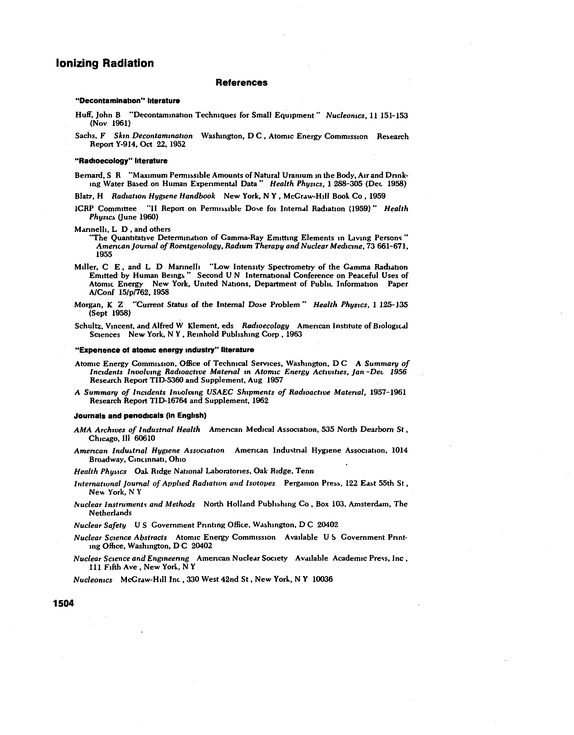
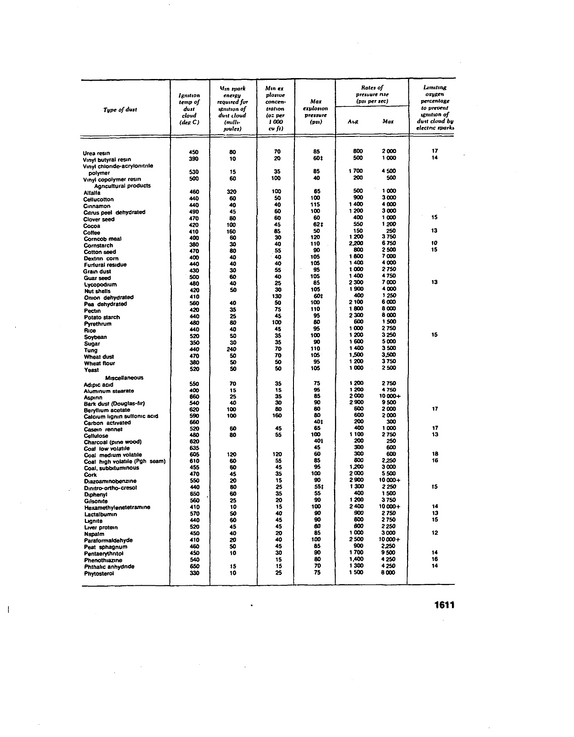
Type of dust Ignition temp of dust cloud (degC) Win spark energy required for ignition of dust thud (mithjoules) Min ex plosive concen tration (oz per 1 000 cuft) Max explosion pressure <pst) Vinyl butyral resin Vinyl chlonde-acrylonitnie polymer Vinyl copolymer resin Agricultural products Alfalfa Cellucotton Cinnamon Citrus peel dehydrated Clover seed Cocoa Corncob meal Cotton seed Furfural residue Grain dust Lycopodium Nut shells Omon dehydrated Pea dehydrated Potato starch Pyrethrum Soybean Tung Wheat dust Wheat flour Yeast Miscellaneous Adipic acid Aluminum stearate Asptnn Bark dust (Douglas-fr) Beryllium acetate Calcium lignin sulfonic acid Carbon activated Casein rennet Cellulose Charcoal (pine wood) Coal low volatile Coal medium volatile Coat high volatile (Pgh seam) Coal, subbitummous Diazoaminobenzine Dmitro-ortho-cresol Diphenyl Gi Isolate Hexamethylenetetramine Lactalbumin Lignite Uver protein Napalm Paraformaldehyde Peat sphagnum Pentaerythntol Phenothiazme Phthalic anhydride Phytosterol 450 390 530 500 460 440 440 490 470 420 410 400 380 470 400 440 430 500 460 420 410 560 420 440 460 440 520 350 440 470 380 520 550 400 660 540 620 590 660 520 460 620 635 605 610 455 470 550 440 650 560 410 570 440 520 450 410 460 450 540 650 330 BO 10 15 60 320 60 40 45 80 100 160 60 30 80 40 40 30 60 40 SO 40 35 25 60 40 50 30 240 50 50 SO 70 15 25 40 100 100 80 80 120 60 60 45 20 80 60 25 10 SO 60 45 40 20 50 10 15 10 70 85 20 601 35 85 100 40 100 65 50 100 40 115 60 100 60 60 45 62* 85 50 30 120 40 110 55 90 40 105 40 105 55 95 40 105 25 85 30 105 130 60* 50 100 75 110 45 95 too 80 45 95 35 100 35 90 70 110 70 105 50 95 so 105 35 75 15 95 35 85 30 90 60 60 160 60 40* 45 65 55 100 40* 45 120 60 55 85 45 95 35 100 15 90 25 55* 35 55 20 90 15 100 40 90 45 90 45 60 20 85 40 100 45 85 30 90 15 80 15 70 25 75 Rates of pressure nse (psi per sec) Avg Max Limiting oxygen percentage to prevent ignition of dutt cloud by electric sparks 800 500 1 700 200 500 900 1 400 1 200 400 550 150 1 200 2.200 800 1 800 1 400 t 000 1 400 2 300 1 900 400 2100 1 600 2 300 GOO 1 000 1 200 1 600 1 400 1,500 1 200 1 000 1 200 1 200 2000 2900 600 600 200 400 1 100 200 300 300 600 1,200 2 000 2900 1300 400 1200 2400 900 600 BOO 1 000 2 500 900 1700 1.400 1 300 1 500 2 000 1 000 4 500 500 1 000 3000 4 000 3 000 1 000 1200 250 3 750 6 750 2500 7 000 4 000 2 750 4 750 7 000 4 000 1250 6 000 8 000 8000 1 500 2 750 3250 5 000 3500 3,500 3 750 2500 2 750 4 750 10 000+ 9500 2000 2 000 300 1 000 2 750 250 600 600 2250 3 000 5500 10 000+ 2250 1 500 3750 10000-12 750 2750 2250 3000 10000+ 2250 9 500 4 250 4250 8000 17 14 15 13 to 15 13 15 17 17 13 18 16 15 14 13 15 12 14 16 14 I 1611
refid# M4NY1JGX0ObrgBLK6Ye31LnKa1 page
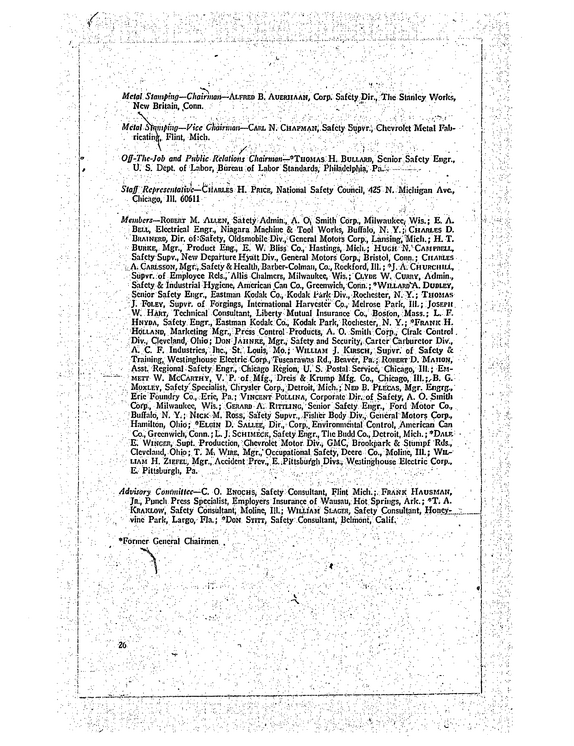
MetalStamping--Chairmati--Ahvma B, Auerhaan, Corp.
refid# pmdJaQrBbo6yX1qyVeD063Qd71 page