Refine
Estimated Years UndatedClear
92,592 results foundRefine Search
Notional Safety Council (Tnuttes, etmtinned) Eovwaks L.
refid# Y2G6rq2019jRRLwd9w8rQ6e81 page
>/
refid# XOw5j0BmKBVDD1LvmeN79DY8g1 page
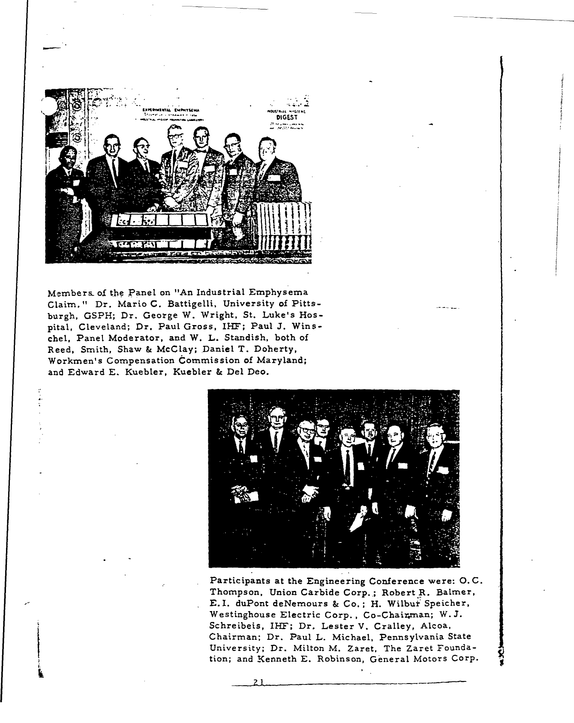
Members. o the Panel on "An Industrial Emphysema Claim," Dr, Mario C.
refid# 44xkb8MQR5KbQOX5rn80eE3dQ1 page
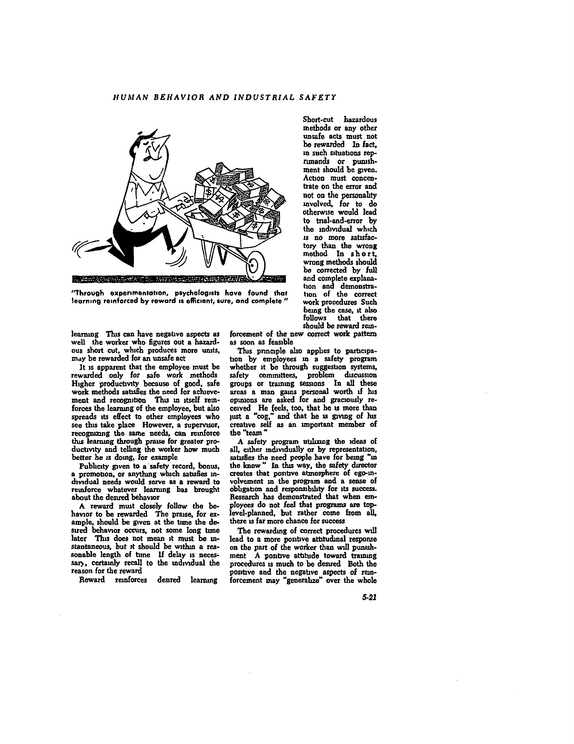
HUMAN BEHAVIOR AND INDUSTRIAL SAFETY learning This can have negative aspects os well the worker who figures out a hazard ous short cut, which produces more units, may be rewarded for an unsafe act It is apparent that the employee must be rewarded ooly for safe work methods Higher producbvity because of good, safe work methods satisfies the need for achieve ment and recognition This in itself rein forces the learning of the employee, but also spreads its effect to other employees who see this take place However, a supervisor, recognizing the same needs, can reinforce this learning through praise for greater pro ductivity and telling die worker how much better he is doing, for example Publicity given to a safety record, bonus, a promotion, or anything which satisfies in dividual needs would serve as a reward to reinforce whatever learning has brought about the desired behavior A reward must closely follow the be havior to be rewarded The praise, for ex ample, should be given at the time the de sired behavior occurs, not some long time later This does not mean it must be in stantaneous, but it should be within a rea sonable length of time If delay is neces sary, certainly recall to the individual the reason for the reward Reward reinforces desired learning Short-cut hazardous methods or any other unsafe acts must not be rewarded In fact, in such situations rep rimands or punish ment should be given.
refid# zdOr7jG78j1YEood2KJGGXaGn1 page
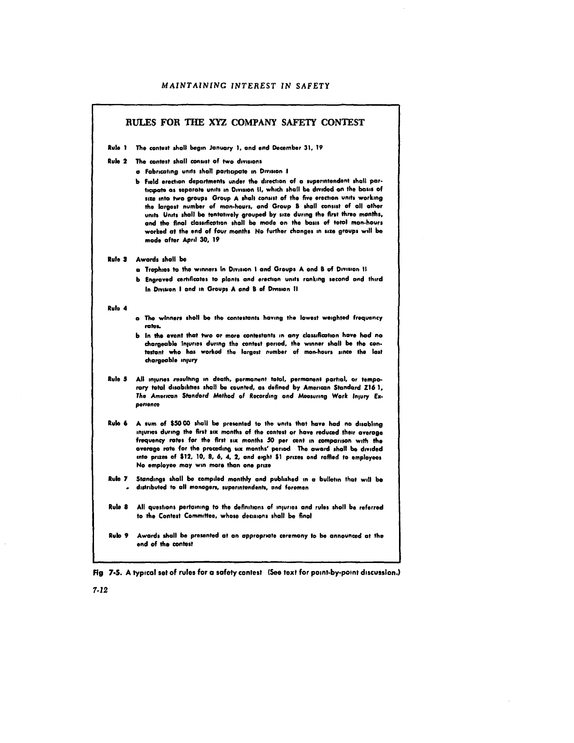
MAINTAINING INTEREST IN SAFETY RULES FOR THE XYZ COMPANY SAFETY CONTEST Rule t The contest shall begin January 1, ond end December 31, 19 Rule 2 The contest shall consist of two divisions o Fabricating units shall participate in Division 1 b Field erection deportments under the direction of a superintendent shall par ticipate os separate units in Division II, which shall be divided on the basis of size into two groups Group A shall consist of the five erection units working the largest number of man-hours, end Group B shall consist of oil other units Units shall bo tentatively grouped by size during the first three months, and the final classification shall be mode on the basis of tetol mon-hours worked at the end of four months No further changes in size groups will be mode after April 30, 19 Rule 3 Awards shall be a Trophies to the winners in Division 1 ond Groups A ond B of Division It b Engraved certificates to plants and erection units ranking second ond third In Division 1 and in Groups A ond B of Division II Rale 4 o The winners tholl be the contestants having the lowest weighted frequency rotes. b In the event that two or more contestants m any classification hove hod no chargeable Injuries during the contest period, the winner shall be the con* testont who has worked the largest number of mon-hours since the lost chargeable injury Rule 5 All injuries resulting in death, permanent total, permanent partial, or tempo rary total disabilities shall be counted, as defined by American Standard Z16 1, The American Sfandord Method of Recording ond Measuring Work Injury Ex perience Rule 6 A sum of $5000 shell be presented to the units that have had no disabling injuries during the first six months of the contest or have reduced their average frequency rates for the first six months 50 per cent m comparison with the overage rate for the preceding six months' period The oword sholl be divided into prizes of $12, 10, 8, 6, 4, 2, ond eight $1 prizes ond raffled to employees No employee may win more than one prize Rule 7 Standings shell be compiled monthly and published in a bulletin that will be distributed to all monogers, superintendents, and foremen Rule 8 All queitioni pertaining to the definition!
refid# gDmL4qYgG5G5wdGR4gkzJVjRG1 page
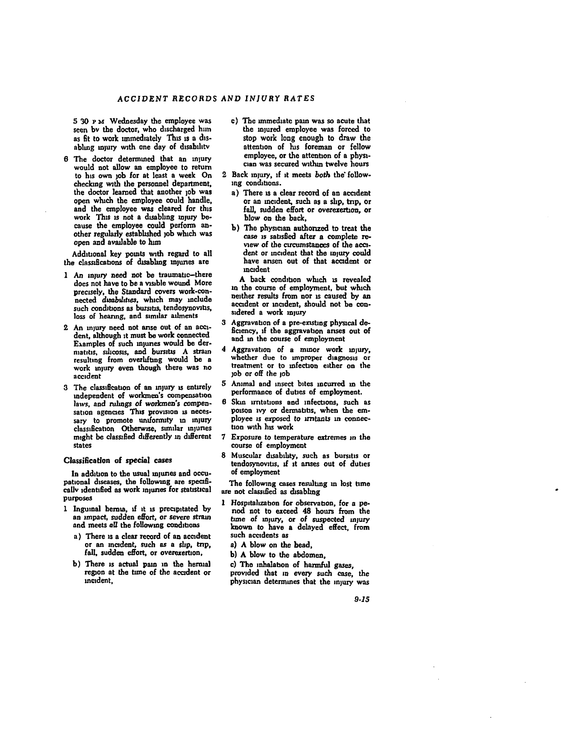
ACCIDENT RECORDS AND INJURY RATES 5 30 pm Wednesday the employee was seen bv the doctor, who discharged him as fit to work immediately This is a dis abling injury with one day of disability 6 The doctor determined that an injury would not allow an employee to return to his own job for at least a week On checking with the personnel department, the doctor learned that another job was open which the employee could handle, and the employee was cleared for this work This is not a disabling injury be cause the employee could perform an other regularly established job which was open and available to him Additional key points with regard to all the classifications of disabling injuries are 1 An injury need not be traumatic--there does not have to be a visible wound More precisely, the Standard covers work-con nected disabilities, which may include such conditions as bursitis, tendosynovibs, loss of hearing, and similar ailments 2 An injury need not arise out of an acci dent, although it must be work connected Examples of such injuries would be der matitis, silicosis, and bursitis A strain resulting from overhfbng would be a work injury even though there was no accident 3 The classification of an injury is entirely independent of workmen's compensation laws, and rulings of workmen's compen sation agencies This provision is neces sary to promote uniformity m injury classification Otherwise, similar injuries might be classified differently in different states Classification of special cases In addition to the usual injuries and occu pational diseases, the following are specifi cally identified as work injuries for statistical purposes X Inguinal hernia, if it is precipitated by an impact, sudden effort, or severe strain and meets all the following conditions a) There is a clear record of an accident or an incident, such as a slip, trip, fall, sudden effort, or overexertion, b) There is actual pain in the hernial region at the time of the accident or incident, c) The immediate pain was so acute that the injured employee was forced to stop work long enough to draw the attention of his foreman or fellow employee, or the attention of a physi cian was secured within twelve hours 2 Back injury, if it meets both the'follow ing conditions. a) There is a dear record of an accident or an incident, such as a slip, trip, or fall, sudden effort or overexertion, or blow on the back, b) The physician authorized to treat the case is satisfied after a complete re view of the circumstances of the acci dent or incident that the injury could have arisen out of that accident or incident A back condition which is revealed in the course of employment, but which neither results from nor is caused by an accident or incident, should not be con sidered a work injury 3 Aggravation of a pre-existing physical de ficiency, if the aggravation arises out of and in the course of employment 4 Aggravation of a minor work mjuiy, whether due to improper diagnosis or treatment or to infection either on the job or off the job 5 Animal and insect bites incurred in the j^erformance of duties of employment. 6 Sion irritations and infections, such as poison ivy or dermatitis, when the em ployee is exposed to irritants in connec tion with his work 7 Exposure to temperature extremes in the course of employment 8 Muscular disability, such as bursitis or tendosynovibs, if it arises out of duties of employment The following cases resulting m lost time are not classified as disabling 1 Hospitalization for observation, for a pe riod not to exceed 48 hours from the tune of injury, or of suspected injury known to have a delayed effect, from such acctdents as a) A blow on the bead, b) A blow to the abdomen, c) The inhalation of harmful gases, provided that m every such case, the physician determines that the injury was 9-15
refid# OxnvN4ErDLNxQkaEOdjp0o2Q1 page
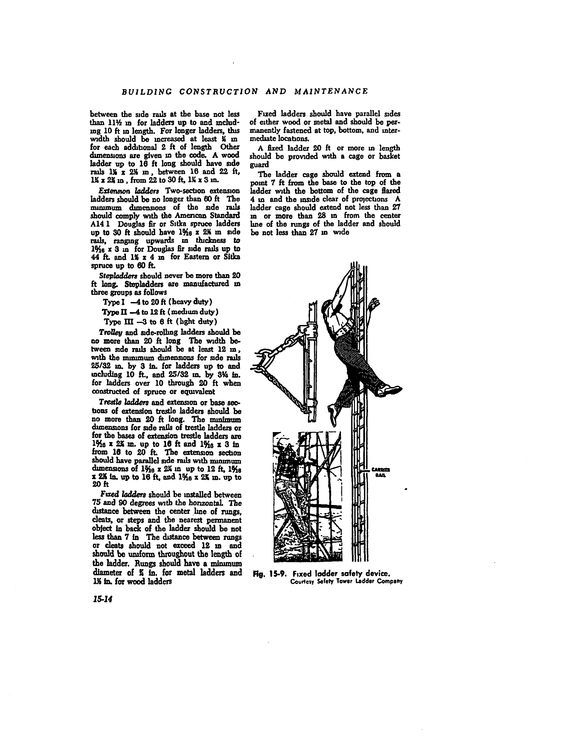
BUILDING CONSTRUCTION AND MAINTENANCE between the side rads at the base not less than 11% in for ladders up to and includ ing 10 ft in length.
refid# j2MjOOyXKwo8bqNEK6z3mov21 page
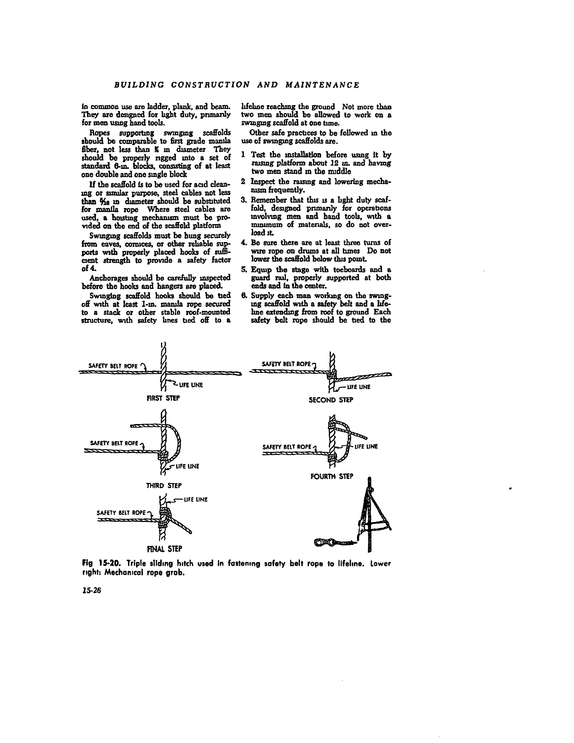
BUILDING CONSTRUCTION AND MAINTENANCE in common use bib ladder, plank, and beam.
refid# wrywM79pd59ErnbgXYOzrg9v41 page
ELEVATORS AND PLANT RAILWAYS If a tread chain breaks, a broken-chain sensing device should cut the power.
refid# rxyYEbzrvqdVo6N7R681RXbK71 page
COLD FORMING OF METALS Measures to preveut accidental tripping of the press in addition to placing a guard over the pedal include 1 A safety spring on the tnp rod 2 Aisles of ample width for trucking ma terial to the presses. 3 Aisles adjacent to the press used only for necessary trucking of dies and stock. 4 Enough working space between adjacent machines in the same line 5 Unauthorized persons kept away from the area 6 Operators protected from interruption. 7 The operator, and all other persons not concerned, kept away from die press when it is being set up 8 A closely supervised, mandatory rule prohibiting the operator from "tiding" the pedal The operator should remove his foot from the pedal immediately each time he trips the press 8 Flywheel brakes Flywheels -- especially on large presses--continue to coast for some tune after the power source has been turned off, and they have been known to cycle a press when the actuat ing control (or controls) was tripped A flywheel brake will stop the flywheel within 10 to 20 seconds Smgle-stroke attachments Through com mon usage the term "nonrepeat" has more or less come to mean both the nonxepeat device which is installed in the clutch mechanism by the manufacturer of the clutch and the smgle-stroke device which is attached to the tnp rod and which dis connects the pedal after each stroke of the press (Fig 23-20) A press with a positive clutch should have a single-stroke attachment which dis connects the pedal or operating lever after each stroke A single-stroke spring device should de pend on spnng action only if it is a com pression spring encased in a close-fitting* tube or closely wound on a rod The type wound on a rod is preferable because it permits easy detection of a broken spnng ".
refid# 71v1VVk01VjLM8eL9Yr21ogma1 page
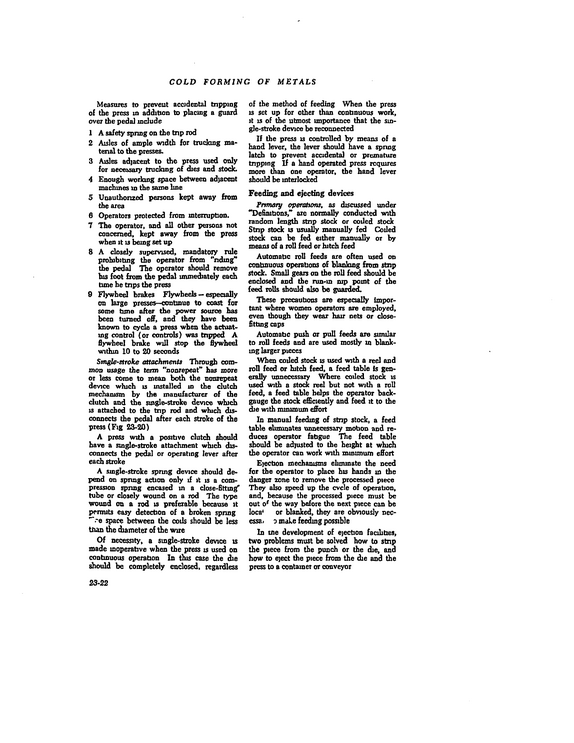
COLD FORMING OF METALS Fig. 23*27: This magazine on a push feed enobles the operator to catch every press stroke Slot "A" in the pusher must be in alignment with interlock "B" before the press can be tripped This feature assures proper positioning of the port in the die Figures courtesy Liberty Mutual Insurance Company blanks or pieces are fed, one at a time, by a mechanical plunger or other device which pushes them under the slide Manually operated plunger feeds are used for individual pieces which, because of their irregular shape, will not stack in a maga zine or will not slide easily down a gravity chute Each piece is placed in the nest in the pusher and moved to the die by manual operation of the pusher.
refid# ppXqLvQzmv84en6JK5qednwX71 page
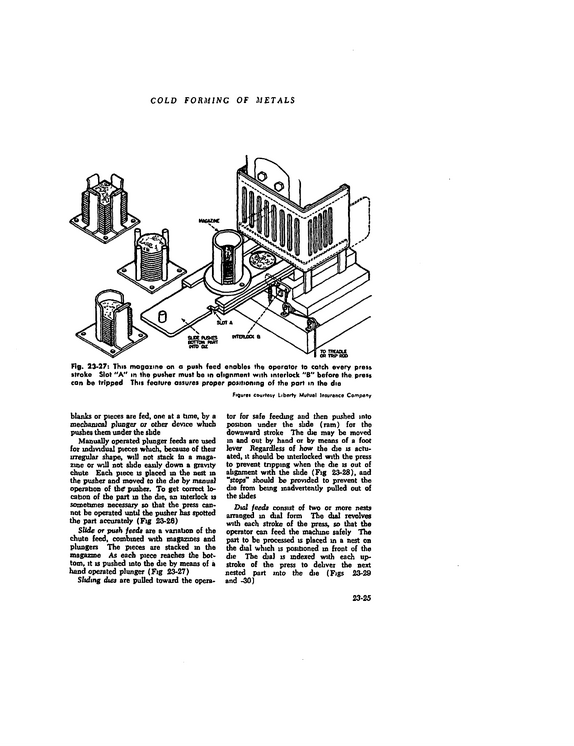
WOODWORKING MACHINERY Underslung cutoff saws An underslung cutoff saw is usually op erated by a treadle, and its forward move ment is fast It should be completely en closed in the idling position (Fig. 25-8).
refid# Z84p6V8OXYBymovxryb0bQoLO1 page
HOT WORKING OF METALS maximal acceptable concentrations, and physiological effects of these materials Also see Chapter 41, "Table of Chemical Haz ards," for summaries of their physical prop erties Dust is generated in m?
refid# N2mZOybq69qLpnBwmRaVGYkVQ1 page
HAND AND PORTABLE FOWER TOOLS merit, such as goggles, can be recommended and issued when the tool is issued.
refid# 4vdkLmw39azaODGonqKLEj30Q1 page
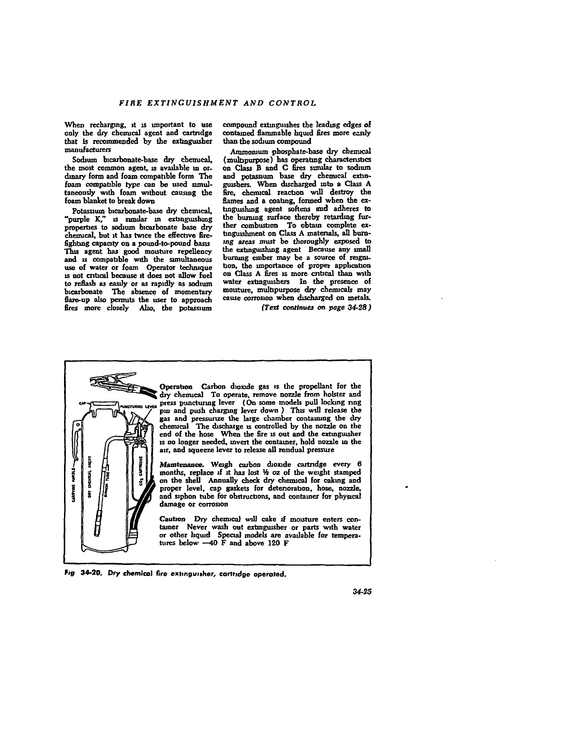
FIRE EXTINGUISHMENT AND CONTROL When recharging, it is important to use only the dry chemical agent and cartridge that is recommended by the extinguisher manufacturers Sodium bicarbonate-base dry chemical, the most common agent, is available in or dinary form and foam compatible form The foam compatible type can be used simul taneously with foam without causing the foam blanket to break down Potassium bicarbonate-base dry chemical, "purple K," is similar in extinguishing properties to sodium bicarbonate base dry chemical, but it has twice the effective fire fighting capacity on a pound-to-pound basis This agent has good moisture repellency and is compatible with the simultaneous use of water or foam Operator technique is not critical because it does not allow fuel to reflash as easily or as rapidly as sodium bicarbonate The absence of momentary flare-up also permits the user to approach fires more closely Also, the potassium compound extinguishes the leading edges of contained flammable liquid fires more easily than the sodium compound Ammonium phosphate-base dry chemical (multipurpose) has operating characteristics on Class B and C fires similar to sodium and potassium base dry chemical extin guishers.
refid# p7EK3nMQz7K215Q2452V602D1 page