Refine
Estimated Years UndatedClear
92,592 results foundRefine Search
not as single, discrete item, but rather in interacting combination This research is concerned, for example, with general per ceptive capabilities and accidents, and not with just the separate abilities that contribute to perception Individual personality.
refid# r6pgZ4xn9Ej9O04N2dqRO75yE1 page
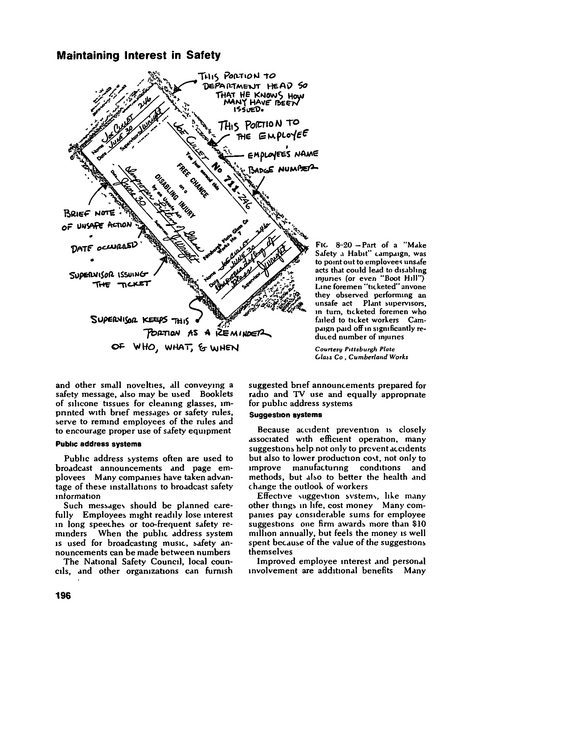
Maintaining Interest in Safety , &/S '?
refid# Ne2Yz002Bey6EGZdkLkGqEZmy1 page
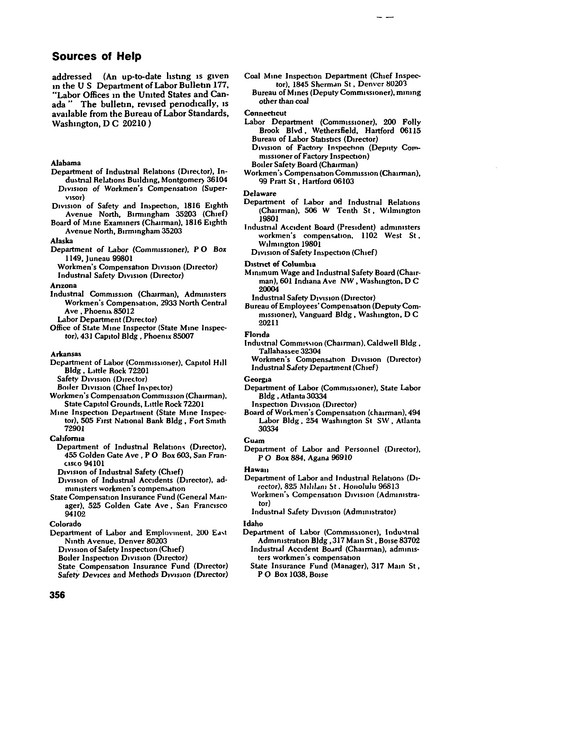
Sources of Help addressed (An up-to-date listing is given in the U S Department of Labor Bulletin 177, "Labor Offices m the United States and Can ada " The bulletin, revised periodically, is available from the Bureau of Labor Standards, Washington, D C 20210) Alabama Department of Industrial Relations (Director), In dustrial Relations Building, Montgomery 36104 Division of Workmen's Compensation (Super visor) Division of Safety and Inspection, 1816 Eighth Avenue North, Birmingham 35203 (Chief) Board of Mine Examiners (Chairman), 1816 Eighth Avenue North, Birmingham 35203 Alaska Department of Labor (Commissioner), P O Box 1149, Juneau 99801 Workmen's Compensation Division (Director) Industrial Safety Division (Director) Arizona Industrial Commission (Chairman), Administers Workmen's Compensation, 2933 North Central Ave , Phoenix 85012 Labor Department (Director) Office of State Mine Inspector (State Mine Inspec tor), 431 Capitol Bldg , Phoenix 85007 Arkansas Department of Labor (Commissioner), Capitol Hill Bldg , Little Rock 72201 Safety Division (Director) Boiler Division (Chief Inspector) Workmen's Compensation Commission (Chairman), State Capitol Grounds, Little Rock 72201 Mine Inspection Department (State Mine Inspec tor), 505 First National Bank Bldg , Fort Smith 72901 California Department of Industrial Relations (Director), 455 Golden Gate Ave , P O Box 603, San Fran cisco 94101 Division of Industrial Safety (Chief) Division of Industrial Accidents (Director), ad ministers workmen's compensation State Compensation Insurance Fund (General Man ager), 525 Golden Gate Ave , San Francisco 94102 Colorado Department of Labor and Employment, 200 East Ninth Avenue, Denver 80203 Division of Safety Inspection (Chief) Boiler Inspection Division (Director) State Compensation Insurance Fund (Director) Safety Devices and Methods Division (Director) Coal Mine Inspection Department (Chief Inspec tor), 1845 Sherman St, Denver 80203 Bureau of Mines (Deputy Commissioner), mining other than coal Connecticut Labor Department (Commissioner), 200 Folly Brook Blvd, Wethersfield, Hartford 06115 Bureau of Labor Statistics (Director) Division of Factory Inspection (Deputy Com missioner of Factory Inspection) Boiler Safety Board (Chairman) Workmen's Compensation Commission (Chairman), 99 Pratt St, Hartford 06103 Delaware Department of Labor and Industnal Relations (Chairman), 506 W Tenth St, Wilmington 19801 Industnal Accident Board (President) administers workmen's compensation, 1102 West St, Wilmington 19801 Division ofSafety Inspection (Chief) Distnct of Columbia Minimum Wage and Industnal Safety Board (Chair man), 601 Indiana Ave NW , Washington, D C 20004 Industnal Safety Division (Director) Bureau of Employees' Compensation (Deputy Com missioner), Vanguard Bldg , Washington, D C 20211 Flonda Industnal Commission (Chairman), Caldwell Bldg , Tallahassee 32304 Workmen's Compensation Division (Director) Industnal Safety Department (Chief) Georgia Department of Labor (Commissioner), State Labor Bldg , Atlanta 30334 Inspection Division (Director) Board of Workmen's Compensation (chairman), 494 Labor Bldg, 254 Washington St SW , Atlanta 30334 Cuam Department of Labor and Personnel (Director), P O Box 884, Agana 96910 Hawaii Department of Labor and Industnal Relations (Di rector), 825 Mililani St, Honolulu 96813 Workmen's Compensation Division (Administra tor) Industnal Safety Division (Administrator) Idaho Department of Labor (Commissioner), Industnal Administration Bldg ,317 Main St, Boise 83702 Industrial Accident Board (Chairman), adminis ters workmen's compensation State Insurance Fund (Manager), 317 Main St, P O Box 1038, Boise 356
refid# MGaKkenB9Z8rRa95rV1gMzqp71 page
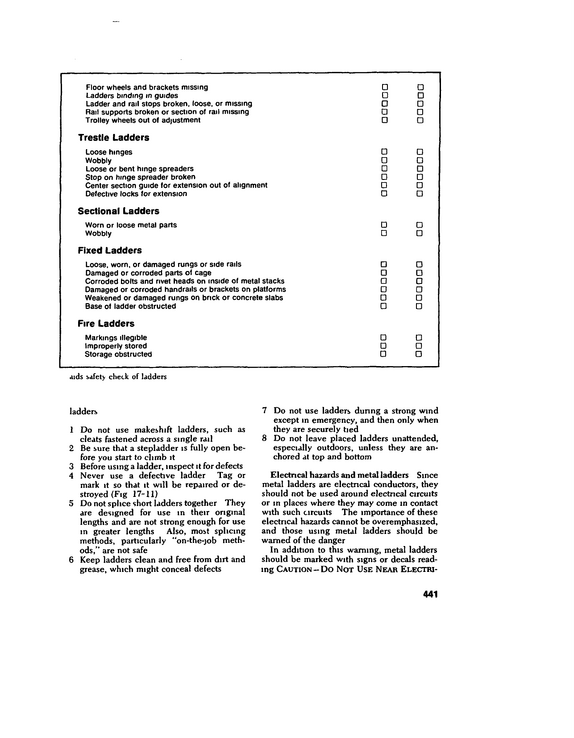
Floor wheels and brackets missing Ladders binding in guides Ladder and rail stops broken, loose, or missing Rail supports broken or section of rail missing Trolley wheels out of adjustment Trestle Ladders Loose hinges Wobbly Loose or bent hinge spreaders Stop on hinge spreader broken Center section guide for extension out of alignment Defective locks for extension Sectional Ladders Worn or loose metal parts Wobbly Fixed Ladders Loose, worn, or damaged rungs or side rails Damaged or corroded parts of cage Corroded bolts and rivet heads on inside of metal stacks Damaged or corroded handrails or brackets on platforms Weakened or damaged rungs on brick or concrete slabs Base of ladder obstructed Fire Ladders Markings illegible Improperly stored Storage obstructed aids safety check of ladders O ladders 1 Do not use makeshift ladders, such as cleats fastened across a single rail 2 Be sure that a stepladder is fully open be fore you start to climb it 3 Before using a ladder, inspect it for defects 4 Never use a defective ladder Tag or mark it so that it will be repaired or de stroyed (Fig 17-11) 5 Do not splice short ladders together They are designed for use in their original lengths and are not strong enough for use m greater lengths Also, most splicing methods, particularly "on-the-job meth ods," are not safe 6 Keep ladders clean and free from dirt and grease, which might conceal defects 7 Do not use ladders during a strong wind except m emergency, and then only when they are securely tied 8 Do not leave placed ladders unattended, especially outdoors, unless they are an chored at top and bottom Electrical hazards and metal ladders Since metal ladders are electrical conductors, they should not be used around electrical circuits or in places where they may come m contact with such circuits The importance of these electrical hazards cannot be overemphasized, and those using metal ladders should be warned of the danger In addition to this warning, metal ladders should be marked with signs or decals read ing Caution-Do Not Use Near Electrj- 441
refid# gEE17GQD5kg59x6ygV4RRGVgq1 page
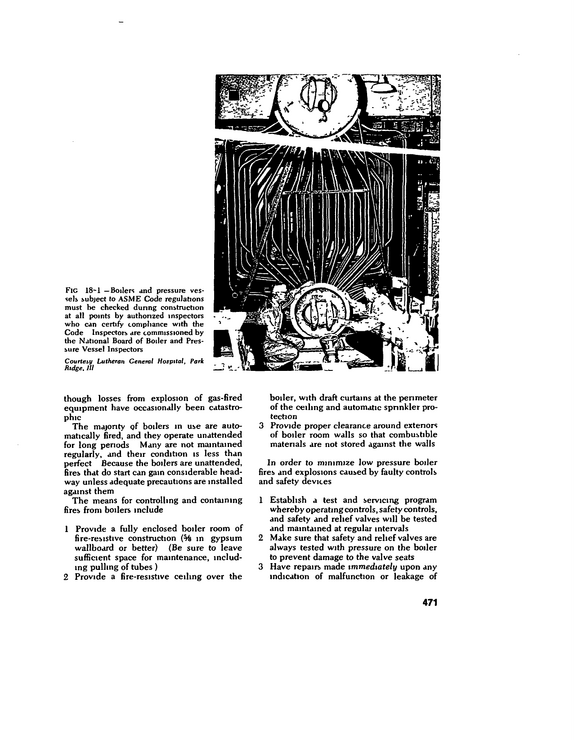
Fig 18-1 --Boilers and pressure ves sels subject to ASME Code regulations must be checked during construction at all points by authonzed inspectors who can certify compliance with the Code Inspectors are commissioned by the National Board of Boiler and Pres sure Vessel Inspectors Courtesy Lutheran General Hospital, Park Ridge.
refid# Ne6dL0NpnX2NovQvkO4NqRw5y1 page
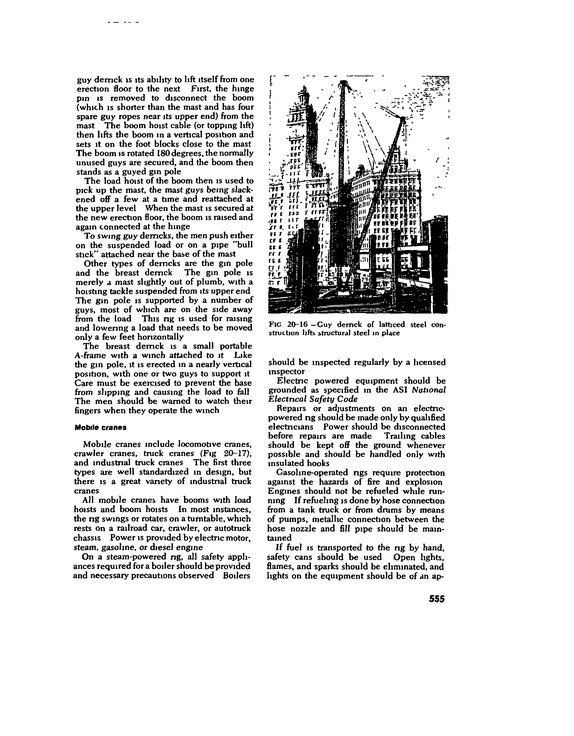
guy derrick is its ability to lift itself from one erection floor to the next First, the hinge pm is removed to disconnect the boom (which is shorter than the mast and has four spare guy ropes near its upper end) from the mast The boom hoist cable (or topping lift) then lifts the boom in a vertical position and sets it on the foot blocks close to the mast The boom is rotated 180 degrees, the normally unused guys are secured, and the boom then stands as a guyed gm pole The load hoist of the boom then is used to pick up the mast, the mast guys being slack ened off a few at a time and reattached at the upper level When the mast is secured at the new erection floor, the boom is raised and again connected at the hinge To swing guy derricks, the men push either on the suspended load or on a pipe "bull stick" attached near the base of the mast Other types of derricks are the gin pole and the breast derrick The gin pole is merely a mast slightly out of plumb, with a hoisting tackle suspended from its upper end The gm pole is supported by a number of guys, most of which are on the side away from the load This ng is used for raising and lowering a load that needs to be moved only a few feet horizontally The breast derrick is a small portable A-frame with a winch attached to it Like the gin pole, it is erected in a nearly vertical position, with one or two guys to support it Care must be exercised to prevent the base from slipping and causing the load to fall The men should be warned to watch their fingers when they operate the winch Mobile cranes Mobile cranes include locomotive cranes, crawler cranes, truck cranes (Fig 20-17), and industrial truck cranes The first three types are well standardized in design, but there is a great variety of industrial truck cranes All mobile cranes have booms with load hoists and boom hoists In most instances, the ng swings or rotates on a turntable, which rests on a railroad car, crawler, or autotruck chassis Power is provided by electric motor, steam, gasoline, or diesel engine On a steam-powered ng, all safety appli ances required for a boiler should be provided and necessary precautions observed Boilers Fic 20-16 --Guy demck of latticed steel con struction lifts structural steel in place should be inspected regularly by a licensed inspector Electnc powered equipment should be grounded as specified in the ASI National Electrical Safety Code Repairs or adjustments on an electncpowered ng should be made only by qualified electncians Power should be disconnected before repairs are made Trailing cables should be kept off the ground whenever possible and should be handled only with insulated hooks Gasoline-operated ngs require protection against the hazards of fire and explosion Engines should not be refueled while run ning If refueling is done by hose connection from a tank truck or from drums by means of pumps, metallic connection between the hose nozzle and fill pipe should be main tained If fuel is transported to the ng by hand, safety cans should be used Open lights, flames, and sparks should be eliminated, and lights on the equipment should be of an ap- 555
refid# Rj03m1z31kErvMw3YZLGKm2XX1 page
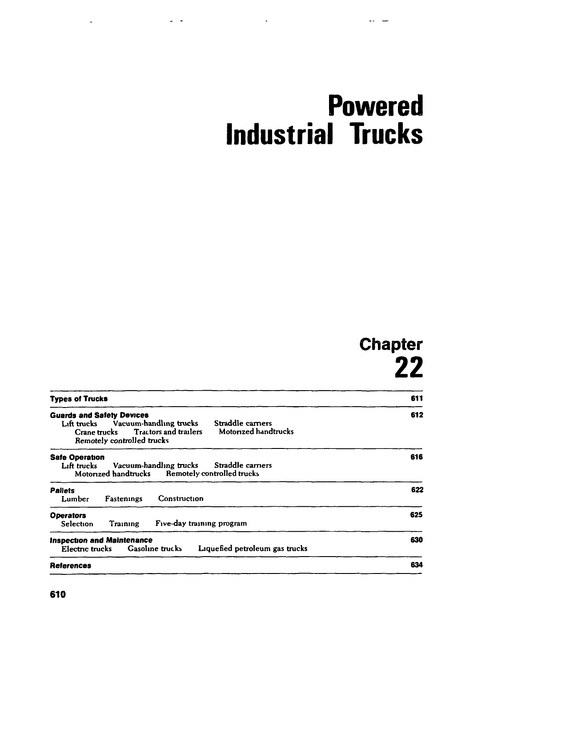
Powered Industrial Trucks Types of Trucks Guards and Safety Devices Lift trucks Vacuum-handling trucks Crane trucks Tractors and trailers Remotely controlled trucks Straddle earners Motonzed handtrucks Safe Operation Lift trucks Vacuum-handling trucks Straddle earners Motonzed handtrucks Remotely controlled trucks Pallets Lumber Fastenings Construction Operators Selection Training Five-day training program Inspection and Maintenance Electnc trucks Gasoline trucks Liquefied petroleum gas trucks References 610 Chapter 22 611 612 616 622 625 630 634
refid# Rpq8r92YjeaBvRM2Drj5ZxXBB1 page
newal, after each accident, injury, or extended illness, or at other appropriate intervals A fair amount of intelligence is required, together with respect for the safety of person nel and property It should be made clear to operators that they carry considerable re sponsibility and that reckless or careless oper ation will not be tolerated They should be checked on the job from time to time for ob servance of this rule Each plant should adopt a set of rules governing the operation of powered industrial trucks Because plant conditions and equip ment vary widely, rules which cover specific conditions should be set up For ready identification, many companies issue badges to authorized truck operators Badges also tend to remind operators of their responsibilities and give them pnde in their job Training A truck incompetently operated may cause severe injury or substantial property damage, no company can afford even one improperly trained truck operator Many companies have set up operator training programs Truck manufacturers can often supply course out lines, instructors' manuals, study text, films, and booklets for training in correct operation and safety Five-day training program A brief discussion of a five-day training course for lift truck operators follows A de tailed description and discussion of this course is available from the manufacturer who supplied the information Courses for train ing operators of other types of powered indus trial trucks are also available A classroom and a paved practice area, at least 50 ft square, should be provided Each class should have no more than five trainees The course is based on four principles tell, show, practice, correct As indicated in the sample outline of curriculum (Fig 22-18), each day's session should be divided between classroom work and practical instruction m the practice area with the trucks On the second and each following day, the session should open with a quiz covering the previous day's work Each trainee should have a record card showing the day's progress and his own weak points He and his in structor should try to eliminate these weak points before the next step is undertaken The final examination should take the form of qualification tests, which require the trainee to demonstrate his skill in handling the truck, his judgment, and his knowledge of safety, basic matenals-handhng, and preventive maintenance A certificate of graduation, which may be an official operator's permit, should be issued upon successful completion of the course Practical training and testing are conducted on obstacle courses consisting of pallets set on end in patterns designed to simulate box cars, aisles, material piles, and other ob structions (Fig 22-19) These obstacle courses and the maneuvers required to nego tiate them have been largely standardized m operator training programs all over the country In many training courses, the final qualifying examination consists of one or more test problems presented on the obstacle course The instructor may be provided with a checklist and test sheet (Fig 22-20) upon which he grades the prospective op erator as he observes the performance Many other points may be included in the checklist, such as failure to look behind when backing, failure to inspect the load before starting, failure to center the forks properly under the load, and traveling with forks raised too high Although other training programs may vary in details from the example given, it demon strates the essentials of good training pro cedures, which include 1 Physical qualification 2 Aptitude selection 3 Classroom instruction and testing 4 Field instruction and testing 5 Authorization only upon satisfactory com pletion of training In some training courses, the candidate is issued a student badge upon successful com pletion of the training course, and can qualify (Text continues on page 630 ) Donald R Holm, "Selecting and Training Fork Truck Operators " Reprinted from Space Magazine liv the Hyster Company, Portland, Ore 627
refid# QMJbZM0O5exVKoVMVx15vRr1E1 page
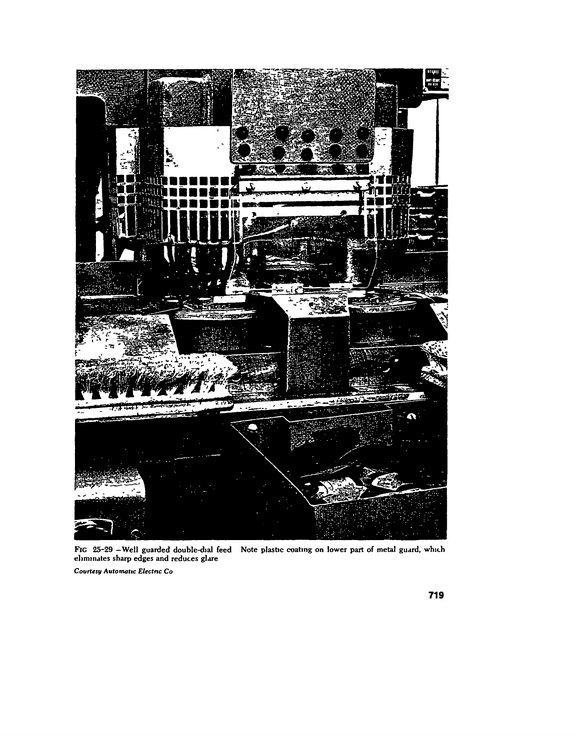
Courtesy Automatic Electric Co 719
refid# L0n7B3QVZLdBrgGqOqB62aQQ1 page
penenced workmen Crucibles should be supported on foundations or pedestals of fire brick, graphite, or other infusible material The removal of heavy crucibles from fur naces calls not only for special skill but also for physical strength If the men are over strained, serious accidents are likely to result Where possible, therefore, a mechanical de vice should be employed for removing heavy crucibles --those exceeding 100 lb in com bined weight of crucible, tongs, and metal (Fig 28-9) Crucible furnaces The operation of crucible furnaces is a rela tively hazard-free operation if suitable ex haust hoods are installed on all furnaces used for melting metals which give off harmful fumes Upright furnaces having crown plates more than 12 in above the surrounding floor should be equipped with metal platforms having standard rails Such platforms should extend along the front and sides of the furnace flush with the crown plates and clear of all obstruc tions Crucibles containing molten metal should be lowered from these platforms me chanically Many crucible furnaces are oil fired, and unless the motors driving the oil pump and the air supply for the furnaces are connected to the same source of power, a considerable quantity of oil may flow onto the floor if the power goes off the air line One remedy is to put a gate valve in the oil supply line so that in case of an air failure, oil can be shut off from the entire battery of crucible furnaces m one operation If the pilot and burner are electrically controlled, this valve can be so arranged that it will be similar to an interlock A mechanical shutoff can be made by the installation in the oil line of a gate leveroperated valve which is closed by the release of a weight Since the weight is held up normally by an air cylinder, the oil supply is stopped at once when the air goes off A small hole may be drilled in the cylinder so that air in it may be released promptly when the oil pressure goes off Ovens The pnncipal hazards in the construction and operation of core ovens and mold drying ovens are excess smoke, gases, and fumes given off into the foundry atmosphere Other unsafe conditions are unprotected firing pits, unguarded vertical sliding doors or their counterweights (which may drop on workers), and flashbacks from fire boxes Finng pits into which men may fall should be guarded with substantial railings or with grating covers having trap doors to give access to the steps leading down into the pits Safe types of vertical sliding doors should be installed Cables and chains having a high factor of safety, substantial cable and chain fastenings, large sheaves to prevent undue wear of cables, and guarded counter weights are also necessary All sliding doors should be thoroughly inspected at frequent intervals Safety dogs may be used to hold the doors in raised position Many vertical core ovens are 60 to 70 ft high and have a driving mechanism located at the top Some foundries have installed steel stairways with standard treads wherever possible Where metal ladders must be used, not less than 6 in of clearance should be maintained from the center of each ladder rung to the side of the oven A caution sign should be placed on the wall near core ovens, giving necessary pre cautions and manufacturer's instructions to be observed when ovens are being lighted Gas-fired ovens Gas-fired ovens should, whenever possible, be located in a room separate from the mold ing floors and also from the coremaking room by a partition This measure will help pre vent equipment failures caused by sand in the controls Blast tip pipe burners should be equipped with baffles to keep sand out of the tip and also to spread the flame Tips should also be horizontal to protect them from sand Safety pilot valves will prevent the flow of unbumed gas into the oven combustion chamber should the burner pilot light go out, or should a cock or burner be accidentally opened A valve of this nature should be installed on every gas-buming furnace or oven A bleeder valve in the line between two control valves close to the burner is an addi tional safety device The operator can then 817
refid# 6bEKjna2g0rQM9GJBo8kbQwyE1 page
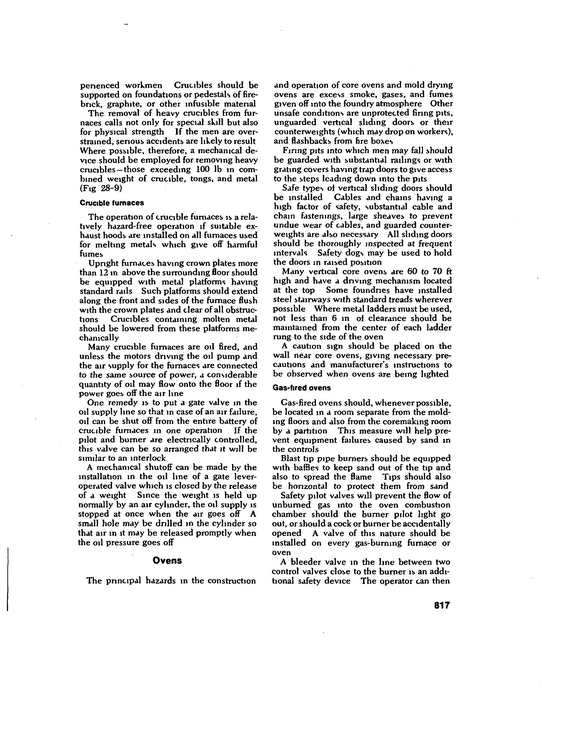
Hot Working of Metals FlC 28-J4 -- "Pill" of radioactive cobalt-60 is placed inside newly cast pump housings Radiation exposes X-ray film strapped to outside of castings and shows up defects Aluminum rod is long enough to keep operators and radiation source safely separated Second man monitors exposure during inspection minute quantities of current generated when two metdllurgicallv or chemically unlike con ductors are moved into frictional contact If the conductors are alike, no current will be generated The equipment consists of a control unit and a portable sorting head connected by means of a cable The sorting head contains all the main controls for actuating the test and is designed for one-handed operation This method is designed to sort and identih metal parts ot not more than four alloy types Electromagnetic methods Two types of electromagnetic tests are currently being used m industry magnetoinductive and eddy current A third type, employing radar frequency, is also being used, but only to a limited extent The magneto-inductive method utilizes variations in the permeability of magnetic materials to create variations in a pickup coil or probe Eddy current The second tvpe ol elec tromagnetic testing utilizes AC in a coil or probe to induce eddv current into the part being tested Delects and variations in properties or geometis cause changes in the strength and distribution ol the eddv current Readout is presented on a cathode ray tube, on a meter, by audible or visible alarm, or bv a combination ot these methods Radar frequency methods use high-frequenev radar waves to measure the electro magnetic properties of thin coatings and surface layers of material To make such tests, a wave guide or cavity oscillator is 828
refid# 2gQJLRz1Eb4ZdrBd94ZQGREb1 page
General and Comfort Ventilation is very severe heat strain, which only a small percentage of the population may be expected to sustain An HS1 of 100 is the maximum strain that can be tolerated daily by fit, ac climatized young men These evaluations of the HS1 are for 8-hour exposures The physiological strain and discomfort may be much less for shorter exposures J S McKames and R S Brief (see "Refer ences") have published nomographs for es timating the heat stress index Control of radiant heat Ventilation does not control radiant heat No number of fans circulating air in a work space will reduce the radiant heat load on a person Control comes only from 1 Reducing the temperature or thermal emissivity of the infrared source 2 Installing shields which will set up in frared "shadows" for men to work in 3 Providing personal protective clothing which is infrared-reflecting Wherever possible, conductive heat insula tion should be applied to sources whose tem perature cannot otherwise be lowered This reduces the surface temperature, and so di minishes the radiant heat emitted However, heat is sometimes an inherent part of the operation or product, and its tem perature cannot be lowered For example, a red-hot ingot of steel, or molten glass, or a heat-treat bath must be at a certain high tem perature Then shields or clothing are the answer Shields have been commonly used for years, as illustrated by the variety of sheet iron, boiler plate, asbestos mat, and wooden shields which can be found in most hot plants However, these matenals are good absorbers of radiant heat They get hot and reradiate to the men working on the "cool" side Such shield matenals are unwisely chosen The following will yield better results Reflective screens or shields made of comigated or flat aluminum sheets (commer cial siding and roofing) Polished copper, nickel, and chromium are also good, but of course are impractical because of cost Tin plate and new galvanized iron are satisfac tory, but tend to tarnish fairly rapidly and then become ineffective Excellent screens are made of aluminum foil, and foil backed by a supporting board such as gypsum board If the foil becomes blackened or tom, it is easy to paste a new piece over the board It is important to realize that the reflection is a surface phenomenon It does not matter how thick the aluminum is To have reflecting surface is vital, and so the aluminum should never be covered or embedded in anything Heat exchanging screens can be made of iron or steel and can be water cooled The heat absorbed by the screen is removed from the area by a film of water flowing over the metal Absorbing screens are a possibility only if they are covered with thermal insulation to keep their "cool" side from getting hot and reradiating to the men Transparent screens can be made of glass They may be (a) heat-absorbing glass, or (b) heat-reflecting glass Ordinary flat glass absorbs long wavelength infrared fairly well, there also are special glasses that accent this property They all, however, get hot and reradiate copiously Heat-refleeting glass has a thin permanent coating that does an admira ble job of reflecting heat, while still being thoroughly transparent to light Glass win dows should be heat-treated Wire mesh can also be used as a semitransparent screen Screens must be tailor-made for each opera tion Sometimes they can be attached per manently to a hot surface, with a gap between it and the shield The width must be suffi cient to allow air movement for removing heat by convection Such an arrangement is generally much cheaper than conductive insulation and does not upset the heat balance of the equipment -- which is important for furnaces, annealing ovens, and the like Sometimes the screens have to be movable to provide access to the equipment Then they can be hung from above with hooks, and hinged One plant uses overhead aluminum garage doors to open large control areas quickly At some operations vertical standing screens on legs or wheels, or folding screens, fill a need 910
refid# KJRJpRGLR8w5zXMKe243yk9z61 page
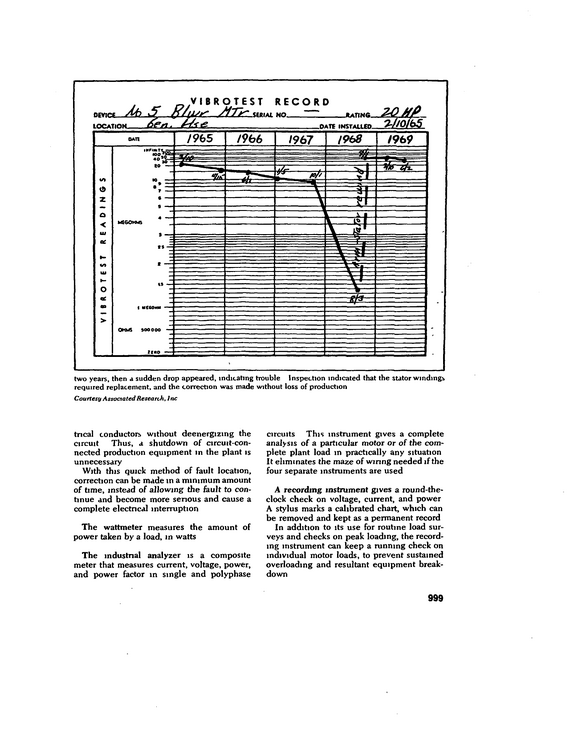
two years, then a sudden drop appeared, indicating trouble Inspection indicated that the stator windings required replacement, and the correction was made without loss of production Courtesy Associated Research, Inc tncal conductors without deenergizing the circuit Thus, a shutdown of circuit-con nected production equipment in the plant is unnecessary With this quick method of fault location, correction can be made in a minimum amount of time, instead of allowing the fault to con tinue and become more senous and cause a complete electrical interruption The wattmeter measures the amount of power taken by a load, m watts The industrial analyzer is a composite meter that measures current, voltage, power, and power factor m single and polyphase circuits This instrument gives a complete analysis of a particular motor or of the com plete plant load in practically any situation It eliminates the maze of wiring needed if the four separate instruments are used A recording instrument gives a round-theclock check on voltage, current, and power A stylus marks a calibrated chart, which can be removed and kept as a permanent record In addition to its use for routine load sur veys and checks on peak loading, the record ing instrument can keep a running check on individual motor loads, to prevent sustained overloading and resultant equipment break down 999
refid# G5Ra5jM04QXjkxBX4YL24ZKe41 page
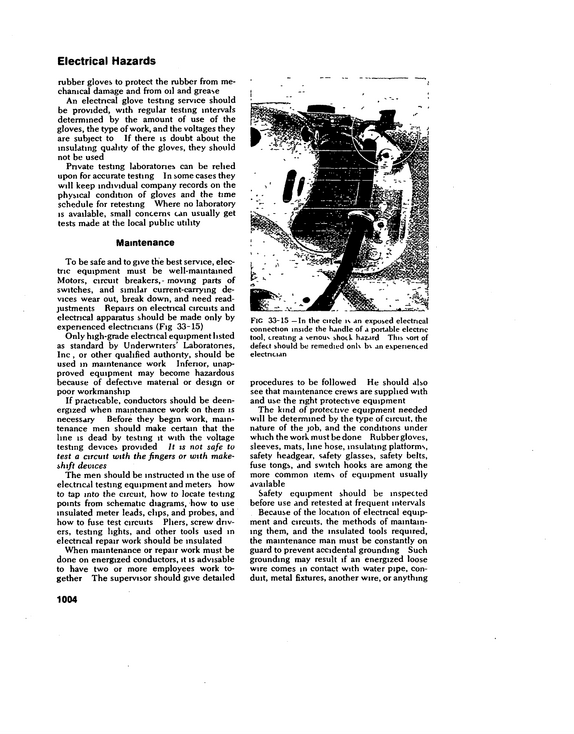
Electrical Hazards rubber gloves to protect the rubber from me chanical damage and from oil and grease An electrical glove testing service should be provided, with regular testing intervals determined by the amount of use of the gloves, the type of work, and the voltages they are subject to If there is doubt about the insulating quality of the gloves, they should not be used Pnvate testing laboratories can be relied upon for accurate testing In some cases they will keep individual company records on the physical condition of gloves and the time schedule for retesting Where no laboratory is available, small concerns can usually get tests made at the local public utility t Maintenance To be safe and to give the best service, elec tric equipment must be well-maintained Motors, circuit breakers,- moving parts of switches, and similar current-carrying de vices wear out, break down, and need read justments Repairs on electrical circuits and electrical apparatus should be made only by experienced electricians (Fig 33-15) Only high-grade electrical equipment listed as standard by Underwriters' Laboratories, Inc, or other qualified authority, should be used m maintenance work Inferior, unap proved equipment may become hazardous because of defective material or design or poor workmanship If practicable, conductors should be deen ergized when maintenance work on them is necessary Before they begin work, main tenance men should make certain that the line is dead by testing it with the voltage testing devices provided It is not safe to test a circuit with the fingers or with make shift devices The men should be instructed in the use of electrical testing equipment and meters how to tap into the circuit, how to locate testing points from schematic diagrams, how to use insulated meter leads, clips, and probes, and how to fuse test circuits Pliers, screw driv ers, testing lights, and other tools used in electrical repair work should be insulated When maintenance or repair work must be done on energized conductors, it is advisable to have two or more employees work to gether The supervisor should give detailed FlG 33-15 -- In the circle is an exposed electrical connection inside the handle of a portable electnc tool, creating a venous shock hazard This sort of defect should be remedied onls b\ an experienced electncian procedures to be followed He should also see that maintenance crews are supplied with and use the right protective equipment The kind of protective equipment needed will be determined by the type of circuit, the nature of the job, and the conditions under which the work must be done Rubber gloves, sleeves, mats, line hose, insulating platforms, safety headgear, safety glasses, safety belts, fuse tongs, and switch hooks are among the more common items of equipment usually available Safety equipment should be inspected before use and retested at frequent intervals Because of the location of electrical equip ment and circuits, the methods of maintain ing them, and the insulated tools required, the maintenance man must be constantly on guard to prevent accidental grounding Such grounding may result if an energized loose wire comes in contact with water pipe, con duit, metal fixtures, another wire, or anything 1004
refid# mq4ZExvyJJg5m0NR8E5EJy7201 page
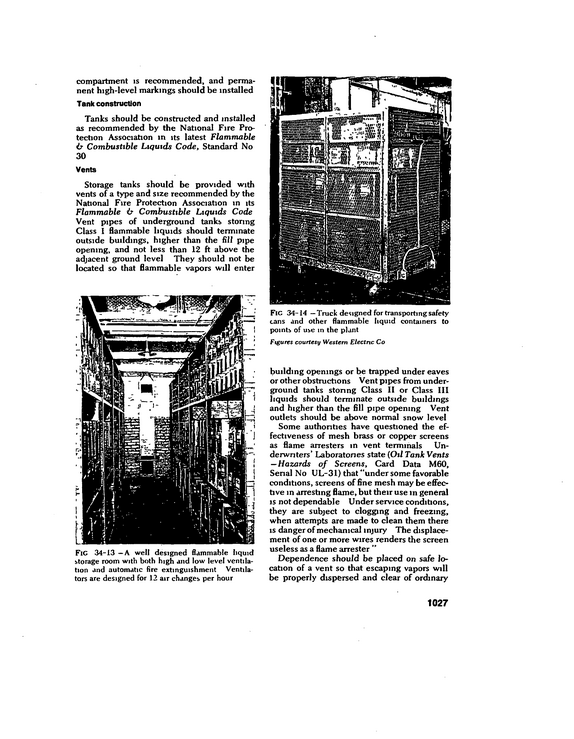
compartment is recommended, and perma nent high-level markings should be installed Tank construction Tanks should be constructed and installed as recommended by the National Fire Pro tection Association in its latest Flammable ir Combustible Liquids Code, Standard No 30 Vents Storage tanks should be provided with vents of a type and size recommended by the National Fire Protection Association in its Flammable ir Combustible Liquids Code Vent pipes of underground tanks storing Class 1 flammable liquids should terminate outside buildings, higher than the fill pipe opening, and not less than 12 ft above the adjacent ground level They should not be located so that flammable vapors will enter FlC 34-14 --Track designed for transporting safety cans and other flammable liquid containers to points of use in the plant Figures courtesy Western Electric Co FlC 34-13 -- A well designed flammable liquid storage room with both high and low level ventila tion and automatic fire extinguishment Ventila tors are designed for 12 air changes per hour building openings or be trapped under eaves or other obstructions Vent pipes from under ground tanks storing Class II or Class III liquids should terminate outside buildings and higher than the fill pipe opening Vent oudets should be above normal snow level Some authorities have questioned the ef fectiveness of mesh brass or copper screens as flame arresters in vent terminals Un derwriters' Laboratories state (Oil Tank Vents --Hazards of Screens, Card Data M60, Senal No UL-31) that "under some favorable conditions, screens of fine mesh may be effec tive in arresting flame, but their use in general is not dependable Under service conditions, they are subject to clogging and freezing, when attempts are made to clean them there is danger of mechanical injury The displace ment of one or more wires renders the screen useless as a flame arrester " Dependence should be placed on safe lo cation of a vent so that escaping vapors will be properly dispersed and clear of ordinary 1027
refid# Y9pMD04dMY1qDrnZg4XBJmB2N1 page