Refine
Estimated Years UndatedClear
92,592 results foundRefine Search
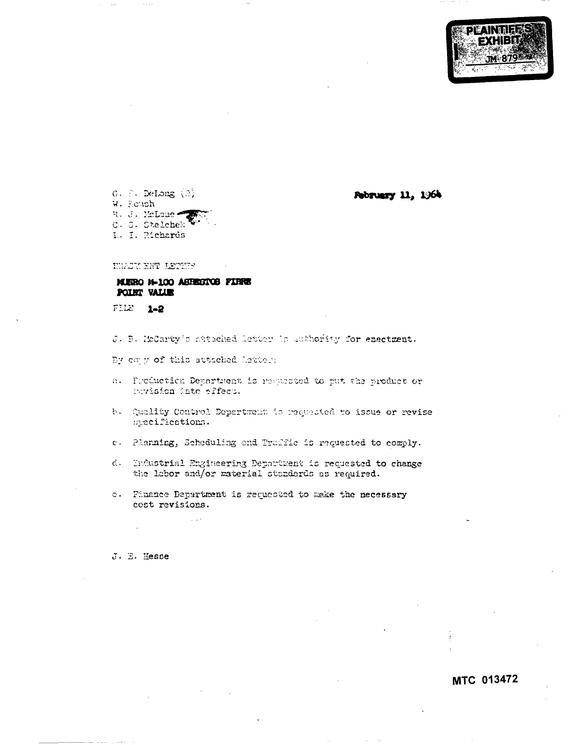
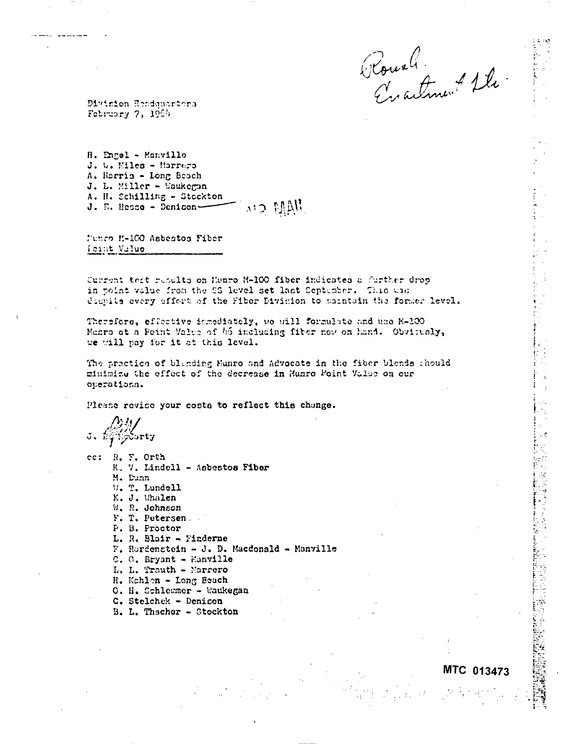
11, lj6k itfdifFNT lsttup KJ6B0 M-100 ASSSTQ8 FIHR8 fQZBT VALUB FILL' 1.2 J.
refid# peL6YK4wdpeyXmoDq5vr52axd2 pages
24--Materials Handling and Storage the normal curvatures are maintained This normally curved spine is termed a "straight back '' With "straight back lifting" the spine is fairly ngid (nonmedically speaking) and the pressure on the lumbar intervertebral disks is evenly distributed When lifting with the back bent, the spine forms an arc with the re sult that the lower back muscles are subject to strain and there is uneven pressure on the disks In addition to the risk of intervertebial disk lesions, lifting an object with the back bent and the legs straight imposes excessive stress on the muscles of the back for two reasons First, the back must be inclined at a greater angle to the vertical for the hands to reach the object Since the "effective weight" (of the object plus the upper part of the worker's body) increases rapidly as this angle is in creased, a much greater effort is required to raise the back to its vertical position Second, muscular effort is required to "straighten" the spine When a weight is being lifted from the ground, making maximum effective use of the legs, the back is straight but inclined for wards As the lift proceeds by the extension of the knees, the back returns to the vertical position The position of the feet and the flexion of the knees are the key factors for maintaining a straight back Arms close to the body When lifting and carrying weights, the arms should be close into the body and remain straight whenever possible This is because flexing the elbows and raising the shoulders imposes unnecessaiy strain on the muscles of the upper arms and chest Carrying involves a static posture of the arms, and particularly m the case of long distances, any assistance given by the body in supporting the weight will lessen the tension m the muscles Carrying with the aims straight enables the weight to rest against the thighs Correct hold.
refid# ZBOGdNxrXOoy4LmY1odE4ZDLZ1 page
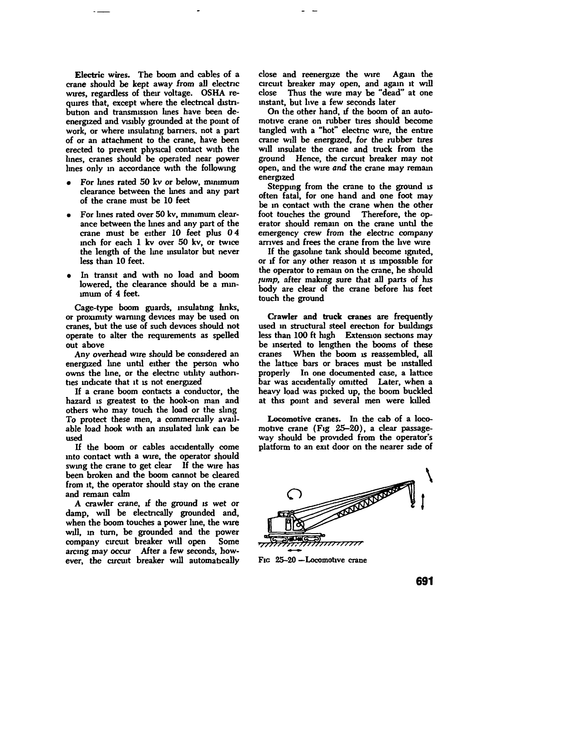
Electric wires.
refid# KGONq5DpevLwDzzrwDmwq1raQ1 page
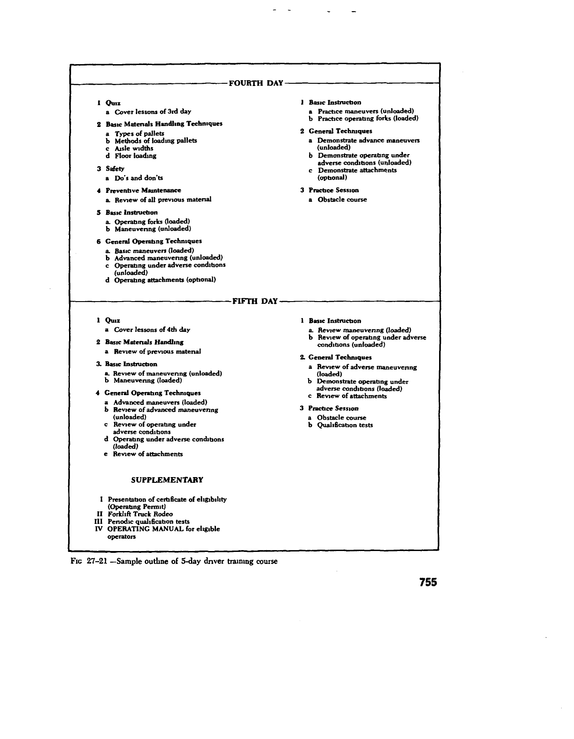
FOURTH DAY 1 Quiz a Cover lessons of 3rd day 2 Baste Materials Handling Techniques a Types of pallets b Methods of loading pallets c Aisle widths d Floor loading 3 Safety a Do's and don'ts 4 Preventive Maintenance a.
refid# jynExKGbn8eGvgJb2669DeKy51 page
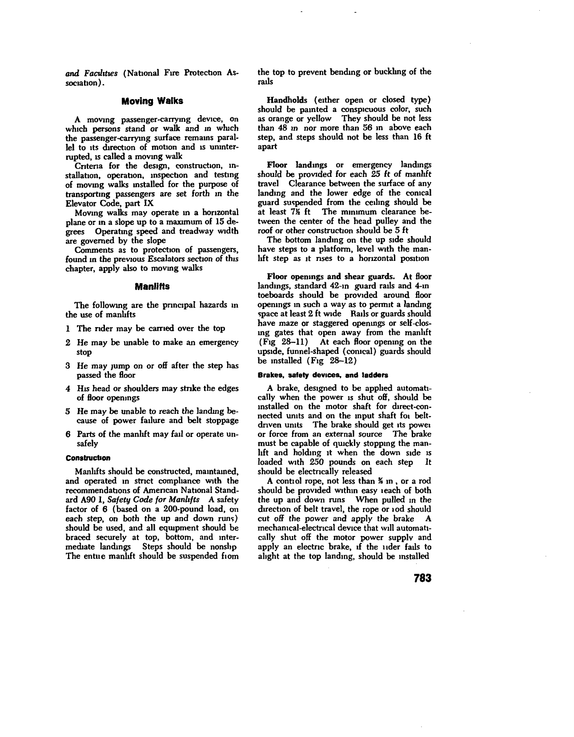
and Facilities (National Fire Protection As sociation).
refid# Gm2p8YwOxby0n50JyRB5MM9Vn1 page
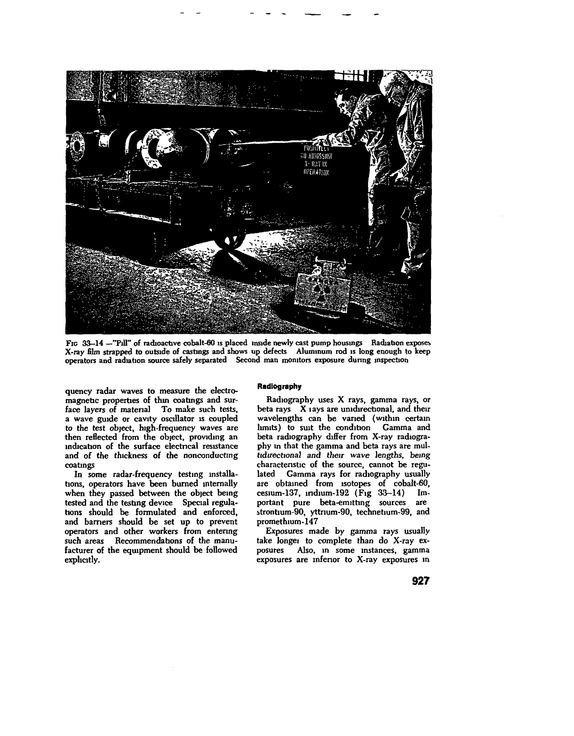
Fic 33-14 --"Pill" of radioactive cobalt-60 is placed inside newly cast pump housings Radiation exposes X-ray film strapped to outside of castings and shows up defects Aluminum rod is long enough to keep operators and radiation source safely separated Second man monitors exposure during inspection quency radar waves to measure the electro magnetic properties of thin coatings and sur face layers of material To make such tests, a wave guide or cavity oscillator is coupled to the test object, high-frequency waves are then reflected from the object, providing an indication of the surface electrical resistance and of the thickness of the nonconducting coatings In some radar-frequency testing installa tions, operators have been burned internally when they passed between the object being tested and the testing device Special regula tions should be formulated and enforced, and barriers should be set up to prevent operators and other workers from entering such areas Recommendations of the manu facturer of the equipment should be followed explicitly.
refid# yyNOp3rvBdXK6qa2N9k7RVZ31 page
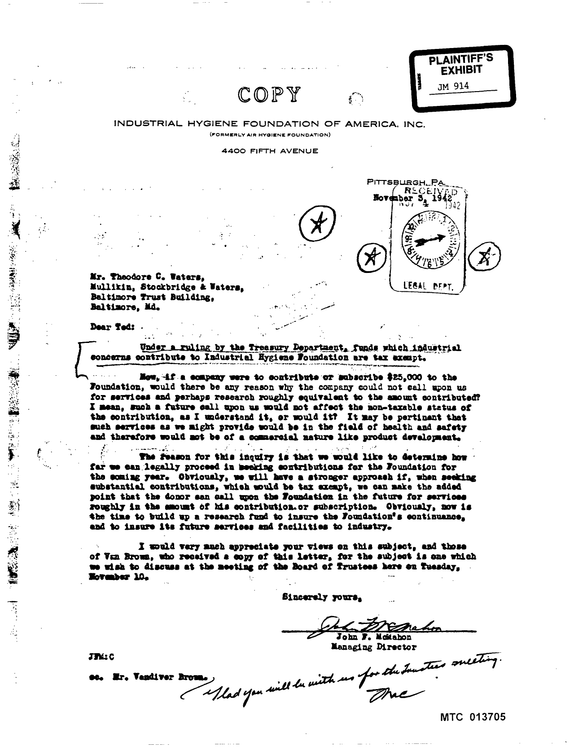
INDUSTRIAL.
refid# MobBDynJ4VJnRv0eY24pnNXVy1 page
,1 i i i PRIVILEGED ^5-?
refid# 0EZvoXZzRvgEqLbj8Egag7pn5 pages
37--Industrial Hygiene standard The criteria package is only pro posed, as of the date of publication of this Manual, but it is possible that the final stand ard may not differ substantially Therefore, establishments that have suspected or known heat problems should assemble the equipment necessary to determine the WBGT Index, and determine the WBGT profiles for both winter and summer conditions at workplaces Experience has shown that men do not stand a hot job very well at first, but develop tolerance rapidly and acquire full endurance in a week to a month Atmospheric pressure It has been recognized from the beginning of caisson work, about 1850, that men work ing under pressures greater than normal at mospheric are subject to various ills connected with the job The mam effect (decompression sickness commonly known as the "bends") results from the release of nitrogen bubbles into the circulation and tissues during decompiession The bubbles lodge at the joints and under muscles, causing severe cramps To prevent this trouble, decompression is earned out slowly and by stages so that the nitrogen can be eliminated slowly and without the formation of bubbles Deep-sea divers are supplied with a mix ture of helium and oxygen for breathing Since helium is an ineit diluent and is less soluble in blood and tissue than is nitrogen, it piesents a less formidable decompression problem Under some conditions of work at high pressure, the concentration of carbon dioxide in the atmosphere may be considerably in creased so that the carbon dioxide will act as a narcotic Keeping the oxygen concentration high will minimize the condition although not prevent it This procedure is useful where the carbon dioxide concentration cannot be kept at a proper level One of the most common troubles en countered by workers under compressed air is pain and congestion m the ears from in ability to ventilate the middle ear properly during compression and decompression As a result, many workers under compressed air suffer from temporary and some from per manent loss of hearing The cause of this damage is considered to be obstruction of the 1054 Eustachian tubes which prevents proper equalization of pressure on the middle ear The effects of reduced pressure on the worker are much the same as the effects of decompression from a high pressure If pres sure is reduced too rapidly, decompression sickness and ear disturbances similar to, if not identical with, the diver's conditions may result.
refid# DGeJzMK7nV6XVmnDkEp6MqZVM1 page
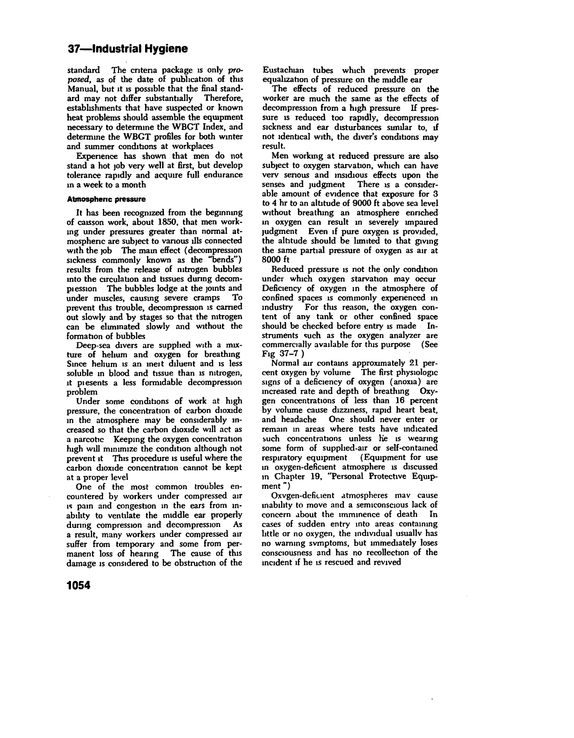
39--Chemical Hazards 1216 Substance o-Cresol p-CresoI Cumene Cyanides Cyanogen Cyclohexane Cyclohexanol Cy clohesanone Cyclopropane DDT TABLE OF CHEMICAL HAZARDS (Continued) 1 2 3 4 5 67 Flammable Limits (% FJosh by to/ume) Point (deg F) Lower Up)*er Vapor Volume (cufi Seventy per and Type gal) of Hazard Prccau~ Action ttons to Oral on Take Toxicity H ealth F fa m m a b i R e a c tiv ity 8 MFPA NSC Data Sheet 9 Reference* MCA Data Sheet A/A Bulletin A/HA Hygienic Culdef 178 1.4 - 32 D-8,7,4 2,3 4 c 2 2 0 (300 F) 202 11 - 32 D 8,7.4 2,3 4 c 2 1 0 (300 F) SD-48 SO 48 10-58 10-58 111 09 65 23 W-1,4 1.3 4 D 0 2 0 12-61 - D 6,8 5.3.2 6 - 32- SD-30 C-5 gas 6 32 - D 1,3 1.3.4 - - 4 4 3 -4 1 3 80 30 D 1,4,7 1.3 3 D 13 0 SD-68 10-63 154 31 C 4.1,7 1.2,3 3 D 12 0 111 11 - 32 C 4,1,7 1.2,3 3 D 12 0 12-65 gas 24 10 4 - D 1,3 1.3 - - 14 0 - C-6,8 3.2 4 - 303 10-59
refid# 0654myXoBaJ4yLqDQxQpv6VDJ1 page
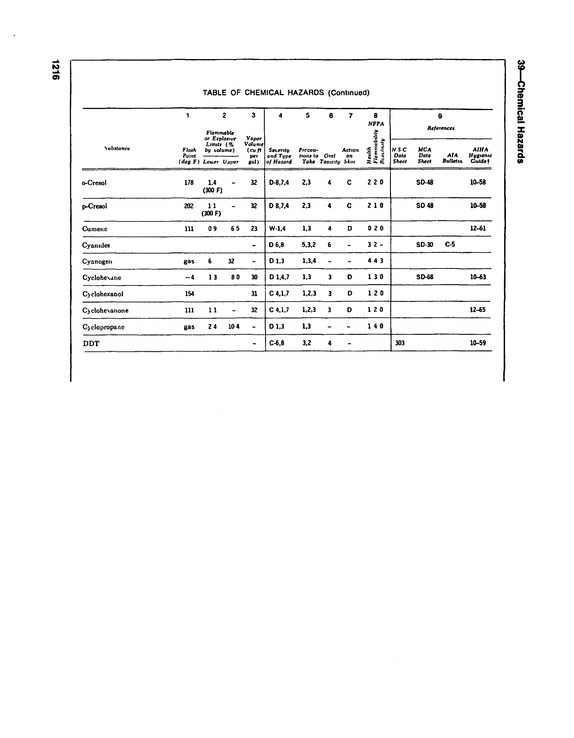
l*rop\ lene oxide Propyne ndine Selenium Silica or silicates Silver nitrate Sodium Sodium chlorate Sodium cyanide Sodium dichromate Sodium hydroxide Stoddard solvent Styrene monomer Sulfur Sulfur chlorides Sulfur dioxide Sulfuric acid -35 gas 68 105 90 245 21 215 - D-1,3 1.3 Cor C 242 6-59 17 - - D-1.5 1.3 - 1 8 12 4 41 W 1,3.7 1.2,3 3 A 242 B,D 2 3 0 310 8-63 - W-7,6 3.2,5 - C 578 C-56 6-59 - C-6 3,5 1 A 531 4-58, 9-57 - C 2,3 4,2,3 4 C 10 1 9-57 - 0-1,7 - W-2,7 5.4.2 Cor 5.4.2 4 C C 3 1 0 231 SD 47 10 2 371 SD-42 C-62 2-58 - D 6,7 5.3,2 6 - - W-6,7,2 3,2.5 4 c - 0-7.6 2,3 Cor c 301 SD-30 SD-46 214, SD-9 373 08 50 20 C-1,4 1.3 3 D 0 2 0 11 61 28 C-4,1,7 3,2.1 - D 2 3 - SD-37 C 48 10-68 - C 6,7,1 3,2,1 3 A 2 1 0 612 SD-74 - W-7,3 3,4,5 - C 2 1 0 SD-77 - D-3 - 0 7,3,2 3.5 3,4 Cor C C 300 SO-52 C-39 12-55 3 0 1 325 SD-20 C-12 9-57 1229 * Open cup flash point T Number in this column refers to dale of publication in AIHA Journal
refid# 2qRQJ3j6kq3Oz4Ow5GVeDkByb1 page
Cleaning Tanks General precautions Protective equipment procedures Cleaning aboveground tanks tanks and containers .
refid# rppb9jMmpm36jGLxdQkVYOO6v1 page
necessity of spark or flame Vapors and gases will spontaneously ignite at a lower temperature in oxygen than in air, and their auto-ignition temperature may be influenced by the presence of catalytic sub stances Flammable limits Flammable liquids have a minimum concentration of vapor in air below which propagation of flame does not occur on contact with a source of ignition.
refid# Dry4XnoxXEo2moD4w4pLabDd1 page
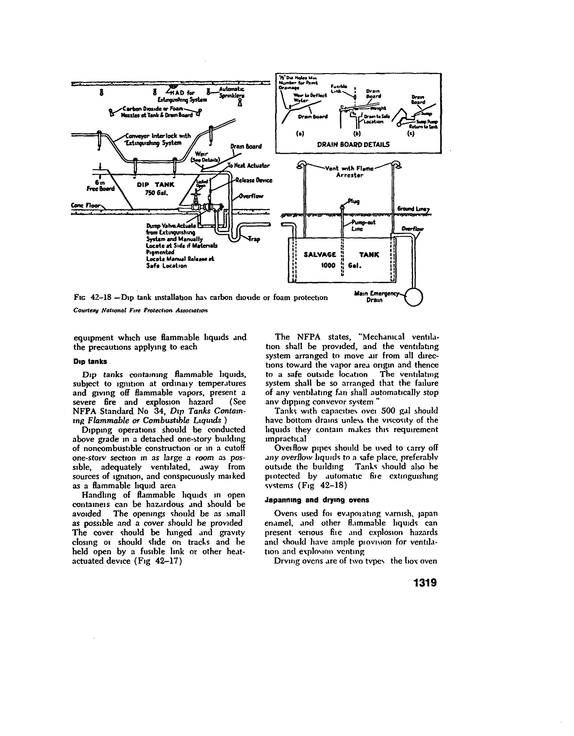
equipment which use flammable liquids and the precautions applying to each Dip tanks Dip tanks containing flammable liquids, subject to ignition at ordinal y temperatures and giving off flammable vapors, present a severe fire and explosion hazard (See NFPA Standard No 34, Dip Tanks Contain ing Flammable or Combustible Liquids ) Dipping operations should be conducted above grade in a detached one-story building of noncombustible construction or in a cutoff one-storv section in as large a room as pos sible, adequately ventilated, away from sources of ignition, and conspicuously maiked as a flammable liquid area Handling of flammable liquids in open contameis can be hazardous and should be avoided The openings should be as small as possible and a cover should be provided The cover should be hinged and gravity closing 01 should slide on tracks and he held open by a fusible link or other heatactuated device (Fig 42-17) The NFPA states, "Mechanical ventila tion shall be provided, and the ventilating system arranged to move air from all direc tions toward the vapor area origin and thence to a safe outside location The ventilating system shall be so arranged that the failure of any ventilating fan shall automatically stop anv dipping convevor system " Tanks with capacities ovei 500 gal should have bottom drains unless the viscosity of the liquids they contain makes this requirement impractical Oveiflow pipes should be used to carry off any overflow liquids to a safe place, preferably outside the building Tanks should also be piotected by automatic fiie extinguishing systems (Fig 42-18) Japanning and drying ovens Ovens used foi evapoiating varnish, japan enamel, and other flammable liquids can present serious fite and explosion hazards and should have ample piovision for ventila tion and explosion venting Drying ovens are of two tvpes the box oven 1319
refid# J33pB6876N9MM51wZVnNZvv6K1 page
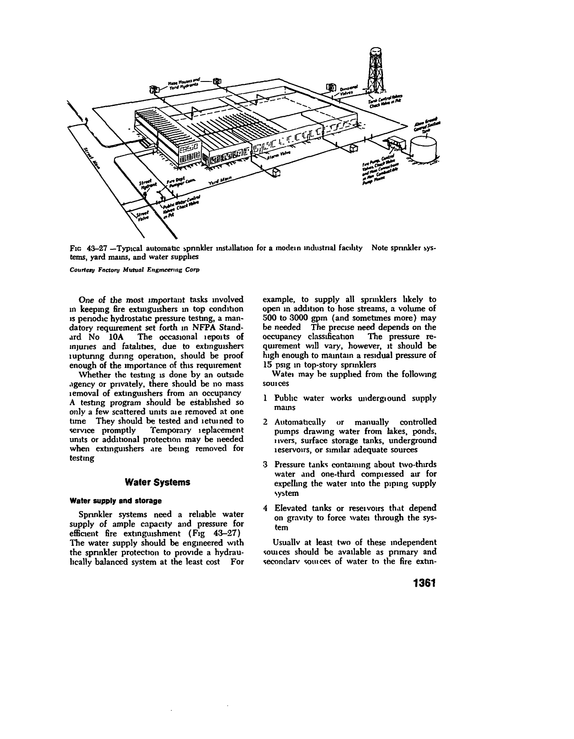
Fig 43-27 --Typical automatic sprinkler installation for a modem industrial facility Note sprinkler sys tems, yard mains, and water supplies Courtesy Factory Mutual Engineering Corp One of the most important tasks involved m keeping fire extinguishers in top condition is periodic hydrostatic pressure testing, a man datory requirement set forth in NFPA Stand ard No 10A The occasional lepoits of injuries and fatalities, due to extinguishers luptunng during operation, should be proof enough of the importance of this requirement Whether the testing is done by an outside agency or privately, there should be no mass lemoval of extinguishers from an occupancy A testing program should be established so only a few scattered units aie removed at one time They should be tested and letuined to service promptly Temporary leplacement units or additional protection may be needed when extinguishers are being removed for testing Wafer Systems Water supply and storage Sprinkler systems need a reliable water supply of ample capacity and pressure for efficient fire extinguishment (Fig 43-27) The water supply should be engineered with the spnnkler protection to provide a hydrau lically balanced system at the least cost For example, to supply all sprinklers likely to open m addition to hose streams, a volume of 500 to 3000 gpm (and sometimes more) may be needed The precise need depends on the occupancy classification The pressure re quirement wiD vary, however, it should be high enough to maintain a residual pressure of 15 psig in top-story sprinklers Watei may be supplied from the following souices 1 Public water works undergiound supply mams 2 Automatically or manually controlled pumps drawing water from lakes, ponds, livers, surface storage tanks, underground leservoirs, or similar adequate sources 3 Pressure tanks containing about two-thirds water and one-third compiessed air for expelling the water into the piping supply system 4 Elevated tanks or reseivoirs that depend on gravity to force watei through the sys tem Usuallv at least two of these independent souices should be available as primary and secondarv souices of water to the fire extin- 1361
refid# kRG72oM2bpOgbOKkBMkjabmV1 page