Refine
Estimated Years UndatedClear
92,592 results foundRefine Search
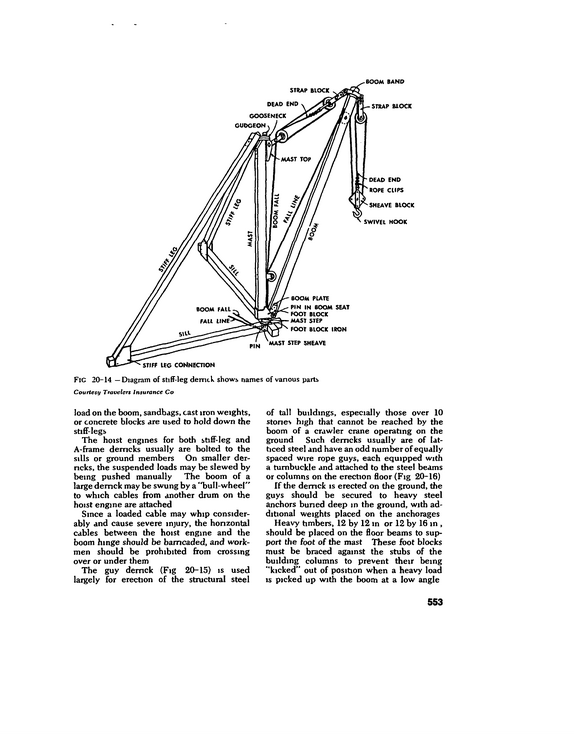
STRAP BLOCK DEAD END GOOSENECK GUDGEON, BOOM BAND STRAP BLOCK SHEAVE BLOCK SWIVEL HOOK BOOM PLATE PIN IN BOOM SEAT FOOT BLOCK MAST STEP FOOT BLOCK IRON MAST STEP SHEAVE STIFF LEG CONNECTION Fig 20-14 -- Diagram of stiff-leg derrick shows names of various parts Courtesy Travelers Insurance Co load on the boom, sandbags, cast iron weights, or concrete blocks are used to hold down the stiff-legs The hoist engines for both stiff-leg and A-frame derricks usually are bolted to the sills or ground members On smaller der ricks, the suspended loads may be slewed by being pushed manually The boom of a large derrick may be swung by a "bull-wheel" to which cables from another drum on the hoist engine are attached Since a loaded cable may whip consider ably and cause severe injury, the horizontal cables between the hoist engine and the boom hinge should be barricaded, and work men should be prohibited from crossing over or under them The guy derrick (Fig 20-15) is used largely for erection of the structural steel of tall buildings, especially those over 10 stones high that cannot be reached by the boom of a crawler crane operating on the ground Such demcks usually are of lat ticed steel and have an odd number of equally spaced wire rope guys, each equipped with a tumbuckle and attached to the steel beams or columns on the erection floor (Fig 20-16) If the demck is erected on the ground, the guys should be secured to heavy steel anchors buned deep in the ground, with ad ditional weights placed on the anchorages Heavy timbers, 12 by 12 in or 12 by 16 in , should be placed on the floor beams to sup port the foot of the mast These foot blocks must be braced against the stubs of the building columns to prevent their being "kicked" out of position when a heavy load is picked up with the boom at a low angle 553
refid# bakbNYMdMDy6KoMgb0dENNwwg1 page
used when the tank is more than 4 ft wide Control velocity over a wider tank can somebmes be obtained by a push-pull system, that is, by blowing air from a nozzle at one side into a hood on the other side of the tank A jet of air under pressure can be confined to a much narrower angle than can be obtained from a sucbon hood, so that a wider tank can be served The jets will entrain material rising from the tank surface and carry it into the hood The velocity of air must be spent before it reaches the exhaust hood Jets should be used only with great caution, because it is possible for them to blow contamination over the working area as well as into the hood In particular, if material is lowered into and raised from the tank, passing through the air jet, the latter is almost certain to be broken up in such a way as to spread the contaminabon The exhaust hoods must be adequately sized, exhaust enough air, and the jet air stream must be pointed in the proper direction Employee participahon Finally, the hood must not interfere with the employee's job -- it is there to help the employee, not hinder him If an employee finds a hood gets in his way, he is likely to take off part of it, if not all of it A job must be analyzed thoroughly m ad vance the operator's motions studied, and even process changes considered Wher ever possible, the man on the job should be consulted and his opinions solicited It may be wise to explain to him exactly how the pro posed hood will work to help him After the hood is installed, the employee should utilize it to its fullest degree He should not place a mancooling fan where it interferes with the effectiveness of the ex haust hood, nor should he be allowed to make adjustments in the exhaust system He should tell his supervisor when he notices a decline in exhaust control Hoods must be fixed in position wherever possible, as it is false security to depend on employees to move them around as needed Ducts After contaminated air has been drawn into a hood, ducts serve the purpose of guiding the air to an air cleaner or to the outdoors When air passes through any duct or pipe, friction must be overcome, that is, energy must be expended The amount of this friction loss must be calculated before the system is in stalled, so the proper size fan and motor can be purchased However, this is a task for a plant engineer, not for the safety director Several excellent references have been published, which remove the guesswork from dust design (See "References" at the end of this chapter, especially Brandt, DallaValle, and Hemeon, and the publications of Ameri can Foundrymen's Society and the American Conference of Governmental Industrial Hy gienists ) Some general comments on sizing of ducts will be helpful to the safety professional in appraising the merits of a given system Starting point m designing a local exhaust system is determining how many cubic feet of air per minute (cfm) must be handled by each hood to control the contaminant released in the workroom (see the topic "Hoods," just before this section) Based on such data, careful duct design accomplishes these objec tives maintains proper transport velocity so the contaminant, if it is a dust or fume, will not settle out and plug the pipe, holds power consumption to a minimum, keeps the system "balanced" at all times Multiple ducts Local exhaust systems with multiple hoods pose problems After settling on how much air flow is needed at each hood to control the contaminant m ques tion, the task of the duct designer is to select pipe sizes and fittings (such as elbows, Y's, enlargements) so that air will distribute itself from hood to hood as he wants it to When two branches coming from two hoods, hood A and hood B, for example, join at a Y to form a single mam (or sub-main or header), the static pressure between this junction point and the face or inlet of hood A is of necessity the same as between this point and the face of hood B If he wants the same rate of air flow from both hoods, the friction loss in each branch must be the same But if the branch to hood A is longer than the one to hood B, or has more elbows, its friction loss, for the same diameter pipe in both branches, will be more than in branch B The velocity ofair in branch A will be less, and so less air will flow into hood A than hood B How can the hoods be made to handle equal 865
refid# 270RjwrwGaMV7zbJV5KL8g061 page
Flammable and Combustible Liquids Definitions Terms used General Safety Measures Preventing dangerous mixtures Smoking Static electricity Bonding and grounding Electrical equipment Spark-resistant tools Health Hazards Toxic effects Combustible gas indicators Loading and Unloading Tank Cars Spotting cars Inspection Relieving pressure Removing covers Loading and unloading connections Placards Fires Loading and Unloading Tank Trucks Inspection Smoking Spotting trucks connections Leaks Fires Loading and unloading Storage Tank construction Vents Dikes Pump houses Gauging Tanks in flooded regions Underground tanks Aboveground tanks Tank fires and their control Inside storage and mixing rooms Storage cabinets Outside storage houses Cleaning Tanks General precautions Protective equipment Proper procedures Cleaning aboveground tanks Cleaning small tanks and containers Abandonment of tanks Common Uses of Flammable Liquids Dip tanks Japanning and drying ovens Oil burners Cleaning metal parts Internal combustion engines Spray booths Casoline blow torches and plumbers* furnaces Liquefied petroleum gases References Chapter 34 1010 1012 1019 1020 1024 1025 1036 1040 1043 1009
refid# w0xO2Ne5oqbaaxQoEJz8wyz31 page
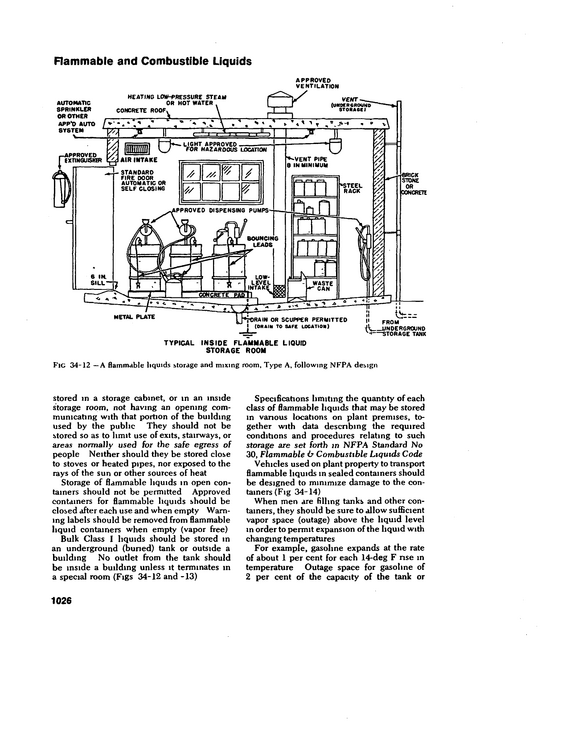
Flammable and Combustible Liquids AUTOMATIC SPRINKLER OR OTHER APP*0 AUTO SYSTEM HEATING LOW-PRESSURE STEAM OR HOT WATER CONCRETE ROOF. _________ a ________ 1 /**.* ' / Jt APPROVED VENTILATION metal plate U^rORAIN OR SCUPPER PERMITTEO (DRAIN TO SAFE LOCATION) TYPICAL INSIDE FLAMMABLE LIQUID STORAGE ROOM FROM ft___ UNDERGROUND ------STORAGE TANK Fig 34-12 --A flammable liquids storage and mixing room, Type A, following NFPA design stored in a storage cabinet, or in an inside storage room, not having an opening com municating with that portion of the building used by the public They should not be stored so as to limit use of exits, stairways, or areas normally used for the safe egress of people Neither should they be stored close to stoves or heated pipes, nor exposed to the rays of the sun or other sources of heat Storage of flammable liquids in open con tainers should not be permitted Approved containers for flammable liquids should be closed after each use and when empty Warn ing labels should be removed from flammable liquid containers when empty (vapor free) Bulk Class I liquids should be stored in an underground (buned) tank or outside a building No outlet from the tank should be inside a building unless it terminates in a special room (Figs 34-12 and -13) Specifications limiting the quantity of each class of flammable liquids that may be stored in various locations on plant premises, to gether with data describing the required conditions and procedures relating to such storage are set forth in NFPA Standard No 30, Flammable ir Combustible Liquids Code Vehicles used on plant property to transport flammable liquids m sealed containers should be designed to minimize damage to the con tainers (Fig 34-14) When men are filling tanks and other con tainers, they should be sure to allow sufficient vapor space (outage) above the liquid level in order to permit expansion of the liquid with changing temperatures For example, gasoline expands at the rate of about 1 per cent for each 14-deg F nse in temperature Outage space for gasoline of 2 per cent of the capacity of the tank or 1026
refid# 50gXvdqyMyd7Vg5MG5o99nEKe1 page
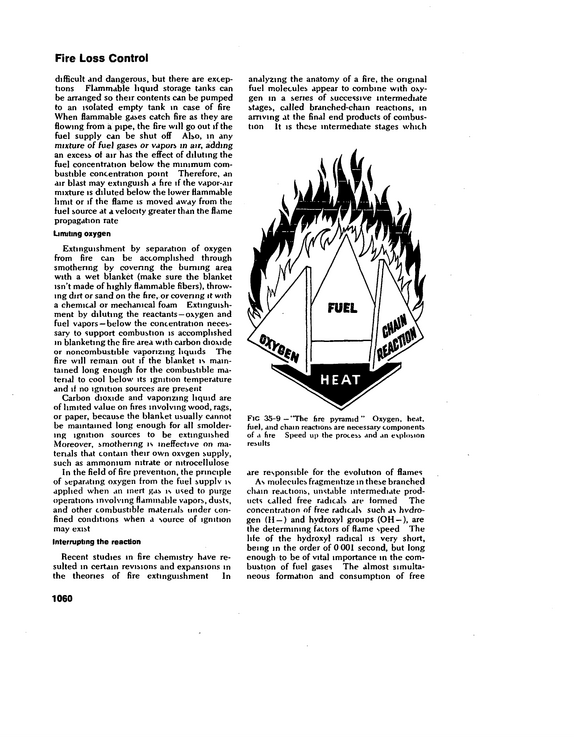
Fire Loss Control difficult and dangerous, but there are excep tions Flammable liquid storage tanks can be arranged so their contents can be pumped to an isolated empty tank in case of fire When flammable gases catch fire as they are flowing from a pipe, the fire will go out if the fuel supply can be shut off Also, in any mixture of fuel gases or vapors in air, adding an excess ot air has the effect of diluting the fuel concentration below the minimum com bustible concentration point Therefore, an air blast may extinguish a fire if the vapor-air mixture is diluted below the lower flammable limit or if the flame is moved away from the fuel source at a velocity greater than the flame propagation rate Limiting oxygen Extinguishment by separation of oxygen from fire can be accomplished through smothering by covering the burning area with a wet blanket (make sure the blanket isn't made of highly flammable fibers), throw ing dirt or sand on the fire, or covering it with a chemical or mechanical foam Extinguish ment by diluting the reactants --oxygen and fuel vapors--below the concentration neces sary to support combustion is accomplished in blanketing the fire area with carbon dioxide or noncombustible vaporizing liquids The fire will remain out if the blanket is main tained long enough for the combustible ma terial to cool below its ignition temperature and if no ignition sources are present Carbon dioxide and vaporizing liquid are of limited value on fires involving wood, rags, or paper, because the blanket usually cannot be maintained long enough for all smolder ing ignition sources to be extinguished Moreover, smothering is ineffective on ma terials that contain their own oxvgen supply, such as ammonium nitrate or nitrocellulose In the field of fire prevention, the principle of separating oxygen from the fuel supply is applied when an inert gas is used to purge operations involving flammable vapors, dusts, and other combustible materials under con fined conditions when a source of ignition may exist Interrupting the reaction Recent studies in fire chemistry have re sulted in certain revisions and expansions in the theories of fire extinguishment In analyzing the anatomy of a fire, the original fuel molecules appear to combine with oxy gen in a series of successive intermediate stages, called branched-chain reactions, in arriving at the final end products of combus tion It is these intermediate stages which Fig 35-9--"The fire pyramid" Oxygen, heat, fuel, and chain reactions are necessary components of a fire Speed up the process and an explosion results are responsible for the ex'olution of flames As molecules fragmentize in these branched chain reactions, unstable intermediate prod ucts called free radicals are formed The concentration of free radicals such as hvdrogen (11 -- ) and hydroxyl groups (OH -- ), are the determining factors of flame speed The life of the hydroxyl radical is very short, being in the order of 0 001 second, but long enough to be of vital importance in the com bustion of fuel gases The almost simulta neous formation and consumption of free 1060
refid# Eq4GKVXO4BVMZawnYpVB5m8kV1 page
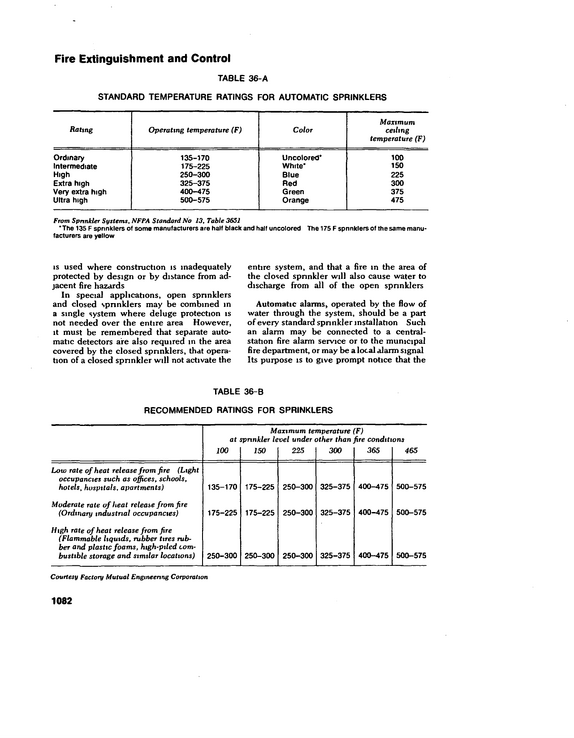
Fire Extinguishment and Control TABLE 36-A STANDARD TEMPERATURE RATINGS FOR AUTOMATIC SPRINKLERS Anting Ordinary Intermediate High Extra high Very extra high Ultra high Operating temperature (F) 135-170 175-225 250-300 325-375 400-475 500-575 Color Uncolored* White* Blue Red Green Orange Maximum ceiltng temperature (F) 100 150 225 300 375 475 From Spnnkler Systems, NFPA Standard No 13, Table 3651 'The 135 F sprinklers of some manufacturers are half black and half uncolored The 175 F spnnklers of the same manu facturers are yellow s used where construction is inadequately protected by design or by distance from ad jacent fire hazards In special applications, open spnnklers and closed spnnklers may be combined in a single system where deluge protection is not needed over the entire area However, it must be remembered that separate auto matic detectors are also required in the area covered by the closed spnnklers, that opera tion of a closed spnnkler will not activate the entire system, and that a fire in the area of the closed spnnkler will also cause water to discharge from all of the open spnnklers Automatic alarms, operated by the flow of water through the system, should be a part of every standard spnnkler installation Such an alarm may be connected to a centralstation fire alarm service or to the municipal fire department, or may be a local alarm signal Its purpose is to give prompt notice that the TABLE 36-B RECOMMENDED RATINGS FOR SPRINKLERS Maximum temperature (F) at spnnkler level under other than fire conditions 100 150 225 300 365 465 Low rate of heat release from fire (Light occupanctes such as offices, schools, hotels, hospitals, apartments) 135-170 175-225 250-300 325-375 400--475 500-575 Moderate rate of heat release from fire (Ordinary industrial occupancies) 175-225 175-225 250-300 325-375 400-475 500-575 High rate of heat release from fire (Flammable liquids, rubber tires rub ber and plastic foams, high-piled com bustible storage and similar locations) 250-300 250-300 250-300 325-375 400-475 500-575 Courtesy Factory Mutual Engineering Corporation 1082
refid# vjD1krK0ekknbb9bp534JNYb1 page
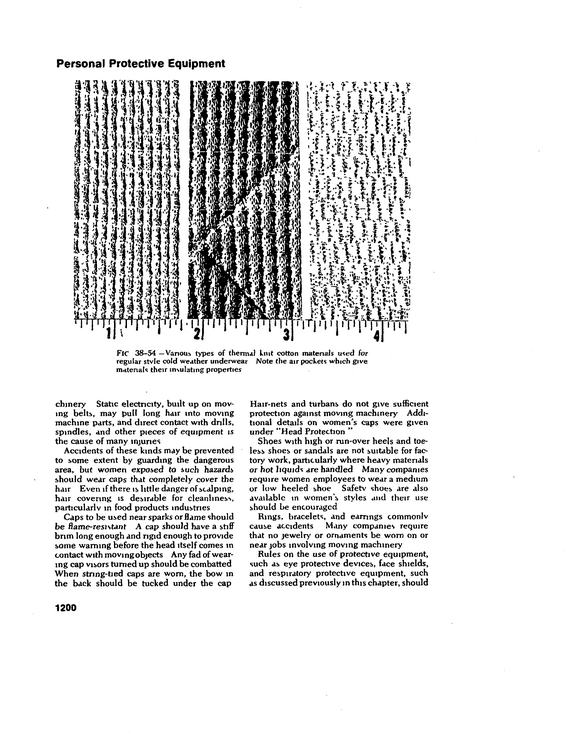
Personal Protective Equipment FlC 38-54 -- Various types of thermal knit cotton materials used for regular stvle cold weather underwear Note the air pockets which give materials their insulating properties chinery Static electricity, built up on mov ing belts, may pull long hair into moving machine parts, and direct contact with drills, spindles, and other pieces of equipment is the cause of many injuries Accidents of these kinds may be prevented to some extent by guarding the dangerous area, but women exposed to such hazards should wear caps that completely cover the hair Even if there is little danger of scalping, hair covering is desirable for cleanliness, particularly in food products industries Caps to be used near sparks or flame should be flame-resistant A cap should have a stiff brim long enough and rigid enough to provide some warning before the head itself comes in contact with movi ng objects Any fad of wear ing cap visors turned up should be combatted When stnng-tied caps are worn, the bow in the back should be tucked under the cap Hair-nets and turbans do not give sufficient protection against moving machinery Addi tional details on women's caps were given under "Head Protection " Shoes with high or run-over heels and toe less shoes or sandals are not suitable for fac tory work, particularly where heavy materials or hot liquids are handled Many companies require women employees to wear a medium or low heeled shoe Safetv shoes are also available in women's styles and their use should be encouraged Rings, bracelets, and eamngs commonlv cause accidents Many companies require that no jewelry or ornaments be worn on or near jobs involving moving machinery Rules on the use of protective equipment, such as eye protective devices, face shields, and respiratory protective equipment, such as discussed previously in this chapter, should 1200
refid# regJ0qBLMyM6j4k4kz17xbKO01 page
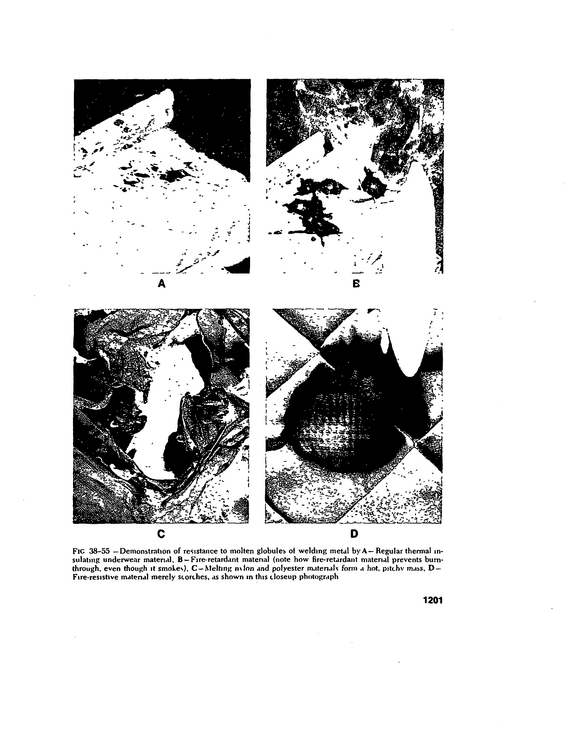
CD Fig 38-55 --Demonstration of resistance to molten globules of welding metal byA-- Regular thermal in sulating underwear material, B--Fire-retardant material (note how fire-retardant material prevents bumthrough, even though it smokes), C --Melting ns Ion and polyester materials form a hot, pitchv mass, D -- Fire-resistive material merely scorches, as shown in this closeup photograph 1201
refid# rpmON0JxqYggj7eBJGB4XKMxE1 page
Elements of Industrial Toxicology Industrial toxicology is primarily concerned with the physiological effects produced m individuals who have been exposed to harm ful materials during the course of their em ployment The constant introduction of new industrial processes, operations, and tech niques involving new chemicals n ake a knowledge of toxicology important to the safety professional who is frequently called upon for advice concerning the dangers as sociated with the use of various chemical agents A safety professional setting up a program to minimize injury from the use of mechanical tools will be concerned with the physical characteristics of the machine tool or ma chinery and the manner m which the vanous parts of the machine come into contact with the operator and cause harm Similarly, he is concerned with, how chemical agents can approach or contact individuals, how that contact can be prevented, and how extensive the injury can be if contact does occut, based on the properties of the chemical agents in volved The principle job of the industrial toxicolo gist is to obtain sufficient basic information concerning the biological action and potential toxicity of a chemical substance so that its relative hazard to man may be ascertained The toxicologist must analyze the points of attack of chemical agents and clarify the mechanism of effect, with the view towards prevention, recognition, and treatment of chemical intoxications Hamilton and Hardy (see "References") state that industrial and nonindustnal toxi cology differ in three important ways First is the manner m which the material is absorbed into the body In nonindustnal cases, the most common way is orally, through the mouth, then through inhalation, and lastly through skin absorption, in industrial cases, entrance through the respiratory tract with the inspired air is of overwhelming impor tance compared with skin absorption or en trance through the gastro-intestmaJ tract The second difference is that industrial poisoning tends to be of the chronic variety, whereas nonindustnal poisoning is more often acute But acute cases do occur in in dustry, although they are far less numerous than the chronic cases The third difference is that generally mdustnal poisoning is a result of exposure to a mixture of substances compared with a single matenal for nonindustnal cases These harm ful mdustnal matenals are absorbed without the voluntary participation of the persons concerned, often hardly observed or even completely unobserved Chemical Toxicity If administered in a suitable manner and in sufficient dosage, practically any substance can be harmful to man It is recognized, therefore, that there are degrees of harmfulness and degrees of safeness for all matenals These degrees are pnmanly related to the amount of matenal that is present in the body--a relationship exists between the biologic effect of a chemical agent and its dose or concentration m the human body Many chemical agents are nonselective in their action on tissues or cells, they may exert a harmful effect on all living matter Other chemical agents may act only on speci fic cells Another agent may be harmful only to certain species, other species may have built-in protective devices Toxicity is relative It refers to a harmful effect on some biologic mechanism The term "toxicity" is commonly used in compar ing one chemical agent with another, but such comparison is meaningless if the biologic mechanism and the conditions under which the harmful effects occur are not specified Pnnci (see "References") states that a chemical stimulus may be considered to have produced a toxic effect when it satisfies the following criteria 1 An observable or measurable physiologic deviation has been produced m any organ or organ system The change may be anatomic in character and may be accelera tion or inhibition of a normal physiolog ical process, or it may consist of a specific biochemical change This chapter was revised by Julian B Olishifski, P E , based upon reviews by selected members of the National Safety Council 1300
refid# LBmB0ra7Bn1eMweYBwjmzJ5z1 page
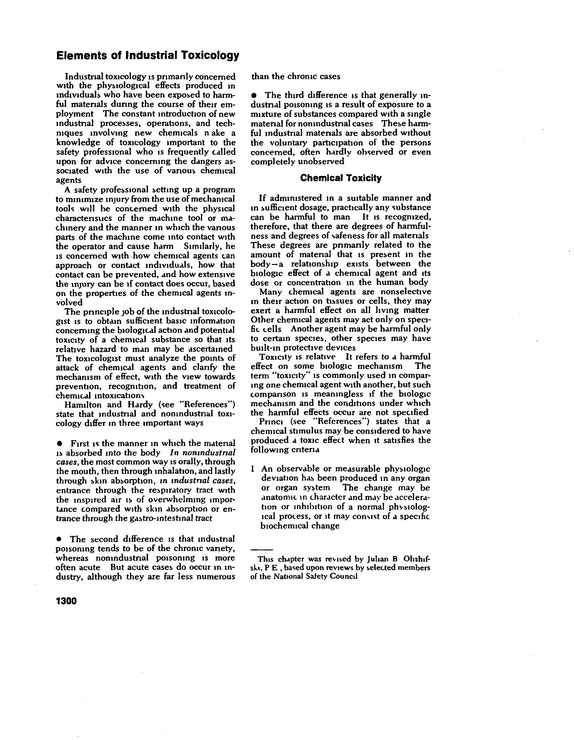
1417 polytetrafluoroethylene decomposition products potassium hydroxide /0-propiolatlone 165 29 propionaldehyde 15-19* 37 propionic acid 130 n-propyl acetate 58 20 iso-propyl acetate 40 18 n*propyl alcohol 77 21 iso-propyl alcohol 53 20 propylene gas 20 propylene dichlonde 60 propylene glyiol 210 34 26 161 8 8 135 12 11 1 14 5 125 311 120 297 842 215 28 860 194 28 700 207 44 750 161 43 -53 205 33 370 45 propyne gas 1 7 - -10 propylene oxide -35 2 1 21 5 95 'Open cup flash point "The higher the number, the slower the evaporation rate t Number in this column refers to date of publication in AIHA Journal 301 -223 1 220 48 3 0 3 1 30 78 1 3 0 77 1 3 0 1 41 35 2 3 0 hygro scopic 01p 242 242 SD-10 4-63 SD-59 C-18 12-61 12-61 6-67 6-59
refid# BRKNgLJo6mYJ9Bzp3e6GbJqjj1 page
Table of Chemical Hazards are remarkably fast to washing, light and chemicals Vulcanization Process of combining rubber (natural, synthetic or latex) with sul fur and accelerators in presence of zinc oxide under heat and usually pressure in order to change the material permanently from a thermoplastic to a thermosetting composition, or from a plastic to an elastic condition Strength, elasticity and abrasion resistance also are improved 1430

refid# bBOVQ3RMoEMpmjVx1kVQv0dNg1 page
i'R0?
refid# BRmoo7DYzjxkano60m8XQJEk1 page
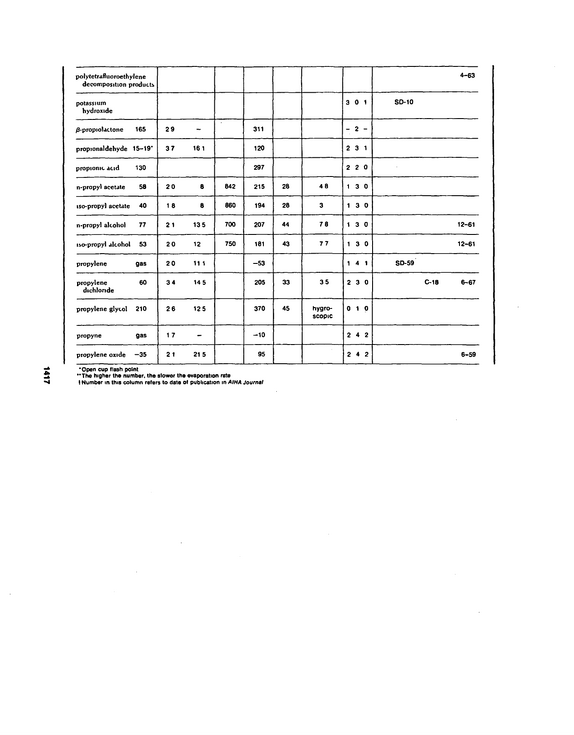
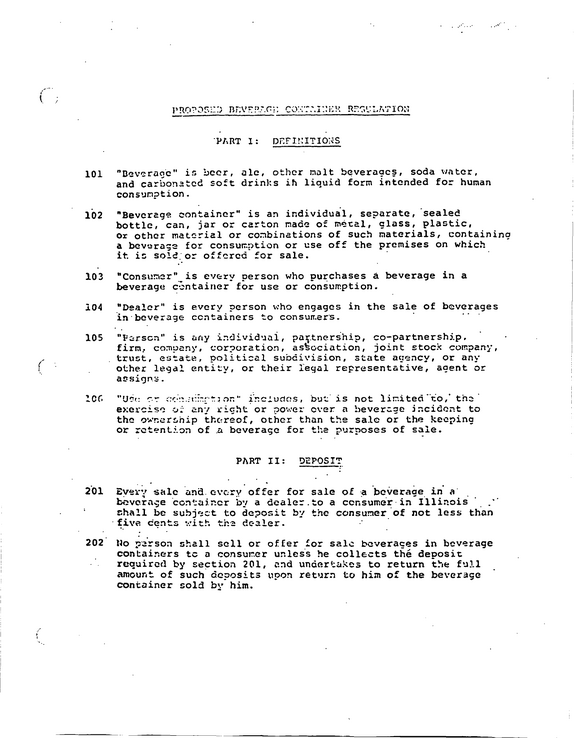
1113 1114 Futurs construction.
refid# dnedpYw02zNjnz84y2Qbvpmvq1 page
-7- 1.
refid# GVwrxYVzrb18ELZ0Xw6ekM7n1 page
10--Human Factors Engineering 1 Usually controls cannot be operated in correctly 2 System designers can usually capitalize on compatible relationships With such a system the following undesirable features are associated 1 The control must be activated before oper ator knows if correct control has been selected 2 Specific design might have to incorporate incompatible relationships Regardless of the type of coding used, all controls and displays should be labeled Labeling is crucial where the operators change often or equipment is shared The use of labels may also reduce operator training time Arrangement Remember that a system is task-oriented and that its components act and interact with each other to perform this task Conse quently, the various elements and components of the system need to be arranged with these considerations in mind Functional principle This principle provides for the grouping of elements or com ponents according to their function--those having related functions are grouped together Importance principle Components can be arranged by their importance Items of some type (displays, controls, components) should be grouped in terms of how critical they are in carrying out a set of operations The important controls should be positioned m the best locations for rapid and easy use Relative importance, of course, is largely a matter of judgement So, to apply this prin ciple one must be in a position to obtain judgements of persons who are knowledge able about the equipment This can be done by either interview or questionnaire Optimum-location principle This principle provides for the arrangement of items so that each one is in its "optimum" location m terms of some criterion of usage (convenience, accuracy, speed, strength to be applied, etc ) Sequence-of-use principle In using controls, sequences or patterns of relationship 236 typically or frequently occur In applying this principle, then, items can be so arranged as to take advantage of such patterns, thus, items used m sequence typically would be in close physical relationship with each other Frequency-of-use principle To ar range items m terms of frequency of use, first obtain information about how often different items might be expected to be used Then place the less frequently used items m more distant locations In the event there is conflict among prin ciples some trading-off must be done Al though no one principle should be held rigor ously, frequency of use and sequence of use should be given major consideration Seek to avoid arrangements on which fre quent transfers (of the entire body, or of the eye, hand, or other body member) from place to place would be required Control evaluations The following questions should be con sidered in assessing the human element in the design of controls What bodily limbs are involved1* Is any one muscle overloaded?
refid# RJd9p9pbRykJJDwqrLB3NnQN71 page