Refine
Estimated Years UndatedClear
92,592 results foundRefine Search
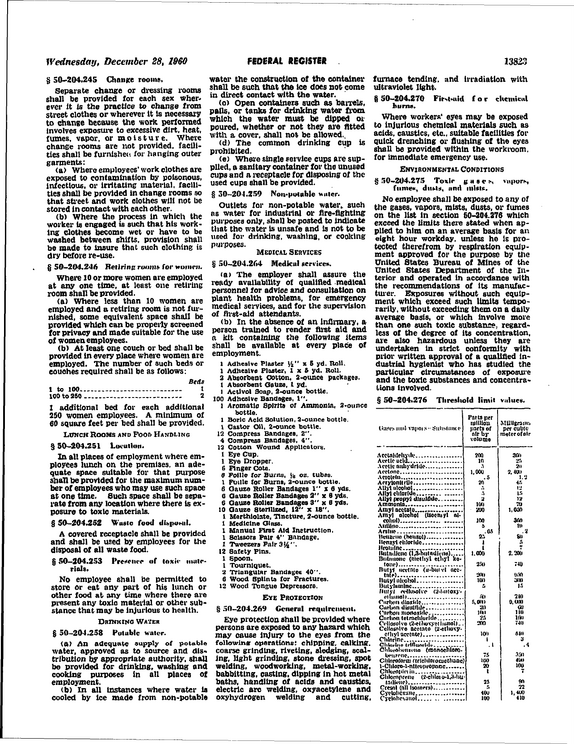
Wednesday, December 28, I960 FEDERAL REGISTER 13823 50-204.245 Change rooms.
refid# XzLB383zrJpNdBQngD9K8gg5J1 page
National Safety Council (Board of Directors, continued) F.
refid# VJmnkad8Jr4NJzwO1M9E5LoDg1 page
SAFETY TRAINING 7 If an emplojee suffers an injury, even a If a company has preplacement physical slight one, he is required to report it at examinations, the doctor or nurse should es once tablish good relations with each new em In addition to these points, any safety rules which are a condition of employment, such as wearing of eye protection or hard hats, should be understood and enforced at once ployee when he is examined The doctor or nurse should tell him about the work of the medical department as it relates to him and should encourage him to make use of its services They, as well as the person who gives general safety information, should Preliminary instruction emphasize the importance of reporting all This preliminary safety instruction is most injuries often given to individuals or small groups by The final step in the employment office the employment department Sometimes the safety procedure should be to emphasize the safety director or a management executive importance of the position of the supervisor gives the safety instruction This method m the safety program The employee must may add force and interest, but it has the understand that his supervisor is interested practical disadvantage that safety directors m safety, that safety instruction and safety and executives are busy people and may supervision will come from him, and that not always be available or may be so pressed his suggestions and questions should be di with other duties that they skimp on the rected to him induction job or delegate it to subordinates less able to handle it More important than who gives the talk is how it is given The talk should be pre pared and presented with the utmost regard for the effect it will have on the new em In order that there will be no gap and no contradiction between the information given in the employment office and that given later, the supervisor should know what has been said in the induction talks ployees Verbal instruction should be given Make rule books logical, enforceable earnestly and with an attitude of good will and friendly cooperation A safety film may do a good job of inter esting and instructing new employees It changes the pace and relieves the monotony of much talking The film should be bnef and should be limited to such essentia) points as those previously mentioned Some companies produce their own films Al The use of rule books or manuals* has long been a part of the early training given to new employees (Fig 6-6) Such rule books should be prepared so the rules are presented in terms that are easily under stood Only logical and enforceable rules should be included Employees cannot be expected to respect and follow rules that are illogical, unfair, or unrealistic though the production of a film may seem costly, if it is shown to all new employees, the cost per employee showing may be only a few cents Films for the purpose may also be purchased Rules that supervisors have had a chance to review are likely to be more effective than those they have had no part m formulating One important advantage of an induction film is that it always says the same thing Management can be sure that, whatever its safety message, it is going to be told in exactly the same way to every new em ployee A few employers have attempted to gam this advantage by presenting a recorded talk by a company executive, but a record alone generally has low interest value Rule books or manuals should contain general instructions as to the employee's responsibility in safety The rules should cover such items as first aid, personal pro tective equipment, work clothing fire fight ing, electrical equipment, and housekeeping Rule books alone cannot be counted upon to accomplish much in the way of mfluenc- Charts illustrating points made in the in duction talk add interest and aid both under standing and conviction Charts should be large enough and simple enough to be seen and understood easily by every member of the group The development, approval, and distri bution of printed safety rules by industrial concerns are discussed m Data Sheet 535, Industrial Safety Rules, published by the National Safety Council 6-17
refid# evYO690p9Gy4zvmjDOq2xQm791 page
maintaining interest in safety tion of a change m company policy, or the announcement of an exceptionally fine safety record Fig 7-1 shows how one plant turns out for presentation of a National Safety Council award In companies with plants in different cities, a top executive may cal] a meeting of employees when he visits a plant His talk may cover safety as well as other subjects One company president makes as annual round of plants with the safety director and speaks at a safety rally of all employees at each plant Under certain conditions, particularly in smaller communities, it may be advisable to hold the mass meetings m a local theater or public hall It then becomes necessary to make fairly elaborate arrangements and to give the meetings considerable publicity to assure good attendance A mass meeting in a public hall naturally has one advantage over a plant meeting It makes possible the attendance not only of employees, but also of their wives or hus bands, families, and fnends "Family safety nights" of this sort are very popular in the railroad industry A considerable number may be held at several different pouts on the railroad during the year.
refid# jg6MyOkXgBkaDyzbB11ppxbYZ1 page
INDUSTRIAL BUILDINGS AND PLANT LAYOUT toons for disposal of radioactive wastes Many wastes can be burned or disposed of on dumps However, precautions are necessary with certain wastes Combusti ble materials, such as wood, scraps, and paper, can be burned in an incinerator A trench can be used for burning oils, oil should be ignited from a safe distance with a fuse Chemical wastes should be ren dered harmless before being dumped, strong acids, for example, should be neutralized Poisonous materials, magnesium chips, ex plosives, and similar substances require special procedures for safe disposal Smoke from power plants and other sources and inert dusts from various types of plants may be nuisances or even sources of danger to the public Provision for com plying with smoke control ordinances should be made before construction is begun Toxic smoke, fumes, or dusts are a seri ous problem in some industries Tall stacks often are used to diffuse gases in the at mosphere.
refid# N4Y5Ejv4bm7x3LnEaKD3NmqQ1 page
INDUSTRIAL BUILDINGS AND PLANT LAYOUT Types of lighting Natural lighting.
refid# O3Gk28djNpn8oQZ8wM56dRk5w1 page
HOISTING APPARATUS AND CONVEYORS conveyor and struck a person Workmen should always be warned to place material carefully on a conveyor so that it will nde safely Maintenance precautions Before mainte nance men commence working on a con veyor, they should padlock the main power control in the "off" position The mainte nance foreman should carry the only key to this lock If two gangs work on one con veyor, the foremen of both gangs should each padlock the master switch Areas should be readily accessible so that maintenance men can change the position of pulleys, sprockets, or sheaves to compensate for normal working conveyor stretch and wear If adjustment is required while equipment is operating, moving parts should be thoroughly guarded Belt conveyors The belt conveyor, consisting of an end less rubber, fabric, plastic, leather, or metal belt running over two large pulleys with numerous flat or troughing idler pulleys be tween them to support the belt, is probably the most common type (Fig 18-24) It is used to carry boxes, cartons, bags, and simi lar objects as well as the bulk material to which this discussion is confined Material in bulk form, such as coal, ore, ot sand, passes from the loading hopper into a loading boot above the tail end of the con veyor At the opening in the boot there is a skirtboard at each side of the belt, about an inch above it and 2 or 3 in inside either edge Thus as the material is delivered onto the belt, it forms a mound on the center that is far enough from the edges not to spill off In the simplest conveyor the material is discharged over the pulley at the head end of the conveyor The loading hopper, with its boot, can be mounted on flanged wheels that nde on small railrpad rails, so that the belt can be loaded at any point In some installations, such as over coal bunkers, it may be necessary to discharge the matenal from the conveyor at various places In this case, the belt is raised up and over a large pulley mounted on a mov able tnpper that runs on a track straddling the conveyor.
refid# MMnGY9qJqM2oXJJmmjQGzbgvz1 page
HOISTING APPARATUS AND CONVEYORS 3 A second telephone circuit, which may be grounded if desired Suitable bghtug should be provided at critical. points for night operation and re pairs Portable conveyors Belt, flight, apron, and fixed bucket con veyors are made also as inclined portable units on a pair of large wheels, for loading railroad cars and trucks with bulk materials (Fig. 18-33).
refid# rLKOQoBLbJ2O43X1mXE4baGv1 page
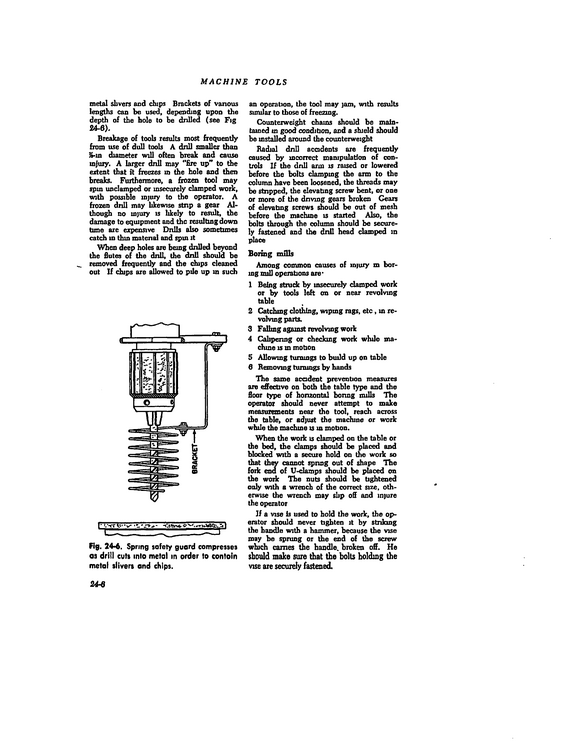
MACHINE TOOLS metal slivers and chips Brackets of various lengths can be used, depending upon the depth of the hole to be drilled (see Fig 24-6), Breakage of tools results most frequently from use of dull tools A drill smaller than 54-in diameter will often break and cause injury.
refid# 13gb0pLmGJDBx5ejbp90vyZm1 page
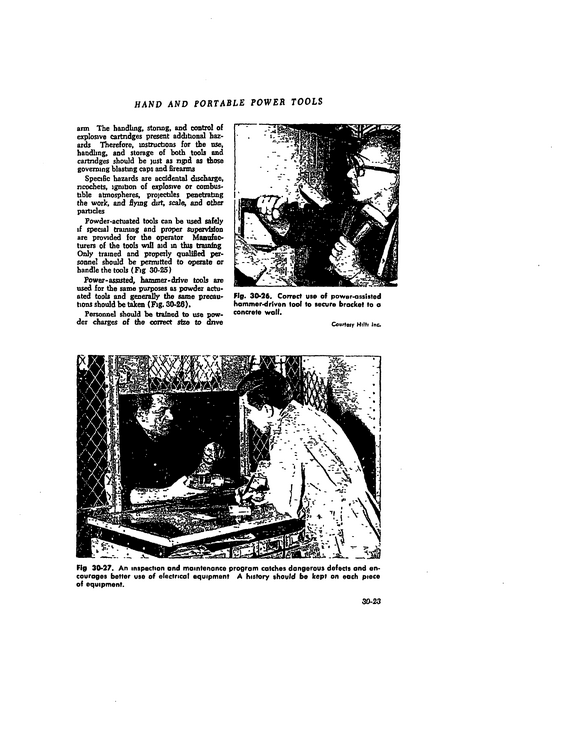
HAND AND PORTABLE POWER TOOLS arm The handling, storing, and control of explosive cartridges present additional haz ards Therefore, instructions for the use, handling, and storage of both tools and cartridges should he )ust as ngid as those governing blasting caps and firearms Specific hazards are accidental discharge, ricochets, ignition of explosive or combus tible atmospheres, projectiles penetrating the work, and dying dirt, scale, and other particles Powder-actuated tools can be used safely if special training and proper supervision are provided for the operator Manufac turers of the tools will aid in this training Only trained and properly qualified per sonnel should he permitted to operate or handle the tools (Fig 30-25) Power-assisted, hammer-drive tools are used for the same purposes as powder actu ated tools and generally the same precau tions should be taken (Fig. 30-20).
refid# ZB9MwxxpMj1RY1rKpnJme2DJY1 page
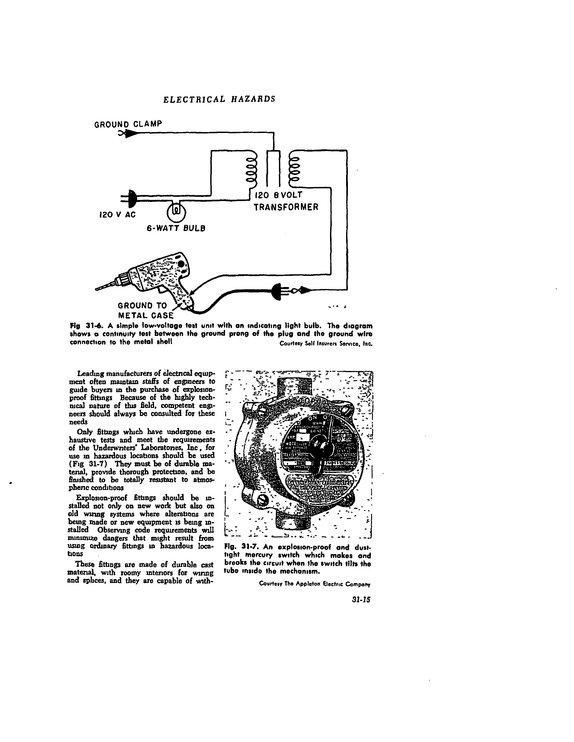
ELECTRICAL HAZARDS GROUND CLAMP Fig 31-4.
refid# BvQyZe7xnN4nGdDzoONpLweD41 page
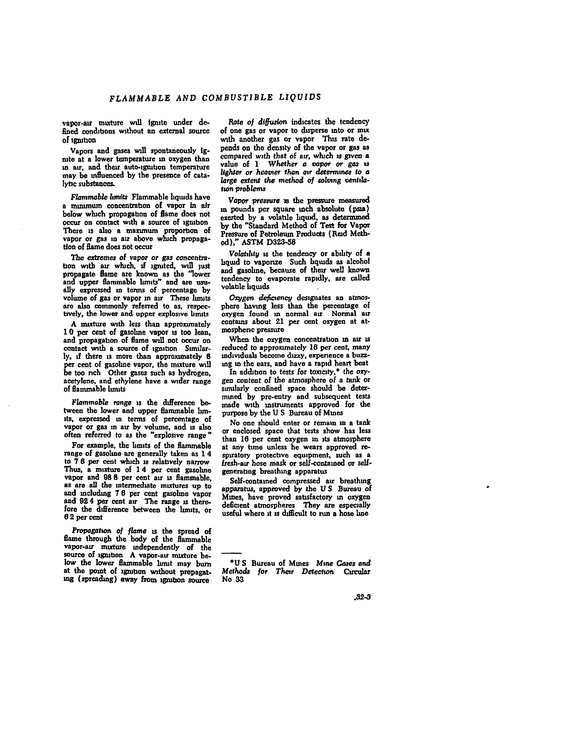
FLAMMABLE AND COMBUSTIBLE LIQUIDS vapor-air mixture will ignite under de fined conditions without an external source of ignition Vapors and gases will spontaneously ig nite at a lower temperature in oxygen than in air, and their auto-ignition temperature may be influenced by the presence of cata lytic substances.
refid# Rj2D4GgRKD5YEwnDE1RY0gmGz1 page
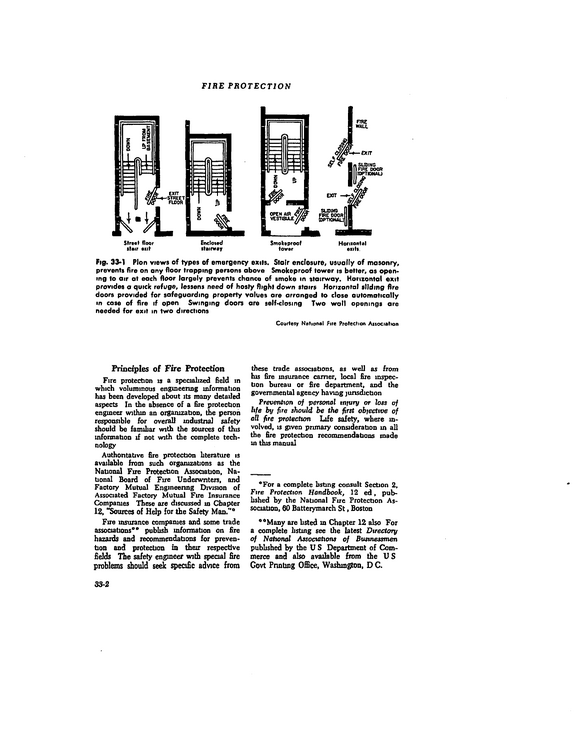
FIRE PROTECTION Slrsflt floor stair ant Enclosed stairway Fig. 33*1 Plon views of types of emergency exits.
refid# 5bxn6NVYKKL78zwr3jGdJkxnR1 page
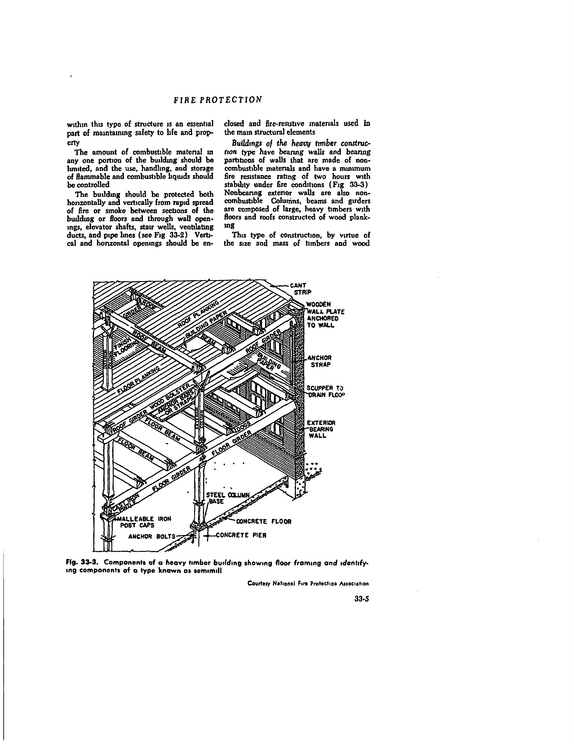
FIRE PROTECTION within this type of structure is on essential part of maintaining safety to bfe and prop erty The amount of combustible material u any one portion of the building should be limited, and the use, handling, and storage of flammable and combustible liquids should be controlled The budding should be protected both horizontally and vertically from rapid spread of fire or smoke between sections of the building or floors and through wall open ings, elevator shafts, stair wells, ventilating ducts, and pipe lines (see Fig 33-2) Verti cal and horizontal openings should be en closed and fire-resishve materials used in the mam structural elements Buildings of the heavy timber construc tion type have bearing walls and bearing partitions of walls that are made of non combustible materials and have a minimum fire resistance rating of two hours with stability under fire conditions (Fig 33-3) Nonbeanng extenor walls are also noncombustible Columns, beams and girders are composed of large, heavy timbers with floors and roofs constructed of wood plank ing This type of construction, by virtue of the size and mass of timbers and wood CANT STRIP WOODEN 'ALL PLATE ANCHOREO TO WALL SCUPPER TO AIN FIDO0 CONCRETE FLOOR ONCRETE PIER Fig. 33-3.
refid# 2Roy9bMr4kNYOx4aZogz1Yn651 page
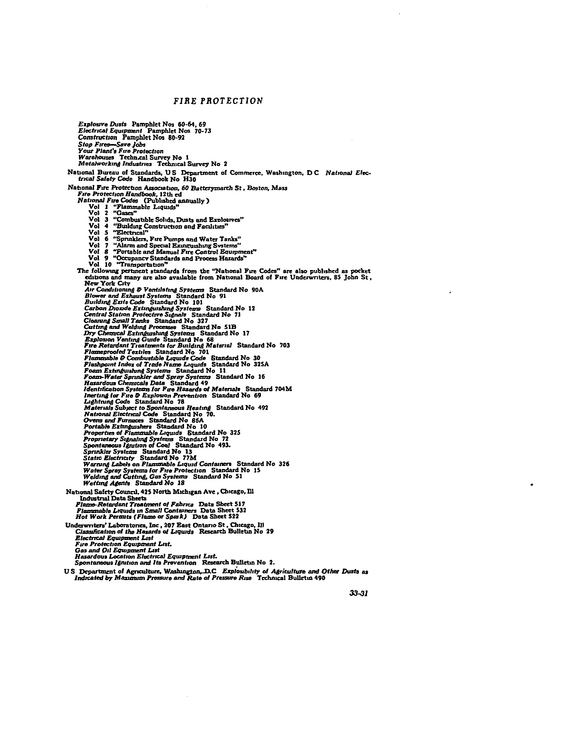
FIRE PROTECTION Explosive Dusts Pamphlet Nos 60-64, 69 Electrical Equipment Pamphlet Nos 70-73 Consfraction Pamphlet Nos 80-92 Stop Fires- Save Jobs Your Plant*s Fire protection Warehouses Technical Survey No 1 Metahvorktng Industries Technical Survey No 2 National Bureau of Standards, U S Department of Commerce, Washington, D C National Elec trical Salety Code Handbook No H30 National Fire Protection Association, 60 Batteryznarch St, Boston, Mass Ftre Protection Handbook, 12th ed national Ftre Codes (Published annually ) Vol I "Flammable Liquids" Vol 2 '*08808" Vol 3 "Combustible Solids, Dusts and Ezolosrves" Vol 4 "Building Construction and Facilities" Vol S "Electrical" Vol 6 "Sprinklers, Fire Pumps and Water Tanks" Vol 7 "Alarm and Special Exmguishmg Svstems" Vo!
refid# xdvLL3Zp4JwJjMmqobn2b7eQE1 page