Refine
Estimated Years UndatedClear
92,592 results foundRefine Search
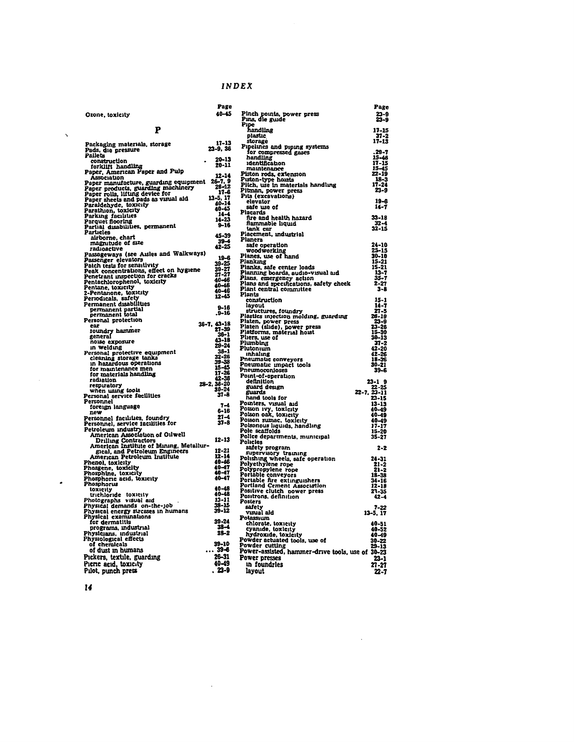
INDEX Ozone, toxicity Page 40-45 Packaging materials, storage Pads, die pressure 17-13 23-9, 36 Pallets construction 20-13 forklift handling ,, 20-11 Paper, American Paper and Pulp Association 12-14 Paper manufacture, guarding equipment Paper products, guarding machinery Paper rolls, lilting device for Paper sheets and pads as visual aid Paraldehyde, toxicity Parathion, toxicity Parking facilities Parquet flooring Partial disabilities, permanent 2602-06177-,1-629 13-5, 17 40-14 40-45 14-4 14-23 9-16 Particles airborne, chart magnitude of sue radioactive 45-39 39-4 42-25 Passageways (see Aisles and Walkways) Passenger elevators Patch tests for sensitivity Peak concentrations, effect on hygiene Penetrant inspection for cracks Pentachlorophenol, toxicity Pentane, toxicity 2-Pentanone, toxicity Periodicals, safety 19-6 39-25 39-27 27-27 40-46 40-46 40-46 12-45 Permanent disabilities permanent partial permanent total 9-16 .9-16 Personal protection ear . foundry hammer general noise exposure in welding Personal protective equipment cleaning storage tanks in hazardous operations for maintenance men for materials handling radiation respiratory when using tools Personal service facilities ,,,, . 36-7, 4237--1389 36-1 43-18 29-24 36-1 32-26 39-38 13-45 17-26 42-36 28-2, 36-20 30-24 37-6 Personnel .
refid# 6Rdyek5Bkjdvr1Gea61dZzdX41 page
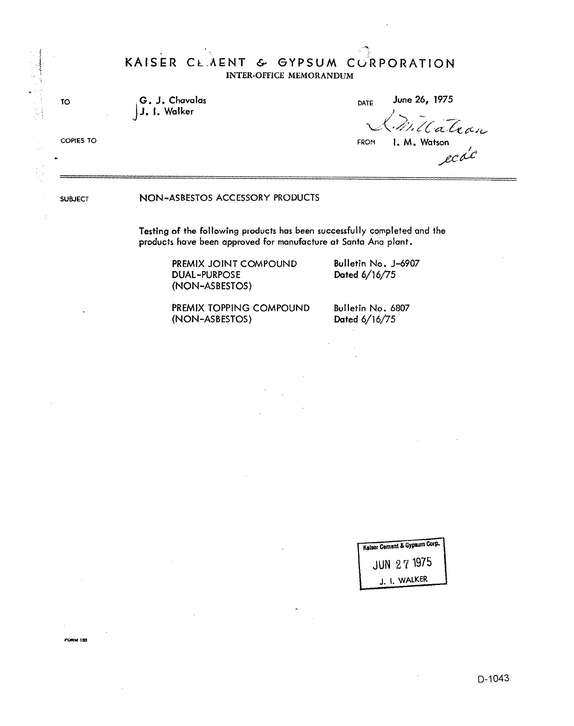
D-1043
refid# b5kwvJdvQvMnxLNajMBVNoKKy1 page
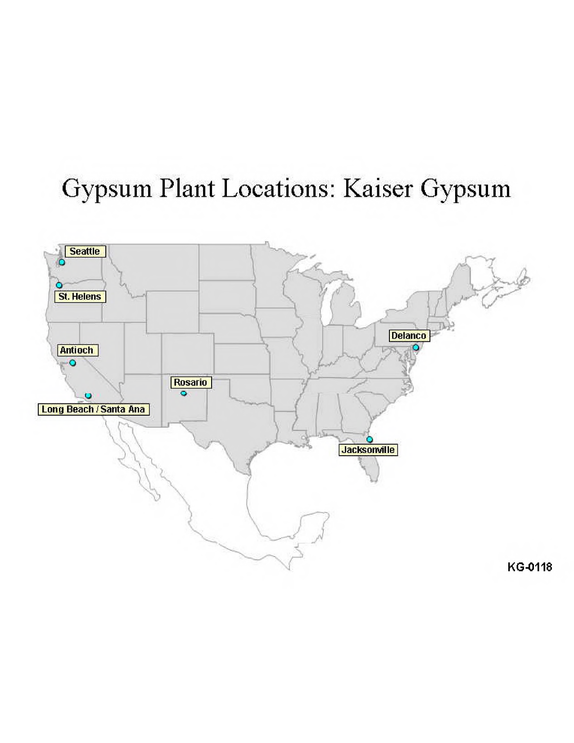
Gypsum Plant Locations: Kaiser Gypsum Seattle o Q St.
refid# MGR2z9BN0krQw7KnmKGDOg05z1 page
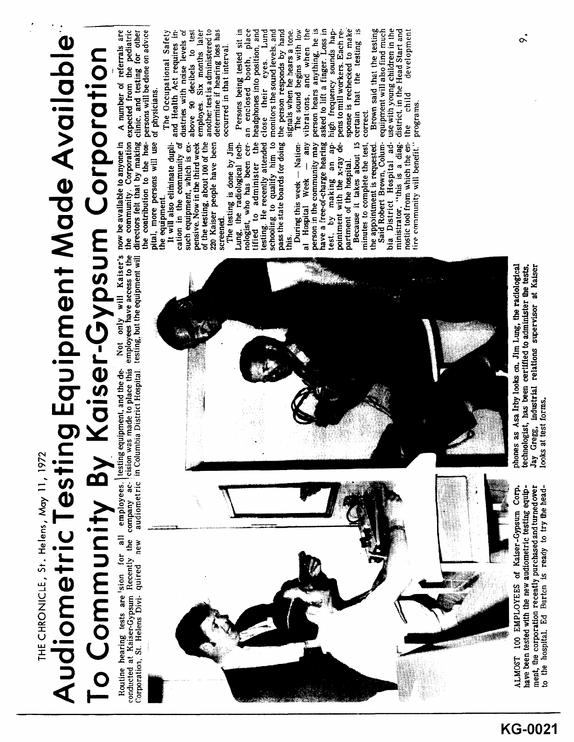
Audiom etric Testing Equipment Made Available To Community By Kaiser-Gypsum Corporation -- 31 W W ^_ < 8.B *5 a ^ ft) - I *J8J.s o .S _g -i c "c 'S"03*''.sZZ2: i=a)lssaf)i .-- Jo= PCI "0 mc -2 3 2 CM O 9Co-L 1cS 41XJ O W) J5 ft> --* C **- TJ o - >,< -5.2 " --C --. 1= T3 o*r ncW 2 1 ft o> p a ?
refid# ppjLLb3ONXR1REa7nOVj39yg71 page
I Notional Safety Congress Transactions Volume 15 INDUSTRIES ) o NATIONAL SAFETY COUNCIL * . 425 N.
refid# jad7767JBNoNJQv1JdmYGVR24 pages
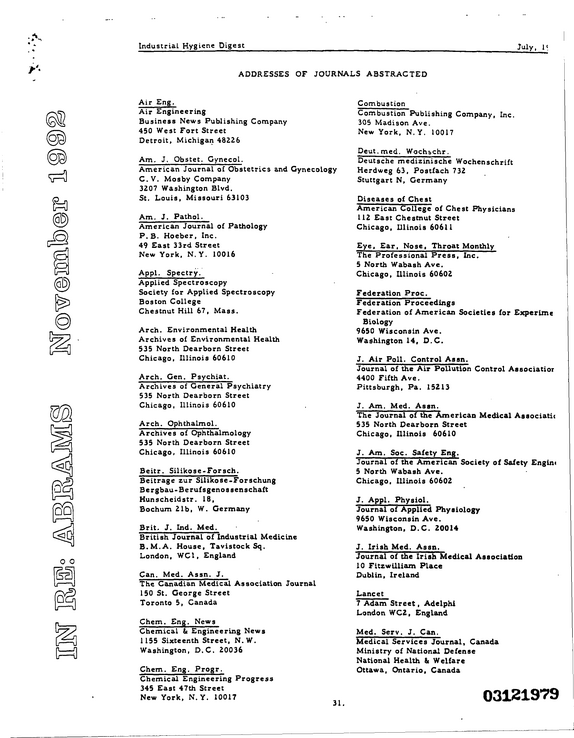
.V A'* 00 C=d Industrial Hygiene Digest July, I< ADDRESSES OF JOURNALS ABSTRACTED Air Eng.
refid# V39DoeMJrx7N3R9B3MEG0J2Kq1 page
Labor Sessions Job Placement and Medical Service. .
refid# O3ydJdYYjr5x2MmGezbZbbMOM1 page
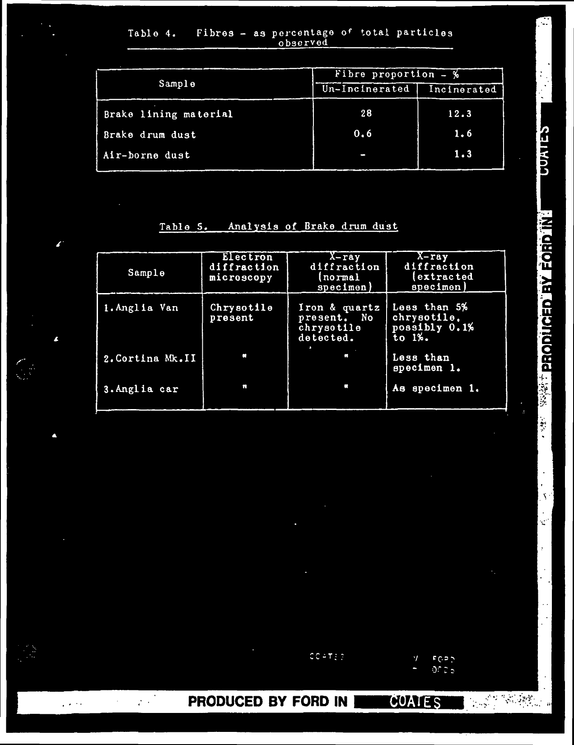
Table 4 Fibres - as percentage of total particles observed_________ _______ Sample Brake lining material Brake drum dust Air-borne dust Fibre proportion - % Un-Incinerated Incine rated 28 12.3 0.6 1.6 1.3 Table 5.
refid# pj6nENd8d4e50evn31exe23D1 page
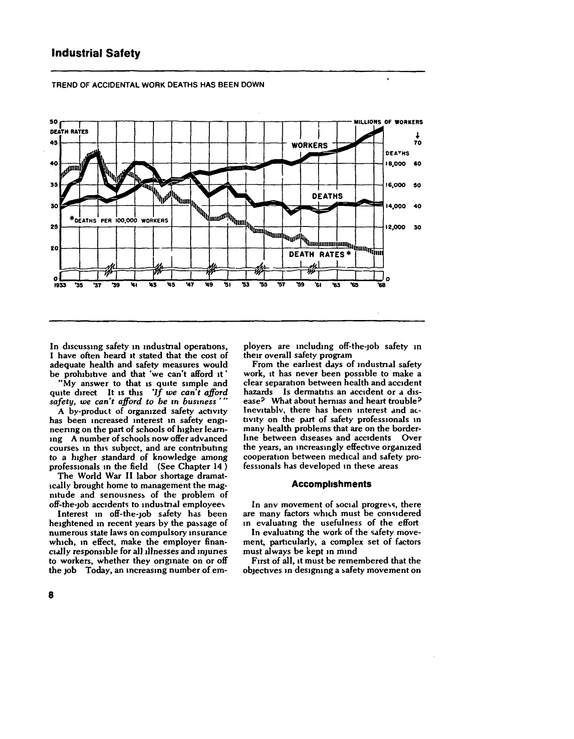
Industrial Safety TREND OF ACCIDENTAL WORK DEATHS HAS BEEN DOWN In discussing safety in industrial operations, I have often heard it stated that the cost of adequate health and safety measures would be prohibitive and that `we can't afford it ' "My answer to that is quite simple and quite direct It is this 'If we can't afford safety, we can't afford to be tn business A by-product of organized safety activity has been increased interest in safety engi neering on the part of schools of higher learn ing A number of schools now offer advanced courses in this subject, and are contributing to a higher standard of knowledge among professionals in the field (See Chapter 14 ) The World War II labor shortage dramat ically brought home to management the mag nitude and seriousness of the problem of off-the-job accidents to industrial employees Interest in off-the-job safety has been heightened in recent years by the passage of numerous state laws on compulsory insurance which, in effect, make the employer finan cially responsible for all illnesses and injuries to workers, whether they originate on or off the job Today, an increasing number of em ployers are including off-the-job safety in their overall safety program From the earliest days of industrial safety work, it has never been possible to make a dear separation between health and accident hazards Is dermatitis an accident or a dis ease'1 What about hernias and heart trouble?
refid# N5ZpjoejR2jxw53QXZVqMqQy1 page
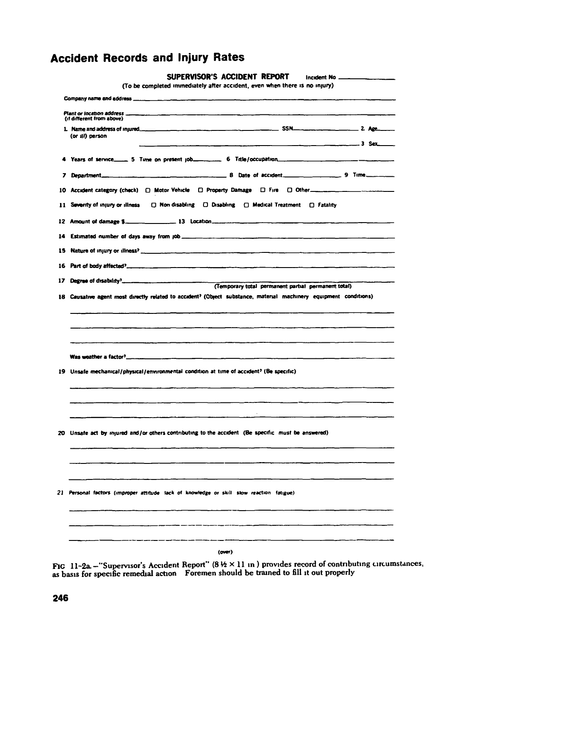
Accident Records and Injury Rates SUPERVISOR'S ACCIDENT REPORT modem No______________ (To be completed immediately after accident, even when there is no injury) Company name and address____ -- - - ----- -- Plant or location address (if different from above) - L Name and address of injuredSSN------------------------------------ Z Age.
refid# pmxgN0DB9bZGoDOem32z8y4bj1 page
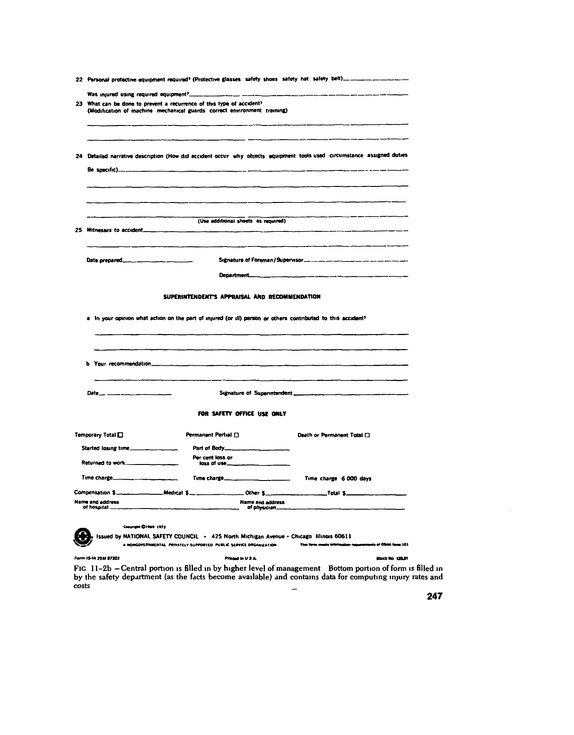
22 Personal protective equipment required7 (Protective glasses safety shoes safety hat safety belt).
refid# Jrd7qKbQnZ2qxp88xZ5L4qbwZ1 page
Accident Records and Injury Rates of materials on bulletin boards is one of the best ways to maintain the interest of employ ees in safety Accident records furnish many items, such as the following No-injury records Unusual accidents Charts showing reductions in acci dents Simple tables comparing depart mental records Standings in contests Frequent causes of accidents Reports to National Safety Council.
refid# ZJ7D4bYayoJe8QDDKOaX7JEn71 page
Walls and other surfaces should conserve light, while avoiding annoying reflections If offices depend largely on daylight, em ployees engaged in the visual tasks should be located near windows North light is pre ferred by draftsmen and artists Window ventilation is often unsatisfactory compared with comfort ("air") conditioning Persons near windows may feel cold, those farther away may be warm Where there are large interior spaces, forced ventilation is needed, usually, if the space is to be used for office purposes All mechanical ventilation and air con ditioning systems require careful planning and installation by experts Private offices, installed around the outer walls of a large office space should not cut off light and ven tilation from the other employees Fans in offices should be placed where they cannot fall on anybody and they probably should be secured in place Adequate ventilation should be supplied for duplicating machines, particularly spirit duplicating machines, or others that use ammonia, methanol, or other toxic liquids Concentrations of methanol around poorly ventilated duplicating machines can reach 200-300 ppm If the duplicating processes are confined to a separate small room, this usually means that mechanical ventilation is necessary Noise in offices should be held to a maxi mum of 40 decibels at the speech interference levels That is, the average of the reading m the three octave bands between 600 and 4800 Hertz (Hz) (cycles per second) should be less than 40 dB Acually, it is desirable that the noise level not be louder than 35 to 40 decibels (dB) m any audible band (16 to 12,000 Hz) Sound-absorging materials should be used on ceilings even where normal noise is not excessive, and noisy machines should be segregated A level of 20 to 30 dB would be classed as a very quiet office, and this level is suitable for a confer ence room Electrical.
refid# VK0bQg5RyRbMqjmMXyw5xX3xp1 page
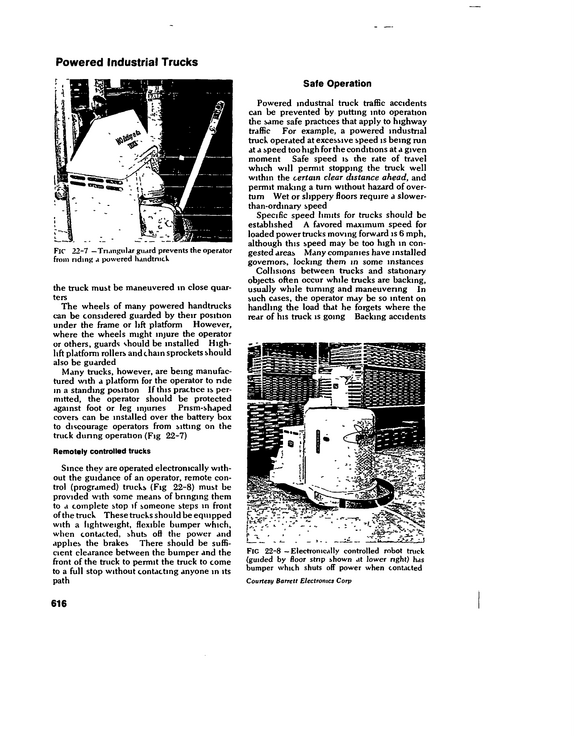
Powered Industrial Trucks Safe Operation FjC 22-7 --Triangular guard prevents the operator from riding a powered handtruck the truck must be maneuvered in close quar ters The wheels of many powered handtrucks can be considered guarded by their position under the frame or lift platform However, where the wheels might injure the operator or others, guards should be installed Highlift platform rollers and chain sprockets should also be guarded Many trucks, however, are being manufac tured with a platform for the operator to nde in a standing position If this practice is per mitted, the operator should be protected against foot or leg injuries Pnsm-shaped covers can be installed over the battery box to discourage operators from sitting on the truck during operation (Fig 22-7) Remotely controlled trucks Since they are operated electronically with out the guidance of an operator, remote con trol (programed) trucks (Fig 22-8) must be provided with some means of bringing them to a complete stop if someone steps m front of the truck These trucks should be equipped with a lightweight, flexible bumper which, when contacted, shuts off the power and applies the brakes There should be suffi cient clearance between the bumper and the front of the truck to permit the truck to come to a full stop without contacting anyone m its path Powered industrial truck traffic accidents can be prevented by putting into operation the same safe practices that apply to highway traffic For example, a powered industrial truck operated at excessive speed is being run at a speed too high for the conditions at a given moment Safe speed is the rate of travel which will permit stopping the truck well within the certain clear distance ahead, and permit making a turn without hazard of over turn Wet or slippery floors require a slowerthan-ordinary speed Specific speed limits for trucks should be established A favored maximum speed for loaded power trucks moving forward is 6 mph, although this speed may be too high in con gested areas Many companies have installed governors, locking them in some instances Collisions between trucks and stationary objects often occur while trucks are backing, usually while turning and maneuvering In such cases, the operator may be so intent on handling the load that he forgets where the rear of his truck is going Backing accidents Fig 22-8 --Electronically controlled robot tnick (guided by floor stnp shown at lower right) has bumper which shuts off power when contacted Courtesy Barrett Electronics Corp 616
refid# NEgeK7jj6MD936epo2X41kwDR1 page
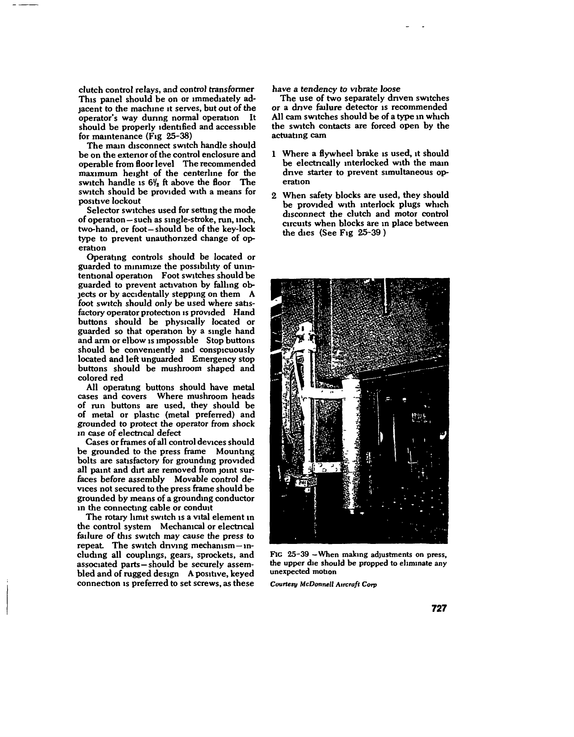
clutch control relays, and control transformer This panel should be on or immediately ad jacent to the machine it serves, but out of the operator's way during normal operation It should be properly identified and accessible for maintenance (Fig 25-38) The main disconnect switch handle should be on the extenor of the control enclosure and operable from floor level The recommended maximum height of the centerline for the switch handle is 6% ft above the floor The switch should be provided with a means for positive lockout Selector switches used for setting the mode of operation --such as single-stroke, run, inch, two-hand, or foot--should be of the key-lock type to prevent unauthonzed change of op eration Operating controls should be located or guarded to minimize the possibility of unin tentional operation Foot switches should be guarded to prevent activation by falling ob jects or by accidentally stepping on them A foot switch should only be used where satis factory operator protection is provided Hand buttons should be physically located or guarded so that operation by a single hand and arm or elbow is impossible Stop buttons should be conveniently and conspicuously located and left unguarded Emergency stop buttons should be mushroom shaped and colored red All operating buttons should have metal cases and covers Where mushroom heads of run buttons are used, they should be of metal or plastic (metal preferred) and grounded to protect the operator from shock m case of electrical defect Cases or frames of all control devices should be grounded to the press frame Mounting bolts are satisfactory for grounding provided all paint and dirt are removed from joint sur faces before assembly Movable control de vices not secured to the press frame should be grounded by means of a grounding conductor in the connecting cable or conduit The rotary limit switch is a vital element in the control system Mechanical or electrical failure of this switch may cause the press to repeat The switch driving mechanism--in cluding all couplings, gears, sprockets, and associated parts--should be securely assem bled and of rugged design A positive, keyed connection is preferred to set screws, as these have a tendency to vibrate loose The use of two separately driven switches or a drive failure detector is recommended All cam switches should be of a type in which the switch contacts are forced open by the actuating cam 1 Where a flywheel brake is used, it should be electrically interlocked with the mam drive starter to prevent simultaneous op eration 2 When safety blocks are used, they should be provided with interlock plugs which disconnect the clutch and motor control circuits when blocks are m place between the dies (See Fig 25-39 ) Fig 25-39 --When making adjustments on press, the upper die should be propped to eliminate any unexpected motion Courtesy McDonnell Aircraft Corp 727
refid# NNBw9zXGGmV3w1w6JwN2rD1eb1 page