Refine
Estimated Years UndatedClear
92,592 results foundRefine Search
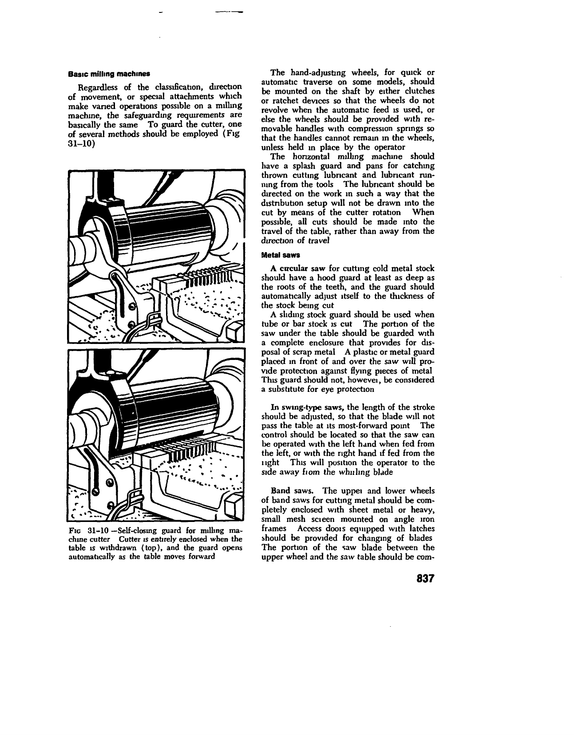
Baste milling machines Regardless of the classification, direction of movement, or special attachments which make varied operations possible on a milling machine, the safeguarding requirements are basically the same To guard the cutter, one of several methods should be employed (Fig 31-10) Fic 31-10 -Self-closing guard for milling ma chine cutter Cutter is entirely enclosed when the table is withdrawn (top), and the guard opens automatically as the table moves forward The hand-adjusting wheels, for quick or automatic traverse on some models, should be mounted on the shaft by either clutches or ratchet devices so that the wheels do not revolve when the automatic feed is used, or else the wheels should be provided with re movable handles with compression springs so that the handles cannot remain in the wheels, unless held m place by the operator The honzontal milling machine should have a splash guard and pans for catching thrown cutting lubneant and lubricant run ning from the tools The lubricant should be directed on the work in such a way that the distribution setup will not be drawn into the cut by means of the cutter rotation When possible, ail cuts should be made into the travel of the table, rather than away from the direction of travel Metal saws A circular saw for cutting cold metal stock should have a hood guard at least as deep as the roots of the teeth, and the guard should automatically adjust itself to the thickness of the stock being cut A sliding stock guard should be used when tube or bar stock is cut The portion of the saw under the table should be guarded with a complete enclosure that provides for dis posal of scrap metal A plastic or metal guard placed m front of and over the saw will pro vide protection against flying pieces of metal This guard should not, howevei, be considered a substitute for eye protection In swing-type saws, the length of the stroke should be adjusted, so that the blade will not pass the table at its most-forward point The control should be located so that the saw can be operated with the left hand when fed from the left, or with the right hand if fed from the light This will position the operator to the side away fiom the whiiling blade Band saws.
refid# aLGK1734Z757yv733devk4RN1 page
31--Machine Tools coat of rouge, tnpoli, or other mild abrasive The softness of the wheel built up of linen, canvas, felt, or leather is determined by the size of the flanges used--the larger the flange, the harder the surface When large flanges are used, it is often necessary to soften the working surface of the built-up wheels to con form to die contour of the object being pol ished A safe procedure for softening is to place the wheel on the floor or other flat surface and pound the edges of the wheel with a hammer or mallet The wheel should not be placed on the spindle with a file or other object held against it Such practice is almost certain to result in the object's catch ing m the wheel and being thrown with such force that the operator or nearby workers may be injured.
refid# OzmDgzb7dwaBq9N9rNwKJOv7v1 page
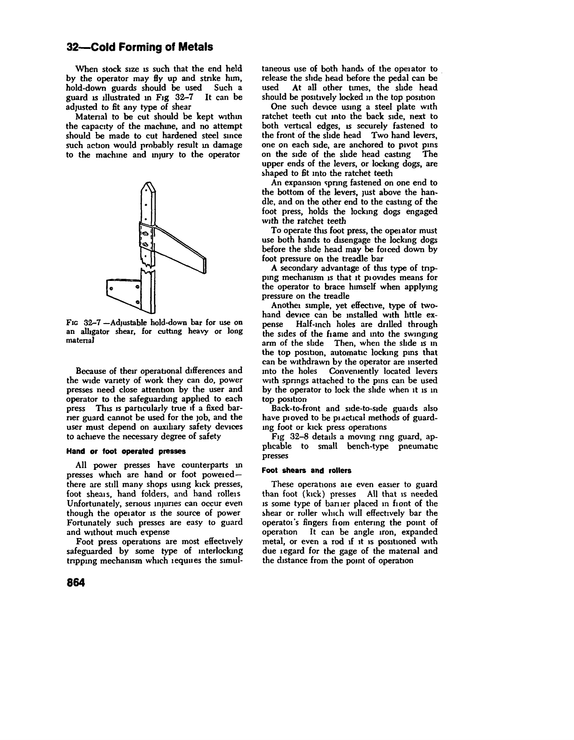
32--Cold Forming of Metals When stock size is such that the end held by the operator may fly up and strike him, hold-down guards should be used Such a guard is illustrated in Fig 32-7 It can be adjusted to fit any type of shear Material to be cut should be kept within the capacity of the machine, and no attempt should be made to cut hardened steel since such action would probably result m damage to the machine and injury to the operator Fic 32-7 --Adjustable hold-down bar for use on an alligator shear, for cutting heavy or long material Because of their operational differences and the wide variety of work they can do, power presses need close attention by the user and operator to the safeguarding applied to each press This is particularly true if a fixed bar rier guard cannot be used for the job, and the user must depend on auxiliary safety devices to achieve the necessary degree of safety Hand or foot operated presses All power presses have counterparts in presses which are hand or foot poweied-- there are still many shops using kick presses, foot sheais, hand folders, and hand rolleis Unfortunately, serious injuries can occur even though the opeiator is the source of power Fortunately such presses are easy to guard and without much expense Foot press operations are most effectively safeguarded by some type of interlocking tnpping mechanism which lequnes the simul 864 taneous use of both hands of the opeiator to release the slide head before the pedal can be used At all other times, the slide head should be positively locked m the top position One such device using a steel plate with ratchet teeth cut into the back side, next to both vertical edges, is securely fastened to the front of the slide head Two hand levers, one on each side, are anchored to pivot pins on the side of the slide head casting The upper ends of the levers, or locking dogs, are shaped to fit into the ratchet teeth An expansion spring fastened on one end to the bottom of the levers, just above the han dle, and on the other end to the casting of the foot press, holds the locking dogs engaged with the ratchet teeth To operate this foot press, the opeiator must use both hands to disengage the locking dogs before the slide head may be foiced down by foot pressure on the treadle bar A secondary advantage of this type of trip ping mechanism is that it piovides means for the operator to brace himself when applying pressure on the treadle Anothei simple, yet effective, type of twohand device can be installed with little ex pense Half-inch holes are drilled through the sides of the fiame and into the swinging arm of the slide Then, when the slide is in the top position, automatic locking pms that can be withdrawn by the operator are inserted into the holes Conveniently located levers with springs attached to the pms can be used by the operator to lock the slide when it is in top position Back-to-front and side-to-side guaids also have pioved to be piactical methods of guard ing foot or kick press operations Fig 32-3 details a moving ring guard, ap plicable to small bench-type pneumatic presses Foot shears and rollers These operations aie even easier to guard than foot (kick) presses All that is needed is some type of bamer placed m fiont of the shear or roller which will effectively bar the operatoi's fingers fiom entering the point of operation It can be angle iron, expanded metal, or even a rod if it is positioned with due tegard for the gage of the material and the distance from the point of operation
refid# JrmNZewKX5vGDYvr472D68nK1 page
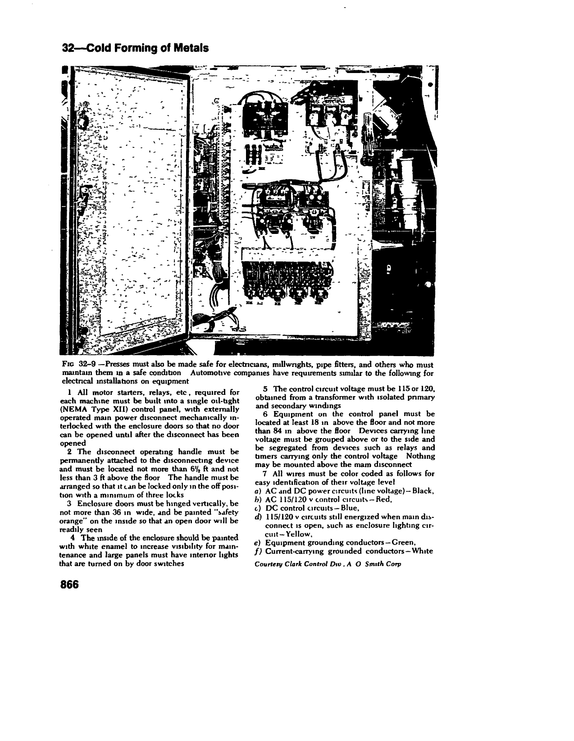
32--Cold Forming of Metals Fic 32-9 --Presses must also be made safe for electricians, millwrights, pipe fitters, and others who must maintain them in a safe condition Automotive companies have requirements similar to the following for electrical installations on equipment 1 All motor starters, relays, etc, required for each machine must be built into a single oil-tight (NEMA Type XII) control panel, with externally operated main power disconnect mechanically in terlocked with the enclosure doors so that no door can be opened until after the disconnect has been opened 2 The disconnect operating handle must be permanently attached to the disconnecting device and must be located not more than 6'/* ft and not less than 3 ft above the floor The handle must be arranged so that it can be locked only in the off posi tion with a minimum of three locks 3 Enclosure doors must be hinged vertically, be not more than 36 in wide, and be painted "safety orange" on the inside so that an open door will be readily seen 4 The inside of the enclosure should be painted with white enamel to increase visibility for main tenance and large panels must have interior lights 5 The control circuit voltage must be 115 or 120, obtained from a transformer with isolated primary and secondary windings 6 Equipment on the control panel must be located at least 18 in above the floor and not more than 84 m above the floor Devices carrying line voltage must be grouped above or to the side and be segregated from devices such as relays and timers carrying only the control voltage Nothing may be mounted above the mam disconnect 7 All wires must be color coded as follows for easy identification of their voltage level a) AC and DC power circuits (line voltage)--Black, h) AC 115/120 v control circuits --Red, c.)
refid# Ra5mz5onXDqKmwRXOLMarzVvn1 page
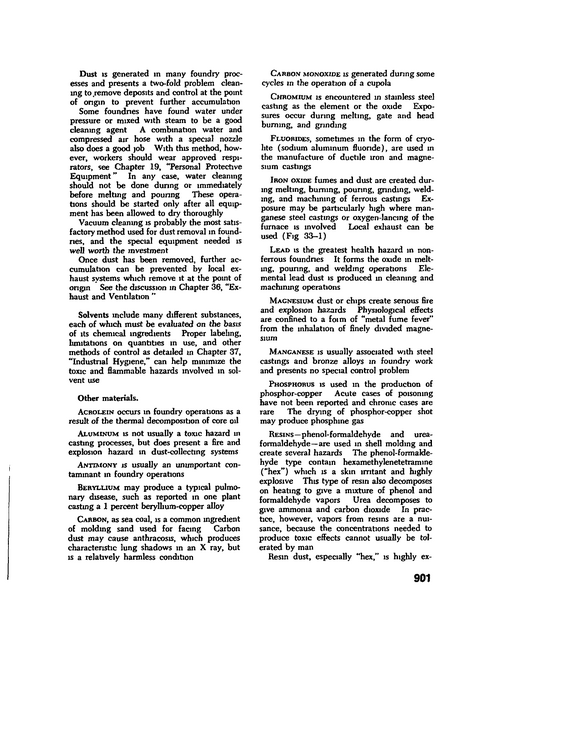
Dust is generated in many foundry proc esses and presents a two-fold problem clean ing to .remove deposits and control at the point of origin to prevent further accumulation Some foundries have found water under pressure or mixed with steam to be a good cleaning agent A combination water and compressed air hose with a special nozzle also does a good job With this method, how ever, workers should wear approved respi rators, see Chapter 19, "Personal Protective Equipment " In any case, water cleaning should not be done during or immediately before melting and pounng These opera tions should be started only after all equip ment has been allowed to dry thoroughly Vacuum cleaning is probably the most satis factory method used for dust removal in found ries, and the special equipment needed is well worth the investment Once dust has been removed, further ac cumulation can be prevented by local ex haust systems which remove it at the point of origin See the discussion m Chapter 36, "Ex haust and Ventilation '' Solvents include many different substances, each of which must be evaluated on the basis of its chemical ingredients Proper labeling, limitations on quantities in use, and other methods of control as detailed m Chapter 37, "Industrial Hygiene," can help minimize the toxic and flammable hazards involved m sol vent use Other materials.
refid# ZBdYEqzkNQBOXeR1DN6by4eg71 page
to help prevent fire Powder washing, a method in which a stream of powdered iron oxide is introduced into the gas flame to intensify the heat pro duced, should be done according to the same safe practices as other welding and cutting of carbon steel or cast iron However, when this method is used to clean or cut sprues, gates, and risers from alloyed castuigs, ex haust ventilation is recommended Power presses Power presses have wide application m finishing departments of foundries Sufficient aisle space, good housekeeping, and effective fighting should be provided for safety m power press operation Machines should be fully guarded and maintained in good work ing order Operators should be carefully se lected and should be trained in efficient and safe operation of the machine Mechanical feed and ejection equipment should be used where practical These topics are fully discussed m Chap ter 32, "Cold Forming of Metals " Nondestructive Testing Visual observation, even with magnifica tion, cannot locate all small, below-the-surface defects in cast and forged metals Proper nondestructive testing will, however, reveal all such defects positively without damage to the parts being tested Nondestructive test ing methods will locate defects inherent in the metal (nonmetallic inclusions, shrinkage, porosity), defects that result from processing (high residual stresses, ciacks and checks caused by handling, spruing, or grinding of castings and forgings), and in-service defects (sharp changes m section, corrosion, erosion) The types of testing most commonly used for forged and cast metals are 1.
refid# 6BL0bLeo2kB21KNZ2LDRb9n7o1 page
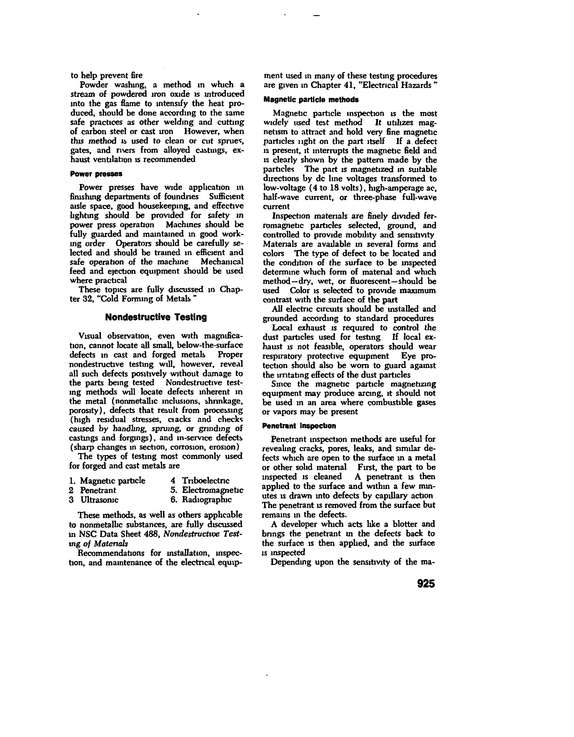
r Johns-Manville V51 Pre-Engineered Building Systems PEBS-7:1 THERMAL-ACOUSTICAL AND EFFECTIVE: 2-1-81 CANCELS: PEBS-7:1, 9-1-80 SOUND CONTROL FIBER GLASS BATTS LAMINATOR--DISTRIBUTOR PRICE LIST Building Systems Division Terms and Conditions of Sale I.
refid# D45LnQ8Lxw3GBmJymK6VrNBB2 pages
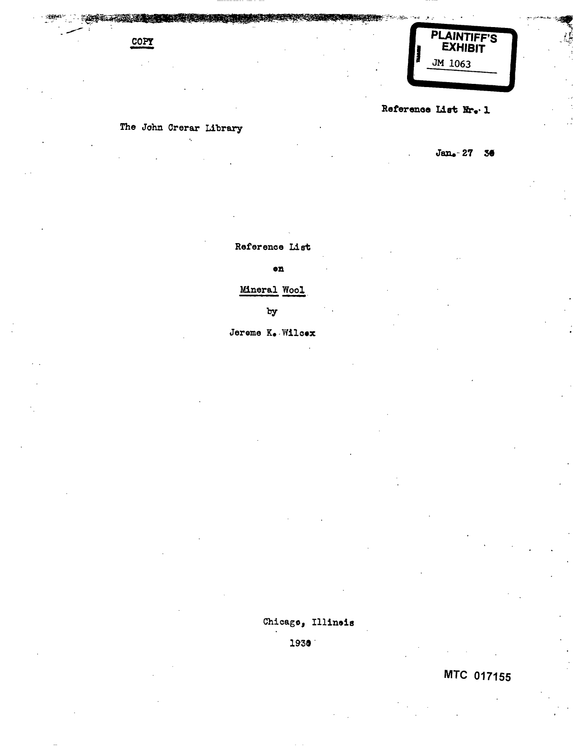
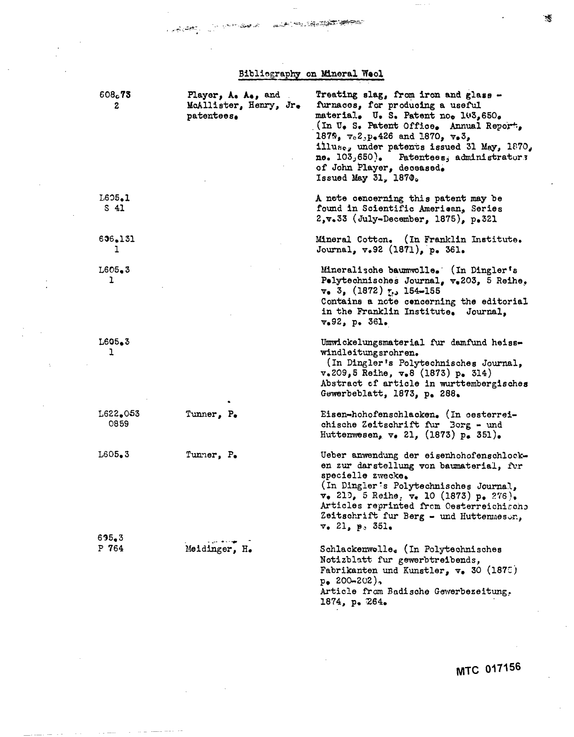
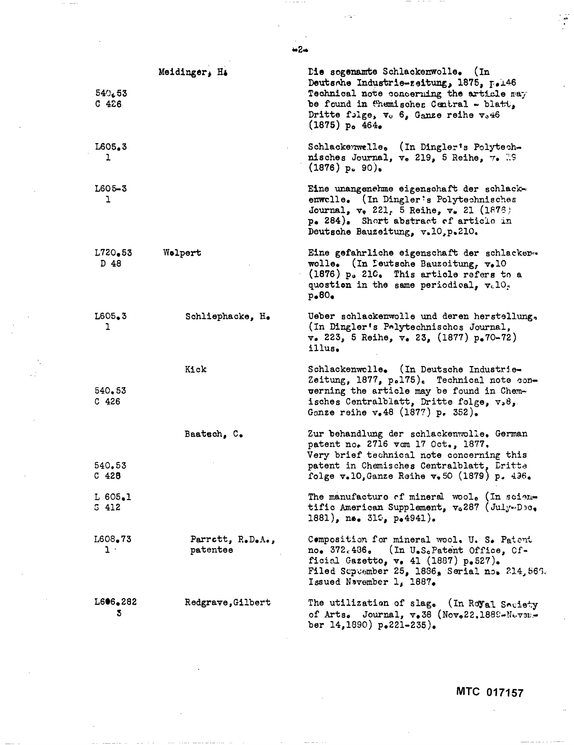
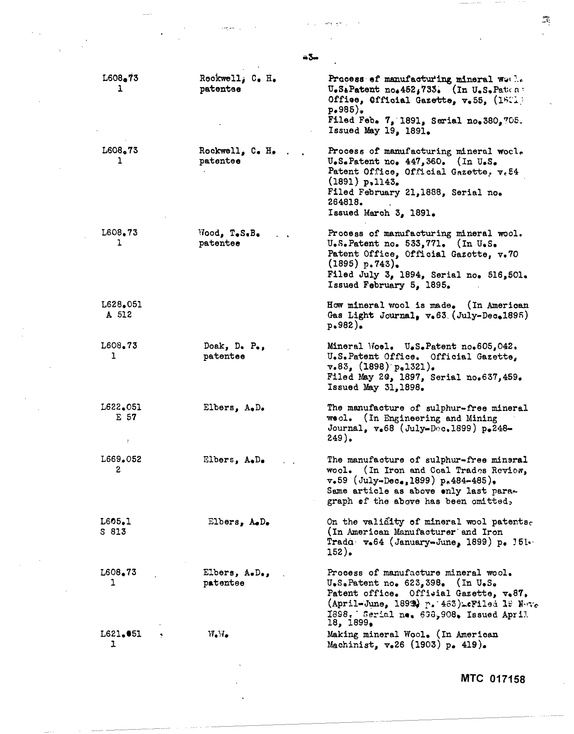
COPT The John Crerar Library Reference List Hr>1 Jan, 27 3# Reference List on Wlwftl UTool by Jerome K,-Wilcox Chicago, Illinois 193# MTC 017155 608o73 2 1.605*1 S 41 636.131 1 L605.3 1 L605.3 1 L622.053 0859 L605.3 695,3 P 764 Bibliography on Mineral Tfaol Player, A, A*, and McAllister, Henry, Jr* patentees* Treating slag, from iron and glass furnaces, for producing a useful material* D, S.
refid# DDVbxkw7YqnZONVjapkrp1eM58 pages
OUTS f DC U.'

refid# xEVdqz5pEYopgV20Npr6dVe62 pages
Cutter jaws should have the hardness speci fied by the manufacturer for the particular kind of material to be cut By adjustment of the bumper stop behind the jaws, cutting edges should be set to have a clearance of 0003 m when closed Wood-cutting tools Edged took should be used so that, if a slip should occur, the direction of force will be away from the body For efficient and safe work, edged tools should be kept sharp and ground to the proper angle A dull tool does a poor job and may stick or bind A sudden release may throw the user off balance or cause his hand to strike an obstruction Dress ing of wood-cutting tools is covered earlier m this chapter Wood chisek.
refid# R2JbvJ2mBE1kQVkRbreEev2yn1 page
38--Industrial Toxicology celsior, paper products, or sawdust, sufficient heat can be generated to char or ignite the materia] if the concentration is above the pyrophoric limit Solutions of butyllithium should never be exposed to the atmosphere but rather handled in enclosed systems or under inert dry atmosphere Emergency showers and eye baths should be placed in convenient locations Every em ployee should be carefully instructed, and understand that direct contact with the skin requires immediate flushing with large quan tities of water to the affected area Butyraldehydes have a relatively low degree of toxicity Although there is a lack of de tailed information on the subject, no cases are known of either acute or chronic intoxication due to exposures to butyraldehydes Butyral dehydes produce irritation and bums of the skin and eyes following contact of short dura tion Butyraldehydes have good warning properties due to a characteristic pungent aldehyde odor Butyraldehyde is a highly volatile flam mable liquid readily forming explosive mix tures with air It has a low flash point and low ignition temperature and is readily ignited by static sparks of relatively low energy It is a reactive chemical and the heat released by an uncontrolled reaction will soon cause boil ing and either pressure increase or release of large volumes of flammable vapor Butyral dehydes undergo rapid oxidation, any spills that are wiped up with rags can lead to fires in the rags Animal experiments have shown that large doses of butyraldehydes produce both de pression of the central nervous system and anesthesia so that the symptoms of acute in toxication in man (such as drowsiness, inco ordination, and headache) might be antici pated The animal experiments also suggest that these systemic symptoms may develop from exposures to concentrations below those causing uncomfortable irritation of the eyes, nose, and throat C Cadmium metal is easily flammable in the form of dust or fine powder The finely pow dered oxide produced in cadmium fires is acutely poisonous, and several cases of serious 1132 poisoning incurred in fighting fires involving cadmium metal have been recorded No at tempt should be made to approach such a fire without a supplied air respirator, universal gas mask with smoke filter, or metal fume respira tor One of the commonest sources of acute in dustrial poisoning is the heating or weldmg of cadmium plated metals This job should be done only under efficient local exhaust or by workmen equipped with supphed air respira tors Industrial poisoning by swallowing of solu ble cadmium compounds is not common, but a number of nomndustrial cases from the prep aration of acid foods in cadmium plated uten sils have occurred There is some disagreement as to the pos sibility of chronic cadmium poisoning One examinabon was made of 38 men working in the production of alkali storage batteries and exposed to atmospheres ranging from three to 900 mg of cadmium and almost equal amounts of nickel per cu m These men com plained of fatigue, nervousness and irritability, thirst, cough and shortness of breath In about half of the workmen with long penods of employment, the sense of smell was im paired Of the 19 men with more than eight years of work m the battery plant, 15 showed protein m the urine, 12 suffered more or less from loss of the sense of smell, and 14 showed impaired kidney function Fifteen of 17 men examined with the spirometer showed im paired lung function, and all of them com plained from time to time of shortness of breath In four cases the changes m the lungs were noticeable on X-ray examination, and six other cases showed signs of inactive tubercu losis One case had active tuberculosis Other examinations were made on 20 work men from a cadmium smelter at repeated in tervals over a period of 3 months These men had exposures varying from 6 months to 22 years, and the atmospheric concentrations in the plant ran from 0 04 to 31 3 mg of cad mium per cu m of air Exposures to the highest concentration, however, lasted only two to three hours per day, and the men were rotated so that total exposure to the highest concentrations was comparatively limited The most characteristic finding was a yellow nng on the teeth of the men with long ex-
refid# NGda1JqkNOV9rmvLK9KndKXaV1 page
38--Industrial Toxicology the whole area with a lime sulfur spray To prevent such inconvenience, metallic mercury should be handled over impervious tables or containers with the surfaces de pressed and arranged to drain to a central point Spilled mercury can then be collected and returned to stock A number of volatile mercury compounds are used m seed disinfection Examples are ethyl mercury chloride and phosphate and the corresponding phenyl mercury compounds These materials are highly toxic When used without adequate enclosure and dust control, they can rapidly produce severe mercurial in toxication These seed-treating compounds are also strong primary skin irritants and will cause itching, burning, and blistering on direct contact Such irritations heal slowly The type of mercury intoxication common to industry is characterized by a tremor of the hands, irritation of the mucous membranes of the mouth, excessive flow of saliva, and changes in the personality Poisoning by one of the volatile compounds may be more rapid so that personality changes are not so likely to be seen Inhalation of mercury vapor, usually in very high concentrations, may produce metal fume fever, which may disappear with no other apparent symptoms, or may be followed by a pneumonitis or other symptoms of mercurahsm The ordinary toxic dust respirator does not protect against intoxication by metallic mer cury or by the volatile seed-treating com pounds, since they are in the form of vapor rather than dust A gas mask offers some pro tection, but if enclosure and local exhaust are not possible, the only effective protection is a supplied air respirator Mesityl oxide is a high-boiling, unsaturated ketone which is thought to be somewhat more toxic than the ketones of lower molecular weights Metal hydrides (primary types) are com pounds of hydrogen and the alkali metals sodium, potassium, lithium, magnesium, cal cium, and strontium Information on the health hazards of metal hydrides is limited Since they react with water to form caustic hydroxides, they are lmtabng to the eyes. 1154 skin, and mucous membranes They also re lease a large amount of heat on reaction with the moisture of the skin Methanol (methyl alcohol) poisoning is usually produced by swallowing the liquid or inhaling high concentrations of vapor m an enclosed place such as a tank The signs of poisoning include headache nausea, vomiting, violent abdominal pains, aimless and erratic movements, dilated pupils, sometimes de lirium, and such eye symptoms as pain, ten derness on pressure, and occasionally blind ness Direct action of the liquid or the vapor on the skin and mucous membranes may pro duce an irritation and inflammation One of the peculiarities of methanol poison ing is its exceptionally severe action on the optic nerve About one-half of all the senous cases of methanol poisoning result in some im pairment of vision, which is usually permanent and may vary from dimness or bhnd spots scattered through the visual field to total blindness Methoxychlor (2,2-di[p-methoxyphenyl]-l,1,1-tnchloroethane) is a synthetic insecticide which is closely related to DDT in its action It is, however, about % to Mo as toxic as DDT Consequently, the hazard from inhalation of the dust or mist of sprays of this insecticide is remote Methoxychlor is not absorbed through the intact skin in significant amounts, and does not seem to have any effect on the central nervous system In animal experiments, con tinued feeding of diets containing methoxy chlor m toxic concentration leads to loss of weight in the animals by their voluntary re striction of food intake and also to fatty in filtration of the liver in the manner of the chlorinated hydrocarbons Methyl acetate is widely used as a lowboihng solvent m the perfume, cosmetic and paint industries It is irritating to the mucous membranes of the eyes and the respiratory passage Animal studies indicate that there may be general poisoning and long-lasting aftereffects when methyl acetate is inhaled in concentra tions below that which produces narcosis If exposure is senous, pulmonary edema and
refid# awzELnEZjOj8DrDR60kGevqa1 page
ally appears within the first few weeks of exposure but may occur m an individual who has worked with the material for a number of years Probably anyone with sufficient ex posure will eventually develop the dermatitis There are also some persons with a true hy persensitivity to TNT who should be per manently removed from exposure Inhalation or ingestion of TNT in excessive quantities will produce systemic poisoning Some of the earliest signs of excessive ab sorption of TNT are digestive disturbances and mild cyanosis The digestive signs in clude nausea, sometimes vomiting m the early morning, loss of appetite, and sometimes con stipation with colic The cyanosis probably starts with the formation of methemoglobm or similar pig ment This indication of overexposure is not in itself dangerous, but it is commonly fol lowed by a reduction m red cells and a severe anemia, which may develop into a typical aplastic anemia TNT also affects the liver and produces a toxic jaundice Young people and people with previous liver disease are the most susceptible To prevent both the dermatitis and the systemic poisoning, the most scrupulous house keeping and dust control measures should be observed TNT handlers should wear com plete work uniforms, change them daily, and never take them from the plant Thev should also be required to wash thoroughly before leaving the plant Soap is not effective Liquid soap with 5 percent potassium sulfite and a small quantity of sulfonated higher alcohol provides a good medium Triorthocresylphosphate (TOCP) is a color less, odorless high-boiling liquid and is usually found in liquid multure with the meta and para isomers Any route of exposure m single or repeated doses constitutes a high health hazard TOCP is readily absorbed through the skin, but there is little vajaor hazard at or dinary temperatures Ingestion of the compound, either as the liquid or the fog or mist, produces symptoms of paralysis without sensory effect Shortly after ingestion, there may be gastro-intestinal symptoms, including nausea, vomiting, diar rhea, and abdominal pain The majority of victims never again regain normal function of the central nervous system Turpentine is the most familiar solvent for oil paints Although there are cheaper sub stitutes, it is still widely used in fine extenor painting Many painters formerly had chronic kidney disease, which they attnbuted to tur pentine vapor but which was probably due to lead It has not been possible to produce chronic kidney disease expenmentally with tur pentine Turpentine hydrocarbons are not particu larly lmtating in themselves but some grades contain highly untabng impunties These differences depend on the method of preparation and probably are a measure of the amount of decomposition produced in the re fining It has been generally believed in this country that gum turpentine, obtained by tapping trees, is less irritating than the steamdistilled variety U Uranium and its compounds are radioactive, and they are toxic when ingested or inhaled The effects on the body depend upon the solubility of the uranium compound con cerned The soluble compounds are eliminated from the body rather rapidly, but if ingested in suf ficient amounts, they will cause a chemical poisomng, primarily affecting the kidneys One investigator has reported that long before a radiologically hazardous amount of uranium could be deposited m the bone structure, the chemical toxicitv to the kidneys would be fatal Insoluble uranium compounds are primarily an inhalation hazard They are dangerous not because of chemical toxicity to the kid neys, but because radioactive particles may ac cumulate m the lungs in an amount exceeding permissible tissue tolerance Urethanes--see Toluene 2,4-diisocyanate.
refid# bqozgOa4ZE6Gmkrn171R27001 page
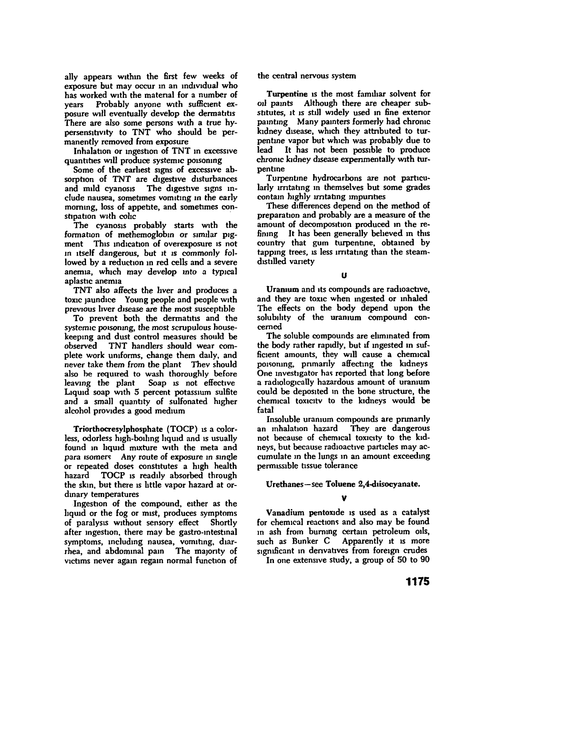
TML tetramethyl lead TNT trinitrotoluene toluene diisocyanate isocyanates toluidme methyl aniline toluol toluene tolylene diisocyanate isocyanates 1,1,1 -tnthloroethjne methyl chloroform tnchloromethane chloroform trunethvlamine methvlamine tnmethvl carlnnol butanol 2.4.6-trinitrophenvlmethvlmtra nine tetryl 2.4.6-tniutroplienol picric acid triorthocresvl phosphate tncresvl phosphate u UDMH 1,1-dimethvlhydrazine unss'inmetncal dimethvl hvdr.izine 1,1 -di meths Ihvdrazi ne V vinegar acid vinyl benzene vmvlcvamde vmvl tnchlonde vinvlidene chloride monomer w acetic acid styrene monomer acrvlonitrile inethvl chloroform dichlonieths lene wood alcohol wood spirit methyl alcohol methyl alcohol X xylols xylenes
refid# QJ67OajMdX1JmO7oGqQv89E1k1 page
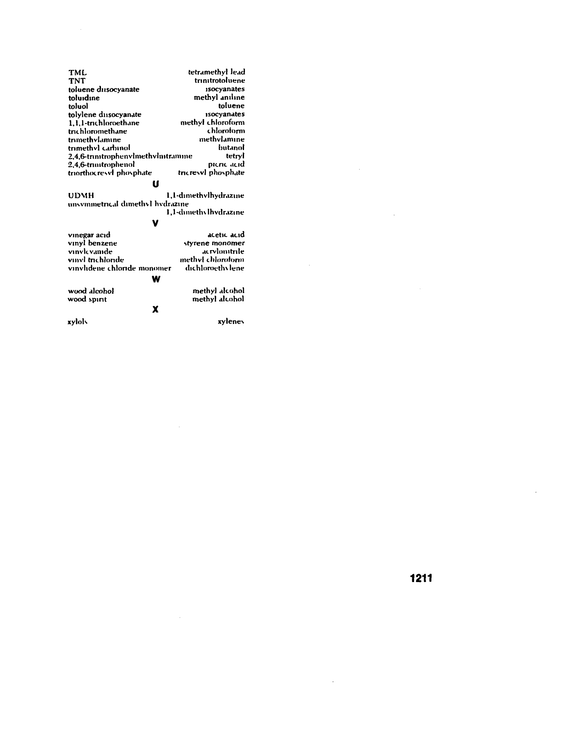
41--Electrical Hazards Fic 41-13 --In the circle is an exposed electrical connection inside the handle of a portable electric tool, creating a serious shock hazard This sort of defect should be remedied only by an experienced electrician Motors, circuit breakers, moving parts of switches, and similar current-carrying de vices wear out, break down, and need read justments Repairs on electrical circuits and electrical apparatus should be made only by experienced electricians (Fig 41-13) Only high-grade electrical equipment listed as standard by Underwriters Laboratories Inc, or other qualified authority, should be used m maintenance work Inferior, unap proved equipment may become hazardous because of defective material or design or poor workmanship If practicable, conductors should be deen ergized when maintenance work on them is necessary Before they begin work, main tenance men should make certain that the line is dead by testing it with the voltage testing devices provided It is not safe to test a circuit with the fingers or with make shift devices 1282 The men should be instructed m the use of electrical testing equipment and meters how to tap into the circuit, how to locate testing points from schematic diagrams, how to use insulated meter leads, clips, and probes, and how to fuse test circuits Pliers, screw driv ers, testing lights, and other tools used in electrical repair work should be insulated When maintenance or repair work must be done on energized conductors, it is advisable to have two or more employees work to gether The supervisor should give detailed proceduies to be followed He should also see that maintenance ciews are supplied with and use the right protective equipment The kind of protective equipment needed will be determined by the type of circuit, the nature of the job, and the conditions under which the work must be done Rubber gloves, sleeves, mats, line hose, insulating plat forms, safety headgear, safety glasses, safety belts, fuse tongs, and insulated switch sticks are among the more common items of equip ment usually available Safety equipment should be inspected be fore use and retested at frequent intervals Because of the location of electrical equip ment and circuits, the methods of maintain ing them, and the insulated tools required, the maintenance man must be constantly on guard to prevent accidental grounding Such grounding may result if an energized loose wire comes in contact with water pipe, con duit, metal fixtures, another wire, or anything metallic that is connected with the earth Lockouts Unexpected operation of electrical equip ment that can be started by automatic oi manual remote control may cause injuries to persons who happen to be near enough to be struck Unexpected starting of motors may injure men working on them as well as the men operating machines controlled by the motors For that reason, when men are to repair motors or other electrical equipment, the cir cuit should be opened at the switch box, and the switch should be padlocked in the "off" position and tagged with a description of the work being done, the name of the man, and the department involved Warning signs or tagging alone does not provide the positive
refid# O3BLG9KQBBvbXprLLDK1NvGNM1 page