Refine
Estimated Years 2000-2009Clear
18,679 results foundRefine Search
B.
refid# zork4dO1LL8rzy0RN04K56joB3 pages
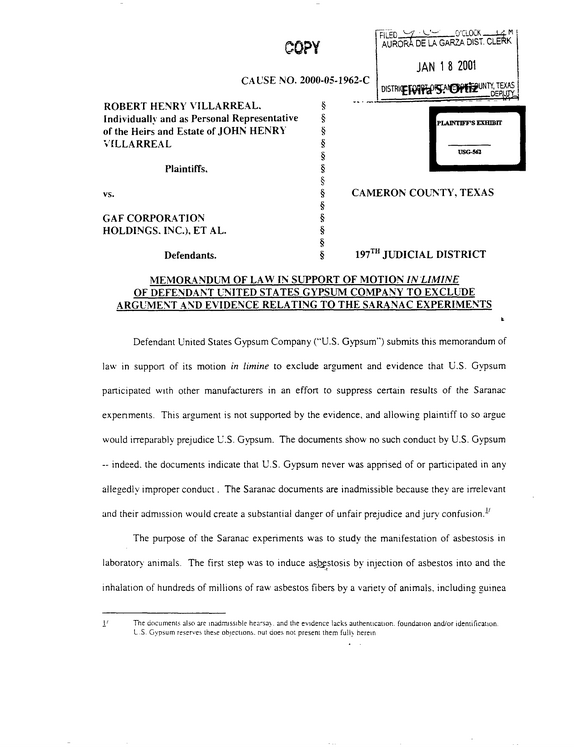
COPY ni cn W - V-'-' -O'CLOCK------4.
refid# ymvBwdzr20BEm4a6VpE1YrvOD41 pages
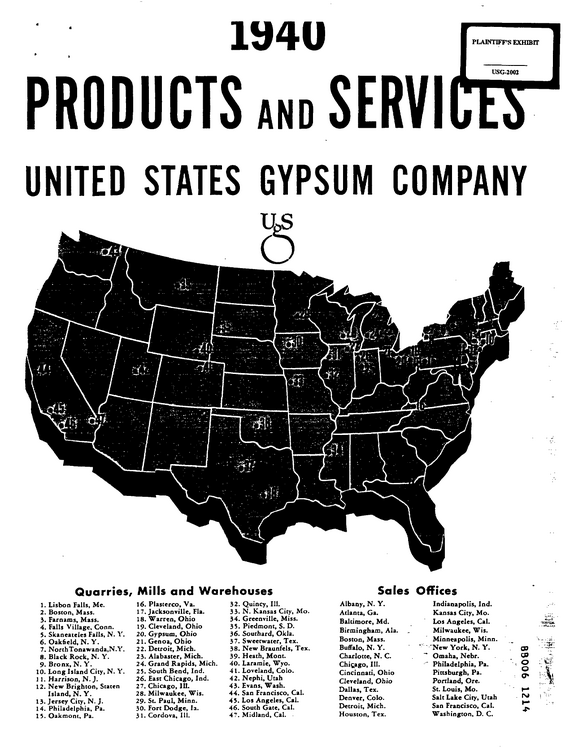
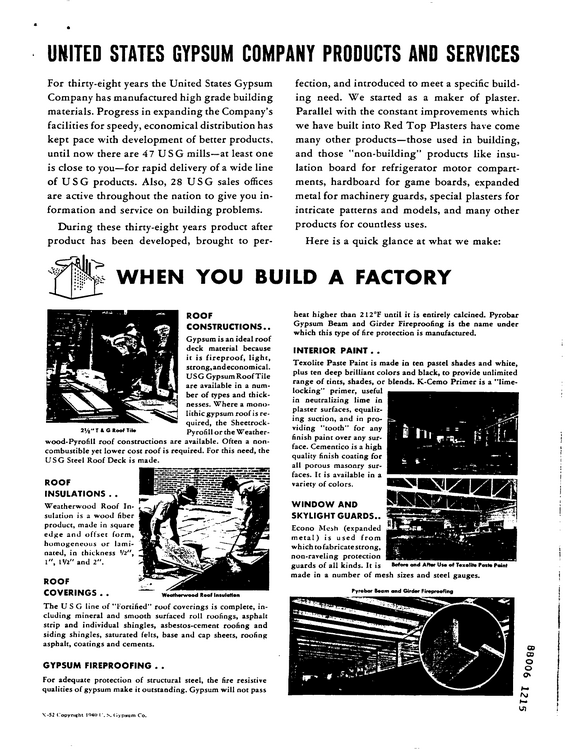
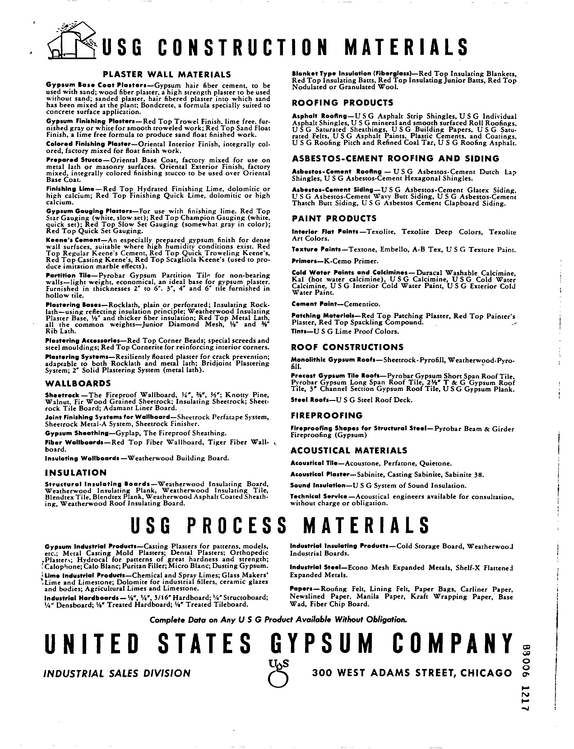
mu PRODUCTS and SE USG-2002 UNITED STATES GYPSUM COMPANY 8 3 0 0 6 121*1 Quarries, Mills and Warehouses 1.

refid# 2j3mpk3817vvQXEbpzgDJEma54 pages
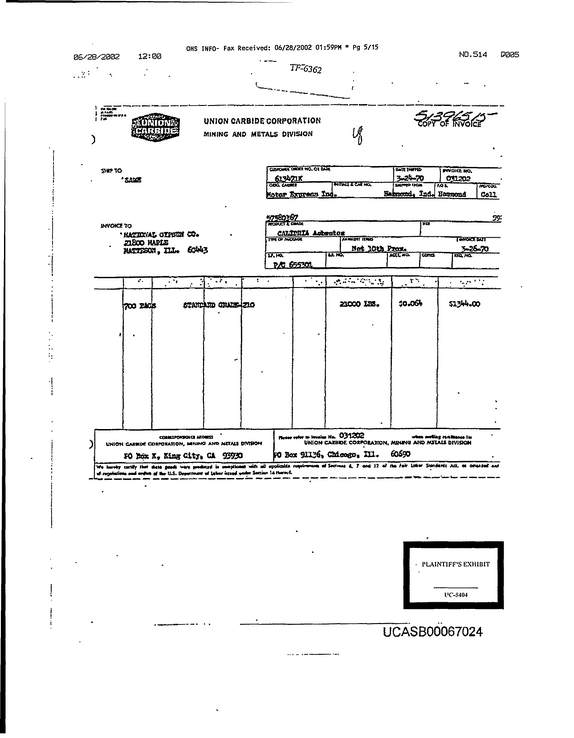
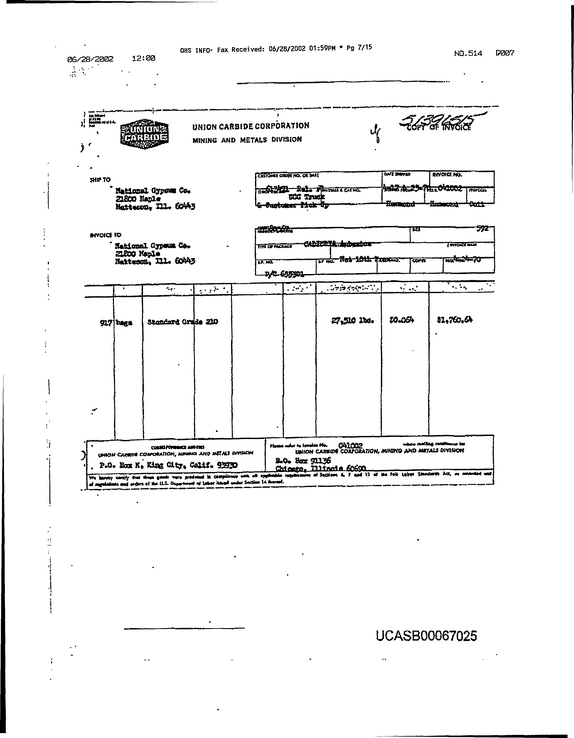
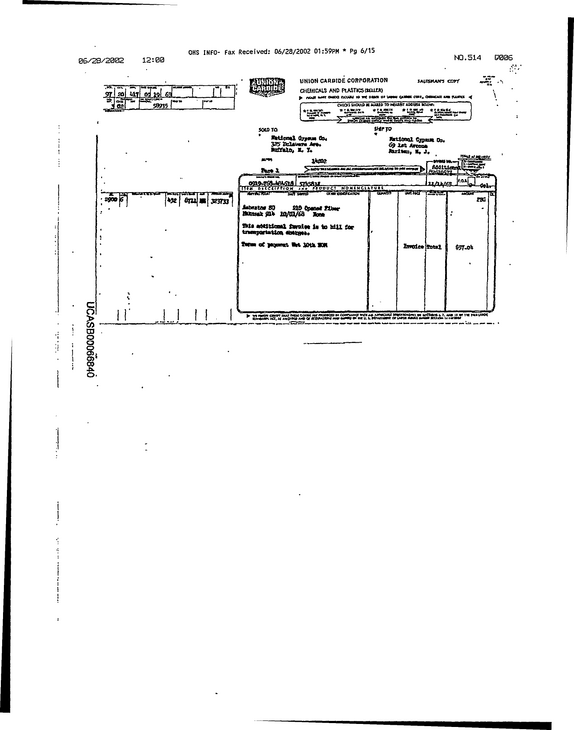
06/28/2002 12:00 OHS INFO- Fax Received: 06/28/2002 01:59PM * Pg 5/15 .
refid# RayBdze2xevN2Ld5XbxKL6nYn3 pages
HHW jrj* --L '-^V-^i** ?
refid# X4yrNaOZDr23MKamm953VZEJ1 page
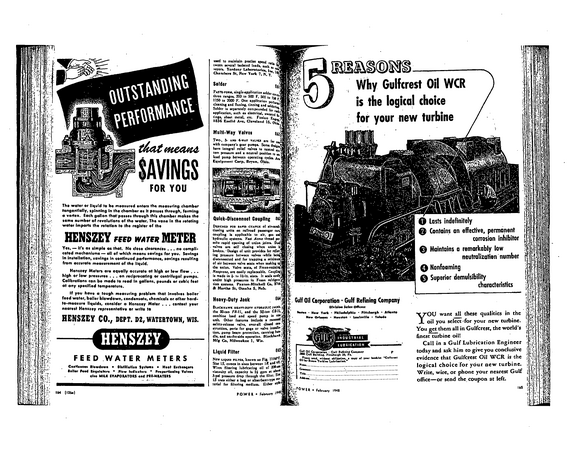
used to msinuin precise speed t tween severs!
refid# QMEpko1bdjEdZeQyEzqLz0QLR1 page
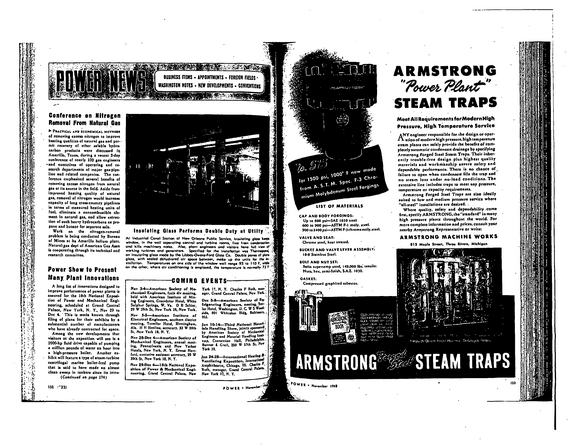
Conference on Nitrogen Removal From Natural Gas Practical and economical methods of removing excess nitrogen to improve heating qualities ol natural gas and per* mtt recovery of other eatable hydro* carbon products were discussed in Amarillo, Terns, during a recent 2-day conference of nearly 100 ges engineers -and executives of operating and re* search departments of major gos-pipcline and related companies.
refid# KR9aqpQgR1zQwo6m42mOxNwVw1 page
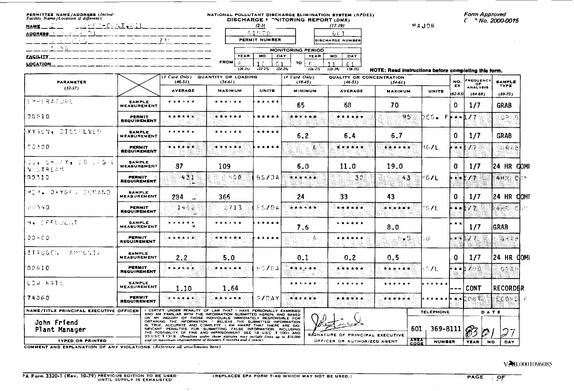
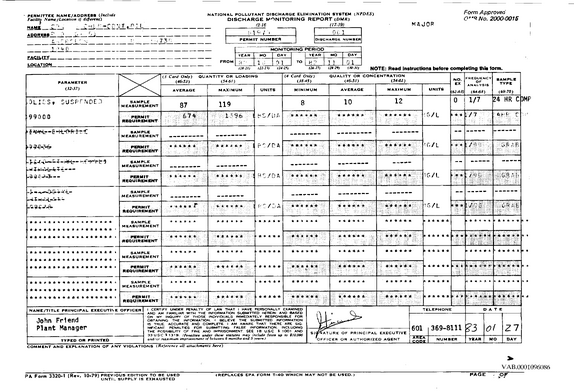
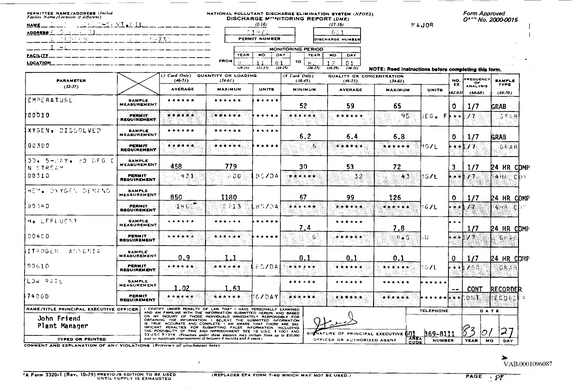
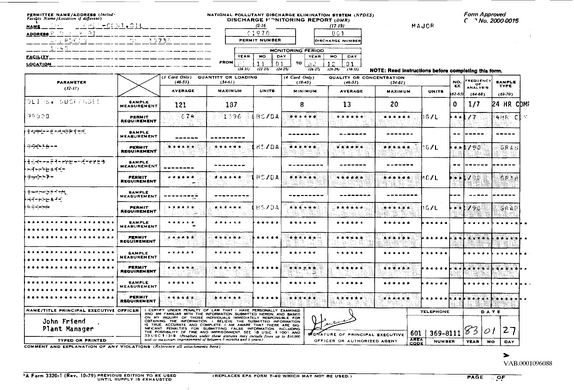
PERMITTEE NAME/ADDRESS Unclud Facility Name/Location if different) NAME -* i r -' r '
refid# waaJQ5jVxR1d2DrrGnzyBdX315 pages
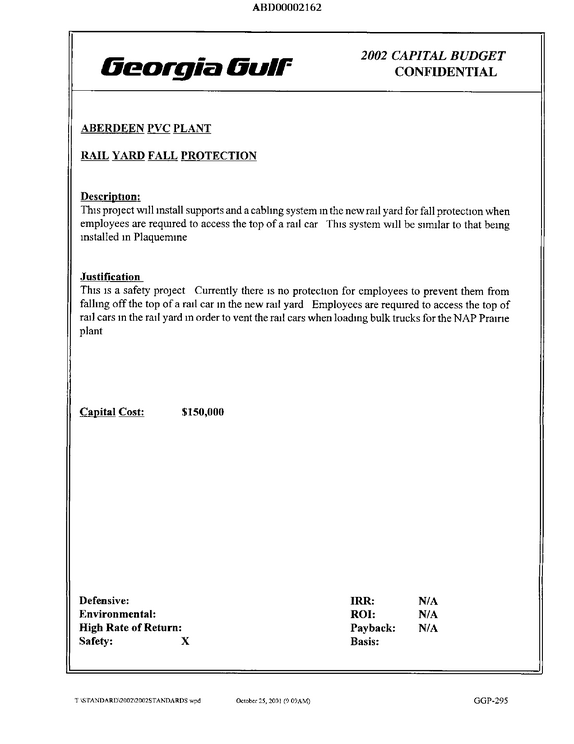
ABD00002162 2002 CAPITAL BUDGET CONFIDENTIAL ABERDEEN PVC PLANT RAIL YARD FALL PROTECTION Description: This proj ect will install supports and a cabling system in the new rail yard for fall protection when employees are required to access the top of a rail car This system will be similar to that being installed in Plaquemine Justification This is a safety project Currently there is no protection for employees to prevent them from falling off the top of a rail car in the new rail yard Employees are required to access the top of rail cars in the rail yard in order to vent the rail cars when loading bulk trucks for the NAP Prairie plant Capital Cost: $150,000 Defensive: Environmental: High Rate of Return: Safety: X IRR: ROI: Payback: Basis: N/A N/A N/A T VSTANDARD\2002\2002STANDARDS wpd October 25, 200] (9 09AM) GGP-295
refid# O12gEZDRJkX6NVZgaRdYq4zxv1 page
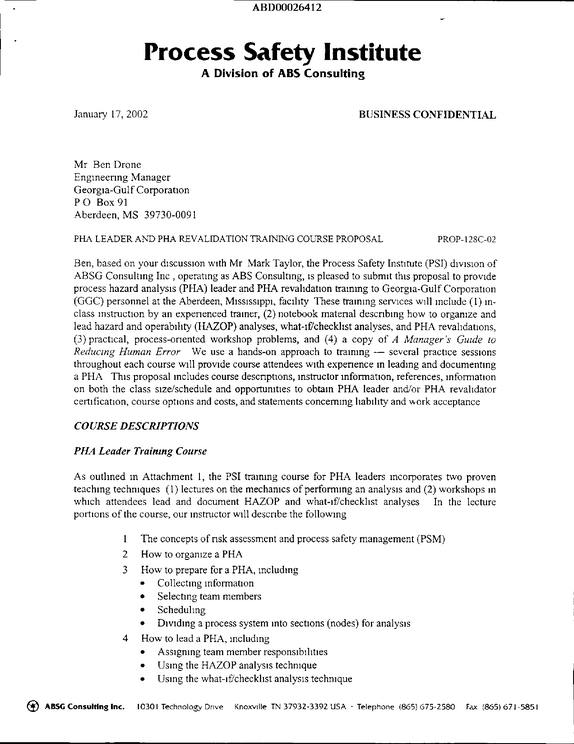
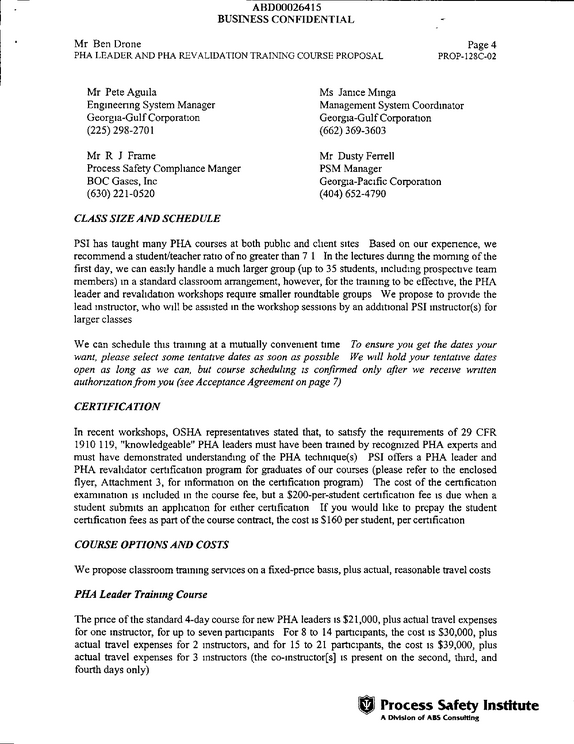
ABD00026412 Process Safety Institute A Division of ABS Consulting January 17, 2002 BUSINESS CONFIDENTIAL Mr Ben Drone Engineering Manager Georgia-Gulf Corporation P O Box 91 Aberdeen, MS 39730-0091 PHA LEADER AND PHA REVALIDATION TRAINING COURSE PROPOSAL PROP-128C-02 Ben, based on your discussion with Mr Mark Taylor, the Process Safety Institute (PSI) division of ABSG Consulting Inc , operating as ABS Consulting, is pleased to submit this proposal to provide process hazard analysis (PHA) leader and PHA revaluation training to Georgia-Gulf Corporation (GGC) personnel at the Aberdeen, Mississippi, facility These training services will include (1) mclass instruction by an experienced trainer, (2) notebook material describing how to organize and lead hazard and operability (HAZOP) analyses, what-if/checkhst analyses, and PHA revaluations, (3) practical, process-onented workshop problems, and (4) a copy of A Manager's Guide to Reducing Human Error We use a hands-on approach to training -- several practice sessions throughout each course will provide course attendees with expenence in leading and documenting a PHA This proposal includes course descriptions, instructor information, references, information on both the class size/schedule and opportunities to obtain PHA leader and/or PHA revalidator certification, course options and costs, and statements concerning liability and work acceptance COURSE DESCRIPTIONS PHA Leader Training Course As outlined m Attachment 1, the PSI training course for PHA leaders incorporates two proven teaching techniques (1) lectures on the mechanics of performing an analysis and (2) workshops in which attendees lead and document HAZOP and what-if/checkhst analyses In the lecture portions of the course, our instructor will descnbe the following 1 The concepts of risk assessment and process safety management (PSM) 2 How to organize a PHA 3 How to prepare for a PHA, including Collecting information Selecting team members Scheduling Dividing a process system into sections (nodes) for analysis 4 How to lead a PHA, including Assigning team member responsibilities Using the HAZOP analysis technique Using the what-if/checkhst analysis technique 0 ABSG Consulting Inc. 10301 Technology Drive Knoxville TN 37932-3392 USA Telephone (865)675-2580 Fax (865)671-5851 ABD00026413 BUSINESS CONFIDENTIAL Mr Ben Drone PHA LEADER AND PHA REVALIDATION TRAINING COURSE PROPOSAL Page 2 PROP-128C-02 Addressing facility/stationary source siting Addressing prior incidents Addressing human factors Conducting a qualitative consequence assessment Expediting an analysis Handling common meeting problems 5 How to document a PHA, including Descnbing elements of a PHA report Resolving action items Our training will address all of the OSHA requirements for PHAs described in paragraph (e) of 29 CFR 1910 119 and the EPA requirements described in 40 CFR 68, and we can modify it to include any GGC corporate requirements Some topics, such as facility/stationary source siting, are more suited to what-if/checklist analysis than to HAZOP analysis What-if/checklist analysis is also very effective in addressing process changes (for management of change) and in addressing the hazards of simpler, less hazardous systems (such as auxiliary process systems) during PHAs Therefore, we offer to teach your prospective leaders both the HAZOP and what-if/checklist techniques so they can optimize their PHA process Our training includes several ways that human factors can be considered during PHAs Most companies find this training extremely useful because many of their accidents/incidents involve human error, particularly during startup and shutdown procedures We explain how to use the HAZOP and what-if/checklist analyses techniques to identify potential human errors during batch and nonroutine operations and to eliminate their causes In the workshop portions of this course, attendees will lead what-if/checklist and HAZOP analyses of process systems Our instructor first descnbes the process to be analyzed (our first problem is usually a chlorine unloading system), then begins the meeting The instructor initially acts as the team leader and assigns the scnbe's duties (i e , taking extensive notes of the meeting) to one of the team members The duties of leader and scnbe are then rotated periodically to give each attendee experience in performing these functions As an alternative to our example problems, we invite GGC to supply information on two or three processes familiar to your personnel The class can perform reviews on these processes as part of the course We have found this training approach to be very effective because the attendees (1) generally know the system quite well and require little class time to leam the process and (2) are accomplishing productive work for GGC while learning the various techniques This approach also demonstrates how the analysis techniques can uncover process weaknesses in designs that have already undergone standard review by the company (When PSI's example problems are used, students sometimes rationalize that the error would have been caught by their company's standard review process, thereby failing to fully appreciate the value of PHAs) If GGC elects to provide m-house processes for review, we will need information on the processes no later than 5 working days before the course begins Process Safety Institute A Division of ABS Consulting ABD00026414 BUSINESS CONFIDENTIAL Mr Ben Drone PHA LEADER AND PHA REVALIDATION TRAINING COURSE PROPOSAL Page 3 PROP-128C-02 PHA Revalidation Training Course As outlined in Attachment 2, the PSI training course for PHA revaluation incorporates two proven teaching techniques (1) lectures on the mechanics of performing a revaluation and (2) workshops in which attendees practice their newly learned skills In the lecture portions of the course, our instructor will describe the following Information necessary to gather and evaluate for a PHA revaluation Factors to consider when determining an appropriate approach for PHA revalidations How to effectively address previous PHA deficiencies and process modifications Steps necessary to prepare for, conduct, and document PHA revaluations Our training will address all of the OSHA PSM requirements for PHA revalidations described in paragraph (e) of 29 CFR 1910 119 and the EPA nsk management program (RMP) requirements described m 40 CFR 68 We recommend that the participants in this course should have already been trained in leading PHAs (such as our basic PHA course descnbed previously, or another similar course) INSTRUCTORS Our instructors are internationally recognized experts m process safety management and process hazard analysis They are among the very best m the field because they combine complete theoretical understanding of hazard evaluation techniques with the experience necessary to discriminate between techniques that work only in theory and techniques that work in practice They also have well-documented industry experience, m fact, our instructors wrote the following two books for AIChE's Center for Chemical Process Safety Guidelines for Hazard Evaluation Procedures, Second Edition with Worked Examples (referenced in 29 CFR 1910 119) and the authoritative book on how to revalidate PHAs, entitled Revalidating Process Hazard Analyses If more than one instructor is required, the lead instructor will be assisted by other expenenced PHA leaders m the workshop sessions We can provide you with resumes of the proposed instructors) once you have selected course dates REFERENCES Our students and technical contacts repeatedly tell us that we offer the best PHA and revaluation training available Please contact any of the following persons who will attest to the value and quality of our services (Note: Many of these clients worked with us as JBF Associates, Inc.; the Risk & Reliability Division of ABS Group Inc.; and/or EQE International, Inc.)
refid# B5oXqpYr8MrEo6QLz6XbgwwaJ7 pages
CG 81 t* CODE YE-69B-D PKG LOT HAY -0-81-E 1439 EST'D. mi, 5632: fli1 /.L PROCESSES- APPROVED BY SYE-698-D CS> F>oSTif7l4/B1 ALTERNATE TYPED BY JMH MAKING NOT&S___ _______________________ TOTAL EST'D WOT- LBS <CRT ENTRY)!


refid# 7R0Q9Jnz7yaZnyMKYyNNXB99j2 pages
,npr o d u c t n am mo l y b d a t e : .o r a n g e NON-BLEEDING :& P,;* ;P J 0i CODE YE~6?


refid# B5Kr1nLp6gBG17EKYKr5LmgXk2 pages
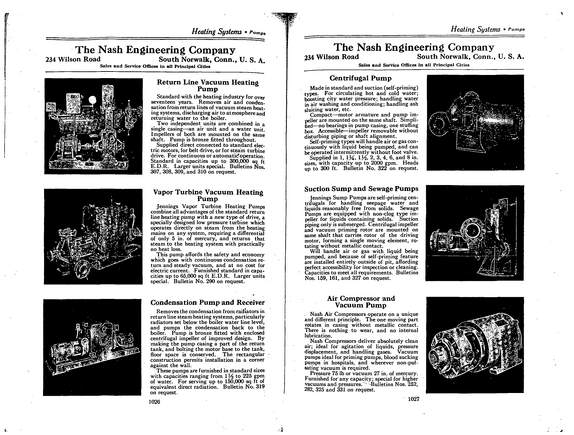
Heating Systems Pump, The Nash Engineering Company 234 Wilson Road South Norwalk, Conn., U.
refid# 8Vk0OJwK3zGgwXw54MY468Lpo1 page
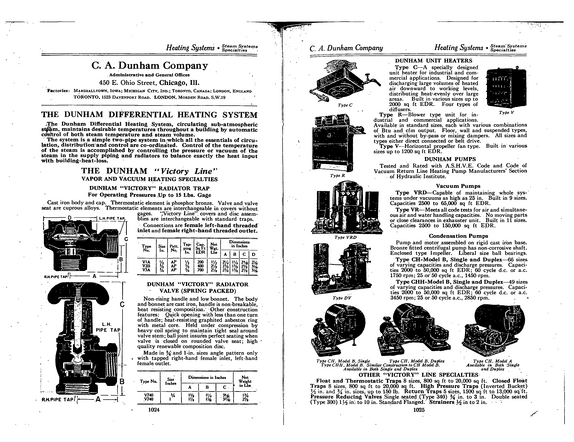
Heating Systems Steam Systems Specialties C.
refid# Dvny1voMNvKnnaM5M1gn7zGOQ1 page
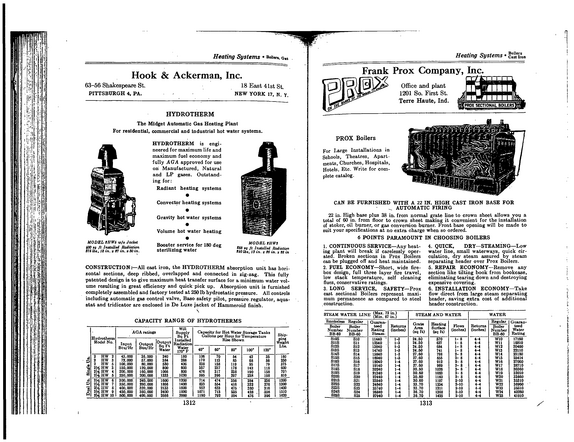
Heating Systems BoUers, o,s Hook & Ackerman, Inc. 63-56 Shakespeare St. 18 East 41st St.
refid# Rbm83vNa5Ba0kV8JpmQeXagv1 page