Refine
Estimated Years 1970-1979Clear
88,744 results foundRefine Search
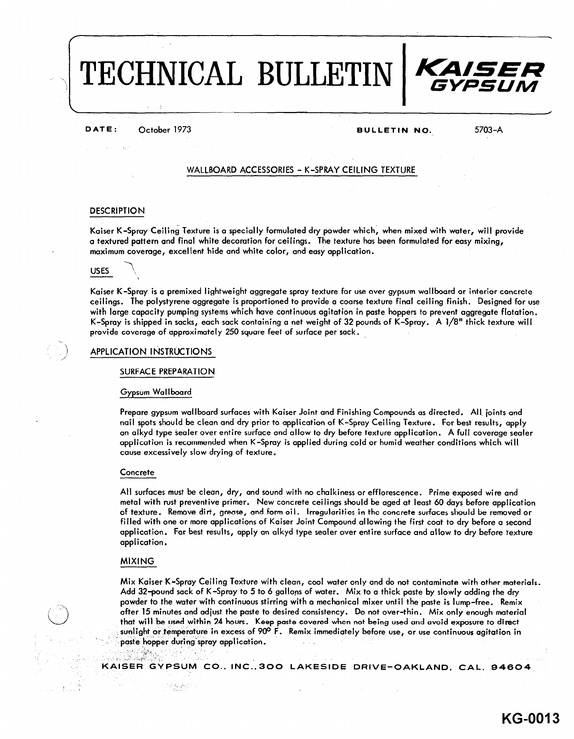
DATE : October 1973 BULLETIN NO. 5703-A WALLBOARD ACCESSORIES - K-SPRAY CEILING TEXTURE DESCRIPTION Kaiser K-Spray Ceiling Texture is a specially formulated dry powder which, when mixed with water, will provide a textured pattern and final white decoration for ceilings.
refid# 9JmZzg1Dg8OrEk07kojLQDzwp2 pages
National Safety Council, 425 North Michigan Ave , Chicago, III 60611 Fundamentals of Industrial Hygiene, 1971 Industrial Data Sheets Checking Performance of Local Exhaust Systems, 428 Dusts, Fumes, and Mists in Industry, 531 Instruments for Testing Exhaust Ventilation Systems, 431 Radiant Heat Control, 381 Pnng, R T, J F Knudsen, and R Dennis "Design of Exhaust Ventilation for Solid Materials Handling " Industrial and Engineering Chemistry, 41 2,442, 1949 Sheinbaum, Milton "Ventilation of Factories, Garages, and Warehouses for Products of Com bustion of Gasoline Engines " Monthly Review, 32 37, Oct 1953 New York City, State Department of Labor, Division of Industrial Hygiene and Safety Standards Stem, Arthur C , ed Air Pollution, Vols I and II New York, N Y , Academic Press, 1962 Stem, Arthur C, and Donald P O'Neil "Recirculation from Industrial Exhaust Systems " Monthly Review, 30 (May, June, July, 1951) New York City, State Department of Labor, Division of Industrial Hygiene and Safety Standards Weisburd, Melvin I, ed Air Pollution Control Field Operations Manual PHS Publication No 937 Washington, D C , U S Department of Health, Education and Welfare Available U S Government Printing Office 1962 895
refid# Ev98eEj5aE96LLQY0zR6b7zQ01 page
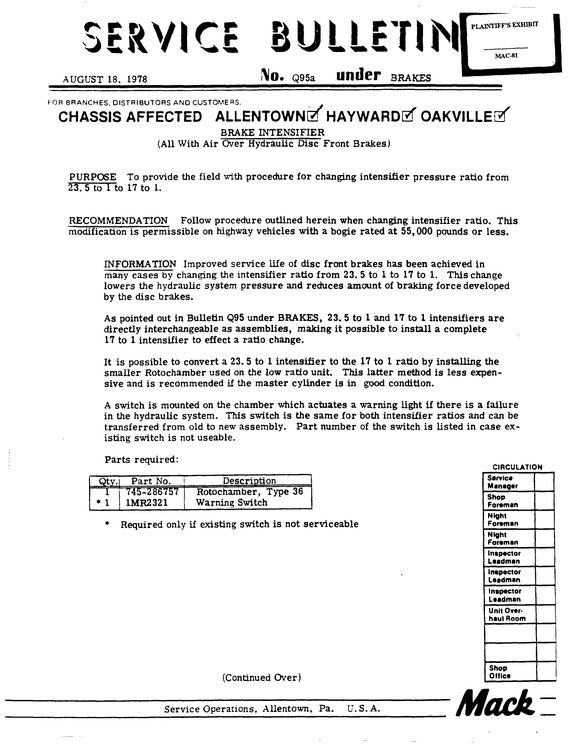
BULLETIN PLAINTIFF'SEXHIBIT AUGUST 18. 1978 No.
refid# danwm3pRB6dOoqjQb6R69EvoG2 pages
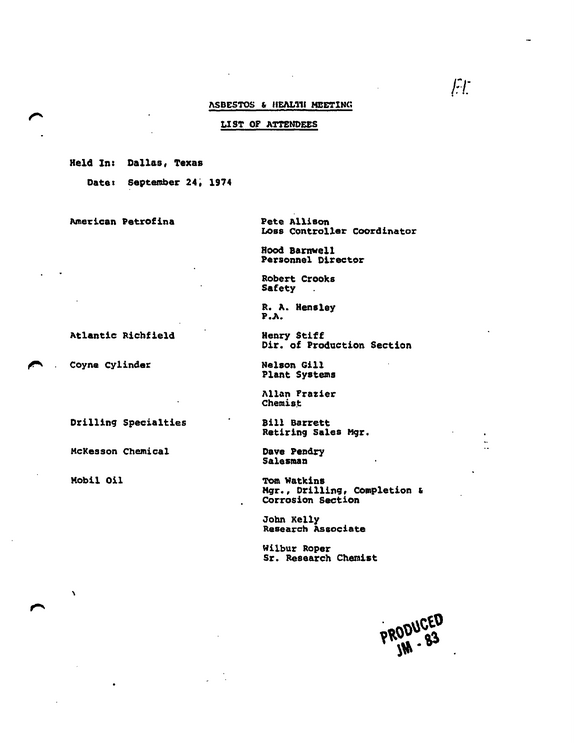
ASBESTOS 6 HEALTH MEETING LIST OF ATTENDEES Held In: Dallas* Texas Date: September 24* 1974 American Petrofina Atlantic Richfield Coyne Cylinder Drilling Specialties McKesson Chemical Mobil Oil Pete Allison Loss Controller Coordinator Hood Barnwell Personnel Director Robert Crooks Safety R.
refid# 93grr4Vkwkb8Eyq7xOaX6621L1 page
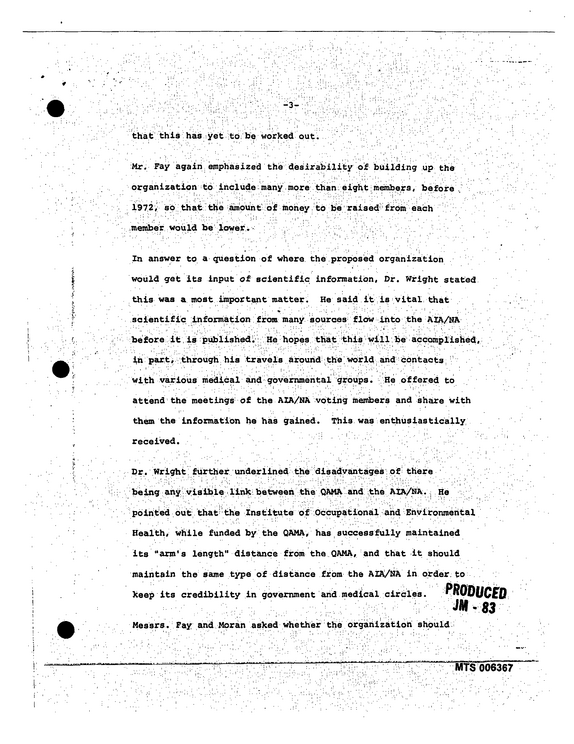
$ | ' \ that this has yet to be worked out.
refid# DM1o111VQ2dpnmw4vNXzRgr0n1 page
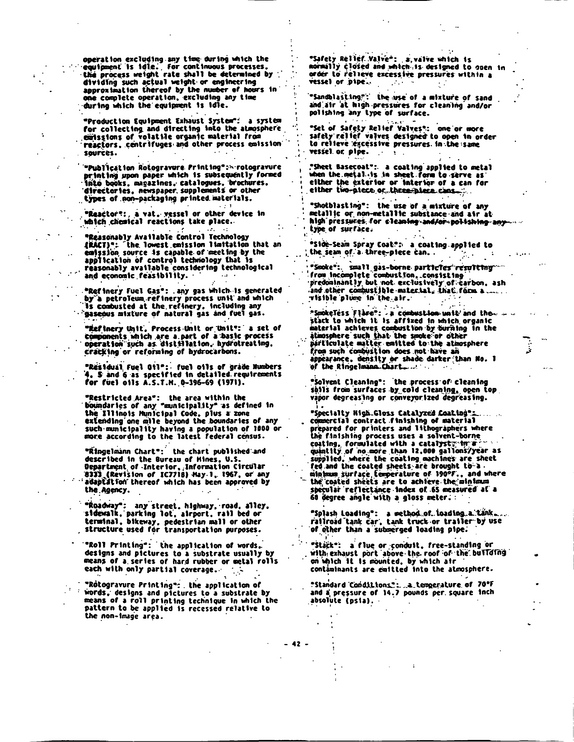
operation excluding any tine during which the -equipment Is idle.. for continuous processes.
refid# 1gV4RJgvpy88dMwdpRrrbxz8Z1 page
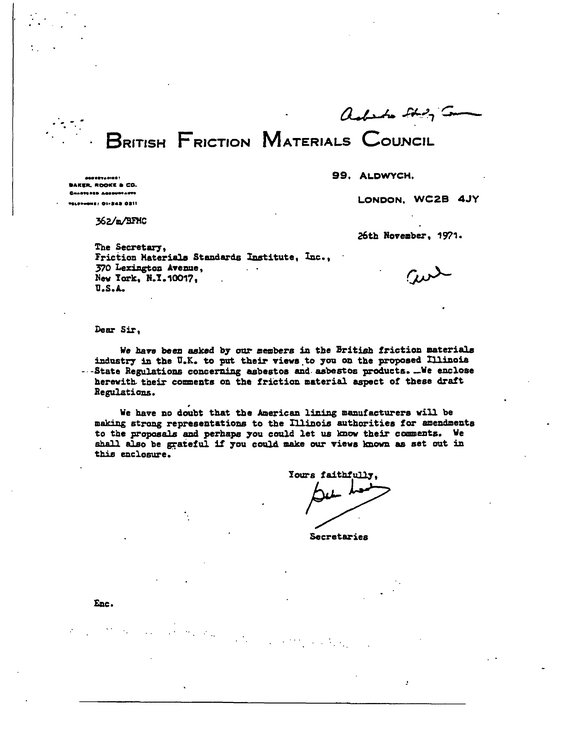
British Friction Materials Council IARIR.
refid# KJ6GGG96w8Nb5gGvOGRmZgxN61 page
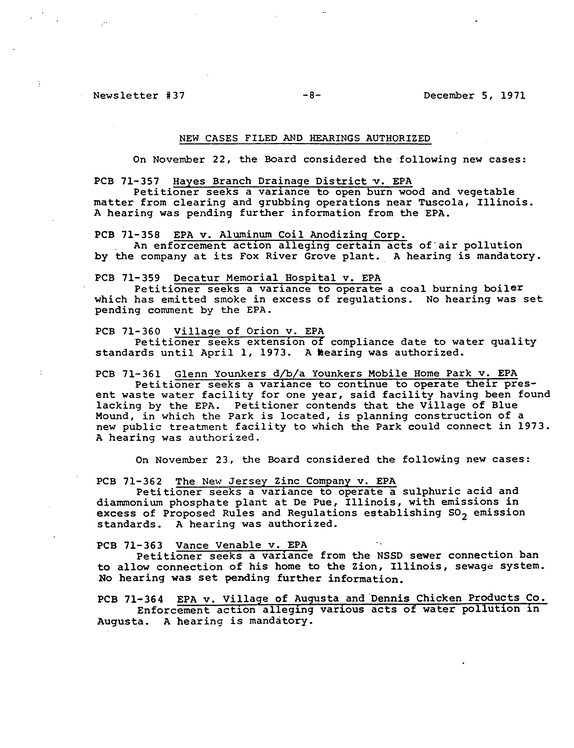
Newsletter #37 8- - December 5, 1971 NEW CASES FILED AND HEARINGS AUTHORIZED On November 22, the Board considered the following new cases: PCB 71-357 Hayes Branch Drainage District v.
refid# Ed3LxN7QBw2oeE0K5x3epBM2V1 page
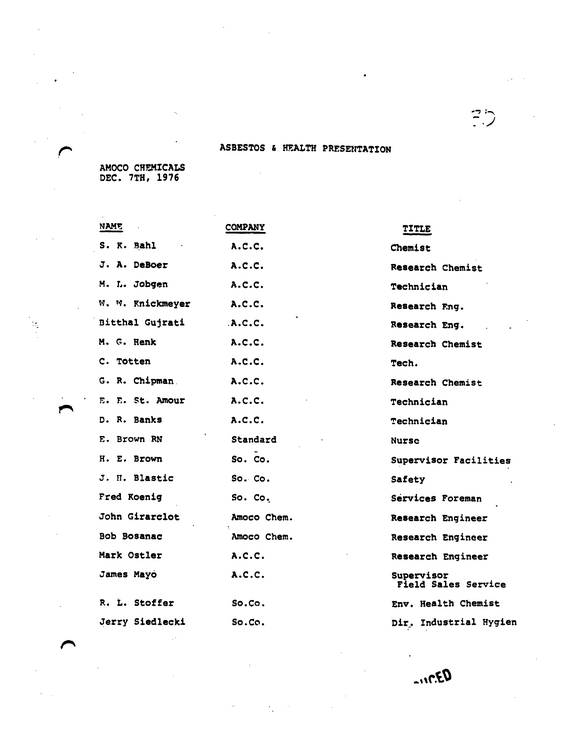
AMOCO CHEMICALS DEC. 7TH, 1976 ASBESTOS & HEALTH PRESENTATION NAME S.
refid# M424GZjo9N5LNJj8k9dbK3mYy1 page
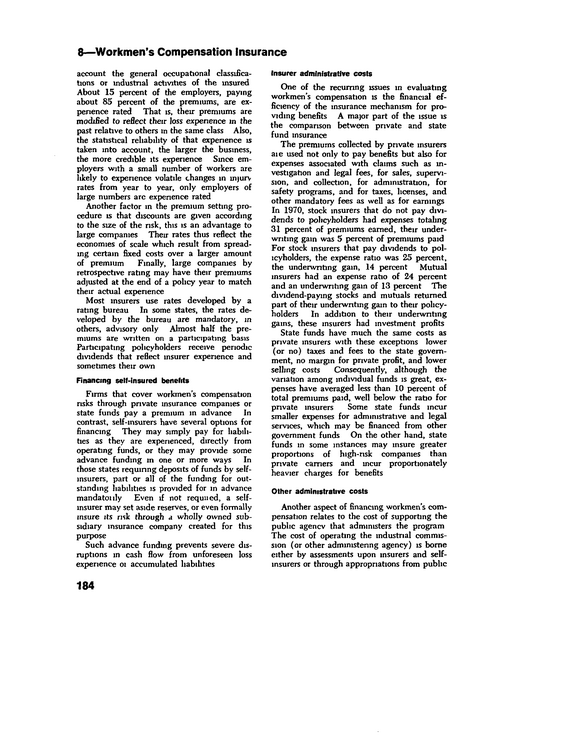
8--Workmen's Compensation Insurance account the general occupational classifica tions ot industrial activities of the insured About 15 percent of the employers, paying about 85 percent of the premiums, are ex perience rated That is, their premiums are modified to reflect their loss experience in the past relative to others m the same class Also, the statistical reliability of that experience is taken into account, the larger the business, the more credible its experience Since em ployers with a small number of workers are likely to experience volatile changes m injury rates from year to year, only employers of large numbers arc expenence rated Another factor in the premium setting pro cedure is that discounts are given according to the size of the risk, this is an advantage to large companies Their rates thus reflect the economies of scale which result from spread ing certain fixed costs over a larger amount of premium Finally, large companies by retrospective rating may have their premiums adjusted at the end of a policy year to match their actual expenence Most insurers use rates developed by a rating bureau In some states, the rates de veloped by the bureau are mandatory, in others, advisory only Almost half the pre miums are written on a participating basis Participating policyholders receive periodic dividends that reflect insurer expenence and sometimes their own Financing self-insured benefits Firms that cover workmen's compensation risks through pnvate insurance companies or state funds pay a premium in advance In contrast, self-insurers have several options for financing They may simply pay for liabili ties as they are experienced, directly from operating funds, or they may provide some advance funding m one or more ways In those states requiring deposits of funds by selfinsurers, part or all of the funding for out standing liabilities is provided for in advance mandatonly Even if not requned, a selfinsurer may set aside reserves, or even formally insure its risk through a wholly owned sub sidiary insurance company created for this purpose Such advance funding prevents severe dis ruptions in cash flow from unforeseen loss experience oi accumulated liabilities Insurer administrative costs One of the recurring issues in evaluating workmen's compensation is the financial ef ficiency of the insurance mechanism for pro viding benefits A major part of the issue is the comparison between private and state fund insurance The premiums collected by pnvate insurers aie used not only to pay benefits but also for expenses associated with claims such as in vestigation and legal fees, for sales, supervi sion, and collection, for administration, for safety programs, and for taxes, licenses, and other mandatory fees as well as for earnings In 1970, stock insurers that do not pay divi dends to policyholders had expenses totaling 31 percent of premiums earned, their under writing gain was 5 percent of premiums paid For stock insurers that pay dividends to pol icyholders, the expense ratio was 25 percent, the underwriting gain, 14 percent Mutual insurers had an expense ratio of 24 percent and an underwriting gain of 13 percent The dividend-paying stocks and mutuals returned part of their underwriting gam to their policy holders In addition to their underwriting gains, these insurers had investment profits State funds have much the same costs as private insurers with these exceptions lower (or no) taxes and fees to the state govern ment, no margin for private profit, and lower selling costs Consequently, although the variation among individual funds is great, ex penses have averaged less than 10 percent of total premiums paid, well below the ratio for pnvate insurers Some state funds incur smaller expenses for administrative and legal services, which may be financed from other government funds On the other hand, state funds m some instances may insure greater proportions of high-nsk companies than pnvate earners and incur proportionately heavier charges for benefits Other administrative costs Another aspect of financing workmen's com pensation relates to the cost of supporting the public agenev that administers the program The cost of operating the industrial commis sion (or other admimstenng agency) is borne either by assessments upon insurers and selfinsurers or through appropnations from public 184
refid# Yj24Lqm6rGE1D4YMv1xx9Rj4y1 page
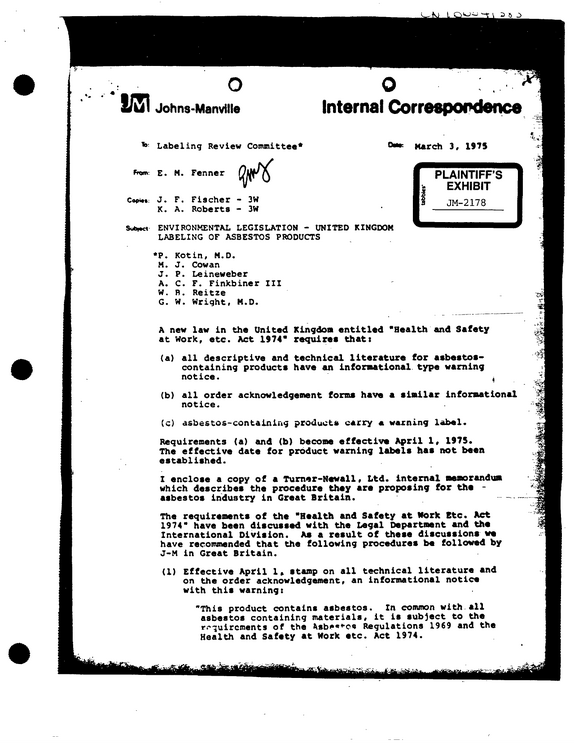
m Johns-Manville Internal Correspondence Labeling Review Committee* O"** March 3, 1975 E.
refid# gaB03XZDvp1DY2Rp7VwJ0pYGa1 page
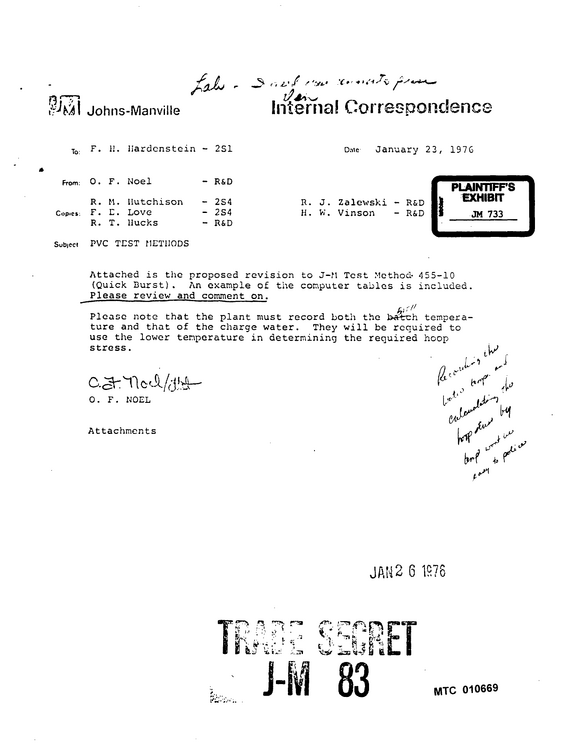
M* Johns-Manville r Interna!

refid# rN7zyxvYjpX0dzny9k933q0a2 pages
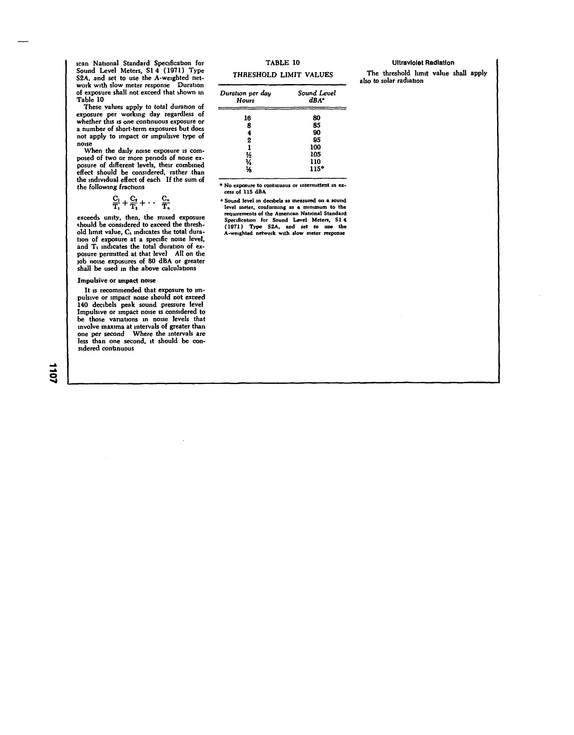
1107 lean National Standard Specification for Sound Level Meters, SI 4 (1971) Type S2A, and set to use the A-weighted net work with slow meter response Duration of exposure shall not exceed that shown m Table 10 These values apply to total duration of exposure per working day regardless of whether this is one continuous exposure or a number of short-term exposures but does not apply to impact or impulsive type of noise When the daily noise exposure is com posed of two or more periods of noise ex posure of different levels, their combined effect should be considered, rather than the individual effect of each If the sum of the following fractions exceeds unity, then, the mixed exposure should be considered to exceed the thresh old limit value, Ci indicates the total dura tion of exposure at a specific noise level, and Ti indicates the total duration of ex posure permitted at that level All on the job noise exposures of 80 dBA or greater shall be used m the above calculations Impulsive or unpact noise It is recommended that exposure to im pulsive or impact noise should not exceed 140 decibels peak sound pressure level Impulsive or impact noise is considered to be those variations in noise levels that involve maxima at intervals of greater than one per second Where the intervals are less than one second, it should be con sidered continuous TABLE 10 THRESHOLD LIMIT VALUES Duration per day Hours Sound Level dBA 16 80 8 85 4 90 2 95 1 100 Vi 105 Vi 110 % 115* * No exposure to continuous or intermittent m ex cess of 115 dBA * Sound level in decibels as measured on a sound level meter, conforming as a minimum to the requirements of the American National Standard Specification for Sound Level Meters, SI 4 (1971) Type S2A, and set to use the A-weighted network with slow meter response Ultraviolet Radiation The threshold limit value shall apply also to solar radiabon
refid# KRqJO78Bp6G50m8Nxmza82v1w1 page
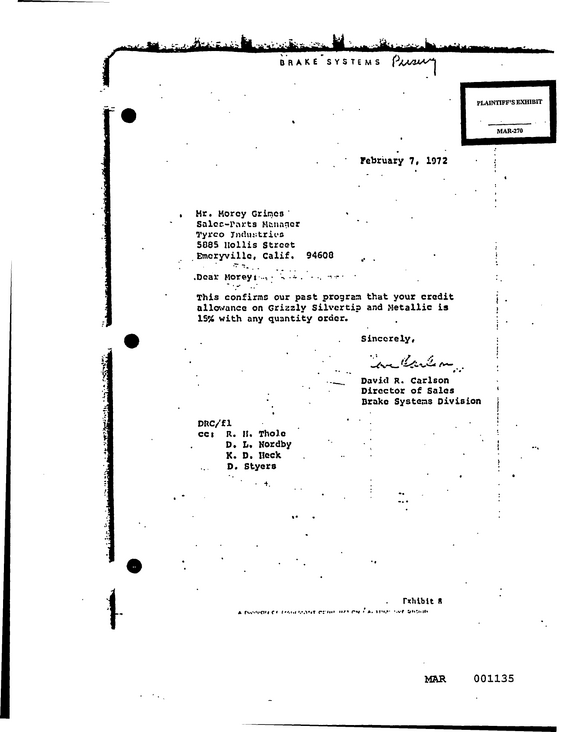
BRAKE SYS TEMS P/SJVJS*| February 7, 1972 Hr.
refid# 2Rk66zz9qd0rDdwQwJZqYdLw71 page
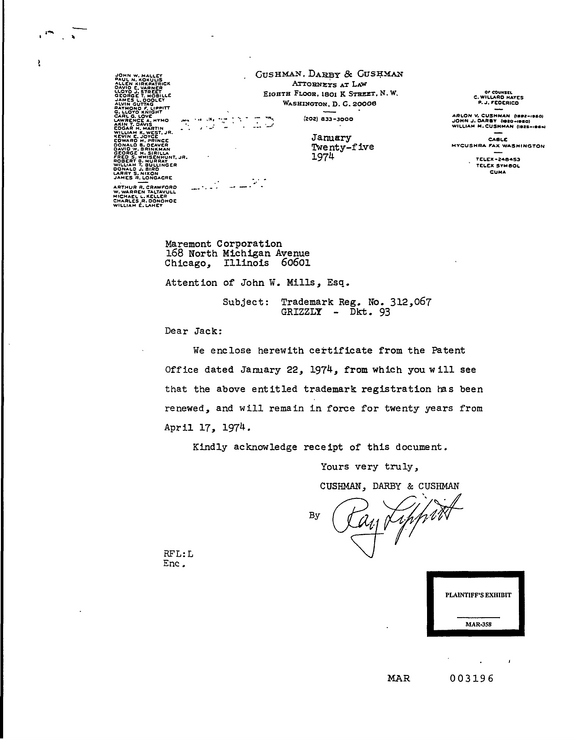
JOHN W.
refid# qdXVnXp9pDdqZd6qjgkKkQ66E33 pages