Refine
Estimated Years 1960-1969Clear
16,810 results foundRefine Search
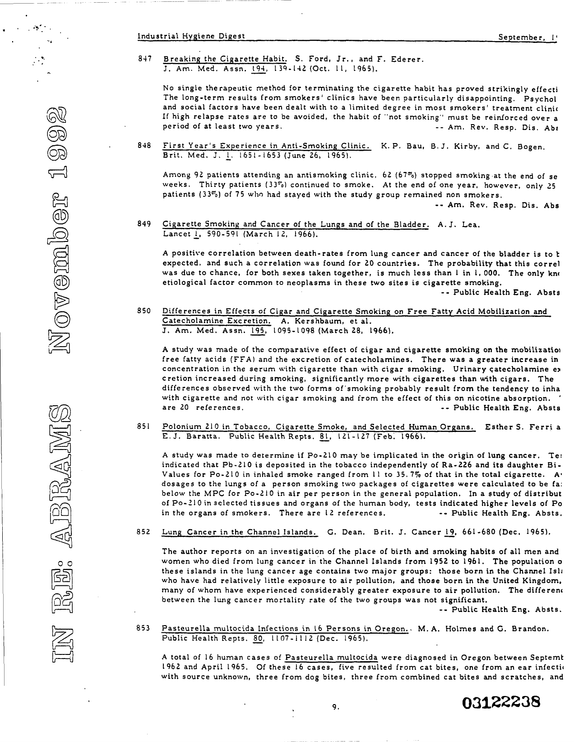
m m ju C==3 Industrial Hygiene Digest September, I1 847 Breaking the Cigarette Habit.
refid# R5EYyozpDeM5nN8nZV2BwOVz1 page
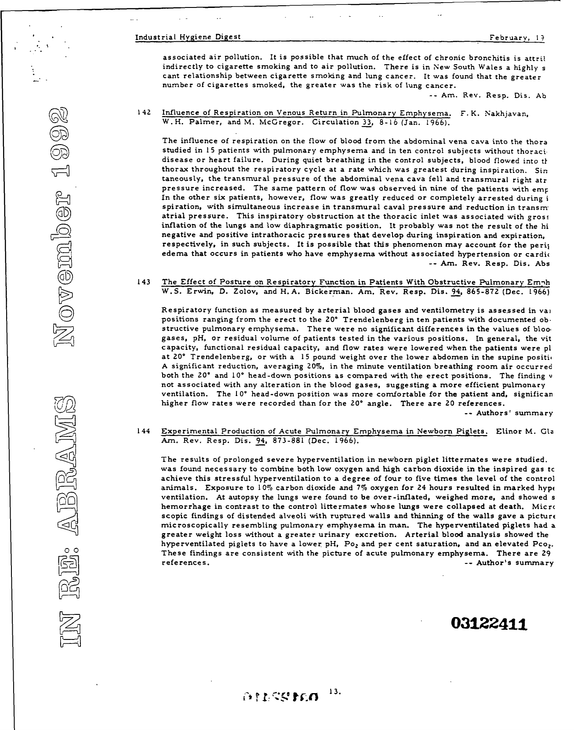
I --------- ' Industrial Hygiene Digest February, I 9 associated air pollution.
refid# qdbe9Z7Xrv6L5M2VGRO7Z6rax1 page
PROCEEDINGS FIBROUS DUST SEMINAR November 22,1968 -j' ' INDUSTRIAL HYGIENE FOUNDATION OF AMERICA ----------------- > 5231 CENTRE AVENUE PITTSBURGH, PA. 1S232 SC-ALL-13900 SCF-ALLF-03070 fH h o z> ,i o i o
refid# rKLy38n97oV0rpp5J73KZLke1 page
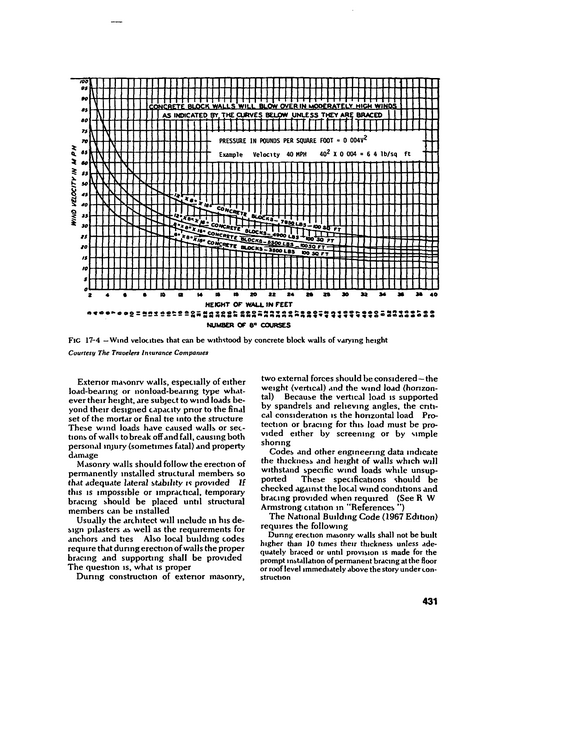
24I Ida 14 A 1820 22 24 M ^M HEIGHT OF WALL IN FEET ww-m WS =5 2 2 S - - -- <*N M g N MM* w A #| p * I* ** 4 4 4 4 4 4 4 4 * NUMBER OF 6" COURSES M M 40 ** FiC 17-4 --Wind velocities that can be withstood by concrete block walls of varying height Courtesy The Travelers Insurance Companies Extenor masonry walls, especially of either load-bearing or nonload-bearing type what ever their height, are subject to wind loads be yond their designed capacity pnor to the final set of the mortar or final tie into the structure These wind loads have caused walls or sec tions of walls to break offand fall, causing both personal injury (sometimes fatal) and property damage Masonry walls should follow the erection of permanently installed structural members so that adequate lateral stability is provided If this is impossible or impractical, temporary bracing should be placed until structural members can be installed Usually the architect will include in his de sign pilasters as well as the requirements for anchors and ties Also local building codes require that during erection ofwalls the proper bracing and supporting shall be provided The question is, what is proper During construction of extenor masonry, two external forces should be considered --the weight (vertical) and the wind load (horizon tal) Because the vertical load is supported by spandrels and relieving angles, the cntical consideration is the honzontal load Pro tection or bracing for this load must be pro vided either by screening or by simple shoring Codes and other engineering data indicate the thickness and height of walls which will withstand specific wind loads while unsup ported These specifications should be checked against the local wind conditions and bracing provided when required (See R W Armstrong citation m "References ") The National Building Code (1967 Edition) requires the following Dunng erection masonry walls shall not be built higher than 10 times their thickness unless ade quately braced or until provision is made for the prompt installation of permanent bracing at the floor or roof level immediately above the story under con struction 431
refid# zzLBe8KO8KdKN4o7G0JxL9wkR1 page
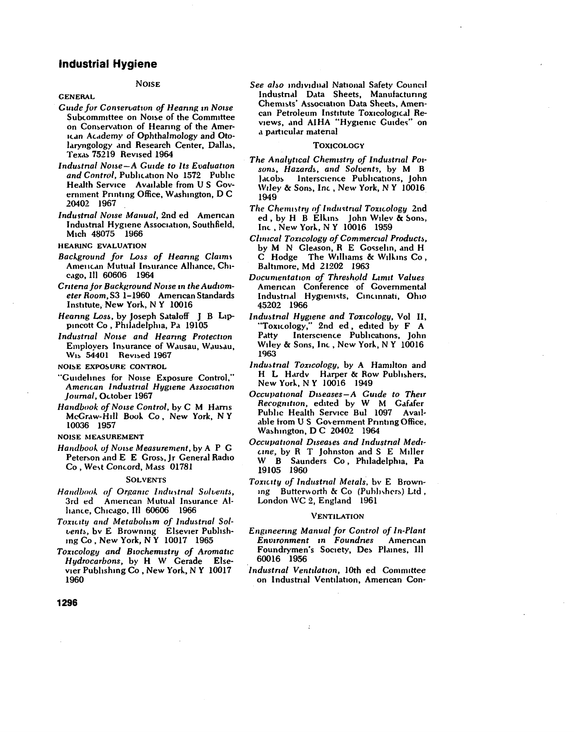
Industrial Hygiene Noise general Guide for Conservation of Hearing in Noise Subcommittee on Noise of the Committee on Conservation of Hearing of the Amer ican Academy of Ophthalmology and Oto laryngology and Research Center, Dallas, Texas 75219 Revised 1964 Industrial Noise--A Guide to Its Evaluation and Control, Publication No 1572 Public Health Service Available from U S Gov ernment Printing Office, Washington, D C 20402 1967 Industrial Noise Manual, 2nd ed American Industnal Hygiene Association, Southfield, Mich 48075 1966 HEARING EVALUATION Background for Loss of Hearing Claims Ameiican Mutual Insurance Alliance, Chi cago, 111 60606 1964 Criteria jor Background Noise in the Audiom eter Boom, S3 1-1960 American Standards Institute, New York, N Y 10016 Hearing Loss, by Joseph Sataloff J B Lippincott Co , Philadelphia, Pa 19105 Industrial Noise and Hearing Protection Employers Insurance of Wausau, Wausau, Wis 54401 Revised 1967 NOISE EXPOSURE CONTROL "Guidelines for Noise Exposure Control," American Industrial Hygiene Association Journal, October 1967 Handbook of Noise Control, by C M Hams McGraw-Hill Book Co, New York, N Y 10036 1957 NOISE MEASUREMENT Handbook of Noise Measurement, by A P G Peterson and E E Gross, Jr General Radio Co , West Concord, Mass 01781 Solvents Handbook of Organic Industrial Solvents, 3rd ed American Mutual Insurance Al liance, Chicago, 111 60606 1966 Toxicity and Metabolism of Industrial Sol vents, bv E Browning Elsevier Publish ing Co , New York, N Y 10017 1965 Toxicology and Biochemistry of Aromatic Hydrocarbons, by H W Gerade Else vier Publishing Co , New York, N Y 10017 1960 See also individual National Safety Council Industnal Data Sheets, Manufacturing Chemists' Association Data Sheets, Amencan Petroleum Institute Toxicological Re views, and AIHA "Hygienic Guides" on a particular matenal Toxicology The Analytical Chemistry of Industrial Potsons, Hazards, and Solvents, by M B lacobs Interscience Publications, John Wiley & Sons, Inc , New York, N Y 10016 1949 The Chemistry of Industrial Toxicology 2nd ed , by H B Elkins John Wilev & Sons, Inc , New York, N Y 10016 1959 Clinical Toxicology of Commercial Products, by M N Gleason, R E Gossehn, and H C Hodge The Williams & Wilkins Co , Baltimore, Md 21202 1963 Documentation of Threshold Limit Values American Conference of Governmental Industnal Hygienists, Cincinnati, Ohio 45202 1966 Industnal Hygiene and Toxicology, Vol II, "Toxicology," 2nd ed, edited by F A Patty Interscience Publications, John Wiley & Sons, Inc , New York, N Y 10016 1963 Industrial Toxicology, by A Hamilton and H L Hardv Harper & Row Publishers, New York, N Y 10016 1949 Occupational Diseases--A Guide to Their Recognition, edited by W M Gafafer Public Health Service Bui 1097 Avail able from U S Government Pnnting Office, Washington, D C 20402 1964 Occupational Diseases and Industrial Medi cine, by R T Johnston and S E Miller W B Saunders Co, Philadelphia, Pa 19105 1960 Toxicity of Industrial Metals, bv E Brown ing Butterworth & Co (Publishers) Ltd , London WC 2, England 1961 Ventilation Engineering Manual for Control of In-Plant Environment in Foundnes American Foundrymen's Society, Des Plaines, 111 60016 1956 Industrial Venttlation, 10th ed Committee on Industrial Ventilation, American Con- 1296
refid# nq2Eqz1nENjQRROBjrynLZqw1 page
The most common complication of asbestosis is cancer of the lung.
refid# oOr9JRmJ7zLRMqx62EQb1omg1 page
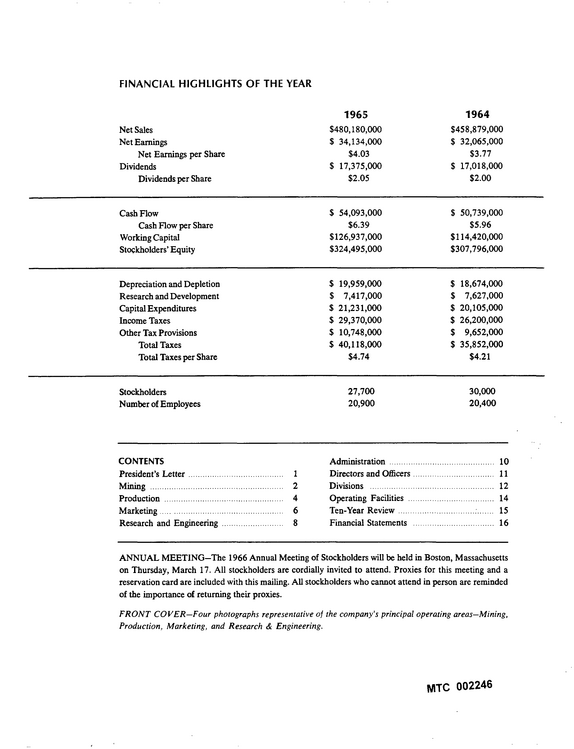
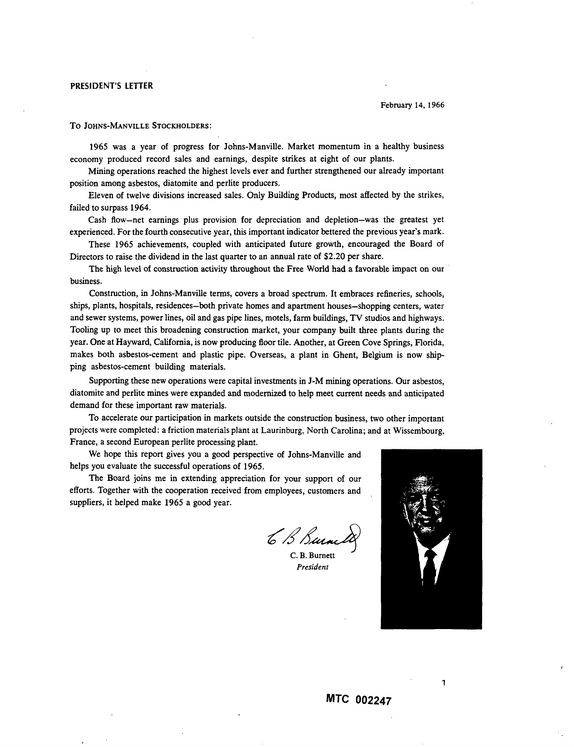
JOHNS-MANVILLE CORPORATION 1965 Annual Report MTC 002245 FINANCIAL HIGHLIGHTS OF THE YEAR Net Sales Net Earnings Net Earnings per Share Dividends Dividends per Share 1965 $480,180,000 $ 34,134,000 $4.03 $ 17,375,000 $2.05 Cash Flow Cash Flow per Share Working Capital Stockholders' Equity $ 54,093,000 $6.39 $126,937,000 $324,495,000 Depreciation and Depletion Research and Development Capital Expenditures Income Taxes Other Tax Provisions Total Taxes Total Taxes per Share $ 19,959,000 $ 7,417,000 $ 21,231,000 $ 29,370,000 $ 10,748,000 $ 40,118,000 $4.74 Stockholders Number of Employees 27,700 20,900 1964 $458,879,000 $ 32,065,000 $3.77 $ 17,018,000 $2.00 $ 50,739,000 $5.96 $114,420,000 $307,796,000 $ 18,674,000 $ 7,627,000 $ 20,105,000 $ 26,200,000 $ 9,652,000 $ 35,852,000 $4.21 30,000 20,400 CONTENTS President's Letter............................. ............
refid# Qk4npoKn8g7oYNYykyYpEgzG538 pages
Accounting Methods February 27, 1964 Denison Finance Managers (except Fiber Glass Division) Credits for Winter Fibre Shipments In accordance with Asbestos Fibre Division Bulletin 53-W of November 21, 1963, they are allowing a credit of $5*00 per ton for fibre shipped to plants during the period December 15, 19^3 to April 30, 196k, regardless of whether it is used or stored by the plant, during that period.

refid# w4VQnw8VDKeZK6zv4oeJkxaB2 pages
I* // THE DOW CHEMIC COMPANY MIDLAND.
refid# 2JrR8R0p9GnZ8yeMxw9Zr7eX51 page
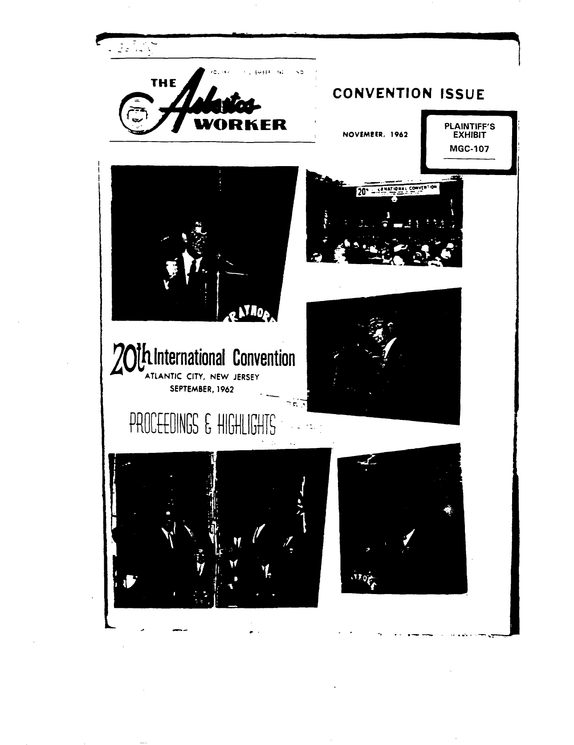
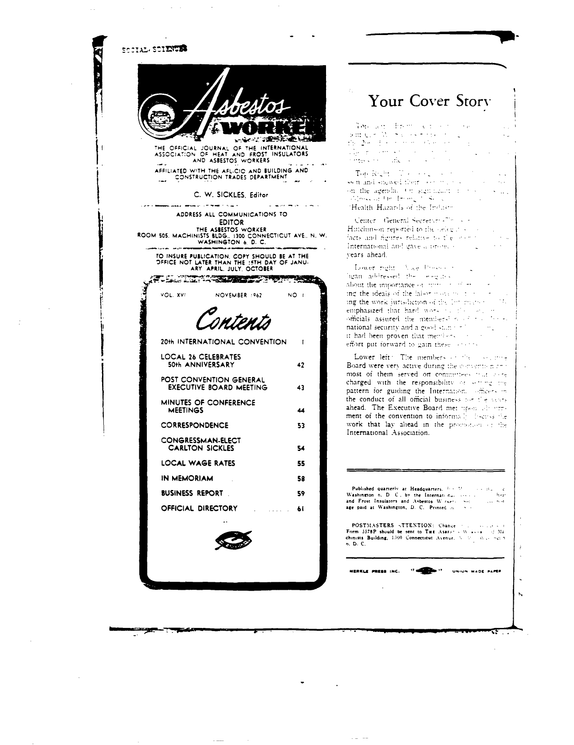
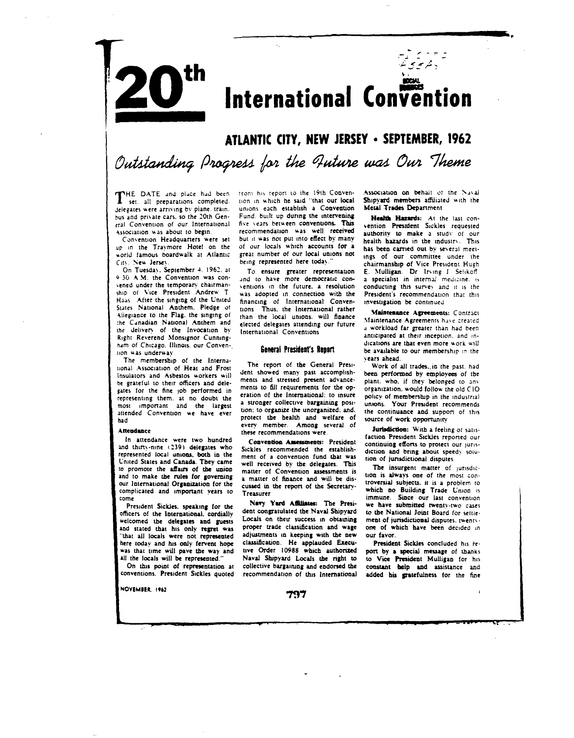
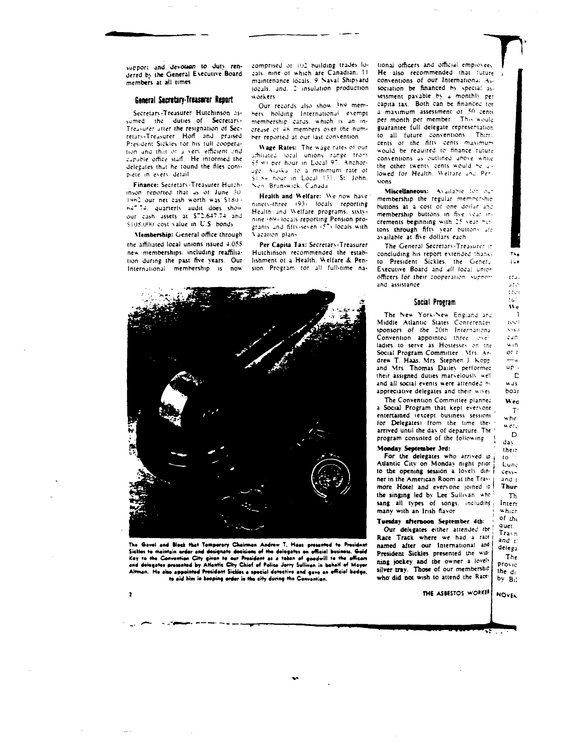
THE WORKER CONVENTION ISSUE 7Q|hlnternational Convention ** ATLANTIC CITY, NEW JERSEY SEPTEMBER, 1962 HHIIK stirs?
refid# pBY89mQoLx9zjRzwg17wQa9va72 pages
oei C.
refid# mbr8Emvr6a0ym8XBoXY5jrBOk7 pages
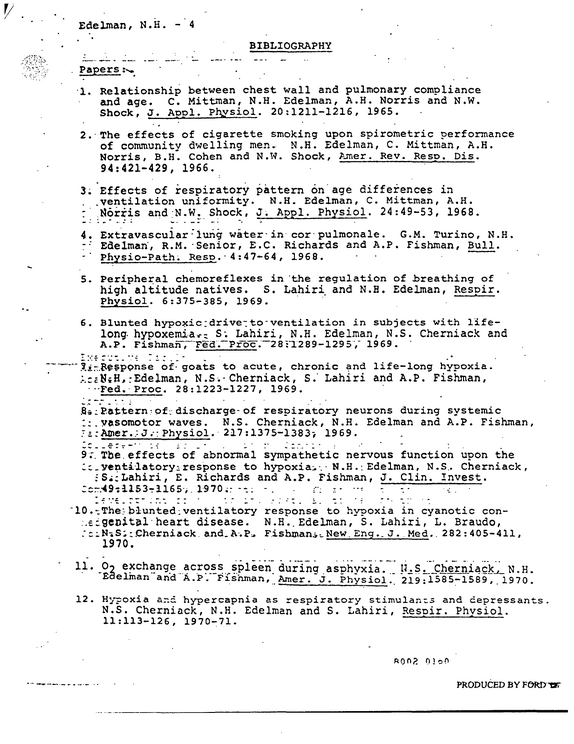
Edelman, N.K. 4 BIBLIOGRAPHY Papers :-n 1.
refid# zdpMZ8Moeb9veE8pnBkymyrqB1 page
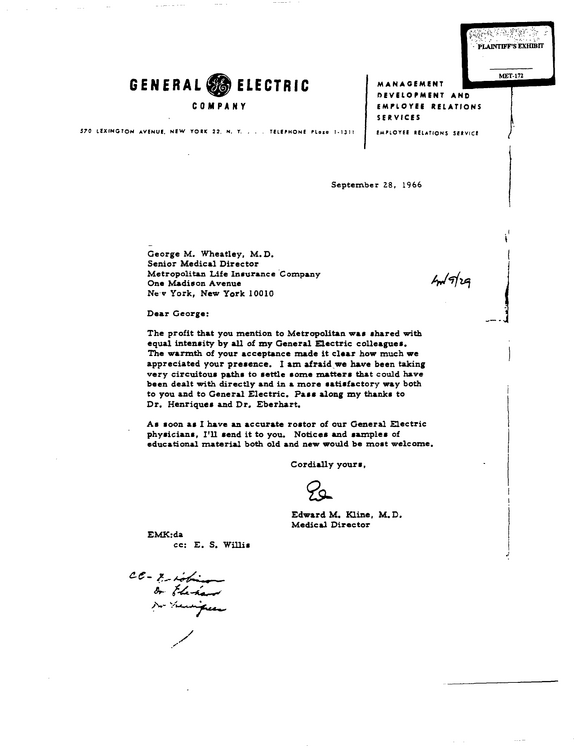
GENERAL sBm ELECTRIC COMPANY 570 IfXINGTOM AVENUE.
refid# dDM4aYprJKjGRGaZOxv3MgKpe1 page
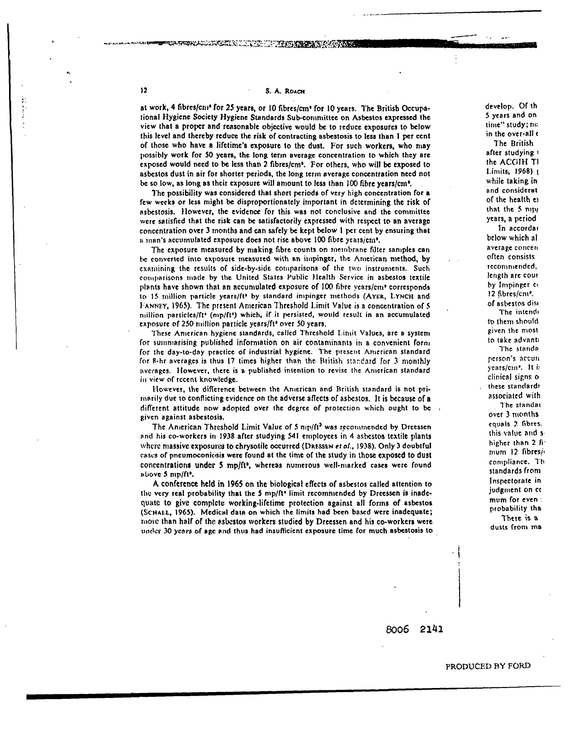
12 S.
refid# vBkNLQko2OxgXB6NYaL4QnpNR1 page
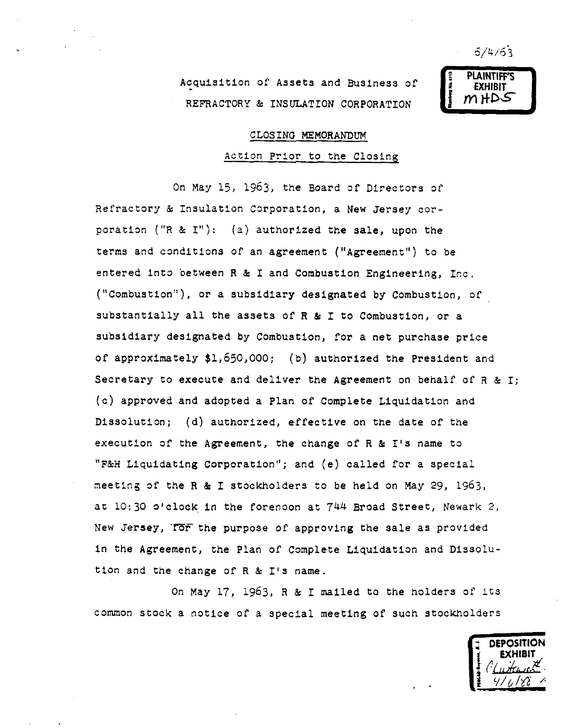
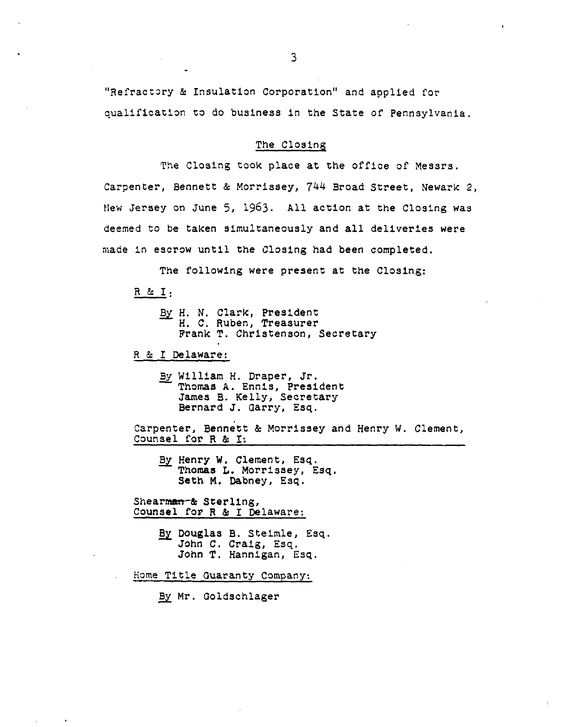
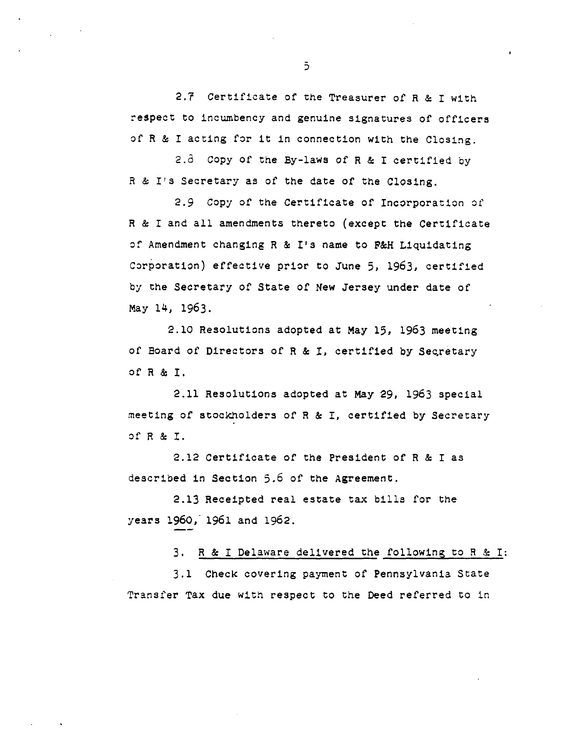
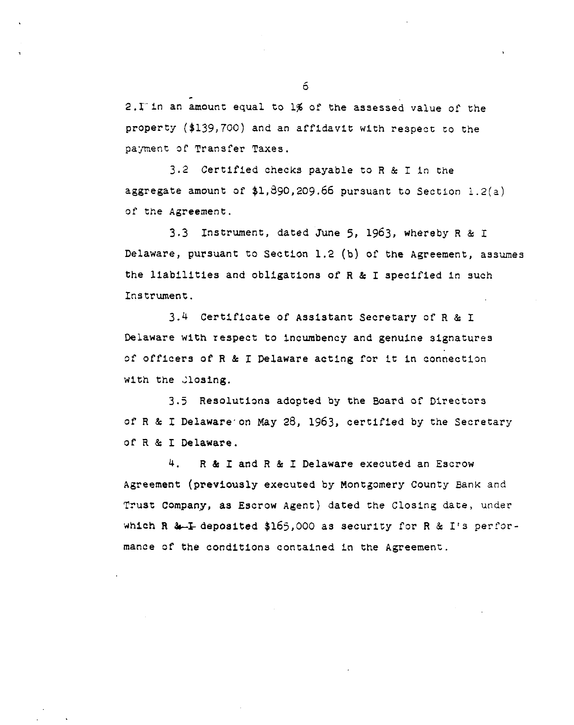
Acquisition of Assets and Business of REFRACTORY & INSULATION CORPORATION 5/4/63 CLOSING MEMORANDUM Action Prior to the Closing On May 15, 1963, the Board of Directors of Refractory & Insulation Corporation, a New Jersey cor poration ("R & I"): (a) authorized the sale, upon the terms and conditions of an agreement ("Agreement") to be entered into between R 8c I and Combustion Engineering, Inc.
refid# K6Xm62Ndx4xw5Eon0xmJ7b77Q5 pages