Refine
Estimated Years 1960-1969Clear
16,810 results foundRefine Search
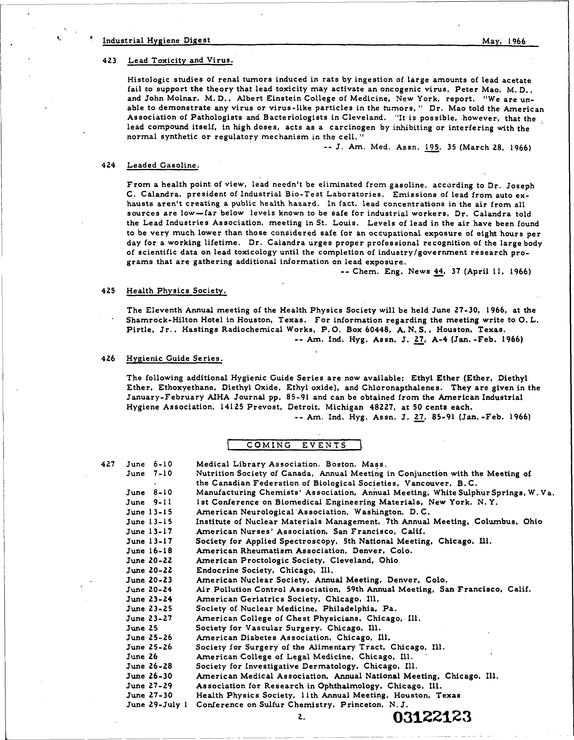
Industrial Hygiene Digest May, 1966 423 Lead Toxicity and Virus.
refid# NeKaa6Jz3oD05nj0xN9Dy8gNE1 page
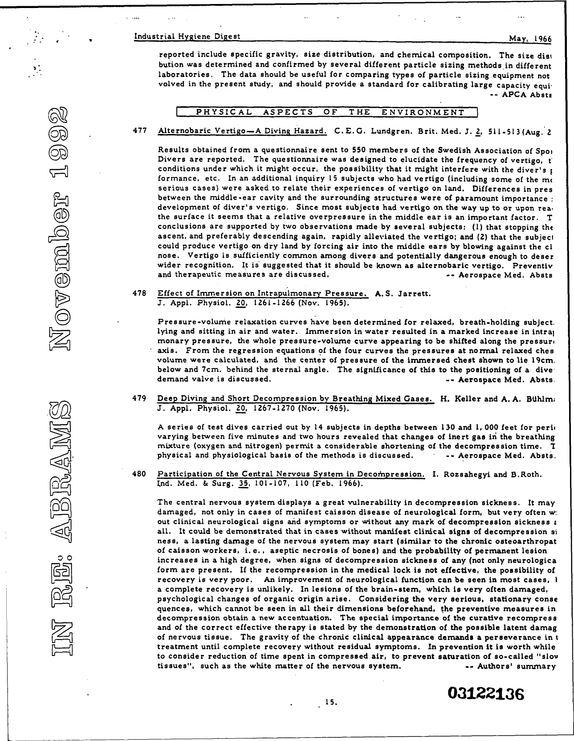
fei OO PI J--------- l Industrial Hygiene Digest May, 1966 reported include specific gravity, size distribution, and chemical composition.
refid# rp4yk9VLLrO70N44nmgvN9bdV1 page
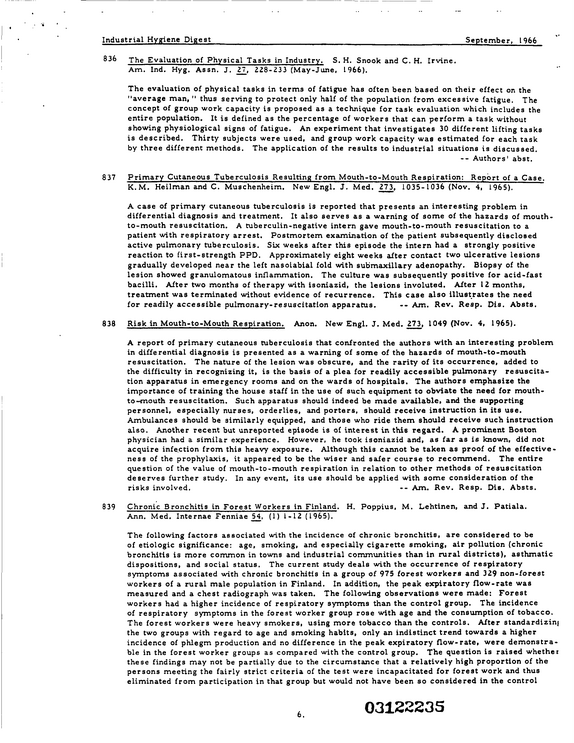
Industrial Hygiene Digeat September, 1966 836 The Evaluation of Physical Tasks in Industry.
refid# KX2DgkBQDrxNVewnZom19agN1 page
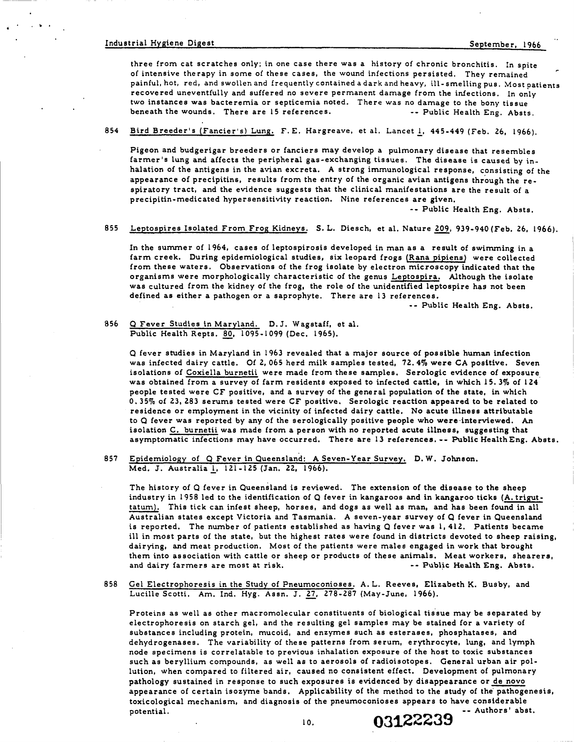
Industrial Hygiene Digest September. 1966 three from cat scratches only; in one case there was a history of chronic bronchitis.
refid# jYxN3GpKa4YM3e8EgrVZoEaR1 page
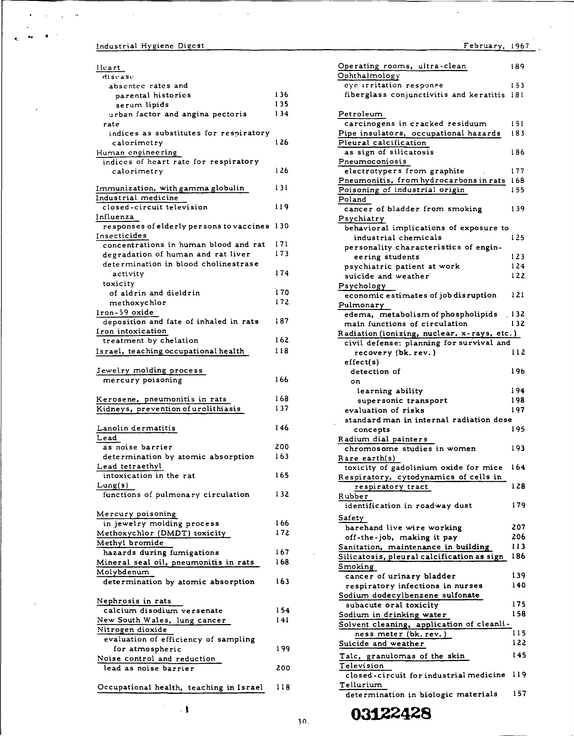
Industrial Hygiene Digest 1 lea rt disease absentee rates and parental histories 136 serum lipids 1 35 urban factor and angina pectoris 134 rate indices as substitutes for respiratory calorimetry 126 Human engineering indices of heart rate for respiratory calorimetry 126 Immunization, with gamma globulin 131 Industrial medicine closed-circuit television 119 Influenza responses of elderly persons to vaccines 1 30 Insecticides concentrations in human blood and rat 171 degradation of human and rat liver 173 determination in blood cholinestrase activity 174 toxicity of aldrin and dieldrin 170 methoxychlor 172 Iron-59 oxide deposition and fate of inhaled in rats 187 Iron intoxication treatment by chelation 162 Is rael, teaching occupational health 118 Jewelry molding process mercury poisoning 166 Kerosene, pneumonitis in rats Kidneys, prevention of urolithiasis 1 68 1 37 Lanolin dermatitis Lead as noise barrier determination by atomic absorption Lead tetraethyl intoxication in the rat Lung(s) functions of pulmonary circulation 1 46 200 163 165 132 Mercury poisoning in jewelry molding process Methoxychlor (DMDT) toxicity Methyl bromide hazards during fumigations Mineral seal oil, pneumonitis in rats Molybdenum determination by atomic absorption 166 172 167 1 68 163 Nephrosis in rats calcium disodium versenate New South Wales, lung cancer Nitrogen dioxide evaluation of efficiency of sampling for atmospheric Noise control and reduction lead as noise barrier 154 1 41 199 200 Occupational health, teaching in Israel 118 i February, 1967 Operating rooms, ultra-clean 189 Ophthalmology eye irritation response 153 fiberglass conjunctivitis and keratitis 181 Petroleum carcinogens in cracked residuum 15!
refid# 3NkY8jGyj8mG46MoX1RRGqVNn1 page
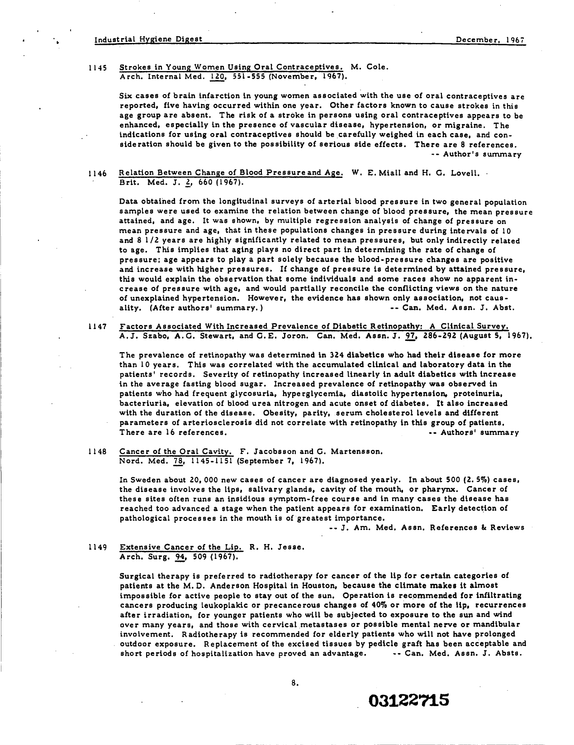
Industrial Hygiene Digest December, 1967 1145 Strokes in Young Women Using Oral Contraceptives.
refid# QgZ9vR6nDDqyrrwwzQXzg0rK51 page
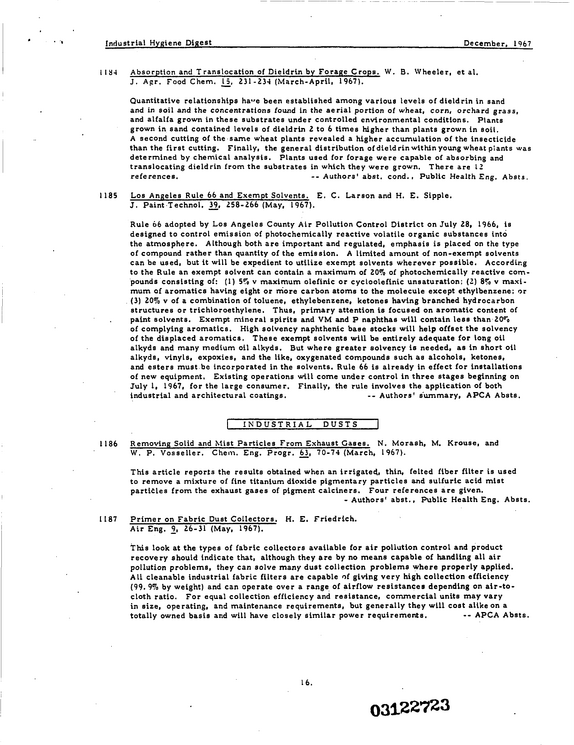
Industrial Hygiene Digest December, 1967 1184 Absorption and Translocation of Dieldrin by Forage Crops.
refid# ppjQjwZygEB5Lod5R043BBa871 page
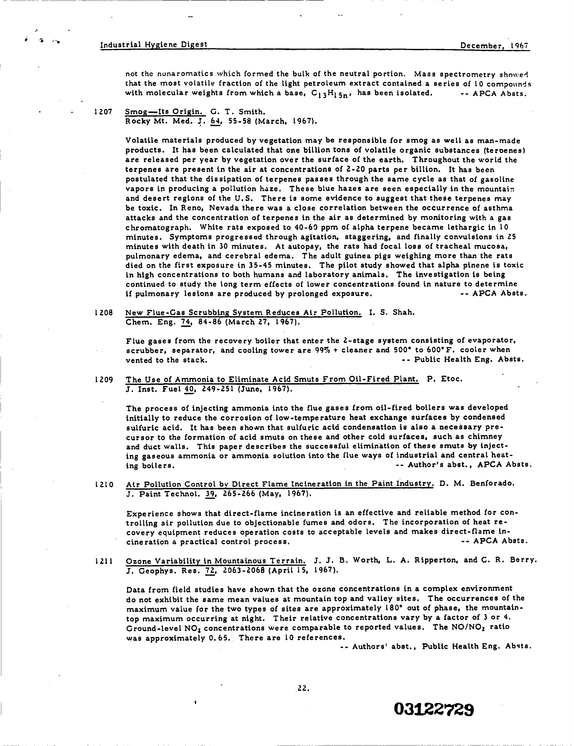
Industrial Hygiene Digest December, 1967 not the nonaromatics which formed the bulk of the neutral portion.
refid# MGnV9X0Bd4w1R3KDOzKqO546M1 page
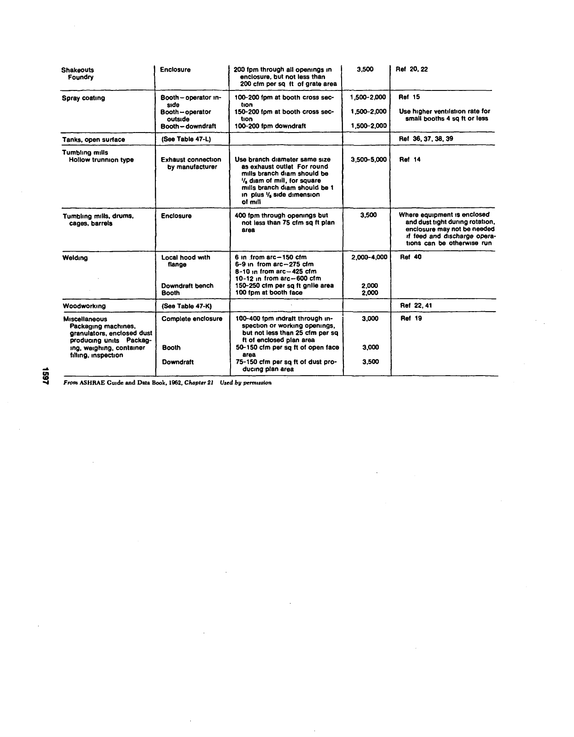
1597 Shakeouts Foundry Spray coating Tanks, open surface Tumbling mills Hollow trunnion type Tumbling mills, drums, cages, barrets Enclosure Booth--operator in side Booth-operator outside Booth - downdraft (See Table 47-L) 200 fpm through all openings in enclosure, but not less than 200 cfm per sq ft of grate area 100-200 fpm at booth cross sec tion 150-200 fpm at booth cross sec tion 100-200 fpm downdraft Exhaust connection by manufacturer Enclosure Use branch diameter same size as exhaust outlet For round mills branch diam should be '/, diam of mill, for square mills branch diam should be 1 in plus V, side dimension of mill 400 fpm through openings but not less than 75 cfm sq ft plan area Welding Local hood with flange Downdraft bench Booth 6 in from arc-150 cfm 6-9 in from arc--275 cfm 8-10 in from arc--425 cfm 10-12 in from arc-600 cfm 150-250 cfm per sq ft gnlle area 100 fpm at booth face Woodworking Miscellaneous Packaging machines, granulators, enclosed dust producing units Packag ing, weighing, container filling, inspection (See Table 47-K) Complete enclosure Booth Downdraft 100-400 fpm indraft through in spection or working openings, but not less than 25 cfm per sq ft of enclosed plan area 50-150 cfm per sq ft of open face area 75-150 cfm per sq ft of dust pro ducing plan area From ASHRAE Cuide and Data Book, 1962, Chapter 21 Used by permission 3,500 Ref 20,22 1,500-2,000 1,500-2,000 1,500-2,000 Ref 15 Use higher ventilation rate for small booths 4 sq ft or less Ref 36, 37, 36. 39 3,500-5,000 Ref 14 3,500 2,000-4,000 Where equipment is enclosed and dust tight dunng rotation, enclosure may not be needed if feed and discharge opera tions can be otherwise run Ref 40 2,000 2,000 3,000 Ref 22,41 Ref 19 3,000 3,500
refid# e7VeYMnOXmQkyZB7EN1LJwkLM1 page
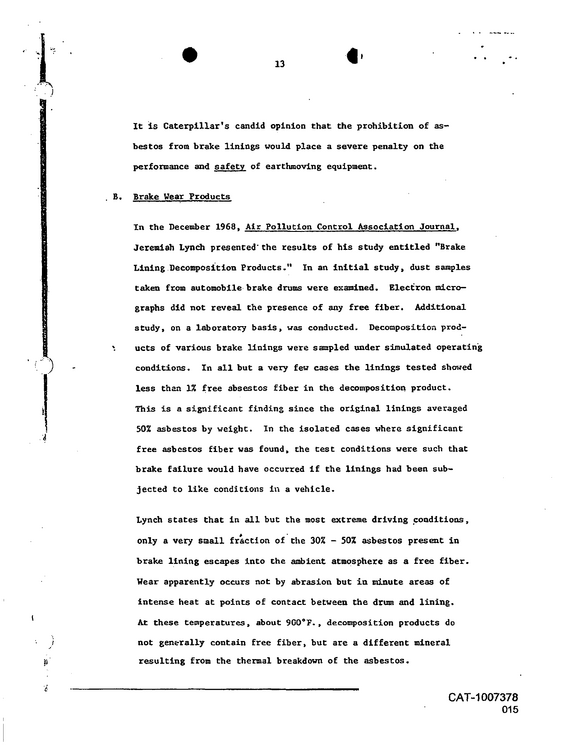
4i 13 t i P' 'i It is Caterpillar's candid opinion that the prohibition of as bestos from brake linings would place a severe penalty on the performance and safety of earthmoving equipment. .
refid# YGR50aVQRO461jEGRjz40RbeN1 page
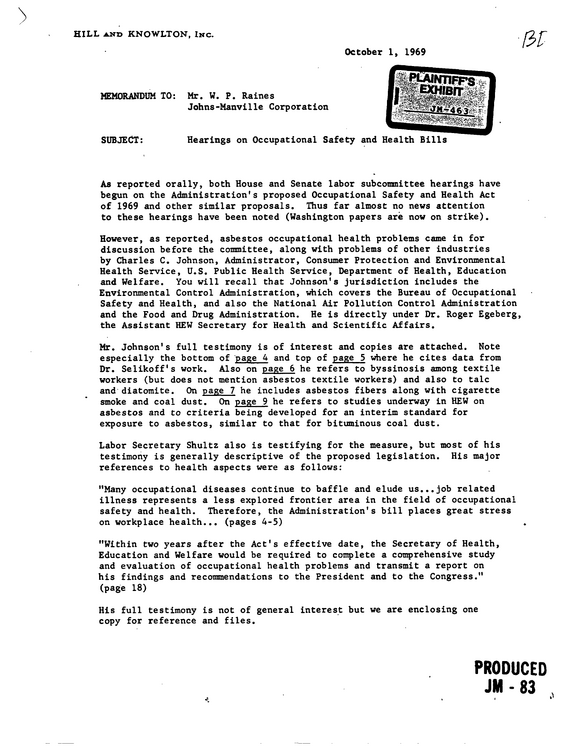
> HILL and KNOWLTON, Inc.
refid# 0qBvvdOkyQ8kb5bvzEjv41a3J33 pages
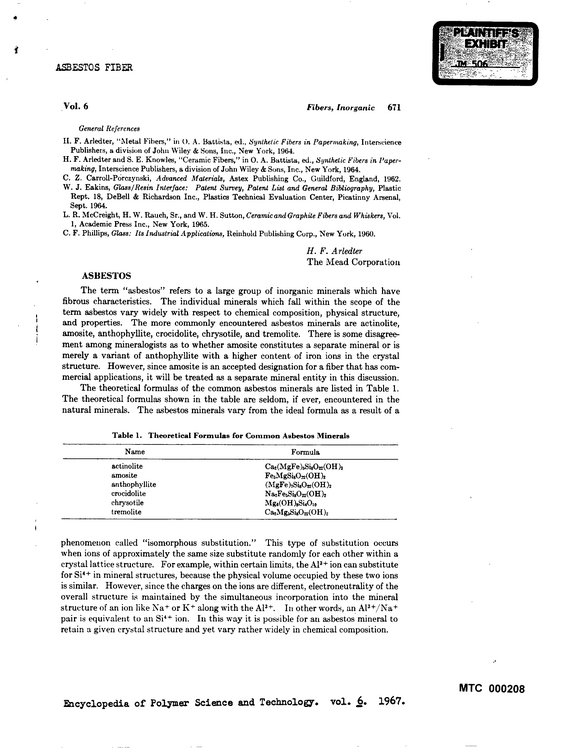
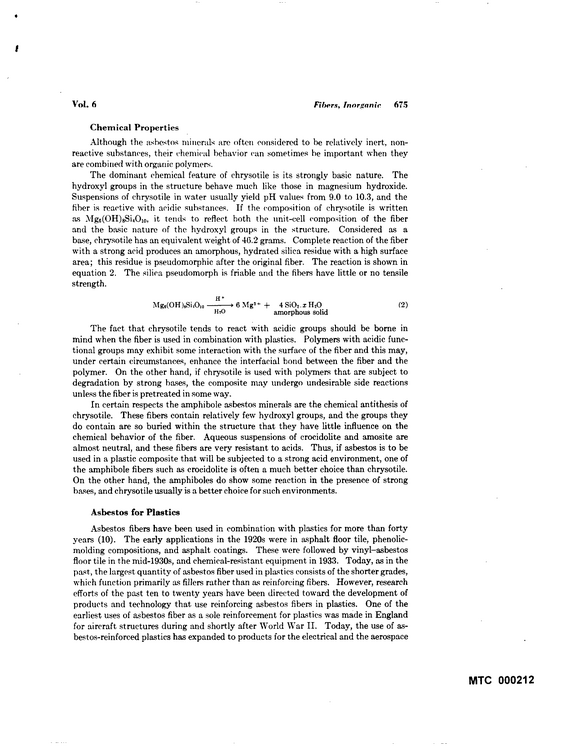
ASBESTOS FIBER .Vol. 6 Fibers, Inorganic 671 General References II.
refid# N2OGeZd4BLxzVpKNqVpJ1VYGR10 pages
visors and two councils concerned with safety of tank truck operations and of automobile transporters Such councils conduct monthly and quarterly meetings and engage m safety engineering activities that relate to their par ticular interests according to geographic loca tions or type of operations The American Waterways Operators, Inc. 1250 Connecticut Ave NW, Suite 502, Washington, D C 20036 The American Waterways Operators, Inc, is a trade association representing the national interests of operators of towboats, tugboats, barges and shallow-draft self-propelled freight ers and tankers engaged in domestic trade primarily over the inland waterways of the United States AWO has a safety committee which pursues three primary objectives Promotion of individual member com pany's safety programs, More participation by members in the Barge and Towing Vessel Industry Safety Contest which the Association co-sponsors with the National Safety Council, and Preparation and distribution of AWO safety posters which the Association issues to its members each month The association's manual.
refid# bygX67D89968qq0j5om4EJ1YZ1 page
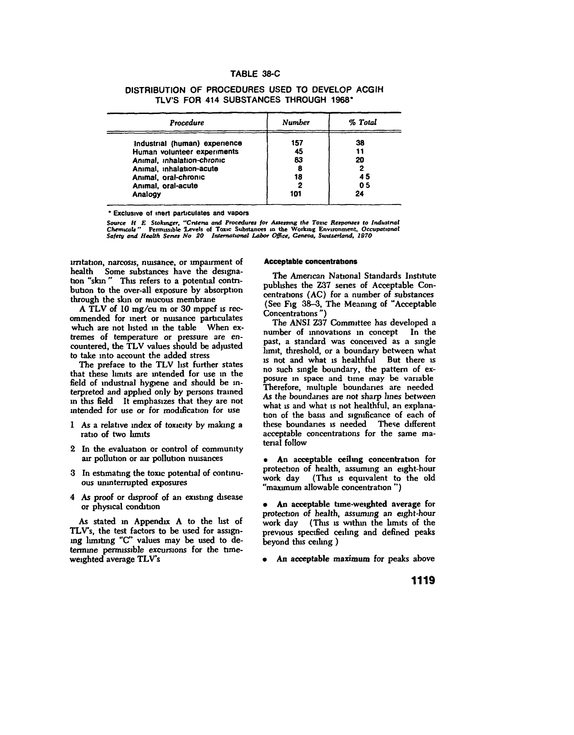
TABLE 38-C DISTRIBUTION OF PROCEDURES USED TO DEVELOP ACGIH TLV'S FOR 414 SUBSTANCES THROUGH 1968* Procedure Number % Total Industrial (human) expenence Human volunteer experiments Animal, inhalation-chronic Animal, inhalation-acute Animal, oral-chronic Animal, oral-acute Analogy 157 45 83 8 18 2 101 38 11 20 2 45 05 24 * Exclusive of inert particulates and vapors Source H E Stokmger, "Criteria and Procedures for Assessing the Toxic Responses to Industrial Chemicals " Permissible Levels of Toxic Substances in the Working Environment, Occupational Safety and Health Senes No 20 International Labor Office, Geneva, Switzerland, 1970 irritation, narcosis, nuisance, or impairment of health Some substances have the designa tion "skin " This refers to a potential contri bution to the over-all exposure by absorption through the skm or mucous membrane A TLV of 10 mg/cu m or 30 mppcf is rec ommended for inert or nuisance particulates which are not listed in the table When ex tremes of temperature or pressure are en countered, the TLV values should be adjusted to take into account the added stress The preface to the TLV list further states that these limits are intended for use m the field of industrial hygiene and should be in terpreted and applied only by persons trained in this field It emphasizes that they are not intended for use or for modification for use 1 As a relative index of toxicity by making a ratio of two limits 2 In the evaluation or control of community air pollution or air pollution nuisances 3 In estimating the toxic potential of continu ous uninterrupted exposures 4 As proof or disproof of an existing disease or physical condition As stated in Appendix A to the list of TLV'S, the test factors to be used for assign ing limiting "C" values may be used to de termine permissible excursions for the timeweighted average TLV'S Acceptable concentrations The American National Standards Institute publishes the Z37 senes of Acceptable Con centrations (AC) for a number of substances (See Fig 38-3, The Meaning of "Acceptable Concentrations ") The ANSI Z37 Committee has developed a number of innovations in concept In the past, a standard was conceived as a single limit, threshold, or a boundary between what is not and what is healthful But there is no such single boundary, the pattern of ex posure in space and time may be variable Therefore, multiple boundaries are needed As the boundaries are not sharp lines between what is and what is not healthful, an explana tion of the basis and significance of each of these boundanes is needed These different acceptable concentrations for the same ma terial follow An acceptable ceiling concentration for protection of health, assuming an eight-hour work day (This is equivalent to the old "maximum allowable concentration ") An acceptable time-weighted average for protection of health, assuming an eight-hour work day (This is within the limits of the previous specified ceiling and defined peaks beyond this ceiling) An acceptable maximum for peaks above 1119
refid# QX4DmqZdOOY8MNxmg6YMy1JZv1 page
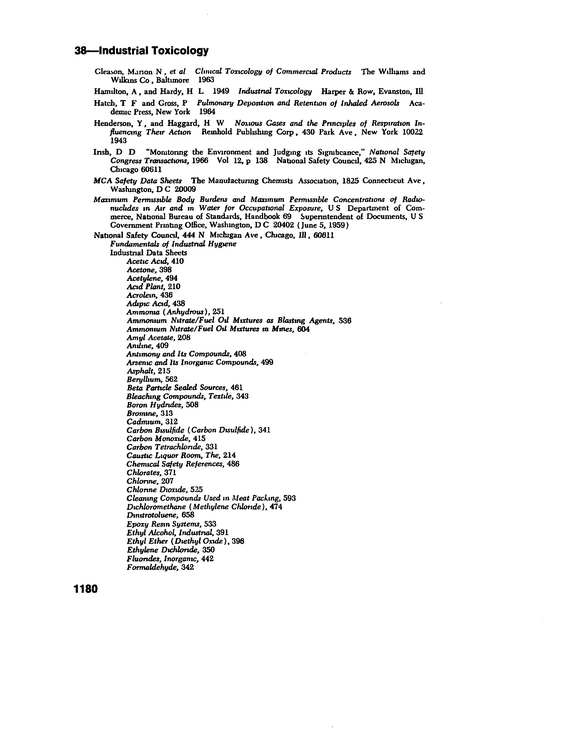
38--Industrial Toxicology Gleason, Marion N , et al Clinical Toxicology of Commercial Products The Williams and Wilkins Co , Baltimore 1963 Hamilton, A , and Hardy, H L 1949 Industrial Toxicology Harper & Row, Evanston, 111 Hatch, T F and Gross, P Pulmonary Deposition and Retentum of Inhaled Aerosols Aca demic Press, New York 1964 Henderson, Y, and Haggard, H W Noxious Gases and the Principles of Respiration In fluencing Their Action Reinhold Publishing Corp, 430 Park Ave, New York 10022 1943 Insh, D D "Monitoring the Environment and Judging its Significance," National Safety Congress Transactions, 1966 Vol 12, p 138 National Safety Council, 425 N Michigan, Chicago 60611 MCA Safety Data Sheets The Manufacturing Chemists Association, 1825 Connecticut Ave, Washington, D C 20009 Maximum Permissible Body Burdens and Maximum Permissible Concentrations of Radio nuclides tn Air and tn Water for Occupational Exposure, U S Department of Com merce, National Bureau of Standards, Handbook 69 Supenntendent of Documents, U S Government Printing Office, Washington, D C 20402 (June 5, 1959) National Safety Council, 444 N Michigan Ave, Chicago, 111, 60611 Fundamentals of Industrial Hygiene Industrial Data Sheets Acetic Acid, 410 Acetone, 398 Acetylene, 494 Acid Plant, 210 Acrolein, 436 Adipic Acid, 438 Ammonia (Anhydrous), 251 Ammonium Nitrate/Fuel Od Mixtures as Blasting Agents, 536 Ammonium Nitrate/Fuel Od Mixtures tn Mtnes, 604 Amyl Acetate, 208 Andine, 409 Antimony and Its Compounds, 408 Arsenic and Its Inorganic Compounds, 499 Asphalt, 215 Beryllium, 562 Beta Particle Sealed Sources, 461 Bleaching Compounds, Texlde, 343 Boron Hydrides, 508 Bromine, 313 Cadmium, 312 Carbon Bisulfide (Carbon Disulfide), 341 Carbon Monoxide, 415 Carbon Tetrachloride, 331 Caustic Liquor Room, The, 214 Chemical Safety References, 486 Chlorates, 371 Chlorine, 207 Chlonne Dioxide, 525 Cleaning Compounds Used tn Meat Packing, 593 Dichloromethane (Methylene Chloride), 474 Dmitrotoluene, 658 Epoxy Resin Systems, 533 Ethyl Alcohol, Industrial, 391 Ethyl Ether (Diethyl Oxide), 396 Ethylene Dichlonde, 350 Fluorides, Inorganic, 442 Formaldehyde, 342 1180
refid# oDLYv3byQdZEdLVeZNaDq3QQ81 page