Refine
Estimated Years 1950-1959Clear
14,527 results foundRefine Search
?
refid# G5yxV844ZMND7w196ZpR1Lk8m1 page
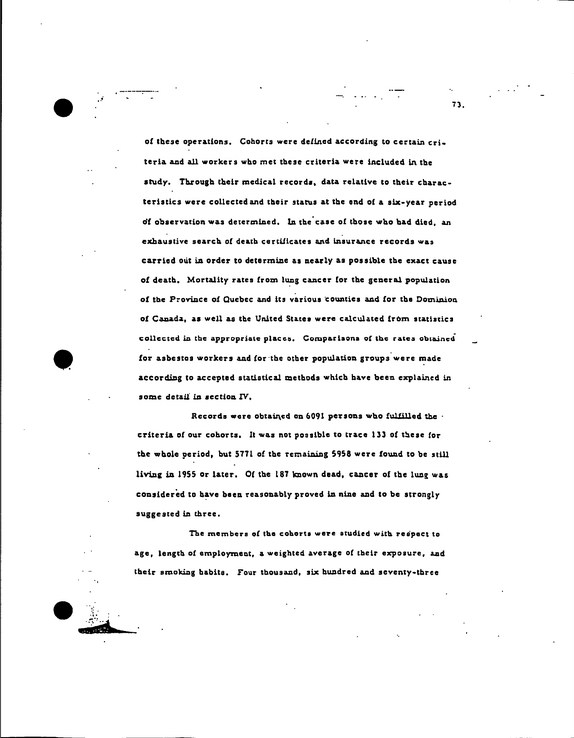
I * ' ............................... .............................................................................................. 36. . iA One further Lntarcetlng observation from Table 1^ la the rather marked Ucreaae la the total number of caaea for the Province between 1950 and 1955. ft le aaaumod that at leaat part of thla tncrcaco la due to lm proved recognition and reporting of lung cancer during the Interval. ]Tor thla raaaon, the yaars 1954 and 1955 were thought to bo more nearly rcpre \ aaautlve of aetual condltlono.
refid# J3RaaKx0LBKbGjRKJ9q5RDKBe1 page
6k .
refid# xjLK6LLpmwN7GvnrqRR74oM7b1 page
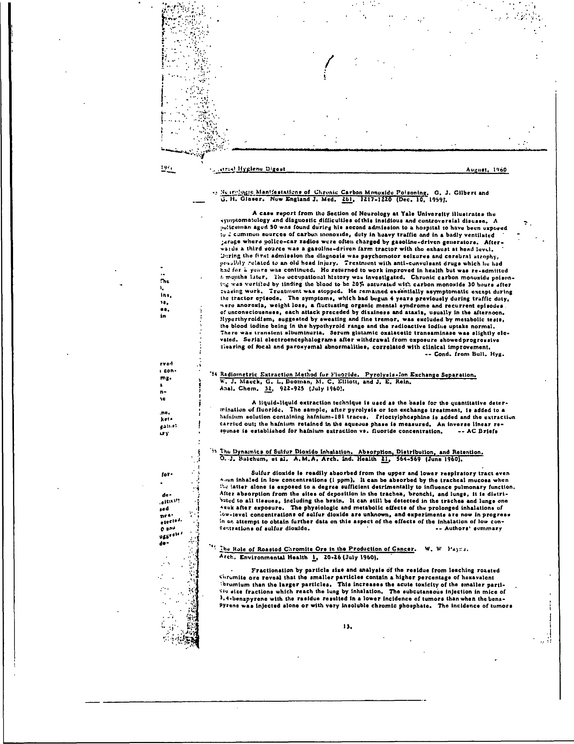
Ionizing Radiation FlC 44-9 -- Deposition of materials inhaled into the bronchial tree, according to particle size m microns Adapted from Atomic Radiation, 1957 by RCA Ser vice Co, Inc 44-9) Fortunately, the lung dynamics are such that most of the particles of size greater than l/i are not retained to any degree, so that the probability of this occurring is low From the standpoint of measuring the concentra tion in air, the particle size does not enter into the problem because the air sample is only counted for total activity In terms of defining or assessing the hazard though, the particle size is important Calculations The degree of the nsk of the inhalation hazard may be estimated from a calculation of the concentration of the radio nuclide together with a knowledge of breath ing rates It can be assumed that a man breathes 10,000 liters (10 cu m) of air in eight hours In general, a man breathes 8 liters per minute at rest, 16 while seated, and 24 while walking A single breath equals about one-half liter One rough estimate of the hazard may be made on the basis that the material released has been uniformly mixed with the air in the room or building An alternate calculation may be made on the assumption that the re leased matenal has been limited to a small number of liters of air which the exposed person has then breathed The radioactivity concentration guides (RCG's) are based upon an average concen tration over a continuous exposure time (a lifetime of 40 hr per week or working time) The concentration at any one location vanes over a time penod as does the exposure time m the particular concentranon for employees whose work takes them into many different locations To find the average concentration, it is best to calculate a time-weighted average concentration The concentration which has been measured existed for the penod of elapsed time represented by the air-sampling time The time-weighted average concen tration is the sum of the products (each con centration found multiplied by the associated lapsed bme), divided by the total elapsed time of all of the sampling time penods Similarly, the time-weighted average con centration of a particular employee is the sum of the products (each concentration in which he worked multiplied by the associated time so worked) divided by the total elapsed time of the penod m question Thus, a single high exposure for a few minutes may average out to be far below the RCG if most of the re mainder of the time penod in question had a zero concentration In such calculations, the decay rate of the radionuclide is an important correction factor if there is a long time in terms of half-life penod between sample collection and analysis or if there is a very short half-life (See, for example, NBS Handbook 51, p 27, item 27 4) Guide doses External sources For whole-body expo sure at any age, a person's total accumulated absorption of ionizing radiation affecting cntical organs (m rems) should not exceed five times the number of vears beyond age 18, that is 5x(age-18), provided that no 13-week increment exceeds 3 rems Doses of ionizing radiation should not exceed those values given in Tables 44-C and-D The Atomic Energy Commission has adopted "Standards of Radiation Protection" which are published in their Manual, Chapter 1460
refid# ZBkZm47xqpoJYnqyBzyxV1BZL1 page
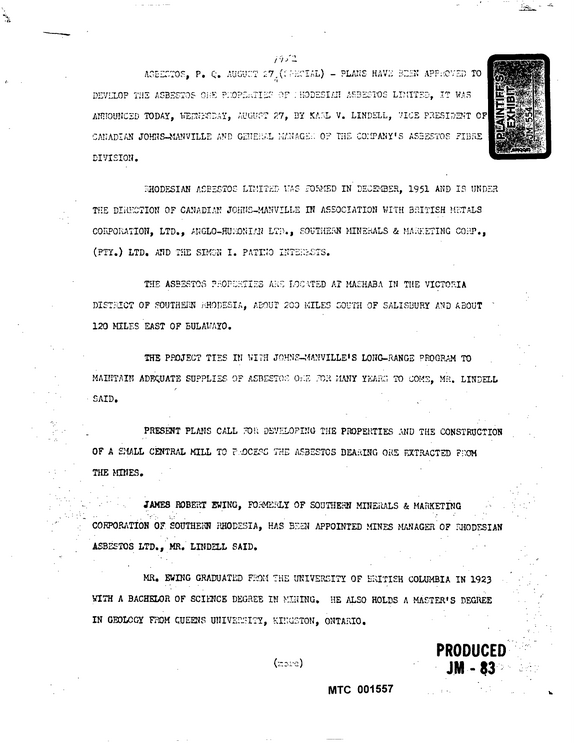
asbestos, p. q /'/> - 27.
refid# byYrKggBoZx6arxYmDOr3NzJD2 pages
References American Conference of Governmental Industrial Hygienists, Committees on Industrial Venti lation and Respirators, P O Box 16153, Lansing, Mich 48901 Industrial Ventilation--A Manual of Recommended Practice Ventilation System Testing American Industrial Hygiene Association, 66 S Miller Road, Akron, Ohio 44313 Heating and Cooling of Man in Industry American Society of Heating, Refrigerating and Air-Conditiomng Engineers, 345 East 47th St, New York, N Y 10017 Guide and Data Book {Issued annually ) American National Standards Institute, 1430 Broadway, New York, N Y 10018 Fundamentals Governing the Design and Operation of Local Exhaust Systems, Z9 2 Practices for Ventilation and Operation of Open-Surface Tanks, Z9 1 Safety Code for Design, Construction, and Ventilation of Spray Finishing Operations, Z93 Ventilation and Safe Practices of Abrasives Blasting Operations, Z9 4 Ventilation Control of Grinding, Polishing, and Buffing Operations, Z43 1 National Fire Protection Association, 470 Atlantic Ave, Boston, Mass 02210 Air Conditioning and Ventilating Systems, Standard No 90A Blower and Exhaust Systems for Duct, Stock and Vapor Removal, Standard No 91 National Electrical Code, Standard No 70 Residence Type Warm Atr Heating, Air Conditioning Systems, Standard No 90B Spray Finishing Using Flammable and Combustible Materials, Standard No 33 National Safety Council, 444 North Michigan Ave, Chicago, 111, 60611 Fundamentals of Industrial Hygiene Industrial Data Sheets Checking Performance of Local Exhaust Systems, 428 Dusts, Fumes, and Mists in Industry, 531 Instruments for Testing Exhaust Ventilation Systems, 431 Radiant Heat Control, 381 Sevems, William H , and Julian R Fellows Air Conditiomng and Refrigeration John Wiley & Sons, Inc, 1959 New York, Strock, Clifford, ed Handbook of Air Conditiomng, Heating and Ventilating New York, The Industrial Press, 1973 1027
refid# zdG3kb6aw0OQkwB21Y1GpvBmm1 page
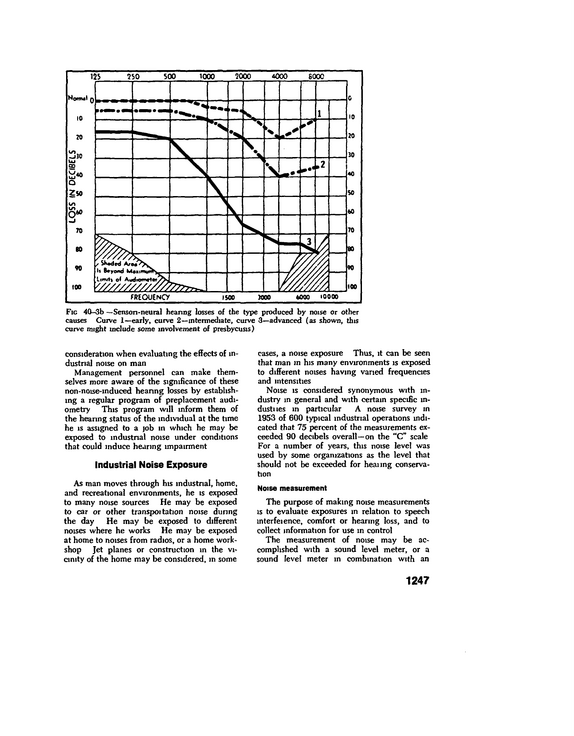
Fic 40-3b --Senson-neural heanng losses of the type produced by noise or other causes Curve 1--early, curve 2--intermediate, curve 3--advanced (as shown, this curve might include some involvement of presbycusis) consideration when evaluating the effects of in dustrial noise on man Management personnel can make them selves more aware of the significance of these non-noise-mduced heanng losses by establish ing a regular program of preplacement audi ometry This program will inform them of the heanng status of the individual at the time he is assigned to a job m which he may be exposed to industrial noise under conditions that could induce hearing impairment Industrial Noise Exposure As man moves through his industnal, home, and recreational environments, he is exposed to many noise sources He may be exposed to car or other transpoi tation noise during the day He may be exposed to different noises where he works He may be exposed at home to noises from radios, or a home work shop Jet planes or construction in the vi cinity of the home may be considered, in some cases, a noise exposure Thus, it can be seen that man m his many environments is exposed to different noises having vaned frequencies and intensities Noise is considered synonymous with in dustry m general and with certain specific mdustues in particular A noise survey in 1953 of 600 typical industrial operations indi cated that 75 percent of the measurements ex ceeded 90 decibels overall--on the "C" scale For a number of years, this noise level was used by some organizations as the level that should not be exceeded for heanng conserva tion Noise measurement The purpose of making noise measurements is to evaluate exposures m relation to speech interfeience, comfort or hearing loss, and to collect information for use m control The measurement of noise may be ac complished with a sound level meter, or a sound level meter in combination with an 1247
refid# LJkqOwO5oZGm3Q7vGgM3ZBJz31 page
CANCER PREVENTION COMMITTEE INC 477 FIRST AVENUE NEW YORK 16, N.
refid# wG5vnmMmNEEZYYo6jno5eYO68 pages
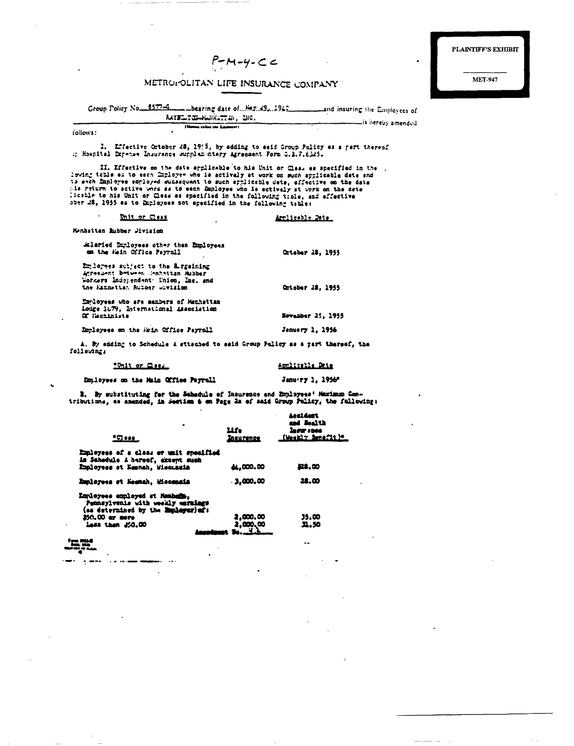
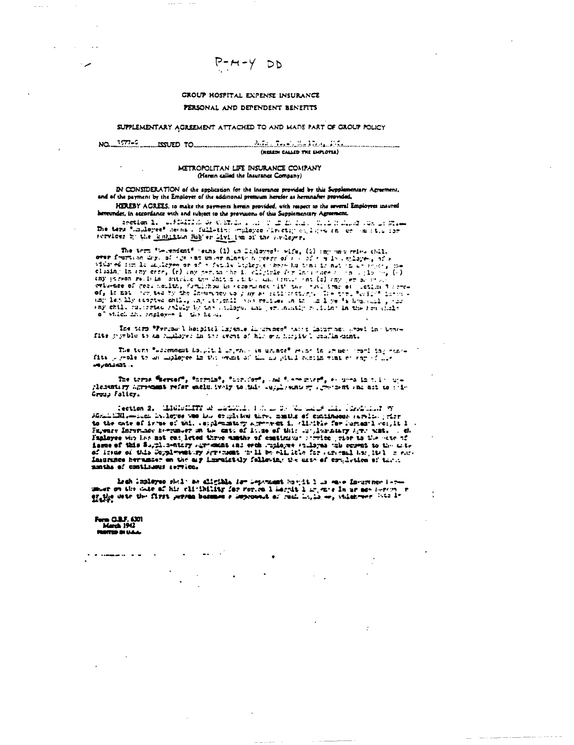
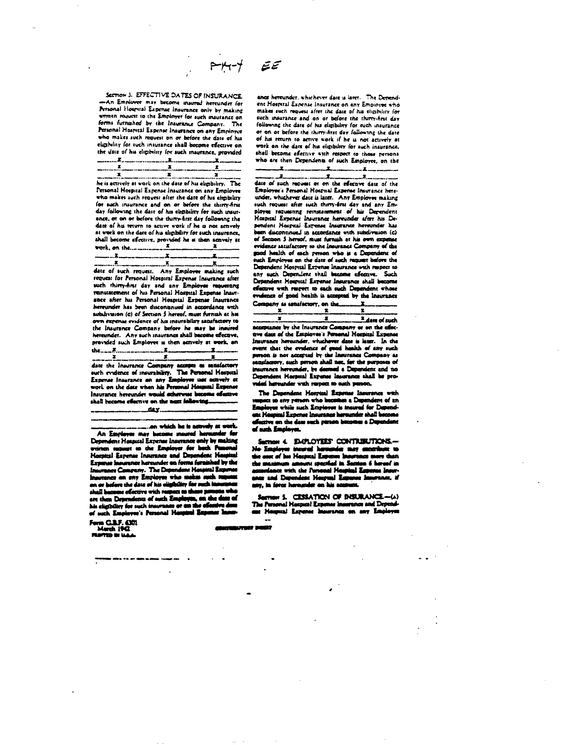
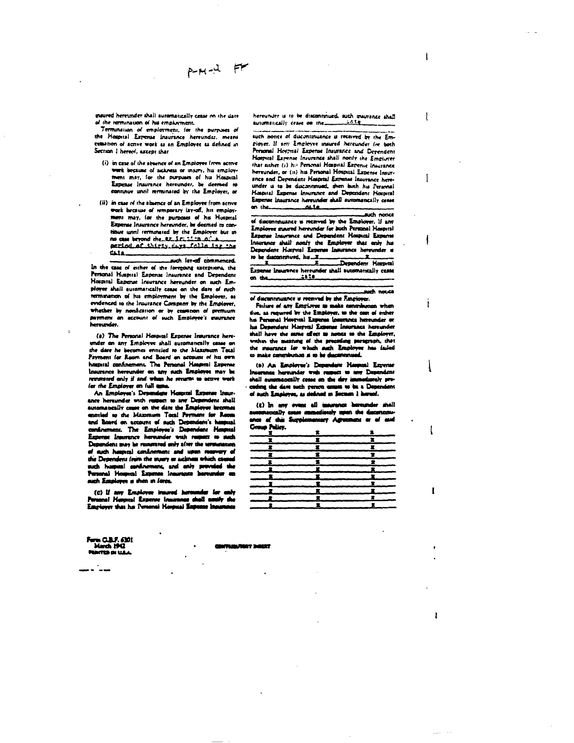
- - - < .P M y cs METROi-OLITAN LIFE INSURANCE COMPANY Croup folic)- No__-------------------bearm; dale ^*TBi.ras-HjiKi7rii<, me. loliowi: J94L jtid imurinj the Employees o/ ------------------- is hereby amended I.
refid# NE9g4Ljx2DaJZ2ZbdYea0zJXD9 pages
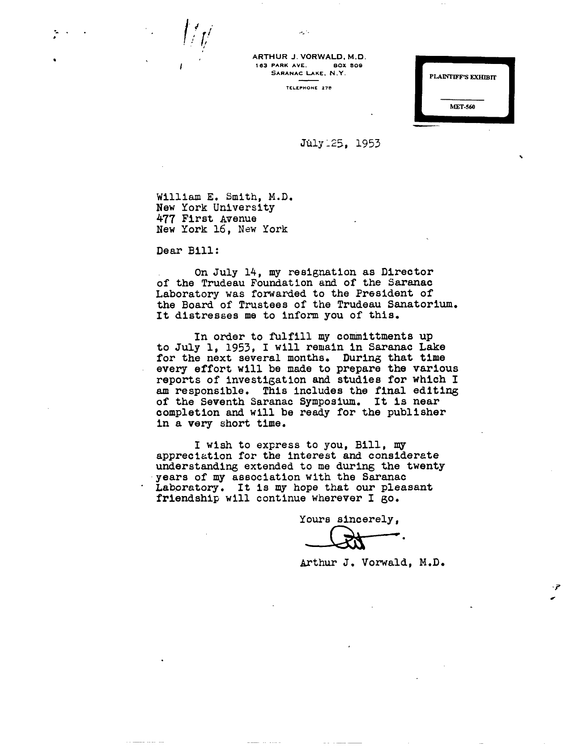
ARTHUR J.
refid# gb6VmDreJ0LDDZnLkXeLvQMBa1 page
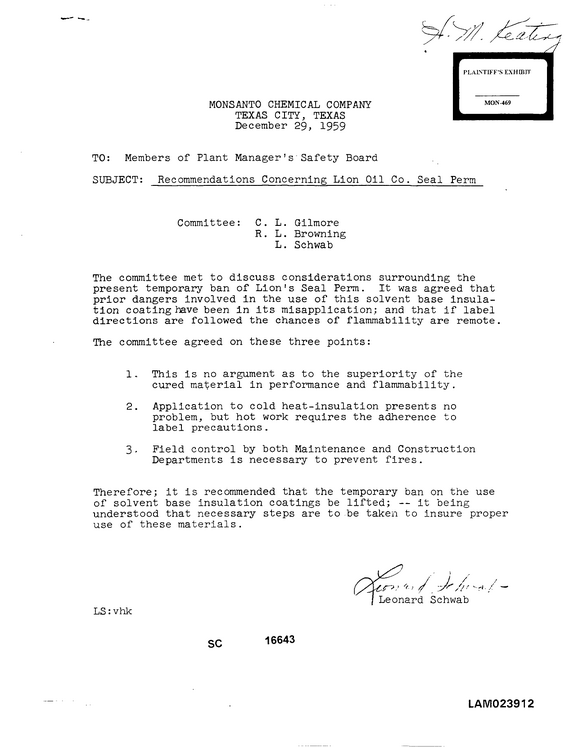
MONSANTO CHEMICAL COMPANY TEXAS CITY, TEXAS December 29, 1959 TO: Members of Plant Manager's'Safety Board SUBJECT: Recommendations Concerning Lion Oil Co.
refid# dQxQYZYG23qEgZr2pMrr87k5b1 page
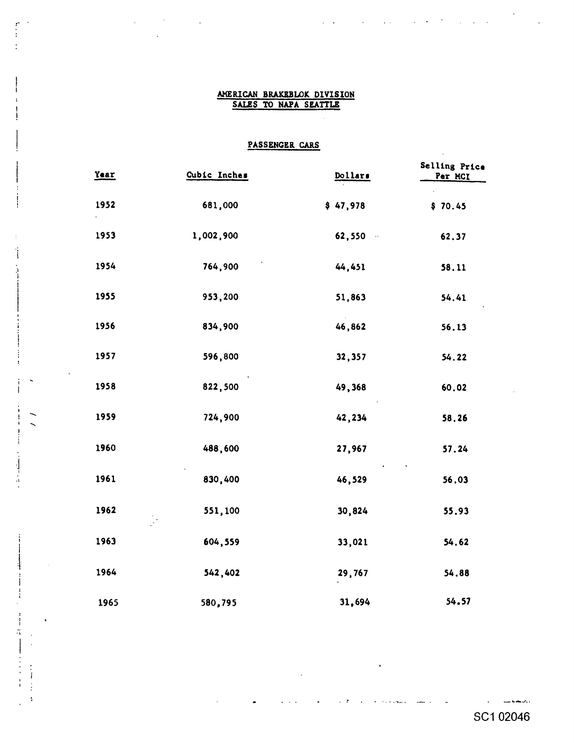
Year 1952 1953 1954 1955 1956 1957 1958 1959 1960 1961 1962 1963 1964 1965 AMERICAN BRAXEBLOK DIVISION SALES TO NAPA SEATTLE PASSENGER CARS Cubic Inches Dollars 681,000 $ 47,978 1,002,900 62,550 764,900 44,451 953,200 834,900 51,863 46,862 596,800 32,357 822,500 49,368 724,900 42,234 488,600 27,967 830,400 46,529 551,100 30,824 604,559 33,021 542,402 580,795 29,767 31,694 Selling Price Per MCI $ 70.45 62.37 58.11 54.41 56.13 54.22 60.02 58.26 57.24 56.03 55.93 54.62 54.88 54.57 SCI 02046
refid# 2jRVKvNN3027ZR9LMENJQQQ061 page
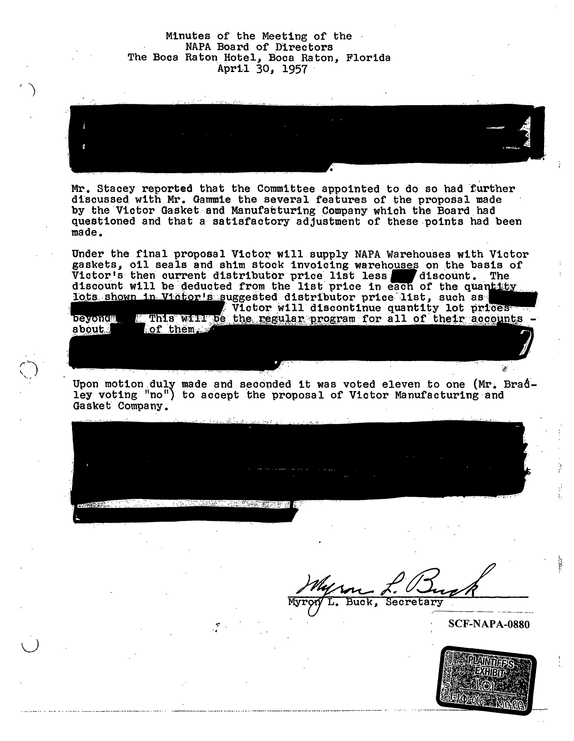
Minutes of the Meeting of the NAPA Board of Directors The Boca Raton Hotel, Boca Raton, Florida April 30, 1957 Mr.
refid# R219LZ5pNDBgO8vdK7GwOOMqX1 page
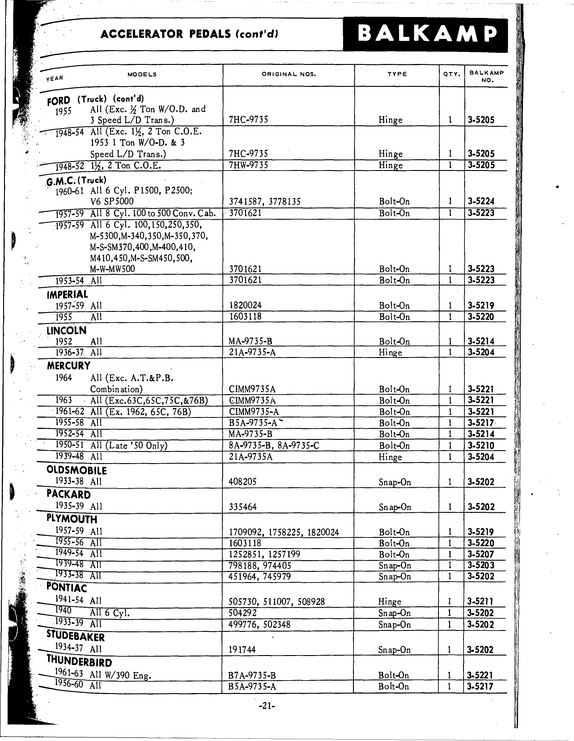
ACCELERATOR PEDALS (cont'd) BALKAMP year MODELS ORIGINAL NOS
refid# 85Yx1jq6ZQeynb1e161dnKap51 page
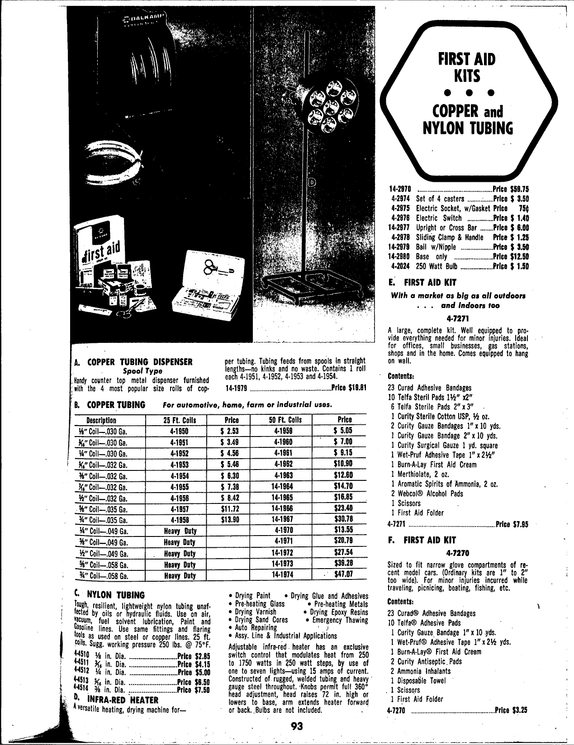
B.
refid# DMygVQB9v7Ekp6Bj4edwROa6a1 page