Refine
Estimated Years 1950-1959Clear
14,527 results foundRefine Search
1042 CHAPTER 41 1957 Guide or another, charges both for demand and energy.
refid# MMQnYxVew1ERLmdKXQg7GJNzV1 page
102 CHAPTER 5 1958 Guide / Rt, and into the water stream through the convection resistance, ,Ri.
refid# e1yBQgmax5na1wGKDYj5Zz8Rp1 page
152 CHAPTER 8 1958 Guide of organic substances such as tobacco, wood, coal, oil, tar and other carbonaceous materials.
refid# 1yzbyg1REnKL0zXr0r6wbr6rj1 page
% l210 CHAPTER 9 1958 Guide: # U = 1/Rt (5)= ` 2 where U. = combined coefficient to be used with ceiling area.
refid# 8R3oaXkag2R2Jp0Zqy0DVzX651 page
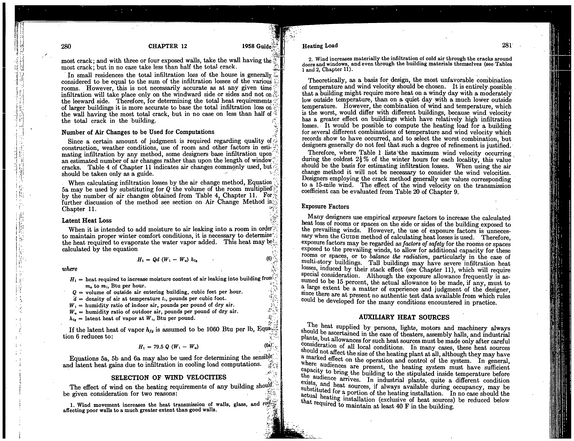
280 CHAPTER 12 1958 Guided, most crack; and with three or four exposed walls, take the wall having the -j most crack; but in no case take less than half the total crack
refid# vVJnw4Xp2kN3nnykMXmKVQeZq1 page
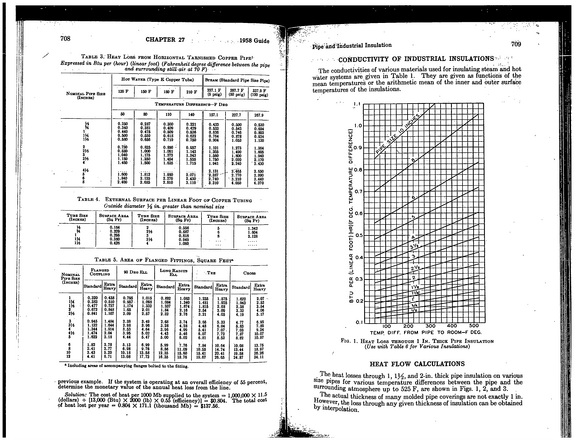
708 CHAPTER 27 1958 Guide Table 3.
refid# EbO473145M0VgjGM631KMDZL1 page
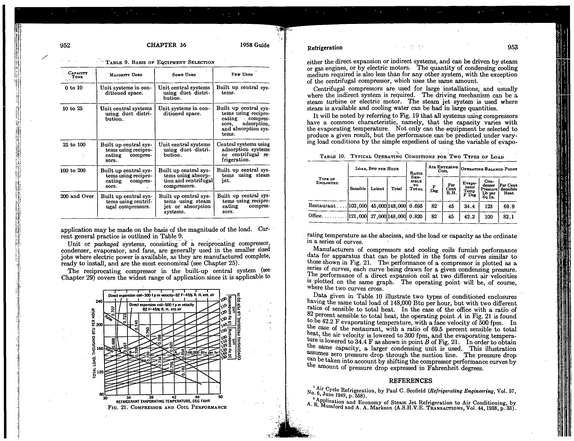
952 CHAPTER 36 1958 Guide Table 9.
refid# mGeq90LxX5KXLzKbEqrxv3Jg1 page
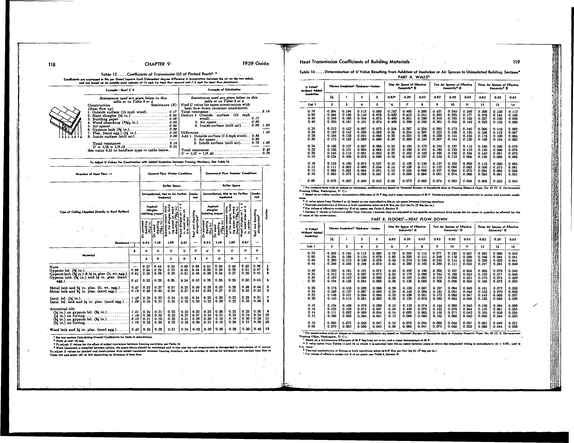
118 CHAPTER 9 1959 Guide Table 15 ....
refid# ba17eQE15XQLdZnvBQOM9oE301 page
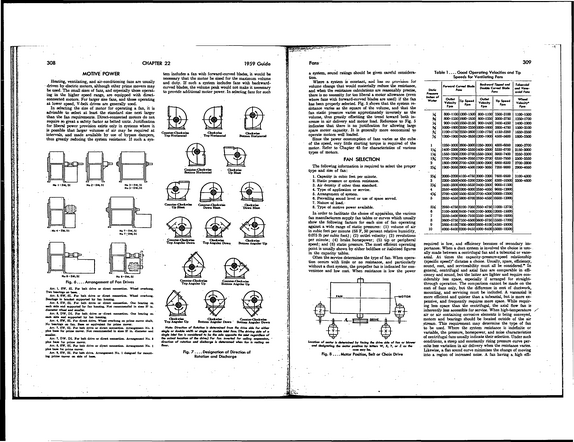
308 CHAPTER 22 1959 Guide MOTIVE POWER Heating, ventilating, and air-conditioning fans are usuaiiy driven by electric motors, although other prime movers may be used.
refid# aZeYqEJXvyE3gV7OwJbLgnLb1 page
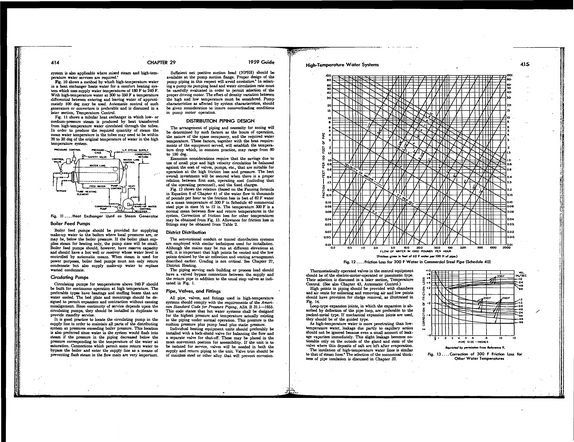
414 CHAPTER 29 1959 Guide system is also applicable where mixed steam and high-temperature water services are required.'
refid# qa2LKrwRyao1RMYZpL0aXNVyM1 page
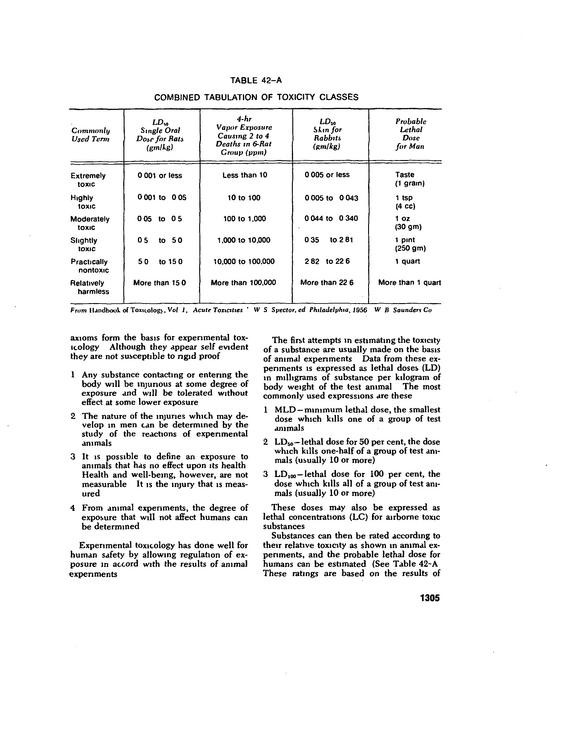
TABLE 42-A COMBINED TABULATION OF TOXICITY CLASSES Commonly Used Term LDW Single Oral Dose for Bats (gmlkg) 4-hr Vapor Exposure Causing 2 to 4 Deaths tn 6-Rat Group (ppm) LD$o Skin for Rabbits (gmlkg) Probable Lethal Dose for Man Extremely toxic Highly toxic Moderately toxic Slightly toxic Practically nontoxic Relatively harmless 0 001 or less 0 001 to 0 05 0 05 to 0 5 0 5 to 5 0 5 0 to 15 0 More than 15 0 Less than 10 10 to 100 100 to 1,000 1,000 to 10,000 10,000 to 100,000 More than 100,000 0 005 or less 0 005 to 0 043 0 044 to 0 340 0 35 to 2 81 2 82 to 22 6 More than 22 6 Taste (1 grain) 1 tsp (4cc) 1 02 (30 gm) 1 pint (250 gm) 1 quart More than 1 quart Fwm Handbook of Toxcolog>, Vo/ J, Acute Toxictties ' W S Spector,ed Philadelphia, 1956 W B Sounder* Co axioms form the basis for experimental tox icology Although they appear self evident they are not susceptible to rigid proof 1 Any substance contacting or entering the body will be injurious at some degree of exposure and will be tolerated without effect at some lower exposure 2 The nature of the injuries which may de velop in men can be determined by the study of the reactions of experimental animals 3 It is possible to define an exposure to animals that has no effect upon its health Health and well-being, however, are not measurable It is the injury that is meas ured 4 From animal experiments, the degree of exposure that will not affect humans can be determined Experimental toxicology has done well for human safety by allowing regulation of ex posure m accord with the results of animal experiments The first attempts in estimating the toxicity of a substance are usually made on the basis of animal experiments Data from these ex periments is expressed as lethal doses (LD) in milligrams of substance per kilogram of body weight of the test animal The most commonly used expressions are these 1 MLD -- minimum lethal dose, the smallest dose which kills one of a group of test animals 2 LDm-- lethal dose for 50 per cent, the dose which kills one-half of a group of test ani mals (usually 10 or more) 3 LD,oo--lethal dose for 100 per cent, the dose which kills all of a group of test ani mals (usually 10 or more) These doses may also be expressed as lethal concentrations (LC) for airborne toxic substances Substances can then be rated according to their relative toxicity as shown in animal ex periments, and the probable lethal dose for humans can be estimated (See Table 42-A These ratings are based on the results of 1305
refid# bRa26gB8JqzXpZo5zwYJ55961 page
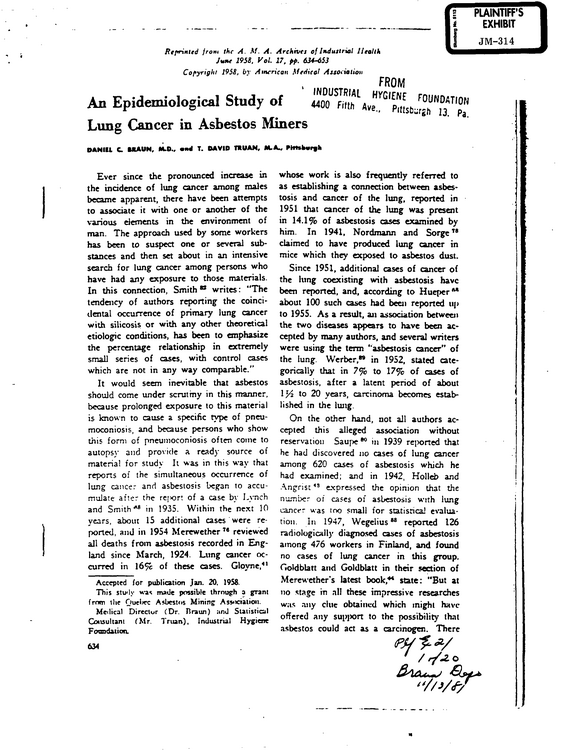
Reprinted from the A.
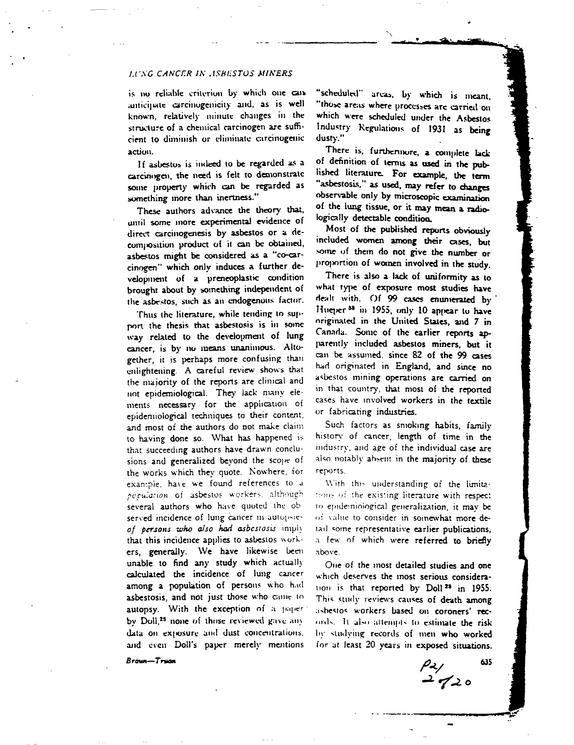
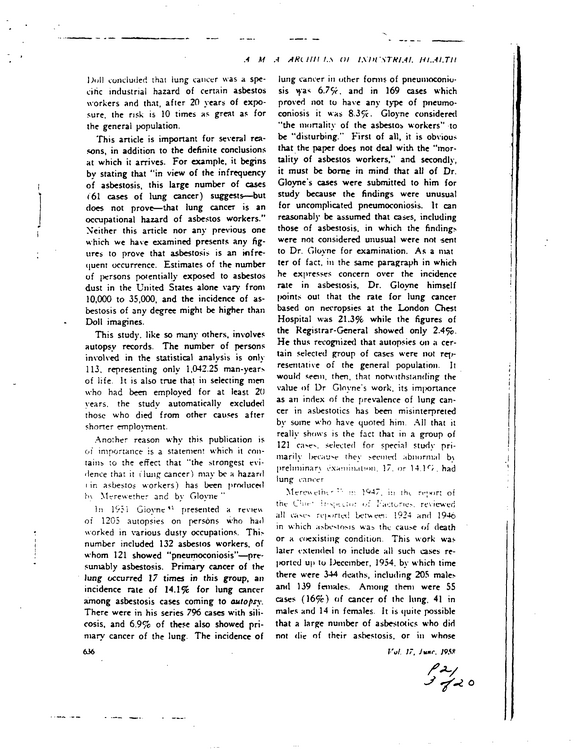
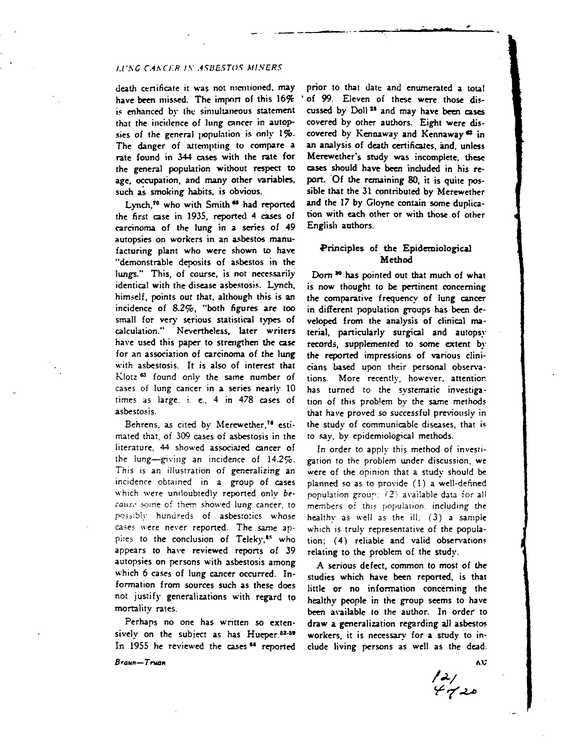
refid# ZB1YgbXM9QOY3yyBYbEbQMQjp20 pages
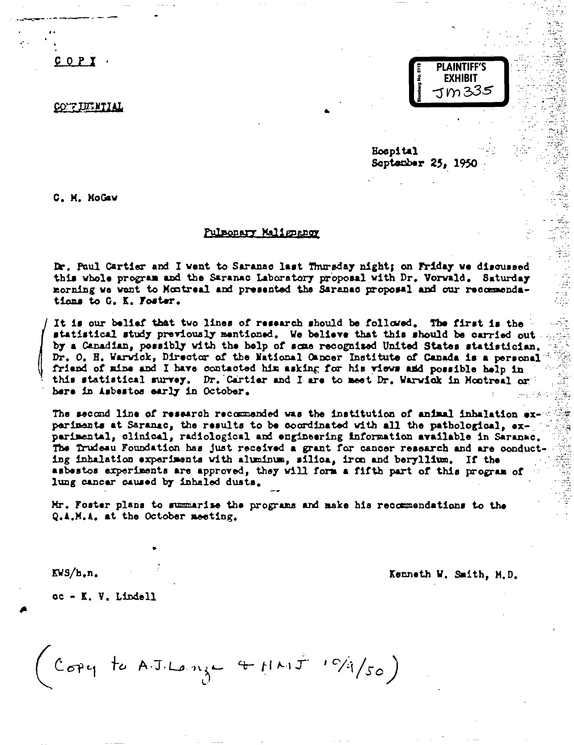
P0M I PLAINTIFF'S !
refid# 7g8vdpxvNDqqY91pgYLEwEno1 page
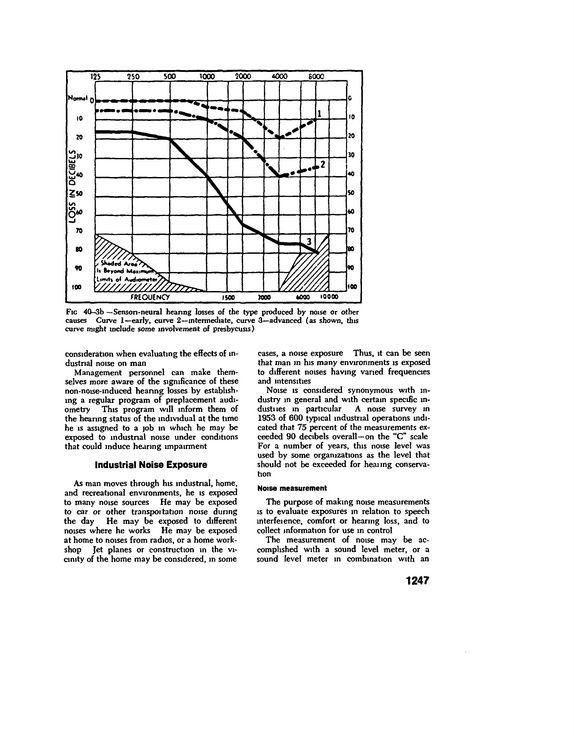
Fic 40-3b --Senson-neural heanng losses of the type produced by noise or other causes Curve 1--early, curve 2--intermediate, curve 3--advanced (as shown, this curve might include some involvement of presbycusis) consideration when evaluating the effects of in dustrial noise on man Management personnel can make them selves more aware of the significance of these non-noise-mduced heanng losses by establish ing a regular program of preplacement audi ometry This program will inform them of the heanng status of the individual at the time he is assigned to a job m which he may be exposed to industrial noise under conditions that could induce hearing impairment Industrial Noise Exposure As man moves through his industnal, home, and recreational environments, he is exposed to many noise sources He may be exposed to car or other transpoi tation noise during the day He may be exposed to different noises where he works He may be exposed at home to noises from radios, or a home work shop Jet planes or construction in the vi cinity of the home may be considered, in some cases, a noise exposure Thus, it can be seen that man m his many environments is exposed to different noises having vaned frequencies and intensities Noise is considered synonymous with in dustry m general and with certain specific mdustues in particular A noise survey in 1953 of 600 typical industrial operations indi cated that 75 percent of the measurements ex ceeded 90 decibels overall--on the "C" scale For a number of years, this noise level was used by some organizations as the level that should not be exceeded for heanng conserva tion Noise measurement The purpose of making noise measurements is to evaluate exposures m relation to speech interfeience, comfort or hearing loss, and to collect information for use m control The measurement of noise may be ac complished with a sound level meter, or a sound level meter in combination with an 1247
refid# LJkqOwO5oZGm3Q7vGgM3ZBJz31 page
HFM -003513 was thought to cause acute respiratorydistress and sudden death.
refid# mRVYVGo1vQ8wdJdweZwExQp01 page