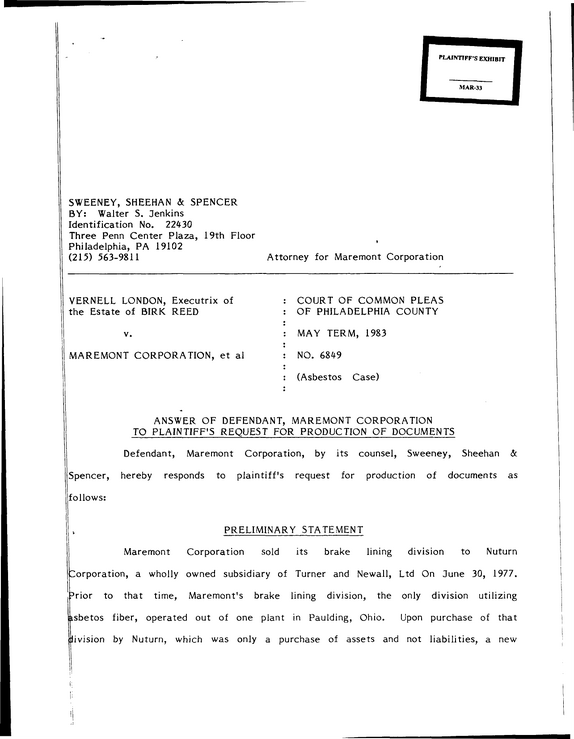
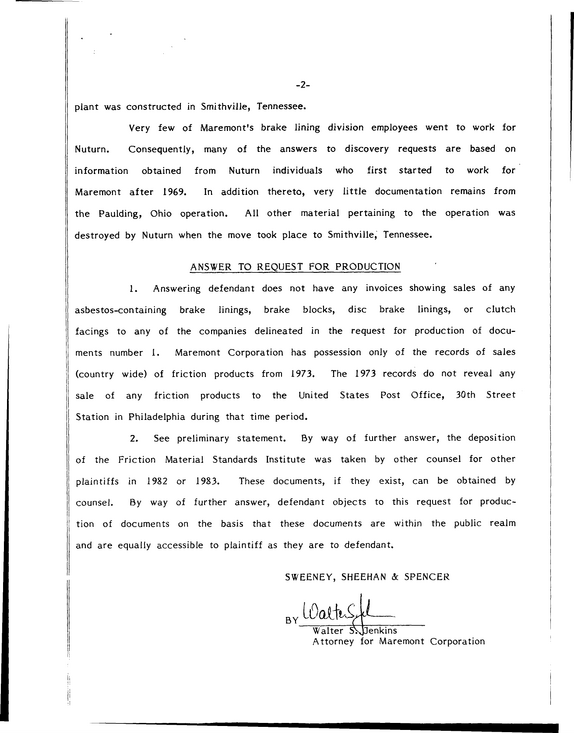
PLAINTIFF'S EXHIBIT MAR-33 SWEENEY, SHEEHAN <Sc SPENCER BY: Walter S.
refid# k9jkJpv388QyKLarG1480DaX02 pages
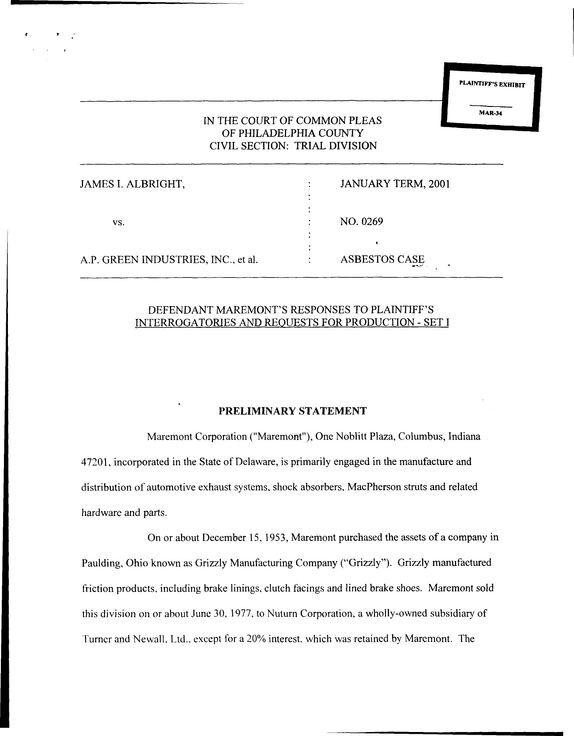
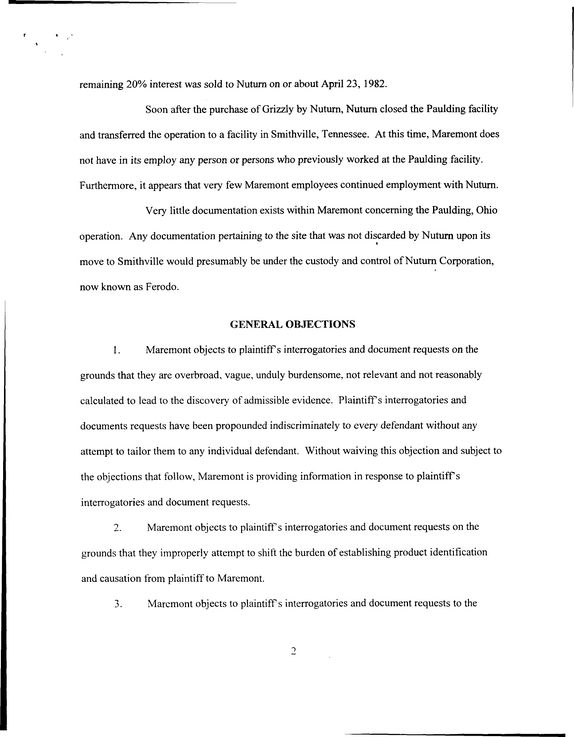
IN THE COURT OF COMMON PLEAS OF PHILADELPHIA COUNTY CIVIL SECTION: TRIAL DIVISION JAMES I.
refid# jagBqYgOVo9RrbRbQKQGdwYN17 pages
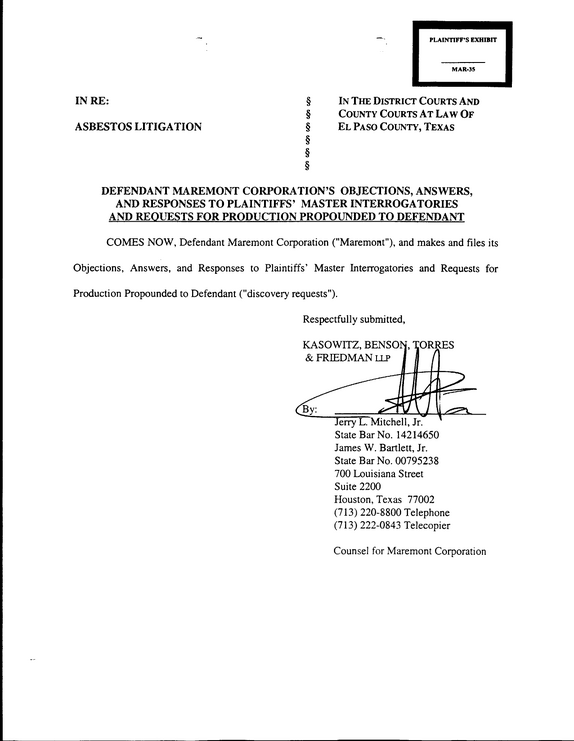
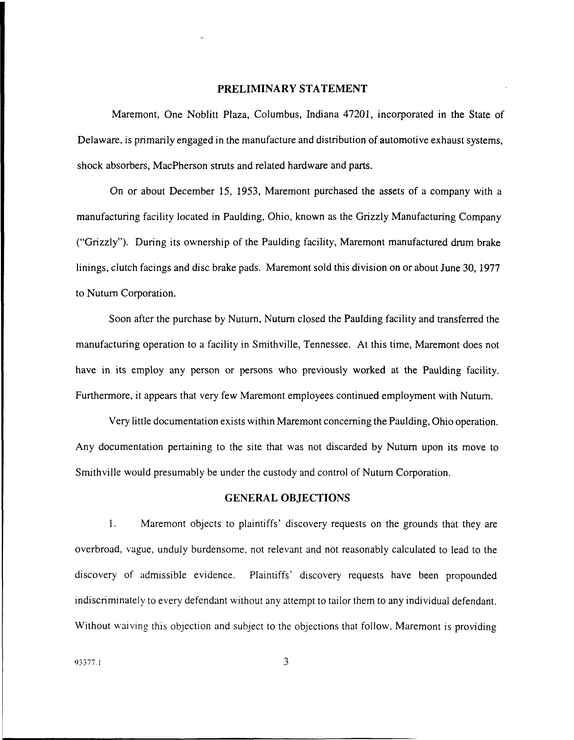
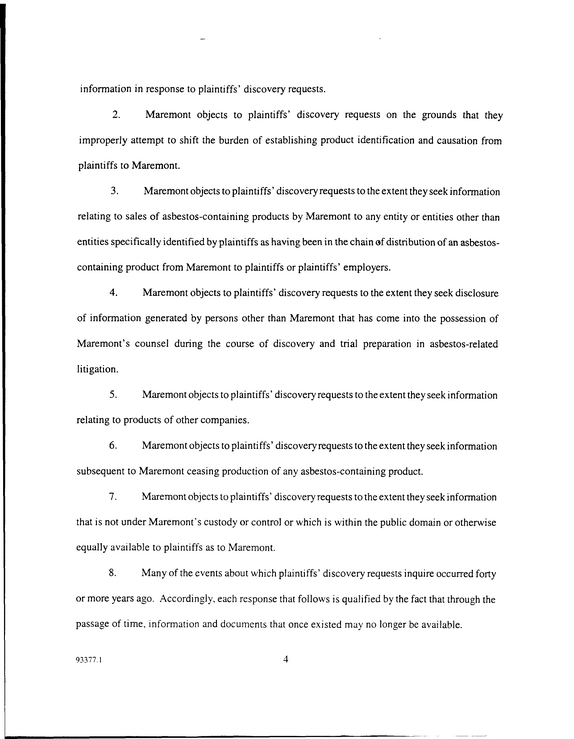
PLAINTIFF'S EXHIBIT IN RE: ASBESTOS LITIGATION In The District Courts And County Courts At Law Of El Paso County, Texas DEFENDANT MAREMONT CORPORATION'S OBJECTIONS, ANSWERS, AND RESPONSES TO PLAINTIFFS' MASTER INTERROGATORIES AND REQUESTS FOR PRODUCTION PROPOUNDED TO DEFENDANT COMES NOW, Defendant Maremont Corporation ("Maremont"), and makes and files its Objections, Answers, and Responses to Plaintiffs' Master Interrogatories and Requests for Production Propounded to Defendant ("discovery requests").
refid# 6opEJb1qp4R8bmQL0ENk68Oo121 pages
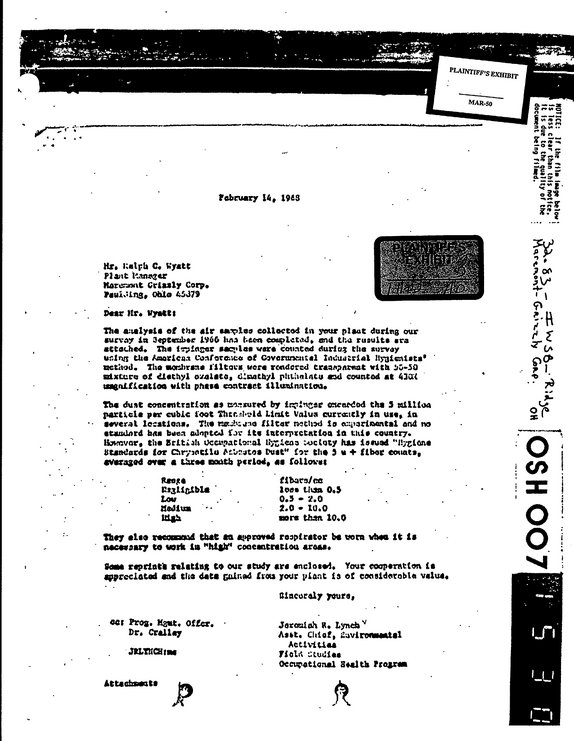
February 14, 1949 Kr KslpU C.
refid# QpZk3QwnYVgLX7Qpvbkg3mo54 pages
.
refid# jBOp5JpeZ7oqX31kYzQvjRqqN9 pages
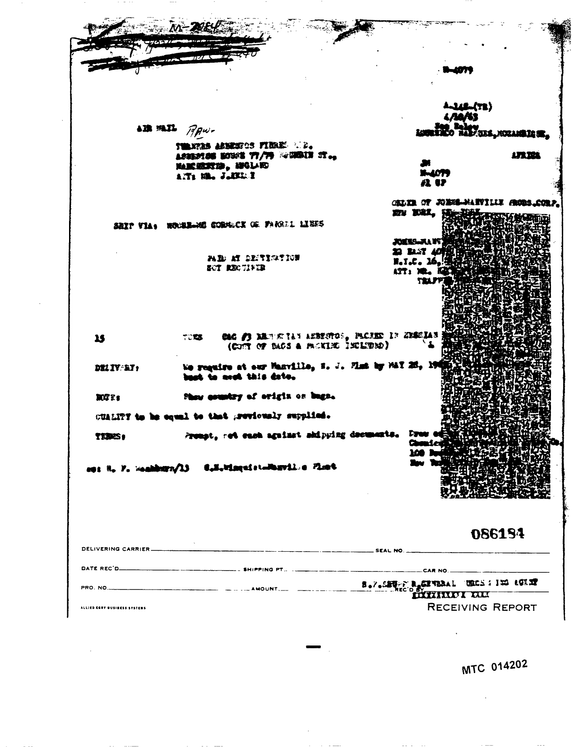
MB AT MSTISATIOi BOX B&Q3X8B* mKMU&mJM CORP. is mat ion at., M.T.9.
refid# anX3n8M824V9n3xVD8y7xpJa3 pages
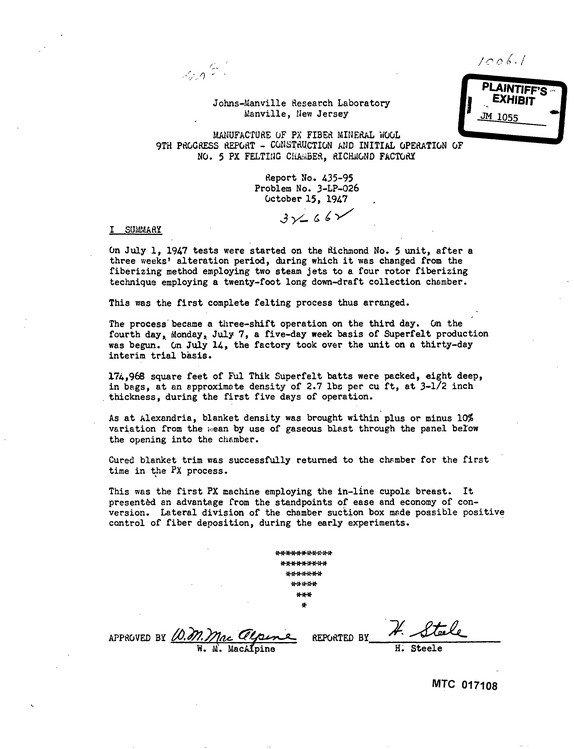
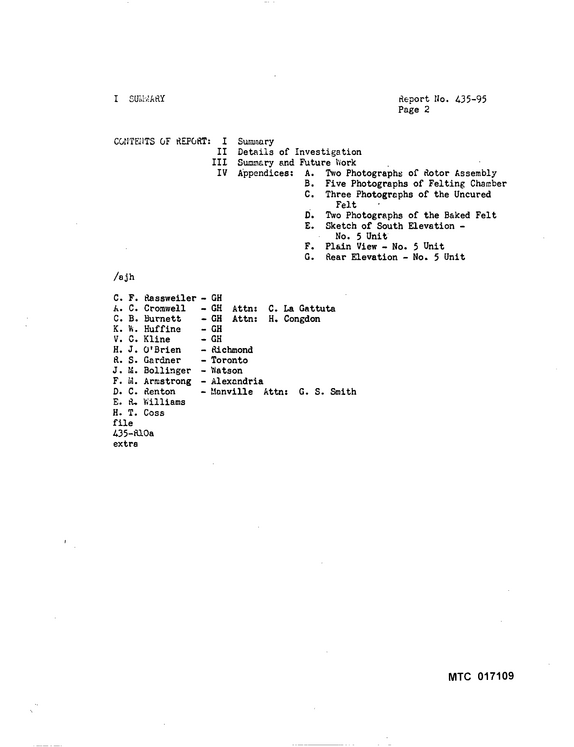
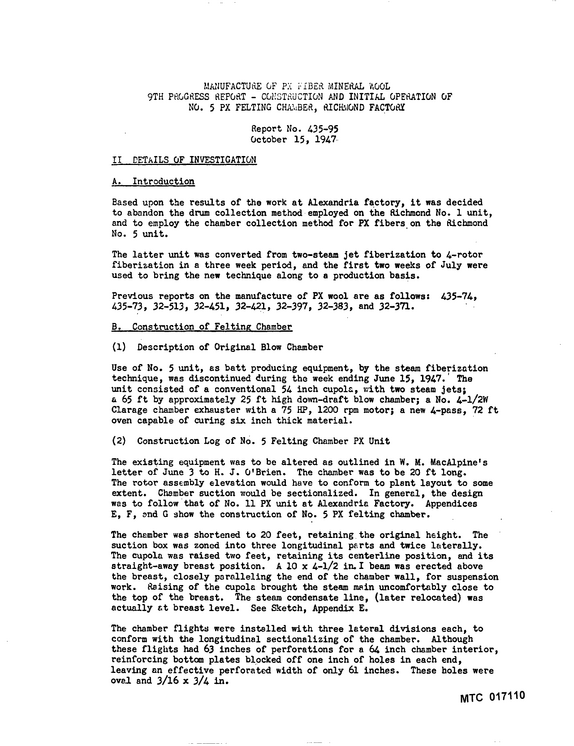
Johns-Manville Research Laboratory Manville, New Jersey MANUFACTURE OF PX FIBER MINERAL WOOL 9TH PROGRESS REPORT - CONSTRUCTION AND INITIAL OPERATION OF NO. 5 PX FELTING CHAMBER, RICHMOND FACTOR!
refid# 3eRwzDJ4zDMOnp4B7p4bL3BEy16 pages
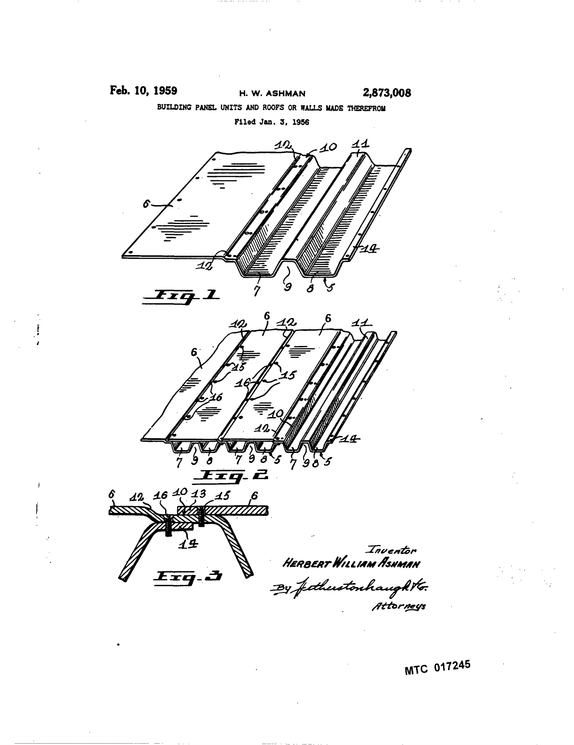
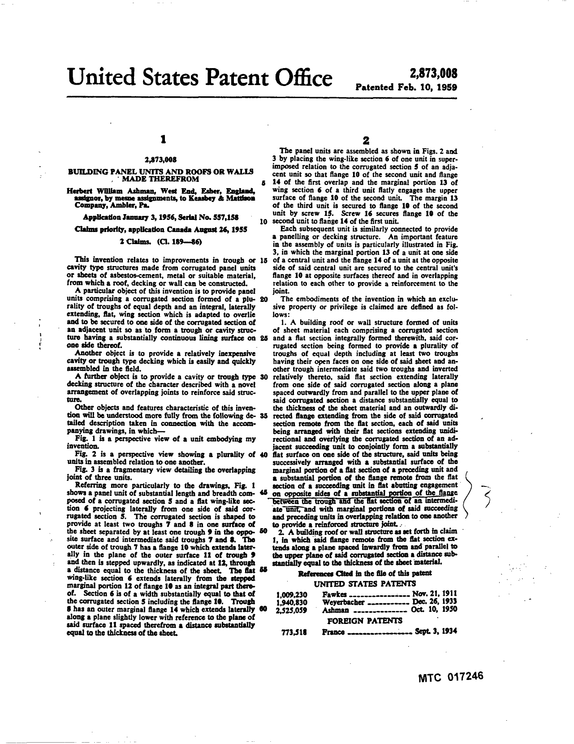
Feb. 10, 1959 h. w. ashman 2,873,008 BUILDINC PANEL UNITS AND ROOFS OR WALLS UADE THEREFROU Filed Jan. 3. 1956 d-Qj.
refid# zDD40Zragn0mnpg9Z6joygD310 pages
V (T Or. rtllliah I.
refid# 1g3YRm72VrZy3gx735r74GrBZ1 page
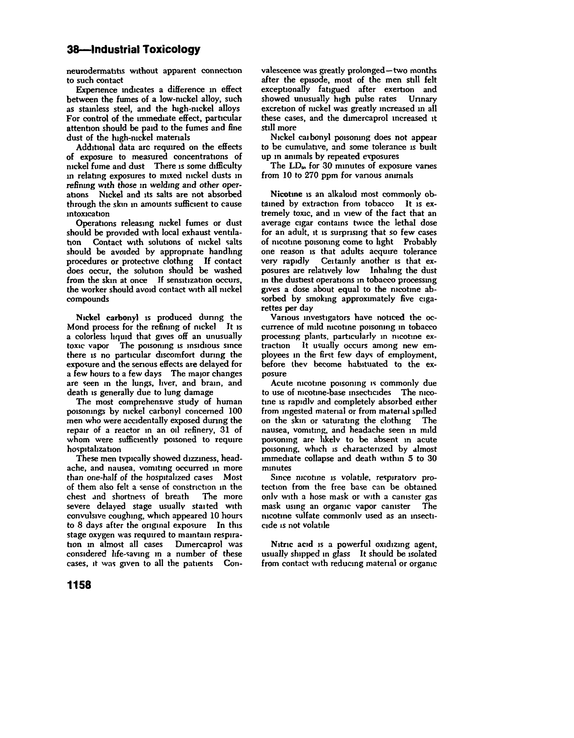
38--Industrial Toxicology neurodermatitis without apparent connection to such contact Experience indicates a difference m effect between the fumes of a low-nickel alloy, such as stainless steel, and the high-nickel alloys For control of the immediate effect, particular attention should be paid to the fumes and fine dust of the high-nickel materials Additional data arc required on the effects of exposure to measured concentrations of nickel fume and dust There is some difficulty in relating exposures to mixed nickel dusts m refining with those in welding and other oper ations Nickel and its salts are not absorbed through the skin m amounts sufficient to cause intoxication Operations releasing nickel fumes or dust should be provided with local exhaust ventila tion Contact with solutions of nickel salts should be avoided by appropriate handling procedures or protective clothing If contact does occur, the solution should be washed from the skin at once If sensitization occurs, the worker should avoid contact with all nickel compounds Nickel carbonyl is produced dunng the Mond process for the refining of nickel It is a colorless liquid that gives off an unusually toxic vapor The poisoning is insidious since there is no particular discomfort dunng the exposure and the senous effects are delayed for a few hours to a few days The major changes are seen in the lungs, liver, and brain, and death is generally due to lung damage The most comprehensive study of human poisonings by nickel carbonyl concerned 100 men who were accidentally exposed during the repair of a reactor in an oil refinery, 31 of whom were sufficiently poisoned to require hospitalization These men typically showed dizziness, head ache, and nausea, vomiting occurred in more than one-half of the hospitalized cases Most of them also felt a sense of constriction in the chest and shortness of breath The more severe delayed stage usually staited with convulsive coughing, which appeared 10 hours to 8 days after the original exposure In this stage oxygen was required to maintain respira tion in almost all cases Dimercaprol was considered life-saving m a number of these cases, it was given to all the patients Con 1158 valescence was greatly prolonged--two months after the episode, most of the men still felt exceptionally fatigued after exertion and showed unusually high pulse rates Urinary excretion of nickel was greatly increased in all these cases, and the dimercaprol increased it still more Nickel caibonyl poisoning does not appear to be cumulative, and some tolerance is built up m animals by repeated exposures The LDs, for 30 minutes of exposure vanes from 10 to 270 ppm for vanous animals Nicotine is an alkaloid most commonly ob tained by extraction from tobacco It is ex tremely toxic, and in view of the fact that an average cigar contains twice the lethal dose for an adult, it is surprising that so few cases of nicotine poisoning come to light Probably one reason is that adults acquire tolerance very rapidly Ceitamly another is that ex posures are relatively low Inhaling the dust m the dustiest operations in tobacco processing gives a dose about equal to the nicotine ab sorbed by smoking approximately five ciga rettes per day Vanous investigators have noticed the oc currence of mild nicotine poisoning in tobacco processing plants, particularly m nicotine ex traction It usually occurs among new em ployees m the first few days of employment, before thev become habituated to the ex posure Acute nicotine poisoning is commonly due to use of nicotine-base insecticides The nico tine is rapidlv and completely absorbed either from ingested material or from material spilled on the skin or saturating the clothing The nausea, vomiting, and headache seen m mild poisoning are likelv to be absent m acute poisoning, which is characterized by almost immediate collapse and death within 5 to 30 minutes Since nicotine is volatile, respiratory pro tection from the free base can be obtained onlv with a hose mask or with a canister gas mask using an organic vapor canister The nicotine sulfate commonlv used as an insecti cide is not volatile Nitric acid is a powerful oxidizing agent, usually shipped in glass It should be isolated from contact with reducing material or organic
refid# 2BV8omaY65mGO0m8vZdqRp5g1 page
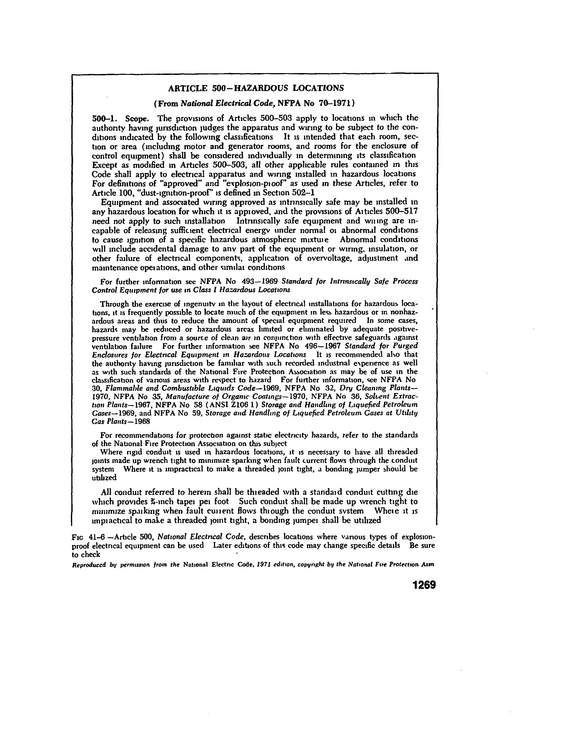
ARTICLE 500--HAZARDOUS LOCATIONS (From National Electrical Code, NFPA No 70-1971) 500-1.
refid# qar6QYqDN4Vjoeboe6xOBmB3M1 page
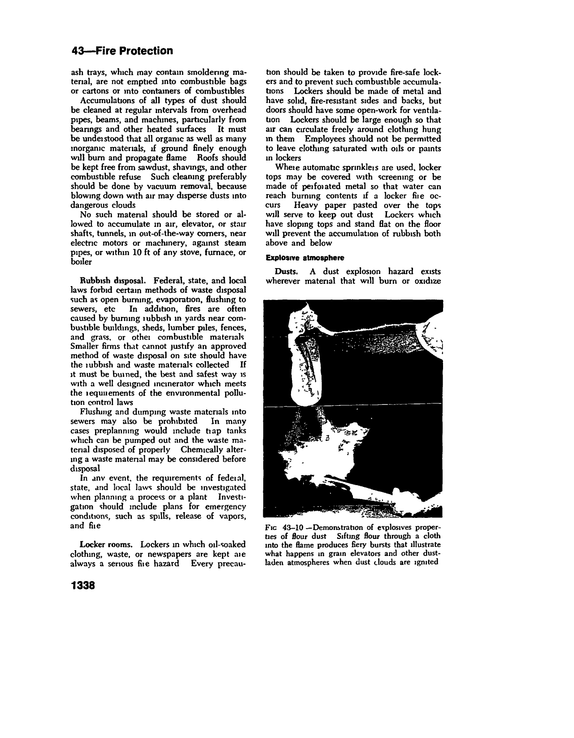
43--Fire Protection ash trays, which may contain smoldering ma terial, are not emptied into combustible bags or cartons or into containers of combustibles Accumulations of all types of dust should be cleaned at regular intervals from overhead pipes, beams, and machines, particularly from bearings and other heated surfaces It must be undei stood that all organic as well as many inorganic materials, if ground finely enough will bum and propagate flame Roofs should be kept free from sawdust, shavings, and other combustible refuse Such cleaning preferably should be done by vacuum removal, because blowing down with air may disperse dusts into dangerous clouds No such material should be stored or al lowed to accumulate m air, elevator, or stair shafts, tunnels, m out-of-the-way comers, near electric motors or machinery, against steam pipes, or within 10 ft of any stove, furnace, or boiler Rubbish disposal.
refid# zoqJGpXyQ9ggMRa0kgVpNyDV61 page
/ #> !
refid# jg9xQwEVwOp7byqBrDyrGZnyO1 page
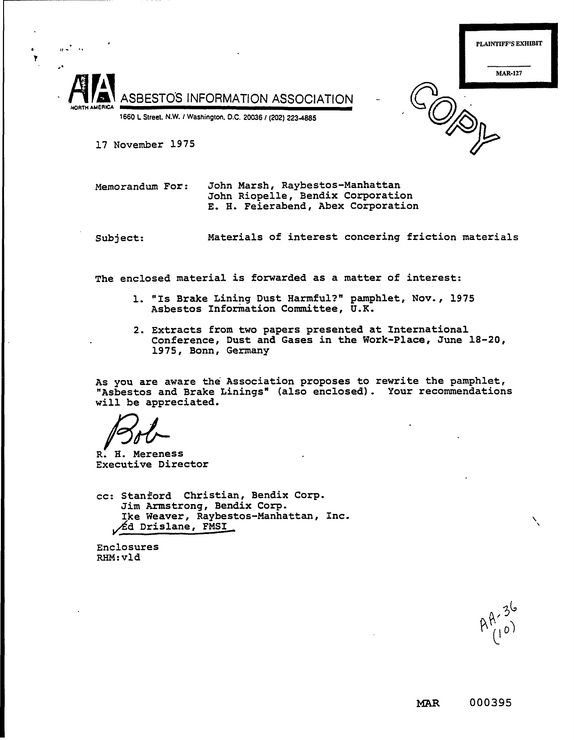
PLAINTIFF'S EXHIBIT sr * W ASBESTOS INFORMATION ASSOCIATION north America 1660 L Street.
refid# e5a3ZoZwwQpxDdmz1j55Y0GxM10 pages
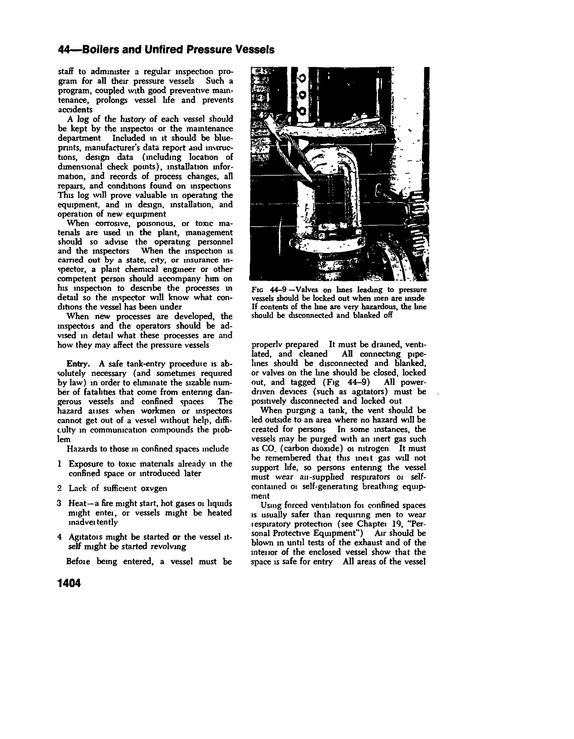
44--Boilers and Unfired Pressure Vessels staff to administer a regular inspection pro gram for all their pressure vessels Such a program, coupled with good preventive main tenance, prolongs vessel life and prevents accidents A log of the history of each vessel should be kept by the inspectoi or the maintenance department Included in it should be blue prints, manufacturer's data report and instruc tions, design data (including location of dimensional check points), installation infor mation, and records of process changes, all repairs, and conditions found on inspections This log will prove valuable in operating the equipment, and in design, installation, and operation of new equipment When corrosive, poisonous, or toxic ma terials are used m the plant, management should so advise the operating personnel and the inspectors When the inspection is earned out by a state, city, or insurance in spector, a plant chemical engineer or other competent person should accompany him on his inspection to describe the processes in detail so the inspector will know what con ditions the vessel has been under When new processes are developed, the inspectoi s and the operators should be ad vised m detail what these processes are and how they may affect the pressure vessels Entry.
refid# 936B7kNrON6b3XoaL9qNBD9bD1 page