Page 159 1 THE COURT: Please be seated.
refid# OEdYY22ae1MNRB2MK0ayx83Qv1 page
1 here.
refid# 4JEgx6aGkvL6dKqg0B23bVpE11 page
1 All these studies, ladies and gentlemen. 2 Mr.
refid# x5MwyYDBEmb1qLradOoXGK4EG1 page
Page 283 1 But something happened in October of 1966. 2 Some guy from New England called, one of the union 3 guys and said, hey, my brother-in-law has been cutting 4 your Kaylo for 10 years, worked in a fabrication 5 shop. 6 What he did, he just installed -- because 7 what happens is a lot of times when you run a pipe, 8 you put it up, wrap it around and when you got to an 9 angle you cut it. 10 -This guy's job was to go back in the 11 fabrication shop and just cut it after 10 years and he 12 said, you know what, I think I got asbestosis from 13 your Kaylo and we say okay.
refid# LJB8ZMY2x5Mx9LbEnLMGE8p431 page
1 copies of the same two articles.
refid# q9Nkv5e71V87nv56pwZ8z3Qx1 page
1 was received into evidence.)
refid# MkOzV8vQRp6GVaE3g9p8YGXj1 page
1 the same percentage of asbestos, 13 to 25 percent Page 518 2 amosite and chrysotile. 3 Again, Doctor, assuming those facts to be 4 true, do you have an opinion, to a reasonable degree 5 of medical certainty, as to which, if any, exposures 6 to that pipecovering and block, Kaylo, would have been 7 substantial contributing factors to the development of 8 his malignant peritoneal mesothelioma?
refid# DG8va2rN49Vaj4QdEndjg8mEd1 page
1 ability to degrade asbestos fibers.
refid# dYjY7D0yzBDMeEjENye32Xp561 page
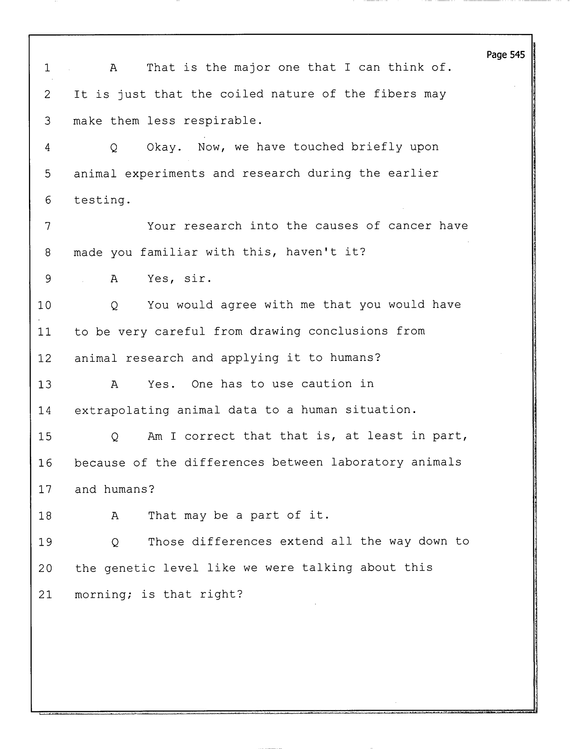
Page 545 1 A That is the major one that I can think of. 2 It is just that the coiled nature of the fibers may 3 make them less respirable. 4 Q Okay.
refid# zEwGVm56QRo22xEzXdzw5Dqg1 page
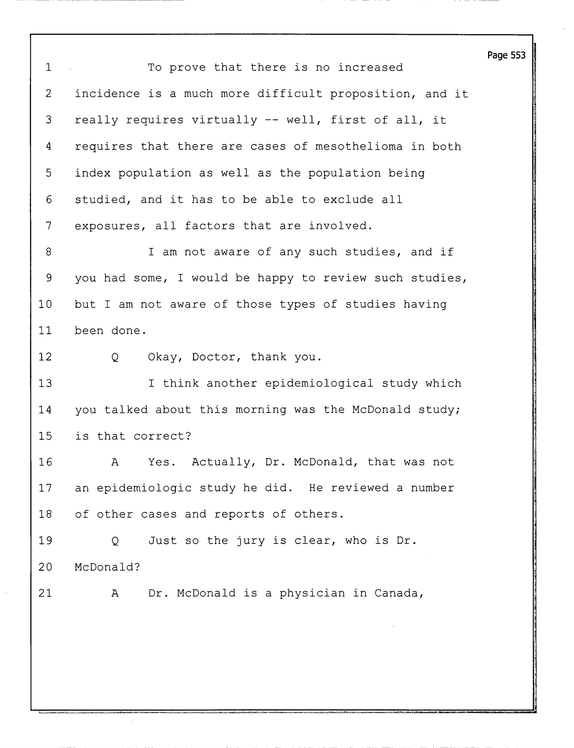
Page 553 1 To prove that there is no increased 2 incidence is a much more difficult proposition, and it 3 really requires virtually -- well, first of all, it 4 requires that there are cases of mesothelioma in both 5 index population as well as the population being 6 studied, and it has to be able to exclude all 7 exposures, all factors that are involved. 8 I am not aware of any such studies, and if 9 you had some, I would be happy to review such studies, 10 but I am not aware of those types of studies having 11 been done. 12 Q Okay, Doctor, thank you. 13 I think another epidemiological study which 14 you talked about this morning was the McDonald study; 15 is that correct?
refid# wDd17JmRD4jXZzEGL5wMZ8v3B1 page
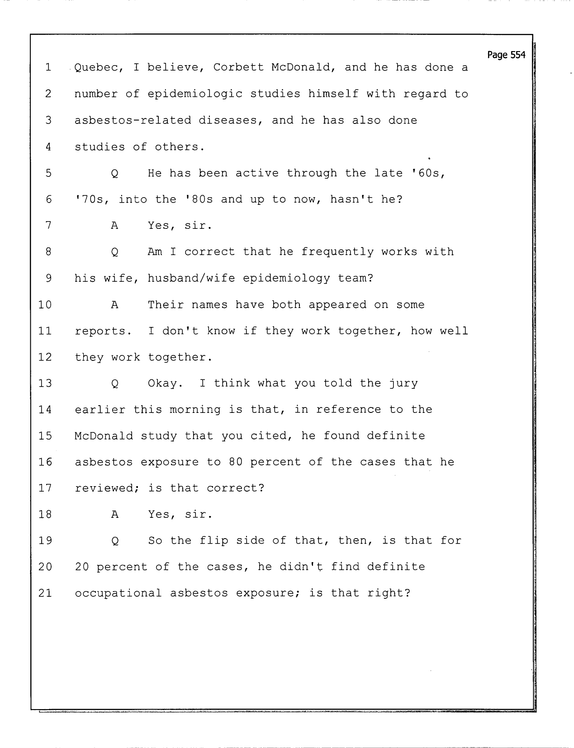
Page 554 1 Quebec, I believe, Corbett McDonald, and he has done a 2 number of epidemiologic studies himself with regard to 3 asbestos-related diseases, and he has also done 4 studies of others. 5 Q He has been active through the late '60s, 6 '70s, into the '80s and up to now, hasn't he?
refid# reZjqQap6EyN7jaMa7R1jeD0e1 page
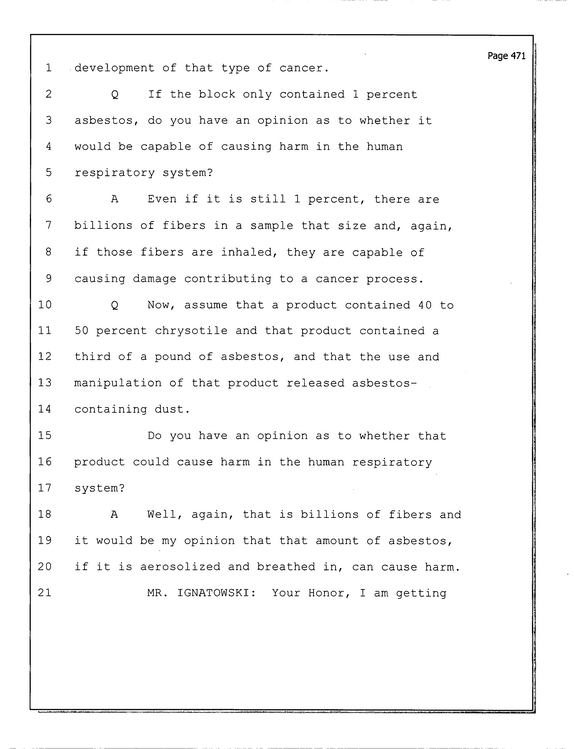
development of that type of cancer.
refid# KJXZoM4wVmYvDrRoVKGzpEBbQ1 page
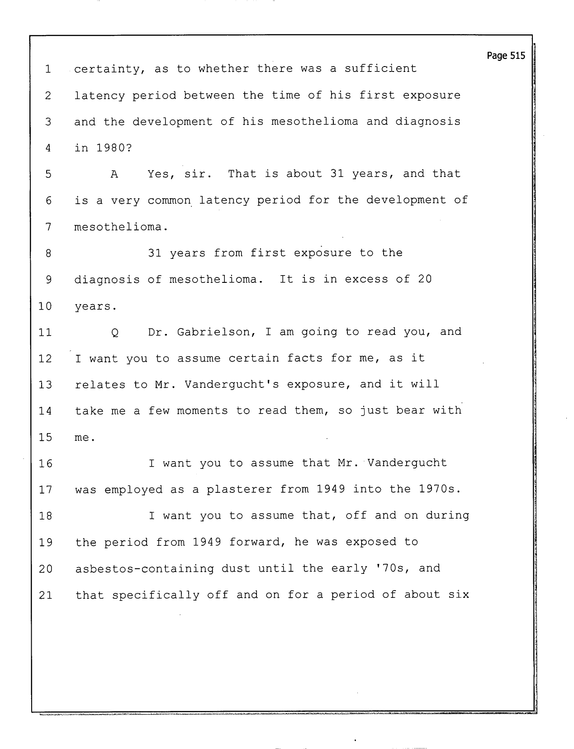
1 certainty, as to whether there was a sufficient Page 515 2 latency period between the time of his first exposure 3 and the development of his mesothelioma and diagnosis 4 in 1980?
refid# 0bm0w9pQwvOMrD1doLXZ528n1 page
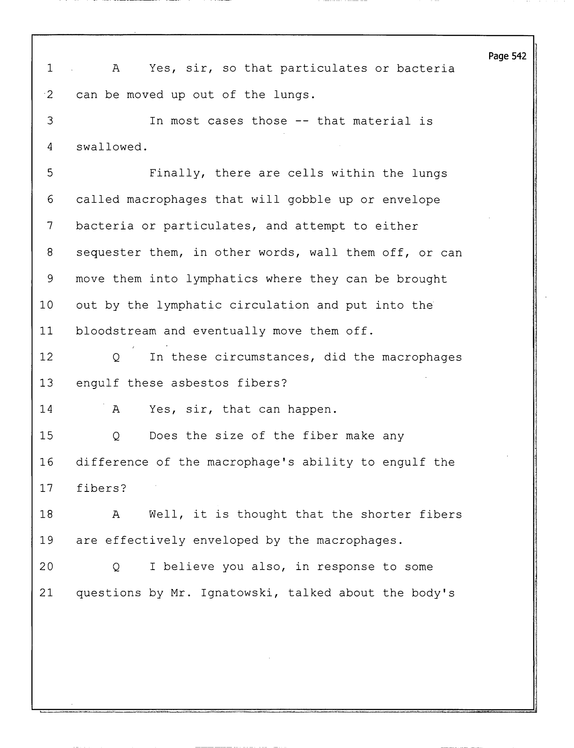
1 A Yes, sir, so that particulates or bacteria 2 can be moved up out of the lungs. 3 In most cases those -- that material is 4 swallowed. 5 Finally, there are cells within the lungs 6 called macrophages that will gobble up or envelope 7 bacteria or particulates, and attempt to either 8 sequester them, in other words, wall them off, or can 9 move them into lymphatics where they can be brought 10 out by the lymphatic circulation and put into the 11 bloodstream and eventually move them off. 12 Q In these circumstances, did the macrophages 13 engulf these asbestos fibers?
refid# YGwZEDEDQ9reEqYbr9E1z7E301 page
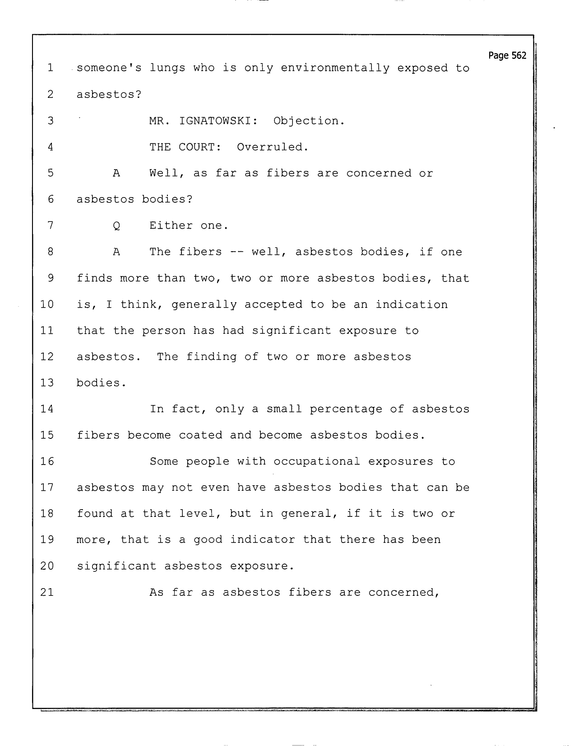
someone's lungs who is only environmentally exposed to asbestos?
refid# 2Jr10rDG004d1aO4RGzn6XeBR1 page