Hot Working of Metals cuit so that the motor cannot be started when the props are in use All die clamps, bolts, washers, blocking, wrenches, and handling equipment should be m good condition at all times The table wedges which are used for mak ing vertical adjustment of the dies must be kept free of scale so that the wedge can be raised and lowered with minimum pressure Trucks or driving rams should not be used for this operation If wedges are kept free of scale, they can be raised or lowered by hand or by air motor wrench Maintenance Maintenance of forging presses requires the same precautions used in maintenance work on power presses used in cold stamping The operating power source should be locked out so that the equipment cannot be energized while it is being worked on If adjustments have to be made while the press is energized, the work must be earned out under the direct supervision of the maintenance supervisor Suitable permanent work platforms should be installed for making brake adjustments and doing repair work at the surge tank and booster cylinders To prevent falls, mainte nance men should not use portable straight ladders nor stand on parts of the press, such as the press crown or the backshaft Major repair work on forging presses usually requires removal of bulky, heavy parts Tear ing down of the rolling type clutch, flywheel, ram, pitman, and crankshaft requires special heavy-duty rigging used by skilled workmen trained in this type of work The brake should be adjusted properly and kept in good repair Precautions must be taken to prevent the brake lining from be coming flooded with oil A sheet steel disk about 2 in larger than the brake wheel, placed on the eccentric shaft back of the brake wheel, will help reduce the amount of lubricant on the brake Pitman bolts should be securely tightened It may be necessary to design and make a socket or box end wrench with a strong heavy handle for the specific press Flywheel hubs, clutch spline hubs, pinion gears, and brake wheels should not be per mitted to become loose on the pinion shaft If they do become loose and run that way very long, keys and keyways will be ruined and the keys will break out a portion of the pinion shaft on one side of the keyway The keys on each side of the pinion shaft should be inspected periodically and driven tight if they are loose When a key will no longer stay tight, it should be replaced with a carefully fitted new key When the hub or gear on the shaft becomes too loose, it wiil be impossible to hold the keys tight and the shaft will have to be turned down The inside of a steel hub should be welded and bored to a shrink fit on the new shaft size The keyways should be remachmed and new keys made If the hub is cast iron, a tapered sleeve can be made or a new hub fitted to the shaft Expenenced repairmen warn against weld ing the flywheel end of the pinion shaft If normalizing of the welded section is not com plete, a crack may start and allow the shaft to break and drop the rotating flywheel Crank shafts and backshafts on forging presses like wise should not be welded The friction slip on a press should be tight ened so that it will not creep even on heavy jobs If the friction slip is allowed to move a small amount with every forging, this move ment will polish or glaze the friction surfaces and soon the friction slip will move more with each forging This movement will cause the friction surface to score the hub and clamp surfaces Rotation of the flywheel on the friction hub will frequently wear or cut the inside diam eter of the flywheel so that it runs off center To correct this condition, the inside diameter of the flywheel can be bored and fitted with a bronze bushing Sometimes the eccentric shaft becomes cracked in the fillet on each side of the ec centric This defect is usually noticed when the shaft is taken out so that the mam bearings can be checked or the shaft can be machined This crack should be examined carefully to determine its length, depth, and direction of travel If the crack is in a critical area where failure would permit the rolling dutch to drop oft, then the shaft must be replaced Other Forging Equipment Hot trimming dies can be made from hard ened chrome, nickel, carbon and vanadium steels or from medium carbon steels with 848
refid# zzRdOXb9qO2G0gNK8aNRBrNK71 page
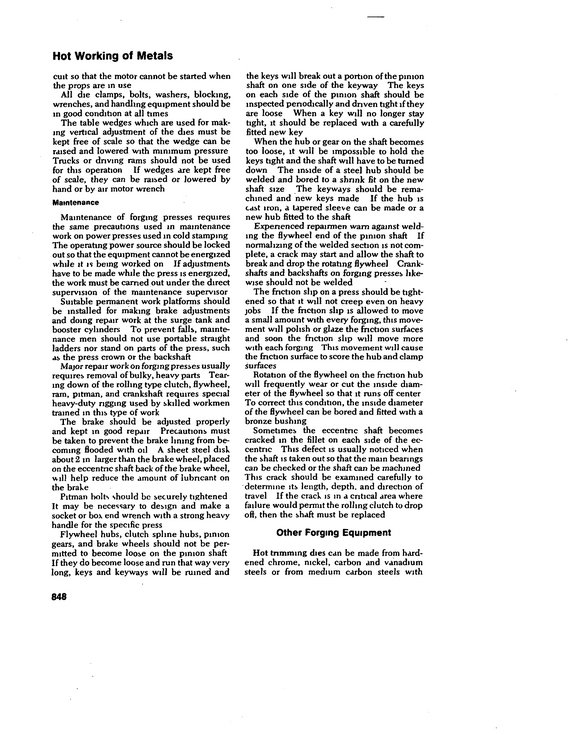
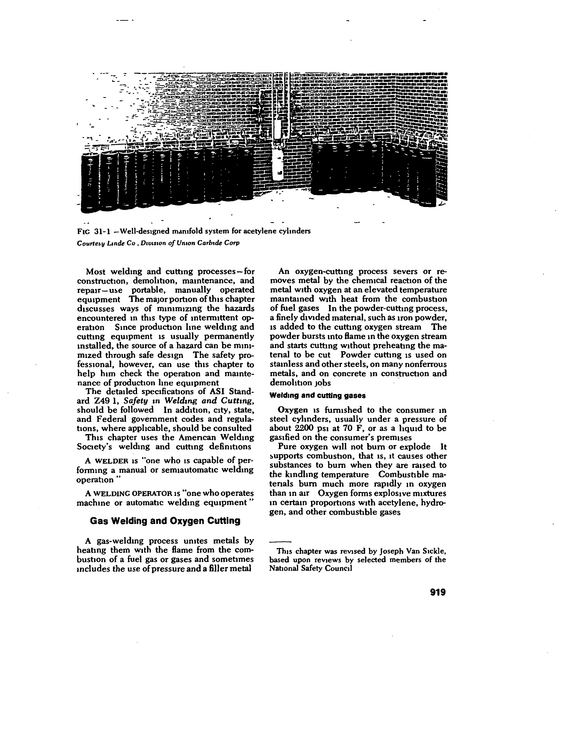
Fig 31-1 --Well-designed manifold system for acetylene cylinders Courtesy Linde Co , Division of Union Carbide Corp Most welding and cutting processes --for construction, demolition, maintenance, and repair--use portable, manually operated equipment The major portion of this chapter discusses ways of minimizing the hazards encountered in this type of intermittent op eration Since production line welding and cutting equipment is usually permanently installed, the source of a hazard can be mini mized through safe design The safety pro fessional, however, can use this chapter to help him check the operation and mainte nance of production line equipment The detailed specifications of ASI Stand ard Z49 1, Safety in Welding and Cutting, should be followed In addition, city, state, and Federal government codes and regula tions, where applicable, should be consulted This chapter uses the American Welding Society's welding and cutting definitions A welder is "one who is capable of per forming a manual or semiautomatic welding operation " A welding operator is "one who operates machine or automatic welding equipment " Gas Welding and Oxygen Cutting An oxygen-cutting process severs or re moves metal by the chemical reaction of the metal with oxygen at an elevated temperature maintained with heat from the combustion of fuel gases In the powder-cutting process, a finely divided material, such as iron powder, is added to the cutting oxygen stream The powder bursts into flame in the oxygen stream and starts cutting without preheating the ma terial to be cut Powder cutting is used on stainless and other steels, on many nonferrous metals, and on concrete in construction and demolition jobs Welding and cutting gases Oxygen is furnished to the consumer in steel cylinders, usually under a pressure of about 2200 psi at 70 F, or as a liquid to be gasified on the consumer's premises Pure oxygen will not bum or explode It supports combustion, that is, it causes other substances to bum when they are raised to the kindling temperature Combustible ma terials bum much more rapidly in oxygen than in air Oxygen forms explosive mixtures in certain proportions with acetylene, hydro gen, and other combustible gases A gas-welding process unites metals by heating them with the flame from the com bustion of a fuel gas or gases and sometimes includes the use of pressure and a filler metal This chapter was revised by Joseph Van Sickle, based upon reviews by selected members of the National Safety Council 919
refid# oRYK0kejejgo6wLVz7vyDpNo1 page
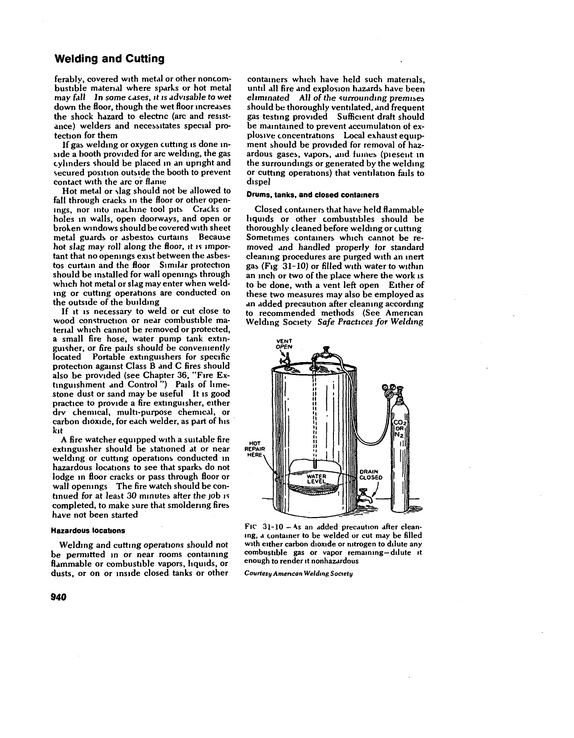
Welding and Cutting ferably, covered with metal or other noncom bustible material where sparks or hot metal may fall In some cases, it is advisable to wet down the floor, though the wet floor increases the shock hazard to electric (arc and resist ance) welders and necessitates special pro tection for them If gas welding or oxygen cutting is done in side a booth provided for arc welding, the gas cylinders should be placed m an upright and secured position outside the booth to prevent contact with the arc or flame Hot metal or slag should not be allowed to fall through cracks in the floor or other open ings, nor into machine tool pits Cracks or holes in walls, open doorways, and open or broken windows should be covered with sheet metal guards or asbestos curtains Because hot slag may roll along the floor, it is impor tant that no openings exist between the asbes tos curtain and the floor Similar protection should be installed for wall openings through which hot metal or slag may enter when weld ing or cutting operations are conducted on the outside of the building If it is necessary to weld or cut close to wood construction or near combustible ma terial which cannot be removed or protected, a small fire hose, water pump tank extin guisher, or fire pails should be conveniently located Portable extinguishers for specific protection against Class B and C fires should also be provided (see Chapter 36, "Fire Ex tinguishment and Control ") Pails of lime stone dust or sand may be useful It is good practice to provide a fire extinguisher, either drv chemical, multi-purpose chemical, or carbon dioxide, for each welder, as part of his kit A fire watcher equipped with a suitable fire extinguisher should be stationed at or near welding or cutting operations conducted in hazardous locations to see that sparks do not lodge m floor cracks or pass through floor or wall openings The fire watch should be con tinued for at least 30 minutes after the job is completed, to make sure that smoldering fires have not been started Hazardous locations Welding and cutting operations should not be permitted m or near rooms containing flammable or combustible vapors, liquids, or dusts, or on or inside closed tanks or other containers which have held such materials, until all fire and explosion hazards have been eliminated All of the surrounding premises should be thoroughly ventilated, and frequent gas testing provided Sufficient draft should be maintained to prevent accumulation of ex plosive concentrations Local exhaust equip ment should be provided for removal of haz ardous gases, vapors, and fumes (piesent in the surroundings or generated by the welding or cutting operations) that ventilation fails to dispel Drums, tanks, and closed containers Closed containers that have held flammable liquids or other combustibles should be thoroughly cleaned before welding or cutting Sometimes containers which cannot be re moved and handled properly for standard cleaning procedures are purged with an inert gas (Fig 31-10) or filled with water to within an inch or two of the place where the work is to be done, with a vent left open Either of these two measures may also be employed as an added precaution after cleaning according to recommended methods (See American Welding Society Safe Practices for Welding VENT FlC 31-10 -- an added precaution after clean ing, a container to be welded or cut may be filled with either carbon dioxide or nitrogen to dilute any combustible gas or vapor remaining--dilute it enough to render it nonhazardous Courtesy American Welding Society 940
refid# 7Op0nvaLwyGa1XXd77pRqbode1 page
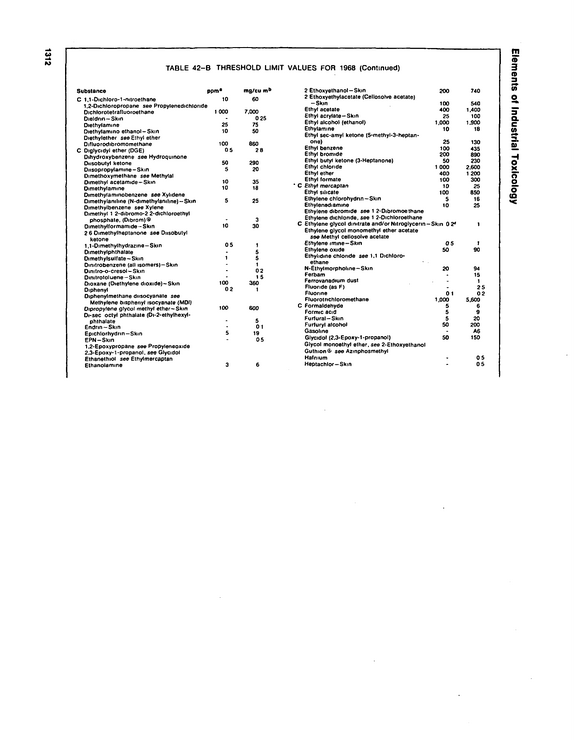
Elements of Industrial Toxicology 1312 TABLE 42-B THRESHOLD LIMIT VALUES FOR 1968 (Continued) Substance ppm" C 1.1-Dichloro-1-mtroethane 1,2-Dichloropropane see Propylenedichloride Dichlorotetrafiuoroethane Dieldrm--Skin Diethylamme Diethylamino ethanol-Skm Diethylether see Ethyl ether Difluorodibromomethane C Oiglycidyl ether (DGE) Dihydroxybenzene see Hydroqumone Dusobutyl ketone Onsopropylamine - Skin Dimethoxymethane see Methytal Dimethyl acetamide-Skin Dimethylamme Dimethytaminobenzene see Xylidene Dimethylaniline (N-dimethylamline)-Skin Dimethylbenzene see Xylene Dimethyl 1 2-dibromo-2 2-dichloroethyl phosphate.
refid# YxRVVQg2qMyNegxDQXoJmYmn1 page
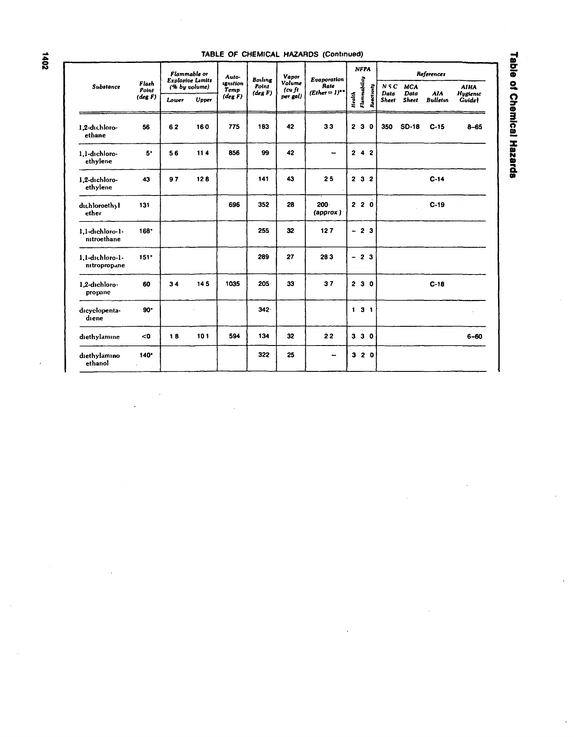
Table of Chemical Hazards 1402 Substance TABLE OF CHEMICAL HAZARDS (Continued) Flammable or Explosive Limits (% by volume) (deg F) Lower Upper Auio* tgmtion Temp (deg F) Boiling Point (deg F) Vapor Votume (cuft per gal) Evaporation Rate (Ether** 1)** NFPA & j i!
refid# R09NKGdyewxRex2dG2p9R0B71 page
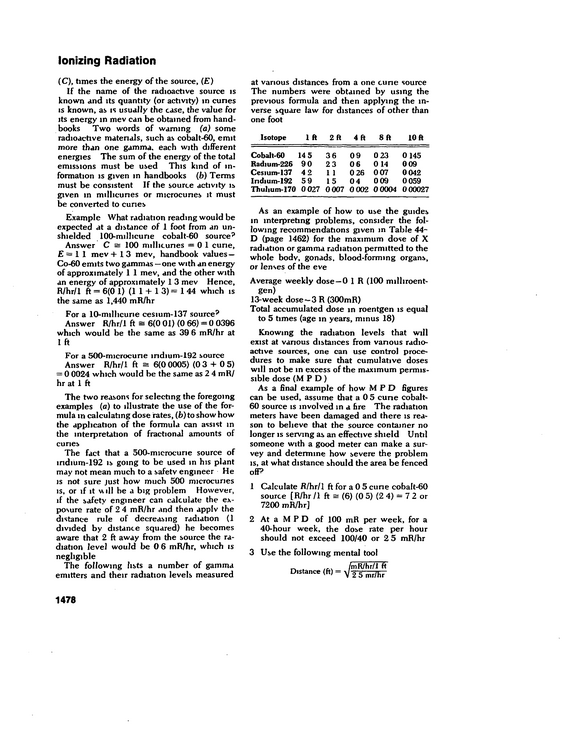
Ionizing Radiation (C), times the energy of the source, () If the name of the radioactive source is known and its quantity (or activity) in cunes is known, as is usually the case, the value for its energy m mev can be obtained from hand books Two words of warning (a) some radioactive materials, such as cobalt-60, emit more than one gamma, each with different energies The sum of the energy of the total emissions must be used This kind of in formation is given in handbooks (b) Terms must be consistent If the source activity is given in millieunes or microcunes it must be converted to curies Example What radiation reading would be expected at a distance of 1 foot from an un shielded 100-milhcune cobalt-60 source'* Answer C s= 100 millieunes =01 cune, E = I 1 mev +13 mev, handbook values -- Co-60 emits two gammas--one with an energy of approximately 1 1 mev, and the other with an energy of approximately 1 3 mev Hence, R/hr/1 ft = 6(0 1) (1 1 + 1 3) = 1 44 which is the same as 1,440 mR/hr For a 10-millicurie cesium-137 source?
refid# 8VR2eL0D5V71EJaO0ox88kZ8m1 page
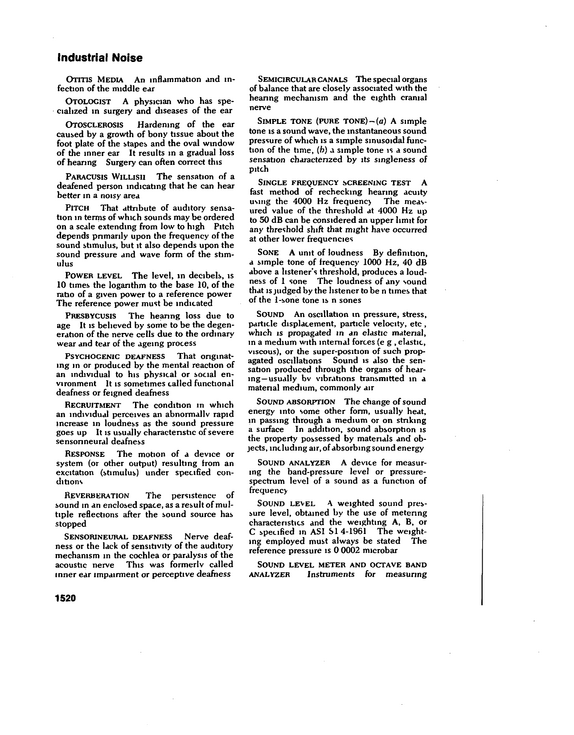
Industrial Noise Oims Media An inflammation and in fection of the middle ear Otologist A physician who has spe cialized in surgery and diseases of the ear Otosclerosis Hardening of the ear caused by a growth of bony tissue about the foot plate of the stapes and the oval window of the inner ear It results m a gradual loss of hearing Surgery can often correct this Paracusis Willisii The sensation of a deafened person indicating that he can hear better in a noisy area Pitch That attribute of auditory sensa tion in terms of which sounds may be ordered on a scale extending from low to high Pitch depends primarily upon the frequency of the sound stimulus, but it also depends upon the sound pressure and wave form of the stim ulus Power level The level, m decibels, is 10 times the logarithm to the base 10, of the ratio of a given power to a reference power The reference power must be indicated Presbycusis The hearing loss due to age It is believed by some to be the degen eration of the nerve cells due to the ordinary wear and tear of the ageing process Psychogenic deafness That originat ing in or produced by the mental reaction of an individual to his physical or social en vironment It is sometimes called functional deafness or feigned deafness Recruitment The condition m which an individual perceives an abnormallv rapid increase m loudness as the sound pressure goes up It is usually characteristic of severe sensorineural deafness Response The motion of a device or system (or other output) resulting from an excitation (stimulus) under specified con ditions Reverberation The persistence of sound in an enclosed space, as a result of mul tiple reflections after the sound source has stopped Sensorineural deafness Nerve deaf ness or the lack of sensitivity of the auditory mechanism in the cochlea or paralysis of the acoustic nerve This was formerly called inner ear impairment or perceptive deafness Semicircular canals The special organs of balance that are closely associated with the hearing mechanism and the eighth cranial nerve Simple tone (pure tone)-(a) A simple tone is a sound wave, the instantaneous sound pressure of which is a simple sinusoidal func tion of the time, (b) a simple tone is a sound sensation characterized by its singleness of pitch Single frequency screening test A fast method of rechecking hearing acuity using the 4000 Hz frequency The meas ured value of the threshold at 4000 Hz up to 50 dB can be considered an upper limit for any threshold shift that might have occurred at other lower frequencies Sone A unit of loudness By definition, a simple tone of frequency 1000 Hz, 40 dB above a listener's threshold, produces a loud ness of 1 sone The loudness of any sound that is judged by the listener to be n times that of the 1-sone tone is n sones Sound An oscillation m pressure, stress, particle displacement, particle velocity, etc , which is propagated in an elastic material, in a medium with internal forces (e g , elastic, viscous), or the super-position of such prop agated oscillations Sound is also the sen sation produced through the organs of hear ing--usually bv vibrations transmitted in a material medium, commonly air Sound absorption The change of sound energy into some other form, usually heat, in passing through a medium or on striking a surface In addition, sound absorption is the property possessed by materials and ob jects, including air, of absorbing sound energy Sound analyzer A device for measur ing the band-pressure level or pressurespectrum level of a sound as a function of frequency SOUND level \ weighted sound pres sure level, obtained by the use of metering characteristics and the weighting A, B, or C specified in ASI SI 4-1961 The weight ing employed must always be stated The reference pressure is 0 0002 microbar Sound level meter and octave band ANALYZER Instruments for measuring 1520
refid# JvRRnOG1Oagz5Qv3OB9BDw9zZ1 page
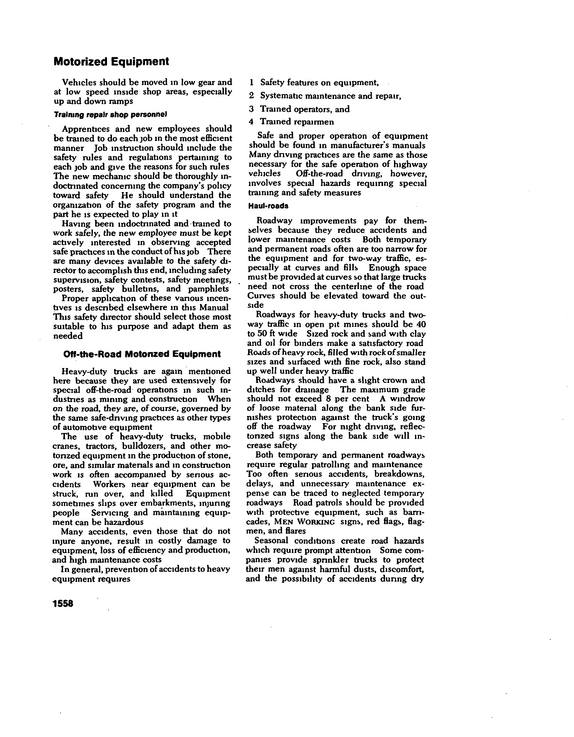
Motorized Equipment Vehicles should be moved in low gear and at low speed inside shop areas, especially up and down ramps Training repair shop personnel Apprentices and new employees should be trained to do each job in the most efficient manner Job instruction should include the safety rules and regulations pertaining to each job and give the reasons for such rules The new mechanic should be thoroughly in doctrinated concerning the company's policy toward safety He should understand the organization of the safety program and the part he is expected to play m it Having been indoctrinated and trained to work safely, the new employee must be kept actively interested m observing accepted safe practices m the conduct of his job There are many devices available to the safety di rector to accomplish this end, including safety supervision, safety contests, safety meetings, posters, safety bulletins, and pamphlets Proper application of these various incen tives is descnbed elsewhere m this Manual This safety director should select those most suitable to his purpose and adapt them as needed Off-the-Road Motorized Equipment Heavy-duty trucks are again mentioned here because they are used extensively for special off-the-road operations m such in dustries as mining and construction When on the road, they are, of course, governed by the same safe-dnving practices as other types of automotive equipment The use of heavy-duty trucks, mobile cranes, tractors, bulldozers, and other mo torized equipment in the production of stone, ore, and similar materials and in construction work is often accompanied by serious ac cidents Workers near equipment can be struck, run over, and killed Equipment sometimes slips over embarkments, injuring people Servicing and maintaining equip ment can be hazardous Many accidents, even those that do not injure anyone, result in cosdy damage to equipment, loss of efficiency and production, and high maintenance costs In general, prevention of accidents to heavy equipment requires 1 Safety features on equipment, 2 Systematic maintenance and repair, 3 Trained operators, and 4 Trained repairmen Safe and proper operation of equipment should be found in manufacturer's manuals Many driving practices are the same as those necessary for the safe operation of highway vehicles Off-the-road driving, however, involves special hazards requinng special training and safety measures Haul-roads Roadway improvements pay for them selves because they reduce accidents and lower maintenance costs Both temporary and permanent roads often are too narrow for the equipment and for two-way traffic, es pecially at curves and fills Enough space must be provided at curves so that large trucks need not cross the centerline of the road Curves should be elevated toward the out side Roadways for heavy-duty trucks and twoway traffic in open pit mines should be 40 to 50 ft wide Sized rock and sand with clay and oil for binders make a satisfactory road Roads ofheavy rock, filled with rock ofsmaller sizes and surfaced with fine rock, also stand up well under heavy traffic Roadways should have a slight crown and ditches for drainage The maximum grade should not exceed 8 per cent A windrow of loose material along the bank side fur nishes protection against the truck's going off the roadway For night driving, reflectonzed signs along the bank side will in crease safety Both temporary and permanent roadways require regular patrolling and maintenance Too often serious accidents, breakdowns, delays, and unnecessary maintenance ex pense can be traced to neglected temporary roadways Road patrols should be provided with protective equipment, such as barri cades, Men Working signs, red flags, flag men, and flares Seasonal conditions create road hazards which require prompt attention Some com panies provide sprinkler trucks to protect their men against harmful dusts, discomfort, and the possibility of accidents during dry 1558
refid# rx2k51v43e7LVRBypOeQ3mRkr1 page
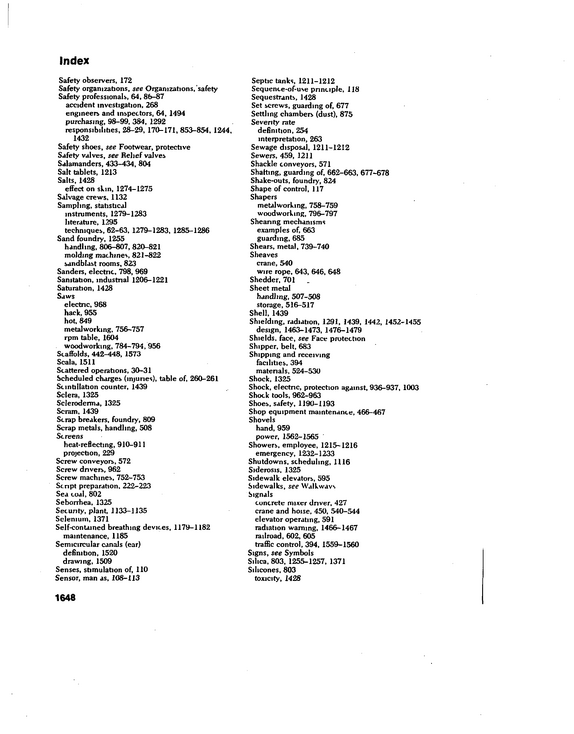
Index Safety observers, 172 Safety organizations, see Organizations, safety Safety professionals, 64, 86-87 accident investigation, 268 engineers and inspectors, 64, 1494 purchasing, 98-99, 384, 1292 responsibilities, 28-29, 170-171, 853-854, 1244, 1432 Safety shoes, see Footwear, protective Safety valves, see Relief valves Salamanders, 433-434, 804 Salt tablets, 1213 Salts, 1428 effect on skin, 1274-1275 Salvage crews, 1132 Sampling, statistical instruments, 1279-1283 literature, 1295 techniques, 62-63, 1279-1283, 1285-1286 Sand foundry, 1255 handling, 806-807, 820-821 molding machines, 821-822 sandblast rooms, 823 Sanders, electric, 798, 969 Sanitation, industrial 1206-1221 Saturation, 1428 Saws electric, 968 hack, 955 hot, 849 metalworking, 756-757 rpm table, 1604 woodworking, 784-794,956 Scaffolds, 442-448, 1573 Scala, 1511 Scattered operations, 30-31 Scheduled charges (injuries), table of, 260-261 Scintillation counter, 1439 Sclera, 1325 Scleroderma, 1325 Scram, 1439 Scrap breakers, foundry, 809 Scrap metals, handling, 508 Screens heat-reflecting, 910-911 projection, 229 Screw conveyors, 572 Screw drivers, 962 Screw machines, 752-753 Script preparation, 222-223 Sea coal, 802 Seborrhea, 1325 Security, plant, 1133-1135 Selenium, 1371 Self-contained breathing devices, 1179-1182 maintenance, 1185 Semicircular canals (ear) definition, 1520 drawing, 1509 Senses, stimulation of, 110 Sensor, man as, 108-113 1648 Septic tanks, 1211-1212 Sequence-of-use principle, 118 Sequestrants, 1428 Set screws, guarding of, 677 Settling chambers (dust), 875 Seventy rate definition, 254 interpretation, 263 Sewage disposal, 1211-1212 Sewers, 459, 1211 Shackle conveyors, 571 Shalting, guarding of, 662-663, 677-678 Shake-outs, foundry, 824 Shape of control, 117 Shapers metalworking, 758-759 woodworking, 796-797 Sheanng mechanisms examples of, 663 guarding, 685 Shears, metal, 739-740 Sheaves crane, 540 wire rope, 643, 646, 648 Shedder, 701 Sheet metal handling, 507-508 storage, 516-517 Shell, 1439 Shielding, radiation, 1291, 1439, 1442, 1452-1455 design, 1463-1473, 1476-1479 Shields, face, see Face protection Shipper, belt, 683 Shipping and receiving facilities, 394 matenals, 524-530 Shock, 1325 Shock, electnc, protection against, 936-937, 1003 Shock tools, 962-963 Shoes, safety, 1190-1193 Shop equipment maintenance, 466-467 Shovels hand, 959 power, 1562-1565 Showers, employee, 1215-1216 emergency, 1232-1233 Shutdowns, scheduling, 1116 Siderosis, 1325 Sidewalk elevators, 595 Sidewalks, see Walkways Signals concrete mixer driver, 427 crane and hoise, 450, 540-544 elevator operating, 591 radiation warning, 1466-1467 railroad, 602, 605 traffic control, 394, 1559-1560 Signs, see Symbols Silica, 803, 1255-1257, 1371 Silicones, 803 toxicity, 1428
refid# o6oE2eyVb36rk0Dd1rJYXnbr1 page
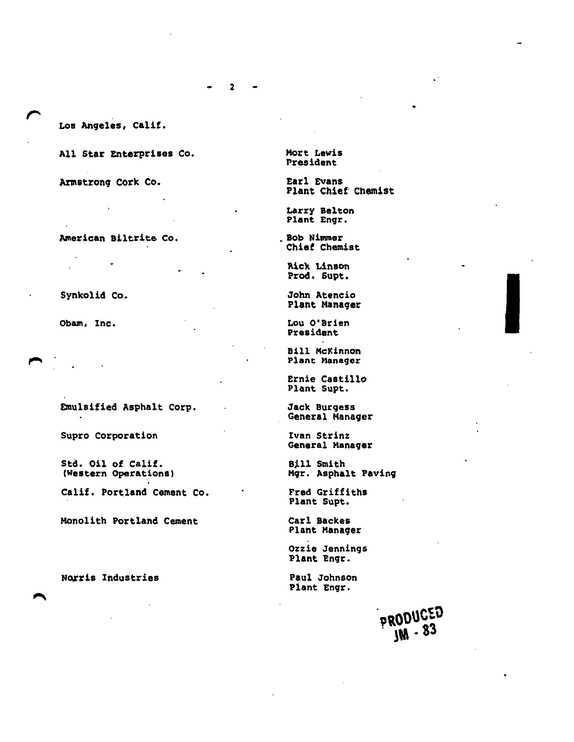
n Lob Angeles, Calif.
refid# 44Ng3wXRoa3V2kOpvOoq9ZyaR1 page
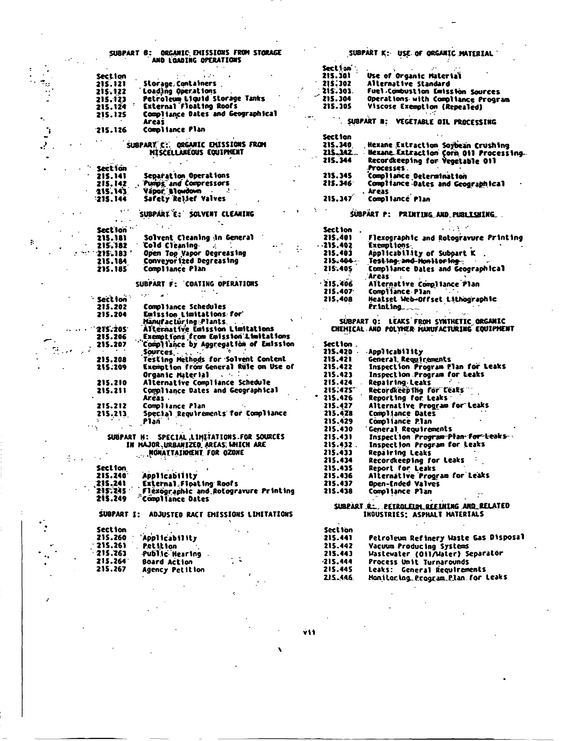
SUBPAST 0: ORGANIC* EMISSIONS FROM STORAGE AMO LOADING OPERATIONS Section 21$.121 Storage,Containers . 21$.122 loading Operations 215.123 Petroleum liquid storage Tanks 21$.124 ' External Floating Roofs 21$. 12$ Coopl 1an<ce Oates and Geographical Areas 215.126 Compliance Plan SUBPARf C:.
refid# DMwy2bQNxE778ZoBJB94XY67n1 page
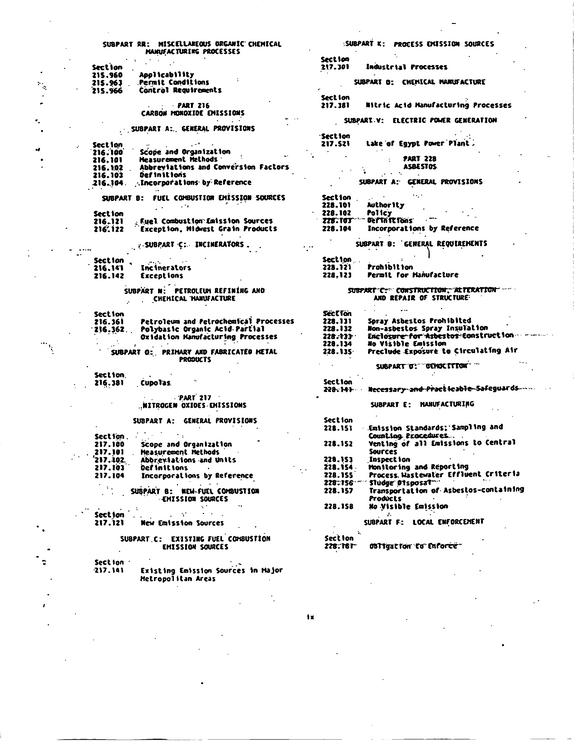
SUBPART RR: MISCELLANEOUS ORGANIC CHEMICAL MANUFACTURING PROCESSES Section 21S.960 21$.96?
refid# 71OrEj4v2011aNdyv9zG2J81j1 page
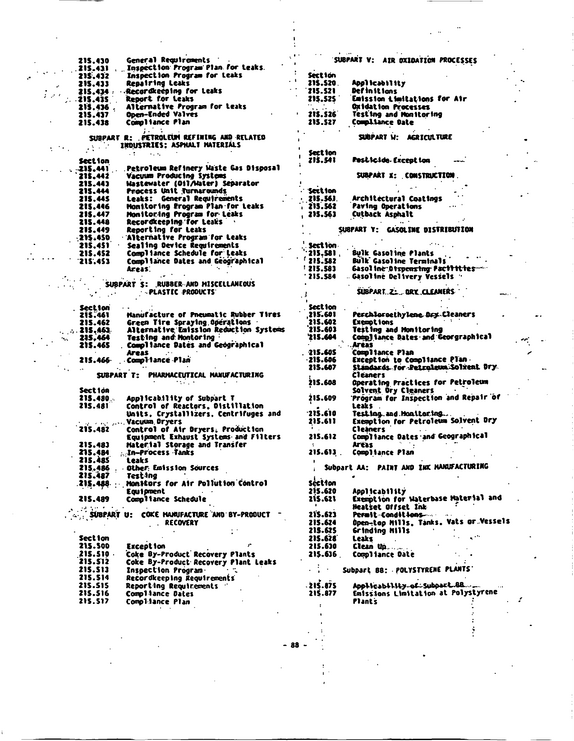
215.430 . .2IS.431 2)5.432 215.433 215.434 215.415 215.436 2)5.437 215.438 General Ktqulrmiiti .
refid# XRn9noX60qazo3maeoLLQmxDJ1 page
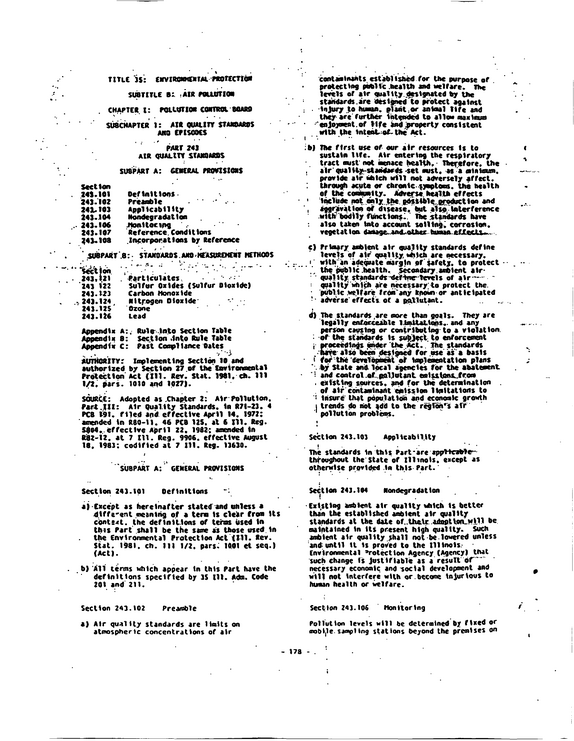
TITLE IS: ENVIRONHENTAt PROTECTION SUBTITLE B: AIR POLLUTION CHAPTER C POLLUTION CONTROL'BOARD SUBCHAPTER 1: AIR QUALITY STANDARDS AMO EP1S00ES PART 243 AIR QUALITY STANDARDS SUSPART A: GENERAL PROVISIONS Section 249.101 242.102 24JU103 242.104 242.106 242.107 142.108 Definitions Preamble Applicability Hondegradatlon .Monitoring Reference.Conditions .Incorporations by Reference SUfcPART.B: STAKOAROSAXO'MEASUREMENT METHODS Section ;`5` -; V
refid# Gm0LnvOXydaGrkKBkDdMNgO5v1 page
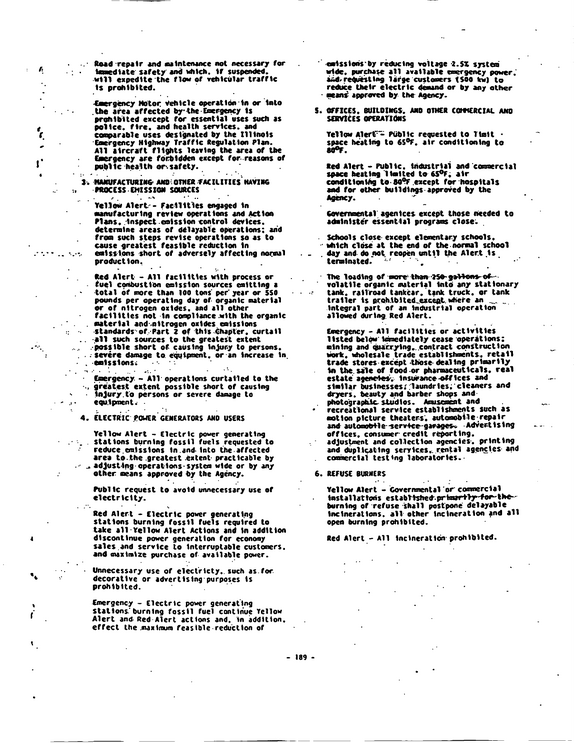
toad repair and Maintenance not necessary for Immediate safety and which. if suspended, util expedite the flow of vehicular traffic is prohibited.
refid# b5JeppoyMzQwgLeoo5jQR0n401 page