experience.
refid# k9BoMK5q15Bwz0VwQare3awN01 page
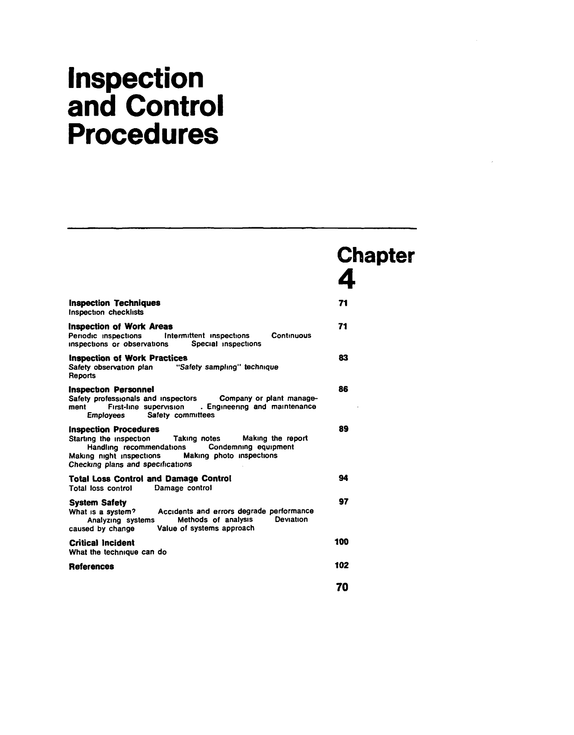
Inspection and Control Procedures Inspection Techniques Inspection checklists Inspection of Work Areas Penodic inspections Intermittent inspections Continuous inspections or observations Special inspections Inspection of Work Practices Safety observation plan "Safety sampling" technique Reports Inspection Personnel Safety professionals and inspectors Company or plant manage ment First-line supervision .
refid# zoB6jJjmBz6dYJgXay5jdzqBa1 page
4--Inspection and Control Procedures ployees spend all their time observing certain equipment and operations Maintenance men, electricians and others, whose job it is to keep equipment in good mechanical condi tion, are assigned to specific groups of ma chines They have no other dubes than to roam about the department, conhnuously ob serving operabons and making adjustments and minor repairs These men are responsible also for the safe operation of assigned machines and help train employees in safe pracbces This method of inspection makes these men familiar with the exact condibon of each part of the machines covered It enables them to point out weak nesses and defects long before they become serious or of a hazardous nature Some companies have roving troubleshooters selected from employees at regular intervals This job is rotated so that in the course of time each employee has had an opportunity to inspect the enbre operabon or his particular department The job is rotated on the theory that each employee will make a definite contnbubon to the safety of the enhre plant and to the safety educabon of fellow employees, as well as himself In one case, the roving inspectors are given a free hand to invesbgate all operations and to report their findings to the foremen Some times the continuous inspecbon is limited to key men in the department who have had long experience and a background of accident prevenbon work A conbnuous system of inspection of per sonal protecbve equipment is especially de sirable A constant check on goggles, respira tors, safety shoes, gloves, and other protecbve clothing, as well as any other personal pro tective devices, will ensure safe maintenance of this equipment Systematic inspection by supervisors.
refid# a1Bo5yo43zZadMK4kZx7gxgkN1 page
4--Inspection and Control Procedures found it practical for analyzing aerospace products.
refid# DGOjbyM6QnKn2GXw2vJLVq6La1 page
8--Workmen's Compensation Insurance employee need not be completely helpless nor unable to earn a single dollar at a job His limitations need only prevent him from com peting in a practical way in the open job market and are such that no stable job market exists for him The exclusive remedy doctrine and third party liability Before workmen's compensation laws were enacted in the states, an employee, m order to recover damages for a work-connected in jury, always was required to show some de gree of fault on the part of his employer Un der what is now known as the "quid pro quo of workmen's compensation law," employers accepted, or were required to accept, re sponsibility for injuries arising out of and in the course of employment without regard to fault In exchange, employees gave up the right to sue employers for unlimited damages These agreements are usually referred to in the state acts as "exclusive remedy" provi sions, a term that is quite misleading In no state are workmen's compensation benefits necessarily the only remedy available to an injured worker Depending upon the working of the applicable statute, the worker may bring a negligence action against a fellow worker, another contractor on the same job, or some other entity or individual who caused the compensable injury From the employer's viewpoint, it is best to refer to the doctrine as the "exclusive liability rule " As the em ployee sees the rule, it remains an "exclusive remedy" for obtaining compensation from the employer But neither Lability nor remedy are perfectly exclusive Private Insurer Programs Pnvate insurers dominate the coverage The ten leading groups wrote almost half the business, the top twenty about 68 percent, up from 62 percent m 1950, although the share of the top ten has changed little The ten leaders wrote as much as 88 percent of the coverage in Hawau to as little as 51 percent m Kansas and Nebraska In four states, one insurer wrote one-fourth of the business Only 36 of the 383 insurers earned work men's compensation premiums of $20 million or more, but these 36 cornered more than 78 percent of the total Companies with nation wide operabons accounted for 83 percent Insurers licensed m only one state, more than 20 percent of all insurance companies, wrote less than 4 percent of the premiums.
refid# NEaRwaXeB54NL1NdQmwNOROYD1 page
cal!
refid# 8RVBxJ8vkYnMdonGw52V2j8bo1 page
Concrete does not withstand acids, and in some types of work employees consider con crete too hard and too cold Resilient non slip mats with low heat conductivity can be placed over the concrete where workmen must stand in one position for considerable periods of time Cork tile is desirable for its insulation, re siliency, quietness, high nonshp rating, and ability to withstand light traffic for long peri ods It is not suitable for wet locations or where there are heavy loadings, and it is ex pensive Cast iron plates with checkered or other wise roughened surfaces laid in cement or asphalt are suitable for some types of rough wear such as that in warehouses The slip ping hazard at the door sills of elevators may be reduced by installing steel grating filled with concrete Lead is used for floors exposed to acids and as a mat for secure footing near wood-working or other machines involving serious danger to the operator if he slips and falls Lead is heat conductive, spark resistant, and quiet It should not be used for heavy trucking Zinc also is used for its spark-resistant qual ities, but, compared to lead, it is attacked more readily by alkalies Floors in com pounding rooms where fire and explosion haz ards exist are zinc-covered in some plants Asphalt-base, vinyl-base or linoleum-type tile often is used in offices, laboratories, and workrooms where cleanliness and good looks are important The material is easily cleaned, noiseless, and a poor conductor of heat Magnesite is suitable for light traffic or where light oils are used It must be laid on a ngid base and should not be used where there is excessive moisture or hydrostatic pres sure, as in basements A coating of bitu minous paint is necessary to protect metals such as pipe from contact, since magnesite corrodes some metals Checkered steel plate wears well, but it is noisy and highly conductive of heat and electricity It is relatively nonshppery unless wom smooth or wet with oil Metal grille floors and gratings will not col lect dust, dirt, or liquids but, because of noise, are not often used where hand trucking is done regularly This type of floor material is particularly useful m boiler rooms and over openings Parquet is laid on an underfloor and is suit able for offices If the material is sealed properly, little maintenance is necessary Par quet wears well but may be noisy Rubber flooring is resilient It also has high dielectric strength, which is undesirable where static electricity is a problem However, conductive types of rubber flooring are avail able Abrasive rubber flooring can be used to overcome slippenness Since terrazzo flooring has no joints m the surface, its use eliminates some of the diffi culties that may be encountered with other types of flooring It can be made electrically conductive by grounded grilles It is a con ductor of heat Suitable sealers are neces sary to make the floor impervious to most acids The terrazzo mixture is slippery unless it includes abrasive aggregates Plants requiring extreme cleanliness and sanitary conditions, such as dairies, use ce ramic glazed tile It should be laid in Trin idad asphalt or m cement with a low lime content Two or three layers of asphalt roof ing felt may be laid beneath the tile Wood floors of the proper matenal and con struction are suitable for vanous services ex cept for the obvious objection of a fire hazard Plank or board floors of the softer woods are generally unsatisfactory and a source of nu merous injuries from slipping and falling as well as from splinters and truck accidents A good floor for light manufacturing can be made from matched or jointed hardwood floor ing nailed to a subfloor structure or to sleepers in concrete The thickness of the hardwood flooring will depend on the service to which it will be subjected It is laid with the gram parallel to the hne of truck travel Wood blocks meet many of the lequirements for a good floor Properly made, a floor of this type is relatively noiseless and does not become slippery or cause fatigue If the blocks are laid on a smooth, ngid base, the floor is not likely to crack and will withstand heavy service Blocks impregnated with creosote are nec essary for floors in contact with liquids or moisture Expansion joints are required along walls, columns, and similar places If blocks are laid with a high melting point pitch, hot weather does not create problems Oils and 391
refid# ppv9ZDMDwY5yXkX4D9322xRvd1 page
strength or elasticity of materials, and de terioration of materials due to wear or othei causes The primary caution legardmg the use of safety belts, as with other personal protective equipment, is to see that they are worn and used correctly A safety belt is worthless unless it is being worn at the time that a fall is possible It should also be securely buckled and worn tight enough to prevent any possibility of the man's slipping out of it Lifelines Lifelines should be seemed above the point of operation to an anchorage or structural member capable of supporting a minimum dead weight of 5400 pounds For most lifelines, mamla rope of X-in diameter or nylon rope of Ji-in diameter is recommended Nylon is more resistant to wear or abrasion than is mamla and is also more resistant to some chemicals Ropes made of other synthetic fibers such as Dacron, polyethylene, and polypropylene have char acteristics that make them very good per formers in certain applications In a lifeline where shock loading strength and high energy absorption is paramount, nylon is superior Knots reduce the strength of all ropes (See Table 26-C ) Tests have shown that mamla lifelines of 3-in diameter, when knotted around a bar or other anchorage, are not strong enough at the knots to be safe for gen eral use unless a shock absorber of low load limit is used How much a knot reduces strength depends upon the type of knot or hitch used and the amount of moisture in the rope Moisture increases the strength of a rope in a knot or around a sharp bend, and dryness greatly diminishes its strength at such points In some cases, a knot will reduce the tensile strength of a rope to less than half of its breaking strength If rope is spliced mto snaps and D-nngs instead of knotted (Fig 19-42), the splice will retain approximately 90 percent of the breaking strength of the rope Breaking strength is always measured m a straight line pull on the rope (See Chapter 26, "Ropes, Chains, and Slings ") Manila rope of &-in diameter has a break ing strength of approximately 2650 pounds, or (dividing by a safety factor of 5) a safe load strength of 530 pounds Spun nylon rope of %nn diameter is rated to have a breaking strength of 6400 pounds--a safe load strength of 710 pounds Manila rope of X-m diameter rates a break ing strength of 5400 pounds--a safe load strength of 1080 pounds When a low-loadlimit shock absorber is used, X-in mamla rope or X-in nylon rope is considered strong enough for most lifelines Without a shock absorber, even X-in mamla rope may not be strong enough to stop a long fall If no shock absorber is available, X-in nylon rope is usually preferable to mamla rope for impact use, because it stretches more and will act as a partial shock absorber The chief disadvantage of nylon for this use is that much of its stretch occurs at a very low load ing, thus the falling workman can fall a con siderable distance closer to some possibly damaging obstruction before an adequate stopping force is exerted by the rope Thereafter, the loading increases very rap idly to a rather high foice before the final stop Also, a considerable amount of re bound is obtained from nylon at the higher loadings Wire ropes should not be used as lifelines wheie a free fall is possible unless some shock-absorbing device is also used, because their rigidity greatly magnifies the impact loading Wire ropes are hazardous when used around electricity Lifelines should be bed to permit as little slack as possible, and thus stop a man with the minimum free fall Special notice must be taken of the nearness of any beam or other obstruebon which the workman might sbike in case of a fall Serious injury or death may result if the total free fall plus the total stretch or elongation of the lifeline and shock ab sorber will allow the workman to sbike some damaging object before he is stopped If there is a long clear space m which a man may be stopped, then a low-limit shock ab sorber may be used with less discomfort to the workman If this space is closely limited, a shorter stop is imperative, even though greater discomfort results Wire lopes should be kept clean and dry and should be frequently lubricated Before 513
refid# EJa6Y66o8qp5GRLy34wZYk2N1 page
I MTC 009709 COVER SHEET FOR B-LEVEL DOCUMENTS REMOVED IN PRIVILEGE REVIEW ORIGINAL B-LEVEL BOX NO._____ _ PRODUCTION BOX NO.

refid# zQnB1ZqRYM9NMd29KGngMvNeB52 pages
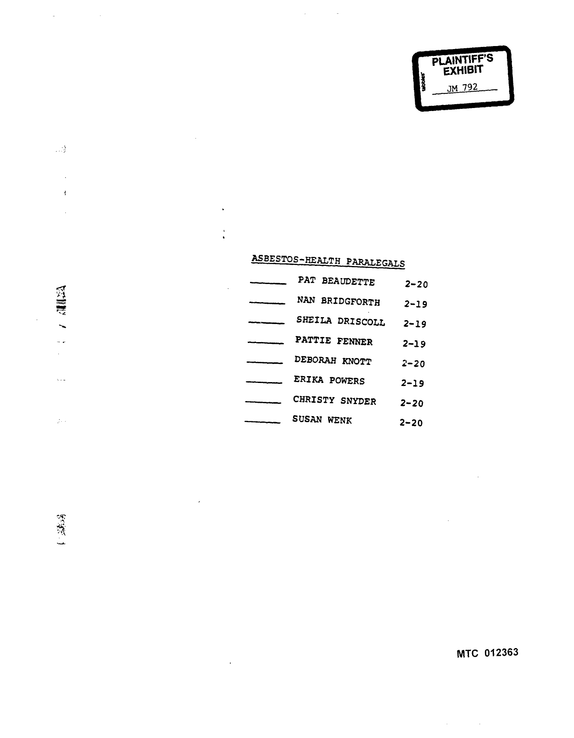
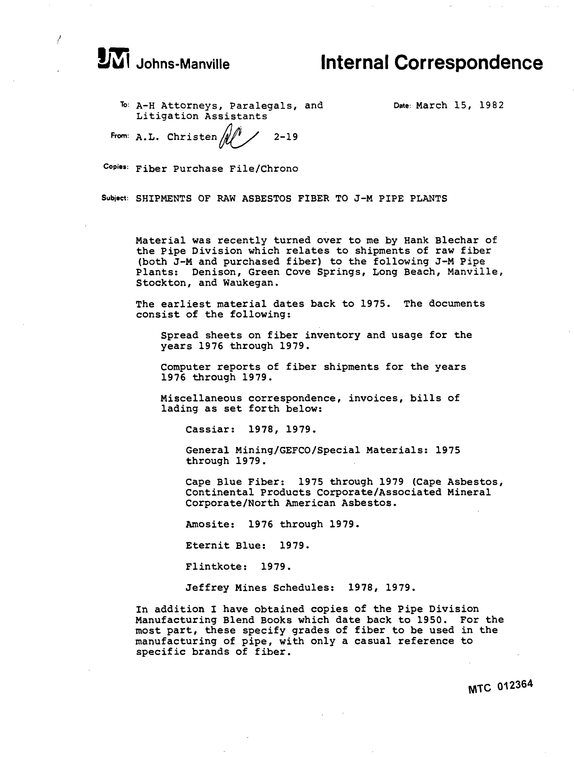
ASBESTOS-HEALTH PARAT.Bflar.c PAT BEAUDETTE NAN BRIDGFORTH SHEILA DRISCOLL PATTIE FENNER DEBORAH KNOTT ERIKA POWERS CHRISTY SNYDER SUSAN WENK 2-20 2-19 2-19 2-19 2-20 2-19 2-20 2-20 MTC 012363 I Johns-Manville Internal Correspondence T: A-H Attorneys, Paralegals, and kyLitigation Assistants From: A.L.
refid# JGRonMGa4w3M1owdy4ZbG8G63 pages
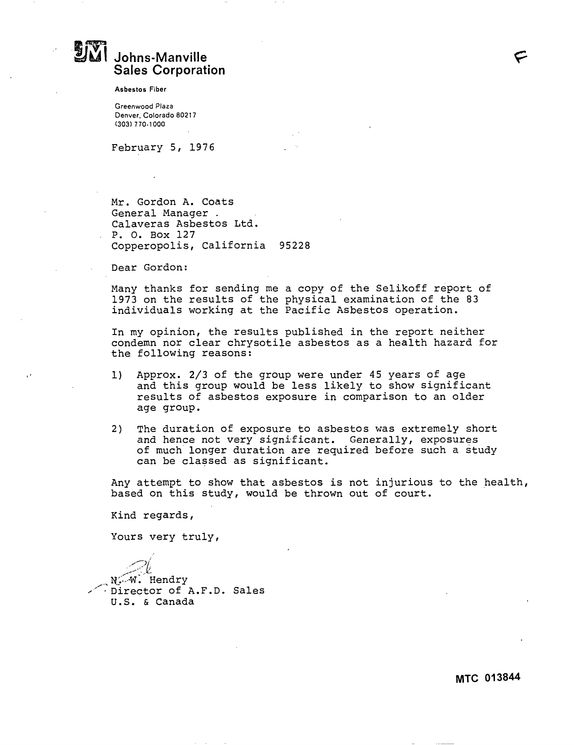
PLAINTIFFS EXHIBIT JM 931 f CP c>\ MTe 013843 Johns-Manville Sales Corporation Asbestos Fiber Greenwood Plaza Denver, Colorado 80217 (303) 770-1000 February 5, 1976 Mr.

refid# by6GNkroMJJXMbjgjbnqjrmvg2 pages
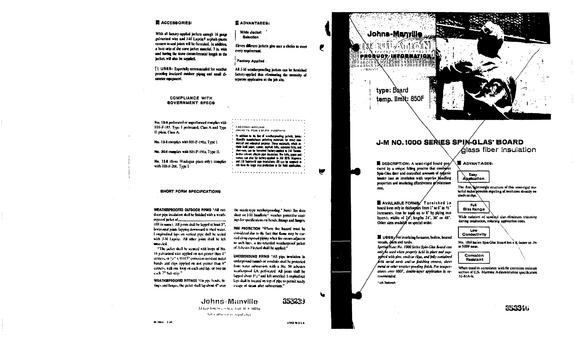
THERMOBESTOS SCORED BLOCK INSULATION IN)?
refid# gDwbaXv5ZyVYnOMGVY8r2Qn5q2 pages
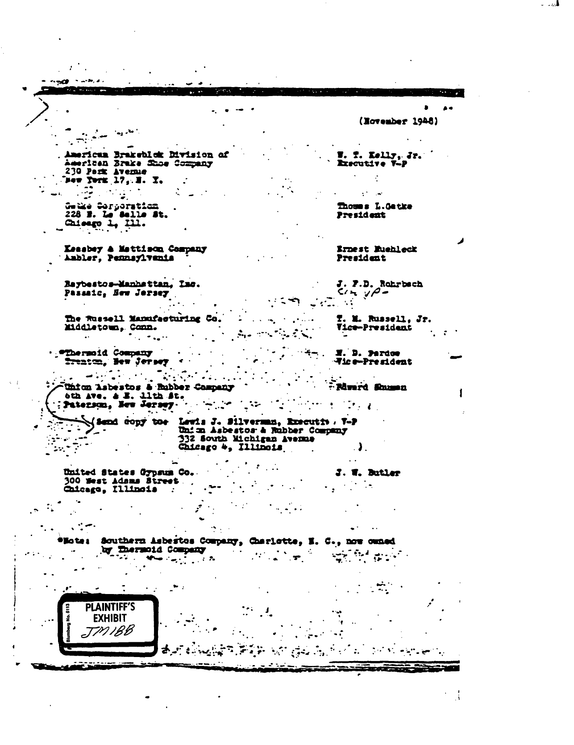
7** (Soreamber 19*4) Aasrleu BraAeblok Dirtsion of American Brake Shoe Sss^asy 230 Pszft Areoue **# T*rtt .17, .a.
refid# x1BENnB7dLL3Z0JvnDR9XOa5E1 page
PtAW$ W1EXHIBIT *} / 3B, XM T. 1 1 I
refid# V3Ne6zR2vKdVk4qvmMN78ydq81 page
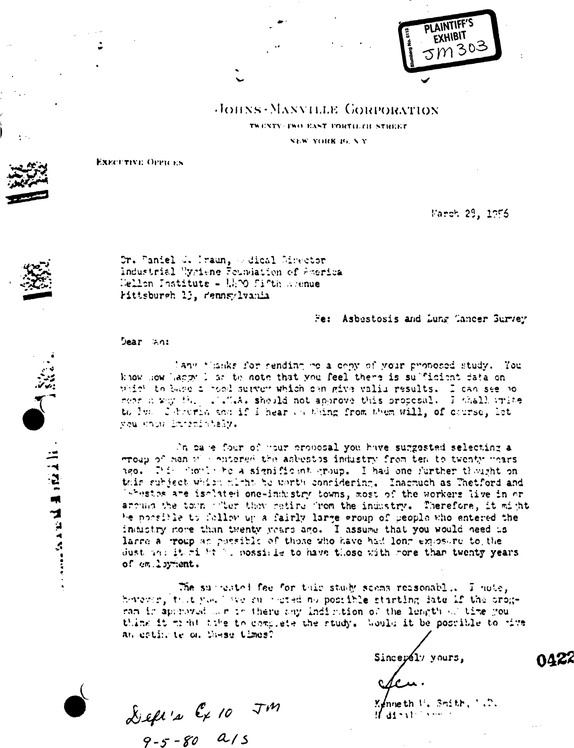
KxwfTtvi: Ori'u ks Ion ns - Many j u.k Ooui'ow.vnoN t* i:\rv-r*t mwTti rn stiikkt Nt.W VIIKK t>>.
refid# MM2RwVDmeDNGeXq5y3okrmjmk1 page