4 J l fl/O /S'C4) r~ *rA+ //$ a/T A>s tf^sres /Z<*<f ^Zjs***** ______________ /Zrd/Jej ,, /*>&?
refid# gbE6E38EV5LnB9rK8badGYwnq4 pages
South Dakota Department of Labor and Management Relations, State Capitol Bldg, Pierre 57501 State Inspector of Mines (Inspector), PO Box 101, Whitewood 57793 Tennessee Department of Labor (Commissioner), Cordell Hull Bldg, Nashville 37219 Workmen's Compensation Division (Director) Workshops, Factories, and Elevators Division (Director) Division of Mines (Director), Knoxville 37902 Division of Boiler Inspection (Director) Construction Safety (Director) Elevator Safety Board (Chairman) Texas Industrial Accident Board (Chairman), State In surance Bldg, Austin 78714 Bureau of Labor Statistics (Commissioner), Box T, Capitol Station, Austin 78711 Boiler Inspection Division (Chief Boiler Inspec tor) Safety Division (Director) Utah Industrial Commission (Chairman), 350 East Fifth South, Salt Lake City 84111 Industrial Safety (including mine inspection) (Commissioner) Workmen's Compensation (Commissioner) Vermont Department of Labor and Industry (Commis sioner), administers Workmen's Compensa tion, Montpelier 05602 Industrial Safety (Deputy Commissioner) Virgin Islands Department of Labor (Commissioner), PO Box 708, Cbnsbansted, St Croix 00820 Division of Workmen's Compensation (Deputy Commissioner), St Thomas 00801 Virginia Department of Labor and Industry (Commis sioner), PO Box 1814, Ninth Street Office Bldg, Richmond 23214 Division of Industrial Safety (Director) Division of Mines and Quarries (Chief) Industrial Commission, Blanton Bldg, P O Box 1794, Richmond 23214 Department of Workmen's Compensation (Chairman) Washington Department of Labor and Industries (Director), Ceneral Administration Bldg , Olympia 98501 Safety Division (Supervisor) Electrical Division (Chief Electrical Inspector) Industrial Insurance Division (Supervisor) West Virginia Department of Labor (Commissioner), 1900 Washington St, East, Charleston 25305 Division of Safety (Director) Workmen's Compensation Fund (Commissioner), 112 California Ave, Charleston 25305 Department of Mines (Director), Capitol Bldg, Charleston 25305 Wisconsin Department of Industry, Labor and Human Rela tions (Chairman), Hill Farms State Office Bldg, PO Box 2209, Madison 53701 Industrial Safety and Buildings Division (Di rector) Division of Labor Standards (Director) Workmen's Compensation Division (Adminis trator) Wyoming Department of Labor and Statistics (Commis sioner), 304 Capitol Bldg, Cheyenne 82001 Workmen's Compensation Department (Director), 2305 Carey Ave, P O Box 408, Cheyenne 82001 State Mine Inspection Department (State In spector of Mines), PO Box 1094, Rock Spnngs 82901 Health and hygiene services Departments or boards of health and in dustrial hygiene services are integral parts of the organization of each of the states, the Dis trict of Columbia, and the autonomous terntones of the United States It is to these organizations that the safety professional must look for his state's specific standards and recommendations on such points as occupational health, food and health engineenng, disease control, water pollution, and other facets of the overall field of plant hygiene Industnal hygiene units usually function full time or, in several states, on a limited basis In addition to the units that operate under state health depaitments, a number of other industrial hygiene units are run by municipalities or other local authoiities In addition to direct industnal hygiene services, these state units are able to bring to industry a more or less complete health program by integrating their work with that of other divisions m the state government, such as sanitation and infectious disease control State and local programs coordinate their 623
refid# bOaerLj7GRd3YZM8xq6J8QGVD1 page
other flammable material.
refid# dYvvQKJBYGLV74E3oxB6Mzd301 page
25--Hoisting Apparatus and Conveyors that the rod will pull out of the piston, thus letting the load drop It is recommended that the locknut be secured to the piston rod by a castellated nut and cotter pin When ever an air hoist is overhauled, a check should be made to see that the piston is well secured to the rod If an ordinary hook is used to hang the hoist from its support, the cylinder may come unhooked if the piston rod comes m contact with an obstruction when lowering A clevis or other device should be used to prevent the hook from being detached from the hoist support To prevent the hoist from rising or lowering too rapidly, a choke, such as a washer with the correct opening, can be placed m the air line coupling It is recommended that a rotary air hoist be provided with a closed loadline guide Hand-operated chain hoists Cham hoists may be portable, but should be either permanently hooked onto a monorail trolley, or built into the trolley as an integral part They are suitable for many operations on which a block and tackle, fitted with fiber rope, is used and are stronger, more depend able, and more durable than fiber-rope tackle There are three general types of chain hoists spur-geared, differential, and screwgeared (or worm drive) The spur-geared type is the most efficient as it will pick up a load with the least effort on the part of a man The differential type is the least efficient Screw-geared and differential hoists are self-locking and will automatically hold a load m position Since the spur-geared type is free running, it tends to allow the load to run itself down Therefore, an automatic load brake, similar to that on a crane, is provided to hold the load It is recommended that the use of common gray iron be avoided for mam load bearing parts The use of ductile materials, such as steel, malleable iron, nodular iron, or alumi num alloy, is suggested as they will withstand sudden shock better Chains should be made of the best quality of welded steel with a load safety factor of 5 Chain hoists should be of larger capacity than the regular work requires Supports for the hoists must be strong enough to carry the load imposed on them Chain inspection is described m Chapter 26, "Ropes, Chains, and Shngs " When a man hangs up a chain hoist prior to using it, he must exercise care not to strain or otherwise injure himself Cranes--design and construction OSHA requires that all new overhead and gantry cranes, constructed and installed on or after August 31, 1971, meet the design speci fications of the American National Standard B30 2 0, Safety Code for Overhead and Gantry Cranes Overhead and gantry cranes con structed before August 31, 1971 should be modified to conform to those design specifica tions by February 15, 1972, unless it can be shown that the crane cannot feasibly or eco nomically be altered and that the crane sub stantially complies with OSHA requirements All parts of every crane (Fig 25-3), es pecially those subject to impact, wear, and rough usage, should be of adequate strength for maximum service Journals and shafts should be of sufficient strength and size to bring the bearing pressure within safe limits Open hooks should not be used to support human loads, loads that pass over workmen, or loads where there is danger of relieving the tension on the hook due to the load or hook catching or fouling Outdoor storage bridges should be provided with automatic rail clamps A wind-indicat ing device should be provided which will give a visible or audible alarm to the bridge opera tor at a predetermined wind velocity If the clamps act on the railhead, any beads or weld flash on the railheads should be ground off Structural members of cranes should never be made of cast iron or other frangible metal In the fabrication and assembly of structural work, such as girders, end frames, operators' cages, booms, and brackets, hot-driven nvets or welding should be used instead of bolts Where bolts must be used, they should be of the "through" type, with locknuts or conven tional nuts and lockwashers Each independent hoisting unit of a crane should have brakes complying with the re quirements of American National Standard B30 Series, "Safety Code for Cranes, Der ricks, Hoists, Jacks, and Slings " The rated load of the crane should be plainly marked on each side of the crane If 668
refid# 8VKBQvwG49O8nO3YmgEDnbykK1 page
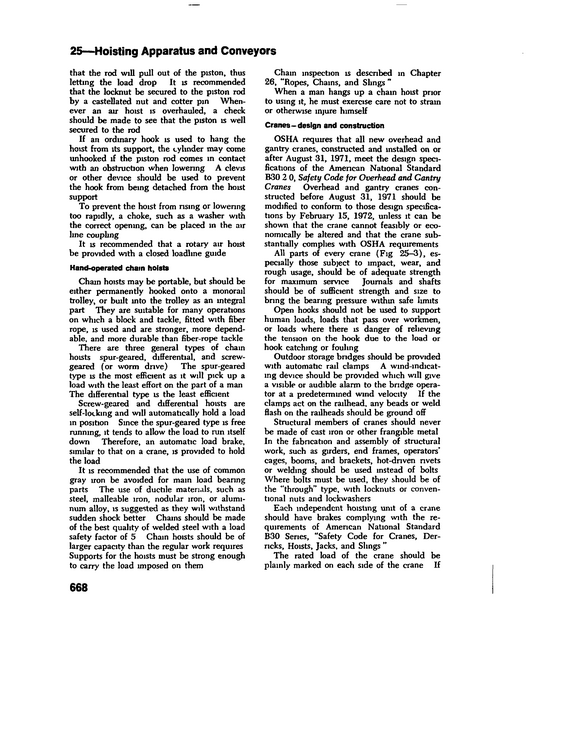
also increase the efficiency of grooved drums For smooth-faced drums, proper direction of lay of rope for specified winding conditions further helps ensure uniform winding The head sheave groove should be checked for poor alignment, worn bearings, broken flanges, and size and shape of the groove at intervals of two or three months, depending on the amount of usage Proper groove size and shape are especially necessary when a new rope is installed Excessive sheave wear and its bad effects on the life of a rope often result from use of sheave or liner material unsuitable for the pressure of the rope If the radial pressure of a 6 x 19 rope exceeds 900 psi, a harder matenal than cast steel, such as manganese steel, is more suitable Lubncation Regular application of a suitable lubricant to wire hoisting rope prevents corrosion, wear from friction, and drying out of the core Thm lubricants, which are fluid at normal temperatures and are fortified with polar addi tives and rust inhibitors, can penetrate the rope and also afford good protecbon even un der wet operating conditions Ropes should be dry, when lubricant is applied, so that moisture will not be entrapped by the lubri cant Thm lubricants can be applied by hand, but the best arrangement is to provide some means of dripping them on the rope, or using a spray device to apply the proper quantity automatically Periodic monthly cleaning, done m mine shafts, eliminates dirt, abrasive particles, and corrosion-producing moisture Cleaning fluids should not be used because of their detri mental effect on the core lubricant Light oils are sometimes used to loosen the coating of lubricant and harmful materials A com pressed air or steam jet (or other mechanical method) cleans a rope effectively and thor oughly Overloading Overloading may occur in the operation of most types of hoisting equipment For ex ample, it is difficult to estimate the load within 25 percent when making a lift with a crane, and m many instances a load is under- TABLE 26-H NUMBER AND SPACING OF CLIPS FOR ROPES OF VARIOUS SIZES Diameter of tope (m ) V, V.
refid# emgEVQRpknODYqZ13Q03zdEx41 page
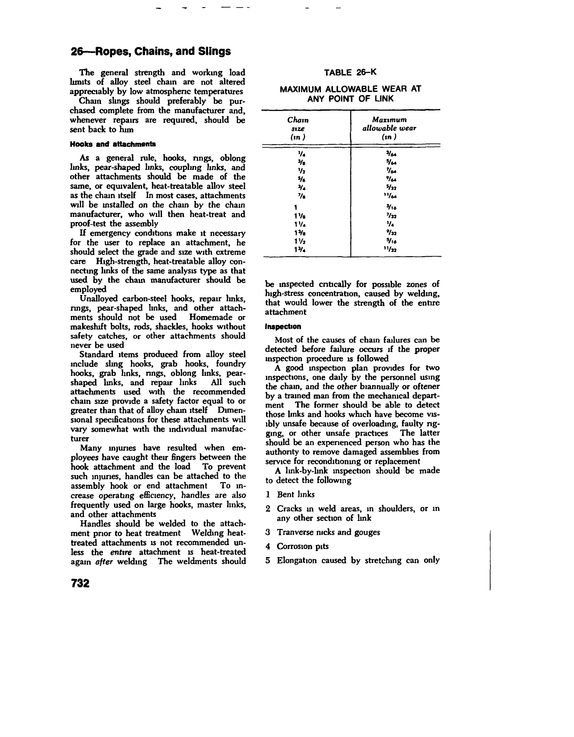
26--Ropes, Chains, and Slings The general strength and working load limits of alloy steel chain are not altered appreciably by low atmospheric temperatures Chain slings should preferably be pur chased complete from the manufacturer and, whenever repairs are required, should be sent back to him Hooks and attachments As a general rule, hooks, nngs, oblong links, pear-shaped links, coupling links, and other attachments should be made of the same, or equivalent, heat-treatable allov steel as the chain itself In most cases, attachments will be installed on the chain by the chain manufacturer, who will then heat-treat and proof-test the assembly If emergency conditions make it necessary for the user to replace an attachment, he should select the grade and size with extreme care High-strength, heat-treatable alloy con necting links of the same analysis type as that used by the chain manufacturer should be employed Unalloyed carbon-steel hooks, repair links, nngs, pear-shaped links, and other attach ments should not be used Homemade or makeshift bolts, rods, shackles, hooks without safety catches, or other attachments should never be used Standard items produced from alloy steel include sling hooks, grab hooks, foundry hooks, grab links, nngs, oblong links, pearshaped links, and repair links All such attachments used with the recommended cham size provide a safety factor equal to or greater than that of alloy cham itself Dimen sional specifications for these attachments will vary somewhat with the individual manufac turer Many injunes have resulted when em ployees have caught their fingers between the hook attachment and the load To prevent such injuries, handles can be attached to the assembly hook or end attachment To in crease operating efficiency, handles are also frequently used on large hooks, master links, and other attachments Handles should be welded to the attach ment pnor to heat treatment Welding heattreated attachments is not recommended un less the entire attachment is heat-treated again after welding The weldments should 732 TABLE 26-K MAXIMUM ALLOWABLE WEAR AT ANY POINT OF LINK Cham size (in ) V Vs V2 Vb Vb Vb 1 1 Vs 1 Vb IVb IVi IVb Maximum allowable wear (m) Vab Vbb Vab Vt* Vm "/ab Via Vm Vb Vm Via "/m be inspected critically for possible zones of high-stress concentration, caused by welding, that would lower the strength of the entire attachment Inspection Most of the causes of chain failures can be detected before failure occurs if the proper inspection procedure is followed A good inspection plan provides for two inspections, one daily by the personnel using the chain, and the other biannually or oftener by a trained man from the mechanical depart ment The former should be able to detect those links and hooks which have become vis ibly unsafe because of overloading, faulty rig ging, or other unsafe practices The latter should be an experienced person who has the authority to remove damaged assemblies from service for reconditioning or replacement A link-by-link inspection should be made to detect the following 1 Bent links 2 Cracks m weld areas, in shoulders, or in any other section of link 3 Tranverse nicks and gouges 4 Corrosion pits 5 Elongation caused by stretching can only
refid# YrkXbxmJaBEKqNbVr9ZaqnVdN1 page
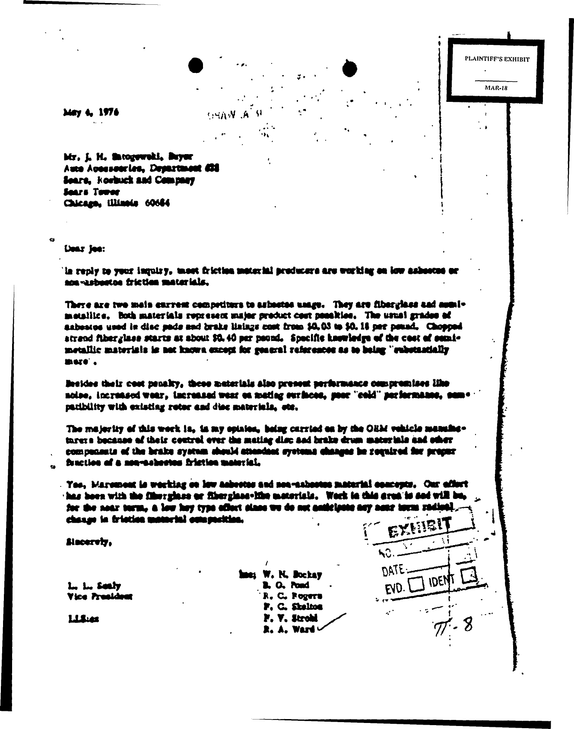
My , im iSA'.V .A ^ Mr.
refid# reLKL7x5BJDZOrGLO6X50dJD71 page
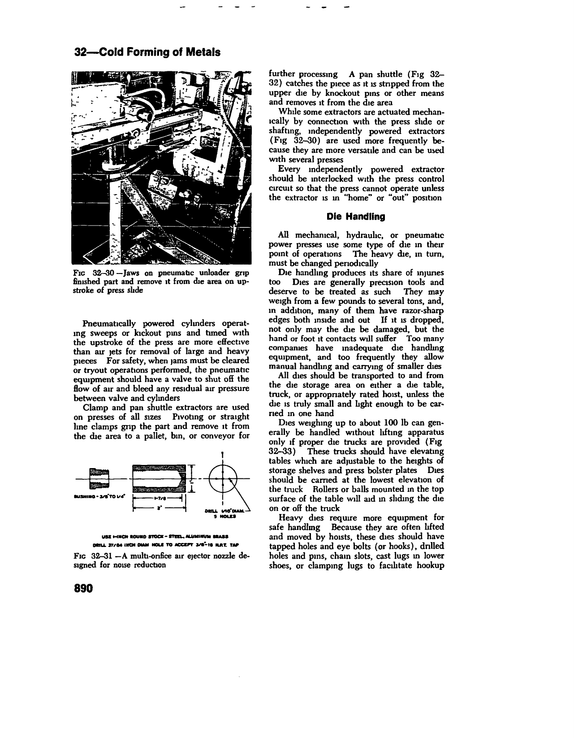
32--Cold Forming of Metals Fic 32--30 --Jaws on pneumatic unloader grip finished part and remove it from die area on up stroke of press slide Pneumatically powered cylinders operat ing sweeps or lockout pins and tuned with the upstroke of the press are more effective than air jets for removal of large and heavy pieces For safety, when jams must be cleared or tryout operations performed, the pneumatic equipment should have a valve to shut off the flow of air and bleed any residual air pressure between valve and cylinders Clamp and pan shuttle extractors are used on presses of all sizes Pivoting or straight line clamps grip the part and remove it from the die area to a pallet, bin, or conveyor for 1 9 HOIXJ use MHO* ftOUHO STOCK - 8TUU ALUtttmm MUSS 0a 17/64 INCH OMM HOLS TO ACCMPT J/6-16 Mt TAP Fic 32-31 --A multi-onfice air ejector nozzle de signed for noise reduction 890 further processing A pan shuttle (Fig 32-- 32) catches the piece as it is stripped from the upper die by knockout pms or other means and removes it from the die area While some extractors are actuated mechan ically by connection with the press slide or shafting, independently powered extractors (Fig 32-30) are used more frequently be cause they are more versatile and can be used with several presses Every independently powered extractor should be interlocked with the press control circuit so that the press cannot operate unless the extractor is in "home" or "out" position Die Handling All mechanical, hydraulic, or pneumatic power presses use some type of die in their point of operations The heavy die, in turn, must be changed periodically Die handling produces its share of injuries too Dies are generally precision tools and deserve to be treated as such They may weigh from a few pounds to several tons, and, in addition, many of them have razor-sharp edges both inside and out If it is dropped, not only may the die be damaged, but the hand or foot it contacts will suffer Too many companies have inadequate die handling equipment, and too frequently they allow manual handlmg and carrying of smaller dies All dies should be transported to and from the die storage area on either a die table, truck, or appropriately rated hoist, unless the die is truly small and light enough to be car ried m one hand Dies weighing up to about 100 lb can gen erally be handled without lifting apparatus only if proper die trucks are provided (Fig 32-33) These trucks should have elevating tables which are adjustable to the heights of storage shelves and press bolster plates Dies should be earned at the lowest elevation of the truck Rollers or balls mounted in the top surface of the table will aid in sliding the die on or off the truck Heavy dies require more equipment for safe handlmg Because they are often lifted and moved by hoists, these dies should have tapped holes and eye bolts (or hooks), drilled holes and pins, chain slots, cast lugs in lower shoes, or clamping lugs to facilitate hookup
refid# RwMOOny9jBZ0LROgMJQQbwXE1 page
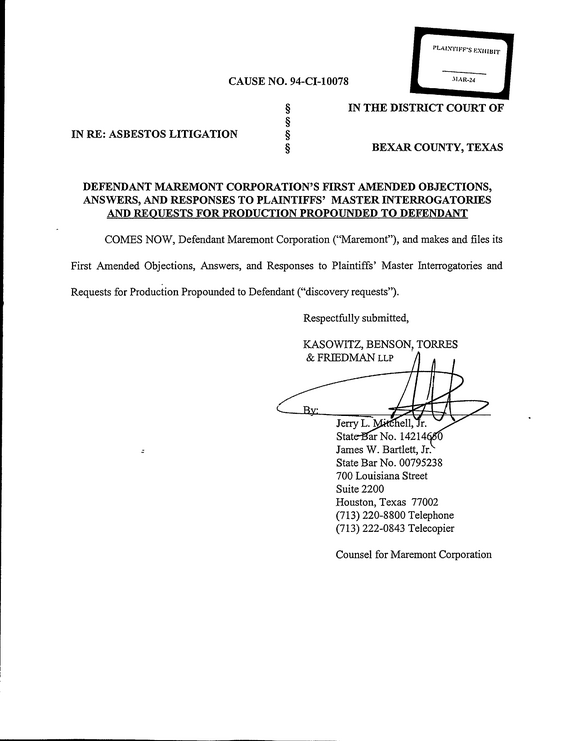
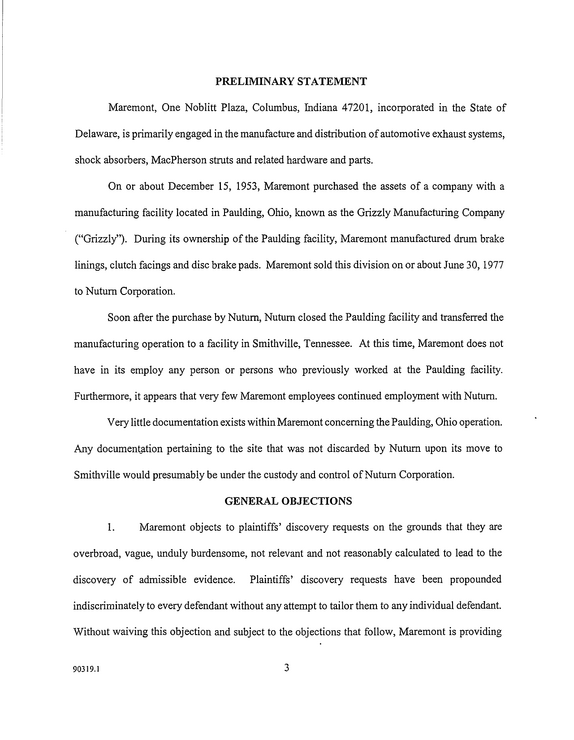
CAUSE NO. 94-CI-10078 IN RE: ASBESTOS LITIGATION IN THE DISTRICT COURT OF BEXAR COUNTY, TEXAS DEFENDANT MAREMONT CORPORATION'S FIRST AMENDED OBJECTIONS, ANSWERS, AND RESPONSES TO PLAINTIFFS' MASTER INTERROGATORIES AND REQUESTS FOR PRODUCTION PROPOUNDED TO DEFENDANT COMES NOW, Defendant Maremont Corporation ("Maremont"), and makes and files its First Amended Objections, Answers, and Responses to Plaintiffs' Master Interrogatories and Requests for Production Propounded to Defendant ("discovery requests").

refid# mB83VNa66OqvxZ1Ye72J74bdJ158 pages
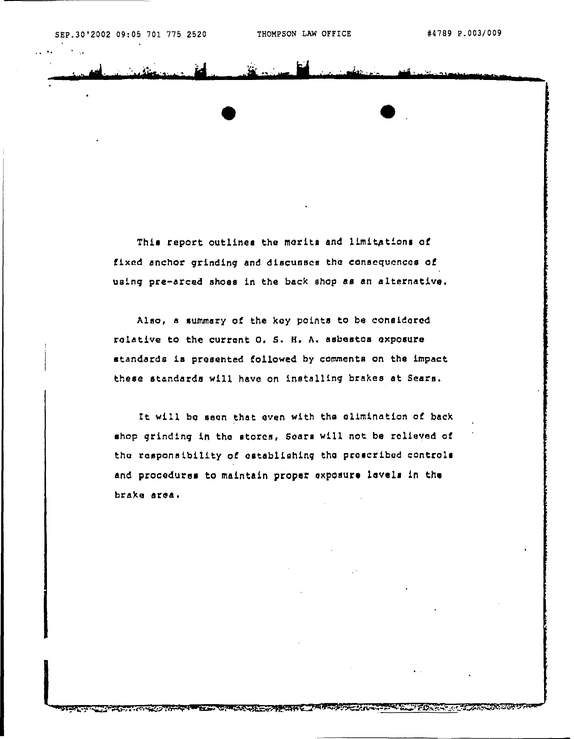
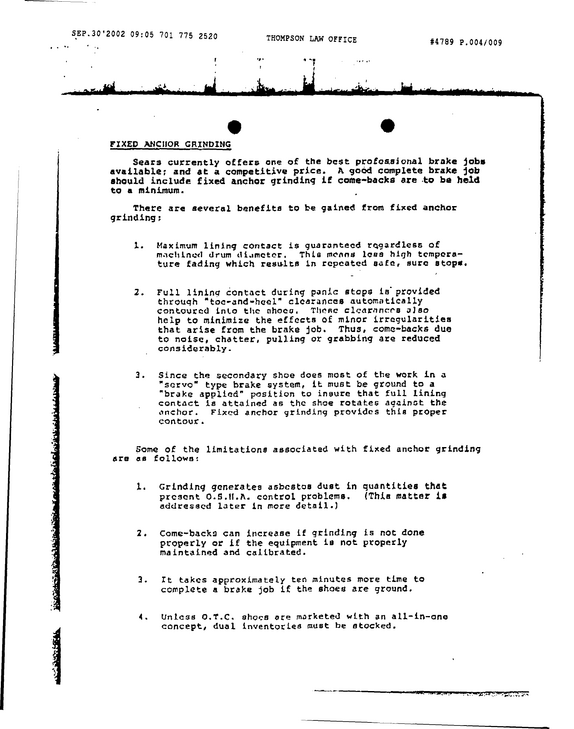
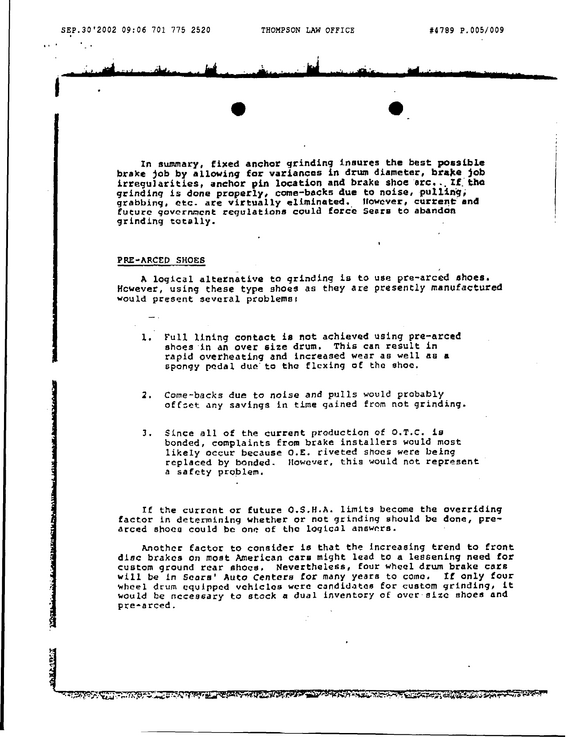
SEP.30'2002 09: 05 701 775 2520 THOMPSON LAW OFFICE #4789 P.002/009 ASBESTOS EXPOSURE -VS- BACK-SHOP BRAKE SHOE GRINDING Prepared For: J.
refid# 6bx5V5nBok9zBgqE689QdDpx66 pages
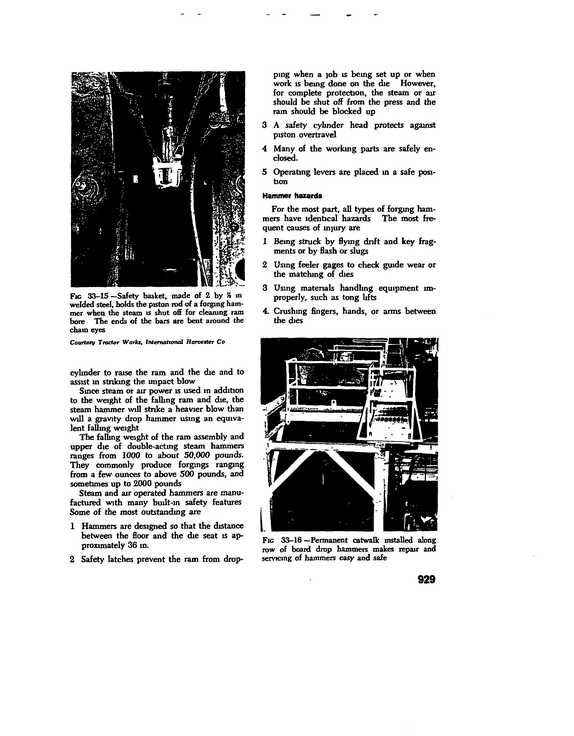
Fic 33-15 --Safety basket, made of 2 by 3* in welded steel, holds the piston rod of a forging ham mer when the steam is shut off for cleaning ram bore The ends of the bars are bent around the chain eyes Courtesy Tractor Works, International Harvester Co ping when a job is being set up or when work is being done on the die However, for complete protection, the steam or air should be shut off from the press and the ram should be blocked up 3 A safety cylinder head protects against piston overtravel 4 Many of the working parts are safely en closed. 5 Operating levers are placed in a safe posi tion Hammer hazards For the most part, all types of forging ham mers have identical hazards The most fre quent causes of injury are 1 Being struck by flying dnft and key frag ments or by flash or slugs 2 Using feeler gages to check guide wear or the matching of dies 3 Using materials handling equipment im properly, such as tong lifts 4.
refid# 6OGEn5w7QE2MawNrLmJ3Ja91 page
*/ .
refid# Lpw4Ek4qrZKNyOwawkvEZvxp51 page
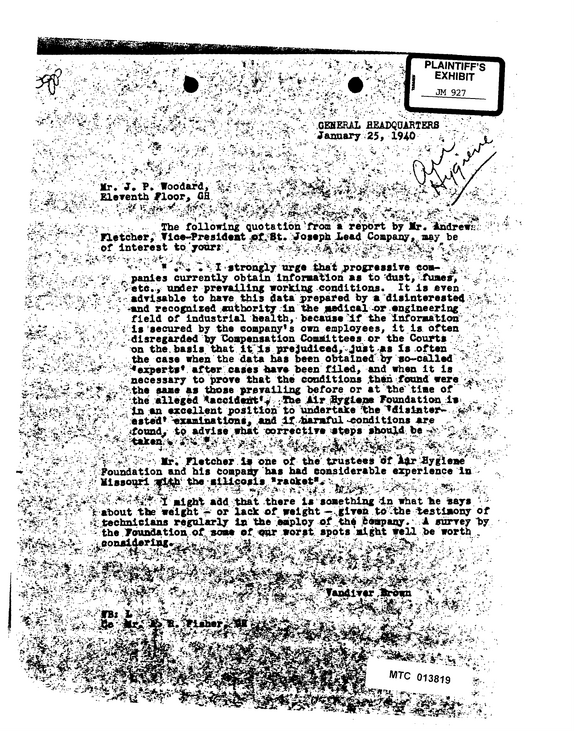
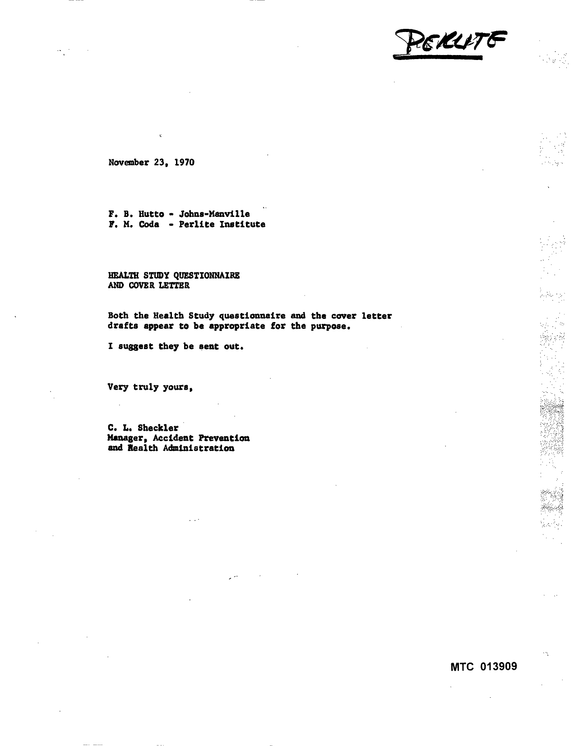
MTC 013908 rP&&/T<P November 23, 1970 F.
refid# yqnBz71xLBRGLonRmL2yaM4d33 pages
I .
refid# 6wN2XpkGz6kLO4EqBBp87ODy112 pages
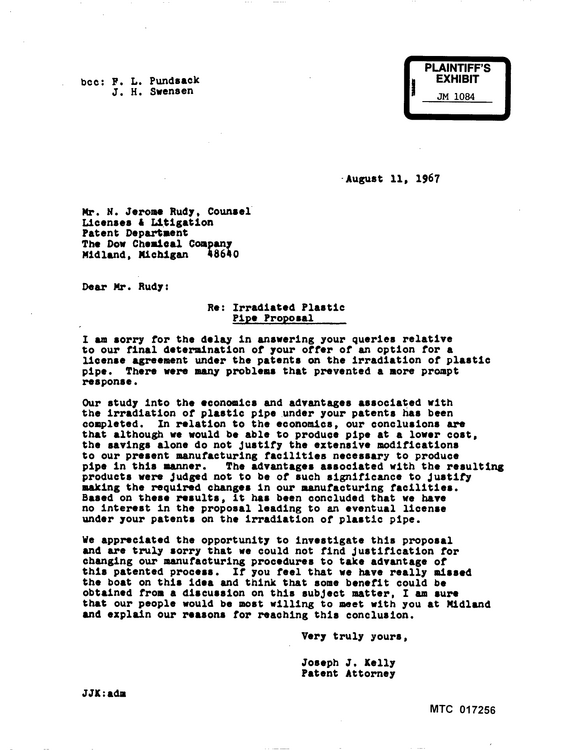
bcc: P.
refid# QkpGKdpVkKjw6MebqLX66bagR1 page