tools frequently and remove from service those found to be defective Many companies have each supervisor check all tools each week A checklist for hand tools considered most hazardous can be helpful in systematiz ing inspection Some workmen prefer to use their own tools even though tools are furnished by the company In this case, supervisors should examine the tools frequently to prevent the use of those that are unsafe If privately owned tools are found to be defective, super visors should insist that they be replaced or that company-owned tools be used instead Carrying tools The workman should never carry tools which in any way might interfere with his using both hands freely on a ladder or while he is climbing on a structure A strong bag, bucket, or similar container should be used to hoist tools from the ground to the job Tools should be returned in the same manner, not brought down by hand, earned m pockets, or dropped to the ground Mislaid and loose tools cause a substantial portion of the hand tool injuries Tools are laid down on scaffolds, on overhead piping, on top of step ladders, and in other locations from which they can fall on persons below Leaving tools overhead is especially hazard ous where there is vibration or where men are moving about Chisels, screw drivers, and pointed tools should never be carried edge or point up in a workman's pocket They should be car ried in a tool box or cart, in a carrying belt like that used by electricians and steel workers, in a pocket tool pouch, or in the hand with points and cutting edges away from the body Tools should be handed from one workman to another, never thrown Edged or pointed tools should be passed, preferably in their carrying case, with the handle toward the receiver Workmen carrying tools on their shoulders should pay close attention to clearances when turning around and should handle the tools so that they will not strike other workmen Maintenance and Repair The tool room attendant or tool inspector should be qualified by training and experi ence to pass judgment on the condition oftools for further use No dull or damaged tool should be returned to stock Enough tools of each kind should be on hand so that when a defective or worn tool is removed from ser vice, it can be replaced immediately with a safe tool Efficient tool control requires periodic in spections of all tool operations These in spections should cover housekeeping m the tool supply room, tool maintenance, service, number of tools in the inventory, handling routine, and conditions of tools Responsibility for such periodic inspec tions is usually placed with the department head and should not be delegated by him When metal tools break in use, there are usually detectable causes overheating or underheating of the forging or steel when it was being hardened, cracks from improper forging, improper tempering, failure to re lieve stresst s in forging, improper quenching, incorrect angle of cutting edge, or steel of poor quality Defects such as these will usually be found m tools of inferior construction, which, because of breakage and inefficiency, are more expensive m the long run than are tools of good quality Therefore, it pays to pur chase tools of the best quality obtainable Hand tools receiving the heaviest wear, such as chisels, wrenches, sledges, star-drills, blacksmith's tools, and cold cutters, require frequent maintenance on a regular schedule Proper maintenance and repair of tools require adequate facilities, workbenches, vises, a forge or furnace for hardening and tempenng, tempering baths, safety goggles, repair tools, gnnders, and good lighting Workmen especially trained in the care of tools should be in charge of these facilities, otherwise tools should be sent out for re pairs Tempenng tools Hammer-struck and striking tools (chisels, stamps, punches, cutters, hammers, sledges, and rock drills) should be made of carefully selected steel and heat-treated so that they are hard enough to withstand blows without mushrooming excessively (Fig 32--4), and yet not be so hard that they chip or crack For safety, it is better that shock tools, 951
refid# N2ZK1a2qYpGmb9verdpDO4n7y1 page
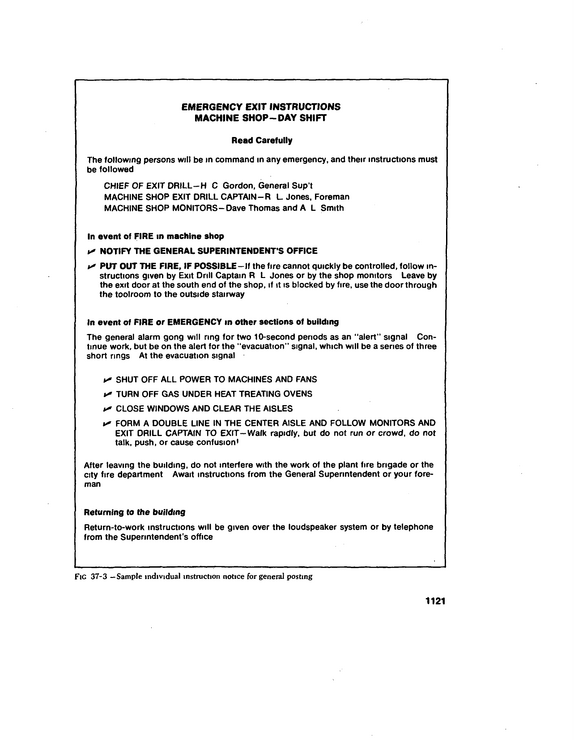
EMERGENCY EXIT INSTRUCTIONS MACHINE SHOP-DAY SHIFT Read Carefully The following persons will be in command in any emergency, and their instructions must be followed CHIEF OF EXIT DRILL-H C Gordon, General Sup't MACHINE SHOP EXIT DRILL CAPTAIN-R L Jones, Foreman MACHINE SHOP MONITORS-Dave Thomas and A L Smith In event of FIRE in machine shop NOTIFY THE GENERAL SUPERINTENDENT'S OFFICE v* PUT OUT THE FIRE, IF POSSIBLE--If the fire cannot quickly be controlled, follow in structions given by Exit Drill Captain R L Jones or by the shop monitors Leave by the exit door at the south end of the shop, if it is blocked by fire, use the door through the toolroom to the outside stairway In event of FIRE or EMERGENCY in other sections of building The general alarm gong will ring for two 10-second periods as an "alert" signal Con tinue work, but be on the alert for the "evacuation" signal, which will be a series of three short rings At the evacuation signal V SHUT OFF ALL POWER TO MACHINES AND FANS TURN OFF GAS UNDER HEAT TREATING OVENS V CLOSE WINDOWS AND CLEAR THE AISLES FORM A DOUBLE LINE IN THE CENTER AISLE AND FOLLOW MONITORS AND EXIT DRILL CAPTAIN TO EXIT--Walk rapidly, but do not run or crowd, do not talk, push, or cause confusion* After leaving the building, do not interfere with the work of the plant fire brigade or the city fire department Await instructions from the General Superintendent or your fore man Returning to the building Return-to-work instructions will be given over the loudspeaker system or by telephone from the Superintendent's office FlC 37-3 --Sample individual instruction notice for general posting 1121
refid# Lg5LGD9p55vRYepvRyBGR5OYQ1 page
I rr i BUUETIh FEBRUARY 22, 1978 i\lo.
refid# 3JRO6ZjeRKjZyyL1D73eRD3aa4 pages
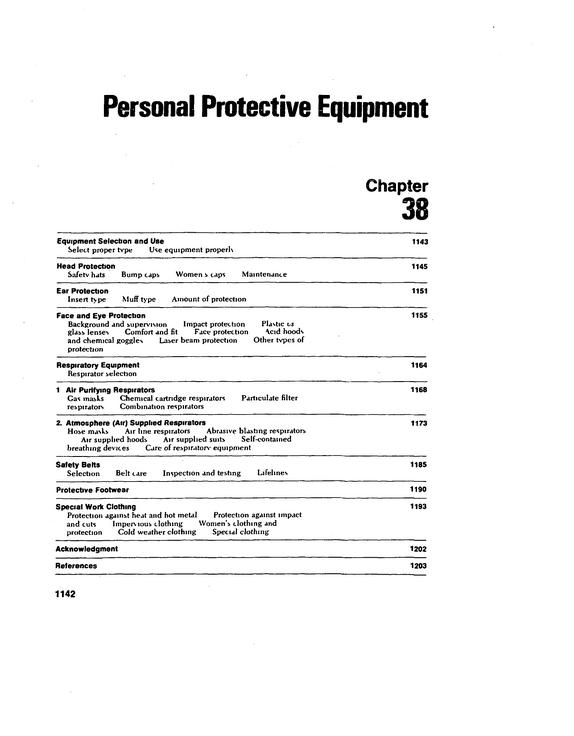
Equipment Selection and Use Select proper tvpe Use equipment properlv Head Protection Safetv hats Bump caps Women s caps Maintenance Ear Protection Insert type Muff type Amount of protection Face and Eye Protection Background and supervision Impact protection Plastic os glass lenses Comfort and fit Face protection Acid hoods and chemical goggles Laser beam protection Other tvpes of protection Respiratory Equipment Respirator selection 1 Air Purifying Respirators Gas masks Chemical cartridge respirators respirators Combination respirators Particulate filter 2.
refid# OJ34GEYqr7MDpVM1g7jBxLQ8j1 page
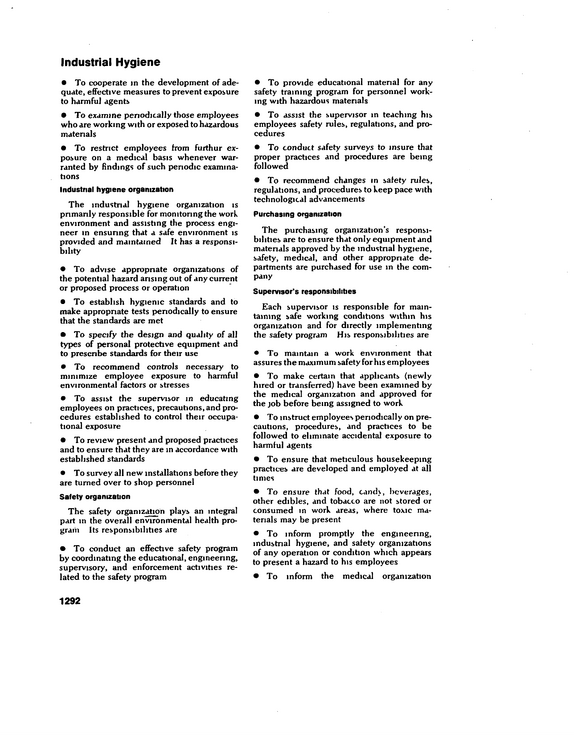
Industrial Hygiene To cooperate in the development of ade quate, effective measures to prevent exposure to harmful agents To examine periodically those employees who are working with or exposed to hazardous matenals To restrict employees from furthur ex posure on a medical basis whenever war ranted by findings of such periodic examina tions Industrial hygiene organization The industrial hygiene organization is primarily responsible for monitoring the work environment and assisting the process engi neer in ensuring that a safe environment is provided and maintained It has a responsi bility To advise appropriate organizations of the potential hazard arising out of any current or proposed process or operation To establish hygienic standards and to make appropnate tests periodically to ensure that the standards are met To specify the design and quality of all types of personal protective equipment and to prescribe standards for their use To recommend controls necessary to minimize employee exposure to harmful environmental factors or stresses To assist the supervisor m educating employees on practices, precautions, and pro cedures established to control their occupa tional exposure To review present and proposed practices and to ensure that they are in accordance with established standards To survey all new installations before they are turned over to shop personnel Safety organization The safety organization plays an integral part in the overall environmental health pro gram Its responsibilities are To conduct an effective safety program by coordinating the educational, engineering, supervisory, and enforcement activities re lated to the safety program To provide educational material for any safety training program for personnel work ing with hazardous matenals To assist the supervisor m teaching his employees safety rules, regulations, and pro cedures To conduct safety surveys to insure that proper practices and procedures are being followed To recommend changes in safety rules, regulations, and procedures to keep pace with technological advancements Purchasing organization The purchasing organization's responsi bilities are to ensure that only equipment and matenals approved by the industnal hygiene, safety, medical, and other appropriate de partments are purchased for use m the com pany Supervisor's responsibilities Each supervisor is responsible for main taining safe working conditions within his organization and for directly implementing the safety program His responsibilities are To maintain a work environment that assures the maximum safety for his employees To make certain that applicants (newly hired or transferred) have been examined by the medical organization and approved for the job before being assigned to work To instruct employees periodically on pre cautions, procedures, and practices to be followed to eliminate accidental exposure to harmful agents To ensure that meticulous housekeeping practices are developed and employed at all times To ensure that food, cands, beverages, other edibles, and tobacco are not stored or consumed in work areas, where toxic ma terials may be present To inform promptly the engineering, industnal hygiene, and safety organizations of any operation or condition which appears to present a hazard to his employees To inform the medical organization 1292
refid# gD663REL7wkLJzb4LRZvzO3ze1 page
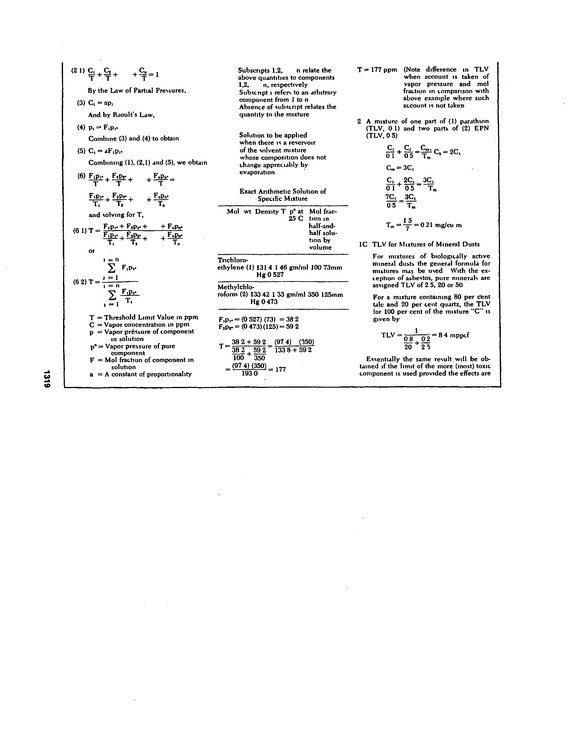
1319 (2 1) C, C, TT =1 T By the Law of Partial Pressures, (3) C, = op, And by Raoult's Law, (4) p, = F,Pf Combine (3) and (4) to obtain (5) C, = aF,p,.
refid# wD8L6mBM5KQjRmEoxnG4ZyQyJ1 page
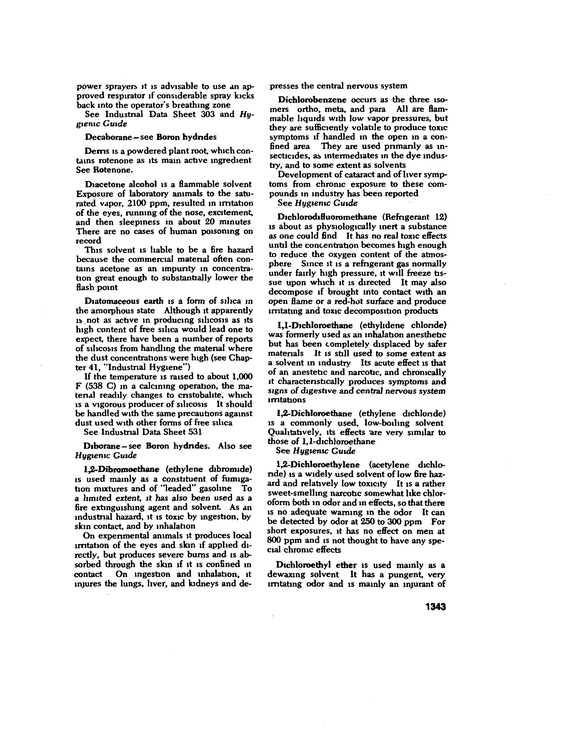
power sprayers it is advisable to use an ap proved respirator if considerable spray kicks back into tbe operator's breathing zone See Industrial Data Sheet 303 and Hygiemc Guide Decaborane--see Boron hydndes Dems is a powdered plant root, which con tains rotenone as its main active ingredient See Rotenone.
refid# O104gB0vLQgxY6raMNJVLq2dL1 page
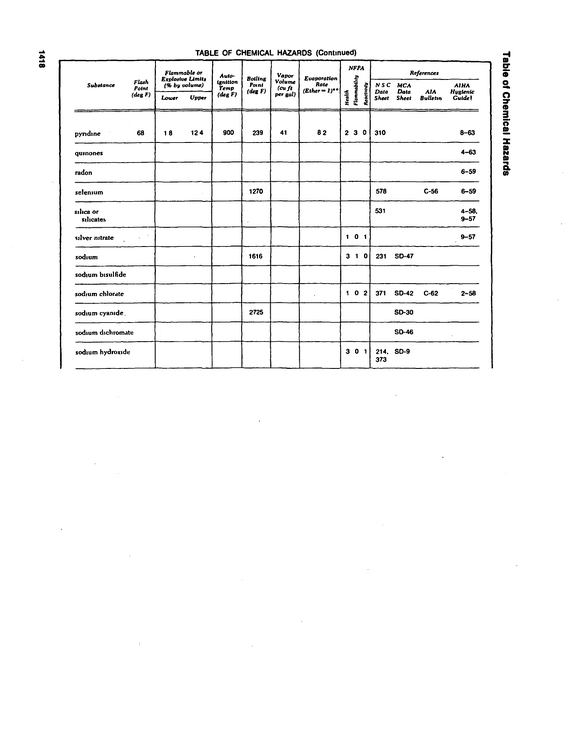
Table of Chemical Hazards 1418 Sub,t,,nce TABLE OF CHEMICAL HAZARDS (Continued) (deg F) Flammable or Explosive Limits (% by volume) Lower Upper Autoignition Temp (deg F) Boiling Point (deg F) Vapor Volume (cuft per gal) Evaporation Rate (Ether** !)
refid# G5yQgO9LQkGwrVG0JZ9YBaX8V1 page
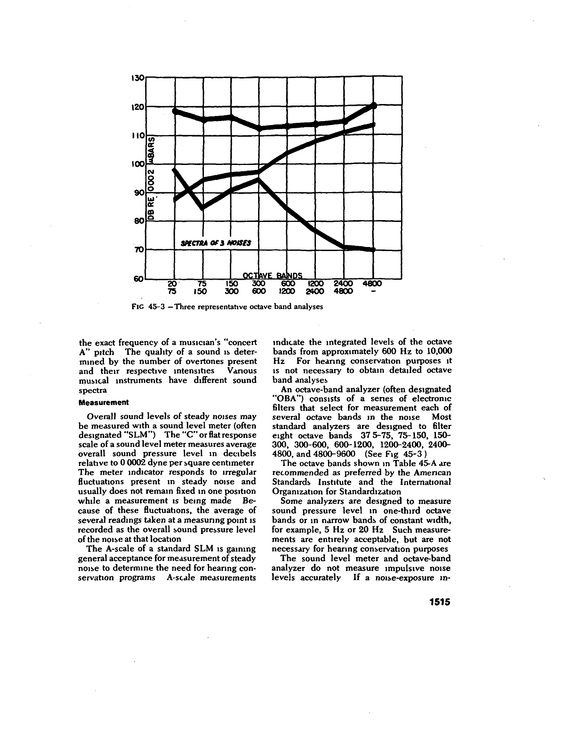
130 120 110 100 90 80 70 60 20 75 150 300 600 1200 2400 4800 75 150 300 600 >200 2400 4800 FlC 45-3 --Three representative octave band analyses the exact frequency of a musician's "concert A" pitch The quality of a sound is deter mined by the number of overtones present and their respective intensities Various musical instruments have different sound spectra Measurement Overall sound levels of steady noises may be measured with a sound level meter (often designated "SLM") The "C" or flat response scale of a sound level meter measures average overall sound pressure level in decibels relative to 0 0002 dyne per square centimeter The meter indicator responds to irregular fluctuations present m steady noise and usually does not remain fixed in one position while a measurement is being made Be cause of these fluctuations, the average of several readings taken at a measuring point is recorded as the overall sound pressure level of the noise at that location The A-scale of a standard SLM is gaining general acceptance for measurement of steady noise to determine the need for hearing con servation programs A-scale measurements indicate the integrated levels of the octave bands from approximately 600 Hz to 10,000 Hz For hearing conservation purposes it is not necessary to obtain detailed octave band analyses An octave-band analyzer (often designated "OBA") consists of a senes of electronic filters that select for measurement each of several octave bands in the noise Most standard analyzers are designed to filter eight octave bands 37 5-75, 75-150, 150300, 300-600, 600-1200, 1200-2400, 24004800, and 4800-9600 (See Fig 45-3 ) The octave bands shown m Table 45-A are recommended as preferred by the Amencan Standards Institute and the International Organization for Standardization Some analyzers are designed to measure sound pressure level in one-third octave bands or in narrow bands of constant width, for example, 5 Hz or 20 Hz Such measure ments are entirely acceptable, but are not necessary for hearing conservation purposes The sound level meter and octave-band analyzer do not measure impulsive noise levels accurately If a noise-exposure m- 1515
refid# 3Jo7My79zyQZeVqxQ6xYZ28kn1 page
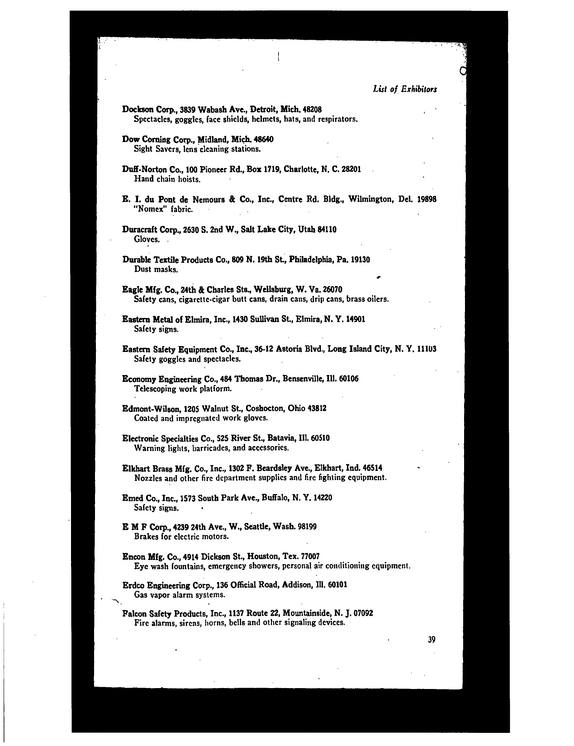
i List of Exhibitors Dockson Corp., 3839 Wabash Ave., Detroit, Mich, 48208 Spectacles, goggles, face shields, helmets, hats, and respirators.
refid# GadpzN7XXM4LqqGzEQ8eKKVV1 page
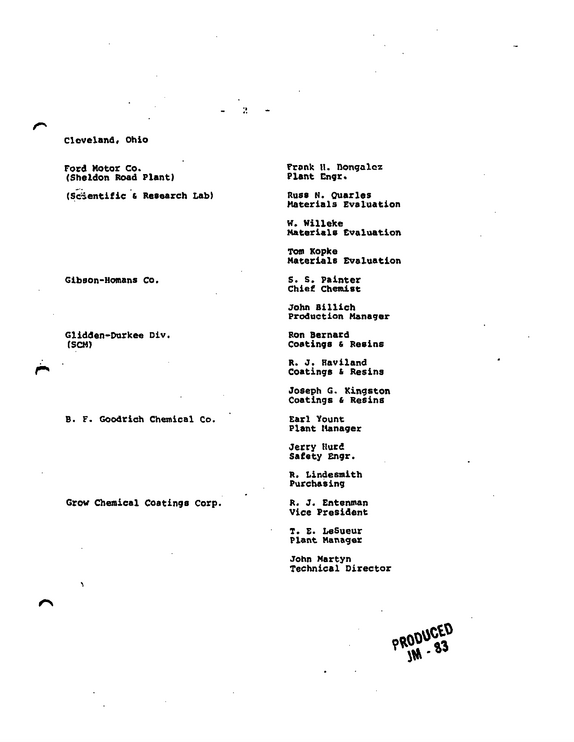
Cleveland# Ohio Ford Motor Co.
refid# eZDyeMkdXM277E27na3B4Dqg1 page
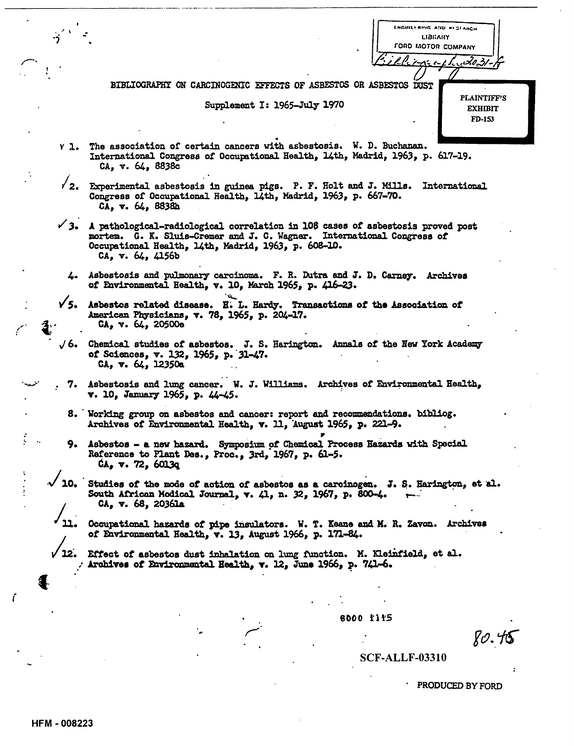
auo mi 21 auch LI3CAHY rono motor company /"`s /Lfl, >-yVC~lr d ;jL BIBLIOGRAPHY OK CARCINOGENIC EFFECTS OF ASBESTOS OR ASBESTOS DOST Supplement I: 1965-July 1970 v 1.
refid# 99M1Xq3GjMdqM1OYdKyzELLV1 page
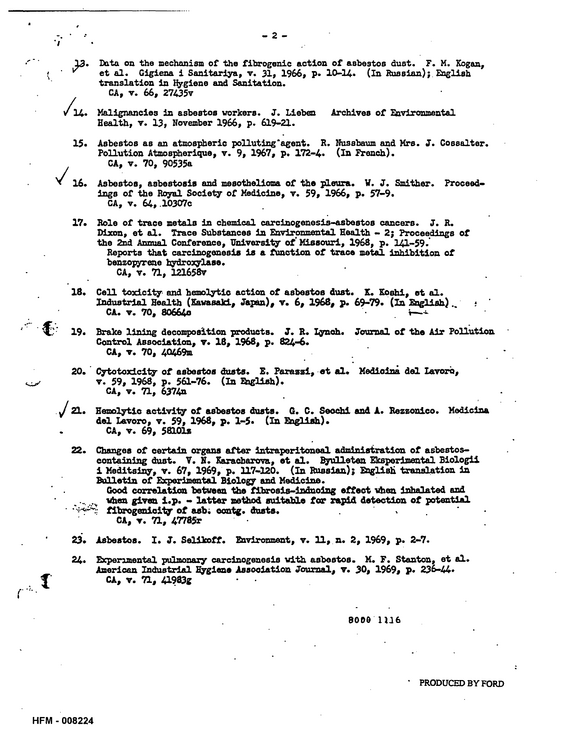
3 Data on the mechanism of the fihrogenie action of asbestos dust.
refid# 6pb4qyR8777X56m41214MaYg1 page
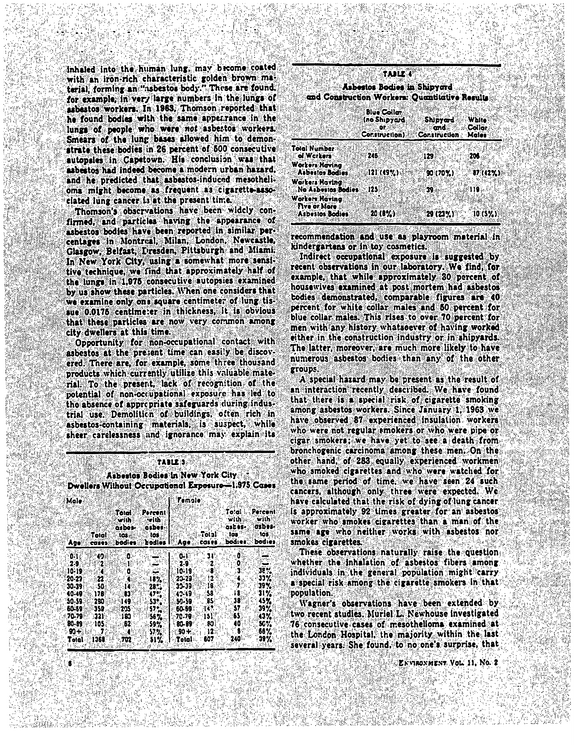
Inhaled into the human lung, may b*come coated with an iron-rich characteristic golden brown ma terial, forming an ".nsbestoa body."
refid# e5Gg5R5gOdNvNG5Xa7vZr5G6e1 page
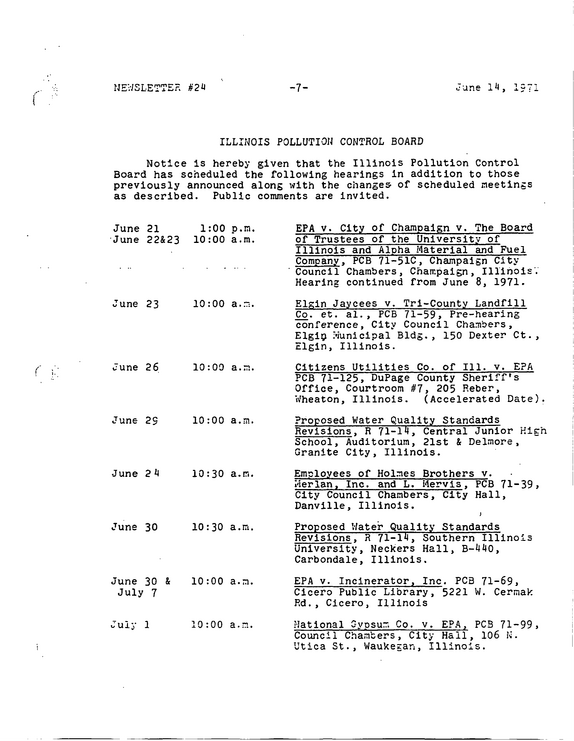
NEWSLETTER #24 -7- cane li y ILLINOIS POLLUTION CONTROL BOARD Notice Is hereby given that the Illinois Pollution Control Board has scheduled the following hearings in addition to those previously announced along with the changes of scheduled nestings as described.
refid# LKpYwB1ejGgbO21ynGG7Yr2jd1 page