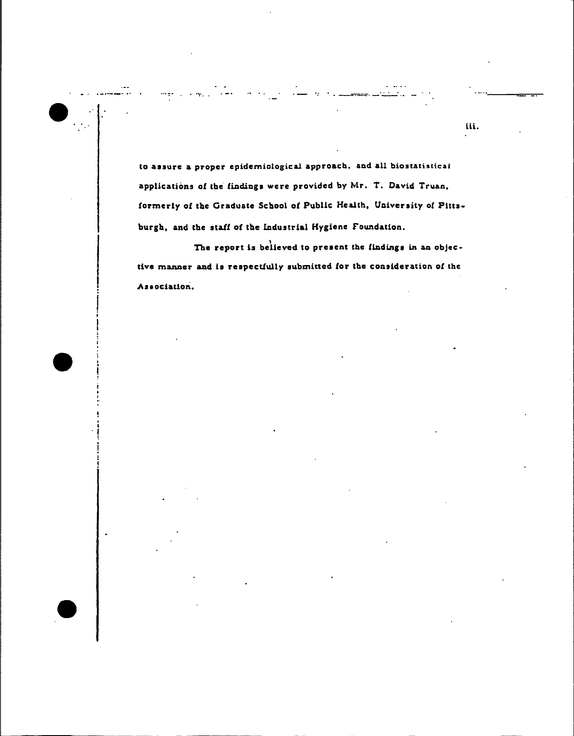
Ui. to assure a proper epidemiological approach, and all biostatistical applications of the findings were provided by Mr.
refid# 37B1rpr2raGd6yMZ17gGQeQ5O1 page
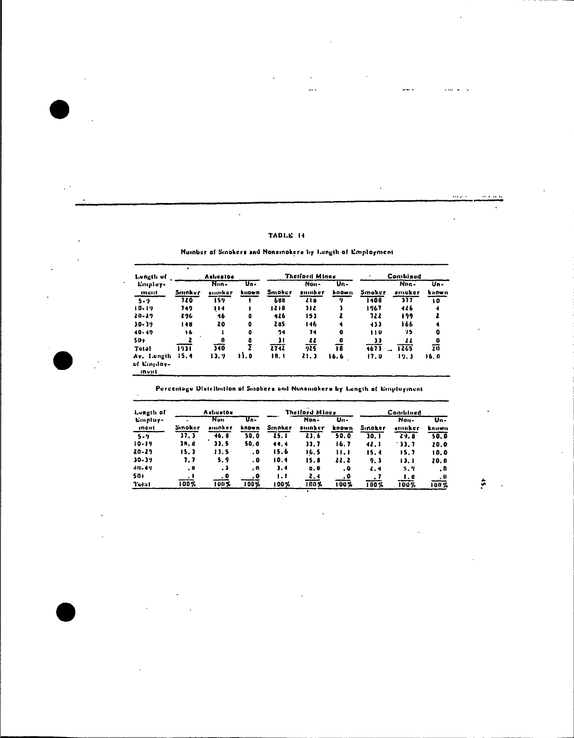
TADm 14 Number ol Smoker. and Nongmokcre by l.cnuili ol Cmploynrcni Unijlli of L'mpluy * Asbestos Nun* ' Un- muni Smnkur omiihor known 5-9 1 D. 1 9 20-29 720 ISO 740 IN 296 46 i 1 0 )0-)9 40.49 I4B 20 0 lb 1 0 5U Total Av.
refid# G10K9Z3VqXDM9YRj53M4ZvVn1 page
I ,t^rft4*aeMawivt .........
refid# jeMR11j6Ym1M2NvNdY0JMgZ91 page
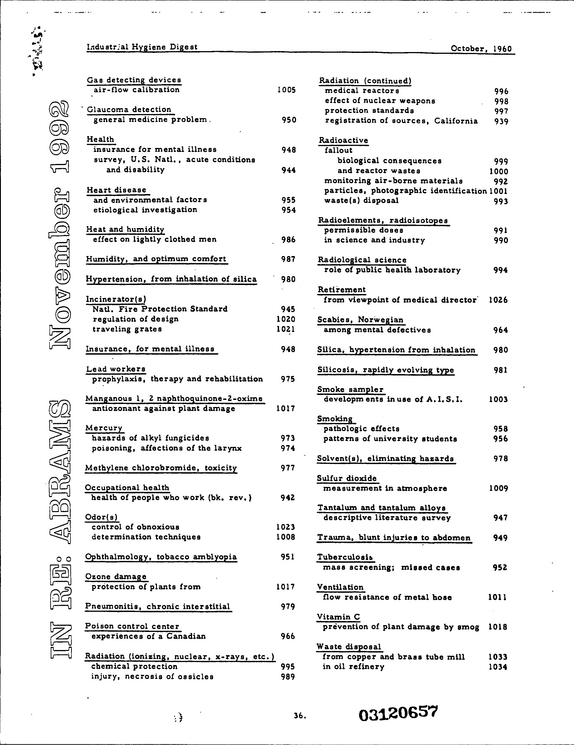
; '/I J Industrial Hygiene Digest October, 1960 Gas detecting devices air-flow calibration 1005 Glaucoma detection general medicine problem. 950 Health insurance for mental illness Burvey, U.S.
refid# mBLdOzJX8JMgyqZOvebzoe8qg1 page
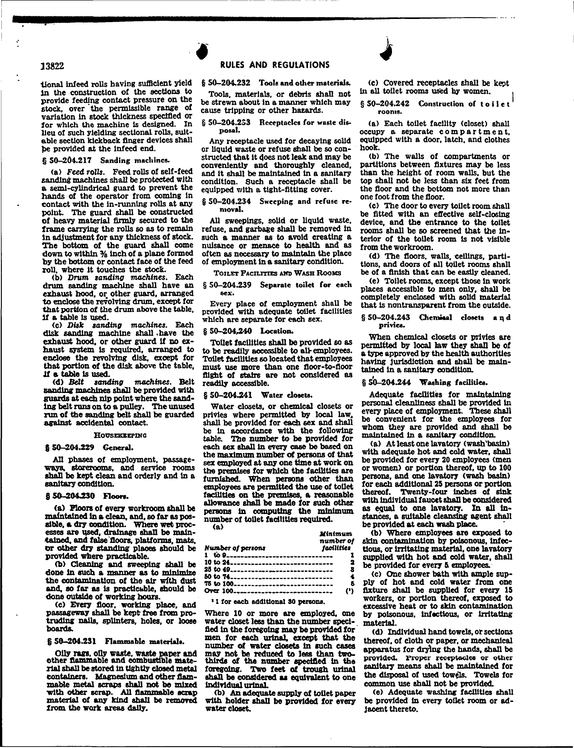
13822 RULES AND REGULATIONS tional infeed rolls having sufficient yield 50-204.232 Tools and other materials.
refid# NEp7NvjLD45Vp43nNN3ZqnmOy1 page
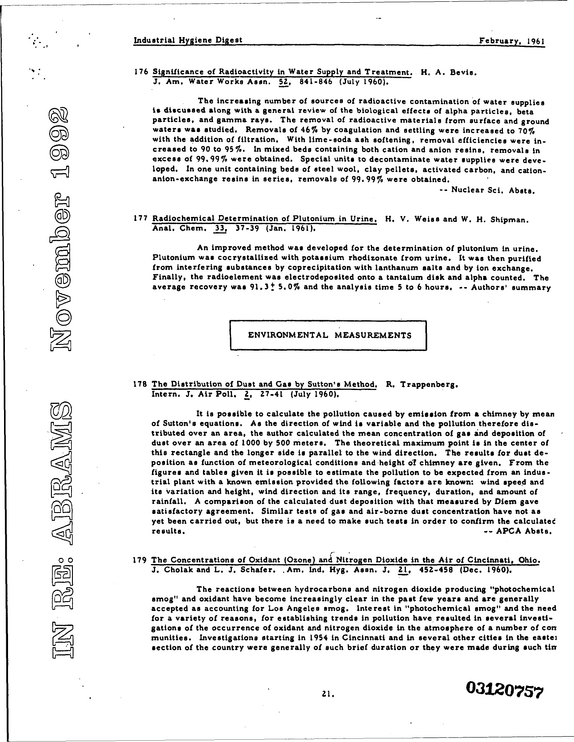
s=3 O0 Industrial Hygiene Digest February, 1961 176 Significance of Radioactivity in Water Supply and Treatment.
refid# NGRD8qdbq6vqOZYwEng3qV1x81 page
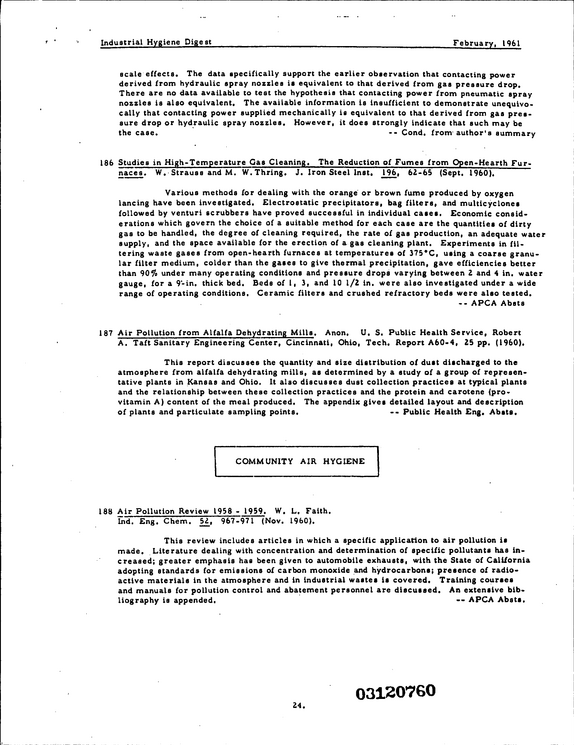
Industrial Hygiene Digest February, 1961 scale effects.
refid# 6Bvg0D0768yNroXeVqeQjYkJ31 page
.. ' V.-.
refid# 7RZVVok62YqnxkN25aQo2yxea1 page
CHAPTER 5 HUMAN BEHAVIOR AND INDUSTRIAL SAFETY Understanding people: psychological factors in safety------------------ Individual differences: contributing factors influence of dif ferences on safety methods of measuring characteristics human nature - -- - ---------------------------------- Motivation- all behavior is `caused' similar internal forms of reference human needs complexity of motivation-- Emotions and attitudes- frustration and anxiety emotional patterns maladjushve results of emotion motivational effect of emotion . . be a good listener attitudes---------- Learning: motivational requirements . laws of learning concomitant process forgetting . ----- ---- timiiny ----- ----------------___ - --- 5-2 5-3 5-6 5-13 5-20 5-24 The function of a safety director or safe ty engineer in industry is to assist line management m achieving maximum produc tion by limiting the number of disabling accidents which occur as a result of the failure of some unit in the industrial proc ess This unit could be the equipment, ma terials, or methods used, the safety devices, or the individual worker To do his job properly, the safety man must make the worker conscious of the importance of safe ty, either as a goal in itself ot as a means to some other goal Consequently, a major portion of safety work lies in the realm of human relations The importance of the other facets of a sound safety program must not, of course, be minimized The safety man is also con cerned with safe plant layouts, safety de vices on machines and use of such devices by employees, the wearing of safe clothing and use of protective equipment, all of which contnbute to the reduction of dis abling accidents When, however, in spite of every precau tion on the part of the manufacturer of equipment, the suppber of materials, the su pervisor, and the safety man accidents are caused, the human element emerges as an important factor It takes working with supervisors, foremen, and other line man agement as well as individual employees be fore the safety man is rewarded by better accident reduction This chapter was revised by the original author Howard C Klopp, Dean of Bogan Junior College, Chicago, based upon reviews by selected members of the National Safety Council S-l
refid# QXBJQJ3vNL209E3xYEv9LLw81 page
SAFETY TRAINING those jobs The method was declared haz ardous only after it resulted in an accident Making sure that safe procedures are estab lished is a supervisory responsibility Gwmg fob instruction, with necessary em phasis on safety aspects of the job, will help eliminate one of the most frequent causes of accidents--lack of knowledge or skill If em ployees are expected to do their work safely, supervisors must show them exactly how to do the work and must make sure that the employees have the knowledge and skill to do it in exactly that manner Assigning people to fobs is closely related to job instruction Whenever a supervisor makes a work assignment, safety, as well as good job performance, requires that he be sure the man is qualified to do the job and thoroughly understands the work method Even an experienced worker needs some direction Superetstng people at work is necessary even after a safe work method has been established and workers have been instructed according to that method People deviate from established safe practices, and injuries result Usually, it is then found that the injured employees have been neglecting safe practices for some time In order to prevent injuries from this cause, supervisors must watch for unsafe work methods and correct them as soon as they are observed Maintaining the equipment and the work place m safe condition is no different from maintaining them in efficient condition Ac cidents result from tools and equipment in poor condition, from a disorderly work place, or from makeshift tools used because the right tools are not available The supervisor who keeps his department and equipment in top condition helps to prevent accidents as well as to improve efficiency Getting supervisors to accept safety responsibility Not only are these five functions a normal part of the supervisor's job but, unless lines of organization and authority are seriously disregarded, nobody else can perform them Sometimes this fact is overlooked True, m exceptional cases and for good reasons, some companies give the chief re sponsibility for safety to safety personnel who exercise direct supervisory authority In these cases, much of what is said here about the responsibility of supervisors does not apply If, however, management expects supervisors to be responsible for safety, lines of authority should be maintained and the responsibility should really be theirs To bring about acceptance of safety re sponsibility by line supervisors in an organi zation where they do not now accept this responsibility requires an executive order, adherence to that order, and education of the supervisors A clear and positive executive order de fining the safety responsibilities of all per sons and departments should be issued All members of management should adhere con sistently to the policy of supervisory responsibihty A careful program of education should be instituted to help supervisors un derstand and accept their responsibilities and to give them specific help m their work of preventing accidents Most supervisors have acquired their pres ent positions in organizations where some sort of safety program was already in exist ence, and their understanding of the pro gram as it has existed is firmly established A safety director undertaking die safety train ing of supervisors will almost mvariably find that his first major job is to get super visors of all levels to understand and accept their responsibility for accident prevention This job cannot be done m a single meeting or a single communication Simply getting supervisors to agree in theory that safety is their responsibility is not enough They must come to understand the many ways m which they can prevent accidents, and they must become interested in improving their safety performance Objectives of safety training for supervisors Before the safety training of sujiervisors is undertaken, the objectives of that training must be understood and stated specifically Determining objectives for supervisory train ing is so important and involves so many lands of activity that it should be made the subject of careful study and consultation Members of the safety department should not attempt to set up objectives alone, but should confer with representative super visors and members of higher management The following statement of objectives should be used only as a guide to be studied and modified to fit specific situations and should be accepted only to the extent that 6-4
refid# o9EJR1mq4G9O326n050BKagoo1 page
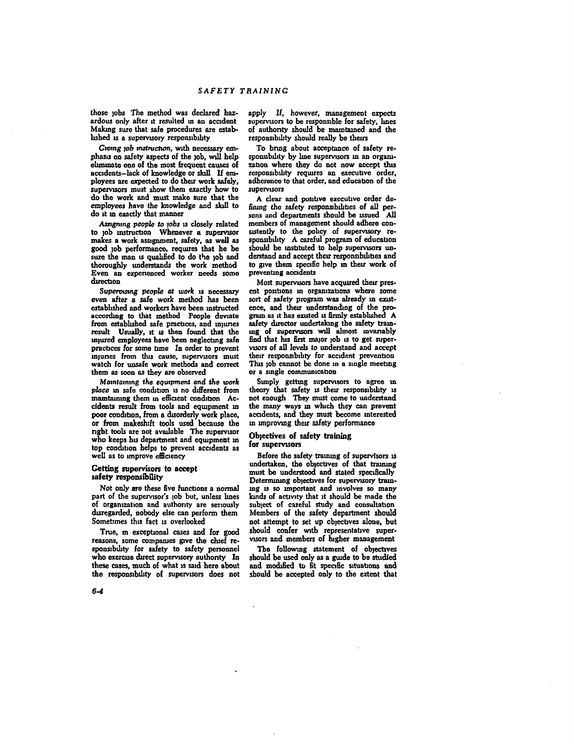
MAINTAINING INTEREST IN SAFETY ever, also can issue attractive booklets, leaf lets, and personalized messages, and at neg ligible expense The National Safety Council, trade asso ciations, and professional organizations publish a wide variety of booklets and leaf lets that are authoritative, attractive, and inexpensive They cover a large range of subjects--handling materials, first aid, housekeepmg, fire prevention, vacation safe ty, safe driving, and the like Such materi als, carefully selected and distributed on a regular basis, effectively supplement com pany prepared publications Letters commending meritorious service, signed by the manager and addressed to in dividuals, make an excellent impression upon workers Safety calendars, published by the National Safety Council, together with Christmas letters from the manager have a direct appeal that reaches the work- Fig 7-16 It's nome mokes this well-known confection o "natural" for conveying a sofety message Roper cups, pencils, note books, and other items have also been used with good effect Cotirlasy Philadelphia Electric Company ers' homes Such mailing lists should in clude every employee Buttons, blotters, book matches, jpencils, and other small novelties, all conveying a safety message, also may be used Giving such a token to each employee with whom the safety man has contact can contribute to good relationships (See Fig 7-16 ) Public address systems Public address systems often are used to broadcast announcements and page employ ees Manv companies have taken advantage of these installations to broadcast safety in formation Such messages should be planned care fully Employees might readily lose mterest in long speeches or too-frequent safety re minders When the public address system is used foT broadcasting music, safety an nouncements can be made between numbers The National Safety Council, local coun cils, and other organizations can furnish suggested bnef announcements prepared for radio and TV use and equally appropriate for public address systems Suggestion systems Since accident prevention is closely asso ciated with efficiency, many safety sugges tions help not only in preventing accidents but also m lowering the cost of production, in improving manufacturing conditions and methods, and m bettering the health and raising the morale of the workers Companies operating general suggestion systems pay out considerable sums for em ployee suggestions They feel thBt it is money well spent because of the value of the suggestions themselves Improved em ployee interest and morale are additional benefits, and these benefits have been the primary consideration in the setting up of many suggestion plans If a company does not have a general sug gestion system, it is probably better not to establish one for safety suggestions alone To do so sets safety aside from ordinary operating procedures The work in connection with receiving and passing on suggestions is considerable, and under a system for safety suggestions only, the suggestions suitable for awards are comparatively few Moreover, the awards usually are small, and this fact does not add to the presbge of safety Getting safety suggestions informally, however, is important and should be encour aged by all ranks of management Posters and other propaganda should urge employ ees to tell their supervisors or members of the safety committee if they have good ideas about safety Recognition for these suggestions should be given by the super visors, and noteworthy cases should be pub licized in the plant paper and on the bulle tin hoards Safety suggestions, like production sug- 7-29
refid# byBKQ3NYZNbDBQL2x0djYn2mD1 page
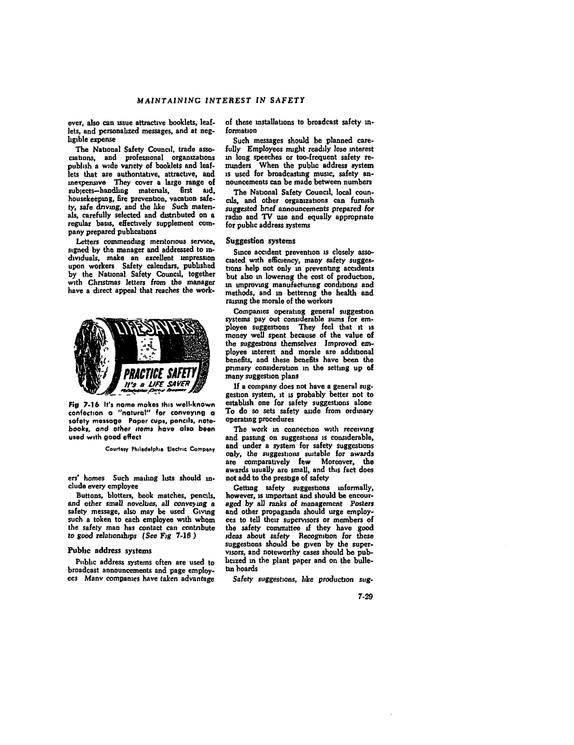
MANUAL HANDLING AND STORAGE OF MATERIALS Fig 17-7.
refid# ZJKrV71oyoJLxKwKzJdvXMN771 page
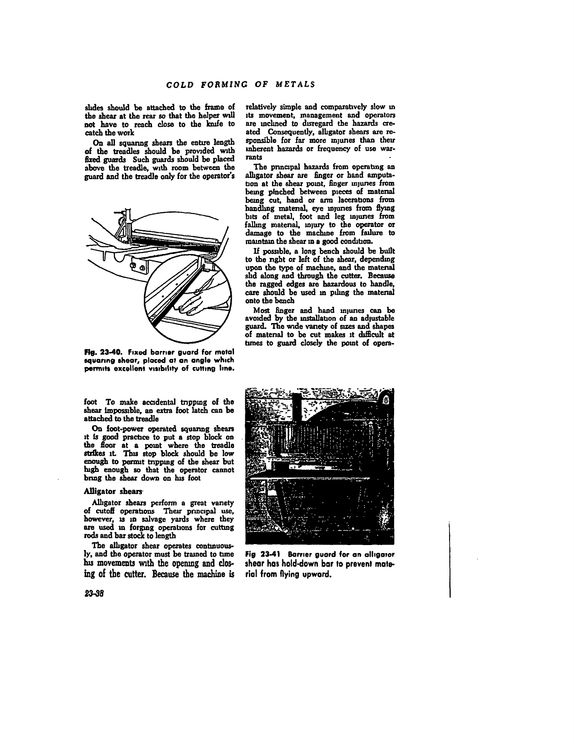
COLD FORMING OF METALS slides should be attached to the bane of the shear at the rear so that the helper will not have to reach close to the knife to catch the work On all squaring shears the entire length of the treadles should be provided with fixed guards Such guards should be placed above the treadle, with room between the guard and the treadle only for the operator's Fig. 23-40.
refid# JJ48RQe634LKMn34mZ10BvnEK1 page
should be tested and each of the several electrical and hydraulic interlocks should be inspected every 8-hour shift to ensure that they are working properly A check list will aid in the inspection and provide a record A fixed barrier guard covering the die opening and all moving parts of the clamp ing mechanism should be installed at the rear of the machine This type of guard is especially important where banks of ma chines are set up close together and the operator of one machine works close to the back of another machine The guard should actuate a switch that completes the electri cal circuit on the machine, then it will have to be m place before the machine can be operated All control levers and knobs must be identified clearly and located so that the operator will be aided in avoiding mistakes The levers and knobs should be recessed or protected so that loose clothing will not catch on them and so that they cannot be accidentally bumped to set the machine in motion On large operations, air facks, elevators, or other lifting devices are used to raise barrels of raw materials for dumping into the hopper.
refid# M4RmqLyb6ZmepzRVK6LRp8qNM1 page
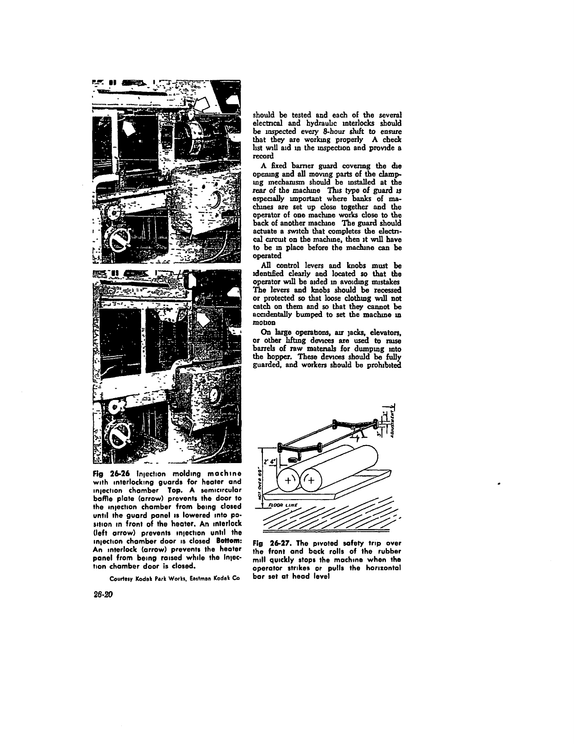
GUARDING EQUIPMENT IN SELECTED INDUSTRIES CARDS (Cotton Mills) 1 Be lure cylinder it stepped before open* mg or stripping o door 2 Use a light stick or long-hondled brush to remove flyings 3 To prevent dangerous bouncing of the roller, apply fight, steady pressure on the stripper ropes until cylinder begins to turn under its own weight 4 Remove drive belt before examining cylinder wire closely or repairing cards Turn cylinder slowly by hand 5 Use a duster, mop or brush to dean cards, never rags or hord waste Do not place mop or brush under cards 6 Be sure stripper gigs on vacuum shipper dose after each stripping operation 7 Report any defective or unguarded ma chines WOOL CARDING 1 Never attempt to remove waste from cylinders, workers, strippers, geors or pulleys white cords ore in motion 2 Follow the instructions of the overseor or second bond on wiping down cards 3 Never attempt to deon out under run* ning cards 4 Report defective guards immediately 5 Be sure to wipe up oil spots promptly 6 Wear clothes that fit, with no loose ends to catch in machines 7 Stop cord before putting on belts 8 Make sure all bond cords and tools ore off moehme ond in rock before storting up WOOL SPINNING 1 Never dimb in bock of mule carnage unless belt is thrown off 2 Be sure all bobbins ore picked up after each doff 3 Pick up bobbins only when mule has gone into forward motion 4 Report defective guards immediately 5 Avoid sudden changes of direction whon operating mules Walk carefully to pro* vent slips or foils 6 Stop carnage before end of outword run 7 Keep excess oil wiped up or use oil absorbent material fl Always opprooeh steps on frames square* ly Avoid stepping up on steps diago nally 9 Women should wear safety cops SLASHERS (Cotton Mills) 1 Push, do not pull, boom ceiling chains 2 Wear snug*flttmg clothing with long sleeves to prevent burnt or scolds 3 Cheek tofety volvo and steam control volvo doily Open steam valves slowly 4 Keep floors free of water, sixe or starch 5 Keep front delivery roll guord in place 6 Be sure steom valve is shut before open ing the sixe kettle lid, then open care* fully 7 Stack empty beams neatly ond in the dear, block empty booms to prevent rolling 8 Sea thot everyone is in the dear before storting slashers Fig 26-36 Safety check lists for the textile Industry 26-29
refid# OEVrz9gYBm5R5MVmpdzr3y49L1 page