Refine
Estimated Years UndatedClear
92,592 results foundRefine Search
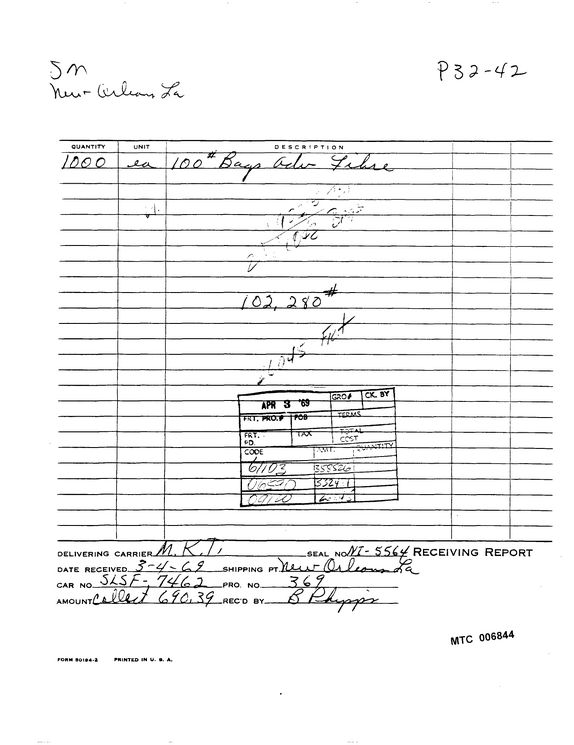
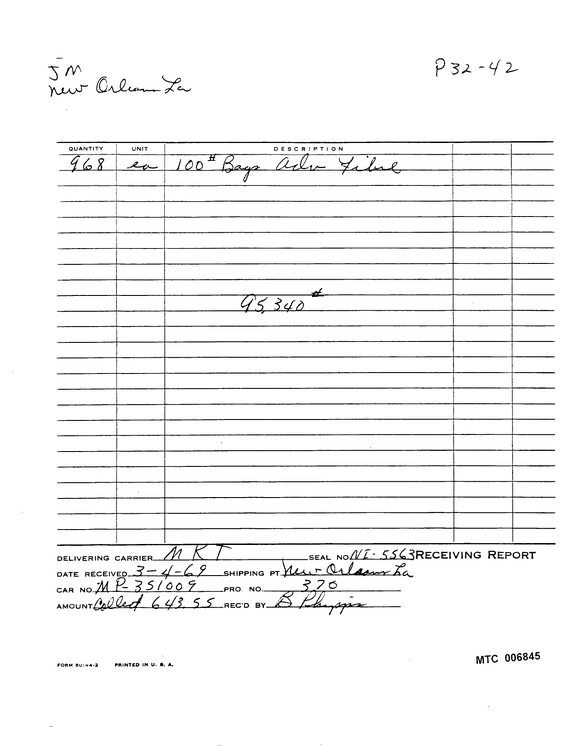
INITIALS MIC 006842 MTC 006843 5a 2- QUANTITY Meo UNIT DESCRIPTION j V A * > ' ___ _L ________________- ^ ,-y. ^ ____________ V'' ' f i / /' ` - (/ -d __________ /Q-3, ,3?
refid# DDOgxmy9kbNp3D5dnGVjjwBg450 pages
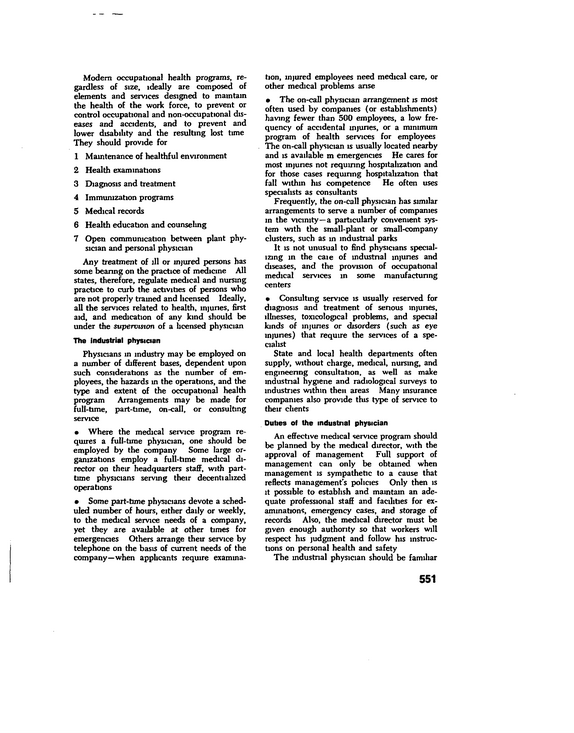
Modem occupational health programs, re gardless of size, ideally are composed of elements and services designed to maintain the health of the work force, to prevent or control occupational and non-occupational dis eases and accidents, and to prevent and lower disability and the resulting lost time They should provide for 1 Maintenance of healthful environment 2 Health examinations 3 Diagnosis and treatment 4 Immunization programs 5 Medical records 6 Health education and counseling 7 Open communication between plant phy sician and personal physician Any treatment of ill or injured persons has some bearing on the practice of medicine All states, therefore, regulate medical and nursing practice to curb the activities of persons who are not properly trained and licensed Ideally, all the services related to health, injuries, first aid, and medication of any kind should be under the supervision of a licensed physician The industrial physician Physicians in industry may be employed on a number of different bases, dependent upon such considerations as the number of em ployees, the hazards in the operations, and the type and extent of the occupational health program Arrangements may be made for full-time, part-time, on-call, or consulting service Where the medical service program re quires a full-time physician, one should be employed by the company Some large or ganizations employ a full-time medical di rector on their headquarters staff, with parttime physicians serving their decentralized operations Some part-time physicians devote a sched uled number of hours, either daily or weekly, to the medical service needs of a company, yet they are available at other times for emergencies Others arrange their service by telephone on the basis of current needs of the company--when applicants require examina tion, injured employees need medical care, or other medical problems anse The on-call physician arrangement is most often used by companies (or establishments) having fewer than 500 employees, a low fre quency of accidental injuries, or a minimum program of health services for employees The on-call physician is usually located nearby and is available m emergencies He cares for most injuries not requiring hospitalization and for those cases requiring hospitalization that fall within his competence He often uses specialists as consultants Frequently, the on-call physician has similar arrangements to serve a number of companies in the vicinity--a particularly convenient sys tem with the small-plant or small-company clusters, such as in industrial parks It is not unusual to find physicians special izing in the caie of industrial injuries and diseases, and the provision of occupational medical services in some manufacturing centers Consulting service is usually reserved for diagnosis and treatment of senous injuries, illnesses, toxicological problems, and special kinds of injuries or disorders (such as eye injuries) that require the services of a spe cialist State and local health departments often supply, without charge, medical, nursing, and engineering consultation, as well as make industrial hygiene and radiological surveys to industries within then areas Many insurance companies also provide this type of service to their clients Duties ot the industrial physician An effective medical service program should be planned by the medical director, with the approval of management Full support of management can only be obtained when management is sympathetic to a cause that reflects management's policies Only then is it possible to establish and maintain an ade quate professional staff and facilities for ex aminations, emergency cases, and storage of records Also, the medical director must be given enough authority so that workers will respect his judgment and follow his instruc tions on personal health and safety The industrial physician should be familiar 551
refid# mm7boaGwpo7gNy19GX8N7Rvq41 page
t.
refid# 2qGKO8Ev64NZ9wavaQDJX3aba5 pages
COVER SHEET FOR B-LEVEL DOCUMENTS REMOVED IN PRIVILEGE REVIEW ORIGINAL B-LEVEL BOX NO._______________ , PRODUCTION BOX NO
refid# N2dQwYYOKLQYrGxZG76xd6w4V18 pages
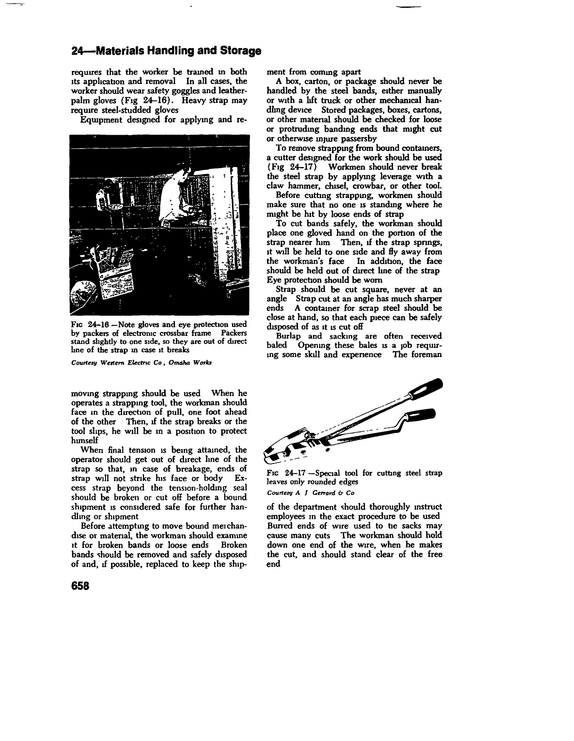
24--Materials Handling and Storage requires that the worker be trained in both its application and removal In all cases, the worker should wear safety goggles and leatherpalm gloves (Fig 24-16).
refid# 4538OQE1g9erJ26b1ZJx4bv11 page
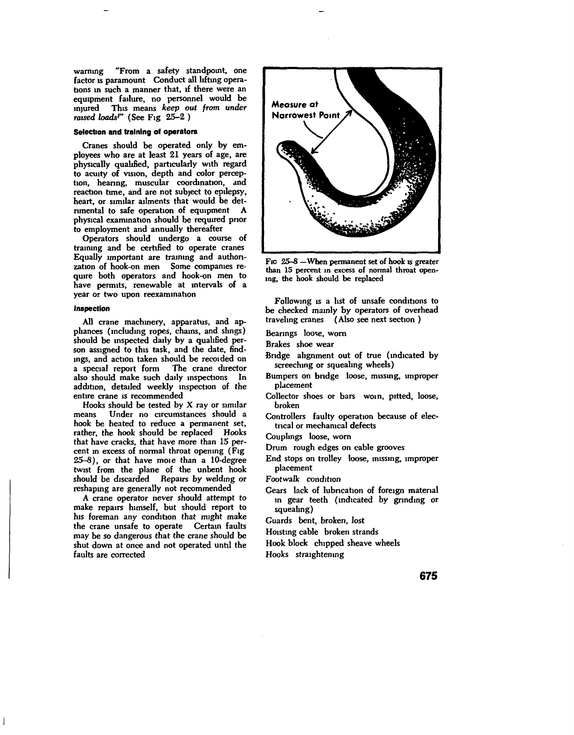
warning "From a safety standpoint, one factor is paramount Conduct all lifting opera tions in such a manner that, if there were an equipment failure, no personnel would be injured This means keep out from under raised loads1" (See Fig 25-2 ) Selection and training of operators Cranes should be operated only by em ployees who are at least 21 years of age, are physically qualified, particularly with regard to acuity of vision, depth and color percep tion, hearing, muscular coordination, and reaction time, and are not subject to epilepsy, heart, or similar ailments that would be det rimental to safe operation of equipment A physical examination should be required prior to employment and annually thereafter Operators should undergo a course of training and be certified to operate cranes Equally important are training and authori zation of hook-on men Some companies re quire both operators and hook-on men to have permits, renewable at intervals of a year or two upon reexamination Inspection All crane machinery, apparatus, and ap pliances (including ropes, chains, and slings) should be inspected daily by a qualified per son assigned to this task, and the date, find ings, and action taken should be recoided on a special report form The crane director also should make such daily inspections In addition, detailed weekly inspection of the entire crane is recommended Hooks should be tested by X ray or similar means Under no circumstances should a hook be heated to reduce a permanent set, rather, the hook should be replaced Hooks that have cracks, that have more than 15 per cent in excess of normal throat opening (Fig 25-8), or that have moie than a 10-degree twist from the plane of the unbent hook should be discarded Repairs by welding or reshaping are generally not recommended A crane operator never should attempt to make repairs himself, but should report to his foreman any condition that might make the crane unsafe to operate Certain faults may be so dangerous that the crane should be shut down at once and not operated until the faults are corrected Fig 25-8 --When permanent set of hook is greater than 15 percent in excess of normal throat open ing, the hook should be replaced Following is a list of unsafe conditions to be checked mainly by operators of overhead traveling cranes (Also see next section ) Bearings loose, worn Brakes shoe wear Bridge alignment out of true (indicated by screeching or squealing wheels) Bumpers on bridge loose, missing, improper placement Collector shoes or bars woin, pitted, loose, broken Controllers faulty operation because of elec trical or mechanical defects Couplings loose, worn Drum rough edges on cable grooves End stops on trolley loose, missing, improper placement Footwalk condition Gears lack of lubrication of foreign material in gear teeth (indicated by grinding or squealing) Guards bent, broken, lost Hoisting cable broken strands Hook block chipped sheave wheels Hooks straightening 675
refid# Nz64gKXpN0Vk8DVpoo9jDLBw1 page
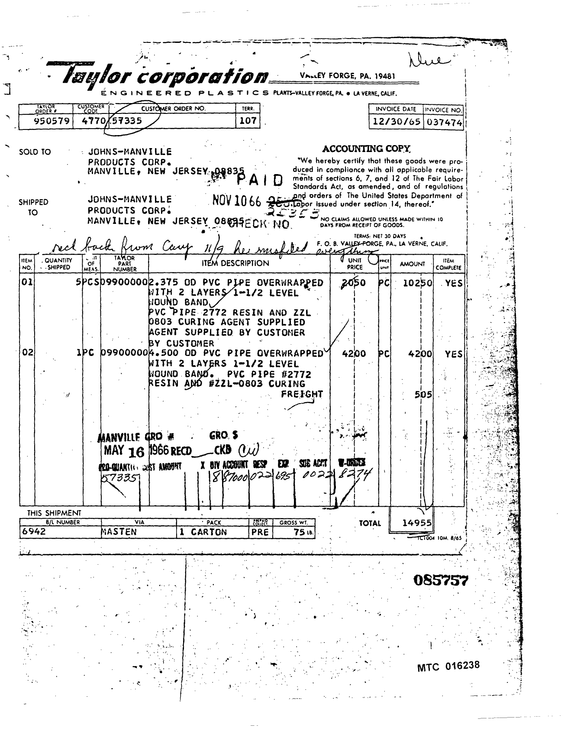
J 1 r r ^C. 0 X> PLAINTIFFS EXHIBIT JM 996 085755 MTC 016236 j f.1 MTC 016237 /u / corporation Vm-aEY FORGE, PA. 19481 ENGINEERED PLASTICS PLAHTS-VALLEY FORGE, PA.

refid# wQ8MwbgJBbr35j5w7eRb2JLo7 pages
0 00 e> 01 64 01 MTC 015711 ^ 0 !
refid# kDyZJodge2ZXrdBz4QXRJv58O360 pages
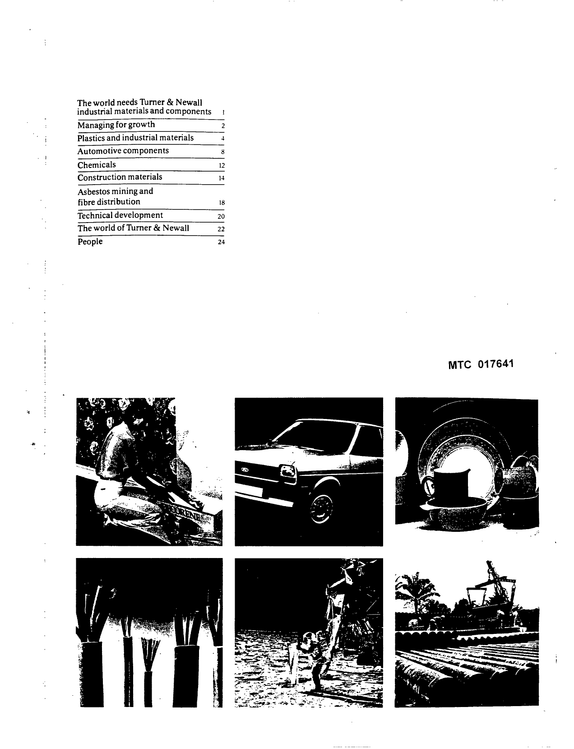
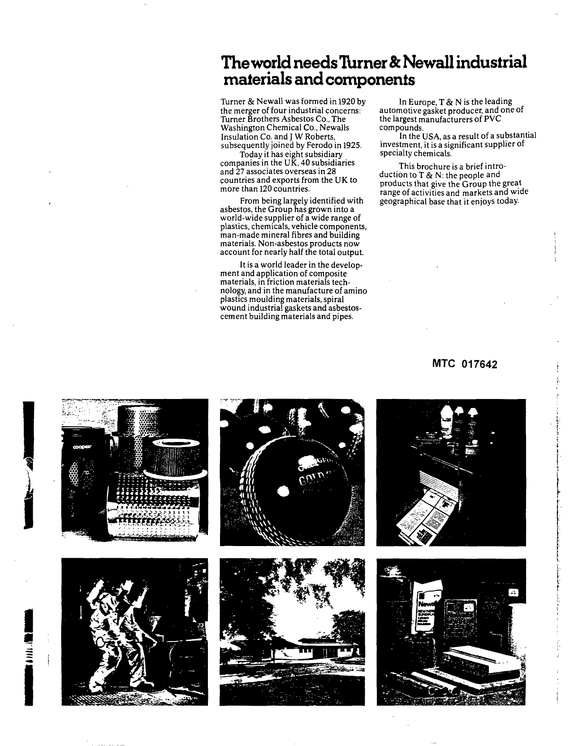
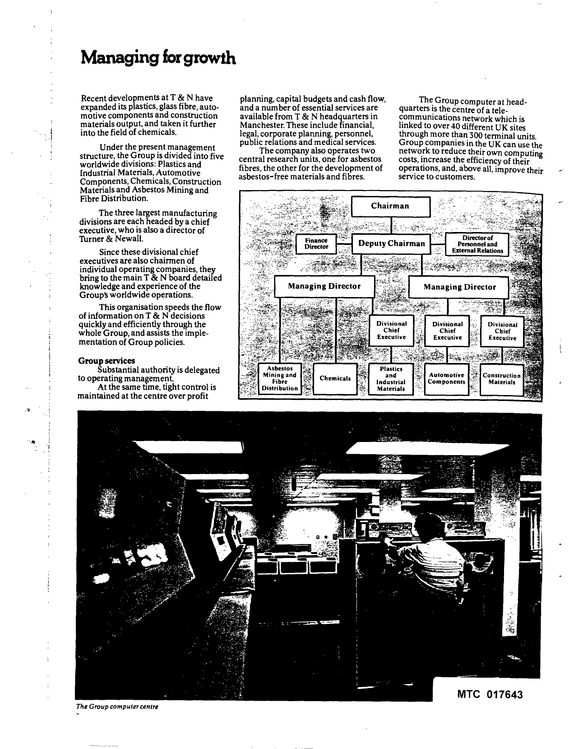
The world needs Turner & Newall industrial materials and components 1 Managing for growth 2 Plastics and industrial materials 4 Automotive components 8 Chemicals Construction materials 12 14 Asbestos mining and fibre distribution 18 Technical development The world of Turner & Newall 20 22 People 24 Theworld needsTurner & Newall industrial materials and components Turner & Newall was formed in 1920 by the merger of four industrial concerns: Turner Brothers Asbestos Co., The Washington Chemical Co., Newalls Insulation Co. and J W Roberts, subsequently joined by Ferodo in 1925.
refid# 99zOLkQEVywb8XZj7Nm8yLobR38 pages
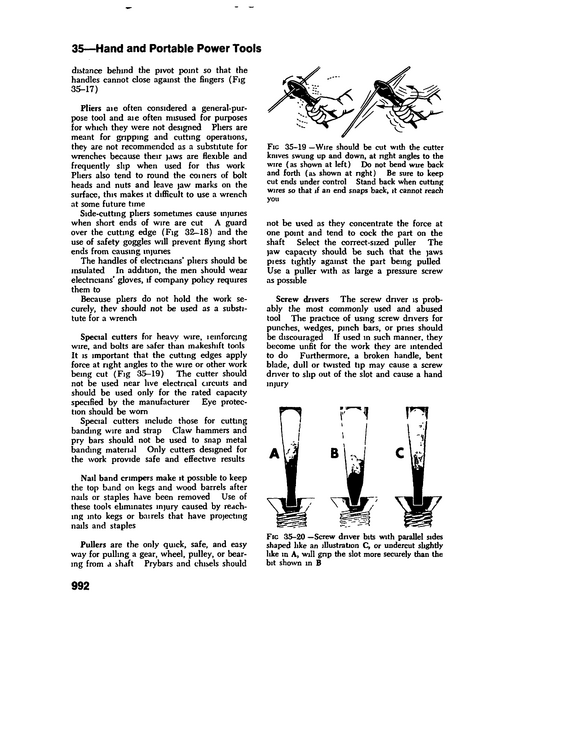
35--Hand and Portable Power Tools distance behind the pivot point so that the handles cannot close against the fingers (Fig 35-17) Pliers aie often considered a general-pur pose tool and aie often misused for purposes for which they were not designed Pliers are meant for gripping and cutting operations, they are not recommended as a substitute for wrenches because their jaws are flexible and frequently slip when used for this work Pliers also tend to round the coiners of bolt heads and nuts and leave jaw marks on the surface, this makes it difficult to use a wrench at some future time Side-cutting pliers sometimes cause injuries when short ends of wire are cut A guard over the cutting edge (Fig 32-18) and the use of safety goggles will prevent flying short ends from causing injuries The handles of electricians' pliers should be insulated In addition, the men should wear electricians' gloves, if company policy requires them to Because pliers do not hold the work se curely, thev should not be used as a substi tute for a wrench Special cutters for heavy wire, reinforcing wire, and bolts are safer than makeshift tools It is important that the cutting edges apply force at right angles to the wire or other work being cut (Fig 35-19) The cutter should not be used near live electrical circuits and should be used only for the rated capacity specified by the manufacturer Eye protec tion should be wom Special cutters include those for cutting banding wire and strap Claw hammers and pry bars should not be used to snap metal banding material Only cutters designed for the work provide safe and effective results Nail band crimpers make it possible to keep the top band on kegs and wood barrels after nails or staples have been removed Use of these tools eliminates injury caused by reach ing into kegs or bairels that have projecting nails and staples Pullers are the only quick, safe, and easy way for pulling a gear, wheel, pulley, or bear ing from a shaft Prybars and chisels should Fic 35-19 --Wire should be cut with the cutter knives swung up and down, at nght angles to the wire (as shown at left) Do not bend wire back and forth (as shown at nght) Be sure to keep cut ends under control Stand back when cutting wires so that if an end snaps back, it cannot reach you not be used as they concentrate the force at one point and tend to cock the part on the shaft Select the correct-sized puller The jaw capacity should be such that the jaws press tightly against the part being pulled Use a puller with as large a pressure screw as possible Screw drivers The screw driver is prob ably the most commonly used and abused tool The practice of using screw dnvers for punches, wedges, pinch bars, or pries should be discouraged If used m such manner, they become unfit for the work they are intended to do Furthermore, a broken handle, bent blade, dull or twisted tip may cause a screw driver to slip out of the slot and cause a hand injury rn r'f n Fic 35-20 --Screw driver bits with parallel sides shaped like an illustration C, or undercut slightly like m A, will grip the slot more securely than the bit shown m B 992
refid# 9KYZK6KKEEZGpVrNVNyegBy61 page
38--Industrial Toxicology and stibine are not produced In experi mental subacute or chronic phosphine poison ing, the effects are similar to those of poison ing by white or yellow phosphorus Phosphoric acid is a corrosive mineral acid, usually encountered as the tnbasic (orthophosphonc) acid Although its irritation of the skin and mucous membranes is not as pronounced as that of nitnc or sulfuric acid, 75 percent phosphoric acid will destroy body tissues and cause severe bums Phosphoric anhydride is a local irritant and a very strong dehydrating agent With mois ture it forms phosphoric acid (corrosive to the skm, mucous membranes, and the eyes, but is not considered as hazardous as nitnc or sulfunc acid) Very high concentrations of the anhydnde will cause violent coughing, al though those exposed regularly to the industnal fume apparently become acclimated to some degree No evidence of systemic poison ing has been reported in the literature for either acute or chronic exposures Suitable process enclosures or local exhaust ventilation or both should be used to control mdustnal exposures Avoid skm and/or eye contact For verv dusty conditions, the use of full face industrial canister masks, coveralls, rubber gloves, aprons, and foot protection are indi cated Phosphorus is supplied commercially as a dark red powder and as a light yellow trans lucent waxy solid Red phosphorus is harm less since it does not react with the air and is extremely insoluble Yellow phosphorus, how ever, melts at just about body temperature and is extremely flammable The liquid ignites spontaneously in the presence of air, and many painful bums have been produced by picking up pieces of phosphorus with the bare fingers It is normally stored as a sohd kept under water and transferred as a liquid Since the water used to shield vellow phos phorus invariably contains small particles of the material, it should not be permitted to escape from the plant premises until the phosphorus has been completely removed and burned The water should be cooled below the melting point of phosphorus, filtered to remove the larger particles, and then aerated 1164 thoroughly to oxidize remaining phosphorus before being disposed Bums from liquid phosphorus are ordinarily extremelv severe because of the high tempera ture of the flaming matenal m immediate con tact with the skm and because particles of the phosphorus will likely be left in the burned tissue when the area is cleaned up The burning can be stopped for the moment by saturating the area with cool water or immers ing the part m water The phosphorus will start to bum again as soon as the water runs off or evaporates The burning can be stopped permanently by washing the burned area thoroughly and repeatedlv with a solution of soluble copper salt, such as 3 percent copper sulfate This will precipitate metallic copper or perhaps copper phosphide on the surface of the phosphorus and prevent its further oxi dation After the skm surface has been cooled to solidify the particles, they can be easily found by their bright coppery appearance and removed If a copper salt solution is not available, the burning part can be covered with cloth satu rated m cold water, and kept saturated until the copper salt solution can be obtained, or until the particles can be otherwise removed If possible, spilled phosphorus should be immediately covered with water Large spills can be confined to a small area with sand or earth dikes and then flooded with water or covered with sand or earth and kept wet until the phosphorus can be burned or recovered Yellow phosphorus is toxic It may produce poisoning if taken by mouth, but m modem industry the only important method of absorp tion is by inhalation Although a few cases of chronic phosphorus poisoning have been reported, it is not a serious mdustnal hazard since most operations can be earned out under water and the ex posure can be minimized Chronic poisoning may take the form of general weakness, with anemia, loss of appetite, indigestion, and chronic cough resulting from lmtation of the gastrointestinal system and fatty degeneration of the liver Bone necrosis ("phossy jaw"), first seen in the preparation of phosphorus matches, may affect any bone but is most commonly seen in the jawbone It usually appears as a tooth ache followed by the loosening of one or more
refid# ymBV0jnpZw4RkwdpZonXn1vKV1 page
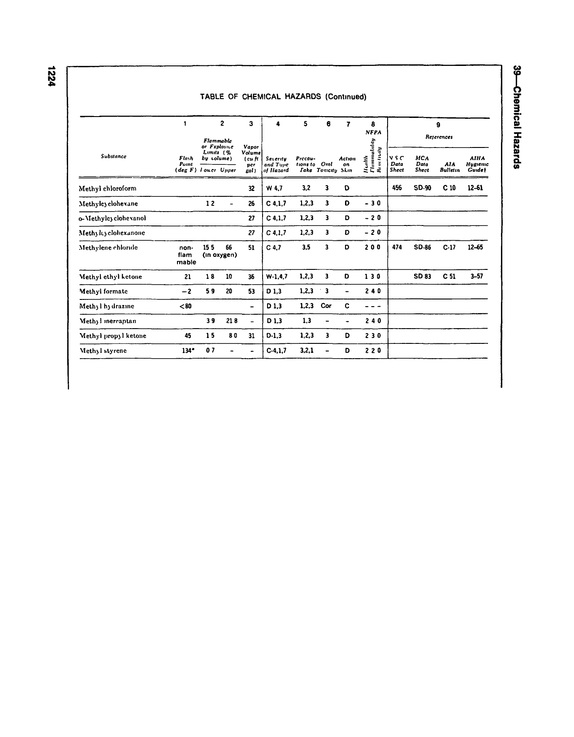
39-- Chemical Hazards 1224 Substance Methyl chloroform Methylcj clohexane o-Methylcj clohexanol Methy Icy clohexanonc Methylene chloride Methyl ethyl ketone Methyl formate Methy 1 hy drazinc Methyl mercaptan Methyl propyl ketone Methyl styrene TABLE OF CHEMICAL HAZARDS (Continued) i 2 3 4 5 67 Flammable or Fxploi ive Limits (% Ffrnh by volume) Point ideGF) / ouer Upper Vapor Volume leu ft SeLerify per and Sol) of Hazard Prccau~ Action tions to Oral on rake Toxicity Skin 8 NFPA s> .23 ^u V SC Data Sheet 9 References MCA Data Sheet A1A Bulletin AIHA Hygienic Guidet 32 W 4.7 12 - 26 C 4,1,7 27 C 4,1,7 27 C 4,1,7 non 15 5 66 51 C 4,7 flam (in oxygen) mable 21 18 10 36 W-l.4,7 -3 59 20 53 O 1,3 <80 - D 1.3 39 218 - D 1.3 45 1 5 80 31 0-1,3 134* 07 - - C-4,1,7 3,2 1,2,3 1.2,3 1,2.3 3.5 3 3 3 3 3 1.2,3 3 1,2.3 3 1.2.3 Cor 1,3 1,2.3 3 3,2,1 - D 0 D O D 0 C D D 456 SD-90 CIO 12-61 -30 -20 -20 2 0 0 474 SD-86 C-17 12-65 130 240 -- 240 230 220 SD 83 C 51 3-57
refid# 3egnDz7z16KxRwJg9yOwmejVa1 page
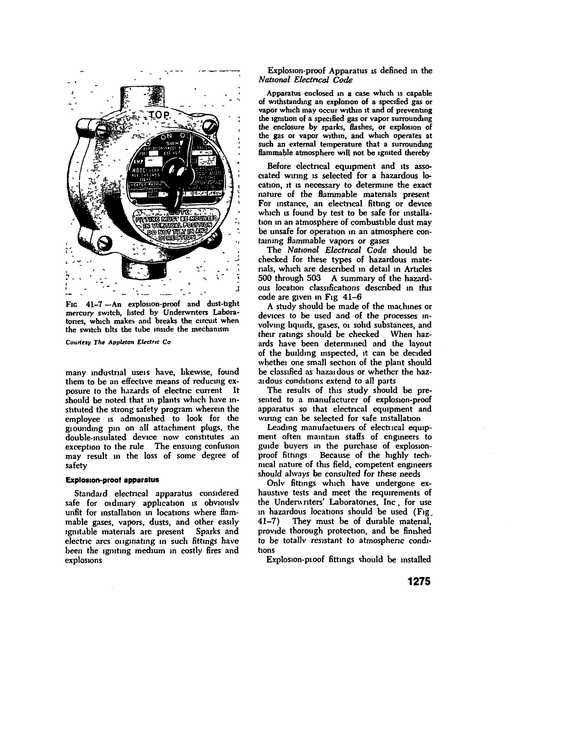
J Fic 41-7 --An explosion-proof and dust-tight mercury switch, listed by Underwriters Labora tories, which makes and breaks the circuit when the switch tilts the tube inside the mechanism Courte>it The Appleton Electric Co many industrial useis have, likewise, found them to be an effective means of reducing ex posure to the hazards of electric current It should be noted that in plants which have in stituted the strong safety program wherein the employee is admonished to look for the giounding pin on all attachment plugs, the double-insulated device now constitutes an exception to the rule The ensuing confusion may result m the loss of some degree of safety Explosion-proof apparatus Standaid electrical apparatus considered safe for oidinary application is obvionslv unfit for installation in locations where flam mable gases, vapors, dusts, and other easily ignitable materials are present Sparks and electric arcs ongmating in such fittings have been the igniting medium in costly fires and explosions Explosion-proof Apparatus is defined in the National Electrical Code Apparatus enclosed in a case which is capable of withstanding an explosion of a specified gas or vapor which may occur within it and of preventing the ignition of a specified gas or vapor surrounding the enclosure by sparks, flashes, or explosion of the gas or vapor within, and which operates at such an external temperature that a surrounding flammable atmosphere will not be ignited thereby Before electrical equipment and its asso ciated wiring is selected for a hazardous lo cation, it is necessary to determine the exact nature of the flammable materials present For instance, an electrical fitting or device which is found by test to be safe for installa tion in an atmosphere of combustible dust may be unsafe for operation m an atmosphere con taining flammable vapors or gases The National Electrical Code should be checked for these types of hazardous mate rials, which are described in detail m Articles 500 through 503 A summary of the hazard ous location classifications described in this code are given in Fig 41-6 A study should be made of the machines or devices to be used and of the processes in volving liquids, gases, oi solid substances, and their ratings should be checked When haz ards have been determined and the layout of the building inspected, it can be decided whethei one small section of the plant should be classified as hazaidous or whether the hazaidous conditions extend to all parts The results of this study should be pre sented to a manufacturer of explosion-proof apparatus so that electrical equipment and wiring can be selected for safe installation Leading manufactuiers of electiical equip ment often maintain staffs of engineers to guide buyers m the purchase of explosionproof fittings Because of the highly tech nical nature of this field, competent engineers should always be consulted for these needs Onlv fittings which have undergone ex haustive tests and meet the requirements of the Underwriters' Laboratories, Inc, for use in hazardous locations should be used (Fig, 41-7) They must be of durable material, provide thorough protection, and be finished to be totally resistant to atmospheric condi tions Explosion-pioof fittings should be installed 1275
refid# 2qYKrNMLx5Rgxj4rLawm4VqaN1 page
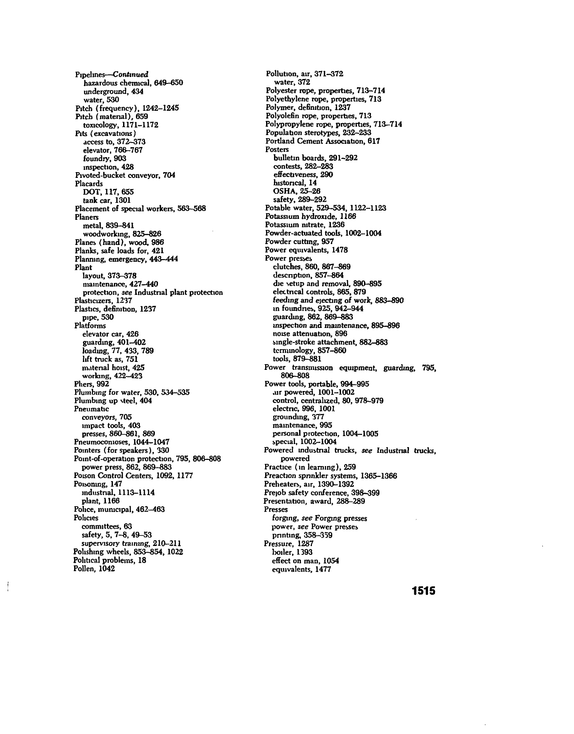
Pipelines--Continued hazardous chemical, 649-650 underground, 434 water, 530 Pitch (frequency), 1242-1245 Pitch (material), 659 toxicology, 1171-1172 Pits (excavations) access to, 372-373 elevator, 766-767 foundry, 903 inspection, 428 Pivoted-bucket conveyor, 704 Placards DOT, 117, 655 tank car, 1301 Placement of special workers, 563-568 Planers metal, 839-841 woodworking, 825-826 Planes (hand), wood, 986 Planks, safe loads for, 421 Planning, emergency, 443--444 Plant layout, 373-378 maintenance, 427-440 protection, see Industrial plant protection Plasticizers, 1237 Plastics, definition, 1237 pipe, 530 Platforms elevator car, 426 guarding, 401-402 loading, 77, 433, 789 lift truck as, 751 material hoist, 425 working, 422--423 Pliers, 992 Plumbing for water, 530, 534-535 Plumbing up steel, 404 Pneumatic conveyors, 705 impact tools, 403 presses, 860-861, 869 Pneumoconioses, 1044-1047 Pointers (for speakers), 330 Pomt-of-operation protection, 795, 806-808 power press, 862, 869-883 Poison Control Centers, 1092, 1177 Poisoning, 147 industrial, 1113-1114 plant, 1166 Police, municipal, 462--463 Policies committees, 63 safety, 5, 7-8, 49-53 supervisory trainmg, 210-211 Polishing wheels, 853-854, 1022 Political problems, 18 Pollen, 1042 Pollution, air, 371-372 water, 372 Polyester rope, properties, 713-714 Polyethylene rope, properties, 713 Polymer, definition, 1237 Polyolefin rope, properties, 713 Polypropylene rope, properties, 713-714 Population sterotypes, 232-233 Portland Cement Association, 617 Posters bulletin boards, 291-292 contests, 282-283 effectiveness, 290 historical, 14 OSHA, 25-26 safety, 289-292 Potable water, 529-534, 1122-1123 Potassium hydroxide, 1166 Potassium nitrate, 1236 Powder-actuated tools, 1002-1004 Powder cutting, 957 Power equivalents, 1478 Power presses clutches, 860, 867-869 description, 857-864 die setup and removal, 890-895 electrical controls, 865, 879 feeding and ejecting of work, 883-890 in foundries, 925, 942-944 guarding, 862, 869-883 inspection and maintenance, 895-896 noise attenuation, 896 single-stroke attachment, 882-883 terminology, 857-860 tools, 879-881 Power transmission equipment, guarding, 795, 806-808 Power tools, portable, 994-995 .ur powered, 1001-1002 control, centralized, 80, 978-979 electric, 996, 1001 grounding, 377 maintenance, 995 personal protection, 1004-1005 special, 1002-1004 Powered industrial trucks, see Industrial trucks, powered Practice (in learning), 259 Preaction sprinkler systems, 1365-1366 Preheaters, air, 1390-1392 Prejob safety conference, 398-399 Presentation, award, 288-289 Presses forging, see Forging presses power, see Power presses printing, 358-359 Pressure, 1287 boiler, 1393 effect on man, 1054 equivalents, 1477 1515
refid# G5bGbeB604DR66q68k6749bXx1 page
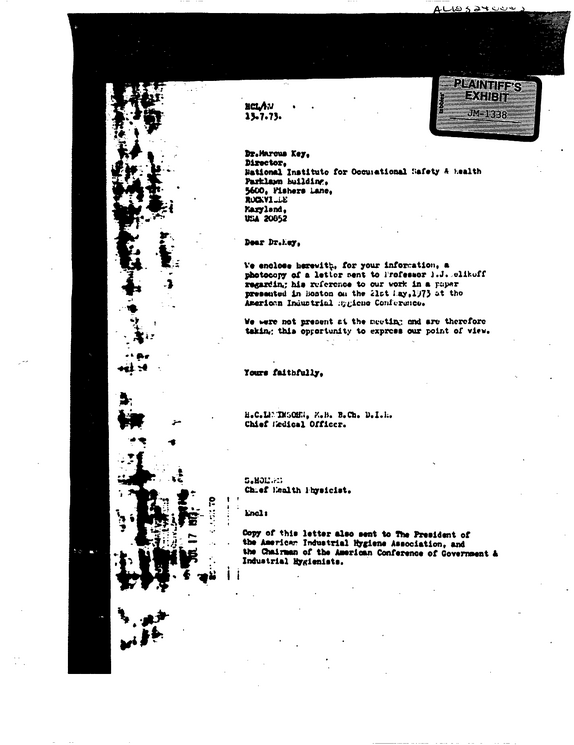
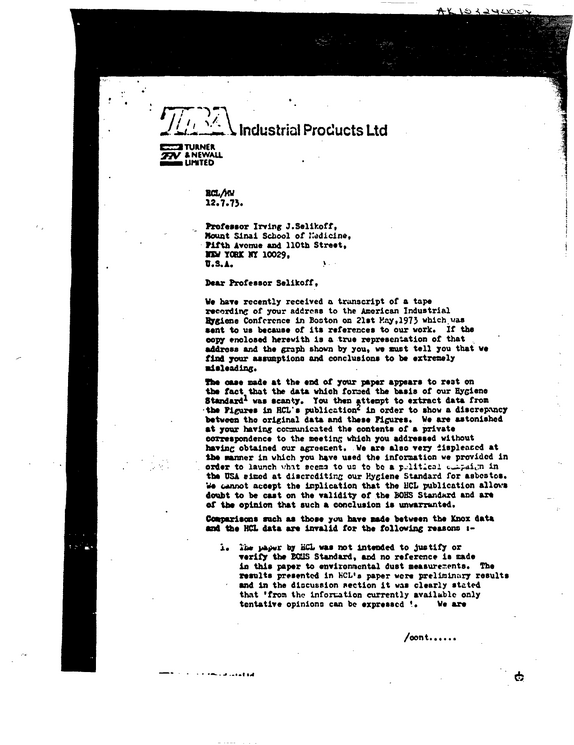
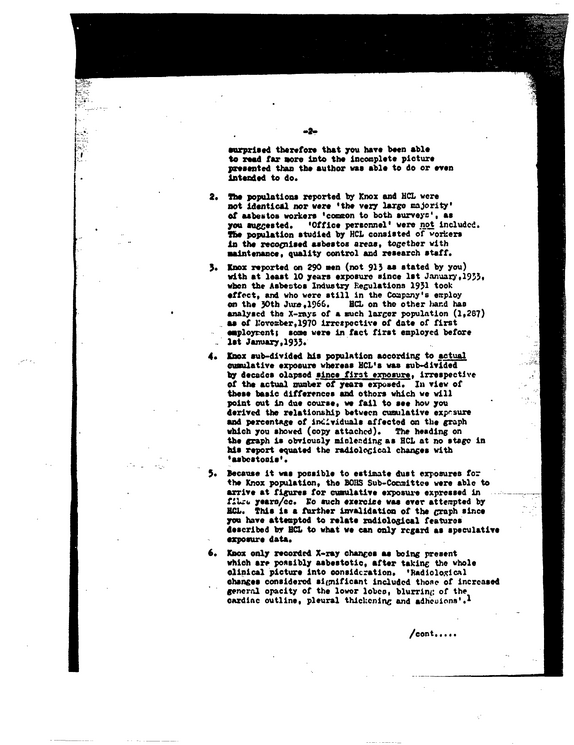
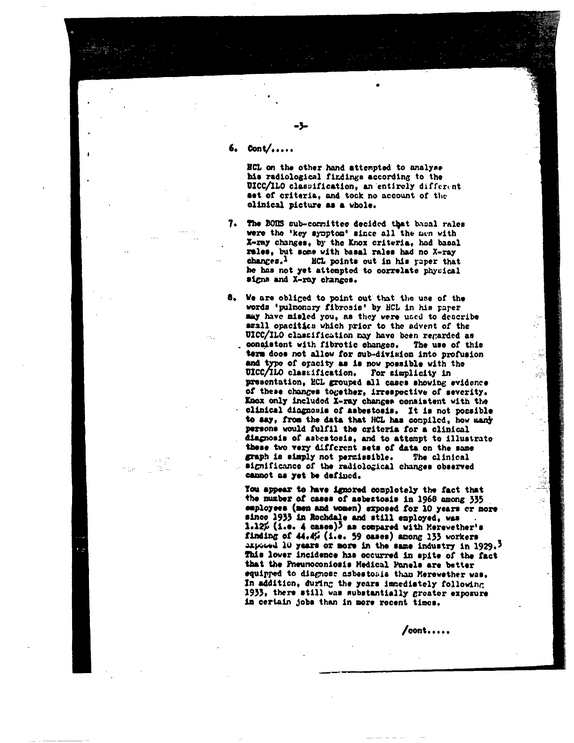
V* encloee berevit^, for your Information, a photocopy of ft letter sent to irofeeeor J.J. elihuff xeoftrdln,; hit reference to our work In a paper preeeuted In boaton on the 11ct fay,1J73 at tho Aserlor.n Indue trial :t;xlcue Conference.
refid# 67BN6eXYRVx6YgvR16kBBLDg6 pages