Refine
Estimated Years UndatedClear
267,365 results foundRefine Search
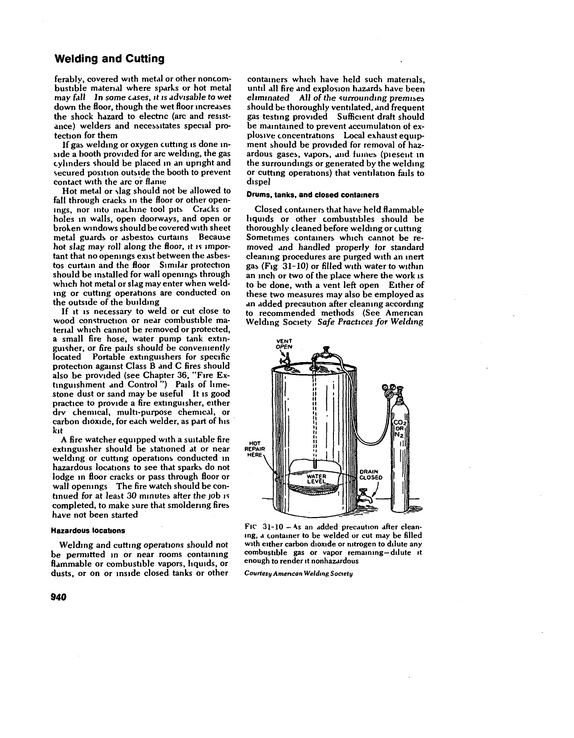
Welding and Cutting ferably, covered with metal or other noncom bustible material where sparks or hot metal may fall In some cases, it is advisable to wet down the floor, though the wet floor increases the shock hazard to electric (arc and resist ance) welders and necessitates special pro tection for them If gas welding or oxygen cutting is done in side a booth provided for arc welding, the gas cylinders should be placed m an upright and secured position outside the booth to prevent contact with the arc or flame Hot metal or slag should not be allowed to fall through cracks in the floor or other open ings, nor into machine tool pits Cracks or holes in walls, open doorways, and open or broken windows should be covered with sheet metal guards or asbestos curtains Because hot slag may roll along the floor, it is impor tant that no openings exist between the asbes tos curtain and the floor Similar protection should be installed for wall openings through which hot metal or slag may enter when weld ing or cutting operations are conducted on the outside of the building If it is necessary to weld or cut close to wood construction or near combustible ma terial which cannot be removed or protected, a small fire hose, water pump tank extin guisher, or fire pails should be conveniently located Portable extinguishers for specific protection against Class B and C fires should also be provided (see Chapter 36, "Fire Ex tinguishment and Control ") Pails of lime stone dust or sand may be useful It is good practice to provide a fire extinguisher, either drv chemical, multi-purpose chemical, or carbon dioxide, for each welder, as part of his kit A fire watcher equipped with a suitable fire extinguisher should be stationed at or near welding or cutting operations conducted in hazardous locations to see that sparks do not lodge m floor cracks or pass through floor or wall openings The fire watch should be con tinued for at least 30 minutes after the job is completed, to make sure that smoldering fires have not been started Hazardous locations Welding and cutting operations should not be permitted m or near rooms containing flammable or combustible vapors, liquids, or dusts, or on or inside closed tanks or other containers which have held such materials, until all fire and explosion hazards have been eliminated All of the surrounding premises should be thoroughly ventilated, and frequent gas testing provided Sufficient draft should be maintained to prevent accumulation of ex plosive concentrations Local exhaust equip ment should be provided for removal of haz ardous gases, vapors, and fumes (piesent in the surroundings or generated by the welding or cutting operations) that ventilation fails to dispel Drums, tanks, and closed containers Closed containers that have held flammable liquids or other combustibles should be thoroughly cleaned before welding or cutting Sometimes containers which cannot be re moved and handled properly for standard cleaning procedures are purged with an inert gas (Fig 31-10) or filled with water to within an inch or two of the place where the work is to be done, with a vent left open Either of these two measures may also be employed as an added precaution after cleaning according to recommended methods (See American Welding Society Safe Practices for Welding VENT FlC 31-10 -- an added precaution after clean ing, a container to be welded or cut may be filled with either carbon dioxide or nitrogen to dilute any combustible gas or vapor remaining--dilute it enough to render it nonhazardous Courtesy American Welding Society 940
refid# 7Op0nvaLwyGa1XXd77pRqbode1 page
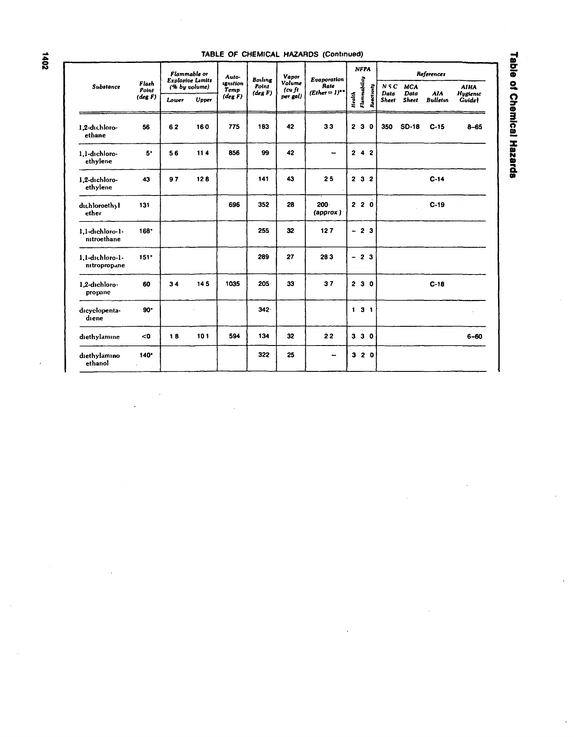
Table of Chemical Hazards 1402 Substance TABLE OF CHEMICAL HAZARDS (Continued) Flammable or Explosive Limits (% by volume) (deg F) Lower Upper Auio* tgmtion Temp (deg F) Boiling Point (deg F) Vapor Votume (cuft per gal) Evaporation Rate (Ether** 1)** NFPA & j i!
refid# R09NKGdyewxRex2dG2p9R0B71 page
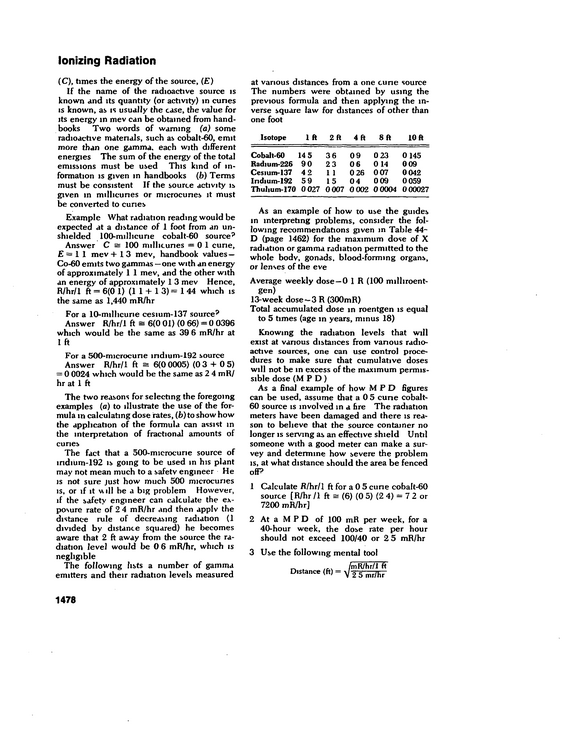
Ionizing Radiation (C), times the energy of the source, () If the name of the radioactive source is known and its quantity (or activity) in cunes is known, as is usually the case, the value for its energy m mev can be obtained from hand books Two words of warning (a) some radioactive materials, such as cobalt-60, emit more than one gamma, each with different energies The sum of the energy of the total emissions must be used This kind of in formation is given in handbooks (b) Terms must be consistent If the source activity is given in millieunes or microcunes it must be converted to curies Example What radiation reading would be expected at a distance of 1 foot from an un shielded 100-milhcune cobalt-60 source'* Answer C s= 100 millieunes =01 cune, E = I 1 mev +13 mev, handbook values -- Co-60 emits two gammas--one with an energy of approximately 1 1 mev, and the other with an energy of approximately 1 3 mev Hence, R/hr/1 ft = 6(0 1) (1 1 + 1 3) = 1 44 which is the same as 1,440 mR/hr For a 10-millicurie cesium-137 source?
refid# 8VR2eL0D5V71EJaO0ox88kZ8m1 page
Motorized Equipment Vehicles should be moved in low gear and at low speed inside shop areas, especially up and down ramps Training repair shop personnel Apprentices and new employees should be trained to do each job in the most efficient manner Job instruction should include the safety rules and regulations pertaining to each job and give the reasons for such rules The new mechanic should be thoroughly in doctrinated concerning the company's policy toward safety He should understand the organization of the safety program and the part he is expected to play m it Having been indoctrinated and trained to work safely, the new employee must be kept actively interested m observing accepted safe practices m the conduct of his job There are many devices available to the safety di rector to accomplish this end, including safety supervision, safety contests, safety meetings, posters, safety bulletins, and pamphlets Proper application of these various incen tives is descnbed elsewhere m this Manual This safety director should select those most suitable to his purpose and adapt them as needed Off-the-Road Motorized Equipment Heavy-duty trucks are again mentioned here because they are used extensively for special off-the-road operations m such in dustries as mining and construction When on the road, they are, of course, governed by the same safe-dnving practices as other types of automotive equipment The use of heavy-duty trucks, mobile cranes, tractors, bulldozers, and other mo torized equipment in the production of stone, ore, and similar materials and in construction work is often accompanied by serious ac cidents Workers near equipment can be struck, run over, and killed Equipment sometimes slips over embarkments, injuring people Servicing and maintaining equip ment can be hazardous Many accidents, even those that do not injure anyone, result in cosdy damage to equipment, loss of efficiency and production, and high maintenance costs In general, prevention of accidents to heavy equipment requires 1 Safety features on equipment, 2 Systematic maintenance and repair, 3 Trained operators, and 4 Trained repairmen Safe and proper operation of equipment should be found in manufacturer's manuals Many driving practices are the same as those necessary for the safe operation of highway vehicles Off-the-road driving, however, involves special hazards requinng special training and safety measures Haul-roads Roadway improvements pay for them selves because they reduce accidents and lower maintenance costs Both temporary and permanent roads often are too narrow for the equipment and for two-way traffic, es pecially at curves and fills Enough space must be provided at curves so that large trucks need not cross the centerline of the road Curves should be elevated toward the out side Roadways for heavy-duty trucks and twoway traffic in open pit mines should be 40 to 50 ft wide Sized rock and sand with clay and oil for binders make a satisfactory road Roads ofheavy rock, filled with rock ofsmaller sizes and surfaced with fine rock, also stand up well under heavy traffic Roadways should have a slight crown and ditches for drainage The maximum grade should not exceed 8 per cent A windrow of loose material along the bank side fur nishes protection against the truck's going off the roadway For night driving, reflectonzed signs along the bank side will in crease safety Both temporary and permanent roadways require regular patrolling and maintenance Too often serious accidents, breakdowns, delays, and unnecessary maintenance ex pense can be traced to neglected temporary roadways Road patrols should be provided with protective equipment, such as barri cades, Men Working signs, red flags, flag men, and flares Seasonal conditions create road hazards which require prompt attention Some com panies provide sprinkler trucks to protect their men against harmful dusts, discomfort, and the possibility of accidents during dry 1558
refid# rx2k51v43e7LVRBypOeQ3mRkr1 page
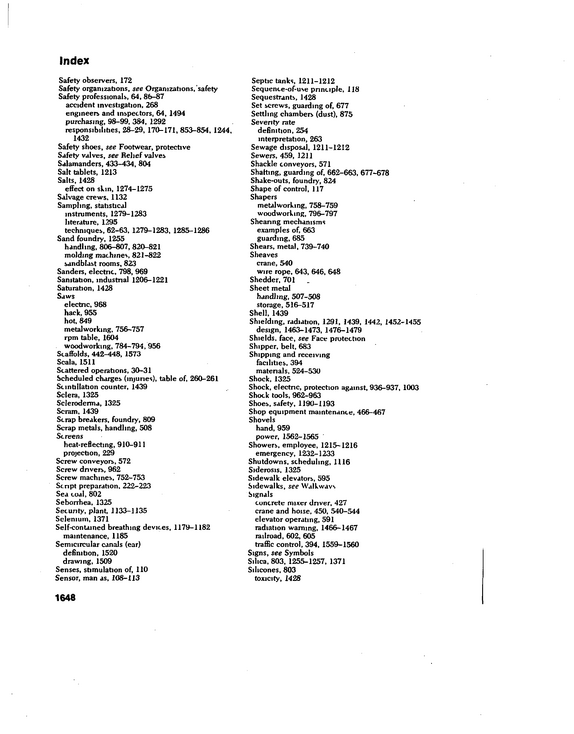
Index Safety observers, 172 Safety organizations, see Organizations, safety Safety professionals, 64, 86-87 accident investigation, 268 engineers and inspectors, 64, 1494 purchasing, 98-99, 384, 1292 responsibilities, 28-29, 170-171, 853-854, 1244, 1432 Safety shoes, see Footwear, protective Safety valves, see Relief valves Salamanders, 433-434, 804 Salt tablets, 1213 Salts, 1428 effect on skin, 1274-1275 Salvage crews, 1132 Sampling, statistical instruments, 1279-1283 literature, 1295 techniques, 62-63, 1279-1283, 1285-1286 Sand foundry, 1255 handling, 806-807, 820-821 molding machines, 821-822 sandblast rooms, 823 Sanders, electric, 798, 969 Sanitation, industrial 1206-1221 Saturation, 1428 Saws electric, 968 hack, 955 hot, 849 metalworking, 756-757 rpm table, 1604 woodworking, 784-794,956 Scaffolds, 442-448, 1573 Scala, 1511 Scattered operations, 30-31 Scheduled charges (injuries), table of, 260-261 Scintillation counter, 1439 Sclera, 1325 Scleroderma, 1325 Scram, 1439 Scrap breakers, foundry, 809 Scrap metals, handling, 508 Screens heat-reflecting, 910-911 projection, 229 Screw conveyors, 572 Screw drivers, 962 Screw machines, 752-753 Script preparation, 222-223 Sea coal, 802 Seborrhea, 1325 Security, plant, 1133-1135 Selenium, 1371 Self-contained breathing devices, 1179-1182 maintenance, 1185 Semicircular canals (ear) definition, 1520 drawing, 1509 Senses, stimulation of, 110 Sensor, man as, 108-113 1648 Septic tanks, 1211-1212 Sequence-of-use principle, 118 Sequestrants, 1428 Set screws, guarding of, 677 Settling chambers (dust), 875 Seventy rate definition, 254 interpretation, 263 Sewage disposal, 1211-1212 Sewers, 459, 1211 Shackle conveyors, 571 Shalting, guarding of, 662-663, 677-678 Shake-outs, foundry, 824 Shape of control, 117 Shapers metalworking, 758-759 woodworking, 796-797 Sheanng mechanisms examples of, 663 guarding, 685 Shears, metal, 739-740 Sheaves crane, 540 wire rope, 643, 646, 648 Shedder, 701 Sheet metal handling, 507-508 storage, 516-517 Shell, 1439 Shielding, radiation, 1291, 1439, 1442, 1452-1455 design, 1463-1473, 1476-1479 Shields, face, see Face protection Shipper, belt, 683 Shipping and receiving facilities, 394 matenals, 524-530 Shock, 1325 Shock, electnc, protection against, 936-937, 1003 Shock tools, 962-963 Shoes, safety, 1190-1193 Shop equipment maintenance, 466-467 Shovels hand, 959 power, 1562-1565 Showers, employee, 1215-1216 emergency, 1232-1233 Shutdowns, scheduling, 1116 Siderosis, 1325 Sidewalk elevators, 595 Sidewalks, see Walkways Signals concrete mixer driver, 427 crane and hoise, 450, 540-544 elevator operating, 591 radiation warning, 1466-1467 railroad, 602, 605 traffic control, 394, 1559-1560 Signs, see Symbols Silica, 803, 1255-1257, 1371 Silicones, 803 toxicity, 1428
refid# o6oE2eyVb36rk0Dd1rJYXnbr1 page
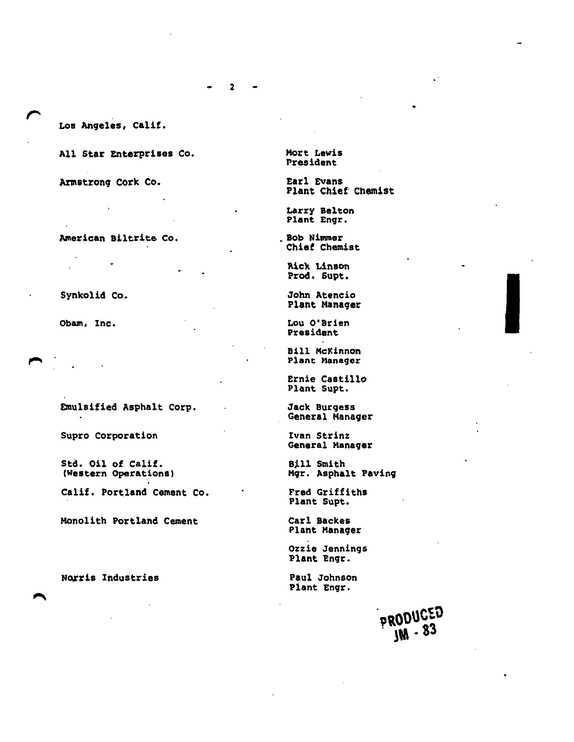
n Lob Angeles, Calif.
refid# 44Ng3wXRoa3V2kOpvOoq9ZyaR1 page
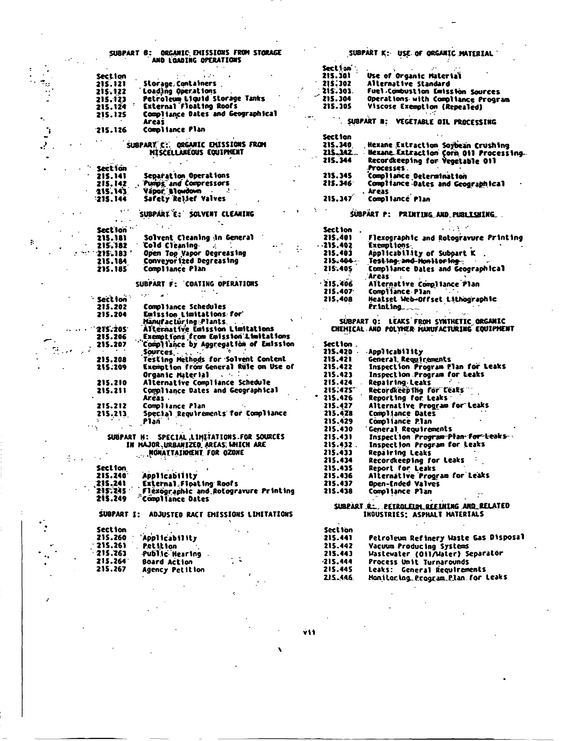
SUBPAST 0: ORGANIC* EMISSIONS FROM STORAGE AMO LOADING OPERATIONS Section 21$.121 Storage,Containers . 21$.122 loading Operations 215.123 Petroleum liquid storage Tanks 21$.124 ' External Floating Roofs 21$. 12$ Coopl 1an<ce Oates and Geographical Areas 215.126 Compliance Plan SUBPARf C:.
refid# DMwy2bQNxE778ZoBJB94XY67n1 page
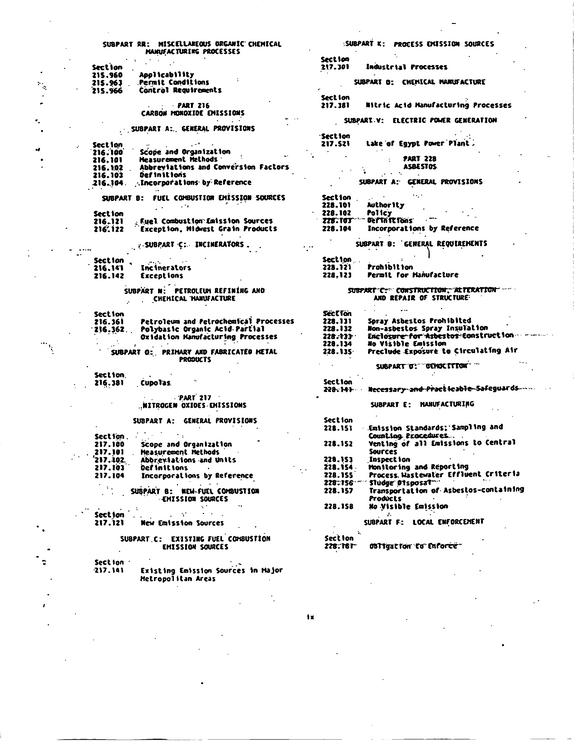
SUBPART RR: MISCELLANEOUS ORGANIC CHEMICAL MANUFACTURING PROCESSES Section 21S.960 21$.96?
refid# 71OrEj4v2011aNdyv9zG2J81j1 page
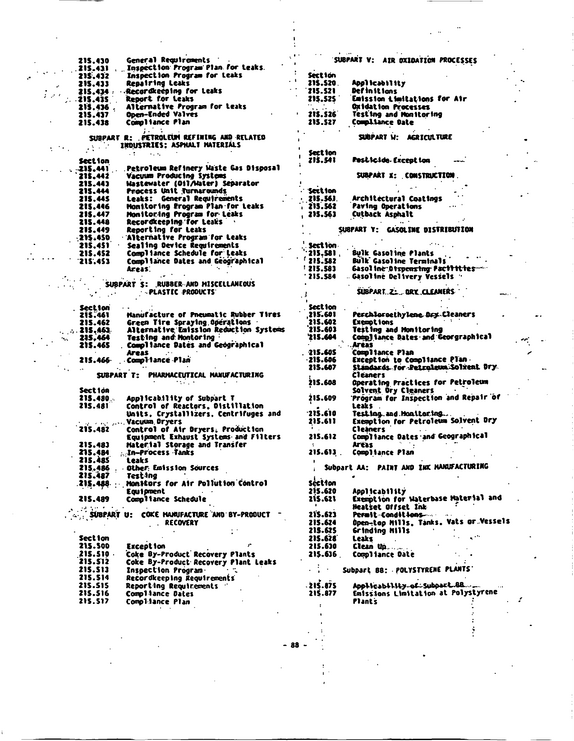
215.430 . .2IS.431 2)5.432 215.433 215.434 215.415 215.436 2)5.437 215.438 General Ktqulrmiiti .
refid# XRn9noX60qazo3maeoLLQmxDJ1 page
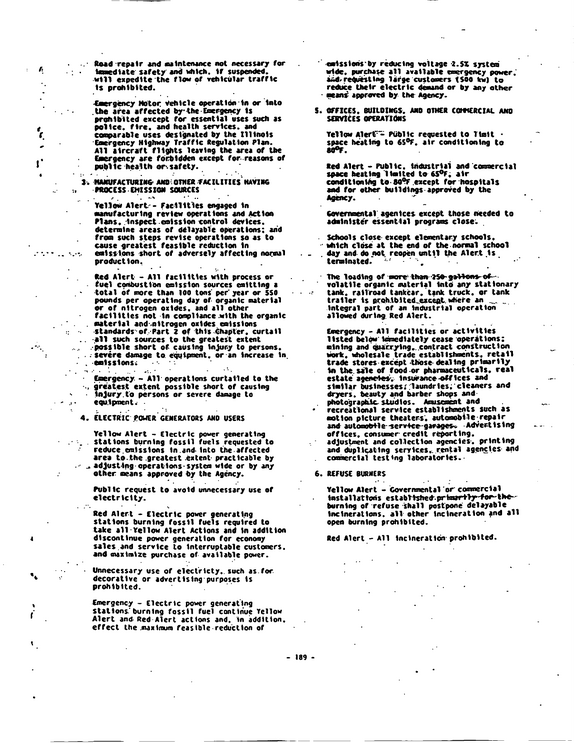
toad repair and Maintenance not necessary for Immediate safety and which. if suspended, util expedite the flow of vehicular traffic is prohibited.
refid# b5JeppoyMzQwgLeoo5jQR0n401 page
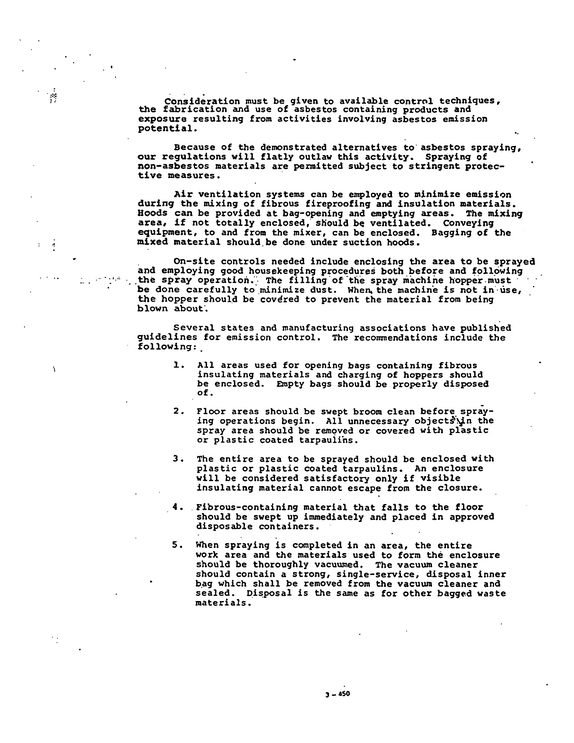
Consideration must be given to available control techniques, the fabrication and use of asbestos containing products and exposure resulting from activities involving asbestos emission potential.
refid# 7O1owB9RvyVEK9JDaBDVOeKej1 page
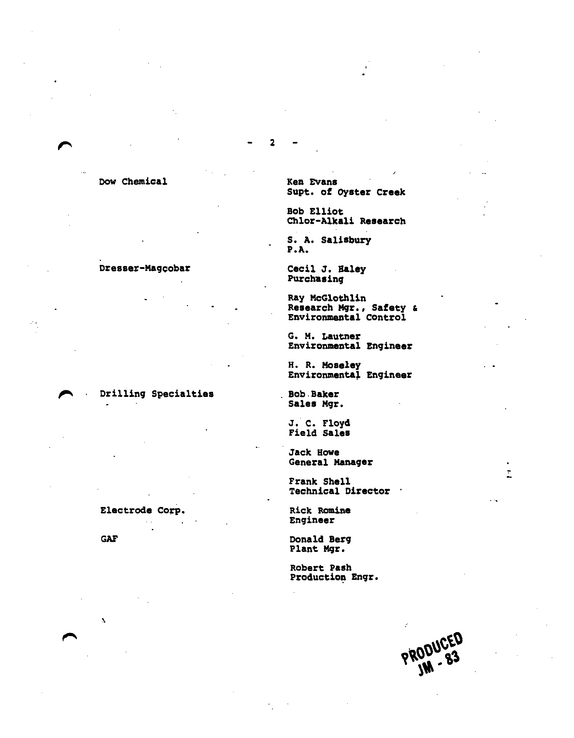
r Dow Chemical Dresser-Magcobar ^ Drilling Specialties Electrode Corp.
refid# kDROdE7XzJ50q9X44qZMzaMpJ1 page
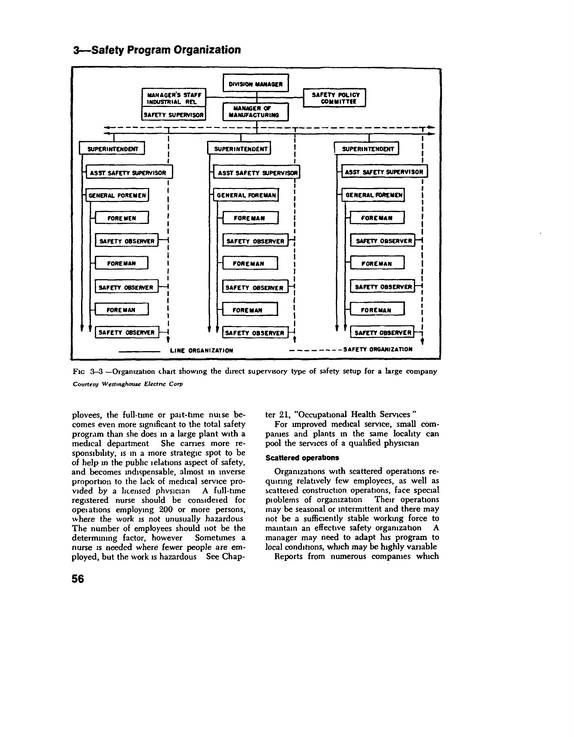
3--Safety Program Organization manager's staff INDUSTRIAL REL SAFETY SUPERVISOR DIVISION MANAGER ----------------- 1--------------------------- 1 MANAGER OF MANUFACTURING SAFETY POLICY COMMITTEE SUPERINTENDENT 1 1 ASST SAFETY SUPERVISOR GENERAL FOREMEN SUPERINTENDENT J ASST SAFETY SUPERVISOR GENERAL FOREMAN | SUPERINTENDENT - ASST SAFETY SUPERVISOR ' GENERAL FOREMEN "L FOREMEN SAFETY OBSERVER FOREMAN FOREMAN SAFETY OBSERVER - FOREMAN FOREMAN SAFETY OBSERVER FOREMAN SAFETY OBSERVER FOREMAN SAFETY OBSERVER - FOREMAN SAFETY OBSERVER FOREMAN SAFETY OBSERVER SAFETY OBSERVER SAFETY OBSERVER LINE ORGANIZATION ___________________SAFETY ORGANIZATION Flc 3--3 --Organization chart showing the direct supervisory type of safety setup for a large company Courtesy Westmghouse Electric Corp plovees, the full-time or pait-time nuise be comes even more significant to the total safety program than she does in a large plant with a medical department She carries more re sponsibility, is in a more strategic spot to be of help m the public lelations aspect of safety, and becomes indispensable, almost in inverse proportion to the lack of medical service pro vided by a licensed phvsician A full-time registered nurse should be consideied for opeiations employing 200 or more persons, where the work is not unusually hazardous The number of employees should not be the determining factor, however Sometimes a nurse is needed where fewer people are em ployed, but the work is hazardous See Chap 56 ter 21, "Occupational Health Services " For improved medical service, small com panies and plants in the same locality can pool the services of a qualified physician Scattered operations Organizations with scattered operations re quiring relatively few employees, as well as scatteied construction operations, face special pioblems of organization Their operations may be seasonal or intermittent and there may not be a sufficiently stable working force to maintain an effective safety organization A manager may need to adapt his program to local conditions, which may be highly variable Reports from numerous companies which
refid# 0qgbZa2Dqgyw8EeroxKN295mx1 page
18--Planning for Emergencies bees ) Installation of protechve wire mesh over windows along public thoroughfares is recommended Floodlighbng of cntacal parts of plants at night is necessary for good proteebon First aid and medical A helpful pubheabon in establishing a dis aster medical service is the Gutde to Develop ing an Industrial Disaster Medical Service compiled by the American Medical Associabon's Council on Occupabonal Health This guide can also assist a company in evaluabng its readiness and will reveal weak areas Ex amples of forms and casualty tags are in cluded Although the guide is designed to combat peacetime disasters, it provides a basis on which to expand the medical services to meet the devastabon following a nuclear at tack First aid and medical service should be headed by the company doctor, if available, as discussed in Chapter 21, "Occupabonal Health Services " In the orgamzabon of the medical phase of the emergency plan, those responsible must select and bam personnel, decide what measures, equipment, and supplies are needed, and establish first aid stabons and a treatment center All employees should be encouraged to en roll m a first aid course People assigned to first aid and medical units should pass stand ard and advanced first aid courses Local chapters of the American Nabonal Red Cross provide excellent training in this regard If a major disaster occurs, there may not be enough trained doctors and nurses available In such an eventuality, care beyond the first aid level wdl have to be provided by non medical people who have received additional training Such a medical team can be de veloped by recruiting volunteer medical aides, preferably with some experience In addihon to first aid training, more advanced mstruebon by regular medical personnel or local hospitals should be provided A major considerabon to keep in mind when establishing an emergency medical pro gram, is that while most of the medical aid will be given in a central medical stabon, some of it may be given on the job site, pos sibly under hazardous condibons 460 Plans should be made for representabves of the medical team to check all personnel at the disaster scene for trauma and to provide a written clearance for them to leave the plant when they are able to leave In this duty, representabves of the invesbgabon team may interview personnel before they leave to be sure that any needed eyewitness information is recorded Welfare and medical service includes the invesbgabon of needs for prevenbon of epi demics, food inspechon, and sanitabon inspec tion In the planning stages, company trucks, if any, should be designated as ambulances and the necessary equipment for them sup plied Two-way radio communication for such ambulance service is essenbal Provi sion should be made for nonpenshable food and water rabons There should be close coordinabon of plant first aid measures with the local civil defense, health, and medical services The chemical service responsibility of this unit requires that gas masks be provided m case tear gas is used as part of the sabotage effort and that trained personnel, equipment, and supplies for chemical defense and decontamination be on hand There should be a plan for priority sequence in decontammabon of the plant--that is, water supply, power plant, machinery areas, warehouse areas, etc Medical team personnel will also be respon sible for any radiological monitoring thought to be necessary after a nuclear attack The mere knowledge that such monitoring equip ment is available is a morale-builder After disaster, no one should be permitted to drmk water until it has been examined Warden service and evacuation The warden service is responsible for main taining employee control during emergencies, including (a) guiding employees to shelter, (b) directang employees away from hazardous areas, and (c) averting panic In smaller companies, the wardens could also have the responsibility of taking charge of shelters In some cases, the warden service may be re sponsible for seeing that shutdown of proc esses and equipment is carried out smoothly This type of service was devised primarily for areas of high populabon densibes, such as commercial structures and factones with
refid# YDpJ6rjKp3RnvjN9x1o2Xv59V1 page
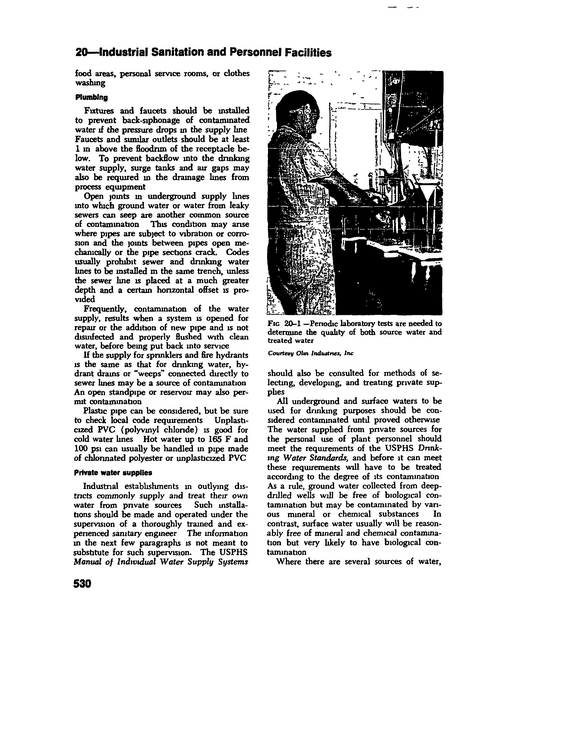
20--Industrial Sanitation and Personnel Facilities food areas, personal service rooms, or clothes washing Plumbing Fixtures and faucets should be installed to prevent back-siphonage of contaminated water if the pressure drops in the supply line Faucets and similar outlets should be at least 1 m above the fioodnm of the receptacle be low.
refid# wgOBb2rMENQ35M04BNbkLJeE1 page