Refine
Estimated Years UndatedClear
34,161 results foundRefine Search
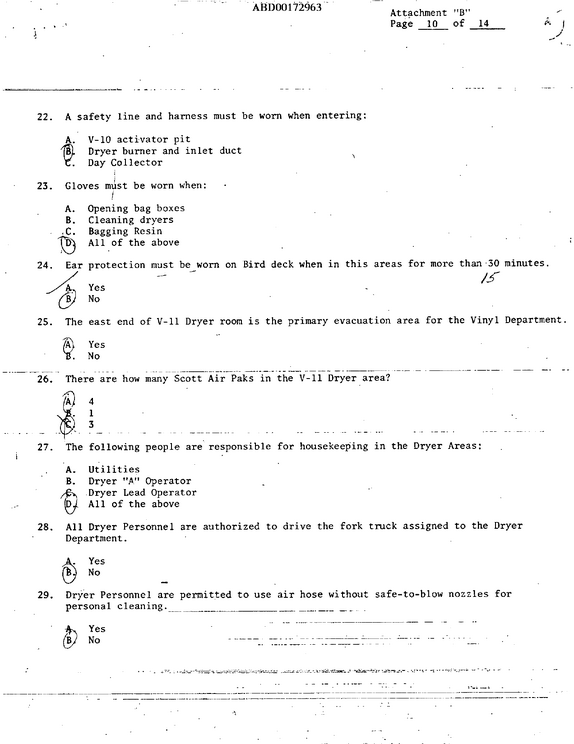
Dryer "A" Operator Dryer Lead Operator All of the above 28.
refid# 7OoewGRn0Mza1RD6zmqq10ZDR4 pages
Again, suppose the hood is made larger, but kept against the wall at the same height above the range Now it is 5X10 ft, and a shed type The side ratio is stall 1 2 X=5=W From Table 28-P, the face velocity should be 120 fpm The face area is 5X10 or 50 sq ft, and the air volume is 50x120 or 6000 cfm-- not much higher than the 5440 cfm required before, even though the hood is 50 per cent larger m area The distance of the hood from the range (X) is now the same as the hood width (W), that is, it is 1 0W, instead of being 1 25W as before, and results in more effective utilization of air The amount a canopy hood should extend beyond the cooking equipment is regulated in many cities by ordinance, and of course m such cases the ordinance should be complied with Where there is no code, it is customary to increase the dimension of a canopy hood 4 to 5 inches for every foot of distance between the hood face and operating surface (range, fryer, etc ) Some designers use a minimum overhang of 12 in A rectangular exhaust hood placed along the wall at the back of deep fat fryers and grills can be installed closer to the source of smoke and odor In effect it becomes a lateral exhaust for an "open-surface tank," and may be designed as already outlined m the section under that heading The smoke and oil vapor are trapped before they nse from the cooking unit, and they have less chance to spread through the room As al ways, end baffles further improve the op eration Crease filters are desirable in all kitchen hoods, including the lateral exhaust type, for two reasons they prevent grease from enter ing the duct, where it condenses, causing a fire hazard, and when placed m the hood it self, they serve as excellent diffusers to assure a uniform distribution of air over the hood opening, which is generally large in area Crease filters, however, add resistance to the system, sometimes as much as 05 in water gauge The exhaust fan should be able to handle the necessary volume of air over the range of filter resistance pressures Crease filters should be cleaned regularly An approved fire damper with a fusible link should be installed in the main exhaust duct or branch adjacent to the range hood This is required by code in many states Recirculation of "cleaned" air When the rate of air exhausted by a con taminant control system is high, either in absolute number of cfm or in comparison to the cubical contents of the room, the sugges tion may be made to recirculate the cleaned air One of two reasons may be put forward It is often argued that the dollars-and-cents savings in heat will be so worthwhile that recirculation is attractive, or the existing heat ing system may have so little reserve capacity that recirculation will be the only way to maintain a comfortable working temperature There are some basic principles to follow in deciding whether to recirculate or to provide tempered makeup air First, savings in fuel or in heating plant capacity are never a valid reason for recircu lating air if the original air contaminant is a potential health hazard For example, if the exhaust system is installed to control free silica dust, lead dust, other toxic dusts, harm ful gases, or solvent vapors, the effluent should be exhausted outdoors Even if the dust filter or other arrester is operating at high efficiency, so the concentration of contami nant downstream is normally within safe limits, a breakdown can always occur which would cause dangerous amounts of material to be blown back into the workroom Second, if the contaminant is harmless and, if after passing through a dust, mist, fume, or vapor separator, the effluent is no more contaminated than the outdoor air, re circulation would be safe Third, there should be no recirculation during warm weather, even ifthe contaminant is of the most harmless sort The local ex haust system, discharging outdoors, will add to the general room ventilation, and so make the area more comfortable This is particu larly true if any of the processes discharge heat or steam Fourth, in every recirculation system, therefore, a Y-connectaon should be included in the discharge of the arrester One leg should go to the outdoors, and the other should lead to the recirculation ductwork Adjust able dampers should be arranged so that 893
refid# gE4pp5o5LdGxyZRXnJLZJqX31 page
11--Human Behavior and Safety recognition from his fellow workers and so might engage m practical jokes and harmful horseplay At the same time, he may be seek ing recognition from his foreman by working hard on the safety committee The need is the same but the means of satisfaction aie m direct conflict This is multiple motivation It would be to the safety professional's advantage, m the second case, to recognize what the need is that the worker is trying to satisfy, and find ways to channel the behavtoi so he can achieve recognition from fellow employees and the foreman Continuing psychosocial need is akin to biological need However, people often as sume that in the psychosocial needs, satisfac tion at one time should suffice for the future and thus they need not be concerned any longer with giving recognition, or affection, or social approval For all people, these needs continue throughout life Satisfaction is always sought for these needs, but not always attained It should be apparent also that the satisfactions sought by individuals will not necessarily be for the same needs At one time, the motiva tion may be for social approval while at an other time the need most requiring satisfaction might be affection Thus, in dealing with people, one must recognize that what was ef fective yesterday may not work today, al though the satisfaction-seeking behavior is to some degree similar Being aware that these needs continually want satisfaction makes it somewhat easier for the safety professional or anyone else to deal effectively with people in the woik situa tion There may be variance from day to day so the safety professional must therefore culti vate his own ability, and the ability of supervisors, to work with people so that he can sense which needs require satisfaction at a given time Since they spend so much time together and with workers, the safety professional and foreman (or supervisor) come to know each other and the workers very well This should provide the key to determining what a work er's behavior at the moment means in terms of need satisfaction This key is based on little cues in the individual's behavior which 246 they have learned over the years to recognize, if they have taken the time and made the ef fort to know their people Careful observation is required Safety professionals should make certain that any foreman training program includes methods of effective observation of workers Conflicting motives constitute another major problem in motivation--needs themselves can be in conflict with one another Seeking af fection could lead to behavior which might be different with fellow workers than with supervisors It may be necessary to determine which source of affection is the more important before doing anything People can internalize these problems to such a degree that the resultant physical stress, worry, anxious periods, or even be havior is completely inconsistent with that expected of them normally For example, a voung man who is assistant safety director in a given company may strongly desire to be come the safety director and yet at the same time be fearful of the duties, the lesponsibihties, and obligations of the job The promo tion would mean more prestige, more money --m all, a better way of fife Here then is a senous conflict The young man's answer will depend greatly on his background expei lences One of the things he might do would be to quit his job and seek employ ment elsewhere He might, on the other hand, seek training to better qualify for the position These are but two of the many choices available The same applies to the woiker on the hne He may strongly desire the approval of his supervisor and at the same time desire to re main an accepted member of his work group If the work group makes fun of or minimizes the importance of the safety program, this worker now is in conflict He may follow the group or he may seek the approval of the management He may do one or the other, or he may do something entirely inconsistent with either Some conflicts can be solved rather simply, for the alternatives lead to positive need satisfactions regardless of which way the in dividual goes These are really no problem Others may have at one pole a positive satis faction and at the other a negative or un-
refid# rp57znnNLO5zayZygBJLZK3XE1 page
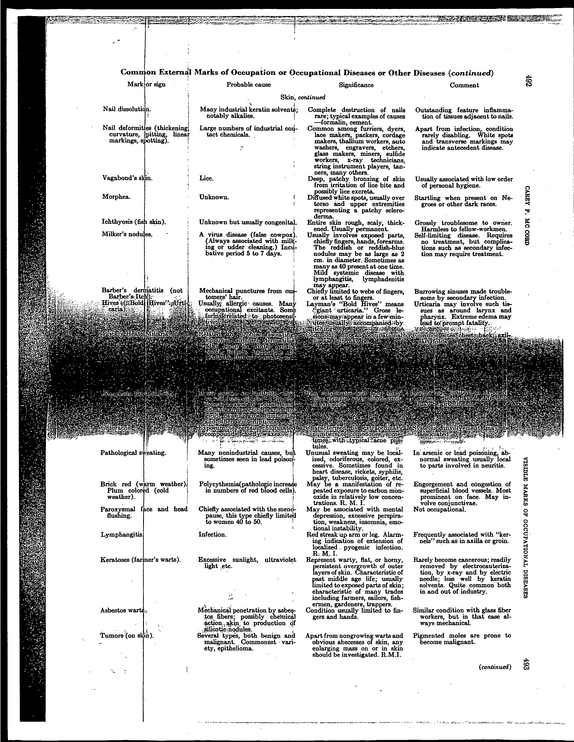
ir- Many nonindustrial causes, b sometimes seen in lead poison ing.
refid# 7OoeMyJ2QgjNDXNV4Mj13rRME1 page
Because its con tinuous research, high engineering stand ards and exclusive specialization have been consistently maintained, AAF equipment is used by leading companies in nearly every industry and is specified by leading architects and engineers for use in commercial and industrial air conditioning.

refid# wDq9ZD4zvRVkZRXLaMZKObn1Q1 page
The only known difficulty m human exposure has occured when Teflon resms are processed at 644-725 F (340380 C) At these temperatures, a condition somewhat like metal fume fever is exhibit ed, but recovery is rapid, usually in 48 hours or less All operations that can lead to the pyrolysis of Teflon resins should therefore be prohibited, particularly smoking where the tobacco may be contaminated with Teflon dusts.
refid# 2jNxm7K4n8QwDqMJ0gV8NV8ML1 page
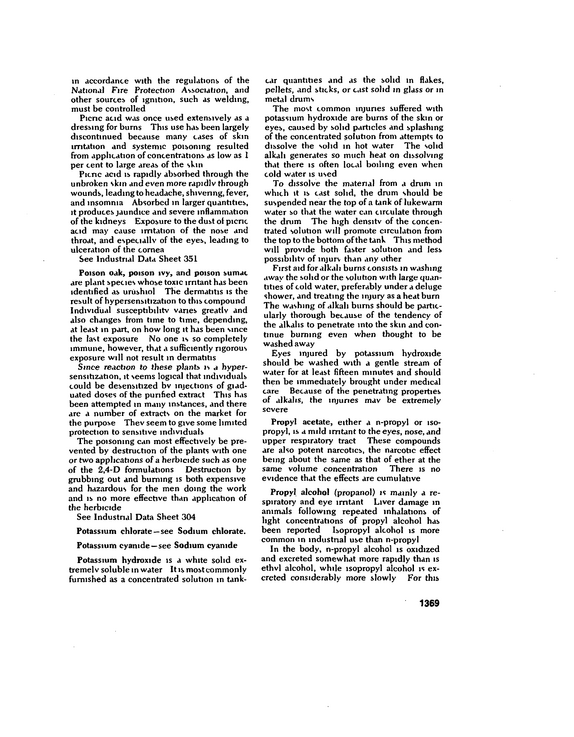
in accordance with the regulations of the National Fire Protection Association, and other sources of ignition, such as welding, must be controlled Picnc acid was once used extensively as a dressing for burns This use has been largely discontinued because many cases of skin irritation and systemic poisoning resulted from application of concentrations as low as 1 per cent to large areas of the skin Picric acid is rapidly absorbed through the unbroken skin and even more rapidlv through wounds, leading to headache, shivering, fever, and insomnia Absorbed in larger quantities, it produces jaundice and severe inflammation of the kidneys Exposure to the dust of picric acid may cause irritation of the nose and throat, and especially of the eyes, leading to ulceration of the cornea See Industrial Data Sheet 351 Poison oak, poison ivy, and poison sumac are plant species whose toxic irritant has been identified as uriishiol The dermatitis is the result of hypersensitization to this compound Individual susceptibility vanes greatlv and also changes from time to time, depending, at least m part, on how long it has been since the last exposure No one is so completely immune, however, that a sufficiently rigorous exposure will not result in dermatitis Since reaction to these plants is a hypersensitization, it seems logical that individuals could be desensitized bv injections of giaduated doses of the purified extract This has been attempted m many instances, and there are a number of extracts on the market for the purpose Thev seem to give some limited protection to sensitive individuals The poisoning can most effectively be pre vented by destruction of the plants with one or two applications of a herbicide such as one of the 2,4-D formulations Destruction by grubbing out and burning is both expensive and hazardous for the men doing the work and is no more effective than application of the herbicide See Industrial Data Sheet 304 Potassium chlorate--see Sodium chlorate.
refid# nmXynnvyXoB9d3bodX3KVOM711 page
I'lONKLK WHITE LEAD tor 7i Yeats.

refid# KRn78Qoazz1Ez6nV14pK3Qr9r1 page
Capacitors In Power Systems with Roctlflov leads.

refid# qm23rQ2Kjk5Oy9Ddk8RoDO1rG1 page
B 1< <--- * t--w W m* NT LIKE m mark of Ac T[MMtcralupiian tiwf knar b u k k mI tKdiatbeli^utfiln. mihlr to MI rtrv perfonunj' the r--faii^ jr>b of bemrih mg, |W(rctiii(( nJ prutuoguig diebltM o m o(u ur That cipUin orty S out of om lOptimrnwkoDutdiBo) I kite Lead- Paint nude *nh DnA Boy fttiios in btntni lunj* rime, can kr tamed to jua the colon yon n ant --and it doe* one crack or teak , due* not demand burning and scrap ing at repaint don.


refid# DwZkX4K412zLwodVQdBGNmrn5 pages
; ' I0 ' x, i; 3<9io 4 S i ________ , 193..V_. 5D% Red Lead, Litharge, aad OOP Lead Total Gross H-V Sales , iir>, n.7^o\tt>; . 7.7.43........... i-u.c-u^.

refid# ykN6vV25eyvB25NGJr3ojv58d1 page
Because its con tinuous research, high engineering stand ards and exclusive specialization have been consistently maintained, AAF. equipment is used by leading companies in nearly every industry and is specified by leading architects and engineers for use in commercial and industrial air conditioning.

refid# nmLby4p0xE0w60vVED7w9yqr21 page
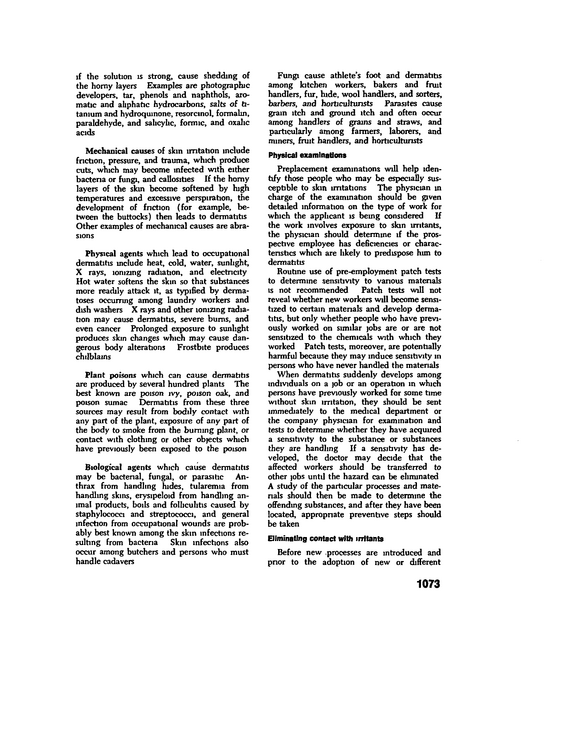
if the solution is strong, cause shedding of the homy layers Examples are photographic developers, tar, phenols and naphthols, aro matic and aliphatic hydrocarbons, salts of ti tanium and hydroquinone, resorcinol, formalin, paraldehyde, and salicylic, formic, and oxalic acids Mechanical causes of skin irritation include friction, pressure, and trauma, which produce cuts, which may become infected with either bacteria or fungi, and callosities If the homy layers of the skin become softened by high temperatures and excessive perspiration, the development of friction (for example, be tween the buttocks) then leads to dermatitis Other examples of mechanical causes are abra sions Physical agents which lead to occupational dermatitis include heat, cold, water, sunlight, X rays, ionizing radiation, and electricity Hot water softens the skin so that substances more readily attack it, as typified by derma toses occurring among laundry workers and dish washers X rays and other ionizing radia tion may cause dermatitis, severe bums, and even cancer Prolonged exposure to sunlight produces skin changes which may cause dan gerous body alterations Frostbite produces chilblains Plant poisons which can cause dermatitis are produced by several hundred plants The best known are poison ivy, poison oak, and poison sumac Dermatitis from these three sources may result from bodily contact with any part of the plant, exposure of any part of the body to smoke from the burning plant, or contact with clothing or other objects which have previously been exposed to the poison Biological agents which cause dermatitis may be bacterial, fungal, or parasitic An thrax from handling hides, tularemia from handling skins, erysipeloid from handling an imal products, boils and folliculitis caused by staphylococci and streptococci, and general infection from occupational wounds are prob ably best known among the skin infections re sulting from bacteria Skin infections also occur among butchers and persons who must handle cadavers Fungi cause athlete's foot and dermatitis among kitchen workers, bakers and fruit handlers, fur, hide, wool handlers, and sorters, barbers, and horticulturists Parasites cause grain itch and ground itch and often occur among handlers of grams and straws, and particularly among farmers, laborers, and miners, bruit handlers, and horticulturists Physical examinations Preplacement examinations will help iden tify those people who may be especially sus ceptible to skin irritations The physician in charge of the examination should be given detailed information on the type of work for which the applicant is being considered If the work involves exposure to skin irritants, the physician should determine if the pros pective employee has deficiencies or charac teristics which are hkely to predispose him to dermatitis Routine use of pre-employment patch tests to determine sensitivity to various materials is not recommended Patch tests will not reveal whether new workers will become sensi tized to certain materials and develop derma titis, but only whether people who have previ ously worked on similar jobs are or are not sensitized to the chemicals with which they worked Patch tests, moreover, are potentially harmful because they may induce sensitivity m persons who have never handled the materials When dermatitis suddenly develops among individuals on a job or an operation in which persons have previously worked for some time without skin irritation, they should be sent immediately to the medical department or the company physician for examination and tests to determine whether they have acquired a sensitivity to the substance or substances they are handling If a sensitivity has develoiied, the doctor may decide that the affected workers should be transferred to other jobs until the hazard can be eliminated A study of the particular processes and mate rials should then be made to determine the offending substances, and after they have been located, appropriate preventive steps should be taken Eliminating contact with irritants Before new processes are introduced and pnor to the adoption of new or different 1073
refid# V7LY38xem9LyqR9a8MrxQwvo1 page
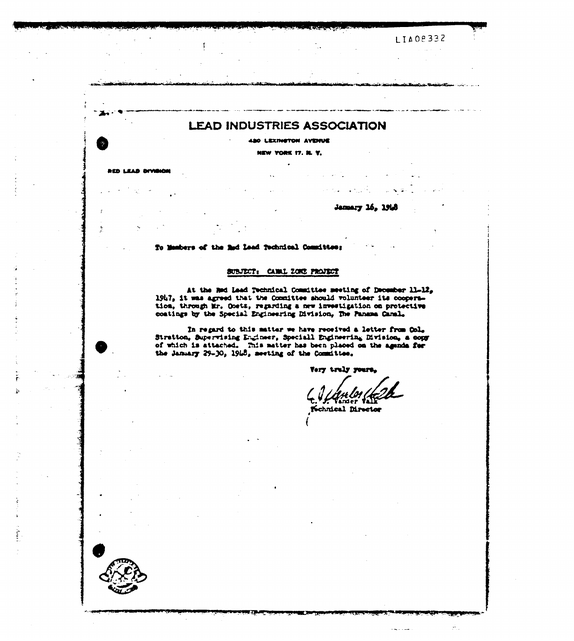
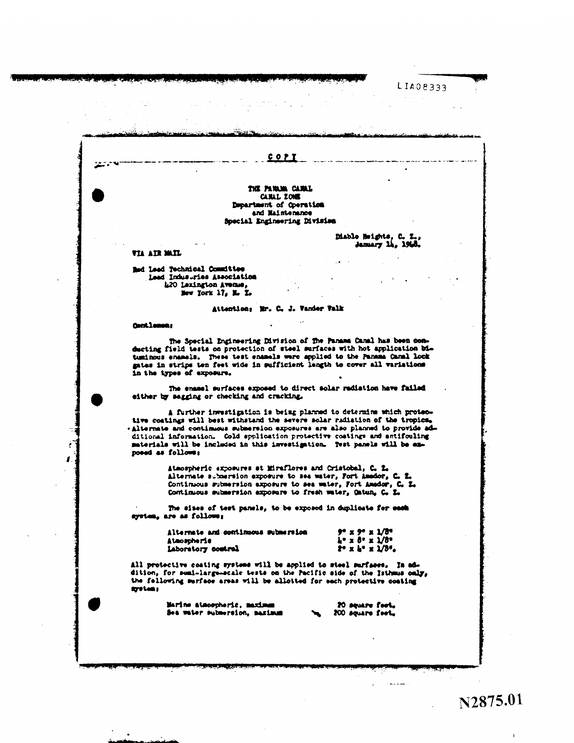
wd Lsed Tsehaleal Coadtt Lead InduS-rla* ASSOCiatlM A20 Lsxinfton iniuti It* Tort 17, *.

refid# qkaZJXMeDvxwNGw7rBYJjy8Oq3 pages
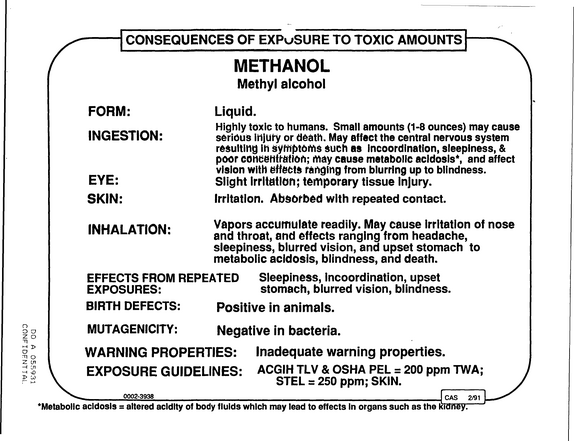
Metabolic acidosis may lead to effects on various organ systems.


refid# qddjbd11gNJwY1aqY8Z6wrw6K3 pages