Refine
Estimated Years UndatedClear
92,592 results foundRefine Search
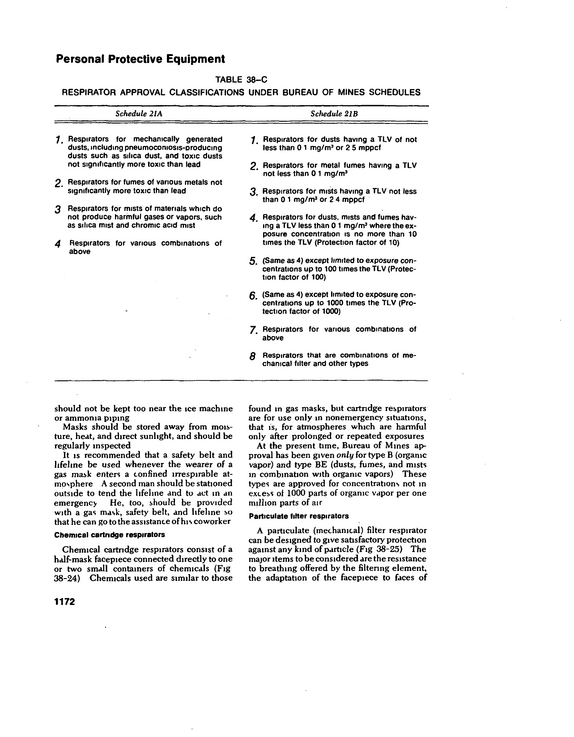
Personal Protective Equipment TABLE 38--C RESPIRATOR APPROVAL CLASSIFICATIONS UNDER BUREAU OF MINES SCHEDULES Schedule 21A Schedule 21B 7, Respirators for mechanically generated dusts, including pneumocomosis-Droducing dusts such as silica dust, and toxic dusts not significantly more toxic than lead 2.
refid# 9gBkVkqmVkYzrNN0KdqEke0R1 page
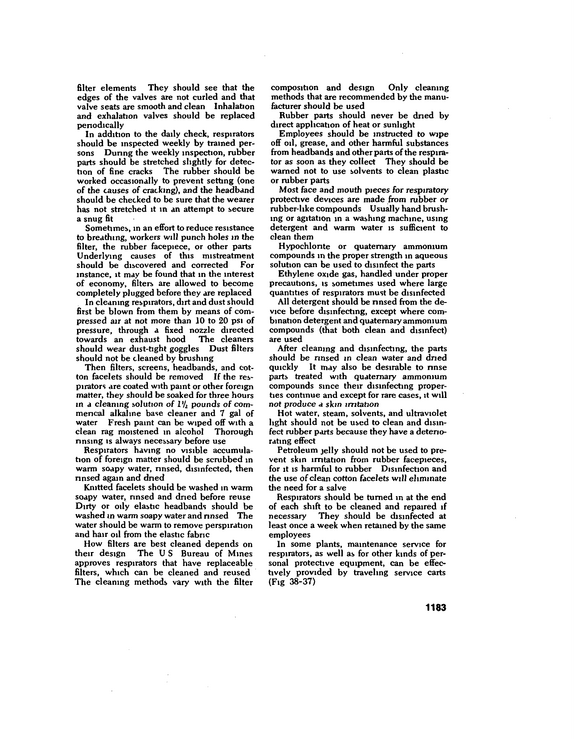
filter elements They should see that the edges of the valves are not curled and that valve seats are smooth and clean Inhalation and exhalation valves should be replaced periodically In addition to the daily check, respirators should be inspected weekly by trained per sons During the weekly inspection, rubber parts should be stretched slightly for detec tion of fine cracks The rubber should be worked occasionally to prevent setting (one of the causes of cracking), and the headband should be checked to be sure that the wearer has not stretched it in an attempt to secure a snug fit Sometimes, in an effort to reduce resistance to breathing, workers will punch holes m the filter, the rubber facepiece, or other parts Underlying causes of this mistreatment should be discovered and corrected For instance, it may be found that in the interest of economy, filters are allowed to become completely plugged before they are replaced In cleaning respirators, dirt and dust should first be blown from them by means of com pressed air at not more than 10 to 20 psi of pressure, through a fixed nozzle directed towards an exhaust hood The cleaners should wear dust-tight goggles Dust filters should not be cleaned by brushing Then filters, screens, headbands, and cot ton facelets should be removed If the res pirators are coated with paint or other foreign matter, they should be soaked for three hours m a cleaning solution of l'h pounds of eommencal alkaline base cleaner and 7 gal of water Fresh paint can be wiped off with a clean rag moistened in alcohol Thorough nnsing is always necessary before use Respirators having no visible accumula tion of foreign matter should be scrubbed in warm soapy water, nnsed, disinfected, then nnsed again and dned Knitted facelets should be washed in warm soapy water, rinsed and dried before reuse Dirty or oily elastic headbands should be washed m warm soapy water and nnsed The water should be warm to remove perspiration and hair oil from the elastic fabric How filters are best cleaned depends on their design The U S Bureau of Mines approves respirators that have replaceable filters, which can be cleaned and reused The cleaning methods vary with the filter composition and design Only cleaning methods that are recommended by the manu facturer should be used Rubber parts should never be dned by direct application of heat or sunlight Employees should be instructed to wipe off oil, grease, and other harmful substances from headbands and other parts of the respira tor as soon as they collect They should be warned not to use solvents to clean plastic or rubber parts Most face and mouth pieces for respiratory protective devices are made from rubber or rubber-like compounds Usually hand brush ing or agitation in a washing machine, using detergent and warm water is sufficient to clean them Hypochlorite or quaternary ammonium compounds in the proper strength in aqueous solution can be used to disinfect the parts Ethylene oxide gas, handled under proper precautions, is sometimes used where large quantities of respirators must be disinfected All detergent should be nnsed from the de vice before disinfecting, except where com bination detergent and quaternary ammonium compounds (that both clean and disinfect) are used After cleaning and disinfecting, the parts should be nnsed m clean water and dned quickly It may also be desirable to nnse parts treated with quaternary ammonium compounds since their disinfecting proper ties continue and except for rare cases, it will not produce a skin irritation Hot water, steam, solvents, and ultraviolet light should not be used to clean and disin fect rubber parts because they have a detenorating effect Petroleum jelly should not be used to pre vent skin untation from rubber facepieces, for it is harmful to rubber Disinfection and the use of clean cotton facelets will eliminate the need for a salve Respirators should be turned m at the end of each shift to be cleaned and repaired if necessary They should be disinfected at least once a week when retained by the same employees In some plants, maintenance service for respirators, as well as for other kinds of per sonal protective equipment, can be effec tively provided by traveling service carts (Fig 38-37) 1183
refid# Xzrdeb95xp8BoJYOMb5pLmGjg1 page
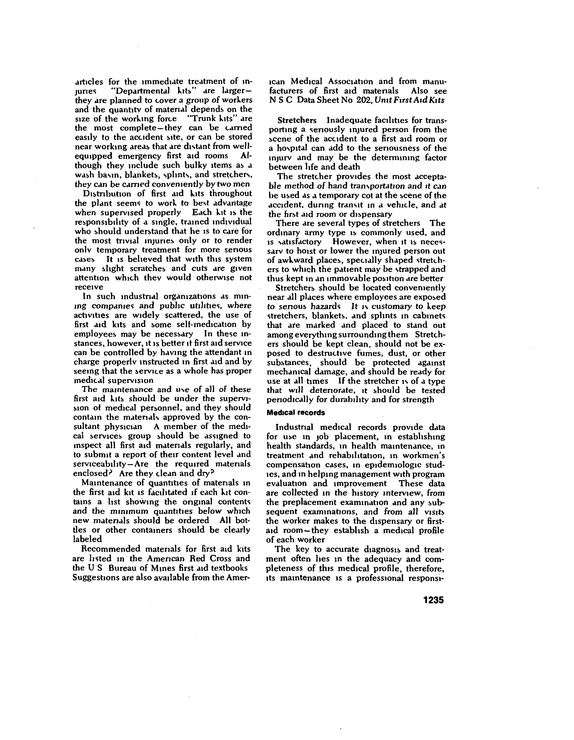
articles for the immediate treatment of in juries "Departmental kits" are larger-- they are planned to cover a group of workers and the quantity of material depends on the size of the working force "Trunk kits" are the most complete--they can be earned easily to the accident site, or can be stored near working areas that are distant from wellequipped emergency first aid rooms Al though they include such bulky items as a wash basin, blankets, splints, and stretchers, they can be carried conveniently by two men Distribution of first aid kits throughout the plant seems to work to best advantage when supervised properly Each kit is the responsibility of a single, trained individual who should understand that he is to care for the most trivial injuries only or to render onlv temporary treatment for more serious cases It is believed that with this system many slight scratches and cuts are given attention which they would otherwise not receive In such industrial organizations as min ing companies and public utilities, where activities are widely scattered, the use of first aid kits and some sell-medication by employees may be necessary In these in stances, however, it is better it first aid service can be controlled by having the attendant in charge properlv instructed in first aid and by seeing that the service as a whole has proper medical supervision The maintenance and use of all of these first aid kits should be under the supervi sion of medical personnel, and they should contain the materials approved by the con sultant physician A member of the medi cal services group should be assigned to inspect all first aid materials regularly, and to submit a report of their content level and serviceability --Are the required materials enclosed'* Are they clean and dry?
refid# jE01xkpMv5z5YnXexvVYqvd21 page
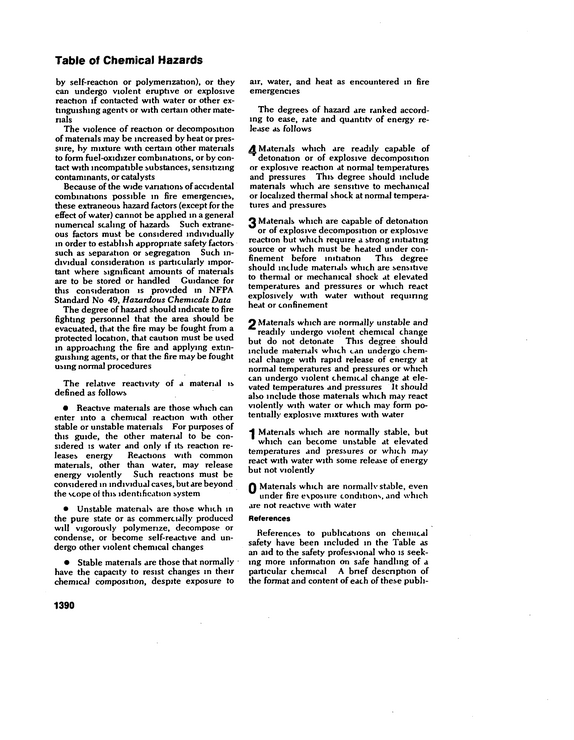
Table of Chemical Hazards by self-reaction or polymerization), or they can undergo violent eruptive or explosive reaction if contacted with water or other ex tinguishing agents or with certain other mate rials The violence of reaction or decomposition of materials may be increased by heat or pres sure, by mixture with certain other materials to form fuel-oxidizer combinations, or by con tact with incompatible substances, sensitizing contaminants, or catalysts Because of the wide variations of accidental combinations possible in fire emergencies, these extraneous hazard factors (except for the effect of water) cannot be applied in a general numerical scaling of hazards Such extrane ous factors must be considered individually in order to establish appropriate safety factors such as separation or segregation Such in dividual consideration is particularly impor tant where significant amounts of materials are to be stored or handled Guidance for this consideration is provided in NFPA Standard No 49, Hazardous Chemicals Data The degree of hazard should indicate to fire fighting personnel that the area should be evacuated, that the fire may be fought from a protected location, that caution must be used in approaching the fire and applying extin guishing agents, or that the fire may be fought using normal procedures The relative reactivity of a material is defined as follows Reactive materials are those which can enter into a chemical reaction with other stable or unstable materials For purposes of this guide, the other material to be con sidered is water and only if its reaction re leases energy Reactions with common materials, other than water, may release energy violently Such reactions must be considered in individual cases, but are beyond the scope of this identification system Unstable materials are those which in the pure state or as commercially produced will vigorously polymerize, decompose or condense, or become self-reactive and un dergo other violent chemical changes Stable materials are those that normally have the capacity to resist changes m their chemical composition, despite exposure to air, water, and heat as encountered in fire emergencies The degrees of hazard are ranked accord ing to ease, rate and quantitv of energy re lease as follows ^ Materials which are readily capable of detonation or of explosive decomposition or explosive reaction at normal temperatures and pressures This degree should include matenals which are sensitive to mechanical or localized thermal shock at normal tempera tures and pressures 0 Matenals which are capable of detonation or of explosive decomposition or explosive reaction but which require a strong initiating source or which must be heated under con finement before initiation This degree should include matenals which are sensitive to thermal or mechanical shock at elevated temperatures and pressures or which react explosively with water without requmng heat or confinement 2 Matenals which are normally unstable and readily undergo violent chemical change but do not detonate This degree should include materials which can undergo chem ical change with rapid release of energy at normal temperatures and pressures or which can undergo violent chemical change at ele vated temperatures and pressures It should also include those matenals which may react violently with water or which may form po tentially explosive mixtures with water ^ Matenals which are normally stable, but which can become unstable at elevated temperatures and pressures or which may react with water with some release of energy but not violently Q Matenals which are normally stable, even under fire exposure conditions, and which are not reactive with water References References to publications on chemical safety have been included in the Table as an aid to the safety professional who is seek ing more information on safe handling of a particular chemical A bnef descnption of the format and content of each of these publi- 1390
refid# 82Kywjewv8qrdr3Eg6Ng2Mw6m1 page
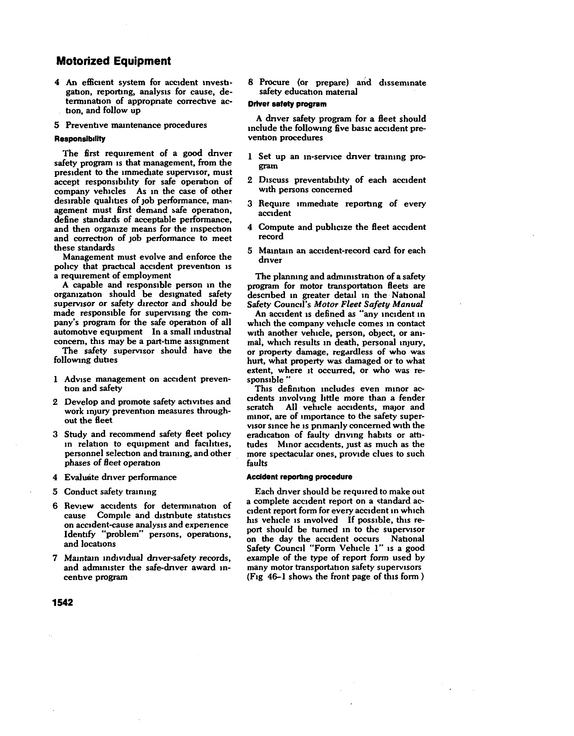
Motorized Equipment 4 An efficient system foi accident investi gation, reporting, analysis for cause, de termination of appropriate corrective ac tion, and follow up 5 Preventive maintenance procedures Responsibility The first requirement of a good driver safety program is that management, from the president to the immediate supervisor, must accept responsibility for safe operation of company vehicles As m the case of other desirable qualities of job performance, man-, agement must first demand safe operation, define standards of acceptable performance, and then organize means for the inspection and correction of job performance to meet these standards Management must evolve and enforce the policy that practical accident prevention is a requirement of employment A capable and responsible person m the organization should be designated safety supervisor or safety director and should be made responsible for supervising the com pany's program for the safe operation of all automobve equipment In a small industrial concern, this may be a part-time assignment The safety supervisor should have the following duties 1 Advise management on accident preven tion and safety 2 Develop and promote safety activities and work injury prevention measures through out the fleet 3 Study and recommend safety fleet policy m relation to equipment and facilities, personnel selection and training, and other phases of fleet operation 4 Evaluate driver performance 5 Conduct safety training 6 Review accidents for determination of cause Compile and distribute statistics on accident-cause analysis and experience Identify "problem" persons, operations, and locations 7 Maintain individual dnver-safety records, and administer the safe-dnver award mcenbve program 8 Procure (or prepare) and disseminate safety educabon material Driver safety program A driver safety program for a fleet should include the following five basic accident prevenbon procedures 1 Set up an m-service driver training pro gram 2 Discuss preventabdity of each accident with persons concerned 3 Require immediate reporting of every accident 4 Compute and publicize the fleet accident record 5 Maintain an accident-record card for each driver The planning and admimstrabon of a safety program for motor transportabon fleets are described in greater detail m the Nabonal Safety Council's Motor Fleet Safety Manual An accident is defined as "any incident in which the company vehicle comes m contact with another vehicle, person, object, or ani mal, which results in death, personal injury, or property damage, regardless of who was hurt, what property was damaged or to what extent, where it occurred, or who was re sponsible " This definihon includes even minor ac cidents involving little more than a fender scratch All vehicle accidents, major and minor, are of importance to the safety super visor since he is primarily concerned with the eradicabon of faulty driving habits or atti tudes Minor accidents, just as much as the more spectacular ones, provide clues to such faults Accident reporting procedure Each driver should be required to make out a complete accident report on a standard ac cident report form for every accident m which his vehicle is involved If possible, this re port should be turned in to the supervisor on the day the accident occurs Nabonal Safety Council "Form Vehicle 1" is a good example of the type of report form used by many motor transportabon safety supervisors (Fig 46-1 shows the front page of this form ) 1542
refid# x1Zj5Dyj2gM96KaeZ0oOvbmLg1 page
>], .Ju I Vsc. 197/ A..
refid# onz98roDLkYQ8bdLOn0z4XO31 page
f-4- SLIDE 6 This is a typical friction disc with its mating disc as is used in oilcooled, multiple disc brakes shown in the previous slide.
refid# zzvw8ExeEXMRZEen2rdGgv0v71 page
. -2- The* following are the main areas discussed and the decisions reached: 1.
refid# 70Ob69VgEO2wVnY59Dk0dGJYe1 page
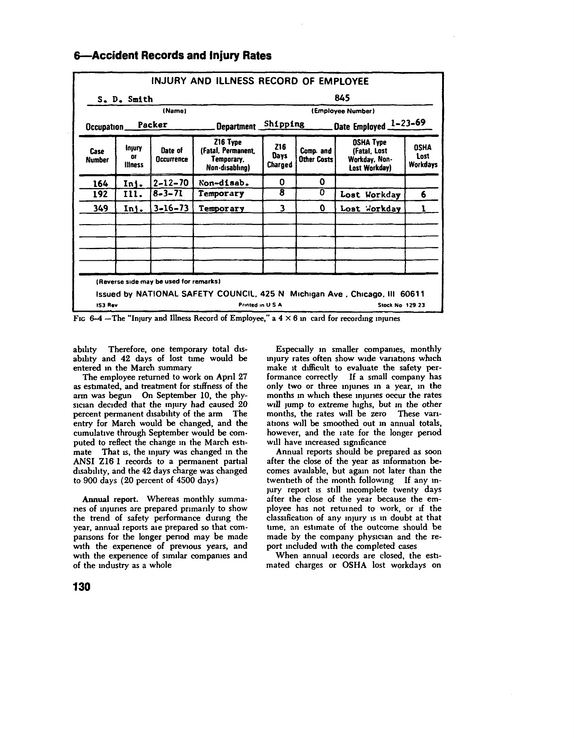
6--Accident Records and Injury Rates INJURY AND ILLNESS RECORD OF EMPLOYEE S.
refid# yk99BRGRDDMZx8wOGR0QOD0yd1 page
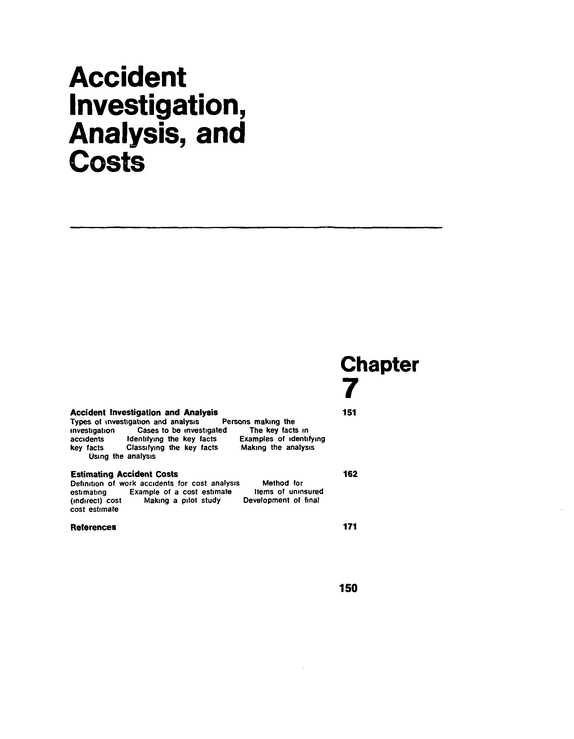
Accident Investigation, Analysis, and Costs Accident Investigation and Analysis Types of investigation and analysis Persons making the investigation Cases to be investigated The key facts in accidents Identifying the key facts Examples of identifying key facts Classifying the key facts Making the analysis Using the analysis Estimating Accident Costs Definition of work accidents for cost analysis Method for estimating Example of a cost estimate Items of uninsured (indirect) cost Making a pilot study Development of final cost estimate References Chapter 7 151 162 171 150
refid# 7Mb6ZqbNzvQoXRwk7V1x21nre1 page
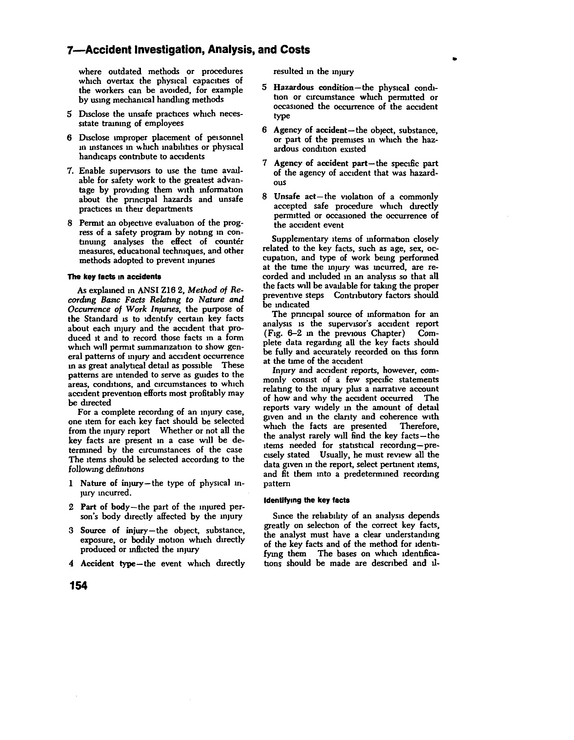
7--Accident Investigation, Analysis, and Costs where outdated methods or procedures which overtax the physical capacities of the workers can be avoided, for example by using mechanical handling methods 5 Disclose the unsafe practices which neces sitate training of employees 6 Disclose improper placement of peisonnel m instances in which inabilities or physical handicaps contribute to accidents 7.
refid# rxmD7Bv0LBJnMabZreyQ7N6yr1 page
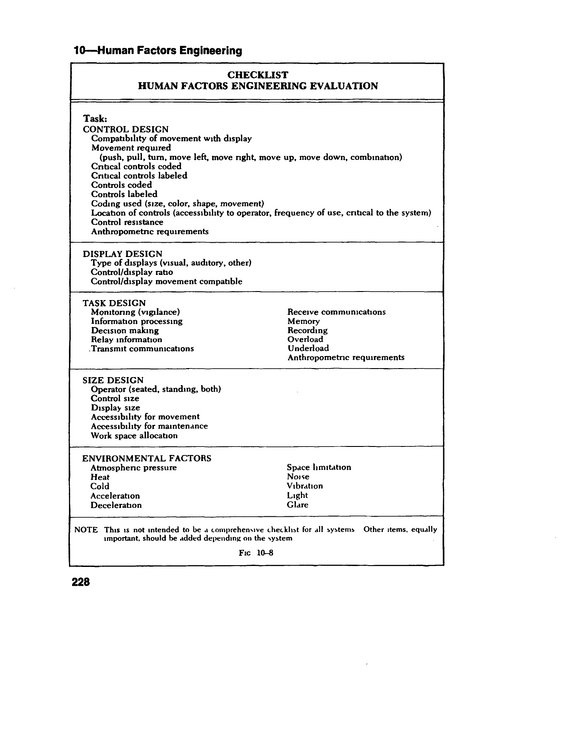
10--Human Factors Engineering CHECKLIST HUMAN FACTORS ENGINEERING EVALUATION Task: CONTROL DESIGN Compatibility of movement with display Movement required (push, pull, turn, move left, move right, move up, move down, combination) Critical controls coded Critical controls labeled Controls coded Controls labeled Coding used (size, color, shape, movement) Location of controls (accessibility to operator, frequency of use, critical to the system) Control resistance Anthropometric requirements DISPLAY DESIGN Type of displays (visual, auditory, other) Control/display ratio Control/display movement compatible TASK DESIGN Monitoring (vigilance) Information processing Decision making Relay information .Transmit communications Receive communications Memory Recording Overload Underload Anthropometric requirements SIZE DESIGN Operator (seated, standing, both) Control size Display size Accessibility for movement Accessibility for maintenance Work space allocation ENVIRONMENTAL FACTORS Atmospheric pressure Heat Cold Acceleration Deceleration Space limitation Noise Vibration Light Glare NOTE This is not intended to be a comprehensive checklist for all systems Other items, equally important, should be added depending on the system Fic 10-8 228
refid# DzGM14dabv9635zp07EoMN0B1 page
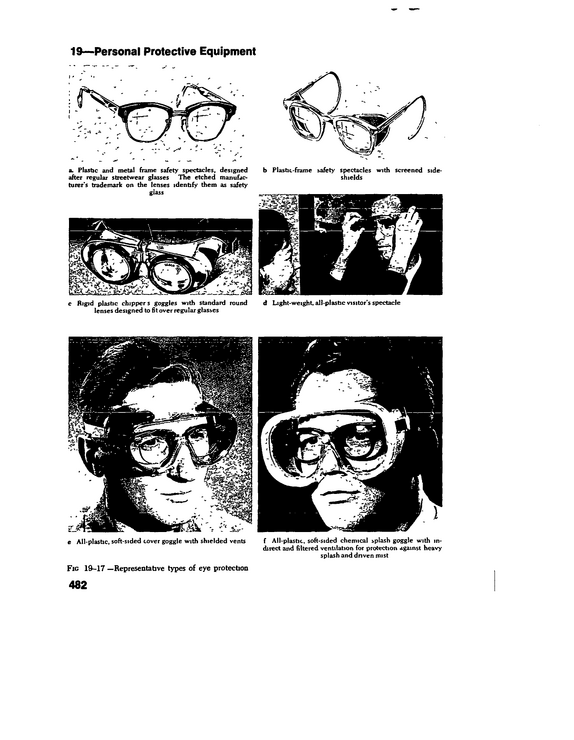
19--Personal Protective Equipment a.
refid# ByzkV4jMX7K07yGE778vwbw4J1 page
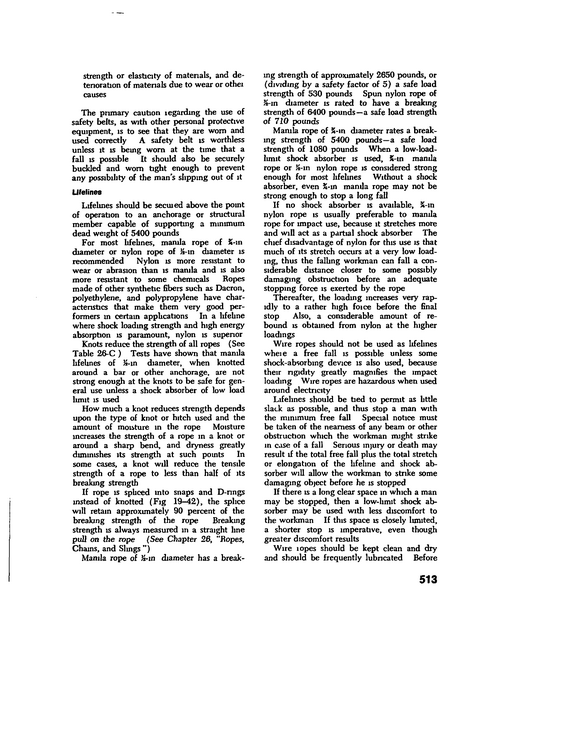
strength or elasticity of materials, and de terioration of materials due to wear or othei causes The primary caution legardmg the use of safety belts, as with other personal protective equipment, is to see that they are worn and used correctly A safety belt is worthless unless it is being worn at the time that a fall is possible It should also be securely buckled and worn tight enough to prevent any possibility of the man's slipping out of it Lifelines Lifelines should be seemed above the point of operation to an anchorage or structural member capable of supporting a minimum dead weight of 5400 pounds For most lifelines, mamla rope of X-in diameter or nylon rope of Ji-in diameter is recommended Nylon is more resistant to wear or abrasion than is mamla and is also more resistant to some chemicals Ropes made of other synthetic fibers such as Dacron, polyethylene, and polypropylene have char acteristics that make them very good per formers in certain applications In a lifeline where shock loading strength and high energy absorption is paramount, nylon is superior Knots reduce the strength of all ropes (See Table 26-C ) Tests have shown that mamla lifelines of 3-in diameter, when knotted around a bar or other anchorage, are not strong enough at the knots to be safe for gen eral use unless a shock absorber of low load limit is used How much a knot reduces strength depends upon the type of knot or hitch used and the amount of moisture in the rope Moisture increases the strength of a rope in a knot or around a sharp bend, and dryness greatly diminishes its strength at such points In some cases, a knot will reduce the tensile strength of a rope to less than half of its breaking strength If rope is spliced mto snaps and D-nngs instead of knotted (Fig 19-42), the splice will retain approximately 90 percent of the breaking strength of the rope Breaking strength is always measured m a straight line pull on the rope (See Chapter 26, "Ropes, Chains, and Slings ") Manila rope of &-in diameter has a break ing strength of approximately 2650 pounds, or (dividing by a safety factor of 5) a safe load strength of 530 pounds Spun nylon rope of %nn diameter is rated to have a breaking strength of 6400 pounds--a safe load strength of 710 pounds Manila rope of X-m diameter rates a break ing strength of 5400 pounds--a safe load strength of 1080 pounds When a low-loadlimit shock absorber is used, X-in mamla rope or X-in nylon rope is considered strong enough for most lifelines Without a shock absorber, even X-in mamla rope may not be strong enough to stop a long fall If no shock absorber is available, X-in nylon rope is usually preferable to mamla rope for impact use, because it stretches more and will act as a partial shock absorber The chief disadvantage of nylon for this use is that much of its stretch occurs at a very low load ing, thus the falling workman can fall a con siderable distance closer to some possibly damaging obstruction before an adequate stopping force is exerted by the rope Thereafter, the loading increases very rap idly to a rather high foice before the final stop Also, a considerable amount of re bound is obtained from nylon at the higher loadings Wire ropes should not be used as lifelines wheie a free fall is possible unless some shock-absorbing device is also used, because their rigidity greatly magnifies the impact loading Wire ropes are hazardous when used around electricity Lifelines should be bed to permit as little slack as possible, and thus stop a man with the minimum free fall Special notice must be taken of the nearness of any beam or other obstruebon which the workman might sbike in case of a fall Serious injury or death may result if the total free fall plus the total stretch or elongation of the lifeline and shock ab sorber will allow the workman to sbike some damaging object before he is stopped If there is a long clear space m which a man may be stopped, then a low-limit shock ab sorber may be used with less discomfort to the workman If this space is closely limited, a shorter stop is imperative, even though greater discomfort results Wire lopes should be kept clean and dry and should be frequently lubricated Before 513
refid# EJa6Y66o8qp5GRLy34wZYk2N1 page
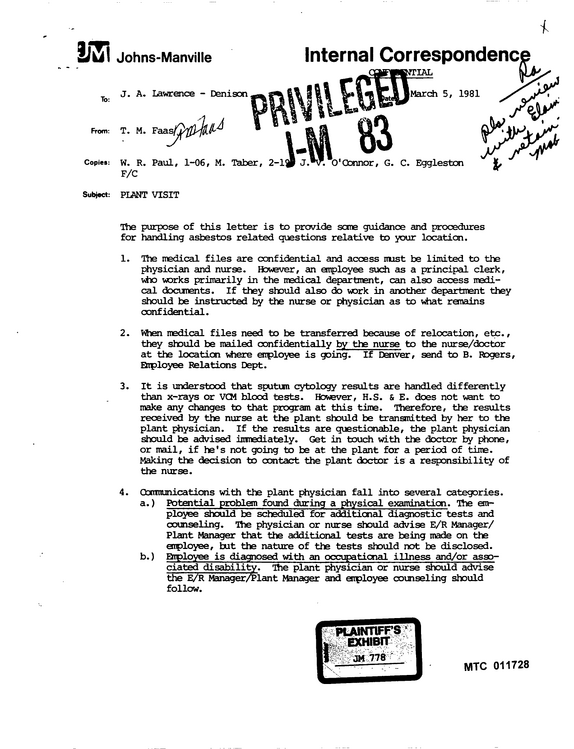
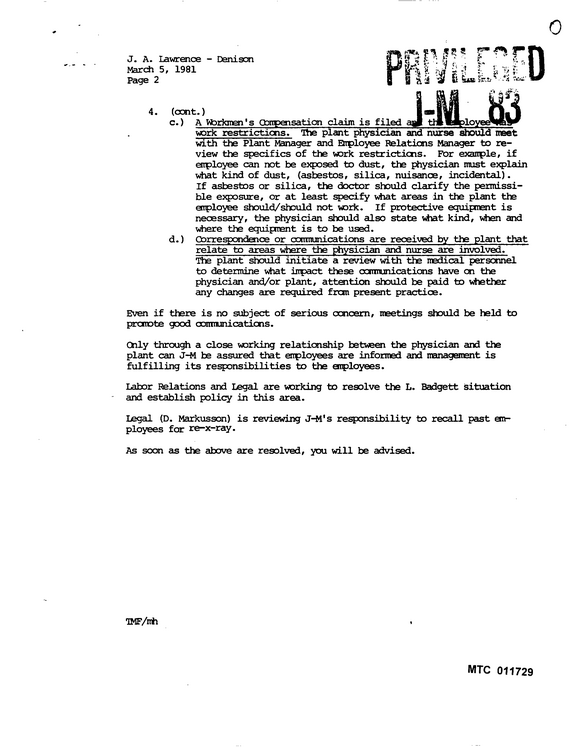
m Johns-Manville Internal Correspondenc from: Copies: Subject: PLANT VISIT The purpose of this letter is to provide seme guidance and procedures for handling asbestos related questions relative to your location. 1.
refid# pBZQBy1ZGJadbd8zgXYr6xLLw2 pages